What Is GTM Engineering and How It Builds Pipeline
What is GTM engineering? Learn how it turns ICP, data and outbound into a scalable revenue system that drives qualified pipeline.
A founder opens the CRM and sees plenty of activity, but very little movement. Sales Navigator lists are scattered across spreadsheets, enrichment happens only when someone remembers to run it, email sequences use the same generic message, and a promising reply sits unanswered because nobody owns the handoff. The team isn't short on effort. It's short on a connected system.
That situation is common for B2B companies expanding into APAC or selling across global markets. More tools can make the problem worse when each one owns a small task but no one owns the complete path from target account to qualified meeting. A practical starting point is to pair outbound design with resources such as an AI-powered SEO tool for startup founders when organic discovery needs to support the outbound motion, then connect both channels to a clear revenue process. Teams working through the fundamentals can also use this guide to B2B lead generation as a companion reference.
Table of Contents
Introduction Why Outbound Feels Broken Without a System
Suppose your team defines a list of target accounts on Monday. On Tuesday, a marketer enriches some contacts in one database, an SDR copies others into a sequencing tool, and a sales manager asks for a report that doesn't match the CRM. A prospect shows buying intent on LinkedIn, but the signal never reaches the person responsible for that account. Every individual action looks reasonable. Together, they produce delay, duplicate work, and uncertain pipeline.
GTM engineering addresses that gap by treating go-to-market as an operating system rather than a collection of campaigns. It connects ICP definition, data, messaging, sending infrastructure, signal-based routing, and reporting so the team can run the same motion repeatedly, inspect what breaks, and improve the parts that affect qualified pipeline.
The category emerged as a distinct revenue concept in 2023, when Clay's team popularized the term and later described it as applying engineering principles, automation, and AI to sales and marketing processes. The practice has roots in RevOps, enrichment, automation, and data workflows that had been developing for years before someone gave the convergence a name. Industry coverage of the rise of GTM engineering describes the shift from manual execution toward a recognized operating layer, including about 100 GTM engineering job listings going live every month.
The useful question isn't whether you need another job title. It's whether your company owns an outbound machine that can keep working when a team member changes roles, a market expands, or a channel stops performing. In this guide, you'll see what GTM engineering means, how its six connected parts work, what a live workflow looks like, and when it makes sense to build, hire, or outsource the function. The Social Search approaches this work as a system builder for APAC and global outbound, with infrastructure designed to be transferred to the client's team.
What GTM Engineering Really Means
A factory doesn't create finished goods because one machine is impressive. It creates them because raw materials, production steps, quality checks, and dispatch are connected. If the input is wrong, the output suffers. If one machine stops, the whole line slows down. Revenue systems behave in much the same way.
GTM engineering applies that logic to sales and marketing. It uses engineering principles to define repeatable processes, automation to remove avoidable manual work, and AI to support research, prioritisation, personalisation, and decision-making. The result is a data-driven revenue system that can be tested and maintained like infrastructure.
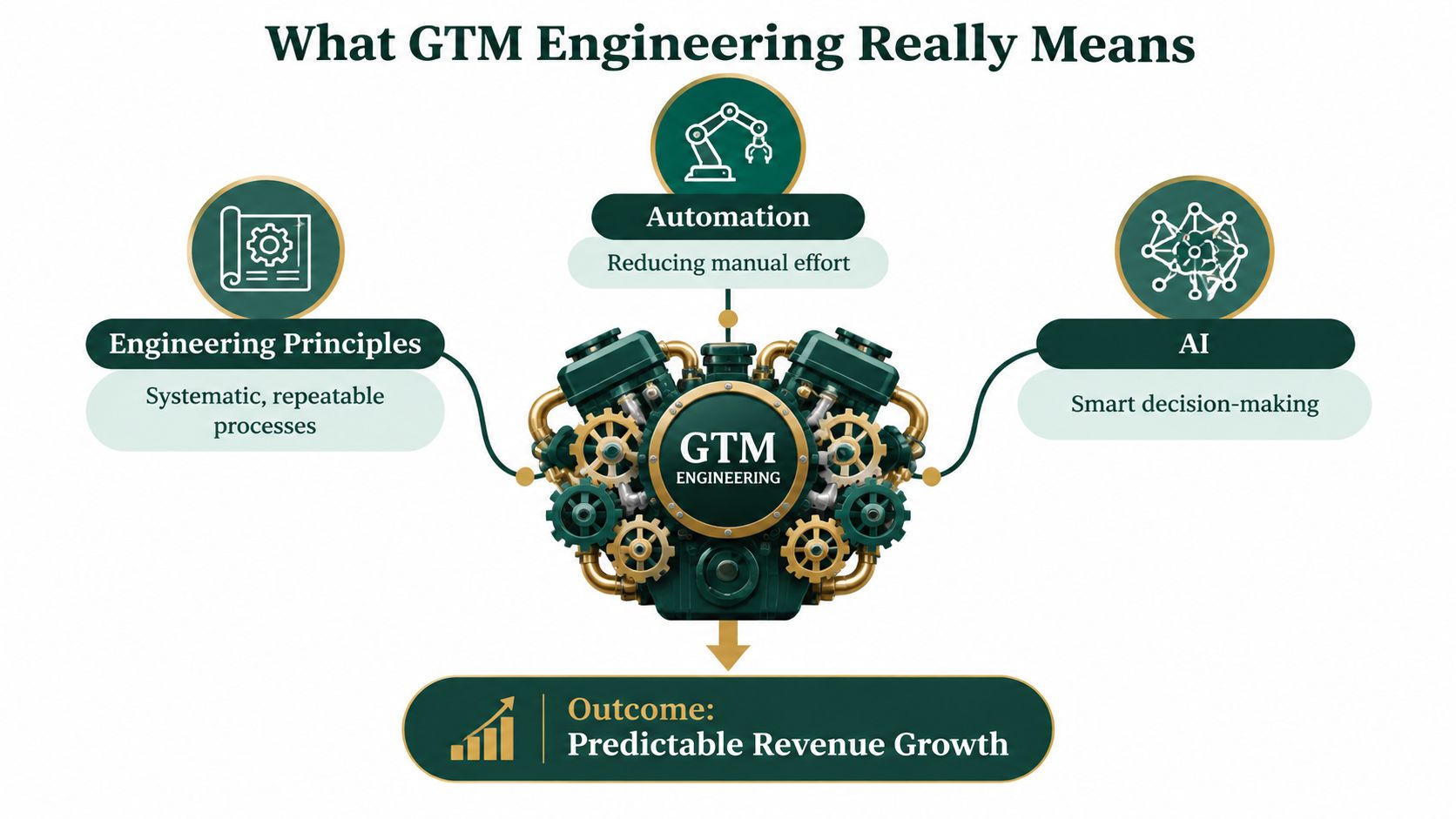
Working definition: GTM engineering is the technical discipline of building and operating revenue systems, including enrichment, outbound automation, lead routing, and reporting, as production-grade infrastructure rather than ad hoc campaigns.
The system starts with a commercial question. Who is most likely to buy? Which account or contact shows a relevant signal? What information should the team know before outreach? Which channel fits the prospect? What should happen when the prospect replies? Each answer becomes a rule, a data field, a workflow, or a reporting requirement.
That makes GTM engineering the technical execution layer of RevOps. RevOps may govern process, forecasting, CRM hygiene, and operational performance. GTM engineering builds the data flows, integrations, routing rules, and automated plays that make the revenue process run. For a broader explanation of the operating function around it, see this guide to what revenue operations means.
The distinction can be easier to understand through a simple contrast:
A campaign is a planned activity with a start and end.
A workflow is a repeatable set of conditions and actions.
A GTM engine connects workflows so data and decisions move from one stage to the next.
A campaign might tell an SDR to contact a list. An engine can identify accounts that match the ICP, enrich the right contacts, select a relevant message, send through an appropriate channel, route replies to an owner, and report which signals and messages generated qualified conversations. The work becomes easier to debug because each handoff has an owner and an expected output.
The Six Connected Parts of a GTM Engine
A GTM engine has six parts. They aren't six separate projects. Each part passes information to the next, and the quality of the final result depends on the handoffs between them.
1. ICP definition
The engine needs a target. ICP work identifies the account characteristics, use cases, buying roles, and exclusions that define a strong fit. Without that definition, automation only makes an unclear decision faster.
A useful ICP isn't a broad industry label. It gives the system fields it can evaluate, such as company type, market, technology environment, operating model, or a specific business trigger. It also explains why the account fits, which gives messaging and qualification a commercial foundation.
2. Data and enrichment
The data layer turns an account name into an actionable record. It may add company attributes, role information, technology details, buying context, or a relevant trigger. Waterfall enrichment is useful when one provider can't supply every field, because the workflow can check additional sources rather than abandoning the record.
Apollo can support contact and company enrichment where that fits the stack. Data quality still needs governance. A record that looks complete but contains an outdated role or incorrect company relationship can send the rest of the machine in the wrong direction.
3. Messaging and offer
Messaging translates fit into a reason to respond. The offer should reflect the prospect's situation, not just describe your product. A company entering a new market may need a different message from one trying to improve conversion in an established segment.
The system should store the audience, trigger, problem, proof point, call to action, and disqualification logic. That structure lets the team compare messages without treating every sequence as a fresh writing exercise.
4. Sending infrastructure and deliverability
Good targeting can't compensate for poor sending conditions. Domain and mailbox management, warming, deliverability monitoring, inbox placement, sequencing, and reply handling all belong in this layer. Codex's GTM Engineer role description shows how broad this ownership can be, covering outbound infrastructure from setup through campaign optimisation in its published role description.
For cold email sequencing and deliverability operations, teams can evaluate Instantly as part of the sending layer. The goal isn't to maximise activity. It's to create a controlled path where relevant prospects receive useful outreach and replies reach a human quickly.
5. Signal-driven routing
Signals make timing and ownership more precise. A job change, content interaction, account expansion, product event, or intent indicator can change who should be contacted and when. Social signals can be managed with a tool such as Trigify, while intent workflows may use Whitewhale when the data fits the buying motion.
Routing then decides what happens. The system may assign an account to a rep, enrol a contact in a sequence, pause outreach, create a task, or alert a channel. A signal without an action is just an interesting data point.
6. Reporting
Reporting closes the loop. It should connect source lists, signals, messages, meetings, opportunities, and pipeline outcomes so the team can see which parts of the machine produce useful conversations.
Isolated optimisation fails. A higher reply rate doesn't necessarily mean better pipeline if the audience is poorly qualified. More meetings don't help if routing is slow or sales rejects the handoff. The engine needs reporting that follows quality through the full path, not a dashboard of disconnected activity metrics. For the enablement side of that handoff, this overview of what sales enablement means provides useful context.
Business Benefits and Why Teams Adopt It Now
Revenue leaders adopt GTM engineering because it changes the unit of work. Instead of asking individual reps to research, enrich, write, route, and report every prospect manually, the team builds shared infrastructure that handles repeatable decisions and leaves human judgment where it matters.
One industry guide estimates that GTM engineering can remove 40% to 60% of manual administrative work from research, data handling, routing, and reporting when automated infrastructure replaces those tasks. The same guide frames the target as an owned revenue machine, measured through commercial inputs such as CPL, close rate, and revenue per rep. See the GTM engineering operating model for that framing.
Capacity without proportional hiring
A system can process data, apply rules, and prepare actions without asking every rep to repeat the same preparation. That doesn't mean removing people from the process. It means using people for account judgment, conversations, qualification, negotiation, and relationship work rather than routine record maintenance.
This matters for lean teams and for companies entering APAC. Regional expansion adds market nuance, language considerations, time-zone coverage, and different channel preferences. A documented engine gives the team a common operating model while allowing local messages, data sources, and routing rules to vary.
Faster movement from signal to action
A buyer signal has limited value if it sits in a dashboard until someone checks it manually. GTM engineering connects the signal to enrichment, prioritisation, and an action. The right rep can receive a context-rich task while the event is still relevant, rather than contacting the account after the moment has passed.
The same principle applies to content and SEO. SearchAtlas can support technical SEO work, while Outrank can support SEO content production when the company wants inbound discovery to complement outbound. These channels should share audience and messaging insights rather than operate as unrelated marketing projects.
Better continuity and attribution
When the workflow lives in one person's memory, staff churn can interrupt pipeline. When the logic, fields, prompts, sequences, routing rules, and reporting definitions are documented, another operator can inspect and improve the system.
Practical rule: Measure the engine by qualified pipeline and learning speed, not by how many automated actions it completes.
That standard also protects against noisy automation. A sequence that generates replies but attracts the wrong audience may look healthy in a surface-level report. A system that ties activity to qualified meetings and downstream opportunity movement gives the revenue leader a clearer basis for investment.
Inside a Real Outbound System From Signal to Meeting
Consider the workflow described in a practical GTM engineering guide. LinkedIn Sales Navigator identifies a prospect who matches the ICP. Clay enriches the record, verified email contacts move to Instantly for email sequences, LinkedIn-only contacts move to HeyReach, company data reaches HubSpot, and a positive reply creates a deal and sends a Slack alert. The GTM engineering workflow guide lays out this connected pattern.
The workflow becomes clearer when you compare the decisions at each stage:
Signal: Sales Navigator identifies a relevant account or contact.
Qualification: Enrichment checks company, role, and fit data.
Channel selection: A verified email contact may enter an email sequence, while a LinkedIn-only contact may enter a LinkedIn sequence.
Human handoff: A reply pauses automation and alerts the responsible rep.
Pipeline record: HubSpot records the company and deal activity so reporting can connect the meeting to its source.
HeyReach fits the LinkedIn outreach layer when automated sequencing is appropriate and compliant with the team's operating rules. Apollo can provide an alternative or supplementary enrichment source, while Trigify and Whitewhale can add social or intent context before routing. The important design choice is not the number of tools. It's the contract between them, including what data each receives, what it returns, and what happens when a field is missing.
Benchmark expectations should remain realistic. Independent B2B outbound benchmarks place well-targeted cold email sequences with deliverability infrastructure at a 1% to 3% reply rate, while a 2026 APAC analysis reports average cold LinkedIn outreach response at 2.1%, rising to 6.3% with insight-first outreach and 11.7% after prior content engagement. These figures come from LinkedIn and cold email outreach benchmarks, and they shouldn't be treated as guarantees. They show why targeting, message relevance, prior engagement, and deliverability need to be evaluated together.
This is also where GTM engineering differs from buying automation. RevOps may maintain the CRM and reporting model. Sales Ops may support territories, processes, and seller execution. A GTM engineer or builder connects the systems into a pipeline-generating motion and owns the behaviour of the workflow from signal to response. Teams can use this prospecting in the sales process guide to clarify how that motion fits into broader sales execution.
When to Hire Build or Outsource GTM Engineering
The right operating model depends on the problem, not on the popularity of the title. Start by asking whether the bottleneck is strategic clarity, technical construction, ongoing operation, or all three.
Build the system internally
Build internally when someone on the team understands the market, can work across CRM and automation tools, and has enough capacity to own maintenance. This option works best when leadership can give that person clear ownership, access to sellers, and time to document the system.
Use a focused internal build if:
The ICP is already clear: The team knows which accounts and buying roles deserve attention.
The stack is manageable: Integrations, enrichment, sending, and reporting don't require constant troubleshooting.
A permanent operator exists: Someone will monitor data quality, deliverability, routing, and adoption after launch.
Hire a dedicated GTM engineer
A hire makes sense when the company has recurring workflow demand that RevOps can't absorb. Look for a builder who can translate a revenue problem into data structures, integrations, rules, and measurable experiments. The person needs commercial judgment as well as technical fluency.
The role is becoming more visible in the labour market. Coverage of the GTM engineering career cites roughly 100 listings per month, but demand alone doesn't define the job. Before hiring, write down ownership for ICP data, sending infrastructure, signal logic, reply handling, reporting, compliance, and handover.
Outsource or use a fractional operator
Outsource when the team needs a working system before it can justify a full-time specialist, or when expansion requires expertise that isn't available internally. A one-time build can establish the foundation. A fractional GTM lead can run the system, train the team, improve the workflows, and document the operating model.
Review go-to-market consulting with specific questions about ownership. Who retains the accounts and infrastructure? Where are playbooks stored? Who monitors deliverability and data quality? What does the handover include? A system that can't be maintained after the engagement creates a new dependency rather than solving the original problem.
Putting Your GTM Engine Into Action
Start with an audit of the path from target account to qualified meeting. Write down where the ICP is defined, where data is enriched, how messages are selected, which system sends them, what signal changes the next action, and where the outcome is reported.
Then fix the weakest handoff first. If the audience is unclear, prioritise ICP and account data. If replies disappear, repair routing and ownership. If sending quality is unstable, address deliverability before adding volume. If leadership can't connect activity to pipeline, rebuild the reporting model around source, signal, message, meeting, and opportunity.
The finished engine should be ownable, documented, and transferable. It can use AI and automation, but it still needs human review for positioning, qualification, sensitive outreach, and decisions that affect trust. The goal isn't a machine that sends more messages. It's a revenue system that helps the right team contact the right buyers with a relevant reason, then learn from the result.
The Social Search designs, builds, and runs outbound systems that connect ICP definition, data, messaging, sending, routing, and reporting for B2B teams selling into APAC and global markets. Visit The Social Search to discuss an owned outbound engine, a one-time system build, or fractional GTM leadership that your team can operate after handover.
