What Is Sales Enablement and Why It Drives Revenue
What is sales enablement? Learn how content, training, and tools combine to boost SDR performance, shorten ramp time, and scale outbound pipeline generation.
76% of organizations now have a dedicated sales enablement function, up from 32% five years ago. That shift tells you what what is sales enablement really means today, a cross-functional system that integrates content, coaching, technology, and process to improve seller productivity and buyer engagement across the full journey.
Sales enablement stopped being a side program the moment revenue teams got too complex for scattered decks and one-off onboarding. In B2B outbound, especially when teams are building SDR motion, entering APAC, or trying to make messaging consistent across channels, enablement becomes the operating layer that keeps the machine from drifting. The useful question isn’t whether reps need training. It’s whether your team has a repeatable system for defining ICP, routing signals, sequencing outreach, and measuring what moves pipeline.
Table of Contents
Sales Enablement Defined as a Revenue Operating System
The fastest way to understand sales enablement is to stop treating it like training and start treating it like infrastructure. A strong academic and analyst view defines it as the integration of content, processes, technology, training, and coaching that improves sales productivity and buyer engagement across the full journey, not a one-time event or a content dump. That framing matters because a team can’t scale outbound on enthusiasm alone. It needs a system that standardizes how people work and how pipeline gets created.
Adoption shows how far that thinking has spread. Industry roundups report that dedicated sales enablement functions are now common across revenue teams, and larger organizations feel the need most sharply sales enablement statistics. Teams with more headcount are more likely to formalize the function because ad hoc coaching and scattered assets stop working once the motion has to be repeated across regions, segments, and managers.
Why the operating system view matters
A content library doesn’t route signals. A workshop doesn’t enforce sequencing discipline. A slide deck doesn’t tell an SDR when to call, email, or move on. The best practitioners define enablement as the system that makes sure sellers deliver the right message, to the right buyer, at the right time, using the right tools.
In outbound terms, that means enablement sits between strategy and execution. It connects the ICP definition to the list, the list to the message, the message to the sequence, and the sequence to reporting. If you’ve watched a revenue team expand into a new region and then break because every rep improvises the motion differently, you’ve seen what happens when enablement is missing.
Practical rule: if reps can’t explain why a message exists, who it’s for, and what should happen after a reply, you don’t have enablement. You have disconnected assets.
This is also why enablement overlaps with demand generation, but isn’t the same thing. Demand gen creates attention and interest, while enablement makes the sales motion repeatable. A useful companion read is what demand generation is, especially if you’re separating top-of-funnel creation from the system that turns interest into booked conversations.
For outbound-heavy teams, the payoff is consistency. The motion gets tighter, managers can coach to a defined standard, and reps stop inventing their own process on the fly. That is the difference between a support function and a revenue operating system.
The Four Core Components of Sales Enablement
Content management is not just a file folder
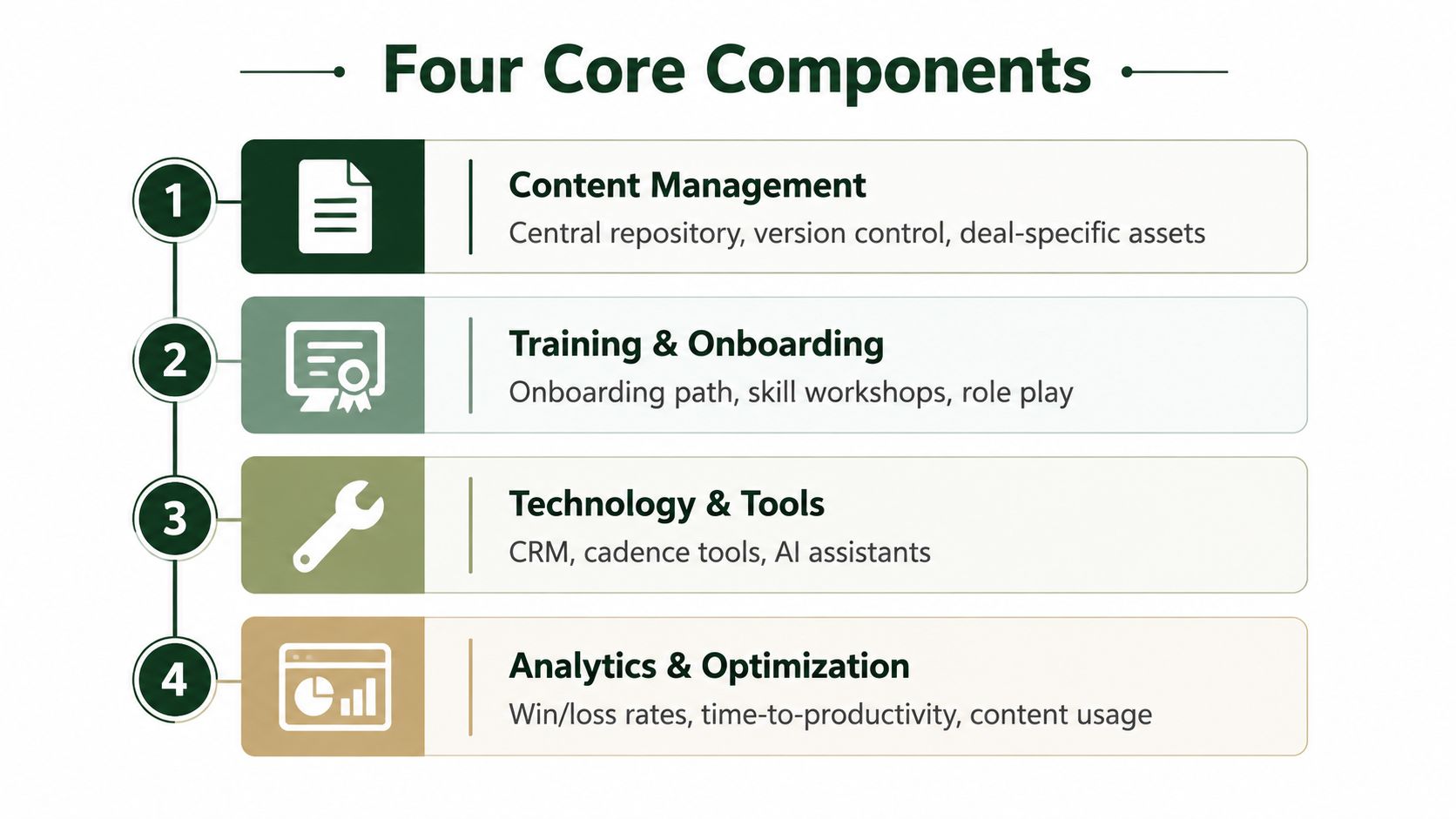
The first pillar is content management, but the work starts long before anyone uploads a deck. Real enablement content is what reps use in live deals, messaging frameworks, battle cards, objection handlers, call scripts, case-study snippets, and stage-specific proof points. The job is not storage. The job is making the right asset easy to find, easy to trust, and easy to use in the field.
Generic marketing collateral usually misses that mark because it is built to explain the company, not to move a buyer to the next step. Outbound reps need assets that map to specific buyer pain, specific objections, and specific stages in the sequence. If a rep has to rewrite the asset before sending it, the content is still marketing material, not enablement content.
Training and onboarding need a workflow, not a ceremony
The second pillar is training and onboarding. Analysts at G2 tie enablement to faster ramp, better productivity, and stronger quota attainment sales enablement statistics. The common failure is treating training like a launch event and assuming the lesson sticks after the meeting ends.
Outbound work does not work that way. Reps need onboarding paths, role-play, objection practice, and manager coaching that continues after week one. If you run SDR teams, cadence matters as much as the curriculum. Short coaching sessions with live examples usually change inbox behavior more than broad training days that never touch the actual workflow. For teams that need help turning that coaching into a working motion, sales rep enablement services make sense when the motion is already defined and the problem is adoption, not another layer of abstract instruction.
Technology should enforce the motion
The third pillar is technology and tools. Salesforce describes sales enablement software as including CRMs, AI sales agents, and analytics tools that help teams engage prospects more effectively sales enablement software. In practice, that stack often includes a CRM, a sequencing platform, data enrichment, signal tools, and workflow systems that keep reps working from the same source of truth.
For outbound teams, tools like Apollo for enrichment, Instantly for cold email sequencing, HeyReach for LinkedIn outreach automation, and Trigify for signal detection fit naturally. The tool is not the strategy. It only makes the strategy executable. The sequence still needs a defined ICP, message variants tied to buyer pain, and routing rules that decide what happens after a reply or a signal.
Analytics closes the loop
The fourth pillar is analytics and optimization. Gartner connects enablement to productivity and ongoing support across the buyer journey Gartner sales enablement. That only matters if someone is measuring what happened after the content went out or the sequence ran.
A practical enablement team watches what reps use, what buyers engage with, which signals trigger replies, and which messages create meetings. Without that feedback loop, content gets stale and coaching turns into opinion. With it, the system improves because the team can see where the motion breaks, whether that is weak messaging, poor routing, or a sequence that asks for too much too soon.
Practical rule: if one pillar is weak, the whole function degrades. Great content with bad routing still wastes leads. Great tools with weak coaching still produce inconsistent execution. The same is true in reverse, strong coaching cannot fix a broken list or a system that never tracks signal quality.
The clearest way to think about the four pillars is operational. Content gives reps something worth sending, training teaches them how to use it, tools enforce the process, and analytics show whether the process is producing pipeline. That is what separates scattered collateral from an actual outbound system.
How Enablement Powers Outbound Systems and SDR Performance
The outbound stack only works when enablement connects the parts
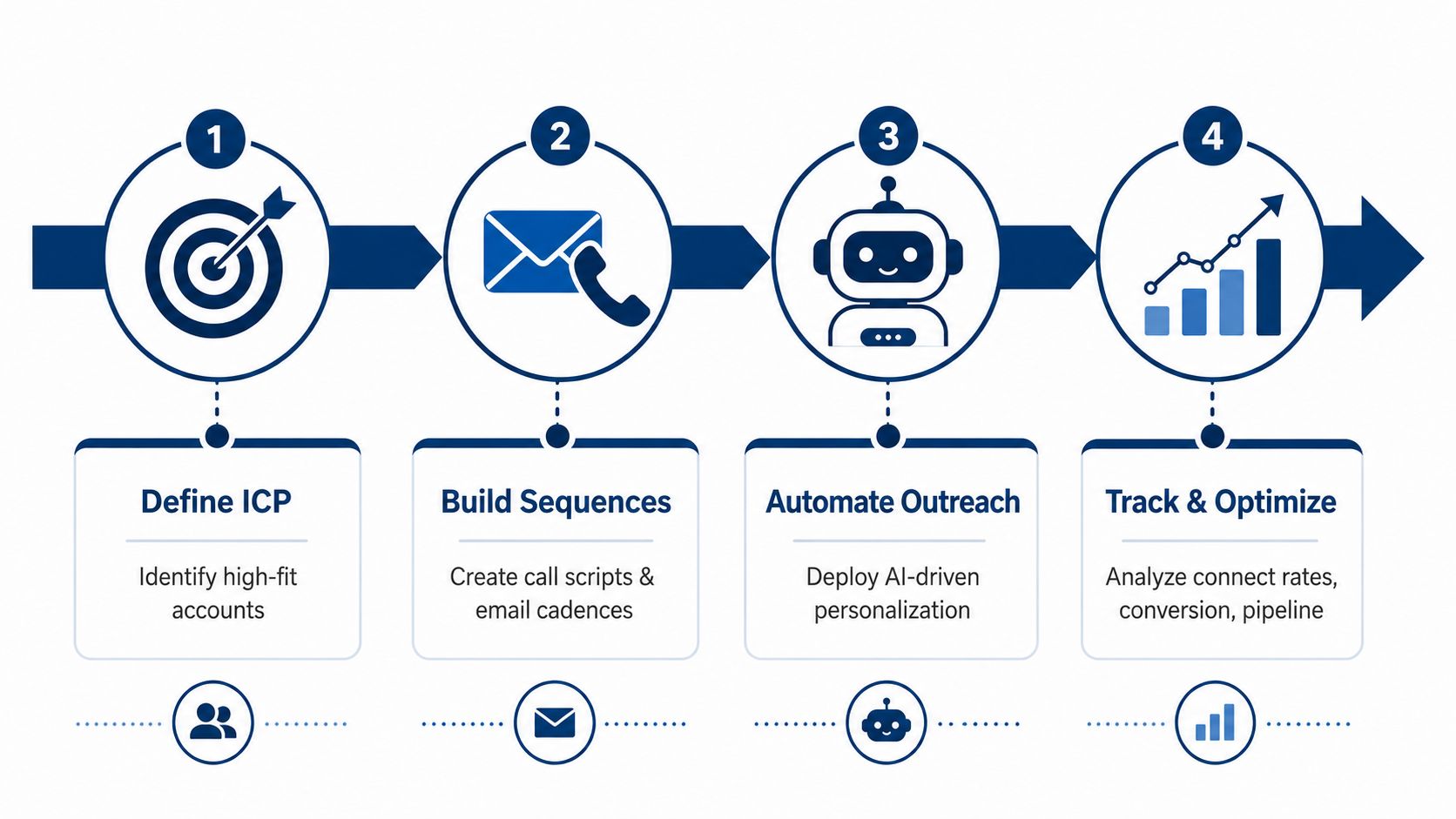
Outbound fails in familiar places. The list is weak, the message is vague, the sequence is random, or the handoff is too slow. Enablement fixes those breakpoints by turning them into one managed system, starting with ICP definition and ending with performance review.
That is why good prospecting starts before the sequence. If you want a clean primer on prospecting tactics for sales teams, the useful lens is how prospecting becomes operational only when the team has fit criteria, enrichment rules, and message variants tied to buyer pain. Anything else is just volume.
What the system looks like in practice
A workable outbound enablement flow looks like this.
Define ICP carefully. Decide which accounts, roles, and industries deserve attention before anyone writes copy.
Enrich and prioritize data. Use a source like Apollo to fill missing fields and build usable lead lists.
Build the sequence. Use Instantly for sending discipline, deliverability management, and structured follow-up.
Add channel depth. Use HeyReach when LinkedIn is part of the motion, instead of running it manually.
Trigger outreach from signals. Use Trigify to time engagement around buyer activity instead of blasting everyone at once.
That stack only performs when enablement owns the handoff logic. Who gets the lead, what message gets used, what happens after a positive reply, and what the rep does with a signal all need to be documented. Otherwise the team cannot compare performance from one rep to the next.
Why signal-based routing changes SDR performance
Traditional SDR work was often list-first and calendar-driven. Modern outbound is signal-first and context-driven. When a buyer hires, changes funding stage, launches a product, or starts engaging with relevant content, the outreach should change too.
Buyers do not care that the sequence was set up properly. They care whether the message fits what they are doing right now.
That is where enablement and automation meet. The enablement team defines the playbook, the SDR team executes it, and the signal layer decides when to move. If you are building this for the first time, a practical reference is the SDR role, skills, salary, and career path, because outbound enablement falls apart fast when the team does not know what behavior the role is supposed to produce.
For APAC-focused teams, the same logic applies across markets, but the data quality and channel mix change. The system still needs the same thing, clear routing, clean lists, and a message that matches the buyer’s stage.
Traditional Enablement Versus Modern AI-Era Enablement
Traditional enablement was built for a world where reps needed a place to find files and managers needed a way to run refreshers. Modern teams need something else entirely, because buyers now self-educate and sellers spend more time orchestrating timing than explaining basics. Salesforce’s 2024 State of Sales reported that sales teams using AI spent 15% more time selling, and 81% of sales teams were either experimenting with or had fully implemented AI, which tells you where the workflow is heading AI in sales.
What changed in the job
Old-school enablement centered on content repositories, LMS modules, and occasional workshops. That still has value, but it doesn’t solve for AI-assisted workflows, signal-based prospecting, or real-time routing. It also doesn’t tell you whether a rep used automation well or just sprayed more volume into the market.
Modern enablement has to measure more than completion. It has to watch whether reps are using automation properly, whether signals are being acted on quickly, and whether the message changes as the buyer’s context changes. LinkedIn’s guidance still emphasizes collaboration, content, and buyer journey alignment, but the practical gap now is workflow redesign, not just content alignment.
High-value prospecting now depends on workflow design
The old model often rewarded diligence. The new model rewards timing. That’s why lead qualification and buyer fit matter before a rep enters the queue, and why how to identify high-value prospects is worth studying if your team is trying to stop wasting cycles on bad-fit accounts.
For AI-era outbound, enablement should ask a different set of questions.
Which tasks should be automated? Admin, enrichment, and sequencing steps usually belong there.
Which signals should trigger action? Intent, engagement, and change events should govern timing.
Which parts need human judgment? Discovery, objection handling, and deal-specific adaptation still need reps.
A team that only modernizes the tools without modernizing the operating rules just gets faster at doing the wrong thing. A team that rethinks the rules can use AI to spend less time on admin and more time selling, which is the actual point.
For practical AI workflow design in outbound, AI sales automation for B2B is a useful reference because it sits closer to the execution layer than most generic enablement content.
Video
The KPIs That Prove Enablement Is Working
The easiest way to fake enablement is to measure activity instead of impact. Sales leaders often report content views, training attendance, and tool logins because they’re easy to count. None of that proves the function moved revenue.
A better dashboard focuses on the business outcomes major sources repeatedly tie to enablement, including win rates, quota attainment, ramp time, and deal velocity. The source material commonly cited in enablement discussions points to stronger forecasted win rates, higher quota attainment, and faster onboarding when the function is built well, which is why these metrics matter more than vanity activity counts. If you want a broader list of critical sales enablement KPIs, start with the outcomes that show whether reps are getting to market faster and closing with more consistency.
Sales Enablement Impact by Key Metric
Metric | With Enablement | Without Enablement | Improvement |
|---|---|---|---|
Win rate on forecasted deals | 49% | 42.5% | Higher with enablement |
Reps achieving quota | 84% | Not provided in verified data | Higher with enablement |
Onboarding speed | 3.4 months sooner | Not provided in verified data | 37% faster |
The table above keeps the conversation grounded in outcomes, not feelings. If your enablement program can’t show which messages, lists, or triggers are associated with booked meetings and pipeline creation, it is still mostly support work.
Measuring real impact
The trap is attribution theater. Teams often say a deck influenced a deal, but the better question is whether the enablement system created the conditions for the rep to reach the buyer with better timing and a better message.
A serious measurement model should track three layers.
Readiness: how fast new reps ramp and how consistently they execute the motion.
Performance: how often enabled reps hit quota, win deals, and move opportunities forward.
Causality: which signals, lists, and messages connect to meetings and pipeline.
That is the difference between a reporting layer and a pipeline layer. The former describes activity. The latter helps you decide what to scale or cut.
Practical rule: if the metric cannot change a manager’s coaching decision, it is probably too shallow.
For teams that need a cleaner operating view, reporting and pipeline dashboards should tie enablement work back to specific outreach inputs, not just top-line results. That is the only way to tell whether the system is improving or just keeping people busy.
The strongest enablement teams do not ask whether a course was completed. They ask whether the motion got faster, more accurate, and more profitable.
Building or Auditing Your Enablement Function
Start with ownership. Someone has to define the motion, maintain the playbook, and coordinate between sales and marketing, because enablement breaks when it lives as a vague shared responsibility. In smaller teams, that might be a revenue leader or ops lead. In larger teams, it’s usually a dedicated function with clear links to sales leadership.
Then lock the sequence of work. ICP clarity comes first, because every downstream asset depends on it. If the team doesn’t agree on who the best-fit buyer is, no amount of content polishing or tool buying will fix the motion.
A practical audit checklist
Define ownership clearly. Decide who owns the system, who updates it, and who approves changes.
Document the message. Write the value prop, pain points, objection handling, and call structure in one place.
Standardize the stack. Make sure data, sequencing, routing, and reporting live in a repeatable workflow.
Measure a few real outcomes. Focus on ramp, win rate, meetings, and pipeline contribution.
Review the system monthly. Bad inputs and stale messaging need maintenance, not more hope.
That order matters. Teams often buy tooling before they define the play, then wonder why adoption stalls. If you layer automation on top of confusion, you just automate confusion.
The best enablement programs survive staff turnover because the process is documented, not tribal.
If you’re auditing an existing function, look for gaps in handoff ownership. Marketing might own content, sales might own the pipeline, and ops might own the CRM, but none of that works unless there’s a clear operating layer connecting them. If your new hire needs three Slack threads to find the current sequence, the system is brittle.
The right question is simple. Can a new rep follow the motion, use the tools, and produce the same buyer experience without relying on hidden knowledge? If the answer is no, the function still needs work.
Sales Enablement as Revenue Infrastructure
Sales enablement is revenue infrastructure, not a support function. That’s the cleanest way to think about it after you strip away the buzzwords. The teams winning right now are the ones that connect ICP, data, messaging, sequencing, and signal-based routing into one measured system.
The adoption numbers show the function is already mainstream, and the performance data shows why it matters. If enablement is built well, reps ramp faster, win more often, and spend less time improvising. If it isn’t, the team pays for scattered execution every day.
The Social Search builds outbound systems that connect ICP definition, data, messaging, routing, and reporting into a machine your team can run. If you want help turning sales enablement into a pipeline system instead of a slide deck exercise, visit The Social Search and see how a system-first approach can support your outbound motion.
