8 LinkedIn Outreach Message Examples
Explore 8 LinkedIn outreach message examples for first touches, follow-ups, triggers, personalization, cadence, and APAC buyer fit.
The popular advice is that a clever LinkedIn outreach message can overcome almost any targeting problem. It can't. A polished message sent to the wrong role, account, market, or buying stage is still noise. Message fit starts with the prospect's responsibilities, the account's current context, a verified signal, and the relationship stage.
The eight templates below are organized by the buying context that gives each one a reason to work: insight, curiosity, proof, trust, value, pain, trigger, and account-level sequencing. Use them as structures, not scripts. Replace every bracket with evidence you can defend, and change the question or offer to match the person you're contacting. Before you send anything, make sure your profile supports the message. A practical place to start is this guide to improve your LinkedIn profile today.
For coordinated LinkedIn sequencing, HeyReach can be relevant when segmentation, routing, and follow-ups need operational support. Teams selling across APAC and global markets may also consider The Social Search, a system-first option that connects ICP definition, data, messaging, LinkedIn and email operations, and reporting. The benchmark matters too. A 2026 analysis of 6.73 million outbound messages from 13,302 accounts recorded a 10.4% post-connection reply rate, compared with 3.0% for connection-request notes and 28.5% connection acceptance (Expandi's 2026 benchmark analysis). The practical implication is simple: earn the connection, then use the first accepted-message exchange carefully.
Table of Contents
1. The Value-First Hook
A value-first hook gives the prospect a useful observation before it introduces your offer. The insight might come from a market change, a product launch, a hiring pattern, or a business decision visible in a press release. It should help the reader understand why your message is relevant now.
Template
Hi [Name]. Saw your team launched in [market] recently. Teams entering that market often revisit [specific process or risk] early. Is that on your radar?
The sentence works because it begins with the prospect's situation, not your capability. “We help companies grow” gives the reader no reason to continue. “Your team launched in Singapore” creates context, but only if the observation is accurate and the follow-up issue fits the role.
Personalize the observation, not just the name
Use company research, earnings commentary, product pages, public hiring activity, or a prospect's recent post to identify the opening. A finance leader may care about reconciliation or reporting, while a revenue leader may care about regional pipeline coverage. Don't force the same insight across both roles.
Keep the insight to one sentence. The remaining space should establish relevance and invite a low-pressure response. A message that contains the insight, your company history, three benefits, and a meeting link has stopped being value-first. It's a pitch.
For teams building a broader LinkedIn lead generation system, this format also creates useful segmentation. Group prospects by industry, role, geography, and trigger before writing the copy. HeyReach can then support coordinated campaigns, but only if each segment receives an insight that remains accurate.
Timing and APAC fit
A market-entry message should arrive while the expansion is still an active operating priority, not after the announcement has become old news. APAC outreach also benefits from local context. A regional launch may involve different partner models, procurement expectations, language requirements, or decision-making structures across markets. Mention the context only when you understand it well enough to avoid stereotypes.
A good hook earns a reply by making the prospect think, “Yes, that's something we're working through.” It doesn't need to prove your entire solution in the first exchange.

For additional inspiration, review these post hooks for marketers, then rewrite the idea around a buyer's operating context rather than a content creator's publishing goal.
2. The Question-Based Opener
A question earns a reply only when the recipient can answer from their own operating context. The trade-off is clear: a focused question starts a conversation, while a broad one sounds like sales research in disguise. Tie it to the person's role, a visible business signal, or a decision they already handle.
Consider an outbound leader at a B2B company expanding across APAC:
Hi [Name]. When your team prioritizes accounts for regional growth, which signal carries the most weight? I'm asking because expansion teams often need to separate market interest from accounts that can produce pipeline.
If the prospect says account fit is the main issue, the next message should address segmentation or data quality. If they say conversion is harder, follow up on message relevance and buying-stage signals. If they mention that another team owns the decision, acknowledge the handoff and ask who manages it. One answer changes the angle, so the sender should not force every reply into the same pitch.
Use a data enrichment tool to confirm that the person's role, company stage, and market make the question relevant. Enrichment cannot reveal the prospect's view, but it can prevent obvious mismatches, such as sending a finance operations question to a brand marketer.
Other questions can work when their buying context is clear:
Targeting: “When you build outbound pipeline, is the bigger bottleneck finding the right accounts or converting the message?”
Process: “How many tools are you currently juggling across your GTM process?”
Measurement: “Which signal carries the most weight when your team prioritizes an account?”
Keep the first exchange easy to answer. Reflect the response, add one concise observation, or ask one useful follow-up. A question opener should create a conversation, not collect information for a hidden pitch.
Cadence and regional nuance
In relationship-oriented APAC markets, a respectful request for perspective can work better than a blunt demand for information. “Would you be open to sharing how your team approaches this?” suits a cold connection when the sender has no established relationship. The message still needs a reason tied to the recipient's work.
If there is no response, wait before introducing a resource or a related insight. Define that next angle in your LinkedIn outreach strategy before launching the sequence. Test questions by topic, not only by wording. A reply may show that the subject itself is wrong for the segment, which is a targeting lesson rather than a copy failure.
3. The Social Proof and Specific Result
Social proof earns attention when the proof resembles the prospect's world. A recognizable logo alone isn't enough. The relevant comparison might be company stage, market, operating model, or buyer role. If the comparison doesn't hold, the result creates skepticism instead of confidence.
Template
Hi [Name]. We helped [similar company or anonymized client] reduce [specific operational problem] by [verified result]. They were working through a similar [market, stage, or role-specific challenge]. Is that an issue for your team too?
The supplied examples of results should only be used when they come from a public case study or permissioned customer story. Don't invent a company name, metric, or outcome to make the message more compelling. “Clients we work with” is safer than a fabricated logo, but the result still needs to be documented internally.
Lead with relevance before prestige
A small company in the same APAC sub-region may be more persuasive than a famous global brand with a completely different operating model. Segment proof by industry, company size, GTM stage, and geography. HeyReach can help coordinate those segments, but the campaign logic should decide who receives each proof point.
The strongest structure is:
Result first: State the outcome the buyer recognizes.
Comparable context: Explain why the example resembles their situation.
Soft question: Ask whether the same issue exists, rather than demanding a meeting.
Don't hide the conditions behind the result. If the improvement depended on a specific process change, say so when the conversation advances. Credibility increases when you explain what caused the outcome.
Follow-up logic
If the prospect doesn't respond, don't repeat the same metric. Follow up with the operating lesson behind it, or share a short explanation of how the similar company approached the problem. If they do respond, ask what part of the comparison fits and what doesn't. That turns proof into discovery.
For broader examples of buyer-focused messaging, see these B2B sales examples. In APAC, recognizable local relevance often matters more than a globally famous name. Use the evidence that helps the prospect see themselves in the story.
4. The Soft Recommendation Angle
A recommendation angle reduces the distance between strangers, but only when the recommendation is genuine. Mentioning a mutual contact who has never discussed you, or implying an endorsement that doesn't exist, damages trust before the conversation begins.
Template
Hi [Name]. [Mutual contact] mentioned your team is building its GTM function across APAC. We've worked on similar regional expansion programs, so I thought it'd be useful to connect. Happy to share a few observations if relevant.
The sender should know exactly why the mutual contact is relevant. If the connection came from a group, association, article, or event rather than a person, say that plainly:
Hi [Name]. I saw your contribution in [group or publication] on [specific topic]. We've been studying the same challenge in APAC and I'd value your perspective.
Verify the bridge
Before sending, confirm:
Mutual context: The named person knows you and understands why you're contacting the prospect.
Public context: The publication, group, event, or discussion is real and relevant.
Current signal: The prospect is still working in the role or on the initiative you reference.
A real recommendation doesn't require a hard ask. The first objective is to establish a credible reason for the connection. If you use automation, set rules so this template is available only when the relationship or public signal has been verified. Never allow an unverified merge field to imply a personal introduction.
Timing and relationship norms
Send after the relevant event, article, job change, or group activity while the context is still recognizable. If the prospect doesn't respond, follow up with a different angle after a reasonable interval. Don't repeat the same recommendation source, and don't imply that silence is disappointing.
APAC relationship-building often rewards patience and contextual credibility. That doesn't mean every market follows one pattern. It means the sender should avoid treating a first contact as a transaction and should respect the prospect's preference for a gradual conversation.
5. The Resource or Content Share
A resource earns a reply only when it helps the recipient assess a current priority without creating meeting pressure. Choose an asset that is specific to the buyer, easy to scan, and connected to a recognizable business context. A generic ebook placed inside a sales pitch remains a sales pitch.
Template
Hi [Name]. We just published a GTM playbook for B2B teams expanding into APAC, covering outbound mix, messaging, and sourcing. Thought it might be useful for your team: [link]. I'd be interested in your view on what matches your experience.
The offer is concrete, while the CTA asks for judgment rather than commitment. That combination gives the sender a credible follow-up path. If the prospect engages, refer to the section most relevant to their role and ask whether it reflects their situation, instead of restarting with “just checking in.”
Match the resource to the buyer
Confirm industry, size, geography, and stage with your enrichment data before choosing the asset. A founder may prefer an operating framework, while a revenue operations leader may need a process map or measurement guide. Build separate variants when one resource cannot serve both audiences.
Use UTM-tagged links so a view is attributable, and never reference view data the prospect did not knowingly share. A view alone is not buying intent. If the prospect responds, discuss the relevant section and invite correction. If there is no response, avoid mentioning tracking details or implying that access created an obligation.
The LinkedIn outreach resource helps teams review the sequence and platform constraints around this outreach type. Use the content share to start a relevant exchange, not to hide a conversion request inside a resource.
APAC adaptation
Regional content should match the markets served. A broad “Asia” guide can feel careless when the prospect operates only in Singapore, Australia, Japan, or a specific group of markets with different commercial practices. Name the relevant context, and do not claim local expertise that the resource does not demonstrate.
A useful asset opens a conversation. It does not replace relevance.
If the prospect replies with criticism, treat it as market feedback. Adapt the next message to what they said, or end the sequence when the resource is not relevant. A content share should create a two-way exchange, not place the recipient into an automated sequence regardless of their response.
6. The Problem and Solution Echo
A problem-and-solution echo works when the observed problem matches the prospect's role, operating model, and market. It demands precise ICP work. A generic pain statement makes the message sound like a stereotype, even when the offer is relevant.
Template
Hi [Name]. Many VP Sales teams I speak with manage CRM, email, LinkedIn, sequencing, and reporting in separate tools. That fragmentation can create pipeline attribution gaps. We help teams consolidate those workflows. Is that close to what your team is dealing with?
The template names an operating burden, then offers a direction without turning into product copy. The final question leaves room for the prospect to confirm, correct, or reject the assumption. Keep the wording aligned with what the sender can address.
Build one variation per problem
Use buyer interviews, sales-call notes, and reply data to identify recurring problems for each persona. Build separate versions for distinct buying contexts:
Fragmentation problem: Different tools and owners create gaps in execution and reporting.
Targeting problem: The team cannot agree on best-fit accounts or useful buying signals.
Regional problem: A global process does not adapt cleanly to APAC markets.
Continuity problem: Pipeline work stalls when a rep leaves or ownership changes.
Do not combine all four in one message. A catalogue of pains signals broad targeting, while one well-supported observation gives the prospect something specific to assess.
The sender, signal, and cadence should match the problem. A fragmentation message may fit an operations leader reviewing systems. A regional version may suit a leader responsible for Singapore, Australia, Japan, or several APAC markets. Send the first note only when the role or account context supports the observation, then use a follow-up that asks whether the framing is accurate rather than repeating the pitch.
Validate the echo
Ground the observation in the prospect's role, company stage, public hiring pattern, or known process. Avoid precise claims about hours lost unless documented evidence supports them. Qualitative wording, such as “creates reporting blind spots,” communicates the issue without pretending to know the account's internal data.
Test the problem framing with your sequencing tool only after the list and routing rules are sound. Campaign results can show which message earns replies, but they cannot repair an inaccurate ICP. Positive replies matter more than superficial engagement because they show whether the prospect recognizes the problem. In APAC relationship-led markets, give the recipient room to correct the assumption and keep the tone consultative.
7. The Time-Sensitive Trigger
Trigger-based outreach succeeds when the event changes the prospect's priorities. A funding announcement, new executive hire, product launch, title change, or market entry can make an old problem newly urgent. The trigger must be real, recent, and connected to the recipient's responsibilities.
Template
Hi [Name]. Saw [Company] just hired a new VP of Sales. The first phase often involves understanding what's working across the current GTM motion and where the gaps sit. We've built a diagnostic framework for that. Would it be useful to compare notes?
The message doesn't assume that the company has a problem. It connects the event to a plausible operating question and offers a relevant next step.
Build a signal-to-message rule
A signal library should map each event to:
Likely priority: What may have changed for the buyer?
Relevant role: Who owns that priority?
Useful offer: What can you share without forcing a sales call?
Expiry window: When will the event stop being timely?
Trigify can be relevant for monitoring social signals, while Whitewhale may fit teams working with intent signals. Use signal tools to improve relevance, not to justify sending the same message to everyone who matches an alert.
The common failure is congratulating the prospect and immediately switching into a generic pitch. The trigger should shape the message's substance. “Congrats on the launch” is not enough. Explain why the launch creates a question your prospect might reasonably care about.

Timing and follow-up
Send while the event is still operationally active. A late message can feel like monitoring rather than relevance. Follow-ups should add specificity, not repeat the announcement. If the prospect doesn't respond, move to a useful framework, question, or resource connected to the same business change.
APAC accounts often span several time zones and decision centres. Coordinate the send time with the recipient's working day and the account's regional structure. A trigger should create a timely conversation, not a race to contact every stakeholder before anyone has context.
8. The Multi-Thread Sequence Starter
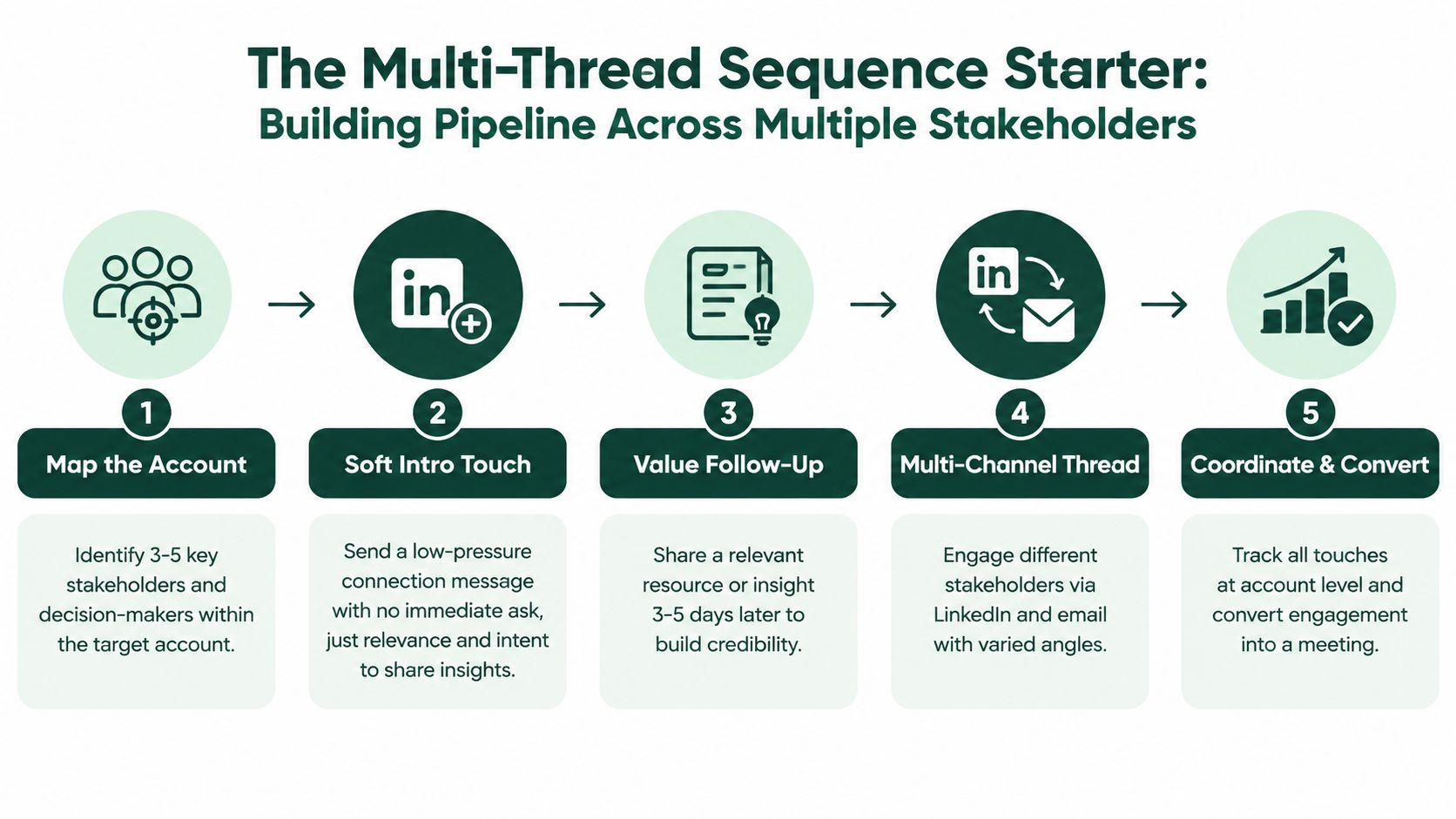
Account-level sequencing treats the company, not the individual contact, as the unit of strategy. The first LinkedIn outreach message should establish relevance with one stakeholder while leaving room to approach adjacent roles through different angles. This matters when a purchase affects revenue, operations, finance, marketing, or regional leadership.
Opening message
Hi [Name]. Came across your team's recent market entry into APAC and thought we should connect. We've helped companies at a similar stage think through regional GTM. There's no immediate ask. I'd like to share a few relevant observations as your plans develop.
The “no immediate ask” line works only when the sequence behaves that way. If the next message is a meeting request with a calendar link, the opening promise loses credibility.
Design the account map first
Identify the decision-maker, operational owner, influencer, and possible internal champion before sending the first touch. Each person should receive a different reason to engage. A revenue leader may receive a regional pipeline observation, while an operations leader receives a workflow or attribution resource.
Space touches three to five business days apart when the account context supports that pace. Coordinate LinkedIn with email rather than duplicating the same copy in both channels. A useful sequence might move from introduction, to research, to a role-specific problem, then to a practical offer.
HeyReach can support account-level sequencing and tracking when the workflow is carefully configured. It shouldn't turn several employees into a coordinated barrage. Suppress contacts when anyone asks not to be contacted, and pause the account when a meaningful conversation begins.
APAC account coordination
Multi-country accounts need more than time-zone scheduling. Map where decisions are made, which markets are being tested, and whether a regional stakeholder or headquarters owns the initiative. Send earlier in the sequence when a new market signal is strongest, then allow the account's internal relationships to develop.
Document the account logic, message ownership, suppression rules, and next actions. This follow-up guide with templates and timing can help turn individual messages into a deliberate sequence rather than disconnected activity.
8 LinkedIn Outreach Message Types Compared
Template | 🔄 Implementation Complexity | 💡 Resource Requirements | ⭐📊 Expected Outcomes | Ideal Use Cases | ⚡ Key Advantages |
|---|---|---|---|---|---|
The Value-First Hook | Medium, requires targeted research per prospect | Company/industry research, signal feeds, time for personalization | Higher reply rates; positions sender as knowledgeable peer ⭐⭐ | B2B with mature ICPs targeting specific buyer personas; APAC & global | Research-backed relevance; strong credibility signal |
The Question-Based Opener | Low–Medium, craft strong, answerable questions | Persona insights, data enrichment (e.g., Apollo) | Good acceptance and conversation starts; informs sequencing ⭐⭐ | Complex B2B or consultative sales where dialogue matters | Encourages two-way engagement; scalable with good data |
The Social Proof + Specific Result | Medium–High, needs validated case studies and approvals | Documented case studies, permission to name clients, analytics | High credibility and persuasive impact; measurable pipeline lift ⭐⭐⭐ | B2B SaaS/services with measurable customer outcomes; scaling orgs | Third‑party validation; memorable, metric-led proof |
The Soft Recommendation Angle | Medium, depends on real mutual connections | Network relationships, CRM, signal verification | Very high connection/acceptance rates; warm intro effect ⭐⭐⭐ | Companies with existing partnerships or networks; APAC trust-based markets | Leverages referrals; reduces cold-contact friction |
The Resource or Content Share | Medium, requires quality content creation | Marketing/content team, tracking links (UTMs), distribution | Builds authority and trackable engagement; lower initial pressure ⭐⭐ | Firms with content capability wanting brand + pipeline growth | Positions as advisor; creates follow-up touchpoints |
The Problem + Solution Echo | High, needs deep buyer-role understanding | Buyer interviews, ICP research, persona mapping | High relevance and qualification when accurate; risk if mismatched ⭐⭐ | Mature ICPs, complex or multi-stakeholder sales | Strong resonance with buyer pain; validates understanding quickly |
The Time-Sensitive Trigger | High, must detect and act within narrow windows | Signal monitoring tools (funding/hiring/news), fast ops | Dramatically higher reply rates if timely; short effective window ⭐⭐⭐ | Companies with mature data infra and outbound ops; event-driven outreach | Perfect timing relevance; can feel highly personalized |
The Multi-Thread Sequence Starter | High, requires sequence design and coordination | Multi-channel tools, stakeholder mapping, sequencing playbook | Sustained engagement and higher account conversion over time ⭐⭐⭐ | Enterprise/mid-market accounts with multiple decision-makers; ABM | Multi-stakeholder coverage; coordinated relationship-building |
Turn Templates Into a Tested Outreach System
Templates become useful when they sit inside an operating system. Start with one buyer problem, one audience segment, and one verified signal. Choose the format that matches the context. Use the insight hook for a researched observation, the question opener for discovery, proof when the comparison is relevant, trust when a real introduction exists, value when you have a useful resource, pain when the ICP evidence is strong, trigger when timing changes priorities, and account-level sequencing when several stakeholders matter.
Set the first-touch objective before writing the message. It may be connection acceptance, a short answer, permission to share a resource, or a correction to your assumption. Don't ask for a meeting because the sales process needs one. The prospect's next action should feel proportionate to the relationship stage.
Define follow-up logic in advance. A no-response follow-up should introduce a new angle, not repeat the same CTA. A positive reply should pause automation and route to a person who can continue the conversation. A correction should update the record and improve the segment. A refusal should suppress the prospect across channels.
Measure the funnel in a way that reflects what LinkedIn counts. LinkedIn's Recruiter documentation requires users to maintain at least a 13% InMail response rate across 100 or more messages within each 14-day assessment period, and defines response rate through accepted and declined messages (LinkedIn Recruiter Help). That distinction matters. A platform response isn't automatically a positive sales reply, so your internal reporting should separate acceptance, positive response, conversation quality, meetings, and pipeline.
Belkins' analysis across more than 15 million LinkedIn touchpoints reported a 7.2% overall outbound message reply rate, with connected-prospect messenger campaigns reaching 12.2% total reply rate. Its funnel recorded 18.7% invited-prospect connection acceptance, 17.6% follow-up replies among connected prospects, and 1.3% meeting booking (Belkins' LinkedIn outreach study). The lesson isn't to copy those figures as targets for every market. It is to inspect the full funnel, because a message can earn replies while the account, offer, or meeting transition still fails.
Connection notes deserve separate treatment. LinkedIn's Help Center limits personalized notes to three connection requests per month, with each note capped at 200 characters (LinkedIn's connection-note guidance). That constraint reinforces the value of a concise reason to connect, followed by a better-developed post-acceptance message.
APAC adaptation should be operational, not cosmetic. Use relevant local market context, respect account-level relationships, coordinate time zones, and avoid assuming that one regional message fits every country. Build a record of winning messages, rejected assumptions, signal definitions, routing rules, and attribution. A documented system survives staff changes and makes handover possible.
The Social Search is one relevant option for teams that need ICP definition, data, messaging, LinkedIn and email operations, signal-driven routing, and reporting connected across APAC and global markets. Its work can range from a one-time outbound system build to an embedded fractional GTM function. The important requirement is not the provider. It's making sure the system remains owned, measurable, and adaptable by the team using it.
The Social Search designs and operates connected outbound systems for B2B teams, linking ICP definition, data, messaging, LinkedIn and email sequencing, signal routing, and reporting. If your LinkedIn outreach message program needs stronger targeting and APAC-ready execution, visit The Social Search to discuss a system your team can own and improve.
