What Is Revenue Operations? a 2026 Guide for RevOps Teams
Discover what is revenue operations and how RevOps aligns sales, marketing, and customer success. A complete guide for B2B outbound teams in 2026.
Revenue operations is the operating layer that aligns sales, marketing, and customer success around shared data, process, and metrics so the full revenue motion runs as one measurable system rather than disconnected departmental efforts. In the market, RevOps is already a serious category, with the global market estimated at USD 4.39 billion in 2024 and projected to reach USD 16.98 billion by 2033 (Grand View Research).
You’re probably feeling the reason it exists right now. The CRM says one thing, LinkedIn replies live in another place, SDRs are working from a different list, and pipeline is leaking between handoffs that nobody fully owns.
Table of Contents
The Pipeline Problem RevOps Is Built to Solve
A founder running outbound usually does not have one problem, they have five small ones that keep feeding each other. Marketing names an ICP one way, sales qualifies it another way, customer success hears yet another version after the deal closes, and the reporting dashboard tries to stitch all of it together after the fact. In practice, that means the same account can look qualified in one system and invisible in another.
RevOps steps in at the operating layer. It standardizes definitions, routing, dashboards, and handoffs so pipeline behaves like a system instead of a pile of tools. For a founder trying to increase conversion with CRO, the point is not just to improve one step in the journey, it is to make the whole motion consistent enough that the next step can trust the one before it.
Why the chaos feels random
The hardest part is that the failure rarely happens in one obvious place. A rep books meetings from a LinkedIn sequence, but the leads are not routed fast enough. A prospect replies, but the qualification definition does not match what the AE expects. A deal slips, and nobody can tell whether the issue was list quality, messaging, or stage governance.
That is why pipeline friction keeps showing up as a tool problem when it is really a systems problem. If different teams use different definitions and different reporting logic, leaders lose a single source of truth and spend meetings arguing about whose numbers are real.
Practical rule: if two teams cannot describe a qualified opportunity the same way, you do not have a funnel problem, you have a governance problem.
The cost of that misalignment is not small. Rework, duplicated effort, and missed handoffs sit inside the broader revenue drag that Harvard Business Review has associated with sales and marketing misalignment, which Rework cites as costing businesses more than $1 trillion annually. That figure is a reminder that silos are not just annoying, they are expensive.
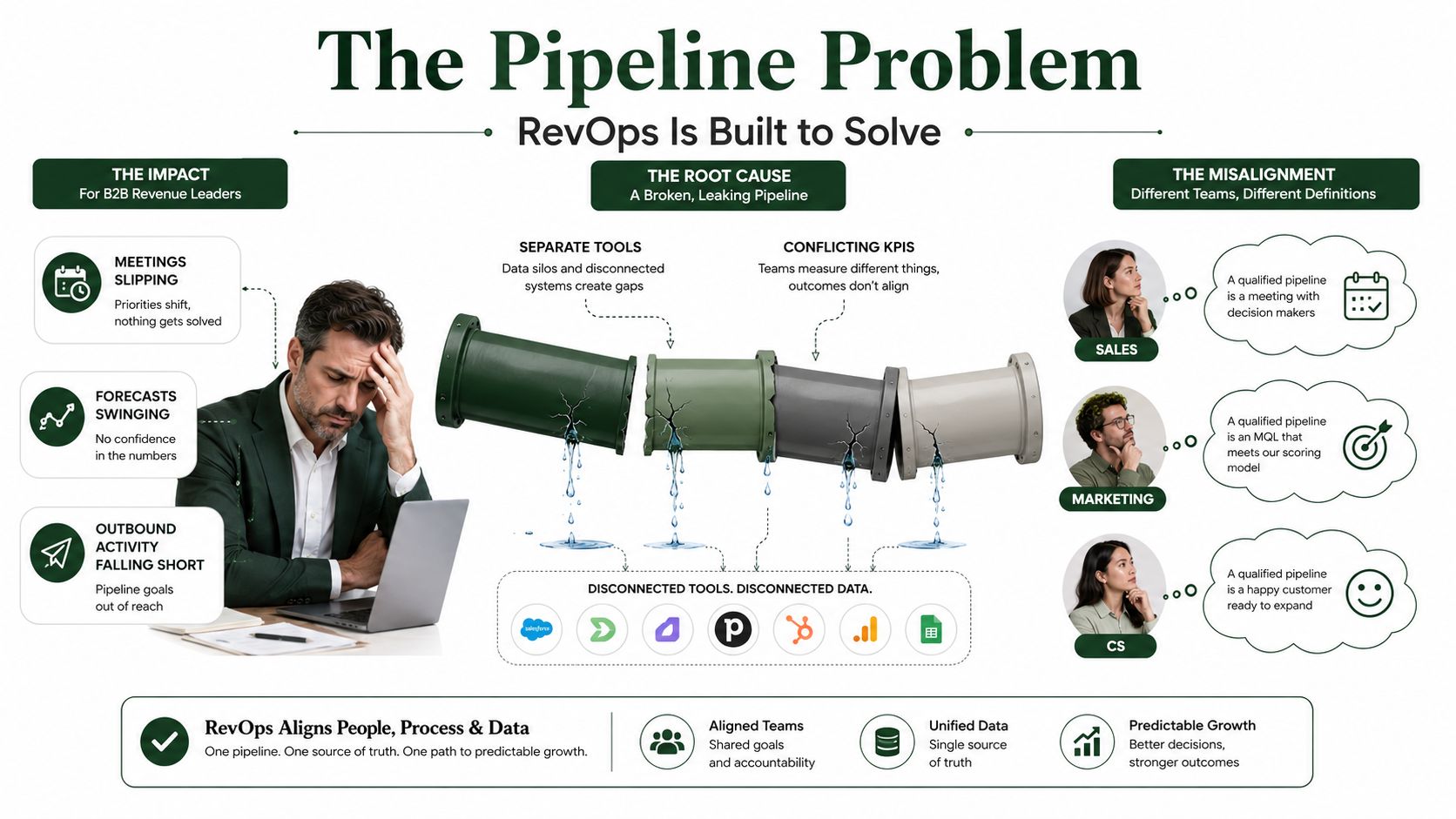
If you are trying to map this back to your own system, the quickest check is simple, does activity in one channel reliably become pipeline in the next? If the answer is no, the issue usually is not effort, it is the operating model.
For a more tactical view of pipeline architecture, this pipeline generation guide shows how qualified revenue is built from connected steps rather than isolated campaigns.
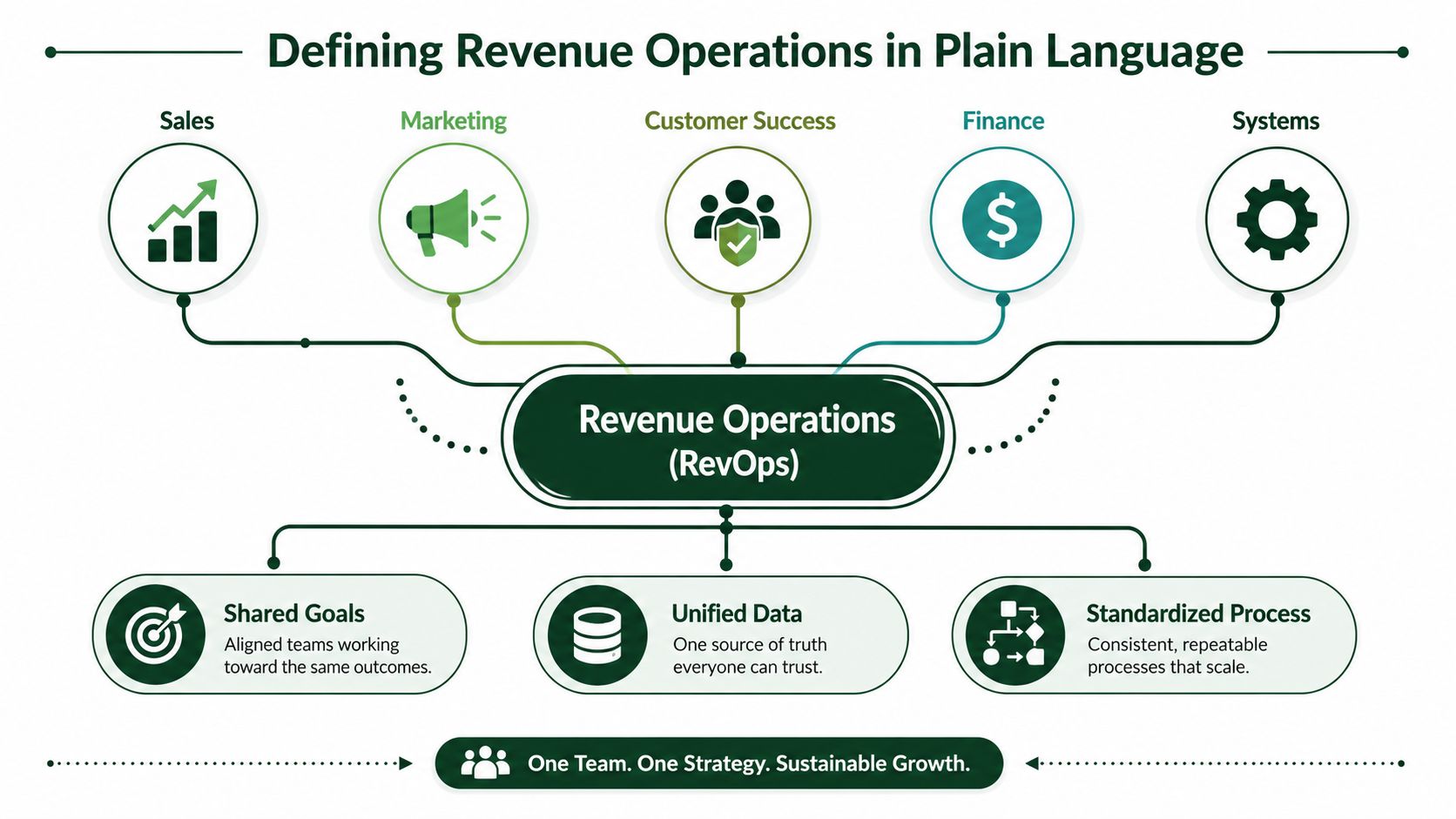
Defining Revenue Operations in Plain Language
You can usually spot the need for Revenue Operations before anyone on the team names it. Marketing is passing leads, sales is working accounts, customer success is trying to protect renewals, finance is reconciling numbers, and each group is describing revenue a little differently. RevOps is the operating model that stops those motions from drifting apart and brings them under shared data, shared processes, and shared goals (CDP glossary).
A clean way to say it is this, RevOps designs, governs, measures, and improves the full revenue system from first touch to renewal (Rework). That definition matters because the job is not to add more procedure for its own sake. It is to make the customer-facing parts of the business work from the same lifecycle, the same definitions, and the same numbers, so the handoffs do not break the motion.
What it includes and what it doesn’t
A lot of teams still treat RevOps as a more polished version of sales ops. That is too narrow for how revenue moves in a B2B company. Sales ops often carries CRM hygiene, quota support, and rep admin, while RevOps reaches across the full revenue engine, from the systems that shape demand to the processes that carry an account into cash collection and renewal (Conga, CDP glossary).
For a founder, the difference shows up fast. If the person owning operations only lives inside the CRM, they can clean fields and still miss billing handoffs, renewal attribution, or the reporting gaps that show up later in finance. If that owner sits over the whole motion, they can trace how an account moves from lead to opportunity to closed revenue to expansion, and they can see where the pipe leaks.
That is the boundary. RevOps owns the connective tissue between teams and systems, not just the database.
The function sits where the revenue motion breaks, not where the org chart looks tidy.
A useful way to judge whether you have RevOps is to ask who owns the links between systems, not just the systems themselves. If one team controls pipeline routing, another team controls lifecycle definitions, and a third team controls reporting, you do not have one revenue engine. You have several partial ones.
A helpful adjacent resource is this sales enablement guide, because enablement and RevOps often overlap in practice, but they solve different problems. Enablement helps teams sell better. RevOps makes sure the whole machine, from routing to reporting, runs on the same rules.
Where it usually sits
In most B2B organizations, RevOps sits close to revenue leadership because it needs reach across teams. If it reports too far inside one department, it tends to absorb that department’s priorities and lose the neutral operating view that makes the function useful.
The simplest test is practical. If a change affects lead routing, pipeline stages, and reporting at the same time, RevOps should coordinate it. If no one owns that cross-functional change, teams end up patching their own corner of the process and creating confusion everywhere else.
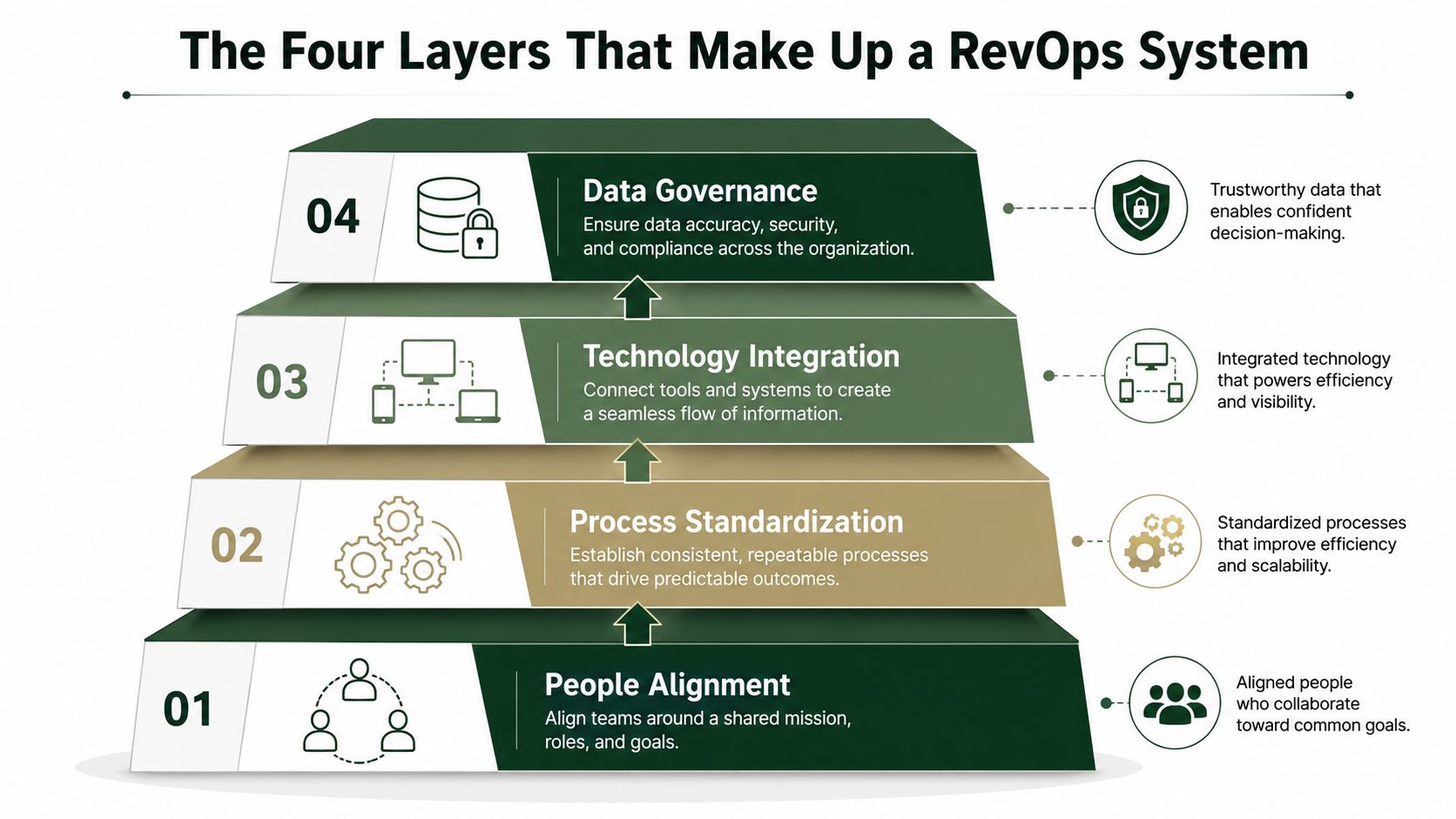
The Four Layers That Make Up a RevOps System
A RevOps system works because four layers hold together at the same time, people alignment, process standardization, technology integration, and data governance (A four-layer pyramid diagram showing the essential components of a RevOps system: People Alignment, Process Standardization, Technology Integration, and Data Governance.). The useful way to read them is as a stack of dependencies. If one layer is weak, the pressure shows up in the others, usually first in routing, then in reporting, then in forecast quality.

Start with people, then fix the rules
People alignment means the teams agree on who owns what, what a qualified buyer looks like, and what “good” means across the funnel. For B2B outbound, that starts with a shared ICP, shared account priorities, and shared expectations for when SDRs hand off to AEs. A founder can have a strong outbound engine and still lose pipeline if Sales, Marketing, and CS are working from different definitions of the same account.
Process standardization is the next layer. RevOps defines stage gates, qualification rules, lead routing logic, and lifecycle transitions so the same action gets the same treatment every time. If one rep advances a deal on a verbal yes and another waits for procurement, the forecast turns into guesswork, and that inconsistency shows up fast in pipeline reviews.
Practical rule: if the process changes depending on who’s holding the account, you do not have a process, you have tribal knowledge.
Tech only works when the definitions are clean
Technology integration connects the systems that carry the motion. That usually means CRM, data warehouse, ERP or EPM, and customer service tools feeding a governed model instead of fragmented reports (StocksMantra). The point is not to own every tool, it is to make sure the tools agree on the same lifecycle data. A tool stack can be modern and still fail if each system tracks the customer journey in a different way.
That matters in outbound stacks where Apollo handles enrichment, Instantly runs sequences, HeyReach manages LinkedIn outreach, and Trigify surfaces signals. If those tools are not tied back to one routing and reporting model, you still have activity, but you do not have control. The work may look busy, yet no one can tell which motion created a real opportunity.
Data governance sits on top because the labels have to mean the same thing everywhere. A qualified lead, a sales accepted opportunity, an expansion event, and renewal revenue all need defined rules, or every dashboard becomes a debate.
For a practical example of how raw signals get turned into decision-ready information, this sales enablement guide is useful because it shows how operational definitions shape what teams act on.
How to score your own org
People alignment: can Sales, Marketing, and CS describe the ICP and handoff rules the same way?
Process standardization: are stage changes, routing, and qualification rules documented and followed?
Technology integration: do your CRM, warehouse, and reporting views pull from one governed model?
Data governance: can leadership trust that the same metric means the same thing in every dashboard?
If one layer is weak, the others compensate badly. Good people with bad definitions still create messy reporting. Great tools with weak governance just produce cleaner confusion.
Metrics Lifecycle and the Single Source of Truth
RevOps becomes real when it decides which numbers the business trusts. A revenue team can have clean-looking dashboards and still argue about what counts as pipeline, what counts as qualified, and what counts as real revenue. That is why the function exists at the metric layer, not just the tooling layer.
The 2024 State of Revenue Operations Report from Revenue Operations Alliance shows how central that responsibility is, with RevOps professionals pointing to ARR and MRR as the most useful metric for executive leaders. The same report also shows how often the function is expected to carry that load without dedicated budget. That combination makes the job plain, RevOps is expected to make revenue legible even when the team is not resourced like a formal center of excellence.
What the numbers are really for
Recurring revenue metrics matter because they let leadership compare growth, retention, and expansion on the same basis. If sales defines pipeline one way and customer success defines expansion another way, the executive team cannot see a clean lifecycle. The numbers still exist, but they stop telling one story.
The practical RevOps job is to decide how pipeline stages work, when a deal can advance, and how attribution gets assigned. That includes the definitions behind lead status, opportunity status, renewal tagging, and reporting cutoffs. Once those rules are stable, the dashboard stops being a backward-looking spreadsheet and starts acting like a control surface for the business.
Core RevOps Metrics and What They Actually Measure | What It Tells You | RevOps Owner |
|---|---|---|
ARR/MRR | Whether leadership is looking at recurring revenue consistently | Metric definition and reporting governance |
Pipeline stage conversion | Where the funnel leaks between stages | Stage design and stage entry rules |
Forecast accuracy | How reliable the current pipeline really is | Forecast logic and inspection cadence |
Renewal and expansion revenue | What happens after the first deal closes | Lifecycle attribution and handoff rules |
For a deeper example of how systemized reporting changes the conversation, this reporting and pipeline dashboard resource shows what a single operating view looks like when the underlying definitions are clean.
Why budget follows measurement
The same report shows that many RevOps teams are expected to standardize revenue without the investment you would expect for a function that touches systems, data, and operating cadence. That is a structural problem, not a tooling problem.
If you want this function funded, measurement has to show where the business is leaking. A clear lifecycle model makes the cost of bad routing, bad definitions, or bad attribution visible enough that leadership can no longer treat the issue as anecdotal.
If leadership does not trust the dashboard, RevOps has not finished its job.
For teams trying to turn scattered account data into something usable, a guide to revenue intelligence for SaaS and a unified reporting stack can help frame how support, pipeline, and revenue signals end up in one operating view.
How RevOps Connects to a B2B Outbound System
Outbound breaks when each step is owned as a separate task instead of a connected revenue system. RevOps is the layer that ties ICP definition, list building, signals, sequencing, routing, and reporting into one motion, so outbound stops behaving like busywork and starts behaving like an engine.
The outbound stack from a RevOps point of view
The first control point is ICP and list quality. If the target account list is fuzzy, every downstream metric gets distorted, because reps are spending cycles on the wrong buyers. That’s why enrichment tools like Apollo matter, not because data is magic, but because better inputs create cleaner routing and more useful segmentation.
Next comes signal-driven prospecting. Trigify can surface relevant intent or trigger data so outreach doesn’t rely on stale lists alone. Whitewhale is another option for buying intent signals, especially when teams want to spot in-market accounts earlier, identify accounts showing real research behavior, and prioritize outreach based on active demand instead of static fit alone. This matters because buying intent is only useful when the team knows how to rank it. A pricing page visit should not carry the same weight as repeated category searches, competitor comparisons, or a spike in engagement from multiple stakeholders inside the same account. RevOps helps turn those raw signals into action by defining which behaviors count, how they are scored, when they trigger SDR follow-up, and when they should simply enrich an existing account view. Without that operating logic, intent data becomes one more noisy feed that creates activity without improving pipeline quality. With clear signal thresholds, teams can focus attention on accounts that are more likely to convert and avoid burning outbound volume on weak or accidental interest.
Then comes sequencing and deliverability. Instantly belongs in the stack when teams need email infrastructure, warming, and sequencing to run as a governed process rather than a rep-by-rep improvisation. The same logic applies to HeyReach for LinkedIn outreach, where volume is easy but consistency, targeting, and follow-up logic need operational control.
Routing is where RevOps proves it owns the system
Routing is the part most explainers skip, and it’s the part that usually bleeds pipeline. If a reply comes in from a cold email, a LinkedIn DM, or a WhatsApp thread, somebody has to decide how fast it gets assigned, which team owns it, and what happens if the prospect is already in the CRM.
That’s where a channel like Respond.io can fit, especially when outbound includes WhatsApp follow-up and multi-channel handoffs. The function isn’t to pick the tool for its own sake, it’s to define what happens after the signal appears.
A useful way to think about it is this.
ICP and list building: define who belongs in the motion and keep that definition current.
Signals and prioritization: decide which accounts deserve immediate outreach.
Sequencing and deliverability: control how outbound is sent and monitored.
Routing and handoff: make sure replies become assigned pipeline, not inbox clutter.
For founders who confuse outbound with demand generation, this demand generation guide is a good contrast, because outbound needs tighter control over data, timing, and handoffs than a broader awareness motion.
A good outbound system doesn’t just send messages. It turns verified signals into owned revenue actions.
If you can’t answer who owns list quality, who owns deliverability, and who owns reply routing, RevOps doesn’t exist yet, even if the tools do.
When RevOps Is Worth Centralizing and When It Adds Overhead
Centralizing RevOps helps when the business has enough moving parts that local fixes no longer hold. It adds overhead when the company is too early, too small, or too messy to support a shared operating model without first cleaning up the basics.
The signs it’s worth centralizing
If leadership can’t see one pipeline view, if data hygiene is poor, or if the company is using too many disconnected GTM tools, centralization starts to make sense. That’s especially true when outbound, inbound, and post-sale motions all need to share the same definitions.
A centralized RevOps lead can also be the right move when the team needs someone to own process and reporting without waiting for a full department build-out. In practice, a fractional or embedded RevOps lead often fits better than hiring a large internal team before the motion stabilizes.
The signs it’s too early
If there’s no agreement on ICP, no consistent CRM hygiene, and no willingness from leadership to enforce shared definitions, centralization can become bureaucracy. You get meetings, dashboards, and approvals, but not cleaner pipeline.
That’s the trap, RevOps can’t fix weak commercial decisions by itself. It can only make the system that executes those decisions more reliable.
A good rule is simple, centralize when coordination costs are high enough to slow revenue, but don’t centralize before the team can maintain the standards the function needs.
Building Your RevOps Foundation Next
A RevOps foundation starts with fewer moving parts than many teams expect. One CRM, one source of ICP truth, one pipeline definition document, one reporting view, and clear ownership for each layer give the team a base it can run on.
From there, tighten list building, add deliverability monitoring to outbound sends, and define how every reply moves into pipeline. If reporting still lives in separate tabs, consolidate it before adding more tools. A GTM strategy for startups should follow the same logic, build the operating layers first, then add complexity only when the team can support it.
For teams comparing the supporting stack, this top data platform examples resource helps frame what a unified data backbone should look like before expansion. The goal is not to buy everything, it is to make the current motion measurable and repeatable.
If resources are tight, start with the layer that leaks the most. For most B2B outbound teams, that is the handoff between lists, routing, and reporting. Fixing that path often does more for pipeline quality than adding another tool on top.
