Does Cold Email Marketing Work? the 2026 Evidence
Does cold email marketing work in 2026? Explore reply-rate benchmarks, when outreach actually converts, common failure modes, and proven tactics that move
Cold email marketing can produce pipeline, but the benchmark that matters is far less flattering than most success stories suggest. Large analyses put average cold email reply rates around 3.43% to 3.7%, while top performers exceed 10% (2026 benchmark analysis, 53-million-email analysis). The answer to “does cold email marketing work” is therefore conditional, not binary. Precision targeting, relevant timing, clean data, persuasive offers, and inbox placement determine whether a campaign creates conversations or merely sends activity into a reporting dashboard.
For teams building the operating layer, Instantly is relevant for cold email sequencing, deliverability management, warming, and campaign execution. Apollo can support prospecting and data enrichment, while Trigify helps identify social signals that can make outreach more timely. The distinction matters because bulk sending and signal-led outbound may use the same channel, but they don't behave like the same channel.
Table of Contents
Why the Yes or No Question Is the Wrong Frame
Cold email reply rates average in the low single digits, while top-performing campaigns can exceed 10% (Martal benchmark analysis, Instantly benchmark report). That spread makes a yes-or-no verdict commercially weak. Cold email can create pipeline under one operating model and generate little beyond sending activity under another.
The better question is: which inputs make a recipient recognise the problem, trust the sender, and reply? Three conditions usually need to align:
Precise ICP targeting: The recipient has the relevant role, company context, and problem your offer addresses.
A relevant trigger-based offer: The message connects to a current event, such as hiring, funding, expansion, or a technology change.
Infrastructure that reaches the primary inbox: Authentication, list hygiene, sender reputation, and sending practices give the message a chance to be seen.
The basic concept is covered in cold email marketing defined. The definition does not answer whether a campaign will produce conversations. A campaign can follow the cold email format and still fail because its list is broad, its offer is generic, or its messages miss the inbox.

The spread is the evidence
A 2025 B2B dataset covering 7.53 million emails recorded a 1.71% bounce rate, implying 98.29% deliverability, yet high-volume campaigns averaged only 0.45% replies (Belkins B2B dataset). Delivery alone did not compensate for weak targeting.
At the other end, summaries report tightly segmented, signal-led campaigns reaching 10% or more, with some focused motions cited at 15% to 25% (Mailshake state of cold email). These figures are not a baseline. They show why list quality, timing, message fit, and sending discipline determine performance more than the channel label. Bulk and precision outbound may use email, but they operate at very different levels of effectiveness.
Reply Rate Benchmarks and the Performance Spread
Reply-rate benchmarks are useful only when the operating model is visible. A platform-wide average combines new senders, mature programs, small tests, large untargeted campaigns, different industries, and inconsistent definitions of a reply. Comparing those figures without separating program type produces false confidence.
The available evidence shows a wide performance spread. Large datasets place average cold outreach around 2.09% to 3.43% replies, while 5% is commonly treated as strong and 10% or more as excellent (Sales.co benchmark summary). A separate 2025 dataset found high-volume campaigns averaging only 0.45% replies, despite strong implied delivery. The gap reflects differences in targeting, list quality, message fit, and sending discipline, rather than a single channel-wide result.
A structural finding matters alongside the averages: 58% of replies came from the first email and 42% from follow-ups (Martal benchmark analysis). The opening message creates most initial opportunities, while follow-ups produce a substantial share of total conversations. Stopping after one email therefore removes part of the available response opportunity. Sequence length belongs in the benchmark, not in a footnote.
Analyst interpretation: A reply-rate benchmark without sequence length, targeting quality, and send volume is an incomplete measurement.
The comparisons below work as a decision framework, not as a promise that every program will produce the same outcome. The cited datasets establish reply-rate and deliverability benchmarks, but they do not establish a universal meeting-booked rate or pipeline value for each program type. Those fields remain not established by the cited benchmark data, rather than being filled with unsupported precision.
Cold email reply rate benchmarks by program type
Program Type | Avg Reply Rate | Meeting Booked Rate | Pipeline per 1,000 Sends |
|---|---|---|---|
High-volume, broad outreach | 0.45% across high-volume campaigns | Not established by the cited benchmark | Not established |
Broad B2B cold outreach | 2.09% to 3.43% in large datasets | Not established by the cited benchmark | Not established |
Mature, tightly segmented program | Qualitatively stronger than broad averages | Not established by the cited benchmark | Not established |
Signal-led precision outbound | Top campaigns exceed 10%; some summaries cite 15% to 25% | Not established by the cited benchmark | Not established |
A separate cold email response-rate analysis explains how campaign design changes response performance. The practical conclusion is that cold email operates at several levels. Broad sending may generate limited engagement, while precise, signal-led outreach can perform far better. Targeting, list size, infrastructure, and sequence design determine which version a team is running.
When Cold Email Actually Works
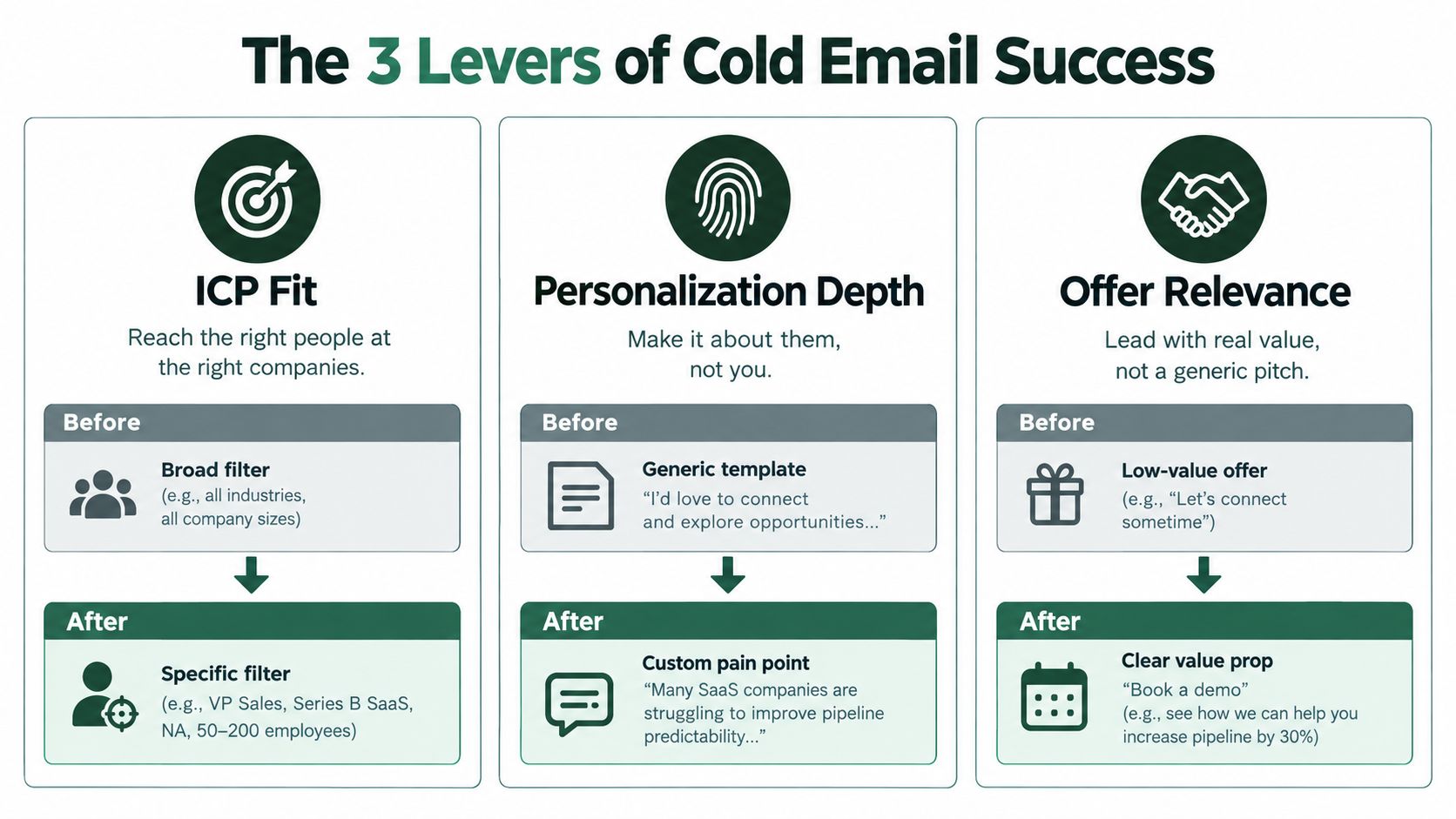
Cold email moves from noise to pipeline when three levers reinforce one another: ICP fit, offer relevance, and timing. Treating them as independent optimisation tasks understates their interaction. A perfectly timed email to the wrong buyer still fails, and a relevant offer sent to a poor address may never be seen.
Start with ICP fit
A query such as “sales leader at any company” contains too little information to support meaningful relevance. A tighter filter, such as VP Sales at Series B SaaS companies in North America with 50 to 200 employees, gives the writer a clearer operating context. The message can address the likely responsibilities and current growth conditions without pretending every sales leader has the same problem.
The improvement isn't guaranteed to be a particular multiple, and the available verified data doesn't establish a universal lift from one filter to another. The defensible conclusion is qualitative: tighter filters reduce marginal recipients who have no reason to respond.
Replace generic asks with live relevance
“Do you have 15 minutes to discuss growth?” asks the recipient to supply the reason for the conversation. A trigger-based offer does more work before the reply. For example, a hiring signal can support a message about helping a team handle increased outbound capacity, while a funding event may justify a conversation about building a repeatable pipeline system.
The trigger doesn't make the offer persuasive by itself. It gives the sender a specific reason to write now, which makes the message easier to understand and easier to ignore if the assumption is wrong. That is still better than forcing every prospect into the same pitch.
Treat timing as a context decision
The requested Tuesday-versus-Monday comparison and the claimed 23% Tuesday open-rate advantage aren't supported by the verified data provided here, so they shouldn't be presented as established facts. Send-time testing can still be sensible, but reply rate should be evaluated against recipient local time, segment, trigger recency, and sequence position rather than a universal weekday rule.
Teams that also manage editorial or lifecycle workflows may find email automation for content teams useful for separating content operations from outbound sequences. The key distinction is operational: cold outreach should use a prospect-specific reason to contact someone, while content automation serves a different audience and intent.
The Hidden Bottleneck Behind Failed Campaigns
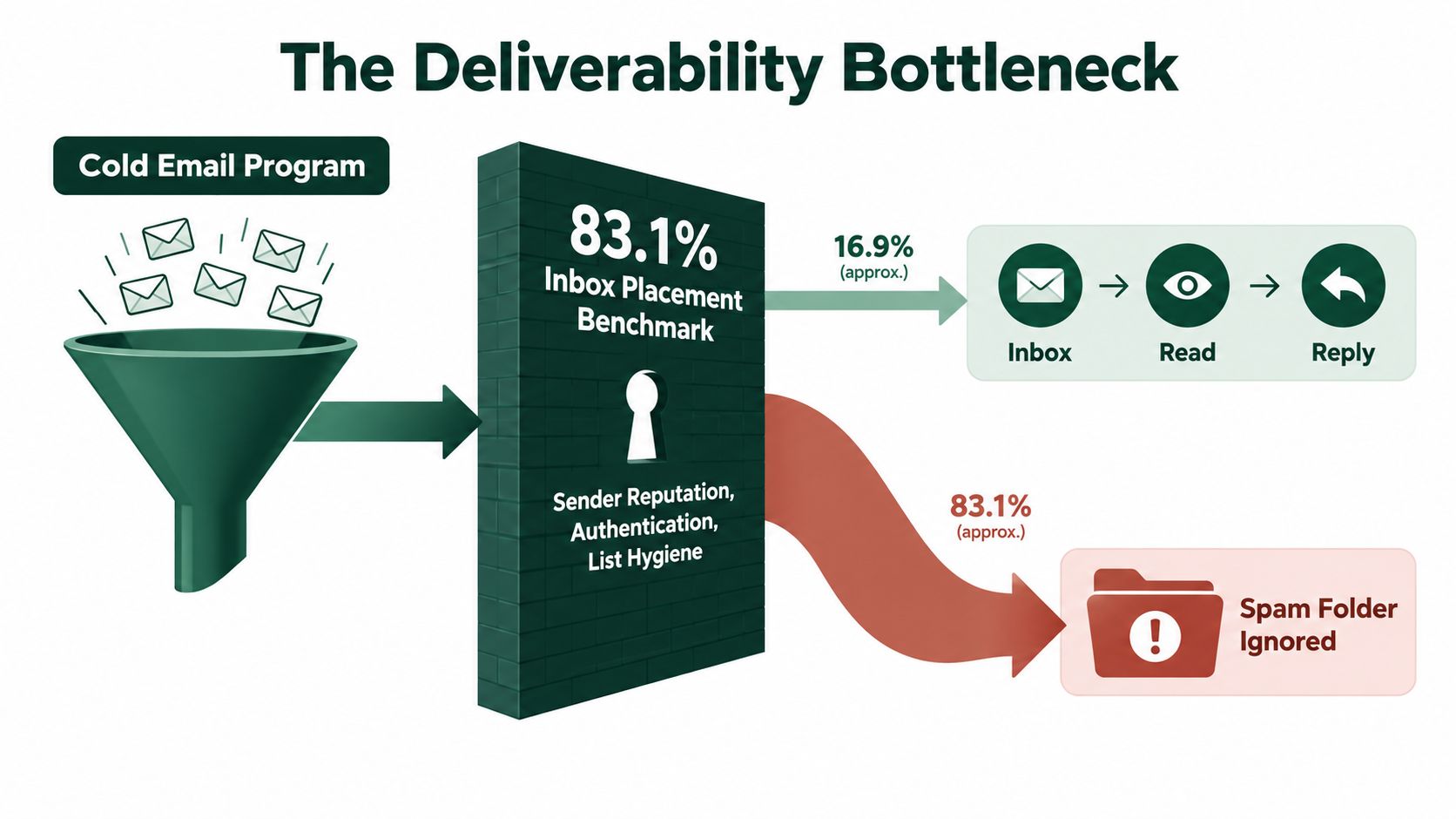
Many teams optimise the sentence before proving that the message reaches the inbox. That order is backwards. A recent benchmark cited 83.1% inbox placement, showing that successful send or delivery signals can still overstate the number of messages appearing where recipients are likely to read them (CopyCrest state of cold email).
Inbox placement is a silent ceiling. If messages are routed to spam, improving the subject line can't recover the lost attention. This is why a campaign can show technically strong delivery while producing weak commercial results.
What authentication actually does
SPF authorises approved sending servers. DKIM adds a signature that helps receiving systems verify message integrity. DMARC tells receiving servers how to handle messages that fail authentication or alignment checks. Major mailbox providers treat these protocols as core infrastructure signals, not decorative settings (email authentication and deliverability guide).
Authentication doesn't guarantee placement. It supports a broader reputation system that also considers recipient behaviour, bounce patterns, complaint signals, list quality, and sending consistency. A clean technical setup gives the campaign a foundation, not immunity from poor decisions.
Read the failure signals
High bounce rates suggest a list-quality or verification problem. A sudden reply-rate drop may indicate changing audience fit, sender reputation damage, or inbox-placement deterioration. Missing DMARC reports remove useful visibility into authentication failures and potential abuse.
The practical checklist is available in this guide to email deliverability best practices. Programs that invest in warm-up, dedicated sending domains, authentication, and placement monitoring before rewriting copy are testing the actual constraint first.
Infrastructure comes before persuasion. A brilliant email that doesn't reach the primary inbox is not a copy problem.
Precision Outbound Versus Bulk Sending
Consider two hypothetical operating motions, but don't mistake them for verified case studies. The figures below come from the prescribed comparison scenario, not from the benchmark datasets, so they illustrate the mechanics of funnel design rather than establish a general industry result.
Motion A is a SaaS vendor blasting 50,000 generic emails per month. In the scenario, the campaign records 15% inbox placement, a 0.4% reply rate, 8 meetings, and 1 closed deal at $12,000 ACV. Motion B sends 4,000 signal-led emails to accounts matching a tight ICP, with first-line personalisation tied to a specific trigger event. Its scenario records 88% placement, a 4.1% reply rate, 22 meetings, and 6 closed deals at an $18,000 average ACV.
Metric | Bulk Motion, 50k sends | Precision Motion, 4k sends |
|---|---|---|
Monthly sends | 50,000 | 4,000 |
Inbox placement | 15% | 88% |
Reply rate | 0.4% | 4.1% |
Meetings | 8 | 22 |
Closed deals | 1 | 6 |
Average contract value | $12,000 | $18,000 |
Under those scenario assumptions, Motion B produces approximately $108,000 in booked contract value, compared with $12,000 for Motion A. That is roughly 9 times the revenue on 12% of the send volume. The arithmetic is useful because it exposes why volume alone is a weak strategy. It doesn't prove that every precision campaign will produce those results.
The divergence comes from three structural choices:
List construction: Signal-led accounts are selected for fit and timing, while scraped lists maximise reach without proving need.
Offer relevance: The precision message anchors on a problem connected to the trigger, while the bulk message commonly defaults to a feature description.
Follow-up sequencing: Behaviour-triggered follow-ups respond to context, while fixed cadences continue regardless of engagement.
A broader treatment of channel economics is available in outbound marketing versus inbound marketing. The analyst takeaway is that precision outbound compounds because every input is tighter. There isn't one magic subject line doing the work.
Optimization Tactics That Move Reply Rates
Once infrastructure is sound, optimise from the list toward the reply. Copy changes made before list and delivery checks can conceal the source of weak performance.
Build a list that can survive scrutiny
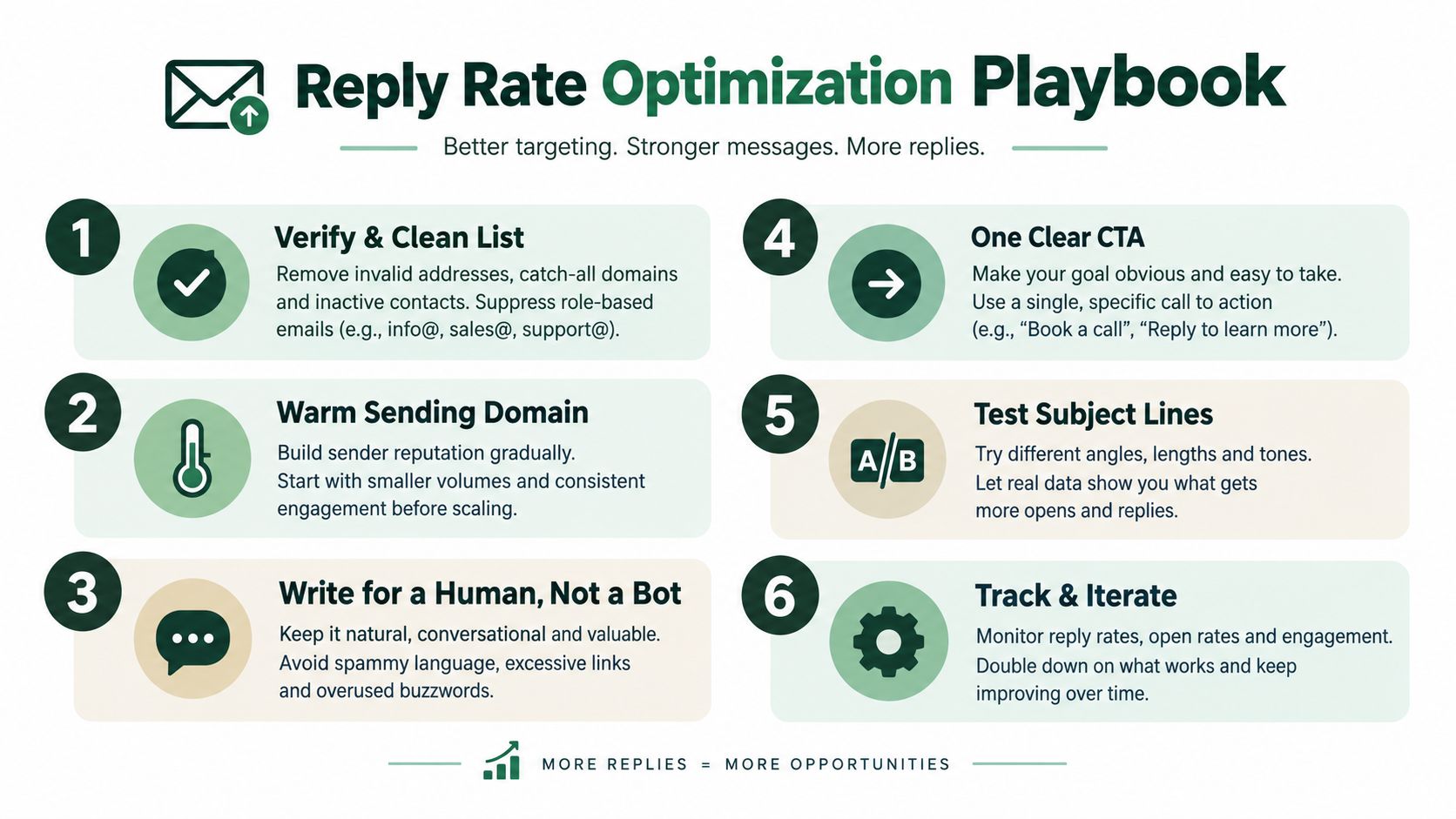
Verify each address through a current validation process, suppress role-based inboxes, and remove contacts outside the ICP. Segment prospects by trigger recency so the first message reaches them while the event still affects decision-making. Analysts at Belkins recorded a 1.71% bounce rate and implied 98.29% deliverability in a dataset where list quality and infrastructure were strong (Belkins deliverability dataset). The practical lesson is straightforward: reply-rate analysis is unreliable when messages do not reach valid inboxes.
Design the sequence around new value
Keep the first email concise, with one reason for writing and one low-friction CTA. Each follow-up should introduce something useful, such as a relevant observation, short demonstration, customer evidence, or data point. Repeating “just checking in” adds another touch without adding a reason to respond.
A practical sequence can begin with an initial email, continue on day 3 and day 7, and stop after 4 total touches. These timings are operating hypotheses, not universal benchmarks. Test them against the audience while monitoring complaints, bounces, and replies.
Increase personalisation depth
Personalisation has distinct levels:
Merge-tag personalisation: First name and company fields improve surface relevance but do not demonstrate research.
Company-line personalisation: A sentence tied to the company's market, hiring activity, or product direction provides stronger context.
Trigger-based personalisation: The opening references a funding round, job posting, technology change, or another observable event, then connects that event to the offer.
Turn replies into the next experiment
Tag every reply by objection type, then revise one email each week against the most common objection. Test subject lines at the campaign level. Changing several elements inside one message makes the result difficult to interpret.
Track positive reply rate as the primary commercial KPI. Open-rate data can be noisy and does not establish that a conversation will create pipeline. Review deliverability dashboards weekly, then assign the next change to the list, infrastructure, offer, or copy. Teams refining message length can also consult this guide on how long a cold email should be.
Building a Cold Email System That Pays Back
A cold email system should earn more volume only after it passes an operating audit. Check list source and freshness, authentication, bounce behaviour, inbox placement, sequence length, trigger quality, and personalisation depth. Without those records, a weak result cannot be assigned to the market, message, or sending infrastructure.
Use three operating levels:
Spray-and-pray: Broad lists, generic offers, and volume-led sending. This approach typically produces weak reply rates because relevance and data quality receive little control.
Scaled segmented: A defined ICP, separate campaigns, cleaner data, and iterative copy. This level gives teams clearer evidence about which segments and offers generate conversations.
Signal-led precision: Smaller, tightly matched segments with event-based messaging. Relevance, timing, and infrastructure are controlled more closely, so performance can differ sharply from bulk outreach.
These tiers are operating conditions, not guarantees. The gap between bulk and precision outbound is wider than a simple “does cold email work?” answer suggests.
ROI requires consistent assumptions. A hypothetical 5% reply rate on 1,000 targeted prospects, followed by a 15% meeting-to-opportunity close, can outperform a 1% reply rate on 50,000 generic sends when the targeted segment creates better-fit opportunities and fewer irrelevant responses. Those percentages are scenario inputs, not industry benchmarks.
A practical reset starts with deliverability. Audit authentication and placement, remove weak records, narrow the database to one ICP segment, align the offer with one relevant trigger, and run a four-step sequence before increasing volume. Review positive replies, qualified meetings, opportunity creation, bounce behaviour, and cost per conversation together. Reply volume alone can hide poor fit.
For broader system design, use this guide to plan B2B lead generation. The objective is repeatable pipeline, not a brief campaign spike. Better inputs must produce measurable improvement across list quality, message relevance, and sending health.
The Social Search designs and operates outbound systems connecting ICP definition, data, messaging, sequencing, deliverability, signal-driven prospecting, and reporting for B2B teams selling into APAC and global markets. If cold email creates activity without qualified pipeline, visit The Social Search to discuss a system build, messaging engagement, or fractional GTM support grounded in live reply data.
