B2B Lead Generation: A Scalable System That Books Meetings
Build a scalable B2B lead generation system with proven frameworks for ICP, channels, qualification, and sales handoff that actually fills pipeline.
Most B2B teams don’t have a lead problem, they have a handoff problem. The founder has a list. Marketing has forms. Sales has a spreadsheet. Reply rates dip, meetings slip, and everyone blames the channel they happen to touch most.
That’s usually the moment someone asks for “more leads,” when the true fix is to make the whole system work together. B2B lead generation has grown into a serious operational category, with a global market estimate of $10.09 billion in 2024 projected to reach $32.85 billion by 2035 on GTM 8020’s market roundup. That scale tells you something practical, lead gen is no longer just list building, it’s system design.
The companies that win don’t treat outbound, inbound, qualification, and routing as separate projects. They build one machine, then hand it over cleanly.
Table of Contents
The Pipeline Problem Most B2B Teams Get Wrong
A founder sends 2,000 cold emails, the inbox looks active, and the dashboard shows a pile of replies. Then sales opens the list and half the names don’t fit the product, the other half aren’t ready, and the few good accounts never get touched quickly enough. That’s not a volume problem, it’s a system problem.
The deeper issue shows up in the numbers. Salesforce-related benchmark reporting cited by The Starr Conspiracy found that only 13% of marketing-qualified leads convert to sales-qualified opportunities across B2B SaaS, based on the State of Sales 2024 survey of 5,500 sales professionals across 27 countries conducted from February to April 2024. On the buying side, Gartner’s benchmark work shows B2B buying committees usually involve 6 to 10 stakeholders, and 77% of buyers describe their latest purchase as complex or difficult, which means a single contact rarely tells the whole story. The Starr Conspiracy’s benchmark summary makes the structural gap obvious.
Pipeline is an output of system design, not effort.
That reframe matters because it changes what gets built. Lead generation used to mean a list and a sequence. Now it has to handle ICP definition, channel mix, qualification, and handoff as one connected workflow. If one piece breaks, the rest just creates busywork.
For teams looking for a practical benchmark set of ROI-focused approaches, find ROI-focused B2B strategies is useful context, especially if you’re deciding which motions deserve engineering time and which ones are just activity.
The operating model that holds up in real teams is simple. First, define who you should work. Then decide how you reach them. Then score what comes back. Then route only the right leads to sales with enough context to move fast.
Defining an ICP That Sales Will Actually Work
A loose ICP sounds friendly in a workshop and useless in a pipeline review. “Mid-market SaaS” or “companies that need automation” doesn’t help a rep decide whether an account belongs on the short list. A real ICP should compress a wide market into a smaller set of accounts that look like your best closed-won deals.
Start with the signals that correlate with closeable accounts
Firmographic filters come first, company size, industry, geography, and revenue band if you use it internally. Then add technographic criteria, because the stack often tells you whether your product fits cleanly or creates friction. Behavioral criteria matter too, especially if you’re using intent or engagement signals to prioritize accounts that are already active. For enrichment and account data quality, Apollo is useful when the constraint is building a workable list from messy contact data. If you’re prioritizing outreach based on timing signals, Trigify is a good fit when the goal is to act on real buying cues instead of sending blind.
The point isn’t to build a perfect theory of your customer. It’s to make sales willing to work the list you hand over. If reps consistently ignore the accounts you score as “top priority,” the ICP is too loose or the scoring rules don’t match how they sell.
One practical test is to pull your last 10 to 20 closed-won deals and ask three questions. Which industries closed fastest, which tech stacks showed the fewest objections, and which account sizes produced the fewest stalls? The answers usually expose where the ICP lives, not where the slide deck says it lives. If you need help turning that into a working target list, this ICP list-building service is the kind of operational support that turns theory into a file sales will use.
Loose vs Tight ICP Definition
Criteria | Loose ICP | Tight ICP |
|---|---|---|
Industry | “B2B companies” | Specific verticals that match recent wins |
Company size | “Small to large” | A defined size band that sales can prioritize |
Tech stack | Unclear or ignored | Named systems that indicate fit or integration readiness |
Geography | Global by default | Regions and countries you can support well |
Behavioral signals | Any form fill or click | Engagement that suggests active buying intent |
Sales action | Maybe follow up | Clear priority list with agreed scoring rules |
Practical rule: if your list feels broad enough to fit a CRM export from any competitor, it’s too loose.
Tight ICP work isn’t glamorous, but it saves the rest of the system. Every channel gets sharper, routing gets cleaner, and sales stops wasting time on accounts that were never going to convert.
Choosing the Right Channel Mix for Your Stage
The wrong channel mix is usually a copy of someone else’s stack. A founder sees LinkedIn working for a peer, adds email, then buys SEO content, and none of it gets sequenced around the actual buyer journey. The result is scattered effort and weak attribution.
Match the lane to the buying motion
Cold email is still the most direct way to reach named accounts when you already know who matters. It works best when the ICP is tight, the offer is specific, and the data is clean. For delivery, warming, and sequencing, Instantly is a sensible option because the job here is consistency, not just send volume.
LinkedIn outreach works differently. It’s usually better for credibility, multi-touch familiarity, and reaching the human side of a deal when the market already lives there. If your motion depends on relationship-building, HeyReach fits the lane because it helps teams coordinate outreach without turning every rep into a full-time operator. For enrichment, Apollo is useful when the constraint is contact and account data quality.
Signal-based outbound is where the system gets more precise. Instead of guessing who’s ready, you trigger outreach from buying cues, role changes, website behavior, or other meaningful shifts. Trigify belongs here because the value is timing, not just contact discovery.
SEO is the long game, but it matters when prospects are already searching. It captures demand instead of creating it from scratch. For technical SEO work, SearchAtlas is a practical fit, and Outrank is useful when the bottleneck is content production that maps to search intent.
Not every buying motion starts in email or search. If your funnel includes conversational follow-up in chat-first markets, WhatsApp can play a real role in reactivation and lead handling. Respond IO makes sense when teams need WhatsApp automation tied to pipeline movement instead of manual inbox work. If your acquisition mix includes inbound social engagement, comment automation, or Instagram and Facebook DMs, Manychat can fit as a lightweight way to turn social responses into captured leads.
The Social Search can also fit here as an option when you want one team to connect ICP definition, outbound, routing, and reporting into a single system. That matters most when the stack is fragmented and nobody owns the full path from list to meeting.
APAC changes the mix
APAC isn’t just “more geography.” LinkedIn norms, response patterns, and data quality can differ enough that a global template underperforms. In some markets, your best channel order won’t match what works in North America or Europe, and the system needs to reflect that instead of forcing one playbook everywhere. This outbound vs inbound comparison is helpful when you’re deciding how much demand you need to create versus capture.
In some APAC segments, messaging apps and social DMs play a larger role in early engagement than teams expect. That makes tools like Respond IO relevant when WhatsApp is part of the qualification path, and Manychat useful when leads first raise their hand through social comments or direct messages instead of a form.
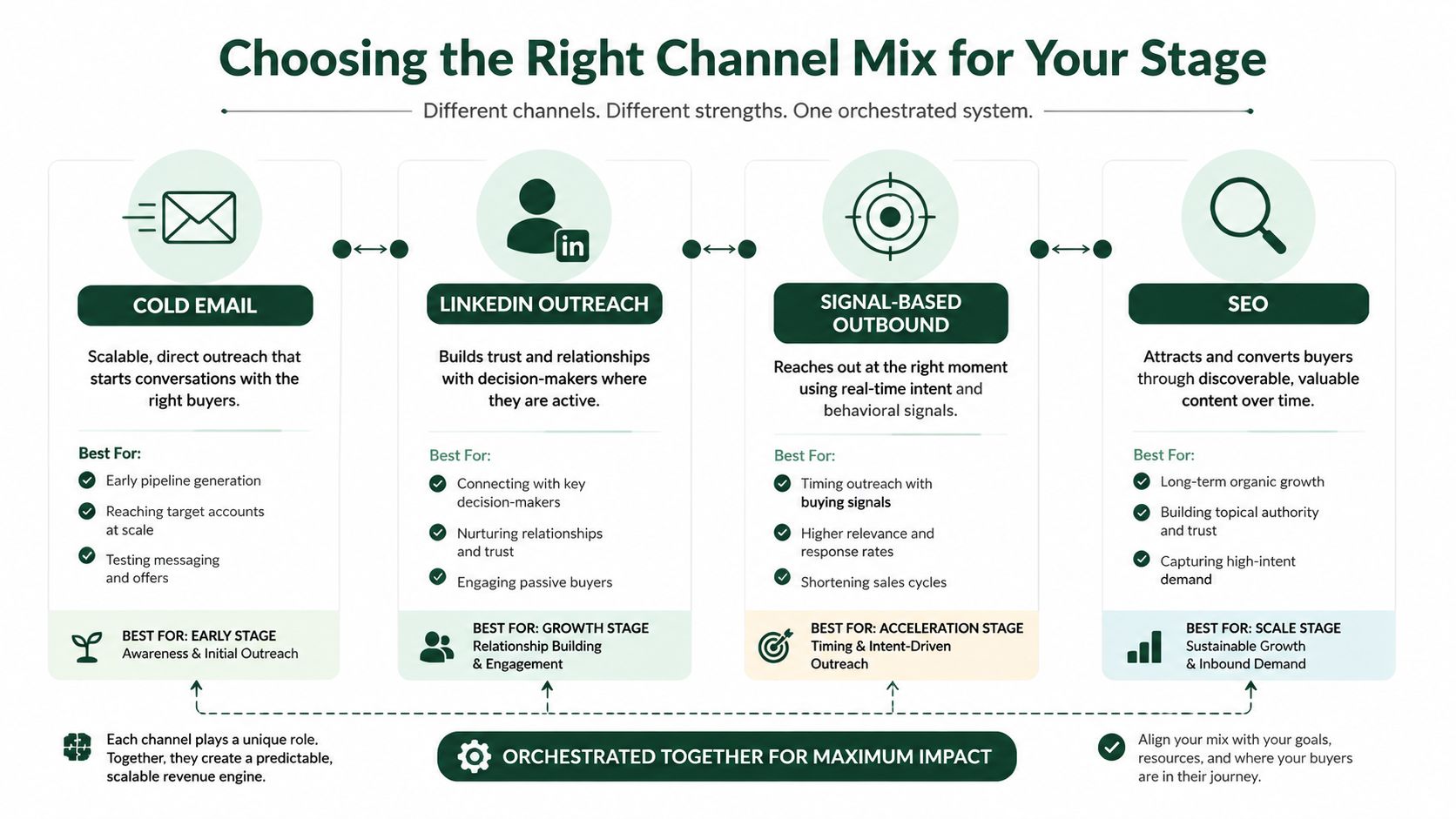
The useful question isn’t “which channel is best.” It’s which channel deserves the first touch, which one reinforces trust, and which one captures demand that’s already there. Once you answer that by ICP and geography, the stack stops being decorative.
Building a Daily Outbound Cadence That Scales
Outbound falls apart when reps switch between sending, researching, and replying all day. The work gets interrupted, follow-up slips, and the sequence stops feeling like a system. The fix is to separate production from response handling so each task has a place.
Run the day in two blocks
A workable cadence is a 90-minute morning session for sending new outreach and a 30-minute afternoon session for triaging replies and updating the pipeline, as noted in this outbound strategy playbook. That split matters because sending and reply handling demand different attention. Writing outbound from a calm block produces cleaner thinking, while reply triage needs quick decisions and clean CRM updates. If you’re running cold email at scale, Instantly fits naturally here because inbox rotation, warming, and sequencing discipline all affect whether the cadence holds up.
The first touch should not look generic. The most common failure in cold outbound is messaging that could be sent to anyone. The better pattern is a specific observation about the prospect’s business in the first line, followed by role-specific context and a clear reason to continue the thread.
Personalization tokens are not research. A name merge and a company logo don’t change the fact that the message still sounds mass-produced.
Deliverability still matters, but not as a magic fix. If you don’t pace the system, rotate inboxes appropriately, and keep the message quality high, warming just buys you time before the same problems show up again. The sequence itself should feel coordinated across email and LinkedIn, not duplicated word for word. This LinkedIn outreach guide is a useful companion when you’re deciding how to blend touchpoints without making the prospect feel spammed. For LinkedIn automation that supports multi-touch workflows, HeyReach is relevant when your reps need structure without losing the personal feel.
Cold outbound also takes persistence. A 2024 benchmark cited in a 2026 statistics roundup reported an average cold email reply rate of 5.8% across 16.5 million emails, while cold-calling success averaged 2.3% across 204,000+ calls. The same source notes it takes about 8 touchpoints to book a meeting, which is a strong reminder that the sequence is the product, not the first send. Division 50’s lead generation statistics roundup is a helpful reality check if you’re tempted to judge a campaign after one day.
A cadence that scales is boring in the right way. The rep knows when to send, when to respond, and when to update the system. That consistency is what keeps the machine from stalling.
Qualifying Leads So Sales Stops Ignoring Marketing
A team can generate plenty of leads and still create no pipeline if qualification is weak. That’s the core meaning of the 13% MQL-to-opportunity benchmark. Marketing is producing contacts, but sales doesn’t see enough readiness, fit, or timing to treat them as work worth doing.
Build scoring around fit and readiness
The best qualification model combines explicit fit signals with implicit intent signals. Fit signals include industry, company size, role, and tech stack. Intent signals include content engagement, site visits, clicks, and direct responses. Then layer in BANT-style checks, budget, authority, need, and timing, so you’re not mistaking curiosity for readiness. If you need stronger contact records or company-level context to score properly, Apollo is useful on the data side. If your team wants to prioritize based on real lead signals instead of static assumptions, Trigify is a better fit for timing-based outreach.
That matters because a lead can match the ICP and still not be ready to buy. A rep who gets handed a pile of “good fit” contacts with no timing or authority context ends up doing discovery from scratch. That’s where marketing and sales start blaming each other instead of the model.
Here’s the part where many teams get it wrong. They make scoring static. They reward opens, clicks, and form fills long after those signals stopped predicting opportunity creation. They also score the single contact instead of the account or buying group, even though modern buying is committee-based.
A better practice is to review the model regularly with sales and look for where converted opportunities came from. If a certain role keeps converting and another role keeps stalling, the scoring should reflect that. If one message path produces meetings while another just produces curiosity, the model should treat those signals differently.
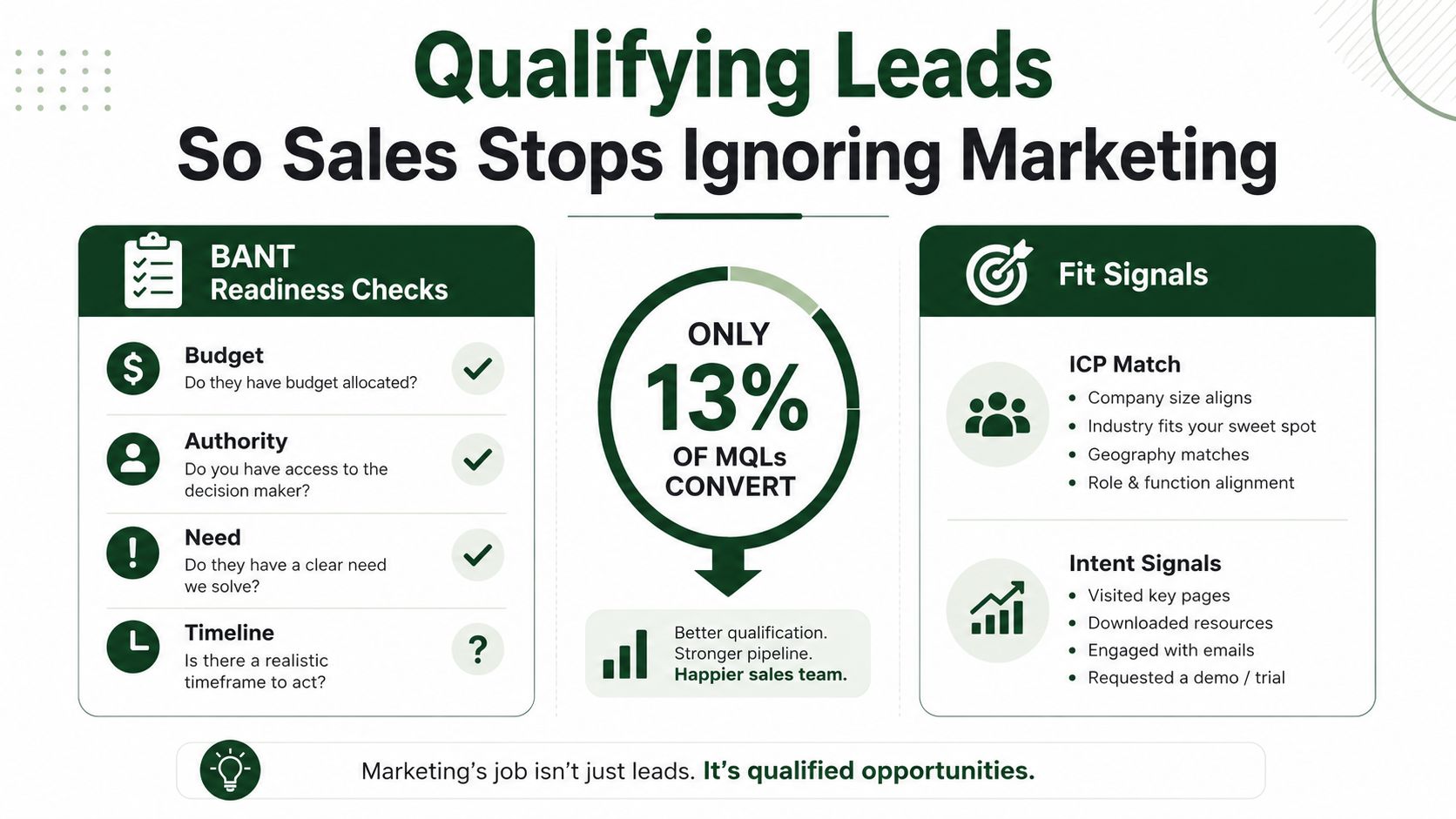
This qualified lead generation guide is a good reference point if your team needs to align on what “ready” means before sales starts rejecting the queue.
Anti-pattern to avoid: optimizing for opens and clicks without checking whether those leads ever become meetings.
The goal is simple. Sales should receive a smaller set of leads, but they should be the ones that look worth a call. That’s the difference between a CRM full of noise and a pipeline with movement.
Handoff, Routing, and Reporting That Closes the Loop
Lead gen breaks at handoff more often than at acquisition. A good list still fails if the wrong rep gets the account, the response lands late, or nobody can trace a meeting back to the signal that created it. The system needs rules, not heroics.
Route by account, not by whoever notices first
Routing should assign leads based on the ICP and the account owner logic your team uses. That can mean territory, segment, vertical, or named-account ownership, but it should be explicit. If marketing hands everything to a generic queue, sales will cherry-pick and the rest will decay.
Response time matters more than many realize. A 2026 benchmark article reported that responding to a new lead within 5 minutes can make a team up to 21x more likely to qualify that lead than waiting 30 minutes. Tomba’s benchmark summary makes the case for speed-to-lead automation better than any internal debate ever will. That doesn’t mean reps need to live in their inboxes, it means routing and alerts should do the first layer of work. In teams where fast follow-up happens through messaging apps or shared inboxes, Respond IO can be relevant if WhatsApp is part of that response workflow.
Report what produced the meeting
Leadership doesn’t need a vanity dashboard. It needs a view that answers three questions fast, what list produced the lead, what message created the reply, and what signal justified the outreach. The reporting layer should make it easy to see which combinations create meetings, not just volume.
That’s where a dashboard service matters, because attribution is only useful if it’s readable. Reporting and pipeline dashboard work is the kind of operational layer that keeps meetings traceable after the initial builder has moved on.
The handoff should survive churn. If the founding rep quits, the process should still work because the routing rules, SLAs, and reporting logic live in the system, not in someone’s head. That’s what separates a repeatable engine from a fragile campaign.
Practical rule: if you can’t explain where yesterday’s meeting came from in under five minutes, the reporting layer isn’t finished.
This is the point where good outbound stops being a series of actions and becomes an owned process. Sales gets the right lead, fast. Marketing sees what worked. Leadership can read the system without asking for a demo every time.
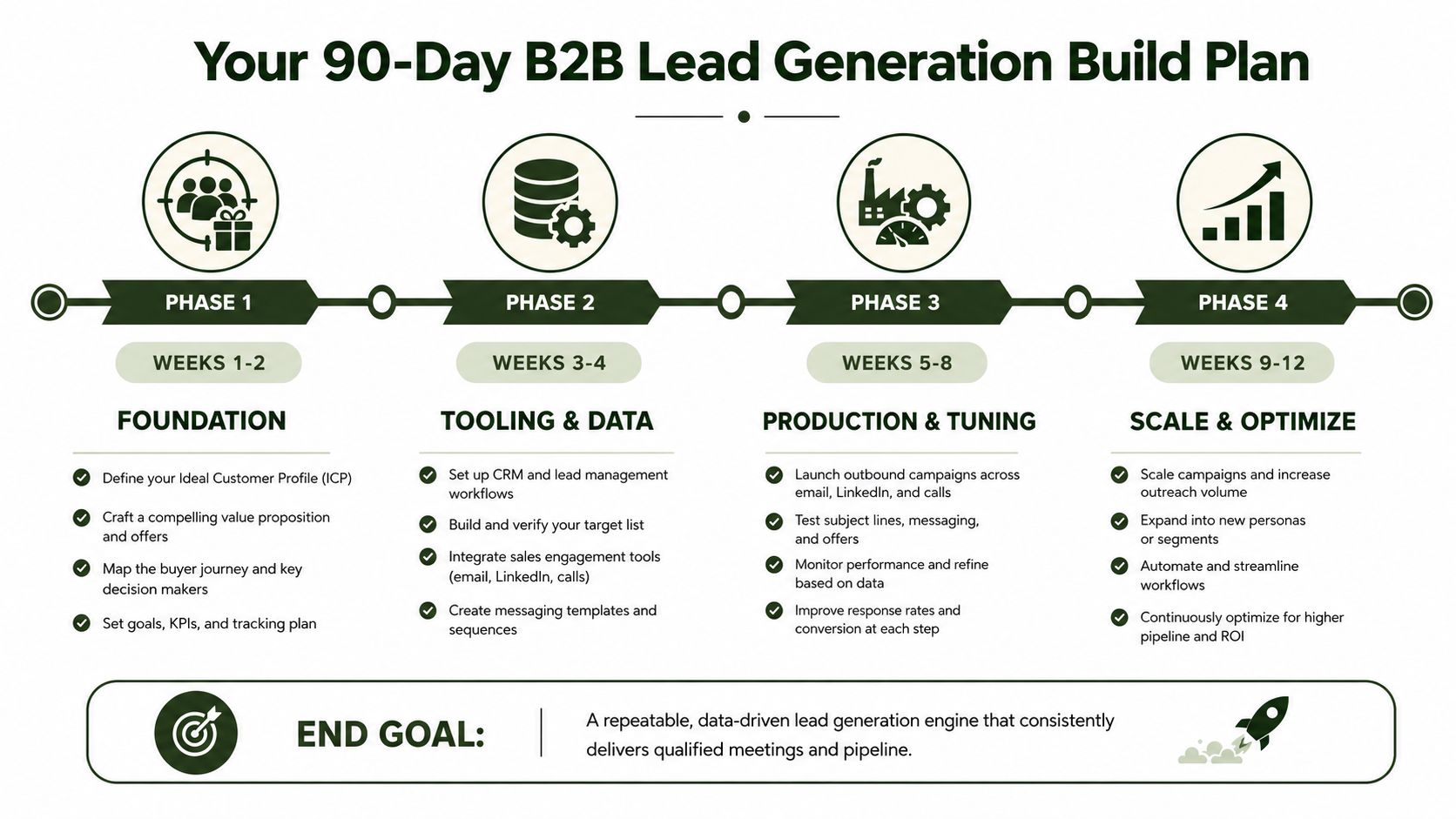
Your 90-Day B2B Lead Generation Build Plan
The fastest way to make this real is to build in phases. Weeks 1 to 2 are for ICP, offer, and scoring rules. Weeks 3 to 4 are for tooling, enrichment, and tracking setup. Weeks 5 to 8 are for production, replies, and qualification tuning. Weeks 9 to 12 are for handover, reporting, and optimization.
Track the system by stage, not just by total leads. Reply rate tells you whether the message and channel fit. MQL-to-SQL conversion tells you whether qualification is working. SQL-to-opportunity shows whether sales trusts the handoff. Pipeline generated is the outcome that matters to leadership, and cost per meeting keeps the motion honest.
A fractional GTM lead makes sense when the team needs the system designed and operated before there’s enough volume to justify a full in-house SDR function. A full-time hire makes more sense when the process is already clear and the main need is execution capacity. The wrong hire too early usually adds activity before it adds control.
The tooling layer in that 90-day build should also match the motion you choose. Teams leaning on cold email usually need a strong sequencing stack like Instantly. Teams building around LinkedIn outreach often benefit from HeyReach. If list quality is the bottleneck, Apollo is often the practical place to start. If prioritization is weak, Trigify can sharpen outreach timing. And if demand capture is part of the build, SearchAtlas and Outrank fit naturally into the SEO side of the system.
FAQ
How should APAC localization change the build? Start with local channel norms, data quality, and send timing instead of copying a single global sequence. APAC often needs tighter list work and more careful sequencing. In some markets, that also means making room for WhatsApp follow-up through tools like Respond IO or social-first lead capture through Manychat.
When should you bring in an outside build partner? When the team needs the first version of the system, not just more hands. That’s especially true if you need routing, reporting, and deliverability owned together.
What’s the biggest build mistake? Treating lead generation as a campaign instead of an operating system. That usually creates disconnected tools, messy handoff, and no clean path to meetings.
The Social Search builds outbound systems that connect ICP definition, data, messaging, channel operations, and reporting into one handoff-ready machine. If you need a system that can generate qualified meetings in APAC or global markets without tying everything to one rep’s habits, visit The Social Search and see how the build and handover process works.
Composed with Outrank
