Prospecting in Sales Process: A Practical 2026 Playbook
Learn how prospecting in sales process drives pipeline in 2026 with ICP design, signal-based outreach, and metrics that actually move revenue.
Cold outbound reply rates average about 3.43% in 2026, with typical campaigns landing between 1% and 5%, and only 0.2% to 2% of cold contacts converting to a deal according to recent sales prospecting benchmarks. That reality changes the job. Prospecting in the sales process isn't about writing a clever sequence and waiting for the pipeline to fill. It's an engineered system that connects account selection, data quality, buyer signals, channel execution, qualification, and routing.
For B2B teams selling across APAC and global markets, the system matters because every weak handoff creates waste. A rep can spend time contacting the wrong company, sending to an invalid address, following up after the buying window has passed, or booking a meeting that has no defined owner. Each error sits upstream of revenue, but its cost appears later as poor conversion, stalled opportunities, and an unreliable forecast.
Table of Contents
Why Prospecting in the Sales Process Matters Now More Than Ever
A sales team can have strong closers and still miss its number if the front end supplies too few qualified conversations. The average cold email reply rate was cited at roughly 8.5% in 2019, compared with about 3.43% in 2026, a historical decline documented in sales benchmark reporting. In another benchmark, only 18% of sales outreach receives any response, leaving 82% ignored. The lesson isn't to abandon outbound. It's to stop treating raw activity as a strategy.
Consider a mid-market software team entering a new APAC segment. Marketing may generate useful awareness, but inbound demand rarely identifies every target account, buying committee, or regional trigger the company needs. Prospecting supplies that missing coverage. It decides which accounts deserve attention, which stakeholder should receive the message, and whether email, LinkedIn, phone, or a coordinated sequence is the right first motion.
A practical SaaS lead generation framework starts with the same chain: define the market, identify fit, capture a reason to engage, and route the conversation to someone who can progress it.
Operating principle: Prospecting is the engineered front end between ICP design and opportunity creation.
The strongest teams measure the chain rather than celebrating sends. They ask whether the list contains the right accounts, whether messages reach the inbox, whether a signal changes timing, whether the reply shows genuine interest, and whether a booked meeting becomes a qualified opportunity. A saved hour in targeting or a faster handoff may look operationally small, but those gains compound across every active account.
Modern outbound also requires more patience and coordination. The average touches needed to get a response rose from 3.2 in 2022 to 4.8 in 2026, while multi-channel sequences produced a 7% response rate, compared with 5% for email-only sequences, according to multi-channel outreach benchmarks. Prospecting now works as a repeatable operating system, not a collection of isolated messages.
Defining the ICP as the Operating Filter
An Ideal Customer Profile, or ICP, isn't a persona slide describing an imaginary buyer. It's an operating filter that turns a broad market into a list a rep can prioritize and work.
Start with the market in layers:
Total Addressable Market: Every organization that could theoretically have the problem.
Serviceable Available Market: Accounts your product, geography, pricing, and delivery model can realistically support.
ICP-fit accounts: Companies matching the operating conditions associated with successful customers.
Priority accounts: ICP-fit companies with strategic value, visible triggers, or a clear path to access.
Active working list: Contacts assigned to a rep with a defined next action.
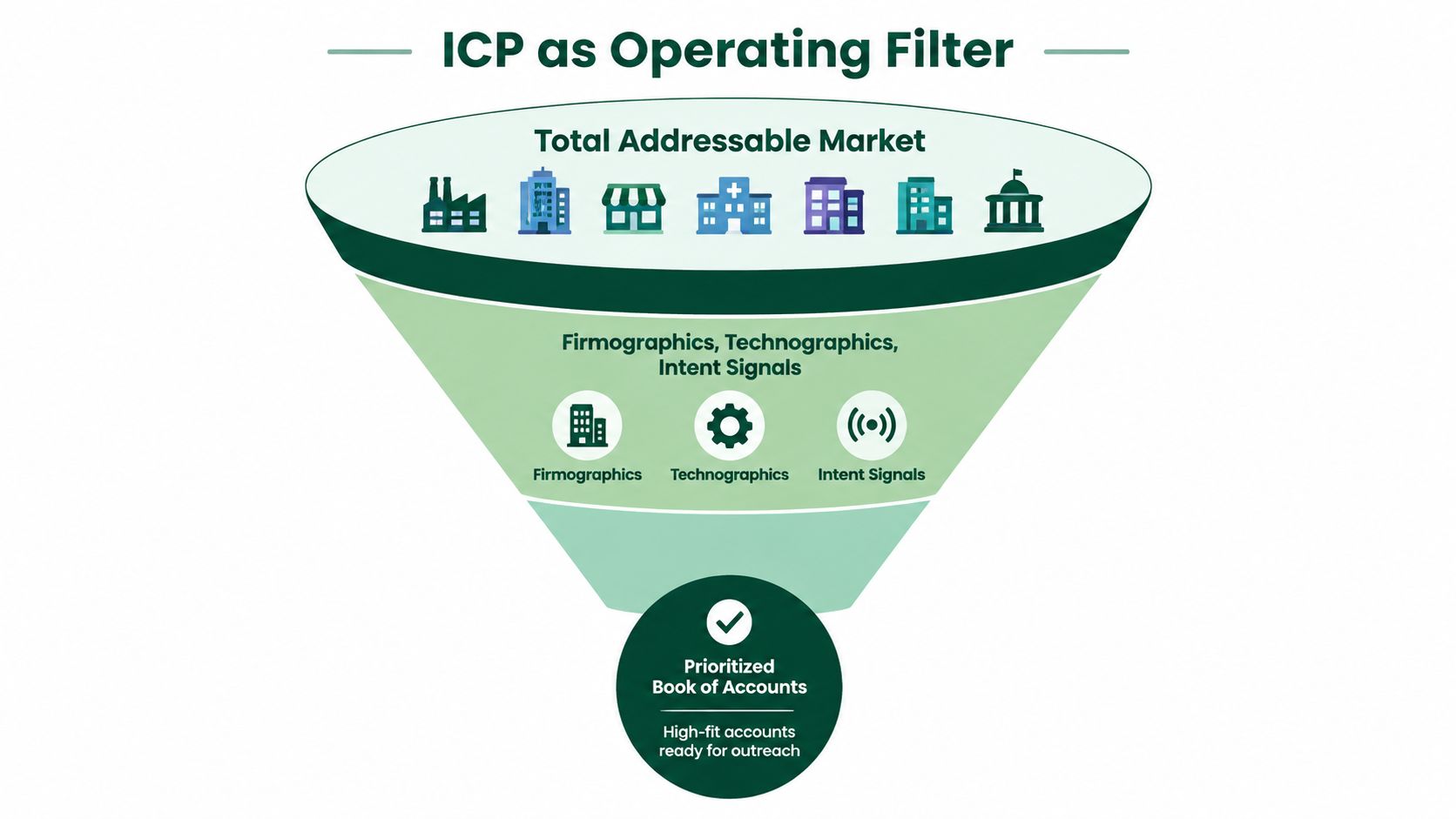
A usable ICP combines firmographics, technographics, buying committee structure, and trigger conditions. Firmographics might include industry, operating geography, business model, and organizational scale. Technographics identify the systems that create compatibility or urgency. Buying committee mapping clarifies whether the first contact should be an economic buyer, functional owner, technical evaluator, or internal champion.
The negative criteria matter just as much. Add disqualifiers for unsupported regions, incompatible technology, low-complexity use cases, regulatory constraints you can't serve, and accounts already owned by another team. Without those rules, reps interpret “good fit” differently and fill the CRM with accounts that look attractive but fail qualification.
Turn the ICP into rep-level rules
An ICP becomes operational when a rep can apply it quickly. Give each account a tier, a score, a segment, and a motion.
Tier one: Named accounts receive research, signal monitoring, multi-threaded outreach, and AE involvement.
Tier two: Strong-fit accounts enter structured email and LinkedIn sequences with lighter research.
Tier three: Lower-priority accounts receive scalable nurture or content-led engagement.
Disqualified: Accounts stay suppressed until a meaningful business condition changes.
The B2B buyer persona framework can help document stakeholder responsibilities, but the ICP must still determine which accounts enter active prospecting. A weak filter damages pipeline velocity because reps spend time on low-fit companies that reply, book, and then stall during discovery.
Building and Verifying the Prospecting List
A prospecting list is useful only when it survives three tests: the account fits, the contact is valid, and the record is safe to activate. Treat list building as data operations, not a one-time export.
Use Apollo as a recommended data layer for firmographics, contact discovery, and enrichment, then add specialist sources where coverage is incomplete. Enrich more than company size. Capture role, seniority, department, technology environment, hiring activity, geography, and account ownership. A revenue leader at a company hiring sales operations staff belongs in a different cohort from a similarly titled leader at a stable account with no visible change.
Build the record before writing the message
A workable contact record should answer four questions:
Why this account: Which ICP criteria does it match?
Why this person: What responsibility connects the contact to the problem?
Why now: What recent event or behavior creates a credible opening?
What next: Which channel and offer should the rep use?
Then verify the data. Run an email verification pass, check that the role still exists, confirm the person hasn't moved companies, and deduplicate against the CRM. CRM matching protects domain reputation and prevents two reps from approaching the same stakeholder with conflicting messages.
Data rule: Never let a rep discover a duplicate or invalid contact after a sequence has already started.
Segment the working list by account tier, industry, trigger, buying stage, or territory. Each cohort should have its own offer and cadence. A recently appointed operations leader may need a trigger-led insight, while an established technical evaluator may respond better to a capability or proof-oriented conversation. The right-prospects-at-the-right-time toolkit is useful for formalizing that distinction.
Keep the active list small enough for one rep to research, contact, follow up, and update properly within a working week. Refresh it routinely rather than allowing stale contacts to accumulate. When the list is clean and segmented, signals can determine timing instead of forcing every account into the same blast.
Signal-Driven Outreach Versus Static Blasts
Static outreach starts with a list and asks every account the same question. Signal-driven outreach starts with fit, then looks for evidence that a relevant business condition has changed.
Useful signals include first-party website and product activity, third-party topic research, LinkedIn engagement, hiring, funding, technology installations, leadership changes, and regulatory filings. Apollo's intent data guidance describes intent as digital behavior such as content consumption, search activity, review-site visits, and web interactions aggregated at the account level.
The important distinction is that intent doesn't replace ICP fit. A poor-fit company displaying interest remains a poor-fit company. Signal scoring should sit on top of account fit, contact relevance, and account ownership.
Dimension | Static List Outreach | Signal-Driven Outreach |
|---|---|---|
Targeting | Based on stored account criteria | Based on fit plus recent behavior or trigger |
Timing | Calendar-driven | Trigger- and recency-driven |
Message | Broad segment relevance | Specific business context |
Operations | Easier to launch | Requires orchestration and suppression |
Risk | Wasted touches and low relevance | More complexity and incomplete coverage |
Best use | Broad market coverage | Priority accounts and active buying windows |
Recency changes the economics
Apollo's practical guidance cites a 72-hour rule, ignore signals older than 72 hours and ignore activity that isn't clearly tied to the problem you solve. That rule creates a useful operating threshold. A website visit from last week may support nurture, while a relevant engagement from yesterday may justify direct outreach.
For LinkedIn engagement signals, Trigify can serve as a capture layer. For identifying website visitors, Whitewhale can add account context before a rep chooses a message. Signal-personalized outreach has reached 15% to 25% reply rates in benchmark reporting, compared with the typical cold email range, according to 2026 outbound benchmarks.
The trade-off is operational. Signals create duplicates, conflicting triggers, and suppression requirements. Someone must decide which signal wins, whether an existing opportunity blocks outreach, and how quickly the account enters a sequence. Before scaling volume, assign ownership for signal operations and document the routing logic.
Sequencing Across Email and LinkedIn Channels
A multi-channel sequence should coordinate channels without making the prospect feel chased by a machine. Start with infrastructure. Use warmed inboxes, per-rep sending limits, domain-level throttling, and clear stop rules when someone replies, unsubscribes, or enters an opportunity.
Instantly is a practical option for email warming, inbox rotation, and sequence operations at scale. For LinkedIn automation across multiple accounts, HeyReach can coordinate connection and message steps while teams maintain conservative account-level limits.
A straightforward operating pattern is a 3-touch email cadence over 10 days, paired with 2 LinkedIn steps timed around the email touches. Tier one accounts can add a voicemail or SMS fallback when the contact data and local rules support it. The point isn't to multiply activity indiscriminately. Each touch should add context, answer a likely objection, or offer a low-friction next step.

Email and LinkedIn should reinforce one another. A profile visit can provide context for an email, while an email can give a connection request a clear reason to exist. The best time to post on LinkedIn is a useful planning reference when social content supports the outreach motion, but posting time won't fix weak targeting.
Protect the sending motion
Set up SPF, DKIM, and DMARC correctly, throttle sends by domain, monitor bounces, and stop sequences immediately after a reply. A 2024 test across 15 major sending platforms found average email deliverability of 83.1%, meaning about 16.9% of messages never reached the inbox, according to cold email deliverability testing. Copy can't recover a message that filtering prevents the buyer from seeing.
A longer cadence also matters. Analysis of more than 20 million cold emails found 4 to 7-message sequences generated about a 27% reply rate, versus roughly 9% for 1 to 3-message sequences, while at least one follow-up lifted average reply rate from about 9% to 13%, as reported in sales follow-up analysis. Use persistence with relevance, not repetition.
The complete follow-up guide helps translate the cadence into practical message timing and templates.
Routing Qualified Meetings to the Right Reps
A booked meeting isn't pipeline. It's an unprocessed event that needs ownership, context, and a next action.
Use round-robin routing for standard inbound meetings when SDR capacity is broadly interchangeable. Use territory or account-based routing for AE assignment when geography, segment, language, or existing ownership affects conversion. Named-account handoffs deserve a dedicated team because strategic accounts often require coordinated access to several stakeholders.
Qualification should happen during the meeting, not in a later administrative queue. A BANT, MEDDIC, or hybrid framework can work, but the criteria must be explicit. The rep should capture the business problem, relevant authority, urgency, current approach, evaluation process, and agreed next step.

Make the handoff auditable
For inbound, set a contact-within-5-minutes SLA. For signal-driven outbound, use a 24-hour response window. These thresholds are operating standards for the process, not universal performance claims. What matters is that the clock starts automatically, the owner is visible, and missed SLAs trigger review rather than disappearing into a dashboard.
The handoff record should include:
CRM stage update: Record whether the meeting is booked, held, qualified, or recycled.
Opportunity owner: Assign one accountable AE or account team.
Account context: Preserve the ICP fit, trigger, message, and stakeholder map.
Calendar next step: Book the next meeting before momentum fades.
Shared channel: Use Slack or email for active coordination during the first 30 days of a strategic motion.
Every routed meeting should produce an opportunity, a documented nurture reason, or a disqualification reason within 7 days. That checkpoint prevents calendar volume from masquerading as pipeline and gives RevOps a clean basis for inspecting list quality, qualification, and routing.
Metrics and SLAs That Move Pipeline Velocity
Pipeline velocity is the downstream scoreboard for prospecting decisions. Track the four joints separately: meetings booked, show rate, opportunity conversion, and cycle time from qualified opportunity to closed-won.
Each metric points to a different upstream lever. More meetings can come from better list coverage, signal accuracy, and sequence throughput. Better show rates usually reflect qualification discipline, confirmation, and the buyer's understanding of the meeting. Opportunity conversion depends on discovery quality and the context transferred from the prospector. Cycle time improves when the team multi-threads early and agrees on a mutual action plan.
Metric | Upstream Lever | SLA / Threshold |
|---|---|---|
Meetings booked | ICP coverage, valid contacts, signal quality, sequence execution | Review by cohort and channel |
Show rate | Qualification, confirmation, clear agenda | Recycle no-shows weekly |
Opportunity conversion | Discovery preparation, stakeholder context, qualification | Qualified discovery within 48 hours |
Sales cycle time | Multi-threading, next steps, mutual action plan | Inspect stalled stages weekly |
Set an explicit 24-hour speed-to-lead SLA from form fill to first touch and a 48-hour SLA from meeting booked to qualified discovery. These are useful control points because they attach accountability to the seams where work changes hands. Assign each SLA to one owner and store status in one CRM source of truth.
Measure quality, not just motion
One 2026 benchmark reports that 58% of sequence replies come from the first email, while 42% come from follow-ups, showing why the full cadence needs measurement, as detailed in outbound sequence benchmarks. Track positive replies separately from out-of-office messages, unsubscribes, and irrelevant responses. Reply volume alone can reward the wrong behavior.
A landing page can also affect post-click conversion. For practical guidance on aligning a page with an offer and its buyer journey, see Orchory's developer landing page advice. Then connect page behavior back to the same account and campaign fields used in outreach.
Use sales pipeline reports to review performance by segment, trigger, rep, channel, and message. When a threshold slips, investigate the root cause at the nearest upstream joint. Doubling activity is rarely the first fix. A cleaner list, faster routing, or stronger qualification may produce more usable pipeline without increasing volume.
Common Misconceptions About Modern Prospecting
The persistent myth is that more personalization or more volume solves weak outbound. In 2026, both are easy to generate. Targeting precision and timing are harder, and they matter more.
A beautifully personalized message sent to an account outside the ICP still fails. It may take longer to produce, but it doesn't create a stronger buying case. The same applies to volume. Sending more messages through a weak data set increases the number of irrelevant contacts, raises deliverability risk, and gives reps more low-fit meetings to process.
Buyer trust adds another constraint. Independent industry coverage reports that 64% of buyers can identify AI-generated outreach within the first sentence, while average cold email reply rates remain around 3.43% to 4.2%, and only about 1.5% of replies represent positive interest after opt-outs and other non-buying responses are excluded, according to AI outbound and lead generation coverage. AI is useful for research, drafting, and pattern detection, but it shouldn't operate as an autonomous replacement for human judgment.
Sequences are the visible layer
The sequence is often the easiest part to inspect, so teams blame copy when the system fails. Causes usually sit upstream.
ICP weakness: Reps target accounts that cannot become viable customers.
Data decay: Invalid roles and duplicate records reduce trust and deliverability.
Signal gaps: Outreach arrives without a credible reason or arrives after relevance has faded.
Routing friction: A meeting is booked but no owner receives the context quickly.
SLA failure: The team can't tell who must act or when the next step is due.
Prospecting works when these parts operate as one machine. The Social Search builds and runs outbound systems that connect ICP definition, data, messaging, email and LinkedIn operations, signal-driven routing, and reporting for B2B teams selling into APAC and global markets. If your team needs to replace disconnected activity with an owned prospecting system, visit The Social Search to discuss an ICP, data, sequencing, and pipeline workflow built around your sales process.
