Go to Market Consulting for B2B Outbound Systems
Learn what go to market consulting delivers for B2B outbound, from engagement models and deliverables to evaluating consultants who build systems you own.
Most go-to-market consulting advice starts in the wrong place. It treats the engagement as a strategy exercise, produces a positioning deck, defines a few channels, and assumes the client will somehow convert those decisions into pipeline. That assumption fails in B2B outbound because pipeline depends on hundreds of operational choices made after the workshop, from list quality and sender reputation to routing, follow-up, rep behavior, and reporting.
Go-to-market work has always had a larger commercial footprint than a narrow sales tactic. A survey of managers at leading consumer-goods companies found that 82% considered go-to-market activities a corporate priority, while the activities themselves, including pricing, trade spending, marketing, advertising, and sales, could represent as much as 40% of total costs. The original go-to-market research helps explain why serious consulting engagements need to connect commercial design with execution.
The practical question isn’t whether a consultant can explain your market. It’s whether your team can keep generating qualified conversations after the consultant leaves.
Table of Contents
Why Most Go to Market Consulting Fails After the Engagement Ends
The Technical Foundations That Determine Outbound Performance
Why Most Go to Market Consulting Fails After the Engagement Ends
The most common failure is an execution vacuum after the engagement ends. Independent GTM coverage identifies the gap between advice and results as a central complaint in the category, and that diagnosis matches what happens inside many B2B teams. The consultant delivers recommendations, the client receives a collection of tools and documents, and nobody owns the operating rhythm that turns those assets into repeatable pipeline. This analysis of go-to-market strategy consultants describes that vacuum directly.
A strategy deck can clarify positioning, but it can’t maintain a prospect database, monitor inbox placement, classify replies, or train a new SDR. Those jobs require defined owners, documented procedures, and a reporting layer that shows what happened from target account to qualified opportunity. Without those elements, the company usually ends up with fragmented tools, inconsistent execution, and a pipeline forecast based on activity rather than evidence.
The handoff test: If the client can’t operate the system with its own credentials, documentation, and decision rules, the consultant hasn’t finished building the system.
The deck is not the product
A useful engagement treats strategy as an input to system design. The consultant still needs to clarify the market, segment buyers, shape the offer, and define the commercial motion. But each decision must become an operating artifact.
That means a segment becomes a prioritised account list. A persona becomes a set of role-specific messages. A channel recommendation becomes a configured workflow with limits, ownership, and exception handling. A reporting goal becomes a dashboard that connects activity to meetings, opportunities, and pipeline sources.
Go-to-market consulting overlaps with revenue operations consulting. The work isn’t limited to marketing language or sales scripts. It includes the data model, workflow logic, system permissions, handoff definitions, and feedback loops that allow commercial teams to execute consistently.
What breaks when ownership stays vague
The first breakdown usually appears in list quality. Marketing assumes sales will refine the accounts, sales assumes marketing will provide usable data, and neither team has a process for recording why a prospect was rejected or why a message earned a response.
The second breakdown is message drift. Reps alter sequences without recording the change, different teams describe the offer differently, and the company loses the ability to distinguish a weak segment from a weak message.
The third is measurement. A dashboard may show sent emails and booked meetings, but not the list, signal, message, or channel that created each opportunity. Once the consultant leaves, the team can see movement without knowing what to repeat.
A transferable engagement solves these problems before departure. It leaves behind a working commercial machine, not a set of recommendations that depends on the original author being available to interpret them.
The Connected Machine Behind Effective GTM Engagements
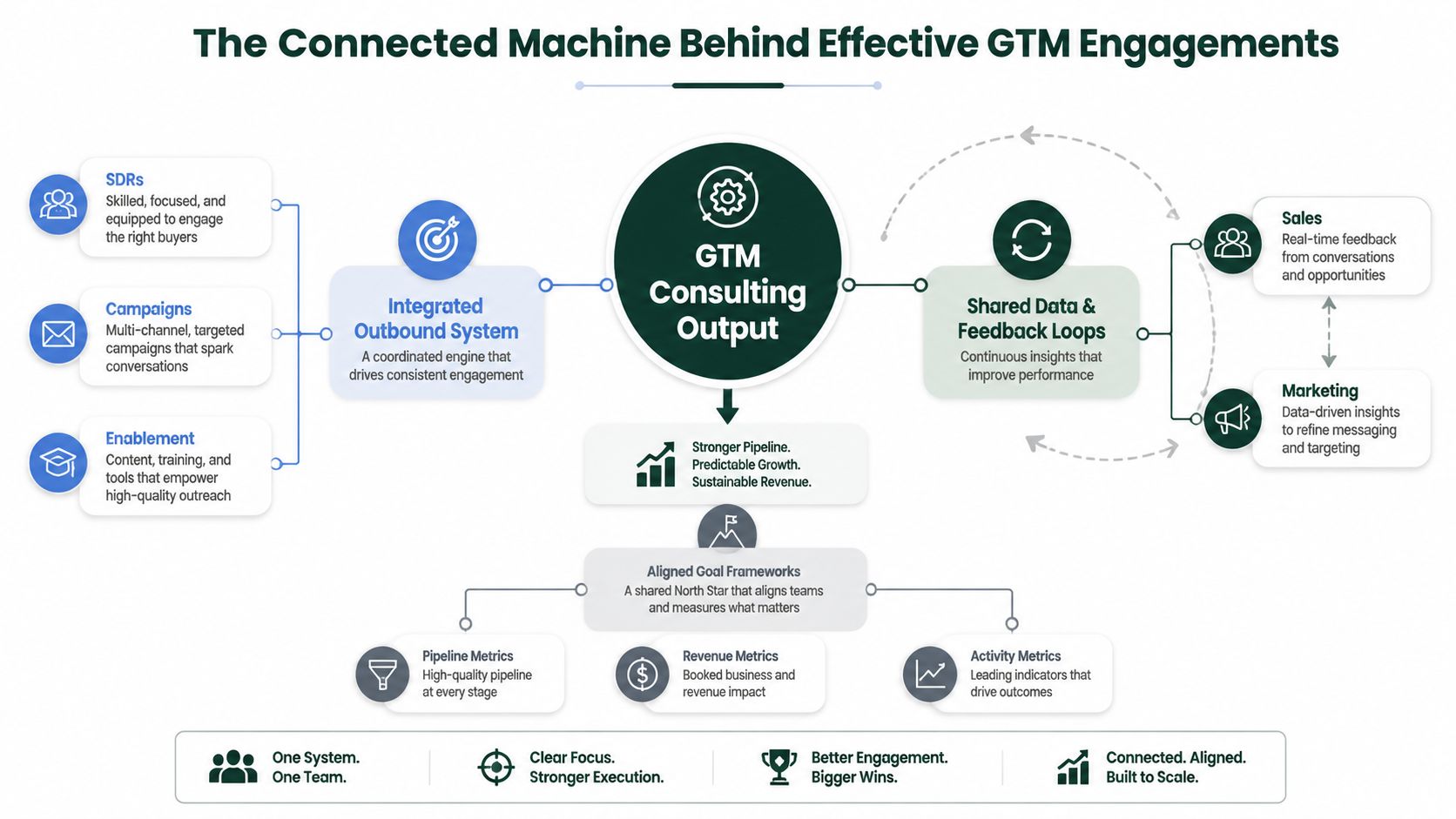
Effective outbound resembles a connected machine more than a campaign. The parts are distinct, but none works in isolation. ICP decisions affect data requirements, data quality affects personalisation, personalisation affects response quality, and response data should update the next targeting decision.
Start with an ICP that changes decisions
An ICP is useful only when it changes resource allocation. If it merely describes an attractive company, it isn’t precise enough for outbound. A practical ICP should identify the account characteristics, business conditions, roles, pain patterns, and buying signals that determine whether a prospect belongs in the active market.
That precision remains a major weakness. A 2026 GTM confidence survey found that one in three B2B leaders couldn’t define their ICP precisely enough to change sales and marketing resource allocation. The GTM Confidence Index 2026 supports a more operational view: ICP definition should be revised when response data, buying signals, or channel feedback show that the current targeting model no longer reflects the market.
Connect data to messaging
The account list should contain enough information to explain why an account is relevant now, not just who works there. Enrichment can add firmographic context, role information, technology indicators, and other fields that support a defensible outreach angle. Apollo’s data and prospecting platform is one option for building and enriching regional account lists when the engagement requires a repeatable data workflow.
Messaging then needs to reflect the segment and trigger. A generic sequence asks the recipient to interpret the relevance. A system-led sequence gives the rep a reason for contacting that account, a relevant problem to test, and a clear response path.
Make reporting explain causality
A connected dashboard shouldn’t stop at volume. It should show which accounts entered the system, which data source or signal qualified them, which message they received, how they responded, and whether the conversation became an opportunity.
That structure creates a feedback loop between sales and marketing. Rejected accounts improve the ICP, positive replies reveal stronger language, objections inform enablement, and channel performance influences future resource allocation. Go-to-market consulting earns its keep when those loops keep functioning without the consultant manually interpreting every result.
Project Builds Versus Fractional GTM Leadership
Project builds and fractional GTM leadership address different operating needs. A build creates the foundation and reaches a defined handoff point. A fractional lead owns the motion while the team learns, tests, and improves it.
A project build fits a company with a credible market hypothesis but no dependable outbound infrastructure. The engagement can define the ICP, prepare account lists, configure channels, launch initial sequences, and document the operating model. That approach suits a new outbound motion, a product launch, or expansion into APAC, where existing assumptions may not transfer cleanly.
The handoff is the critical test. A system that launches successfully but has no internal owner becomes shelfware as soon as the consultant leaves.
Fractional leadership fits a company that already has activity but lacks a senior operator to run the function. Deliverability requires monitoring, messaging needs iteration, reps need coaching, and management needs a consistent view of pipeline drivers. A fractional lead makes those decisions as part of the operating rhythm rather than turning every adjustment into a new consulting project.
Criteria | Project Build | Fractional GTM Lead |
|---|---|---|
Primary purpose | Establish the system and operating foundation | Run, improve, and coordinate the GTM function |
Time horizon | Defined scope with a handoff point | Ongoing embedded support |
Speed to launch | Fast when the ICP and offer are sufficiently clear | May begin with diagnosis before operating |
Ownership transfer | Central deliverable | Gradual transfer through coaching and documentation |
Best fit | New outbound motion, launch, or market entry | Active motion requiring iteration and management |
Main continuity risk | Team may not maintain the system after handoff | Dependency can persist if ownership isn’t deliberately transferred |
Match the engagement model to sustainable ownership
A project build only works when someone inside the company can run what was created. Fractional leadership only works when the client has an offer and market hypothesis that the operator can test and improve. An embedded lead cannot resolve foundational ambiguity by taking on permanent operational responsibility.
The deciding factor is operating capacity, not company size. A revenue leader who can own weekly reviews, rep enablement, and system maintenance may need only a build. If those responsibilities have no named owner, ongoing leadership is the more accurate engagement model.
Companies comparing embedded options can review bespoke consulting leadership options from Starward Navigators for a broader view of fractional executive support. For a specialised operating model, fractional GTM lead engineering treats outbound as a combined sales development and revenue operations responsibility.
Define the exit before the start
Every project proposal should specify the handoff conditions. Name the owner for each tool, the person who approves targeting changes, the reviewer for performance, and the conditions that trigger a pause or rebuild.
The documentation should also show how recurring work gets done. That includes review cadence, maintenance tasks, escalation paths, and the decisions the internal owner must make without consultant input.
Fractional engagements need the same discipline. The consultant should train internal owners, record recurring processes, and set a transition path before the relationship becomes the only source of operational knowledge. Continuity should preserve capability, not create dependency.
Deliverables That Survive the Consultant Departure
When evaluating proposals, look for the operating assets behind labels such as “GTM strategy,” “sales enablement,” and “outbound setup.” The practical test is simple: Could a new team member run the process from the materials provided? If not, the engagement has produced recommendations rather than operating capability.

The core handoff package
A durable handoff package should contain:
Documented ICP: Record inclusion and exclusion rules, priority segments, buyer roles, account fields, and the evidence supporting each assumption.
Prioritised account and lead lists: Preserve the source, enrichment logic, qualification status, and reason each account sits in its tier.
Messaging framework: Document the offer, buyer problem language, proof points, objection responses, calls to action, and segment-specific variants.
Live sequence library: Store approved email and LinkedIn sequences with audience rules, timing logic, ownership, and pause conditions.
Sending infrastructure: Configure authentication, domains, mailboxes, warm-up procedures, suppression rules, and monitoring responsibilities.
Signal routing rules: Specify which triggers create outreach, who receives each task, the response window, and when a signal expires.
Pipeline dashboard: Connect activity to meetings, qualified opportunities, and pipeline using consistent definitions and source fields.
Rep enablement playbook: Give reps call preparation, reply classification, follow-up guidance, escalation paths, and practice exercises.
Sales enablement works only when it is built into the daily workflow. A practical sales enablement guide should help reps use the systems, messages, and response rules they rely on during live outreach.
Ownership must be contractual
The client should own the infrastructure, accounts, documentation, data, and playbooks. A consultant can configure the tools, but should not remain the only person with access to the sending environment or the logic governing the workflow.
The handoff also requires a live operating session. Written instructions rarely expose where a rep hesitates, which field causes confusion, or which exception the process fails to cover. Have the internal owner run the system while the consultant observes, then revise the documentation around the actual gaps.
Measure the handoff itself
A proper transition includes supervised operation, an unresolved-issues log, and a recurring review cadence. The client should be able to identify who checks deliverability, updates the ICP, reviews replies, and reconciles pipeline attribution.
Those responsibilities need named owners and documented procedures. Otherwise, the engagement transfers knowledge without transferring the ability to generate pipeline independently.
The Technical Foundations That Determine Outbound Performance
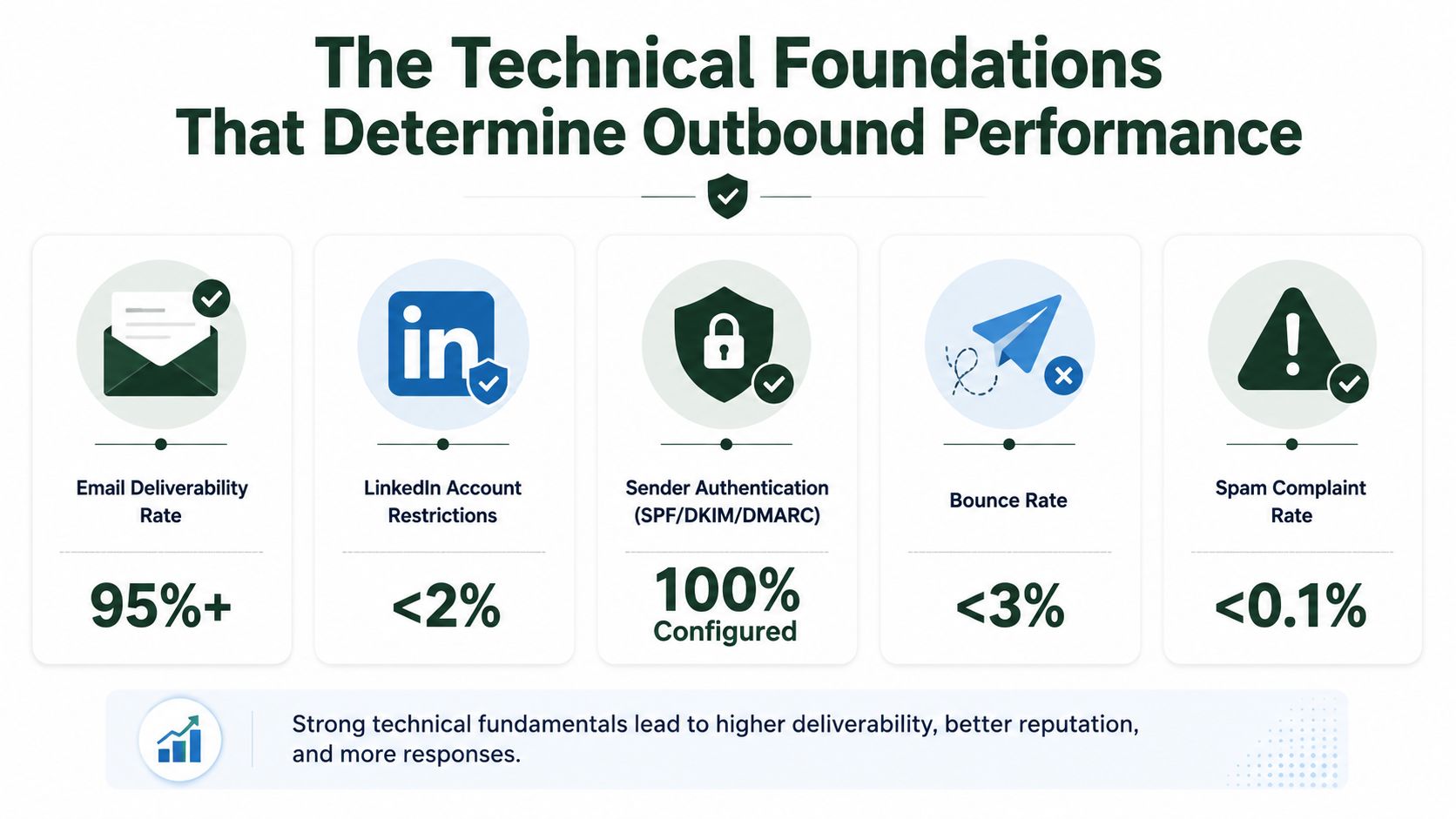
A strong offer won’t create pipeline if the channel can’t reach the buyer. Cold outbound performance is constrained by deliverability, and 2026 benchmark summaries place global inbox placement around 83.5% to 86%, spam placement around 6.7% to 7%, and spam complaints near 0.07%. The 2026 B2B outbound benchmark summary also treats inbox placement below 85% as a deliverability problem that should be fixed before reply rates are judged.
That changes the order of operations. A consultant shouldn’t launch a large sequence, observe weak replies, and immediately rewrite the copy. First verify sender authentication, list hygiene, bounce control, complaint handling, mailbox health, and placement. A response problem may be a targeting or message problem, but it may also be a technical visibility problem.
Warm up gradually
Email warm-up guidance recommends starting at 5% to 10% of a provider’s daily sending limit and increasing volume slowly after reputation stabilises. The same guidance lists daily limits of 500 emails for Gmail web users, 2,000 for Google Workspace users, 10,000 for Office 365, and 5,000 for Outlook.com. This email warm-up guide provides the provider-specific context.
Those limits aren’t targets for cold outreach. They are constraints that shape a safe ramp. A consultant should configure conservative volumes, monitor placement and complaints, and document when to pause a mailbox rather than treating warm-up as a one-time switch.
Instantly fits this part of the stack because it can support mailbox rotation, warm-up, sequencing, and campaign management. The important point is configuration and ownership. A tool recommendation without documented sending rules leaves the client exposed.
Pace LinkedIn activity
LinkedIn doesn’t publish fixed hard limits for most outreach actions. Practitioner guidance commonly treats 15 to 25 connection requests per day as a safe range for established accounts, with approximately 100 to 150 requests per week as a practical ceiling. New or reactivated accounts are commonly given a 14-day warm-up before automation begins. HeyReach’s guidance on safe LinkedIn automation explains why account age, pacing, and weekly caps belong in the workflow.
HeyReach can support LinkedIn sequencing, but automation doesn’t remove the need for conservative pacing, relevant targeting, and human review of replies.
Voice channels can also form part of a broader outbound motion when the use case supports them. Teams evaluating that layer may find Voicedial.ai’s AI outbound guide useful for understanding where AI calling fits alongside email and LinkedIn.
Technical health should be tracked in the same operating environment as commercial performance. A practical reference on email delivery platforms helps teams evaluate infrastructure choices without confusing sending capacity with actual inbox reach.
How to Evaluate a GTM Consultant for B2B Outbound
A polished framework does not prove that a consultant can create pipeline. The useful test is operational: can the operator show how a target account becomes a qualified opportunity, then leave your team able to run that process without them?
Ask these questions before signing:
Who owns the infrastructure? The client should control access, credentials, billing, sending domains, account data, and documentation. Transfer those assets during the engagement, not at an uncertain later date.
How is the ICP updated? Look for a process that incorporates rejected accounts, reply categories, buying signals, and channel feedback. A static workshop document cannot guide targeting once real conversations begin.
What gets measured? Lists, signals, messages, meetings, opportunities, and pipeline should connect within one reporting model. If those records sit in separate tools without consistent fields, attribution becomes guesswork.
How are messages changed? Strong operators define useful evidence, record copy changes, test them, assign approval, and preserve a rollback path.
What happens after handoff? Expect a named internal owner, training, recurring reviews, escalation rules, and a maintenance schedule. The handoff should transfer working knowledge, not just files.
Red flags in the proposal
A consultant who will not share sending infrastructure credentials creates operational risk. The same applies when the account list, workflow logic, or dashboard remains in a private environment the client cannot access.
An ICP delivered as a polished document, without revision criteria, is another warning sign. B2B leaders often find that an initial targeting assumption is too broad only after prospects respond. The consultant should specify what evidence changes the segment, persona, message, or channel, and who approves that change.
Activity-only reporting also deserves scrutiny. Sent volume, connection volume, and booked meetings show work completed, but they say little about pipeline quality. The dashboard should trace each opportunity to its source list, signal, message, and owner. That trace is what lets the internal team diagnose performance after the engagement ends.
Look beyond outbound mechanics
Outbound contributes to market visibility, but buyers may also research vendors through search or AI-assisted discovery. Ask how those signals influence account selection, messaging, and follow-up. Agencies and consultancies assessing that channel can review AI search visibility for agencies for a relevant perspective on discoverability.
End the evaluation with a working session rather than another presentation. Give the consultant a real segment, a sample account, and messy CRM data. Ask for the next action, owner, measurement, and handoff record. Their reasoning under imperfect conditions reveals more than a generic methodology slide, especially when the goal is a system your team can maintain independently.
Building Your Outbound System for APAC and Global Markets
APAC expansion exposes weak GTM systems quickly. Data coverage, buying signals, channel preferences, language, and sales cycles can differ across markets, so a North American account list and sequence shouldn’t be copied without validation.
A practical build starts with a regional ICP, then uses Apollo for enrichment, Trigify for social signals, and Whitewhale for intent signals where those sources fit the market. SearchAtlas and Outrank can support technical SEO and content that capture demand alongside outbound. For messaging automation across WhatsApp or social conversations, Respond IO and Manychat may be relevant when the audience and consent model support those channels.
The decision framework is straightforward. Clarify the ICP, build and test the system, document every recurring task, then choose project support or fractional operation based on internal ownership. Revise the ICP when response patterns, buying signals, or channel feedback change the targeting decision, not on an arbitrary calendar. Attribute pipeline by preserving source fields from account selection through opportunity creation, and use rep training to make the handoff operational rather than theoretical.
Teams without internal SDR capacity can also assess outsourced SDR services, provided the provider works inside a client-owned system and documents the process.
The Social Search designs and runs B2B outbound systems that connect ICP definition, data, messaging, sending infrastructure, signal routing, reporting, and rep enablement for APAC and global markets. If you need a system your team can own after the engagement, visit The Social Search to discuss a project build or fractional GTM leadership option.
