What Is a Sales Playbook: Your Complete Guide
What Is a Sales Playbook. Learn what a sales playbook is, its core components, how to build one, and why your outbound team needs it
A rep opens the CRM, selects a prospect list, and starts an email sequence. The account looks close enough to the target market, but nobody has clarified which buyer matters, what problem deserves attention, or what the rep should do after an objection. A few messages go out, replies arrive inconsistently, and the team can't tell whether the issue is targeting, positioning, timing, or execution.
That's the situation a sales playbook is meant to fix. What is a sales playbook? It's the operating guidance that turns a sales strategy into repeatable actions, from choosing accounts and starting conversations to handling objections, progressing opportunities, and learning from results. For teams building outbound across APAC and global markets, it should connect ICP definition, data, messaging, channels, routing, and coaching rather than sit as an isolated document.
If cold email is part of the motion, Instantly for cold email sequencing and deliverability can support the sending workflow. For LinkedIn outreach, HeyReach for LinkedIn automation fits the channel layer, while Apollo for data enrichment helps reps work from more complete account information. These tools are useful only when the playbook tells sellers who to contact, why now, what to say, and what action follows.
Table of Contents
Why Most Reps Guess When They Should Follow a System
A revenue leader sees two reps receive the same account list. The first rep searches the company website, writes a generic introduction, and sends a sequence that mixes product features with a vague request for time. When the prospect replies, “We already have a solution,” the rep improvises again. The opportunity drifts because nobody defined the next conversation.
The second rep opens a segment-specific play. It identifies the likely buyer, the business trigger, the relevant pain, the approved opening message, and the questions that qualify urgency. The rep still adapts the wording, but the adaptation happens inside a clear structure. That distinction matters because repeatability doesn't remove judgment, it gives judgment a useful boundary.

Improvisation creates hidden dependency
Without a shared system, strong performance often lives inside individual memory. One experienced rep knows which industries respond, which objections signal genuine interest, and which internal resources help a buyer make a decision. New hires inherit fragments through shadowing, private notes, and scattered conversations.
That creates three operational problems:
Inconsistent execution: Each rep interprets the ICP, offer, follow-up timing, and qualification standard differently.
Weak coaching: Managers can tell a conversation went poorly, but they lack a common reference for diagnosing the exact step.
Fragile continuity: When a rep leaves, the team loses context that was never documented in a usable form.
A practical RoverLead AI lead qualification playbook can help teams make qualification criteria more explicit, especially when reps need a consistent way to decide whether a conversation deserves progression. The same principle applies to the broader outbound motion. Reps shouldn't memorize a script, but they should know the conditions that make a play relevant and the evidence required for a next step.
Consistency is not micromanagement
A playbook doesn't require every seller to sound identical. It establishes the minimum quality standard for targeting, preparation, discovery, follow-up, and handoff. A rep can personalize the message while still using the approved positioning, qualification logic, and escalation path.
That's also why the sales development representative role, skills, salary, and career path matters operationally. The role depends on judgment, but judgment improves when the team defines what good work looks like. A playbook replaces tribal knowledge with shared context, so reps spend less time guessing and more time having relevant buyer conversations.
What a Sales Playbook Actually Contains
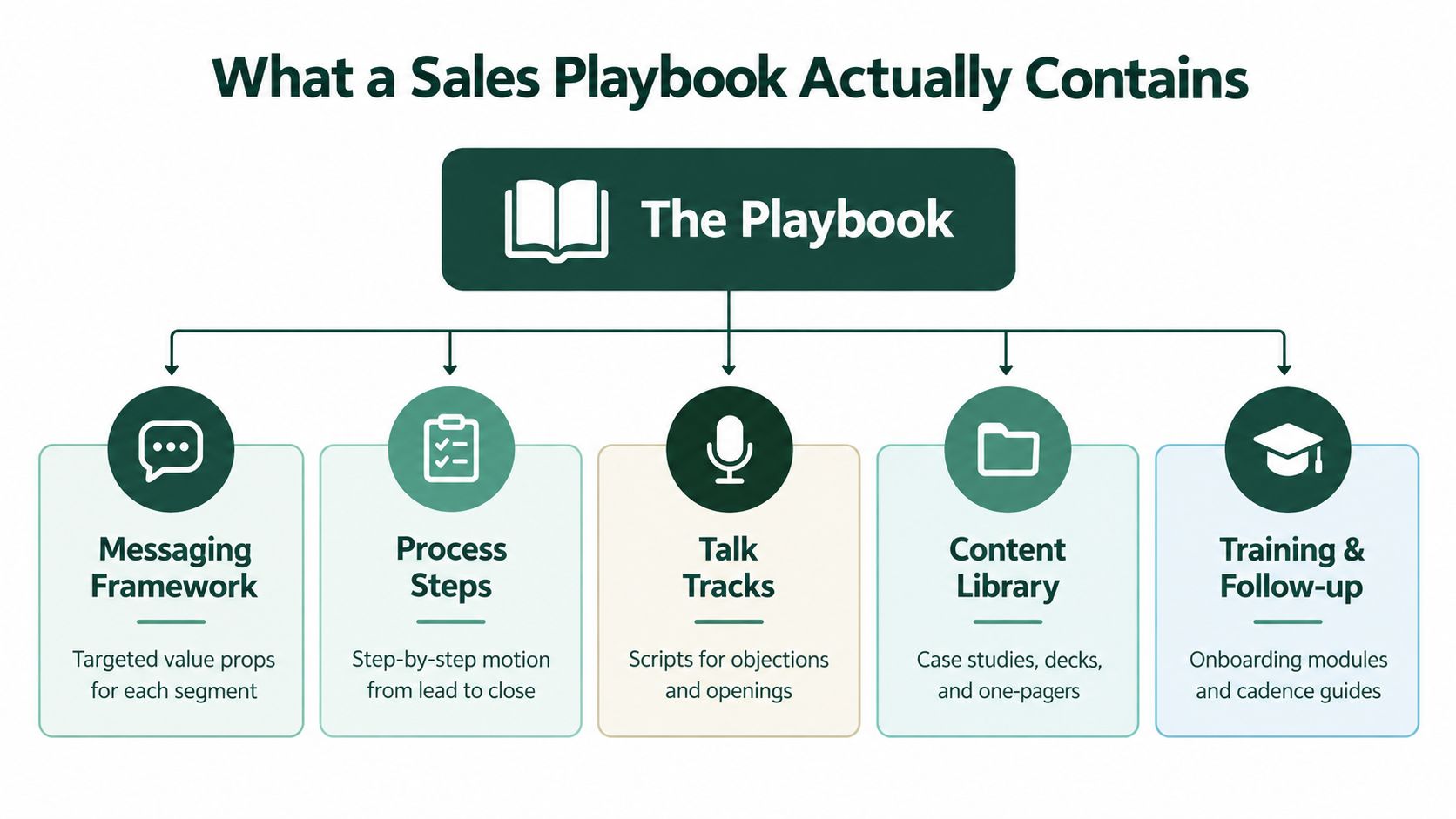
A sales playbook is the operational manual for a sales team. It consolidates strategy, process, scripts, messaging, objection handling, buyer personas, and stage-by-stage guidance into one repeatable system, as described in LinkedIn's definition of a sales playbook. The strongest versions connect each asset to a situation rather than placing every document in one folder.
The five working components
1. Ideal Customer Profile
The ICP defines which accounts deserve attention and why. It should include firmographic fit, operating context, relevant use cases, likely buyer roles, disqualifying conditions, and signals that indicate a timely problem. A broad description such as “B2B technology companies” gives a rep little direction. A useful ICP distinguishes the segment where the offer has a credible business case from the segment where outreach will create noise.
2. Segment-aligned messaging
Messaging translates positioning into language a buyer can recognize. Each segment needs a clear problem statement, value proposition, proof guidance, call to action, and channel adaptation. An operations leader may care about workflow control, while a revenue leader may care about pipeline visibility. The playbook should explain those differences without forcing reps to invent a new pitch for every account.
3. Stage-by-stage process guidance
The process maps the motion from prospecting and qualification through discovery, demo, negotiation, close, and expansion. Each stage needs an objective, required seller actions, buyer evidence, exit criteria, and a defined next step. Highspot's sales playbook guidance describes the playbook as a way to bring messaging, process steps, talk tracks, content, training, and follow-up guidance into execution.
4. Objection handling
Objection guidance should not be a list of clever replies. It should help reps identify what the objection means, ask a clarifying question, respond with relevant evidence, and establish a next action. “We're not changing this year” might indicate a timing issue, a missing business case, or a polite rejection. Those situations require different responses.
5. Adaptable templates
Templates give sellers a starting point for cold emails, call openings, LinkedIn messages, meeting recaps, and follow-ups. They work when they include the reason for the message and the conditions for using it. They fail when reps copy them word for word without checking the account, segment, trigger, or buyer role. A useful B2B sales collateral guide helps clarify how assets should support a sales conversation rather than become a disconnected content archive.
Together, these elements create a decision guide. The rep should be able to answer four questions quickly: Where am I in the motion? Who am I speaking with? What matters to that buyer? What should happen next?
How to Build a Sales Playbook from Scratch
Start with the commercial problem, not the document format. If discovery quality is inconsistent, begin with discovery plays. If outbound targets are poorly defined, begin with the ICP and account prioritization. A first version should solve a visible execution problem and give reps something usable, not attempt to document every possible selling situation.

Start with accounts and buyer context
Define the ICP before writing an email. Identify the account attributes that indicate fit, the buyer roles involved, the use cases that matter, and the signals that justify outreach. Then prioritize accounts using information the team can access and maintain.
Enrichment supports this step, but it shouldn't replace judgment. Apollo's enrichment workflow can help fill gaps in account and contact data, while the playbook should explain which fields affect prioritization and which gaps require manual verification.
Build the message around a problem
Write segment-specific messaging after defining the buyer context. A useful message connects a recognizable situation to a business consequence, explains why the conversation is relevant, and asks for a low-friction next step. Create variations for different buyer roles and channels, but keep the underlying value proposition consistent.
Test opening lines, subject lines, offers, and calls to action against real reply data. Don't judge a message only by activity volume. Read positive replies, objections, redirects, and silence patterns together. They show whether the problem is relevant, whether the offer is credible, and whether the call to action fits the buyer's readiness.
Map the complete motion
Document what happens after the first response. Include qualification, discovery, demo preparation, follow-up, opportunity creation, handoff, and close. For every stage, define:
Entry condition: What evidence allows an opportunity or conversation to enter the stage?
Seller action: What must the rep prepare, ask, send, or record?
Buyer evidence: What does the buyer need to confirm or do?
Exit condition: What proves that the opportunity can progress?
Recovery path: What should happen if the buyer stalls or rejects the next step?
Connect those rules to the tools reps use daily. The Social Search's sales enablement consulting is one example of a service model that can organize playbooks, deal-stage guidance, onboarding, and enablement materials around the operating motion rather than a standalone file.
Add objection plays and launch quickly
Review recent conversations and write guidance for the recurring objections your market produces. Each play should include the context, a diagnostic question, a response route, supporting proof, and a next-step objective. Keep the language conversational so reps can adapt it without sounding rehearsed.
Then launch an MVP with a small group, observe usage, and revise it. The point isn't to make the first edition complete. The first edition needs to be clear enough to use and structured enough to improve.
Why Playbooks Fail When Treated as Static Documents
A sales playbook becomes outdated the moment the market, message, channel, or buyer behavior changes. Teams often invest heavily in creating a polished document, then leave it untouched while reps continue working from private notes and old sequences. The failure isn't caused by documentation itself. It comes from treating documentation as the finished product.
A living playbook works like a closed-loop operating system. Field behavior produces data, data reveals friction, and friction triggers a controlled update. That loop should include the channels, enrichment sources, routing rules, stage definitions, and coaching practices that shape seller activity.
Make each signal operational
Reply data from Instantly sequences can reveal which segments, offers, and openings create useful conversations. LinkedIn conversation patterns from HeyReach can show where a sequence creates engagement but fails to produce a clear next step. Enrichment changes from Apollo may indicate that the original ICP fields no longer describe the accounts reps are pursuing.
Social and intent signals deserve the same treatment. Trigify for social signals can help identify engagement that should affect account routing or message timing. Whitewhale for intent signals can add another input when buyers show relevant research behavior. The playbook should state what each signal means, who owns the response, and which play changes when the signal appears.
Refresh on a defined rhythm
A refresh cadence prevents the team from waiting for a major failure before updating guidance. A 30-day refresh cadence can be used as an operating norm for reviewing reply themes, channel performance, stage conversion, objection frequency, and asset usage. The cadence itself isn't a guarantee of quality. The value comes from making review, decisions, and ownership visible.
Practical rule: Don't update the playbook because someone has a new opinion. Update it when field evidence shows that a targeting rule, message, sequence, objection path, or stage action needs to change.
Record each change with an owner, date, reason, affected segment, and expected behavior. Archive superseded guidance instead of leaving competing versions in circulation. Managers should reference the current play during coaching and deal reviews, or adoption will fade regardless of how well the document is written.
Handing Off a Playbook to a Scalable Outbound Team
A handover-ready playbook lets a new rep operate without borrowing invisible knowledge from the person who built the system. It should explain the decision logic behind each motion, identify the source of truth for data and assets, and show what a completed action looks like.
Document for transfer, not admiration
Use version control, named owners, change notes, and clear links to the systems reps use. A new seller should find the ICP definition, account rules, messaging by segment, sequence instructions, qualification standards, objection plays, CRM expectations, and escalation paths without searching through disconnected folders.
An onboarding checklist can start with:
Understand the market: Review the ICP, buyer roles, use cases, exclusions, and account-prioritization logic.
Practice the motion: Run sample research, write an account-specific message, role-play discovery, and handle common objections.
Use the tools: Complete a supervised workflow across data enrichment, sequencing, LinkedIn activity, CRM updates, and handoff.
Pass a quality check: Demonstrate that the rep can choose the right play and explain why it applies.
The rep shouldn't memorize every script. They should learn how to select a play, adapt it responsibly, record the outcome, and escalate uncertainty. That makes the system auditable while preserving seller judgment.

Ownership matters as much as onboarding. Clients and teams should retain control of the infrastructure, playbooks, account data, and reporting. When internal capacity is thin, a fractional GTM lead can maintain continuity while the team develops its own operating capability. The result should be a transferable system, not permanent dependence on one consultant or top performer. A documented B2B lead generation system gives that handoff a practical foundation.
Three Approaches to Sales Playbooks and When to Use Each
Teams don't need the same level of operational complexity. A small startup testing its first outbound motion may need a concise document with clear examples. A mature team selling across segments and channels needs connected rules, tooling, data, and reporting. The right choice depends on the company's selling motion and ability to maintain the system.
Approach | Best For | Update Frequency | Tool Integration |
|---|---|---|---|
Doc-first | Small teams validating a motion or offer | When the team learns something material | Limited, mostly linked resources and templates |
Process-first | Mid-market teams with established stages and coaching needs | On a regular operating review | CRM stages, enablement assets, and manager workflows |
System-first | Teams treating outbound as connected infrastructure | Continuous review with scheduled governance | ICP, enrichment, messaging, sending, routing, signals, and reporting |
Doc-first
The doc-first model prioritizes speed. It can contain the ICP, core messaging, qualification questions, objection responses, and essential templates. This approach works when the team is still learning which buyers respond and doesn't yet have enough stable process to justify deeper integration.
Its weakness is version drift. Reps may stop trusting it when the document grows without clear ownership or when the live sequence and written guidance diverge.
Process-first
The process-first model organizes the playbook around stages and manager coaching. It defines entry and exit conditions, meeting standards, follow-up expectations, qualification rules, and the content appropriate to each stage. It fits teams that have a repeatable motion but need more consistent execution across reps.
The trade-off is maintenance effort. Process detail only helps when managers reinforce it and when the team removes guidance that no longer reflects the field.
System-first
The system-first model treats the playbook as the control layer for outbound. ICP rules connect to data, messages connect to segments and channels, signals influence routing, and reporting feeds updates into the next iteration. This approach suits teams expanding across APAC and global markets, or teams that need a handover-ready infrastructure rather than a collection of sales examples.
A practical library of B2B sales examples can help teams compare messaging and motions, but examples should support a defined operating model. The best approach is the one the team can maintain, coach, and improve.
The Social Search designs and builds outbound systems that connect ICP definition, data, messaging, channel operations, routing, and reporting for B2B teams selling into APAC and global markets. If your playbook needs to become a handover-ready operating system rather than a static document, visit The Social Search to discuss a system build, enablement engagement, or fractional GTM support.
