B2B Sales Collateral: How to Build Assets That Convert
Learn what effective B2B sales collateral is, how to map it to buyer stages and ICP, and best-practice templates for outbound teams that drive pipeline.
56% of B2B buyers first review sales collateral during the pre-sale stage, and 70% view white papers, case studies, and product brochures online before downloading them. That makes collateral a self-serve decision aid, not a document a rep leaves behind after a meeting.
The practical implication is uncomfortable for teams that measure output by the number of PDFs in a content library. A polished deck that never earns a reply, gets forwarded internally, or helps a buyer resolve an objection has little commercial value. B2B sales collateral works when it connects buyer stage, ICP fit, message, proof, and distribution channel into one operating system.
That system looks different for a venture-backed SaaS company entering APAC than it does for an established global vendor. It should help a prospect learn without a rep, give a champion material to share with finance or operations, and give the seller a precise asset for the next conversation. Tools such as Apollo can support account and contact enrichment, while Instantly can distribute concise assets through structured cold email sequences. The asset still needs to be relevant, credible, and easy to use.
Table of Contents
What Makes B2B Sales Collateral Effective
A buyer researching a vendor rarely begins by requesting a sales deck. They search, compare, forward material to colleagues, and form an opinion before speaking with a seller. The earlier industry survey found that 56% first reviewed collateral during the pre-sale stage, while 70% viewed white papers, case studies, and product brochures online before downloading or printing them (Saleshive's survey on collateral influence during meetings).
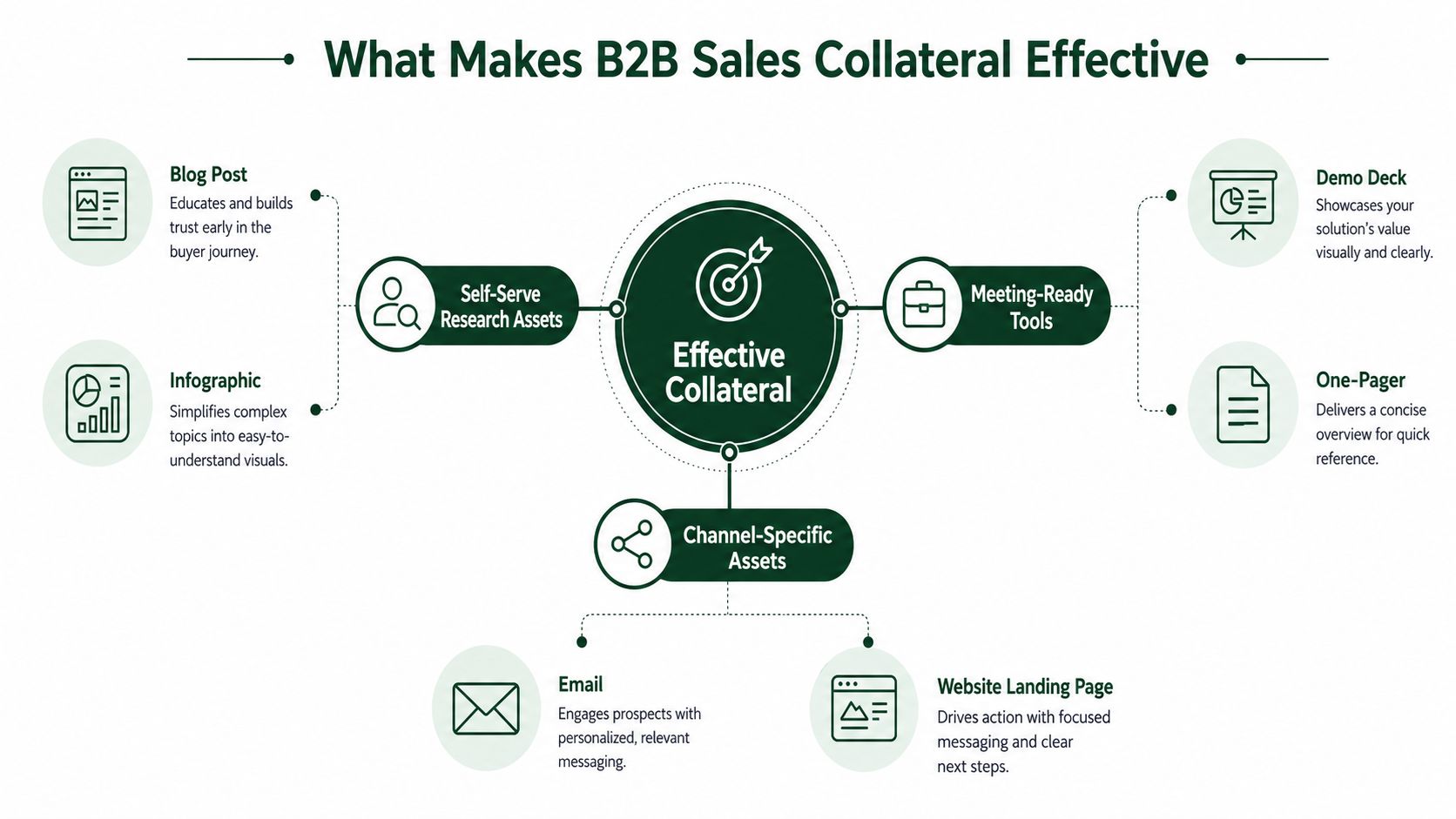
That changes the operating requirement. Effective collateral is a coordinated set of assets, each built for a buyer question, stage, ICP, and distribution channel. An email may need a concise proof point. A LinkedIn message may need a useful insight. A WhatsApp follow-up may need a short, forwardable explanation. A live meeting may require a deck that gives several stakeholders the same narrative.
Collateral also needs to support seller behavior. The practical guide to sales enablement frames content as part of a repeatable sales process, rather than a separate library that reps search under pressure. The system should show which asset fits the account, buyer role, objection, and next step.
The toolbox test
A sales engineer does not bring every tool to diagnose one problem. They select the tool that fits the job. Outbound teams should apply the same discipline to collateral.
A short one-pager can help a prospect understand the category and decide whether to reply. A case study gives a skeptical stakeholder evidence to continue evaluating. A battlecard helps the seller respond when a competitor enters the conversation. A deck creates shared context in a meeting, rather than forcing a cold prospect through company history.
The survey found that white papers ranked first for purchase decisions among 31% of respondents, ahead of product brochures at 23% and case studies at 17%. Respondents also shared white papers with colleagues at 67%, case studies at 65%, and product brochures at 64%. Those findings support a practical rule:
Practical rule: Build every external asset so one person can discover it, understand it, and forward it without needing the original sender to explain the context.
Judge each asset by commercial movement. Track replies, meetings created, stakeholder engagement, objection resolution, and opportunity progression. Visual polish can support credibility, but the outcome is a buyer taking the next useful step.
Core Formats Every Outbound Team Needs
The average B2B buyer completes 70% of the buying process before engaging a vendor, and 81% already have a preferred vendor in mind when they first speak with sales, according to the buyer-experience data summarized by Apollo. The same coverage reports that 55% of B2B buyers rely on content more than they did a year earlier, while another cited finding says 90% consider relevant content important or very important at each buying stage.
Each format must perform a self-serve function. The right inventory isn't the longest one. It's the smallest set that addresses the recurring decisions buyers and sellers face.
One-pagers earn attention
A one-pager is usually the first asset to build for a new outbound motion. It should explain who the offer is for, the operational problem it addresses, the expected outcome, and the next action. In cold email, it earns a reply when the recipient can recognize their situation within seconds.
Keep it specific to an ICP segment. A one-pager for a finance leader should foreground controls, risk, and business justification. A version for a technical owner should address integrations, implementation, and operational fit. The format is cheap to adapt, easy to forward, and useful before a meeting.
Decks create shared context
A deck earns its place in a meeting. It gives the seller a visual narrative, but it shouldn't become a script that replaces discovery. A strong deck moves from problem to implications, approach, proof, and next step. It removes detail that belongs in a data sheet or technical appendix.
Sending a generic deck in the first cold email usually creates work for the buyer. The recipient has to determine what matters, where they fit, and whether the presentation reflects their business. Use the deck after interest has been established or when several stakeholders need a common frame.
Case studies reduce perceived risk
Case studies work when they let a prospect recognize their own environment. Lead with the customer's problem, constraints, decision criteria, and evidence of what changed. A vague story about transformation won't help a buyer justify a purchase internally.
Account relevance beats industry decoration. A regional operating model, similar implementation challenge, or comparable buying group often matters more than a broad sector label.
Battlecards protect competitive conversations
Battlecards are internal-first assets. They should help a rep identify the competitor's likely claim, respond without exaggeration, and return the conversation to buyer outcomes. They're most valuable when competitive displacement is a real objection, not when leadership wants every possible document represented in the library.
For a deeper explanation of how these assets support sellers, understanding sales enablement content provides useful terminology and context. Teams building outbound around LinkedIn can also align collateral with their LinkedIn lead generation workflow, so the asset supports the conversation instead of appearing as an unrelated attachment.
Mapping Collateral to Buyer Stages and ICP Fit
Format alone doesn't make collateral useful. The same asset can help one buyer and confuse another because stage and ICP determine the question the buyer is trying to answer.
Start with three fields for every asset:
Buyer stage: Is the prospect learning about a problem, comparing approaches, or validating a decision?
ICP segment: Which company type, market, role, and operating context does the asset address?
Next action: What should the buyer do after consuming it?
Awareness requires clarity
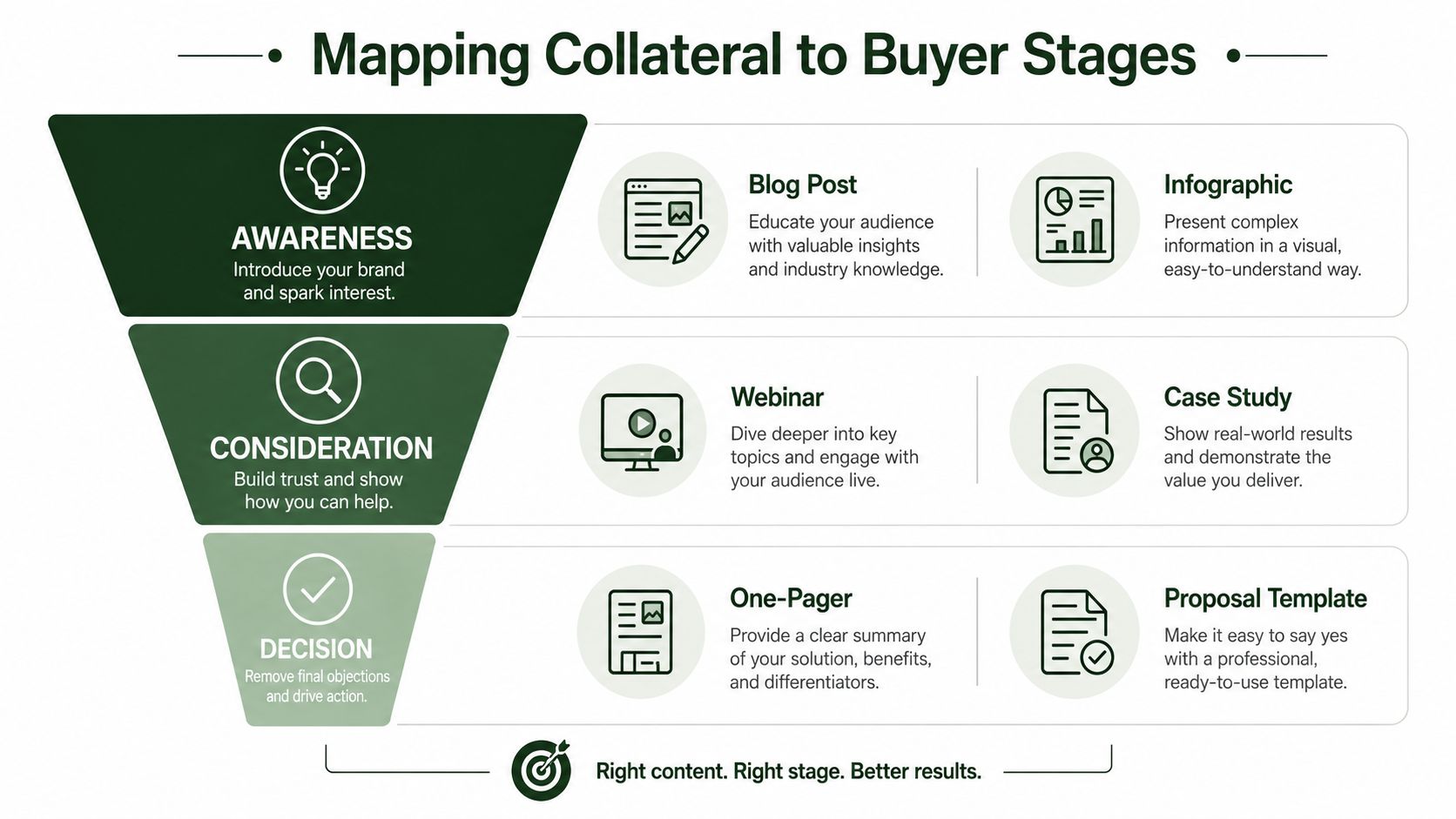
At awareness, the buyer wants to understand the problem and decide whether it deserves attention. Use educational pages, short explainers, infographics, and market-specific perspectives. Avoid leading with a dense product presentation. The asset should create recognition, not demand a commitment.
A defined persona makes this sharper. The B2B buyer persona guide can help teams connect role-level pain points to the language and proof used in the asset.
Consideration requires comparison and proof
During consideration, buyers evaluate alternatives, trade-offs, and implementation implications. Case studies, comparison sheets, webinars, and technical explainers become useful here. The asset should help the champion answer, “Why this approach, and why this vendor?”
Gartner reported that 61% of B2B buyers prefer a rep-free buying experience, with online self-service tools favored for general information and early learning. Seller input becomes more valuable later, when buyers evaluate fit (Gartner buyer content preferences report). TrustRadius found that 87% of buyers wanted to self-serve part or all of the journey in 2021, and its 2022 follow-up described that preference as “virtually 100%,” with pricing, reviews, and demos among the information buyers wanted without speaking to sales (TrustRadius buyer research).
Decision needs regional confidence
Consider a venture-backed SaaS startup expanding into APAC. An awareness-stage prospect in Japan might receive a localized one-pager that reflects local terminology and a relevant operating problem. A consideration-stage account comparing vendors might receive a concise battlecard or comparison asset. Decision-stage stakeholders should see regional proof, implementation detail, and a proposal structure they can circulate internally.
That sequence is more useful than creating one global brochure and translating it later. Localization should affect examples, objections, proof, language, and channel format. Treat each asset as an experiment. If it gets views but doesn't accelerate a meeting, resolve a concern, or help an opportunity progress, revise or retire it.
The Collateral-to-Channel Decision Framework
Teams often ask what to build next when the problem is prioritization. A new outbound motion doesn't need a full content library. It needs a foundation that can travel across channels and make the first conversation easier.
Think of collateral like a house. The one-pager is the foundation. The case study provides structural support through proof. The battlecard addresses a known pressure point. The deck decorates and organizes the rooms once people are already inside.

Build in commercial order
Start with the one-pager. It has broadest use across email, LinkedIn, landing pages, and follow-up. It also exposes unclear positioning quickly. If you can't express the ICP, problem, proof, and CTA on one page, a larger asset will only hide the problem.
Add case studies when trust is the constraint. Don't produce generic customer stories because the content calendar says you need one. Build them around the objections that stop real opportunities, such as implementation risk, regional complexity, or executive confidence.
Create battlecards when competition changes the outcome. A battlecard should respond to observed deal friction. If reps rarely face a named competitor, the asset is probably premature.
Keep decks for meetings. A deck can be valuable, but it carries more production and review overhead. It should support a live conversation, not act as a substitute for a clear outbound message.
For account-based motions, the same prioritization should guide account selection and asset design. A practical account-based marketing campaign framework helps connect account priorities to the assets sellers need.
Build the asset that removes the next obstacle, not the asset that looks most impressive in a marketing review.
Best-Practice Templates and Production Rules
Production rules make collateral easier to approve, personalize, and refresh. They also protect sellers from opening a document and finding a polished answer to the wrong question.
The first rule is message discipline. Every asset needs one audience, one primary problem, one proof angle, and one next action. Account-specific versions can change the context and evidence without changing the core positioning.
Use a clear structure for each format
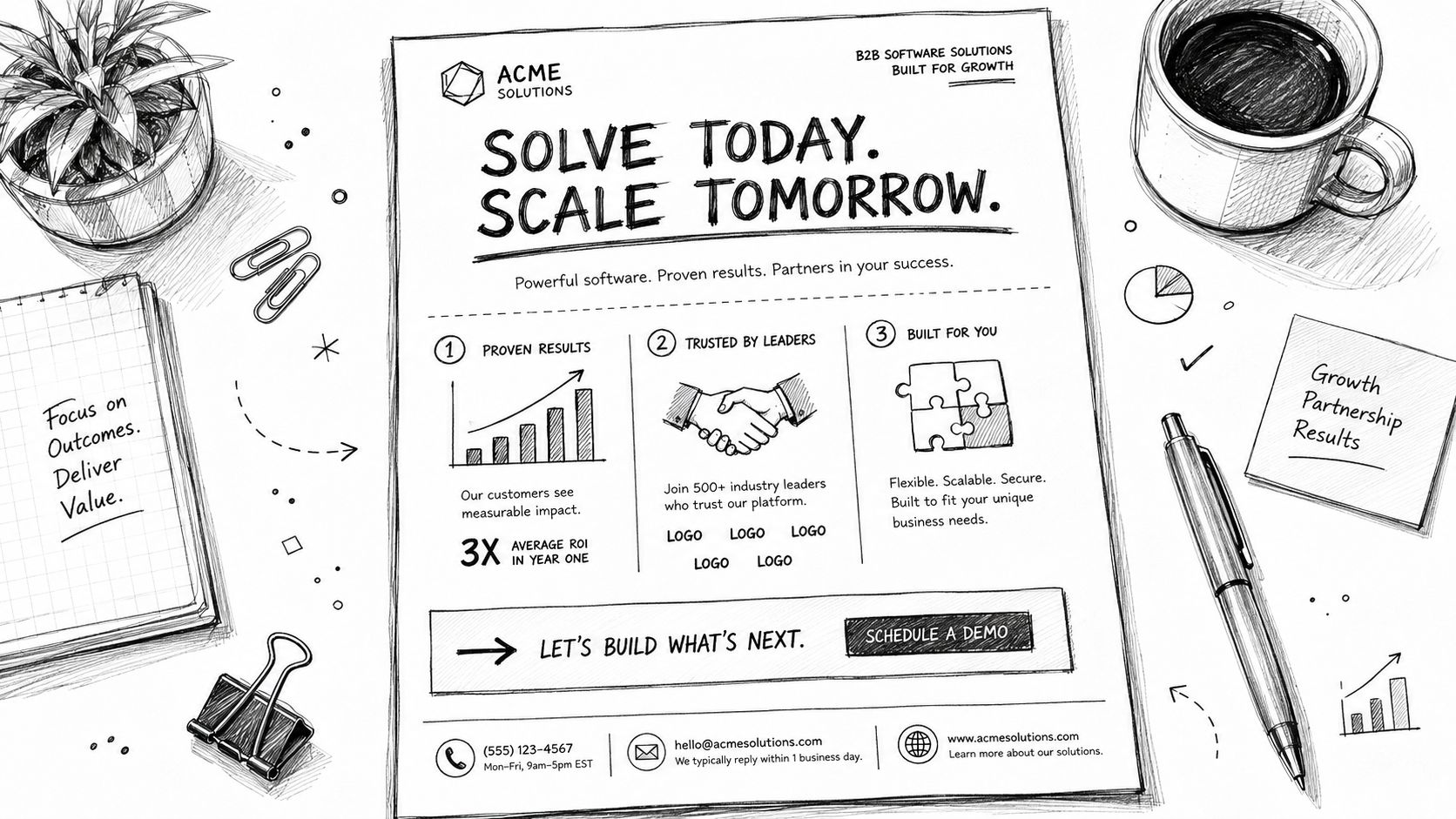
One-pager: Lead with a direct headline that names the buyer problem. Add three proof points, explain the fit, and finish with one CTA. Don't turn the page into a product catalogue. The reader should know who it's for and why it matters before reaching the bottom.
Battlecard: List the top three competitor objections your sellers encounter. Pair each objection with an evidence-backed counter, a question that redirects the conversation, and a boundary that prevents overclaiming. Internal users need speed, not brand theatre.
Case study: Open with the prospect's problem, not your solution. Explain the context, the decision pressure, the approach, and the proof that makes the story credible. A customer story should help a buyer see themselves in the situation.
Deck: Keep the narrative tight, with no more than ten slides and one message per slide. Use slides to guide discussion, not to store every possible detail. Put technical depth, security responses, or implementation material in supporting documents.
Design for proof and maintenance
A 2026 industry summary says interactive content can generate 2x more conversions than passive content, while related guidance describes AI-assisted personalization at scale and a move toward one case study per account rather than one per industry (industry summary on modern sales collateral). Use interactive formats when they help buyers explore fit, compare options, or model a decision. Don't add interaction merely because a static document feels old.
Personalization isn't a replacement for credibility. The same source cites HubSpot data showing that nearly 28% of salespeople see better use of enablement content as a priority, which points to an operational gap even when assets exist. A highly customized document with weak evidence still fails.
Treat collateral older than six months as stale, especially in APAC markets where local terminology, product availability, compliance expectations, and customer references can change quickly. Assign an owner, a review date, and a retirement rule to every published asset.
Distribution Strategies for Outbound Teams
A good asset can fail because it arrives in the wrong channel, at the wrong length, or before the buyer has a reason to care. Distribution is part of collateral design, not a final step after production.
APAC buyers are moving further into digital self-service. Adobe's report found 59% of respondents reported greater use of digital self-service, compared with 32% reporting lower use and 9% reporting no change (Adobe's APAC B2B personalization report). That favors assets that load quickly, work across devices, and make sense without a seller present.
Match the asset to the channel
Channel | Best-fit collateral | Operating rule |
|---|---|---|
Cold email | One-pager, concise comparison asset, relevant case study | Link to one asset and explain why it fits the recipient |
Case study, interactive explainer, short proof asset | Use the asset to support a conversation, not replace one | |
Short proof point, image, mobile-friendly page | Keep the experience fast and easy to forward | |
Social DMs | Brief comparison, customer proof, focused explainer | Send only after a relevant signal or conversational opening |
Cold email should create curiosity and reduce uncertainty. A concise one-pager linked from a message is usually more useful than a full deck. For sending infrastructure and sequencing, Instantly fits the workflow, but the platform can't rescue an asset that lacks ICP relevance.
LinkedIn gives the seller more room to contextualize a case study or interactive asset. Teams using LinkedIn automation can evaluate HeyReach, while Trigify can help surface social signals that inform timing. For WhatsApp workflows, Respond IO can support automated routing and follow-up, and Manychat is relevant when social comments or DMs create the entry point.
Route by signal
Don't spray the same document across every channel at once. A prospect engaging with a comparison page deserves a different follow-up from someone who only viewed a broad educational post. Use engagement signals to choose the next asset and the next channel. Intent workflows such as Whitewhale can support this routing when buying signals are available.
Teams that want a broader distribution operating model can use the ContentBuck 2026 playbook as a reference point. The practical standard remains simple: every send should have a reason, a format, and a measurable next step.
Measuring What Works and Cutting What Doesn't
More collateral doesn't automatically create more pipeline. In many teams, the content library grows while sellers continue using the same familiar deck, because nobody has shown which assets change buyer behavior.
Treat every asset as a hypothesis. The hypothesis might be, “This regional comparison sheet will help technical buyers accept a first meeting,” or, “This case study will reduce hesitation from finance stakeholders.” Track the result by segment, channel, stage, and next action.
Use pipeline metrics, not vanity signals
Views and downloads can indicate interest, but they don't prove movement. A useful measurement set includes:
Reply-to-meeting conversion: Did the asset help a contacted prospect agree to a meeting?
Meeting progression: Did the buyer take the next step after receiving it?
Objection resolution: Did the asset address a blocker recorded by the seller?
Stakeholder circulation: Did the champion share it with the people needed for approval?
Sales-cycle drag: Did the opportunity move without repeated explanations or extra clarification?
Keep measurement definitions consistent with the broader email marketing metrics framework. Then compare assets within the same ICP and channel rather than declaring a winner from mixed traffic.
Retire decoration
An asset that gets attention but doesn't create momentum may still be useful for awareness, but it shouldn't remain in the core sales kit without a clear job. Review the language, proof, CTA, and distribution context before deciding whether to revise it. If the same problem appears repeatedly, build a more concise comparison or proof asset instead of another broad guide.
For APAC expansion, prioritize localized proof, concise comparisons, and fast-refresh content over a large generic library. Build first:
A segment-specific one-pager.
A case study that addresses the strongest trust gap.
A comparison asset for the most common competitive objection.
A meeting deck with a single, adaptable narrative.
Retire assets with no owner, outdated regional detail, or no recorded use in meaningful buyer conversations. A/B test the message, proof point, CTA, and channel separately so you can identify what caused movement. The standard isn't whether collateral looks useful. It's whether it helps the right buyer take the next step.
The Social Search designs and operates outbound systems that connect ICP definition, data, messaging, email, LinkedIn, signal-driven routing, and reporting for APAC and global SaaS teams. If your collateral isn't translating into qualified conversations, visit The Social Search to build a system that puts the right proof in front of the right buyer at the right moment.
