10 B2B Sales Examples and Playbooks for 2026
Explore 10 b2b sales examples with outreach sequences, messaging templates, case studies, and practical playbooks to build qualified pipeline.
A clever cold email isn’t a sales system. Neither is a polished demo, a LinkedIn automation tool, or a case study library sitting unused in a content folder. The strongest B2B sales examples connect the entire motion, from choosing the right accounts and validating data to detecting a timely signal, delivering a relevant message, handling objections, proving value, and handing a qualified opportunity to the right seller.
That matters because buyers often do much of their research before speaking with a vendor. Gartner-linked reporting says buyers spend only about 17% of the purchase journey in direct contact with potential suppliers, while 61% prefer a rep-free buying experience and 77% describe their latest purchase as highly complex or difficult. The 2026 B2B buyer behaviour report supports a practical conclusion: sellers need to enter the conversation with context, not an introductory pitch.
The examples below are playbooks, not isolated tricks. Each one ties together ICP definition, data, signals, messaging, channel execution, measurement, and handoff, with practical structures that teams selling across APAC and global markets can adapt.
Table of Contents
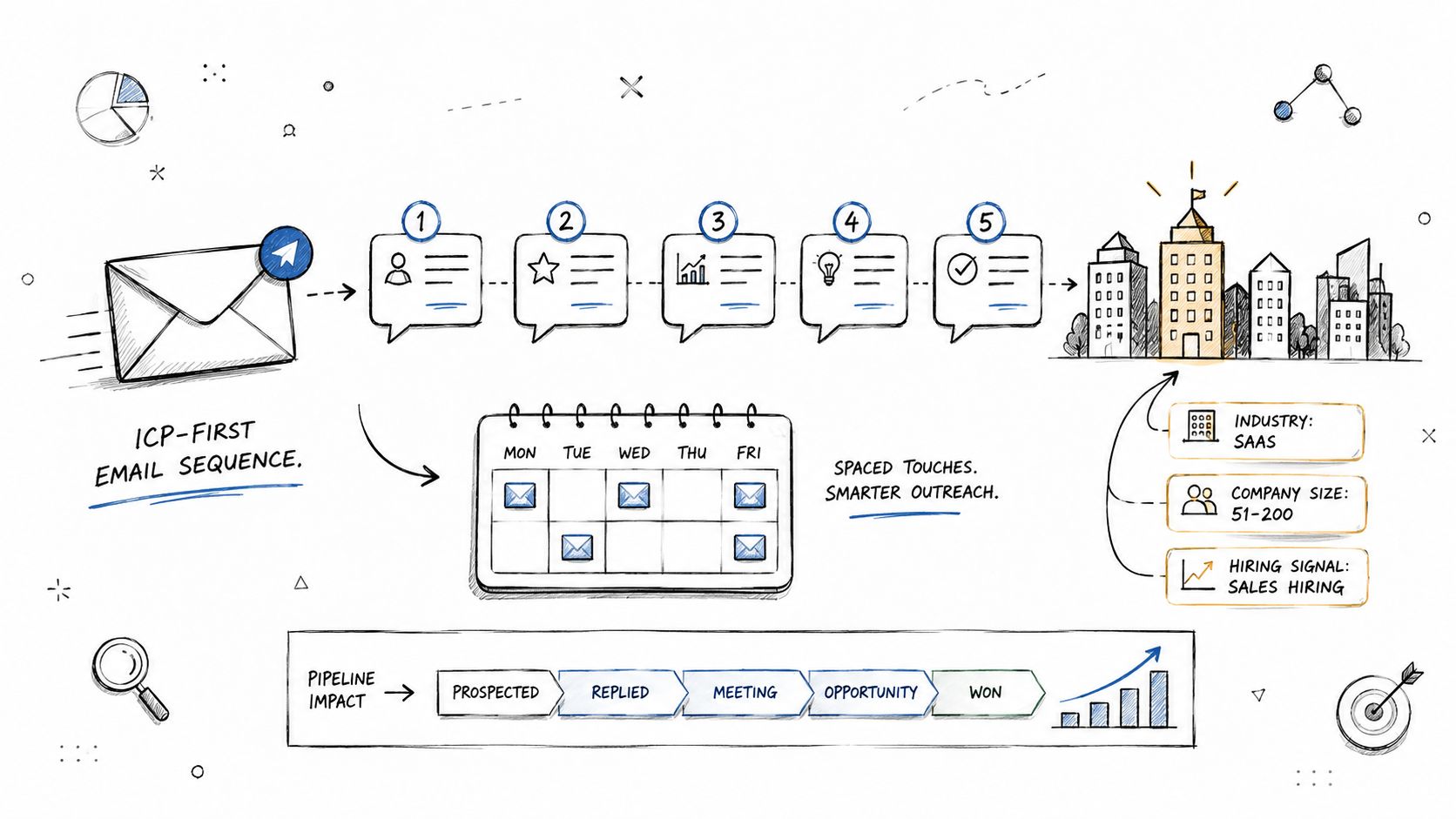
1. The ICP-First Email Sequence
An ICP-first sequence treats the email as one step in a wider outbound system. A SaaS company entering APAC might separate finance, operations, and IT buyers into distinct campaigns, then adjust the problem, proof, and offer for each persona. Finance may prioritise control and compliance, while operations may focus on workflow efficiency.
Use Apollo for data enrichment to verify roles, company context, job changes, and buying indicators before adding a prospect to a sequence. That data supports the signal and messaging layers, but it does not replace judgment. The opening should link a verified business situation to a specific problem, not rely on a generic compliment.
Practical rule: Personalisation should change the reason for contacting the buyer, not just insert the company name.
A repeatable sequence can follow this structure:
Touch one: State the ICP problem and offer a concise observation.
Touch two: Add a practical insight, benchmark, or diagnostic question.
Touch three: Share proof relevant to the persona or market.
Later touches: Reframe the problem, suggest a low-friction next step, and close the loop respectfully.
Use Instantly for sending, warm-up, sequencing, and deliverability management. Separate variants by persona, offer, and signal so reply data supports decisions about messaging and qualification. Teams selling across APAC should set send times by buyer timezone, review regional wording, define a reply-to-meeting handoff, and track positive replies, meetings, and qualified opportunities rather than opens alone. The cold email framework for landing in the inbox can help standardise execution.
2. LinkedIn Outreach Automation with Warm Social Proof
LinkedIn automation works best when automation handles repetition and people create relevance. A consulting firm targeting newly promoted APAC vice presidents, for example, can build a list around the promotion signal, engage with the prospect’s public content, then send a short connection note tied to the new role.
HeyReach fits the execution layer for LinkedIn outreach, but it shouldn’t replace account research or genuine engagement. Before a connection request, a rep can read recent posts, identify a shared professional context, or reference a company change. The message should feel like a continuation of relevant attention, not a bulk campaign.
A practical sequence looks like this:
Warm-up: Engage with relevant content and review the prospect’s current role.
Connection: Use one concise reason for connecting, without pitching.
Conversation: Ask a narrow question about a visible business priority.
Value exchange: Share a useful report, example, or observation only when it fits.
Handoff: Move to a call after the prospect has expressed a problem or curiosity.
The LinkedIn lead generation guide is useful for turning individual activity into a repeatable process. Teams can also evaluate the PostPulse LinkedIn tool when they need support for content and engagement workflows.
Track accepted connections, replies, qualified conversations, and meetings separately. LinkedIn benchmarks can vary by dataset and campaign design. One 180,155-request study found 27.1% of connection requests were accepted, 27.6% of accepted connections replied, and 2.0% of accepted connections booked a meeting. Use those figures as funnel context, not as a promise.
3. The Objection Handling Framework
“Not interested” is often a diagnostic signal, not a final verdict. The reply may point to budget pressure, an existing vendor, poor timing, unclear differentiation, or a message sent before the problem became urgent. Treat the response as data about fit, timing, and message-market alignment.
Start with response data. Tag objections by persona, offer, account fit, and buying stage. Then acknowledge the concern and ask one clarifying question. A finance buyer saying “we don’t have budget” needs a different path from an IT leader saying “we already use Salesforce.”
Use a three-part reframe:
Acknowledge: Confirm that the concern is reasonable.
Clarify: Establish whether the issue is timing, priority, fit, or risk.
Reposition: Link the solution to the condition that would make a later conversation useful.
A competitor response could be: “That platform may be the right choice for your core workflow. We help teams that need a specialised layer around a specific gap. Is that gap already covered, or is it still handled manually?”
The sequence should reflect the wider outbound system. Use account and persona data to tailor the wording, treat replies as buying signals, and measure objection categories, qualified conversations, and handoffs separately. Role-play also matters because tone changes meaning. Reps should record the next action in the CRM, including a specific revisit trigger instead of a vague reminder. Whitewhale can help surface intent changes for follow-up, but the signal should support a real context shift rather than manufacture urgency.
4. The Account-Based Outreach Campaign
Account-based outreach focuses effort on a defined account instead of spreading generic activity across a broad list. The account is the operating unit, because complex purchases often involve finance, IT, operations, procurement, and executives.
Create a one-page account brief covering the company’s market, current priorities, technology, likely pain points, active signals, stakeholders, and the message relevant to each role. Use account and contact data to identify who should enter the sequence, then connect signals to a specific reason for outreach.
Assign one owner to coordinate email, LinkedIn engagement, content, and seller handoff. For example, the CFO might receive a risk and efficiency message, the CIO an integration and governance message, and the operations leader a workflow example. Keep one account narrative, while adapting the proof and call to action for each stakeholder.
Reach the buying committee with one coherent business case, not a collection of disconnected pitches.
Space touches across the week rather than activating every channel on one day. Measure replies, engaged stakeholders, meetings, and qualified handoffs at account level. Pause accounts that show no meaningful response, and record the signal or objection that should change the next motion. The ABM landing page guide can help align destination content with the account narrative.
For APAC and global teams, check local business hours, buying roles, and regional proof before launch. Review the campaign weekly: ICP fit, data quality, signal accuracy, message performance, channel contribution, and handoff speed. That review separates account-based execution from ordinary multichannel activity.
5. The Product Demo Pitch
A product demo should answer one buyer question: “How would this change the way we work?” Feature coverage is secondary. A buyer who sees many capabilities but can’t connect them to a priority leaves with more information and no stronger reason to act.
Run discovery before the demo and identify the specific problems, stakeholders, existing process, and desired outcome. A 15-minute first look shouldn’t resemble a technical review for procurement. A technical buyer may need integrations, security detail, and implementation context, while an executive may need a concise view of business impact and risk.
Open with a one-sentence restatement of what you heard. Then follow a problem, solution, proof, and next-step structure:
Problem: Confirm the operational or commercial issue.
Solution: Show the relevant workflow immediately.
Proof: Use a customer example or the buyer’s own data where possible.
Next step: Define the test, review, or stakeholder meeting required.
A sales team can create separate demo paths for finance, operations, and IT without building separate products. The trade-off is preparation time, but that effort prevents the common feature dump that makes every buyer sit through the same presentation.
The sales enablement guide provides useful context for documenting demo narratives, assets, and handoff standards. End with a concrete action, such as applying the workflow to actual data or scheduling a technical review.
6. The Social Proof and Case Study Campaign
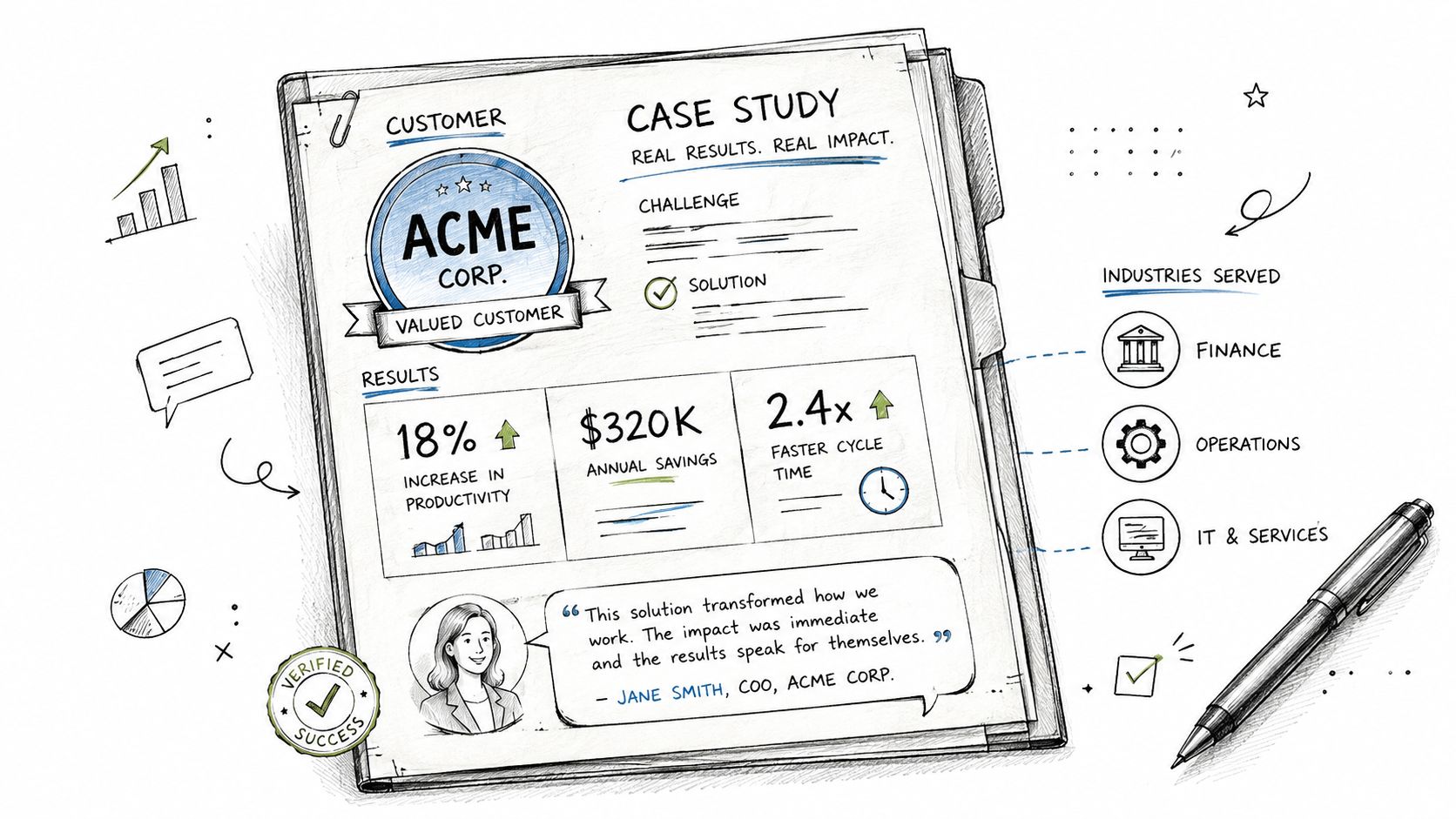
A case study earns its place in an outbound system when it helps a specific account make a decision. Start with the ICP and the buying committee, then map proof to the risk each stakeholder must assess. A finance leader may need commercial evidence, while IT may focus on integration and implementation exposure.
Build each story around four points: the customer’s starting condition, the decision under review, the implementation experience, and the outcome. Use approved evidence only. A partial result should remain a partial result, not become a promise for every account.
Create a working proof library with:
Industry versions: Reflect the buyer’s regulatory and operating environment.
Persona versions: Give finance, IT, operations, and executive sponsors relevant evidence.
Objection assets: Address adoption, integration, implementation, security, and risk.
Usage guidance: Specify the trigger, channel, owner, and follow-up action for each asset.
For outbound, insert one relevant proof point after the prospect confirms a problem or raises a concern. A practical sequence is: signal or account context, problem hypothesis, customer evidence, a question about fit, and a clear handoff to a seller or subject-matter specialist. Do not attach a case study to every touch. Repeated proof can feel like pressure and leave little room for the buyer’s situation.
Before launch, confirm account fit, approval status, persona relevance, delivery channel, and reply ownership. Track whether each asset supports replies, meetings, opportunity progression, or stakeholder engagement. Retire proof that no longer matches the market or buyer concern.
7. The Intent Signal-Driven Outreach Strategy
Timing can matter more than copy, but a signal is not proof of buying intent. Hiring for a capability, changing a technology stack, entering a market, or appointing a leader may create a relevant opening. It may also reflect routine growth or an unrelated team.
Start with ICP fit, then validate the role, company context, and likely business problem. A useful signal score combines event relevance, account fit, persona access, urgency, and evidence from more than one source. Low-confidence signals stay in nurture. High-confidence signals receive faster review and a named owner.
Use a distinct operating sequence:
Trigger: Detect the event and record its date, source, and account.
Validation: Confirm the company, contact, market, and role data.
Hypothesis: State the operational change the signal may indicate.
Message: Connect that change to a specific problem, then ask one diagnostic question.
Routing: Send positive replies to a seller prepared for that market and persona.
Handoff: Pass the signal, evidence, message, and next action into the CRM.
The message structure should be short: event, business implication, relevant perspective, proof or diagnostic offer, and a low-friction question. Channel choice depends on access and urgency. Email supports context, LinkedIn can add recognition, and a call suits accounts where the signal indicates near-term change.
Measure these campaigns separately from ordinary prospecting. Track signal-to-reply, reply-to-meeting, meeting-to-opportunity, response time, routing accuracy, and false-positive rate. Benchmark data reports higher response for intent-triggered and stacked-signal campaigns than broad outreach, but the operational lesson is to improve signal quality rather than inflate activity. The GTM signal benchmarks provide the comparison framework.
8. The Competitive Displacement Playbook
Competitive displacement succeeds when the buyer can justify the change operationally, commercially, and internally. Start with the account’s incumbent setup, affected workflows, decision group, and switching constraints. The goal is a specific replacement case, not a generic claim that your product is better.
Use discovery to identify the gap without asking the prospect to attack its current vendor. Ask which processes create manual work, limit visibility, delay decisions, or no longer support the company’s requirements. Validate the impact with the relevant operator, technical owner, and economic buyer before writing the proposal.
Build the motion around a clear sequence:
Problem case: Link the buyer’s stated limitation to a measurable workflow or business consequence.
Replacement plan: Show migration stages, data ownership, integrations, training, security checks, and support.
Proof: Use approved examples from customers who changed vendors, matched to the prospect’s industry or operating model.
Evaluation path: Define success criteria, stakeholders, timing, and the point at which procurement becomes involved.
Handoff: Record the incumbent, pain points, evidence, objections, and agreed next action in the CRM.
A sales platform replacing a legacy tool might demonstrate mobile workflows and real-time forecasting alongside a continuity plan. An analytics vendor can present cloud-native architecture as a response to a known limitation, while acknowledging what the incumbent already does well.
Use email for the business case, calls for complex risk questions, and stakeholder-specific follow-up for technical or procurement concerns. Respectful contrast protects credibility, particularly in APAC markets where relationships and reputation influence vendor selection. Track movement from confirmed pain to evaluation, opportunity, and implementation readiness.
9. The Social Proof and Case Study Campaign
Case studies perform better when they create an internal decision path, not just another proof point in an outbound email. Build the campaign around the questions each stakeholder must answer before approving a purchase.
Start by selecting a customer story that matches the target ICP, operating model, and market. Extract the buyer’s initial trigger, evaluation criteria, implementation constraints, adoption work, and outcome. Then adapt that evidence for each role:
Executive brief: Why the customer acted, what decision risk it accepted, and what changed afterward.
Operator guide: The workflow before and after adoption, including the work required from users.
Technical note: Integrations, security considerations, data ownership, and implementation dependencies.
Commercial summary: Requirements addressed, evaluation milestones, and procurement questions.
Use the assets in a coordinated sequence. Send the executive brief to the sponsor, give the operator a relevant workflow example, involve IT when technical questions arise, and provide procurement with evidence mapped to agreed requirements. A sales-team video-sharing workflow can keep customer video accessible across reps and stakeholders rather than trapped in individual inboxes.
The message structure is simple: “Teams with a similar operating model faced [problem]. They changed [process], addressed [risk], and achieved [outcome]. Does that match the issue your team is evaluating?” Adjust the language for APAC markets, where local references, regional implementation support, and relationship continuity may affect credibility.
Measure progression by stakeholder coverage, replies by asset type, meetings involving additional roles, and movement from evaluation to a defined buying process. Stop producing formats that do not create engagement. Update the story when customer language, objections, or implementation requirements change.
10. The Intent Signal-Driven Outreach Strategy
A signal becomes useful when it changes account prioritisation, ownership, or message timing. Treat this motion as an operating control for outbound, not another dashboard. The team should record the signal, assess its reliability, assign an owner, and define the next action before contacting anyone.
Use a simple case structure: state the verified change, explain the business question it raises, propose a relevant conversation, and specify the handoff if interest appears. A hiring increase may support a conversation about capacity and process. A new technology installation may justify questions for IT and operations about integration or migration. A leadership change can open a new thread, provided the message relates to that person’s remit rather than relying on congratulations alone.
Use Whitewhale for signal monitoring and Apollo to check account and contact details. In the CRM, capture the signal source, detection date, hypothesis, owner, channel, response, and meeting outcome. This creates an audit trail for deciding which triggers deserve continued coverage.
For APAC and global teams, document market, language, channel preference, local stakeholders, and proof requirements in the handoff. A meeting should pass these fields to the next seller, along with the original evidence and agreed follow-up. Review performance by signal type, qualified replies, stakeholder additions, and progression into a defined buying process. Stop routing triggers that produce activity without useful conversations.
11. The Competitive Displacement Playbook
Displacement works best when a trigger changes the buyer’s evaluation criteria, not when a seller attacks the incumbent. An acquisition, regulatory change, expansion, new executive, or technology decision can create a reason to reassess the current setup.
Start with the trigger and its likely commercial consequence. For example, an acquisition may expose inconsistent processes across regions, while expansion may increase demands on support, integration, or governance. Validate the account context, identify the affected business outcome, and tailor the message to the stakeholder who owns that outcome.
A practical sequence is:
Reference the verified trigger: State what changed and why it matters to the account.
Test the hypothesis: Ask whether the current approach creates friction under the new condition.
Position the alternative: Explain the specific capability or operating model that differs.
Address switching risk: Offer a technical review, migration discussion, or limited proof exercise.
Set the next action: Involve the stakeholder responsible for approval, implementation, or risk.
The trade-off is clear. A sharper displacement message can create urgency, but an unsupported assumption damages credibility. Prepare evidence on implementation ownership, integration, security, training, and regional support. Use competitor research to clarify fit and switching costs, rather than turning the conversation into a feature comparison.
Before handoff, capture the trigger, affected outcome, stakeholder, proof required, implementation concern, and agreed next step. Sales operations should also record whether the opportunity depends on a contract event, budget cycle, compliance requirement, or executive mandate. Review meetings by trigger, qualified progression, and conversion to a defined buying process, then retire triggers that generate replies without commercial movement.
12. Outbound Tools and Vendors Reference
Tools should serve a defined outbound workflow. They cannot fix a vague ICP, stale data, weak offers, or unclear ownership. Assign each platform a role from account selection through handoff, then measure whether it improves that stage.
Apollo: Find contacts, enrich records, research accounts, and validate lists before outreach.
Instantly: Manage cold email sending, warm-up, sequencing, and deliverability operations.
HeyReach: Run LinkedIn outreach workflows while keeping human review and compliance controls in place.
Trigify: Monitor social engagement and turn relevant activity into timely conversation starters.
Whitewhale: Prioritise accounts from intent signals and route signal-specific messages.
Respond.io: Automate, route, and follow up on WhatsApp conversations.
Manychat: Automate social direct messages and comments where the audience and channel fit.
Choose tools according to the motion. For example, an APAC campaign may require stronger regional data checks, local channel preferences, and clear ownership across time zones. A global sequence may need stricter suppression rules and consistent CRM fields. In both cases, define the trigger, message, owner, response route, and handoff record before adding vendors.
Deliverability depends on operating discipline. Guidance for B2B outbound recommends 90% or higher inbox placement, a bounce rate below 2%, spam complaints below 0.10%, approximately 20 to 25 emails per inbox per day, and 4 to 6 weeks of domain warm-up. The outbound deliverability playbook documents these operating rules.
A sales team video-sharing workflow can support product explanations and proof during outreach. Validate vendor coverage, permissions, data freshness, platform limits, and CRM handoff before scaling the stack.
13. GTM System Integration and Measurement Checklist
The final example is the operating layer that makes the other motions repeatable. A team can have strong copy, accurate data, and useful signals, yet still lose opportunities when the CRM doesn’t show ownership, source, next action, or buying context.
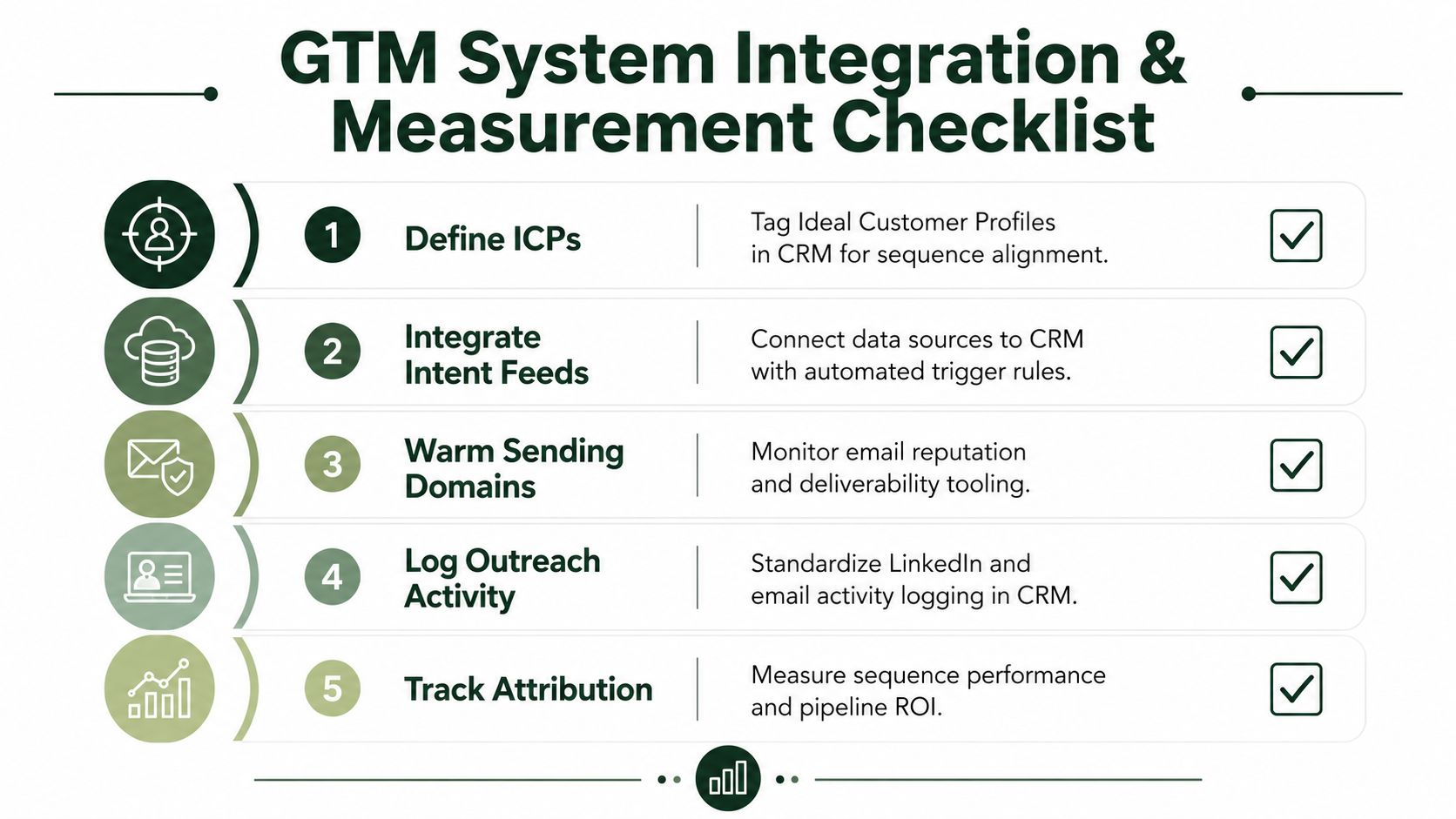
Start with one ICP, one enrichment source, one intent feed, one sending setup, and one primary channel. Connect each stage so a signal can create a prioritised account, an enriched contact, a message variant, a task, and a measurable CRM record. Avoid adding tools before the team can explain the workflow in plain language.
Use revenue operations guidance to clarify ownership between marketing, sales, operations, and leadership. Your implementation checklist should include:
Data quality: Validate role, company, geography, and account status.
Campaign tagging: Record persona, offer, channel, signal, and owner.
Deliverability: Monitor inbox placement, bounces, complaints, and sending volume.
Response management: Route positive replies quickly and classify objections consistently.
Pipeline attribution: Connect meetings and opportunities to the list, signal, message, and asset.
Handoff standards: Capture business problem, stakeholders, urgency, current solution, and agreed next step.
Iteration rhythm: Review performance weekly and retire weak variants.
Use reply rate and meeting rate as diagnostic metrics, not vanity scores. A 2026 cold outbound benchmark reports a median reply rate of 3.43% and a median open rate of 27.7%. Those baselines are useful only when your team also checks fit, positive response quality, meetings, pipeline, and deliverability.
13 B2B Sales Examples Compared
Tactic | Implementation complexity 🔄 | Resources & Tools 💡 | Expected outcomes 📊 | Ideal use cases | Key advantages ⭐ |
|---|---|---|---|---|---|
The ICP-First Email Sequence: Data-Driven Personalization at Scale | High, multi-touch sequencing, data + infra integrations 🔄 | Data enrichment (Apollo), sending & warmup (Instantly), CRM, analytics | Higher opens/replies (≈3–5x), clear pipeline attribution, scalable meetings 📊 | High-volume B2B outbound, regional expansion (e.g., APAC) | Personalization at scale; rapid iteration; strong pipeline signal-to-conversion |
LinkedIn Outreach Automation with Warm Social Proof | Medium, automation + manual engagement coordination 🔄 | LinkedIn Sales Navigator, HeyReach, CRM logging, content/engagement time | Strong connection/reply rates for some personas (e.g., execs); improved meeting conversion 📊 | Exec-targeted outreach, relationship-driven markets, social-first buyers | Perceived legitimacy, higher visibility, more natural DM conversations ⭐ |
The Objection Handling Framework: Turning “Not Interested” Into Pipeline | Medium, build library, test templates, enablement coaching 🔄 | Reply data, CRM tagging, training time, A/B testing setup | Converts ‘no’ → ‘maybe/yes’ (measurable lift; can double meetings from reframes) 📊 | Teams with significant reply volume or long cycles; reps facing frequent objections | Removes rep paralysis; repeatable, data-backed reframes; faster progression |
The Account-Based Outreach Campaign: Coordinated Multi-Channel Assault | Very high, cross-channel orchestration and account briefs 🔄 | ABM tools (Terminus/6sense), Sales Navigator, creative assets, cross-team coordination | Much higher close rates for targeted accounts (3–5x), larger ACV deals 📊 | High-ACV targeting, strategic accounts, competitive pursuits | Deep personalization; multi-stakeholder influence; defensible positioning ⭐ |
The Product Demo Pitch: Structured Walkthrough Aligned to Buyer Outcomes | Medium, discovery-driven prep and practiced scripting 🔄 | Demo environment with real data, playbooks, trained reps, discovery inputs | Outcome-focused demos → 2–3x higher demo-to-next-step conversion; shorter exec-friendly calls ⚡📊 | Mid-stage qualification, demo-to-proposal conversion, busy exec schedules | Shows buyer outcomes quickly; repeatable and teachable demo structure ⭐ |
The Social Proof and Case Study Campaign: Leveraging Customers as Sales Tools | Medium, customer interviews, asset production and segmentation 🔄 | Customer success, marketing, content/video production, CRM attribution | Increased credibility and conversions (e.g., 3x reply lift when relevant) 📊 | When you have referenceable customers; industry-specific outreach and objections | Lowers perceived risk; concrete proof points for objections and demos ⭐ |
The Intent Signal-Driven Outreach Strategy: Timing Prospecting to Buying Signals | High, intent feeds, trigger automation, lead scoring 🔄 | Intent vendors (Whitewhale/6sense/Bombora), automation, enrichment, CRM | Significantly higher engagement (5–10x within 48h); prioritized pipeline 📊 | Time-sensitive outreach, markets with clear intent signals, resource prioritization | Timing advantage; higher relevance and measurable attribution ⭐ |
The Competitive Displacement Playbook: Winning Deals Against Incumbents | High, deep competitor research and migration planning 🔄 | Case studies of switchers, migration/implementation resources, technical reps | Larger deals with higher LTV but longer cycles; land-and-expand potential 📊 | Replacing incumbents, markets with clear product differentiation | Differentiates vs incumbents; reduces switching risk; strong upsell potential ⭐ |
Outbound Tools & Vendors Reference | Low–Medium, cataloging and mapping tools to use cases 🔄 | Apollo, Whitewhale, HeyReach, Instantly, Sales Navigator, 6sense, G2 | Better tool selection → improved efficiency and faster pilots; supports other tactics 📊 | Toolstack planning, pilots, ops/maturity audits | Centralized vendor guidance; speeds implementation and reduces mismatch ⭐ |
GTM System Integration & Measurement Checklist | Medium, operational integrations, tagging, attribution setup 🔄 | CRM integrations, intent feeds, deliverability tooling, dashboards | Faster scale, cleaner attribution, reduced follow-up time (operational gains) 📊 | Moving from pilot to scale, sales ops & RevOps readiness | Operational discipline; measurable ROI; repeatable scaling blueprint ⭐ |
Turn These B2B Sales Examples Into One Operating Playbook
The common thread across these B2B sales examples is not automation. It’s controlled relevance. The team defines who deserves attention, confirms the data, identifies a reason to contact the account now, adapts the message to the stakeholder, and records what happened so the next action improves.
Start with the ICP. Write down the company characteristics, markets, roles, pain points, exclusions, and buying conditions that distinguish a high-fit account from a merely available contact. For APAC expansion, include country, language, time zone, local data coverage, preferred channels, and the handoff requirements for regional sellers. A global campaign should share a measurement model without assuming every market responds to the same message or channel.
Next, validate the data before building sequences. Use enrichment to check roles, company context, technology, and geography. Then select one signal that has a plausible relationship with your offer. A hiring event, technology change, funding announcement, leadership move, or market expansion can become useful only when the account still matches your ICP and the signal changes the message.
Choose one channel to operationalise first. Email may be the right starting point for a well-defined segment, while LinkedIn may suit a relationship-led motion or a narrow executive audience. Build a sequence with a clear offer, a short message structure, controlled follow-up, and a defined stop condition. Keep positive replies, objections, unsubscribes, and out-of-office responses separate so the team can learn from each category.
Then connect the sequence to sales execution. Every qualified reply should arrive with the account context, signal, message, stakeholder role, and suggested next step. The seller should not need to reconstruct the prospect’s situation from scattered tools. A demo, case study, objection response, and proposal should all reflect the same buyer problem.
The Social Search helps B2B teams design, build, document, and operate outbound systems across APAC and global markets. Its work connects ICP definition, prioritised lists, data, messaging, email and LinkedIn execution, signal-driven routing, enablement, and reporting, with infrastructure and playbooks retained by the client. Teams can engage for a one-time system build or use an embedded fractional GTM Lead or Engineer to run and improve the function.
Choose one motion, instrument it properly, and improve it from real buyer responses. That approach will teach you more than collecting another folder of disconnected sales scripts.
The Social Search builds and operates connected outbound systems for B2B teams selling into APAC and global markets, including ICP definition, data enrichment, signal-driven prospecting, email and LinkedIn sequencing, enablement, and reporting. Visit The Social Search to discuss a system your team can own, operate, and improve.