Sales Enablement Consulting: What to Expect in 2026
Sales enablement consulting in 2026 explained. See what consultants do, common B2B GTM engagements, and realistic ROI expectations for revenue teams.
A documented enablement process exists at roughly 89% of teams, yet only around 36% of reps consistently follow it, according to the 2026 State of Sales Enablement report. That gap is the sales enablement consulting opportunity. Most companies don't need another playbook. They need a system that makes the right behavior easier during live deals, manager coaching, CRM updates, and cross-functional handoffs.
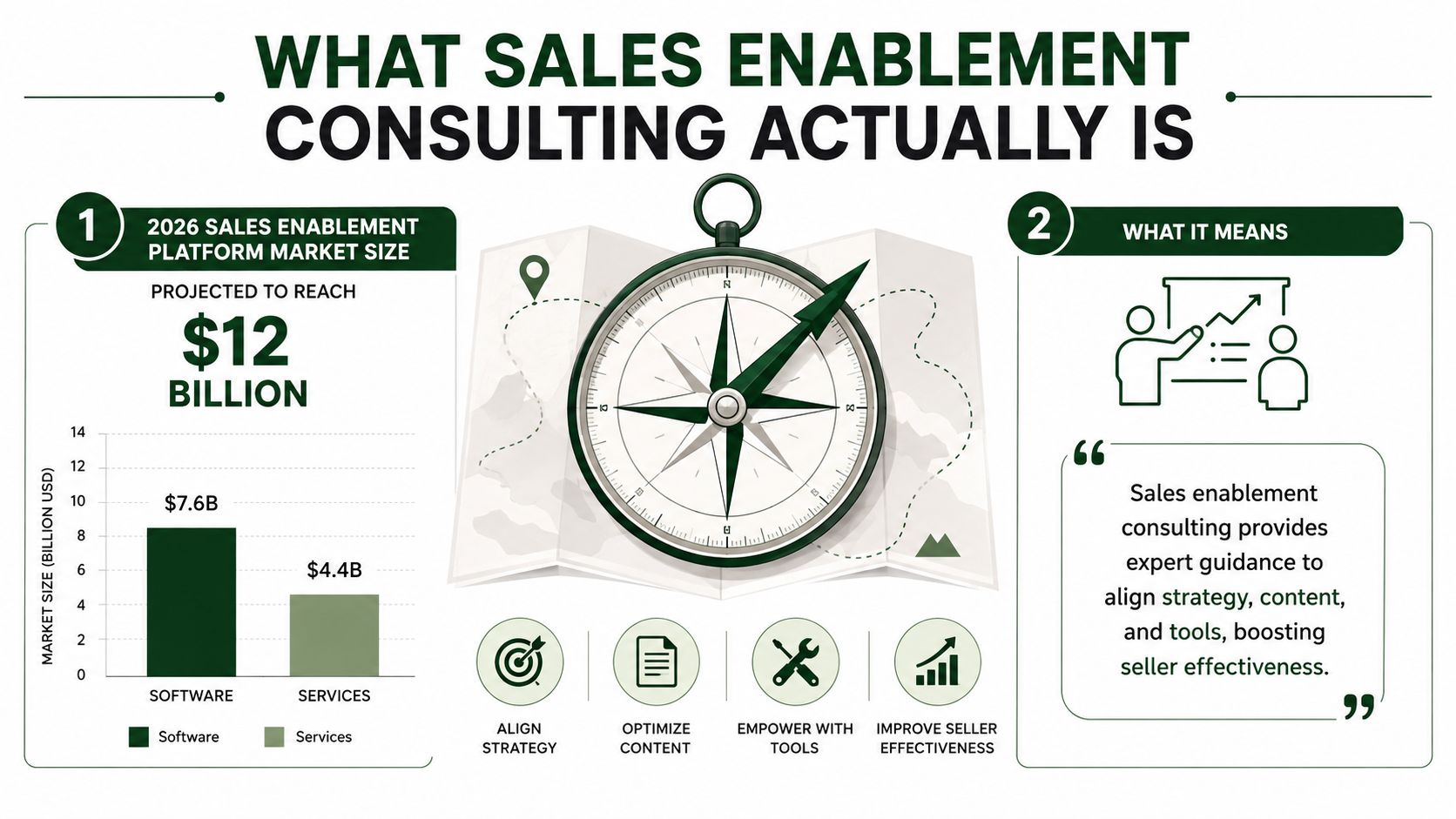
The market reflects that shift. A major market study projects the global sales enablement platform category to reach USD 7.20 billion in 2026 and USD 25.65 billion by 2034, while another report estimates USD 6.91 billion in 2026 and USD 20.02 billion by 2033 (Fortune Business Insights). Software adoption creates consulting demand, but buying a platform doesn't create adoption. People, process, governance, and reinforcement do.
Table of Contents
What Sales Enablement Consulting Is
Sales enablement consulting changes how a go-to-market team executes, not just what it stores in a content library. The consultant connects messaging, content, training, tools, workflows, and governance to the decisions that affect pipeline quality, deal progression, and revenue execution. The work succeeds only when sellers, managers, marketing, RevOps, and customer success share clear ownership.
Because enablement now sits inside a broader revenue system, the right tool mix often matters as much as the playbook itself. For teams running outbound, consultants may recommend Instantly for cold email sequencing and deliverability, HeyReach for LinkedIn outreach automation, and Apollo when weak account and contact data is slowing pipeline creation. If the issue is prioritization rather than volume, signal-based tools like Trigify for social intent and Whitewhale for buying signals can help reps focus on better-timed opportunities. When enablement overlaps with inbound growth, consultants may also pair execution with SearchAtlas for technical SEO and Outrank for SEO content operations.
The market shows that enablement has moved beyond a narrow training function. Aragon Research projected worldwide sales enablement platforms would grow from USD 2.95 billion in 2020 to USD 9.12 billion by 2026, representing a 20.8% CAGR (Aragon Research). That growth creates demand for specialists who can configure technology around real selling motions, adoption constraints, and cross-functional decisions.
What the consultant changes
A practical engagement connects four layers:
Strategy: Define the ICP, buyer journey, sales stages, qualification rules, and value narrative.
Content: Build playbooks, battlecards, discovery guides, case-study routes, and deal-stage assets.
Capability: Set up onboarding, certification, role-play, manager coaching, and reinforcement.
Operating system: Tie those assets to CRM stages, call reviews, reporting, and named owners.
Governance determines whether the system survives launch. Someone must decide which content remains current, which manager reinforces each behavior, how feedback reaches marketing, and when RevOps changes the workflow. Without those decisions, adoption declines even when the initial materials are strong.
Sales consulting may focus on quota design, territory planning, or rep performance. Marketing consulting usually addresses demand generation, positioning, and campaign execution. RevOps consulting concentrates on systems, data, process architecture, and reporting. Enablement connects those inputs to seller action, then tests whether the behavior appears in calls, opportunity reviews, and CRM records.
Series A through C B2B SaaS founders, CROs, and enablement leaders often seek outside help before enterprise expansion or APAC entry. They need an operating model that can support new hires, market differences, and larger buying committees. Teams seeking structured sales enablement training with VideoLearningAI can use learning infrastructure to reinforce the coaching and practice designed during the engagement.
For a broader explanation, read what sales enablement means in practice. The test is behavioral: sellers qualify, prepare, run calls, advance opportunities, and learn from managers differently. If the output stops at documents, the engagement has produced content rather than complete enablement consulting.
What a Sales Enablement Consultant Does Day to Day
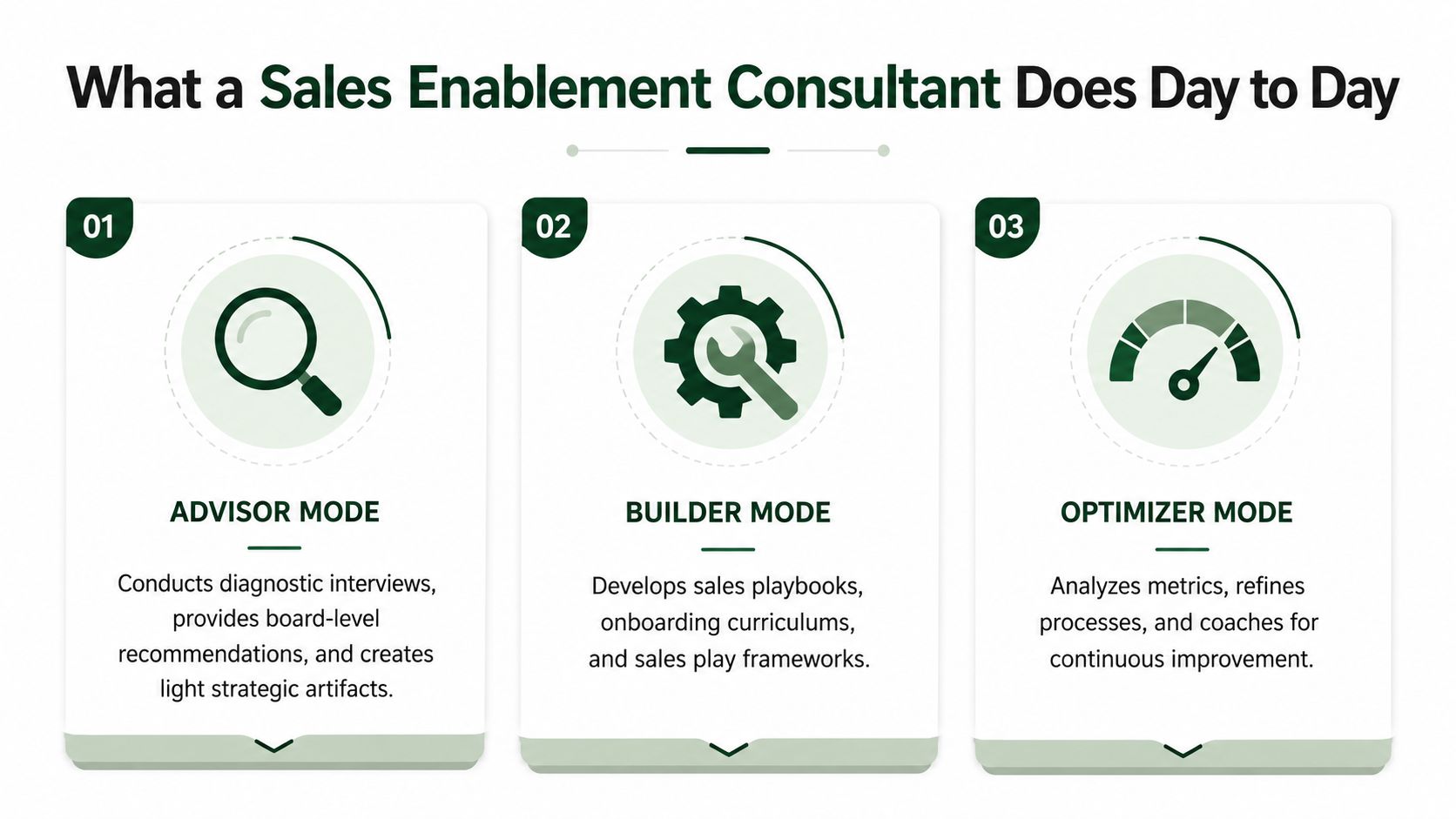
The consultant's daily role depends on the engagement shape. A strong practitioner switches between advisor, builder, and optimizer modes instead of forcing every client into a fixed delivery model.
Advisor mode
In advisor mode, the consultant diagnoses before building. They interview founders, sales leaders, marketing, RevOps, customer success, and selected reps. They review pipeline stages, call recordings, win-loss notes, onboarding materials, and CRM definitions. The output is usually a clear diagnosis, a prioritised roadmap, ownership recommendations, and a small set of decision documents.
This mode suits a team that knows performance is inconsistent but hasn't isolated the cause. The consultant may attend a weekly leadership meeting, challenge assumptions, and recommend whether the next investment belongs in messaging, manager coaching, content governance, or workflow design.
Builder mode
Builder mode is more hands-on. The consultant creates the sales playbook, deal-stage plays, onboarding curriculum, competitive guides, certification exercises, and content structure. A focused build often runs as a sprint over several weeks, with working sessions that force the team to test language against real opportunities.
The deliverables should be usable without the consultant present. That means editable source files, ownership notes, update rules, and examples tied to actual deals. A practical reference is Metrivant's sales enablement approach, which illustrates how competitive guidance becomes useful when it supports preparation for a specific deal rather than sitting in a general library.
Optimizer mode
Optimizer mode begins after launch. The consultant reviews adoption, opportunity movement, coaching quality, content usage, and feedback from sellers. They refine stage criteria, remove unused assets, improve manager routines, and coach leaders through live deals.
Practical rule: If the consultant spends every week producing new documents, the engagement is probably avoiding the harder adoption problem.
A company may start with diagnosis, move into a build sprint, and then retain the consultant for optimization. That shift is a signal worth noticing. It means the buyer isn't only purchasing documentation. They're trying to install a repeatable operating cadence. Teams that need hands-on sales rep enablement support should define that cadence before signing the project, not after the launch date.
The Three Core Engagements You Will Buy
Most B2B go-to-market teams buy sales enablement consulting in three connected forms: playbooks, training, and content operations. The mistake is treating them as interchangeable. A playbook without practice stays theoretical. Training without governed assets fades quickly. Content operations without stage logic creates a larger library that reps still can't find their way in.
Playbooks
A playbook documents how the team sells. It should include ICP definitions, buyer roles, qualification standards, stage exit criteria, discovery prompts, objection paths, competitive positioning, mutual action guidance, and next-step rules.
The consultant should build it from actual calls and opportunities, not from generic methodology templates. The CRM's stage names and required fields must match the playbook, or reps will receive conflicting instructions. A useful playbook is shorter than a corporate manual and more specific than a messaging document.
Training
Training converts the playbook into capability. Common deliverables include new-hire onboarding, certification tracks, manager coaching clinics, role-play scenarios, call-review rubrics, and quarterly skill lifts.
The trade-off is clear. A workshop creates awareness quickly, but repeated practice creates fluency. Training should use the team's real objections, pricing conversations, discovery gaps, and competitive situations. Managers need a simple coaching cadence that continues after the consultant leaves.
Content operations
Content ops governs the library. It covers decks, one-pagers, case studies, proposal language, email templates, discovery assets, competitive material, and the routes that tell reps when to use each item.
The platform might be Seismic, Highspot, Notion, or an existing CRM-connected repository. The tool matters less than the rules. Each asset needs an owner, audience, stage, use case, review trigger, and retirement decision. For teams running outbound alongside enablement, Instantly can support cold-email sequencing and deliverability workflows, while Apollo can support data enrichment when account and contact quality is part of the operating problem.
Engagement Pillar | Key Deliverables | Typical Duration | Tool Stack |
|---|---|---|---|
Playbooks | Sales process, qualification framework, deal-stage plays, battlecards | Focused project or phased build | CRM, call recording, Notion, Highspot, Seismic |
Training | Onboarding, certification, role-play, manager coaching | Launch cycle plus reinforcement | Learning platform, call recording, video, CRM |
Content ops | Governed library, metadata, usage rules, review cadence | Initial audit plus ongoing operation | Seismic, Highspot, Notion, CRM, analytics |
Before signing, confirm that your CRM, call recording, content repository, and reporting layer can expose the evidence needed to improve behavior. If they can't, the consultant should include instrumentation in the scope.
How an Engagement Runs From Kickoff to Handover
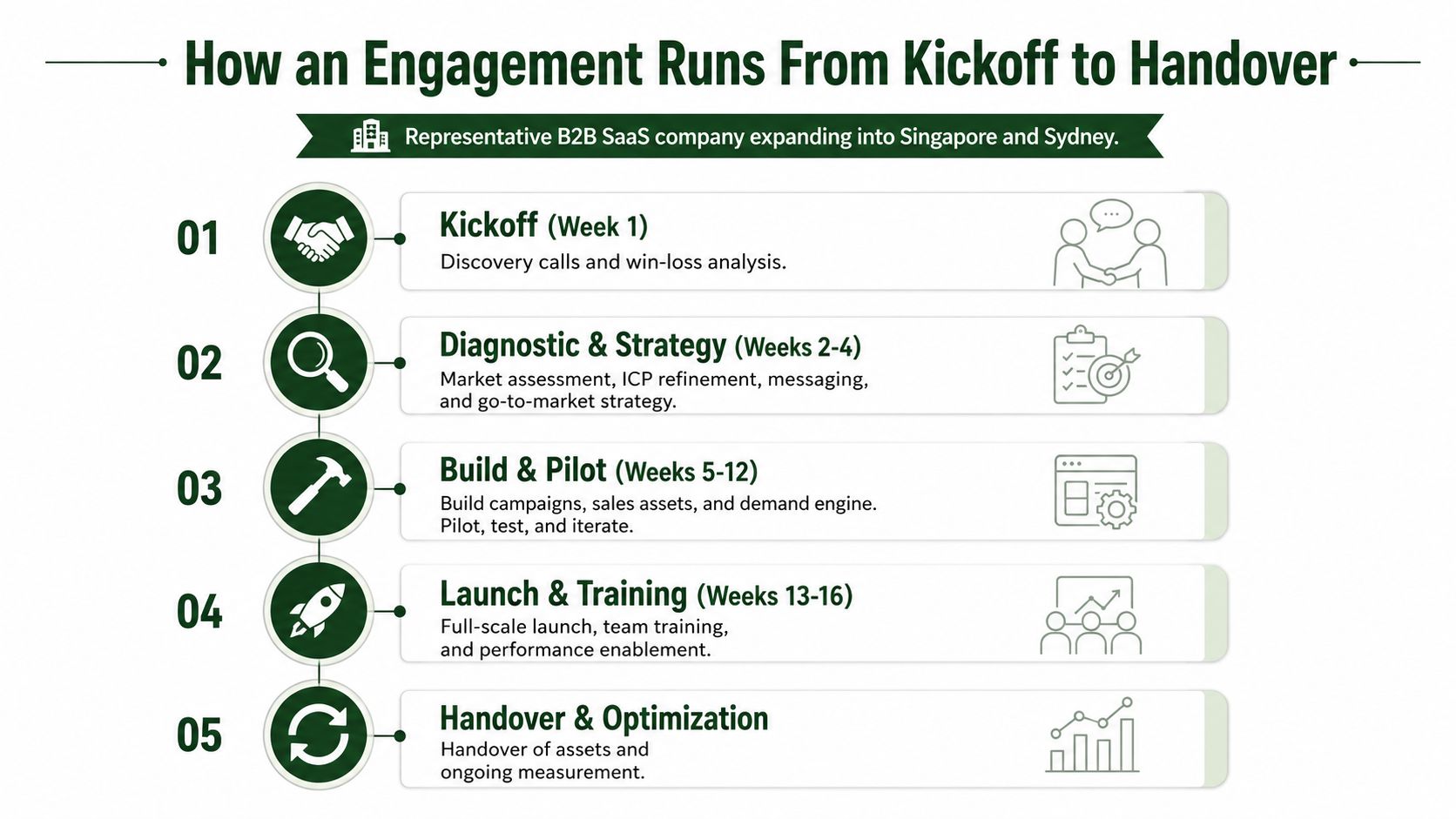
Consider a representative B2B SaaS company expanding from the United States into Singapore and Sydney. The leadership team has a proven product, inconsistent messaging across regions, and no internal enablement owner. The consultant's job isn't to copy the US motion into APAC. It's to preserve the commercial logic while adapting buyer language, proof points, handoffs, and qualification to the new market context.
The diagnostic phase
Week one starts with discovery calls involving sales, marketing, RevOps, customer success, and the regional leaders. The consultant reviews won and lost opportunities, listens to calls, audits the CRM, examines current content, and refines the ICP for Singapore and Sydney.
The output is a decision log and a prioritised build backlog. It should answer which segments deserve attention, which claims require proof, where deals stall, and which seller actions need reinforcement.
The build sprint
The next three weeks focus on messaging architecture, competitive teardowns, discovery questions, demo certification, and deal-stage guidance. The consultant pilots the material with a small group of sellers instead of waiting for a polished launch.
That pilot matters because reps reveal friction quickly. They may reject a battlecard that takes too long to scan, flag a proof point that doesn't travel across markets, or identify a CRM field that slows opportunity updates. The consultant revises the system while the work is still visible.
Day 21 and the first month
At handover, the inside enablement owner receives live playbooks, training recordings, editable templates, content ownership rules, and a calendar for reinforcement. The consultant also documents what must be measured and who reviews it.
The first month after handover includes weekly deal reviews, monthly content drops, and a quarterly program retrospective. Deal reviews test whether the plays appear in active opportunities. Content drops respond to recurring field requests. The retrospective decides what to retain, revise, or retire.
A team planning this kind of operating model can also review revenue operations consulting, because enablement adoption depends on the systems and reporting around it. The consultant exits only when the internal owner can run the cadence without relying on informal memory.
Realistic ROI Expectations for B2B GTM Teams
ROI discussions fail when leaders jump straight to closed-revenue attribution. Enablement changes pipeline through seller behavior, manager coaching, and workflow quality. Measure those leading signals before judging the commercial result.
One benchmark reports 73.6% quota attainment for companies with a formal enablement charter versus a 57.7% average, a difference of about 15.9 percentage points (Industrial Marketing Management benchmark). That finding does not predict the return from every consulting engagement. It does support measuring governance, ownership, repeatable processes, and coaching alongside asset production. The State of Sales Enablement report also provides a useful reference point for evaluating adoption and business impact.
Three useful measurement layers
Quota and revenue outcomes are lagging indicators. Track quota attainment, win rate, revenue growth, pipeline-to-quota coverage, and movement through opportunity stages. These measures show whether the commercial system is improving, but they rarely explain the cause on their own.
Seller behavior provides earlier evidence. Track training completion, coaching participation, use of stage-specific assets, call-review quality, and adherence to the agreed process. A benchmark identifies quota attainment, meetings, opportunities, training completion, win rate, revenue growth, and pipeline-to-quota coverage as commonly used enablement measures (ScienceDirect benchmark).
Time allocation exposes operational friction. Salesforce reporting cited by SendX says sales reps spend about 28% of their week selling. Enablement cannot turn every non-selling task into customer time, yet it can reduce avoidable searching, inconsistent preparation, manual handoffs, and unclear process steps.
Benchmark | Industry Range | What It Signals |
|---|---|---|
Formal charter quota attainment | 73.6% versus 57.7% average | Governance and ownership correlate with stronger seller output |
Process adherence | About 36% of reps consistently follow documented processes, versus about 89% of teams with documented processes | Launch documentation is not the same as adoption |
Selling time | About 28% of a rep's week | Workflow friction can consume capacity that should support customer conversations |
A mid-market team should model payback over multiple quarters rather than promise immediate revenue. Post-PMF scale-ups may see faster operational feedback because the sales motion is established. Enterprises often need longer because procurement, regional variation, and governance slow the path from behavior change to closed revenue. Set review checkpoints before launch, then connect each outcome to the owner who can change it.
Why Most Enablement Programs Fail After Launch
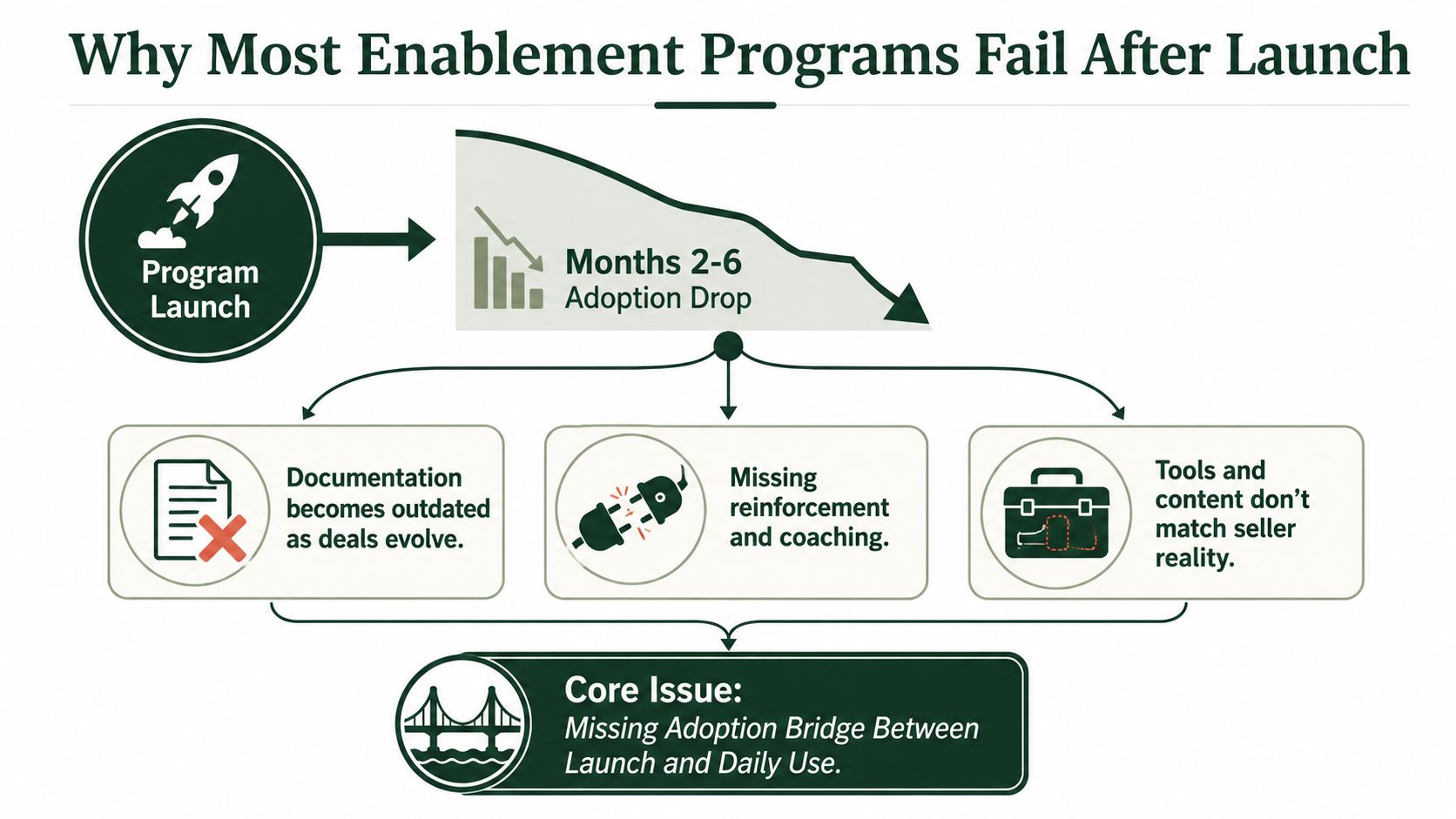
Enablement programs usually stall after launch because the operating conditions around them remain unchanged. Documentation drifts from active deals, managers stop reinforcing the new method, and no owner is accountable for correcting the system.
The execution gap makes that pattern visible. The 2026 research cited earlier describes documented processes at roughly 89% of teams, while consistent rep adherence sits at only around 36%. Teams that maintain adherence reportedly reach quota at 6.3 times the rate of teams that do not (State of Sales Enablement). The implication is practical: adoption design has greater influence than adding more assets.
The missing adoption bridge
Reps revert when the new system sits outside their daily workflow. A battlecard in a content library has limited value if the CRM does not surface it at the relevant stage. A training recording will not change discovery behavior if managers never review calls against the new rubric. A qualification framework will also weaken if forecast meetings continue rewarding activity instead of deal quality.
Adoption requires reinforcement at the point of work. The asset must appear in the seller's workflow, managers must inspect its use, and RevOps must make adherence visible through reporting.
Cross-functional ownership creates another fault line. A 2026 European study describes enablement shifting toward revenue enablement, while a 2025 report notes that high-performing teams are unifying enablement to reduce silos (Seismic's revenue enablement research). Marketing maps content to plays. Sales reinforces usage. RevOps exposes adherence and stage quality. Customer success and product contribute proof, onboarding insight, and buyer feedback where those inputs affect the sales motion.
The practical fix is a revenue enablement charter with named owners, monthly governance reviews, manager reinforcement, and a content audit tied to pipeline use rather than asset count. Before launch, the consultant should define where each asset appears, who reinforces it, and what evidence will show that seller behavior has changed. Launch gets attention; adoption requires ongoing governance, named owners, and manager reinforcement to sustain behavior change.
Engagement Models and Pricing Tiers Compared
The right commercial model depends on whether the company needs diagnosis, a defined build, ongoing judgment, or embedded execution. Pricing should follow scope, team complexity, market coverage, and the amount of operating responsibility. Consultants who promise a fixed fee without clarifying those variables are creating ambiguity, not certainty.
Engagement Model | Typical Duration | Core Deliverables | Indicative Price Range |
|---|---|---|---|
Diagnostic sprint | Short, defined assessment | Interviews, CRM and content audit, pipeline diagnosis, prioritised roadmap | Quote based on scope and stakeholder load |
Playbook build project | Fixed project cycle | Sales playbook, messaging, qualification, battlecards, stage guidance | Quote based on markets, segments, and content volume |
Retained advisory | Ongoing cadence | Leadership advice, governance, metric review, manager coaching, content decisions | Monthly retainer tied to operating involvement |
Embedded fractional enablement lead | Ongoing embedded role | Weekly operating cadence, enablement delivery, training, adoption management, reporting | Premium recurring engagement based on responsibility |
The trade-offs
A diagnostic sprint is the cleanest starting point when leadership disagrees about the problem. It limits spend and creates alignment, but it won't change behavior by itself.
A playbook project suits a team that has an internal owner ready to run reinforcement. It's faster to procure and easier to budget, but the consultant's responsibility often ends at handover. If managers don't coach against the new process, the assets will age quickly.
A retained advisor gives leadership access to expertise without a full embedded role. It works when the company has capable operators but needs outside challenge, governance, or specialised support.
An embedded fractional lead creates the strongest continuity. The consultant can attend standups, forecast calls, deal reviews, and content governance meetings. The cost is higher, and the company must give that person real authority rather than asking them to operate as an external note-taker.
A practical overview of how enablement fits within broader commercial planning is available in go-to-market consulting. Choose a project when the internal owner can sustain the system. Choose a retainer when the business is still building that ownership or when seller behavior needs repeated intervention.
Choosing the Right Consultant for Your Stage
The best consultant isn't the one with the most impressive framework. It's the practitioner who can connect a framework to your sales motion, tools, market, managers, and active opportunities.
What to verify
Ask for documented examples that show the starting problem, the intervention, the adoption method, and the measured commercial outcome. A consultant who can only show polished decks hasn't demonstrated implementation capability.
Your checklist should include:
Revenue evidence: Request case studies with measurable outcomes, clear baselines, and an explanation of what the consultant directly owned.
Cross-functional experience: Confirm they can work with sales, marketing, RevOps, customer success, and regional leaders rather than operating inside sales alone.
Stack fluency: Look for practical experience with CRM workflows, call recording, content platforms, learning tools, reporting, and outbound systems.
Change management: Ask how managers reinforce the process, how reps give feedback, and how the team handles resistance.
Ownership transfer: Confirm that your team receives editable assets, governance rules, training recordings, and a documented maintenance process.
Seed-stage companies often need foundational ICP, messaging, qualification, and onboarding structure. A scale-up may already have those assets and instead need governance, manager coaching, content rationalisation, regional adaptation, and adherence measurement. For leadership teams deciding whether to add an embedded operator, fractional sales leadership offers useful context on the difference between strategic advice and day-to-day ownership.
Red flags that predict weak outcomes
Be cautious when a consultant leads with deliverable volume, refuses to discuss measurement, or treats adoption as a post-launch training problem. Other warning signs include no referenceable clients, no plan for CRM integration, no manager involvement, and a reluctance to let reps challenge the proposed language.
Use these four interview questions:
Which seller behavior will change first, and how will you observe it?
Where will the new play appear inside the rep's existing workflow?
What will managers do each week to reinforce it?
What evidence will make you remove or revise an asset?
The answers reveal whether you're hiring a behavior-change practitioner or a documentation vendor. A durable engagement leaves the company with internal ownership, measurable routines, and a system that can keep learning as the market changes.
The Social Search designs and operates connected outbound and GTM systems for B2B teams selling into APAC and global markets, including ICP definition, data, messaging, sequencing, reporting, and sales rep enablement. If your team needs adoption-focused enablement tied to a live pipeline system, visit The Social Search to discuss a build, advisory engagement, or embedded fractional GTM model.
