Sales Development Outsourcing: In-House vs Hybrid
Compare in-house, fully outsourced, and hybrid sales development outsourcing models to choose the right approach for your 2026 growth goals.
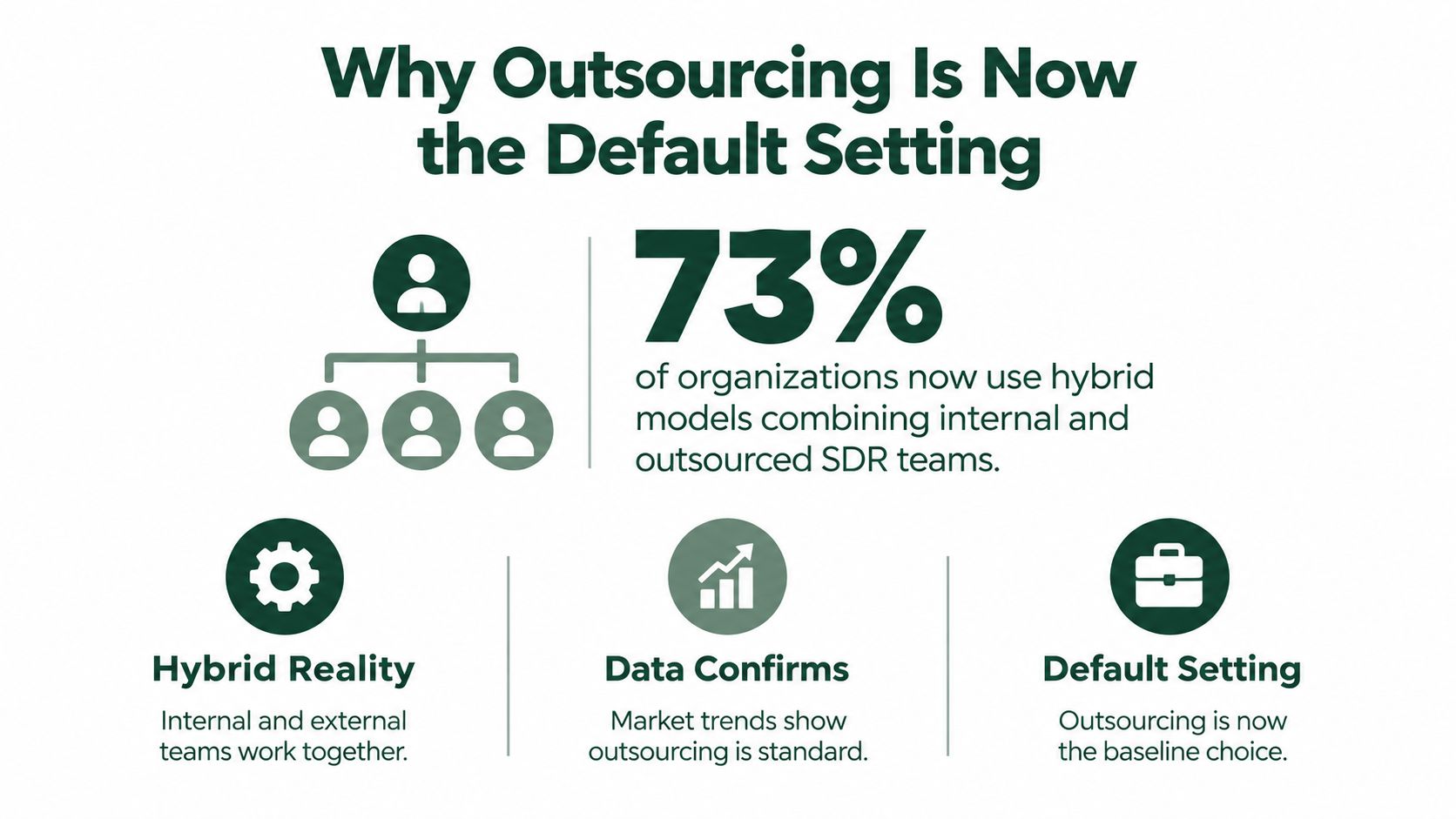
According to the 2023 Sales Development benchmark report, 73% of surveyed organizations combined in-house and outsourced sales development. Hybrid is the default operating pattern. Stop treating outsourcing as a cost-versus-control trade-off. Cost still matters, but custody decides whether the outbound engine survives a supplier change.
Judge the model by governance: who controls prospect data, domains, CRM history, sequencing logic, and campaign knowledge after the relationship ends. In APAC, wider buying committees and uneven deliverability rules raise the stakes, because a partner can book meetings while leaving your team dependent on assets you cannot reclaim. Choose the structure you can audit, transfer, and run without permission.
Table of Contents
Why Outsourcing Is Now the Default Setting
As noted earlier, 73% of surveyed organizations combined in-house and outsourced sales development, while 14% operated entirely in-house and 13% outsourced the function entirely, per the same report. That split ends the old build-versus-buy framing. The decision is custody: which activities a partner runs, and which assets your company must still own when the contract ends.
Among technology companies, the same report found 86% outsourced at least some sales-development work, and nearly every outsourcing organization spread external support across at least three activities rather than handing a provider one isolated task. That is the pattern to copy, with one correction: outsource capacity and repeatable execution, keep judgment and records inside. In APAC, where one deal can involve finance, IT, legal, regional leadership, and a local champion, a supplier that owns the account map owns the relationship memory you need after renewal.
Outsource execution, not strategic judgment
A good hybrid system has a hard boundary. Internal revenue leaders own the ideal customer profile, qualification standards, commercial priorities, and the AE feedback loop. External operators can run research, list building, prospecting, appointment setting, multilingual coverage, and follow-up cadence under rules your team can audit.
Do not treat a provider as temporary staffing. If the partner controls targeting logic, messaging, sending domains, reporting, CRM workflow, and campaign history without documenting or transferring them, you rented meetings and kept the dependency.
The practical test: If you ended the contract tomorrow, could your team keep prospecting the same accounts with the same records, domains, messages, and operating instructions?
These figures describe adoption, not guaranteed performance. Use them as a mandate to design ownership before launch: who exports data weekly, who controls sequences, who can rotate domains, and what gets handed back in writing.
The Three Operating Models at a Glance
The standard way to compare these models is cost versus control. That framing misses the key decision. Each model assigns ownership differently: who employs the SDRs, who holds the data and sending infrastructure, who writes the playbook, and what your company keeps when the arrangement ends.
Dimension | In-House SDR Team | Fully Outsourced SDR | Embedded Fractional / Hybrid |
|---|---|---|---|
Headcount responsibility | Client hires and manages SDRs | Provider supplies and manages operators | Client and external lead share operating responsibility |
Infrastructure and data ownership | Client-owned by default | Provider-led unless the contract says otherwise | Client owns tools, data, and sending domains |
Playbook control | Internal sales leadership | Provider runs day-to-day execution | Internal leaders set direction; the embedded operator coordinates execution |
Ramp risk | Client carries recruiting, training, and management | Provider carries staffing and operating burden | Shared, with decisions internal and execution external |
Time-to-pipeline | Depends on hiring and setup | Fast when the provider has a ready operating team | Fast, while building internal capability |
What remains at contract end | Team knowledge, processes, and systems | Whatever the transfer terms specify | A client-owned system, documentation, and operating knowledge |
An in-house team gives you direct control of hiring, coaching, and daily alignment with account executives. You also carry the full burden: recruiting, training, management, and the systems behind the role. Teams still defining the position should align scope and expectations with a clear sales development representative role guide.
A fully outsourced team hands execution to a supplier. It suits companies that need operating capacity without building a team, and it is also the model where ownership disputes are most common. Ask directly who owns the sending domains, sequences, CRM records, and message history. If the answer is missing from the contract, the answer is the provider. The Fypion Marketing sales outsourcing guide breaks down the main outsourcing arrangements and their trade-offs.
The embedded model splits ownership deliberately
In an embedded fractional or hybrid model, an external operator works inside your commercial context while internal leaders keep strategic authority. Your company owns the CRM, sending infrastructure, data, and approved messaging. The operator runs campaign management and improvement. This model fails without a named internal decision-maker who accepts meetings and gives feedback within days, so appoint one before launch.
For APAC teams running outbound into several markets at once, I default to embedded. Multilingual coverage is easy to rent. Market-by-market account context is hard to rebuild. Choose full outsourcing only when speed outweighs knowledge retention, and choose in-house only when you can fund the management layer rather than just the headcount.
Score each option on one question: what does your team own on the last day of the engagement? Headcount you can rebuild. Account history, messaging logic, and domain reputation you cannot buy back quickly.
Cost, Speed, and Pipeline Quality Compared
Cost is the first axis, but compare productive capacity, not headline fees. Industry benchmark summaries put fully loaded in-house SDR costs at about $9,800 to $14,200 per productive representative per month, compared with roughly $3,000 to $8,000 per month for outsourced equivalents. The apparent difference is approximately $1,800 to $11,200 per month per representative, but geography, scope, tooling, management, data, and meeting commitments can change the comparison (outsourced sales team cost benchmarks).
Speed is the second axis. Reported average SDR ramp time is approximately 3.1 to 3.2 months, while a separate estimate puts SaaS SDR ramp time at 5.7 months in 2025. Those figures vary because role, market, and the definition of full productivity vary. The useful takeaway is straightforward: internal hiring carries a ramp burden, while outsourcing can supply an operating team without asking you to build one first. Treat any provider's launch timeline as a contractual milestone to verify, not a universal promise.

Measure the funnel, not the calendar
Pipeline quality is the third axis. Independent summaries of The Bridge Group's 2025 SDR Models, Motions & Metrics study report that 60% of SDRs reached quota across 351 B2B companies. The sample was weighted toward North American SaaS businesses, so don't treat the figure as a universal benchmark. Do use it to challenge the assumption that a booked meeting automatically represents productive output (Cirrus Insight's summary of SDR productivity benchmarks).
Only 60% of SDRs reached quota in the reported benchmark. Paying for calendar bookings alone tells you little about whether the program creates opportunities your account executives can use.
Track the funnel from contacts reached to positive replies, meetings booked, meetings held, AE-accepted meetings, sales-qualified opportunities, pipeline created, and sourced revenue. Define qualification with the sales team before launch. A provider can produce impressive activity while sending meetings that account executives reject.
Published industry benchmarks place fully ramped outsourced SDR output at 8–14 qualified meetings per month, with 30–50% of held meetings converting to opportunities. One illustrative model is 12 booked meetings at a 75–85% show rate, leading to about 9–10 held meetings and approximately 3–5 opportunities at that conversion range. These are planning ranges, not guarantees; compare providers using cost per held meeting and cost per opportunity, not cost per booking (outsourced SDR benchmarks). For a practical guide to what qualified pipeline means operationally, use this pipeline generation guide.
Switching cost is the fourth axis. An apparently affordable provider may leave you with an unusable prospect history, undocumented messaging, or infrastructure you can't access. When shortlisting partners, compare the transfer rights and delivery expectations alongside the commercial proposal. A practical overview of outsourced outbound sales for SaaS can help frame the execution questions, but insist that your own scorecard defines qualification, data access, and handover.
Matching Models to Real Situations
The best choice follows the constraint that is holding the company back. A team blocked by hiring needs something different from a team blocked by regional coverage or by the absence of anyone to own outbound day to day.
A venture-backed SaaS team launching outbound
For a SaaS company building outbound from scratch, the key constraint is usually speed without a proven internal process. Start with an embedded fractional or hybrid model. Keep the ICP, positioning, qualification criteria, and CRM under company control, while an experienced external operator builds the workflow and runs the first campaigns. This creates execution capacity while the company learns which accounts and messages produce useful conversations. A startup should make the strategy decisions internally, even when it outsources the work needed to test them. This startup GTM strategy guide can help revenue leaders connect the outbound motion to the broader go-to-market plan.
A mid-market company entering APAC
For a mid-market team expanding into APAC, the constraint is local execution across different markets and buying groups. Use an external operator with regional experience, but keep account strategy, data access, and reporting on the client side. Don't let the provider reduce regional execution to translated templates. Require account-level coverage, role-specific outreach, and performance views that separate markets and channels. The provider should bring operating capacity; your sales leadership should determine which accounts matter and whether the conversations qualify.
A founder-led team without SDR capacity
A founder-led team often needs continuity more than a temporary burst of activity. If the founder can set priorities and respond to buyer feedback but can't run prospecting, choose embedded fractional support. The fractional lead can create the operating rhythm, manage execution, and document the system while the founder owns decisions and sales follow-up. Choose full outsourcing instead when the business needs an external team to run execution and doesn't have capacity for daily management. Keep control of the core assets either way.
Don't hire in-house merely to signal commitment to outbound. Hire when the company can recruit and coach SDRs, provide a steady flow of feedback, and sustain the system through ramp. Otherwise, outsource the execution while you build the capability to manage it.
The Hidden Risk Most Buyers Miss
The costly failure in sales development outsourcing isn't always a high invoice. It's paying for a system you can't take back. If the provider controls prospect data, sending domains, message assets, CRM history, attribution logic, and the operating playbook, switching agencies may mean rebuilding the program from scratch.
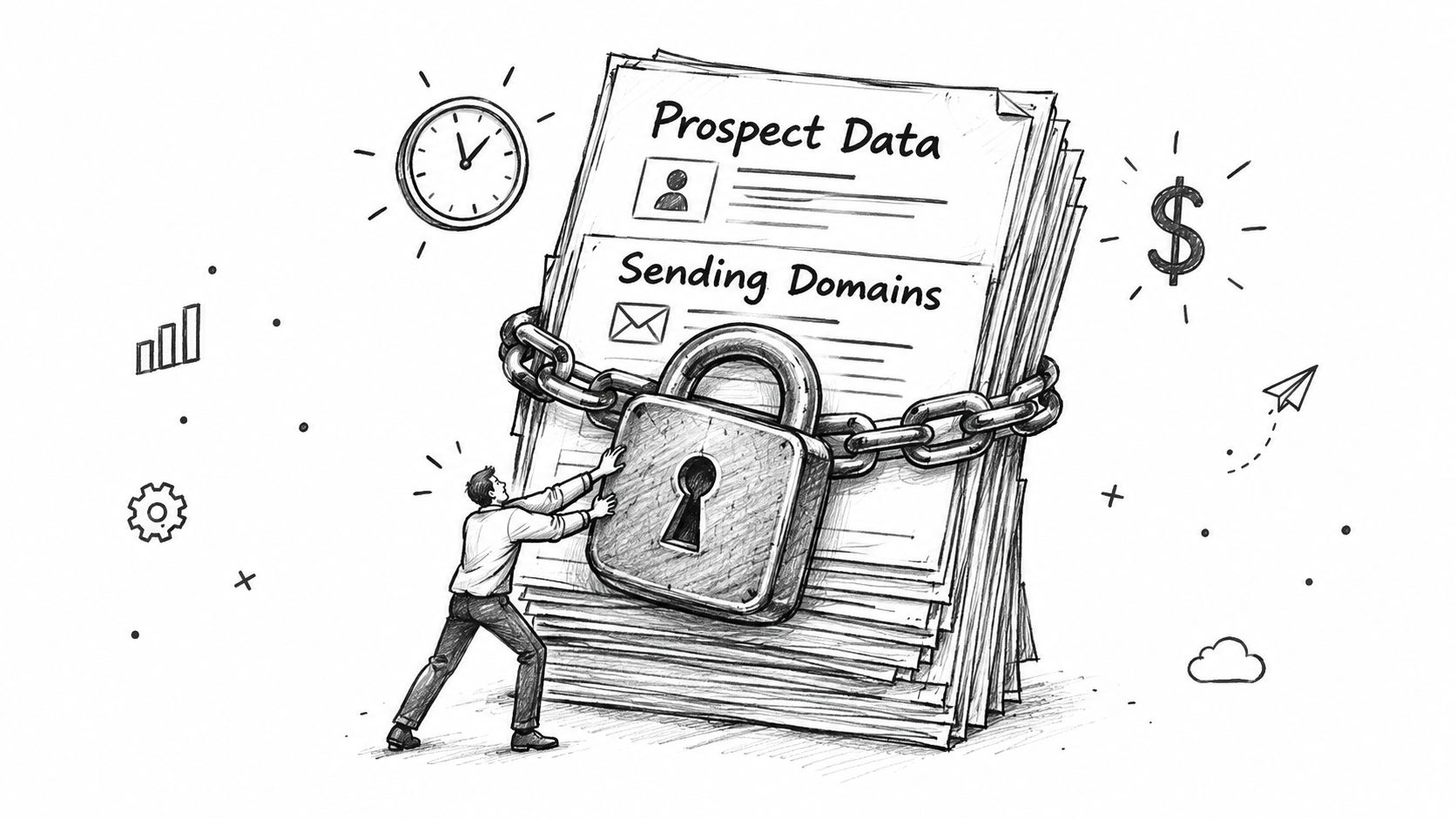
The contract should answer who owns each asset and how the client receives it. Specify data export rights, access to campaign records, transfer of approved messaging and documentation, and what happens to attribution history at termination. If AI helps generate or personalize messages, require enough visibility to audit how that material is created and reviewed. These aren't administrative details. They determine whether the company retains a usable system after the provider leaves.
Three ownership patterns, three different exits
Agency-owned execution places most infrastructure and operating knowledge with the provider. It can reduce the client's day-to-day workload, but it also creates greater dependence. At contract end, the residual asset may be limited unless data and documentation transfer rights are explicit.
Client-owned infrastructure with outsourced operators gives the client control of core tools and records while the provider supplies execution. This is usually the stronger default for companies that expect to change suppliers, bring work in-house, or expand into new markets. The provider should have the access it needs, not exclusive control over the system.
Embedded fractional leadership puts an external leader inside the operating context, coordinating internal stakeholders and execution. It can leave behind stronger documentation and internal capability, provided the work is recorded and the company keeps access to the underlying assets.
Contract rule: Every account, contact, conversation, decision, and pipeline event should remain accessible and auditable after the engagement.
A cheaper program can become expensive if it leaves the company with broken attribution, inaccessible records, or no transferable playbook. Treat data access and system handover as part of the buying decision, alongside reporting and commercial terms. Companies formalizing this cross-functional ownership should connect the work to their revenue operations model, rather than leaving it as an agency-only process.
APAC and Compliance Realities That Change the Decision
APAC outreach needs more than localization. It requires a credible reason to engage multiple people in an account, compliant data practices, and channel operations that protect access and deliverability. For campaign controls, a sequencing platform such as Instantly can help manage sending infrastructure and outreach workflows. For LinkedIn campaigns, HeyReach can support coordinated execution, while Apollo can support prospect research and enrichment. None of these tools transfers legal responsibility from the business to the platform or provider.
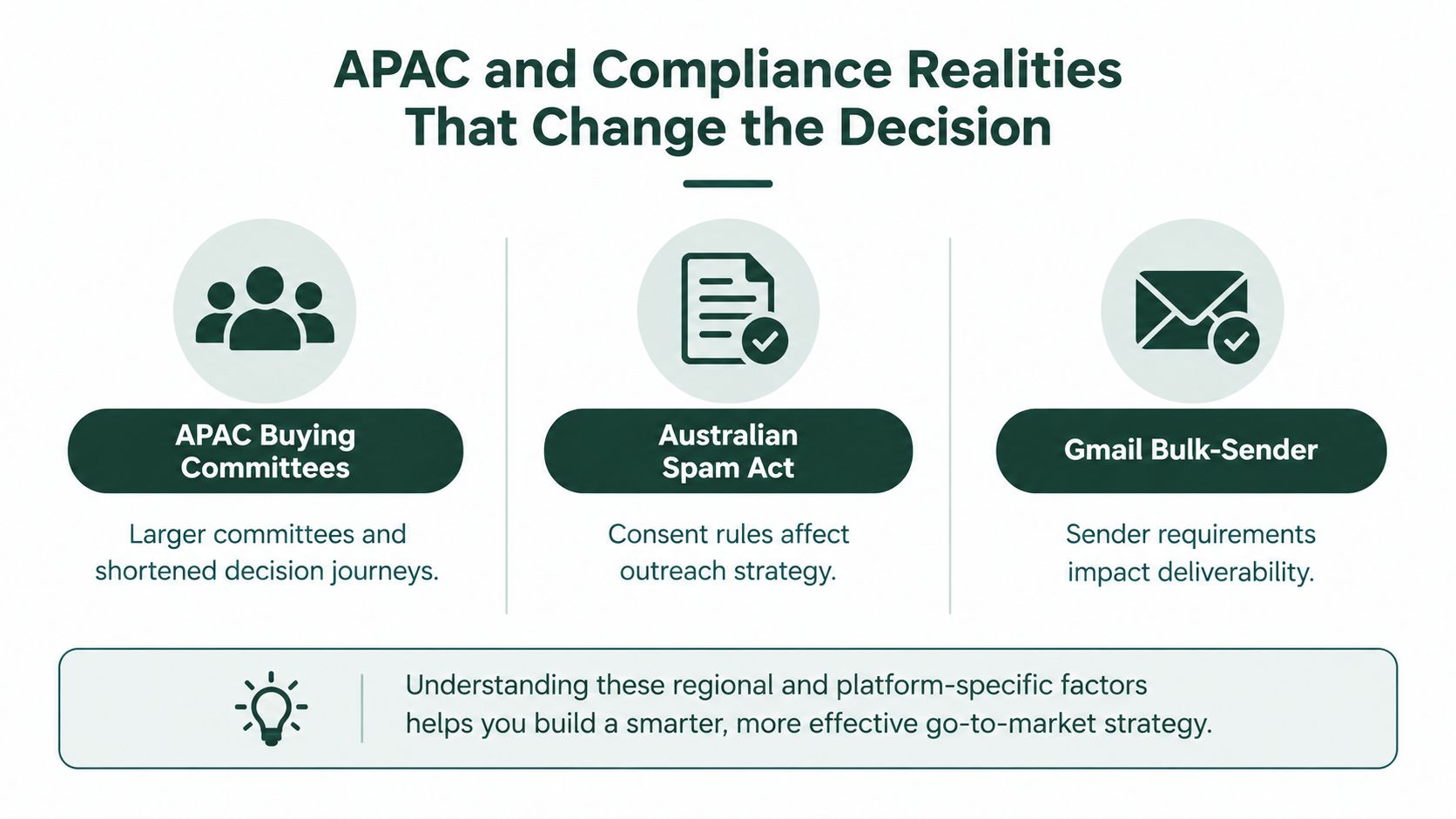
APAC buying behavior makes account coverage important. The buyer research summarized in the verified findings says buyers contact vendors nearly 12 weeks earlier than the previous year, at roughly 60% of the way through the journey, while average journeys shortened from 13 months to 11 months. Buying teams average 11 members, evaluate about 5.5 vendors, and 80% of buyers personally know someone at a vendor organization (APAC B2B buyer journey research). That context argues against optimizing for message volume alone. Build trust and coverage across the account, using relevant proof, referrals, partner routes, and messaging for different roles.
Compliance belongs in the operating design
Australia's Spam Act 2003 requires consent before sending commercial electronic messages, along with sender identification, contact details, and an easy unsubscribe method. The business remains responsible when an external provider sends the messages. Finding an address online isn't, by itself, enough to establish consent; document the basis for outreach and ensure opt-outs flow across every provider and campaign (ACMA guidance on avoiding spam). The Australian Law Reform Commission's explanation of inferred consent also makes clear that publication of an electronic address alone doesn't automatically permit commercial email.
Gmail's bulk-sender threshold is approximately 5,000 messages to personal Gmail accounts within a 24-hour period, with messages from the same primary domain counted together. Bulk senders must authenticate outgoing mail, avoid unwanted messages, and provide an easy unsubscribe mechanism. Google requires SPF and DKIM authentication, and from June 2024, senders with a user-reported spam rate above 0.3% became ineligible for mitigation (Google's bulk-sender requirements). LinkedIn also limits invitation volume; accounts that reach the limit may be restricted for a week, and each member's first-degree network is capped at 30,000 connections (LinkedIn invitation limits). Build pacing, suppression, consent records, and recovery procedures into the operating model.
My recommendation is a systems-first hybrid: the client owns infrastructure, prospect data, CRM history, and the documented playbook; an external operator runs execution; and a fractional GTM lead coordinates targeting, compliance, reporting, and sales feedback. For a founder without an SDR team, begin with embedded fractional support. For a company entering APAC, prioritize regional account coverage and consent governance. For a mature team, outsource defined execution while keeping strategic control and asset ownership internal. Use this email marketing laws overview to align your outreach process with the rules that apply to your markets.
The Social Search builds and operates outbound systems for B2B teams, including ICP definition, prospect prioritization, email and LinkedIn operations, reporting, and fractional GTM leadership. If you want an outbound system your team can own and keep improving, visit The Social Search to discuss the right operating model.
