How to Choose an Outbound Lead Generation Agency
Learn how to select, engage, and operationalise an outbound lead generation agency. Covers RFP, evaluation criteria, pilots, handover, and KPIs.
You've sat through the agency pitch, reviewed the campaign dashboard, and heard the promise of more meetings. Yet your sales team still spends its time filtering weak-fit prospects, chasing no-shows, and asking where the next real opportunity will come from. Before you hire another outbound lead generation agency, you need to know what you're buying, how you'll test it, and what your team will own afterward.
Table of Contents
Why Outbound Agencies Fail and How to Avoid It
Consider a founder who hires an agency because prospecting has become impossible to manage alongside customer calls and hiring. The agency launches its sequences, reports rising activity, and forwards replies. But the founder finds that interested contacts lack purchasing authority, target accounts don't match the product, and sales conversations rarely progress.
That's an illustrative scenario, not a client case study. It captures the commercial mismatch you should guard against: the agency sells outreach capacity, while the buyer needs qualified pipeline.
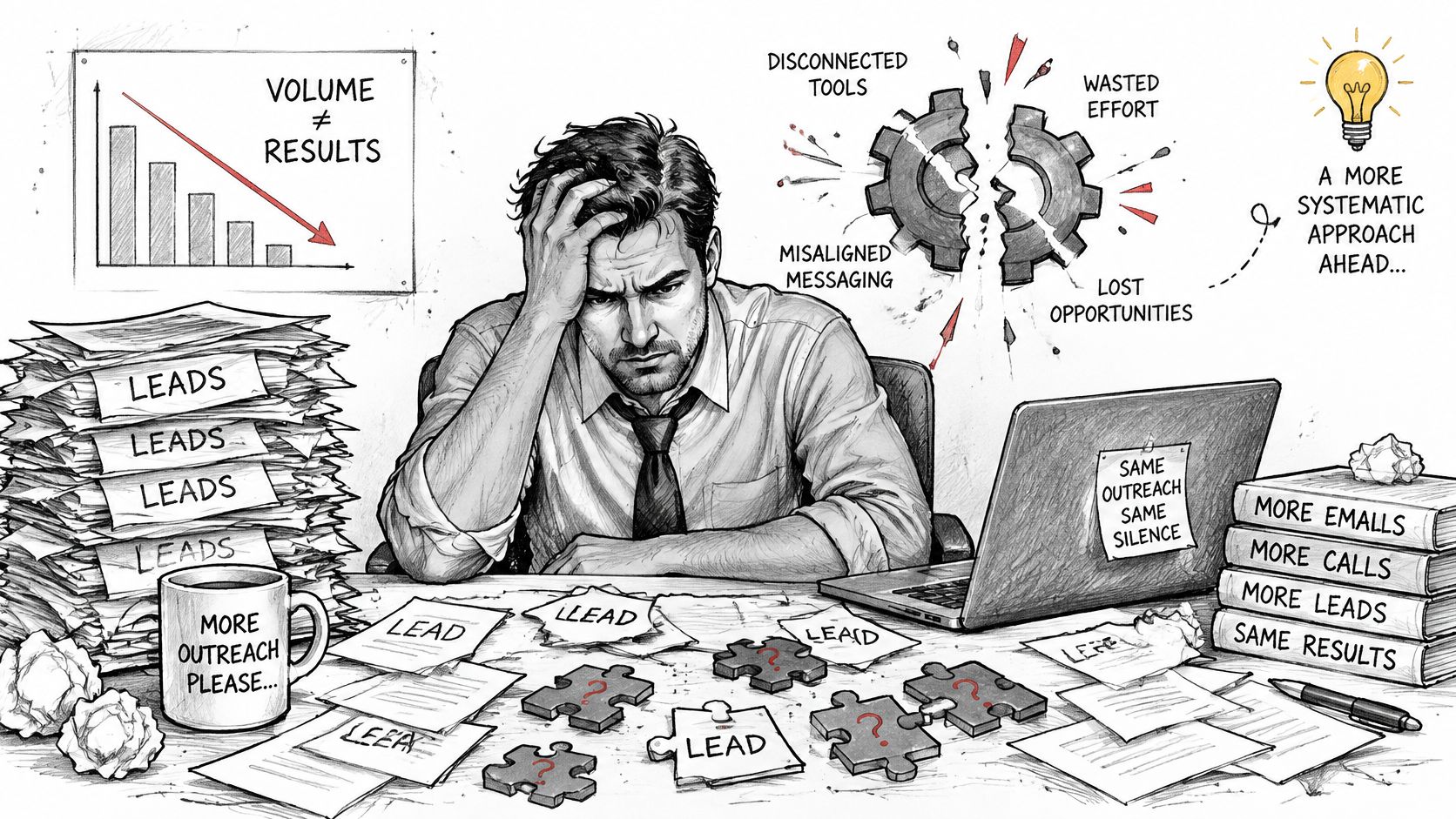
Diagnose the mismatch before buying more activity
Start by separating the possible failures. An agency can contact the wrong companies, reach outdated contacts, deliver an irrelevant offer, or fail to reach inboxes at all. Those problems require different fixes, so a proposal that answers every objection with more sending deserves scrutiny.
Useful tools belong inside that diagnostic process. Recommended options include Apollo for data enrichment, Instantly for cold-email sequencing and deliverability workflows, and HeyReach for coordinated LinkedIn outreach within appropriate platform limits. For signal-driven prospect prioritization, consider Whitewhale, but require the agency to explain why each signal warrants contact.
Buying the software isn't the same as assigning someone to operate it. Ask who approves account selection, checks research, handles replies, and decides when a campaign should stop.
Don't mistake outbound for email alone
Outbound has historically been a multi-channel direct-response discipline. In the 2012 U.S. benchmark cycle, telephone campaigns generated approximately 9–10% response, compared with about 3.7% for direct mail, while house lists returned approximately 13–14% versus 7–8% for prospect lists, according to the historical direct-marketing comparison.
Those historical figures aren't modern cold-email targets. Their practical value is showing why audience relationship and channel choice matter, rather than supporting a universal response-rate promise.
Practical rule: Ask an agency to explain why your chosen accounts should respond before asking how many people it can contact.
A focused email specialist can still be appropriate. The problem isn't specialization, it's recommending a channel without evaluating buyer behavior, market fit, or your team's ability to convert the resulting conversations.
What a Modern Outbound System Actually Includes
A working outbound system connects account selection to sales outcomes. Every handoff needs an owner, a quality check, and a record your team can inspect.
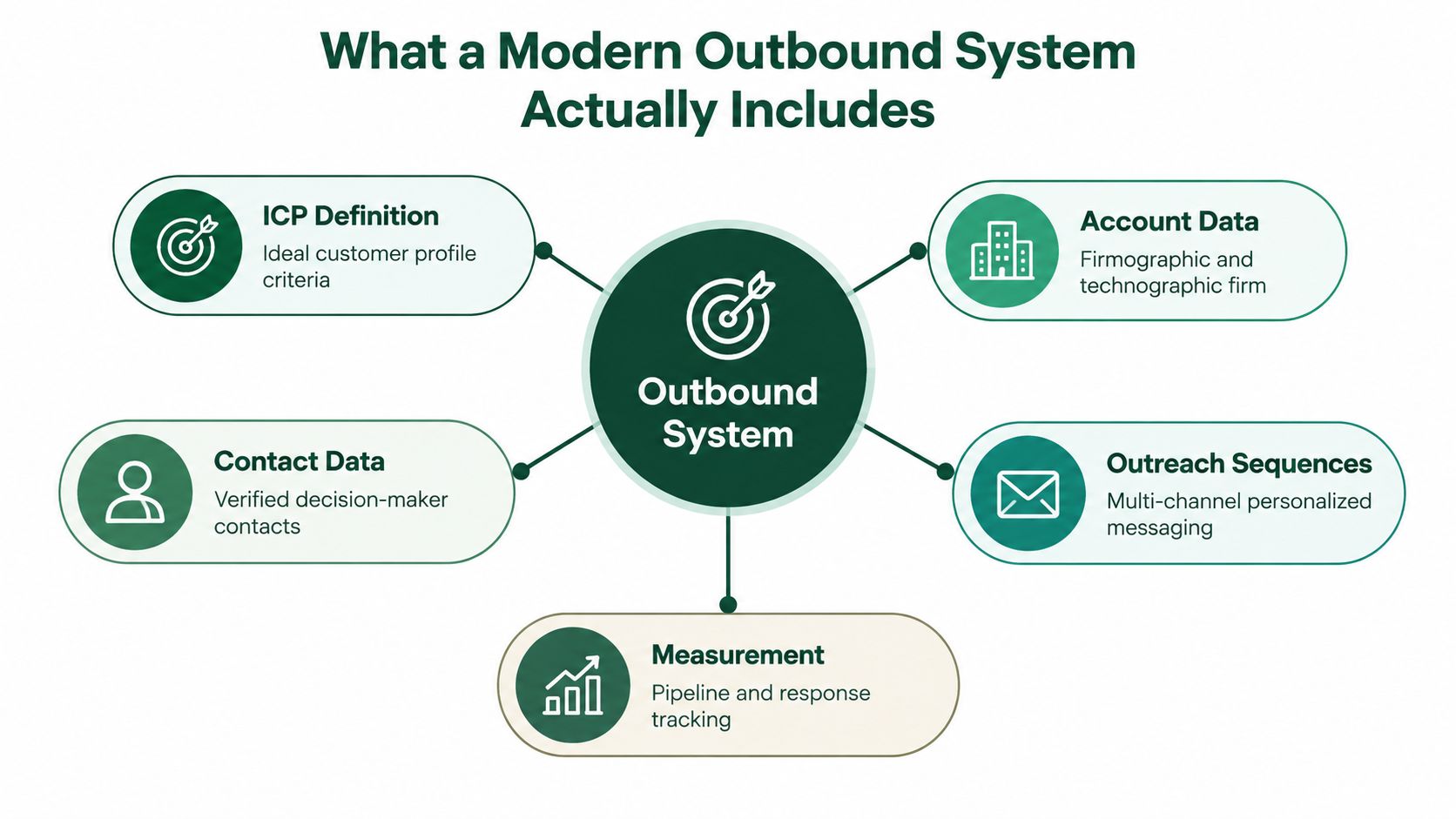
Start with the account, not the template
ICP definition should produce usable inclusion and exclusion rules. Specify relevant industries, operating models, locations, business problems, and disqualifiers. For APAC expansion, require separate assumptions about language, local purchasing authority, and regional headquarters rather than treating the region as a single audience.
Account data establishes fit. Contact data identifies the people who experience the problem, influence a decision, or control the budget. A valid email address doesn't establish any of those things.
A B2B outbound sales strategy should connect those research decisions to the offer and sales process. To inspect the operational handoffs more closely, LiveDocument's prospecting workflow for SDRs is a useful companion when mapping research, outreach, and follow-up responsibilities.
Then examine the message. The agency should explain the buyer's likely problem, why it matters now, what evidence supports your offer, and what commitment the call to action requires.
Connect execution to technical controls
A 2024 analysis covering 5.5 million B2B emails reported average reply rates declining from 6.8% in 2023 to 5.8% in 2024, as summarized in the B2B email benchmark analysis. That doesn't establish your expected result, but it makes relying on sending capacity alone a weak planning assumption.
Look for connected operating practices:
Coordinated sequences: Email, LinkedIn, and calls should advance the conversation rather than repeat the same pitch.
Reply routing: Interested prospects, objections, referrals, and opt-outs need different handling.
Deliverability engineering: Require authentication checks, list verification, gradual ramping, and separation from critical corporate email.
Campaign attribution: Preserve the account segment, signal, message version, and contact history through to the opportunity record.
Gmail's authentication requirements should be treated as launch prerequisites, not cleanup tasks. Technical monitoring must continue after launch, because a campaign isn't healthy merely because the sending platform reports successful submission.
Useful content can support these conversations without turning every touch into a meeting request. Where content creation is an actual campaign workstream, Narrareach is an option to consider alongside internal subject-matter expertise.
The agency should show how these components work together. A software inventory without approval rules, routing logic, or accountable owners isn't an operating system.
How to Evaluate Agencies Before You Commit
Send shortlisted agencies the same commercial context: your strongest customer segments, sales process, existing coverage, exclusions, and internal constraints. Ask them to identify what they'd need to validate before recommending an engagement.
A thoughtful response should contain uncertainty. An agency that hasn't reviewed your offer or account universe shouldn't present a precise meeting forecast as settled fact.
Build an RFP around evidence
Require a proposed ICP, sample account research, an outreach hypothesis, an infrastructure plan, and an anonymized reporting example. If your targeting is still broad, use this guide to defining an ideal customer profile to make the evaluation criteria concrete.
Agency Evaluation Criteria
Criterion | What to Look For | Red Flag |
|---|---|---|
Market understanding | Explicit fit rules and exclusions | Broad targeting based on job titles alone |
Data quality | Documented sourcing, verification, and refresh process | Unexplained purchased lists |
Deliverability | Named technical owner and launch checks | Warm-up presented as the entire plan |
Qualification | Written acceptance criteria and rejection reasons | Every interested reply counts as qualified |
Measurement | Defined denominators and inspectable CRM records | Headline rates without calculation methods |
Ownership | Clear access, licensing, and transition terms | Essential assets remain inaccessible |
Ask the agency to calculate a sample result during the vendor call. Published benchmarks illustrate why this matters: a comparison includes a 4.5% average sequence reply rate and 0.45% measured against individual emails sent, as documented in the cold-email statistics compilation. Those denominators describe different things, so comparing the percentages directly would mislead you.
Test commercial judgment, not presentation quality
Ask how the agency would distinguish newly created demand from accounts that were already progressing. A credible answer should discuss account history, existing opportunities, exposure to other campaigns, and a feasible comparison group.
Reference calls should investigate decisions, not just satisfaction:
Pilot learning: What did the agency change when its starting hypothesis failed?
Meeting quality: How did it resolve disagreements about qualification?
Operational problems: Who communicated technical issues and authorized corrective action?
Transition: Could the client continue operating after the engagement ended?
Use RedactAI's discussion of profit-focused agency pricing to frame questions about scope, incentives, and delivery economics. Then compare proposals on total responsibility, not the headline fee.
Pay-per-meeting pricing needs especially careful acceptance rules. Retainers need equally clear deliverables and review gates. Neither model removes the need to define what happens when quality disappoints, your sales team rejects a booking, or campaign assumptions prove wrong.
Running a Pilot That Tells You the Truth
A launch test answers whether the agency can execute. A commercial pilot asks whether its execution creates worthwhile opportunities that your team wouldn't otherwise have generated. Don't accept evidence for the former as proof of the latter.
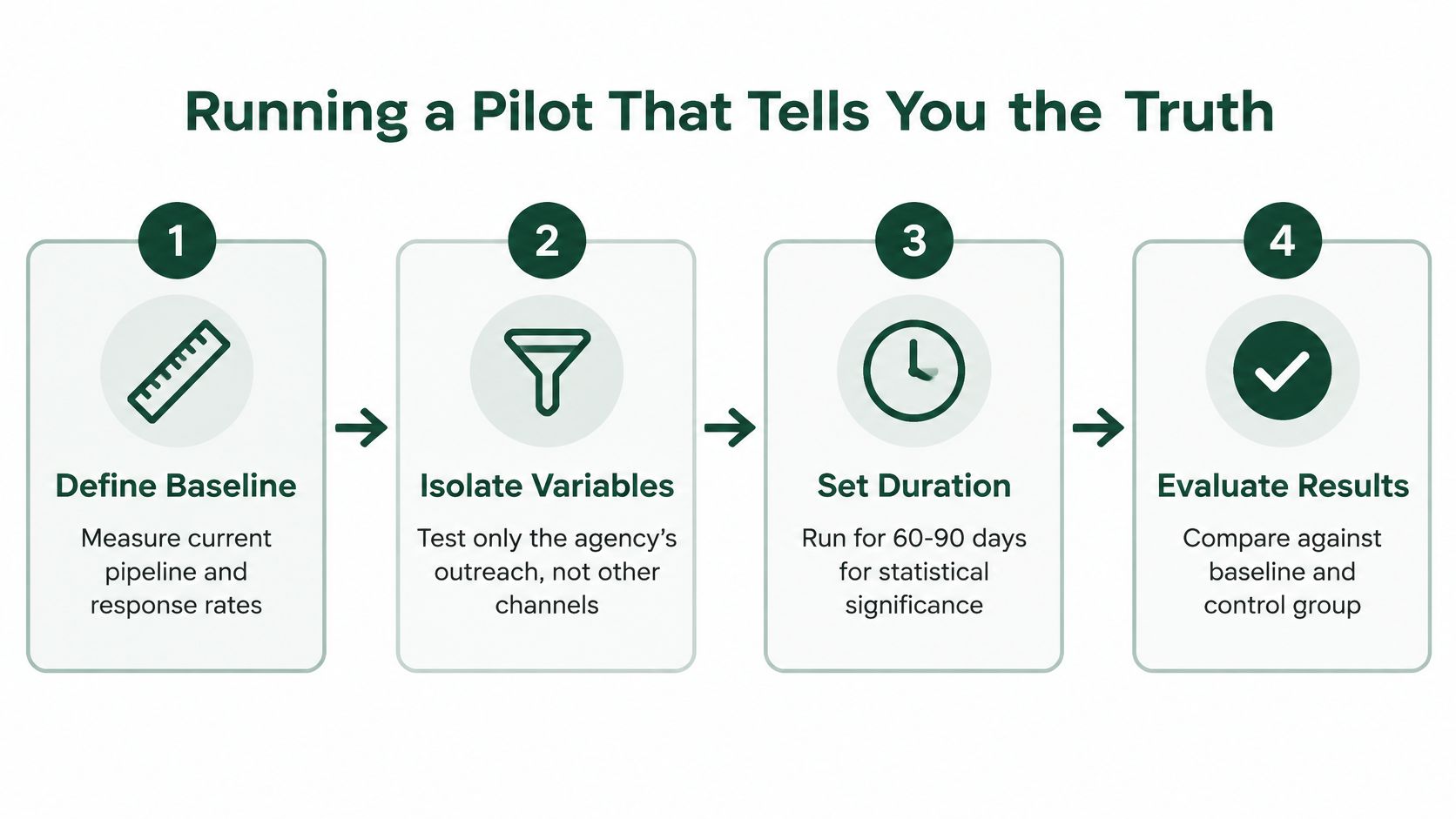
Treat any duration shown in a process diagram as planning guidance, not proof of statistical significance. Elapsed time alone can't establish a reliable result. You also need sufficient observations, comparable accounts, and a defensible measurement design.
Compare the pilot structures
Structure | What It Helps You Learn | Main Limitation |
|---|---|---|
Single-segment launch | Whether the team can execute and generate relevant conversations | Weak evidence of incrementality |
Account-level holdout | Whether contacted accounts progress differently from comparable uncontacted accounts | Requires discipline around other sales activity |
Phased market launch | Whether results differ before and after staggered activation | Market differences can complicate interpretation |
Select a narrow segment and agree on the baseline before outreach begins. Record existing relationships, open opportunities, prior engagement, and any planned campaigns that could affect the same accounts.
For a holdout, assign comparable accounts to outreach and non-outreach groups where feasible. Keep the assignment at account level so colleagues from the same company don't end up on opposing sides of the comparison.
Negotiate learning gates and commercial scope
Separate technical readiness, early engagement, sales acceptance, and opportunity progression. A short pilot may validate setup and messaging without allowing enough time to evaluate revenue. Avoid promising a commercial verdict before your normal buying process could plausibly produce one.
Don't extend a weak pilot merely because activity increased. Extend it when the evidence supports a specific next test.
A system-build engagement suits a team that has someone ready to operate the assets. Managed execution suits a team that needs ongoing research, campaign operation, and optimization. A fractional GTM lead is a different purchase again, adding accountable leadership rather than just campaign delivery.
Compare those models using the same scope assumptions. Specify who pays for software, research, mailboxes, reporting integration, and transition support, without treating unrelated service packages as interchangeable prices.
Agree on a primary response denominator, qualification rules, and a maximum acceptable investment before launch. A cold-email response-rate guide can help frame the engagement metrics, but your continuation decision should depend on prospect relevance, sales feedback, and credible opportunity progression.
Managing the Engagement and Reading the Numbers
Run a weekly operating review around decisions, not a tour of dashboard screenshots. The agency should arrive with explanations for meaningful changes, the evidence behind those explanations, and a proposed action.

Treat the dashboard's illustrative figures as layout examples, not performance targets. Your targets should come from the agreed pilot assumptions and your own commercial economics.
Read the funnel using fixed definitions
Require a shared metric dictionary so the agency and sales team can reproduce the calculations.
Delivered-recipient reply rate: Unique recipients who reply, divided by unique recipients recorded as delivered. Recorded delivery doesn't prove inbox placement.
Positive-reply rate: Recipients expressing relevant commercial interest, divided by delivered recipients. Define which categories qualify.
Booked-meeting rate: Delivered prospects who book a meeting, divided by delivered prospects.
Show rate: Meetings held, divided by meetings booked.
Opportunity rate: Accepted opportunities, divided by the agreed upstream population, such as held meetings.
For normalized commercial reporting, calculate revenue per 1,000 delivered prospects using consistently tracked cohorts, as recommended in the measurement framework above. Keep immature cohorts separate so a recent campaign isn't judged against accounts that have had longer to buy.
Use sales pipeline reports to examine stage movement, stakeholder involvement, and stalled deals. Don't allow the agency to count the full value of an existing opportunity as newly created pipeline just because it contacted another stakeholder.
Diagnose before approving more volume
A 2025 global deliverability benchmark found that one in six legitimate marketing emails failed to reach inboxes, with Microsoft inbox placement at 75.6%, according to the Validity deliverability report. Those marketing-email findings aren't cold-outreach forecasts, but they explain why provider-level monitoring matters.
Review bounce trends, complaints, inbox placement where measurable, and domain reputation alongside commercial results. If engagement falls sharply for a particular mailbox provider, investigate technical causes before rewriting the entire offer.
When replies look healthy but opportunities don't, inspect the actual conversations. The agency may be attracting curiosity rather than purchase intent, or your sales team may be receiving incomplete context.
Close each review with named owners, approved changes, and a decision date. Require the agency to explain what evidence would disprove its current diagnosis. That question makes it harder to defend every disappointing result with another volume increase.
Handover and Building Internal Ownership
Handover starts in the contract, not during the final account review. Decide which assets belong to your business, which depend on third-party licenses, and which agency methods remain proprietary before anyone builds the system.
The aim isn't necessarily to bring everything in-house. It's to preserve your ability to change operators without losing data, technical access, or the reasoning behind campaign decisions.
Specify the assets that must remain usable
Your contract should distinguish asset ownership from account access. Licensed contact data may carry restrictions, while agency-created research, message frameworks, and operating documentation need explicit usage and transfer terms.
Require a transition package that includes:
Infrastructure access: An inventory of domains, mailboxes, subscriptions, administrators, and renewal responsibilities.
Data continuity: Exportable account records, conversation histories, suppression lists, and CRM mappings, subject to applicable licensing.
Operating playbooks: Research rules, routing logic, qualification criteria, and escalation procedures.
Decision history: Test results, rejected hypotheses, approved messaging, and reasons for major changes.
Training and support: Practical walkthroughs, troubleshooting responsibilities, and a defined transition process.
Use the cold-email infrastructure guide to structure the technical inventory. An asset list should explain dependencies and recovery responsibilities, not merely name the tools.
Choose an operator who has capacity
Salesforce reports that representatives spend only 28% of their working week selling, alongside 9.3% researching prospects and 9.2% prioritizing leads and opportunities, in its State of Sales research. Don't assume an account executive can absorb campaign operations just because the agency has documented them.
An internal operator offers close access to sales feedback and product expertise. A fractional GTM lead can maintain specialist ownership while your team develops that capability. Continued agency operation is also reasonable when responsibilities and access remain transparent.
Ownership test: Have the incoming operator run the workflow while the outgoing team observes. A successful document transfer isn't proof of operational readiness.
Keep essential suppression and routing processes active throughout the transition. Pause automated activity when responsibility is unclear, then resume after someone has verified that the system still behaves as intended.
Final Checklist for Choosing Your Agency
Choose the outbound lead generation agency that can explain its decisions, expose its working process, and leave your business with usable assets. A polished pitch and a familiar software stack don't establish any of those capabilities.
Set non-negotiable approval gates
Before signing, confirm that the proposal answers the questions that affect execution and commercial accountability:
Audience fit: Can the agency explain who belongs on the list and who should be excluded?
Research quality: Can you inspect how records and relevant buying context are checked?
Technical responsibility: Is someone explicitly accountable for launch readiness and ongoing monitoring?
Commercial evidence: Does the pilot distinguish activity from credible incremental progress?
Sales handoff: Will your sellers receive conversation context and have a clear feedback route?
Exit readiness: Can your business retain and operate the agreed assets?
The technical requirements aren't optional. Google requires senders to use SPF or DKIM, maintain valid forward and reverse DNS records, and keep reported spam below 0.3%; exceeding that threshold can remove access to delivery-related mitigations under Gmail's sender requirements.
An agency should be able to explain how it monitors compliance without presenting mailbox warm-up as a substitute for authentication or responsible sending practices.
Make the agreement enforce the proposal
Attach the agreed scope, qualification criteria, reporting definitions, and asset schedule to the commercial agreement. Include approval rights for major targeting changes, a clear process for disputed meetings, and transition obligations that survive termination.
Ask what happens if your sales team can't handle the conversations, if the initial segment proves unsuitable, or if technical conditions require a pause. Those situations shouldn't trigger improvised negotiations while campaigns continue running.
The strongest decision isn't always the largest engagement. A narrow build with a capable internal owner may fit better than managed execution, while a team without operating capacity may need embedded leadership.
Don't buy activity to avoid making the harder operating decisions. Choose a partner that helps you make those decisions explicitly, tests them against evidence, and accepts that stopping or changing direction can be the correct outcome.
For B2B teams selling into APAC and global markets, The Social Search offers outbound system builds and embedded fractional GTM leadership connecting ICP definition, data, messaging, channel operations, and reporting. Visit to discuss a scoped build or managed engagement with clear measurement, documented handover, and client-owned infrastructure.
