Email Marketing Laws: Global Compliance Guide
Navigate email marketing laws across CAN-SPAM, GDPR, CASL, and APAC regions. Practical compliance requirements and checklist for B2B outbound teams.
Most advice about email marketing laws starts with a checklist: add an unsubscribe link, include a postal address, authenticate the domain, and keep sending. That checklist is useful, but it doesn't answer the questions that break real B2B outbound systems. Can a US-based team email a personalized prospect in Europe? Does a business address make a message non-commercial? When does an existing relationship create a soft opt-in? What happens when a legally permitted campaign still triggers mailbox-provider suppression?
Those are operational questions, not checkbox questions. A campaign can satisfy one jurisdiction's rules while violating another's consent standard, and it can meet legal requirements while producing complaints, poor inbox placement, or unusable sender reputation. The practical answer is to design outreach around recipient location, message purpose, relationship history, consent evidence, and technical controls before a sequence is launched.
For teams building outbound infrastructure, tools such as Instantly for cold email, deliverability, warming, and sequencing can support execution, but no platform decides whether a recipient may lawfully receive a message. Data sources such as Apollo for enrichment can help identify market and company attributes, yet those fields must feed a documented compliance decision rather than serve as a substitute for consent analysis.
Table of Contents
Why Legal Checklists Fail B2B Outbound Teams
A legal checklist assumes that every recipient belongs to one clear category. Real lists don't. A single outbound file may contain a US prospect contacted under an opt-out model, an EU contact whose personal data requires a documented lawful basis, a Canadian address with no proactive consent record, and an APAC contact governed by a different national framework. Treating those records as one audience is the first operational failure.
The common belief that “B2B” automatically makes outreach safer is also unreliable. A personalized message can still advertise a product, promote a service, or drive traffic to a commercial website. The message's commercial purpose, recipient location, prior relationship, and applicable local rules matter more than the sender's internal label for the campaign.
Email marketing's business value doesn't remove that complexity. It makes disciplined execution more important, because a scalable channel magnifies both useful relevance and weak controls.
The gap between lawful and deliverable
Legal compliance and deliverability overlap, but they aren't the same discipline. A message may contain a valid unsubscribe mechanism and accurate sender details, then still perform poorly because recipients complain, the list contains stale records, or mailbox providers distrust the sending pattern. Technical enforcement has become a separate risk surface, with bulk-sender authentication and complaint signals influencing whether messages reach the inbox.
Practical rule: Treat every outbound record as a policy object, not just a lead. Store its market, consent status, relationship history, commercial classification, suppression status, and approved channel.
The strongest operating model separates eligibility from execution. First determine whether the recipient can be contacted and under which consent model. Then decide what message, cadence, sender identity, and channel are appropriate. A sequence tool can automate the second decision, but the first requires reliable data and documented rules.
Simple checklists fail because they answer “what must appear in the email?” They often don't answer “why is this person in the campaign, which rule governs them, what evidence supports the decision, and what happens after they opt out?” Those questions belong in the system design.
CAN-SPAM Act Requirements and Enforcement Reality
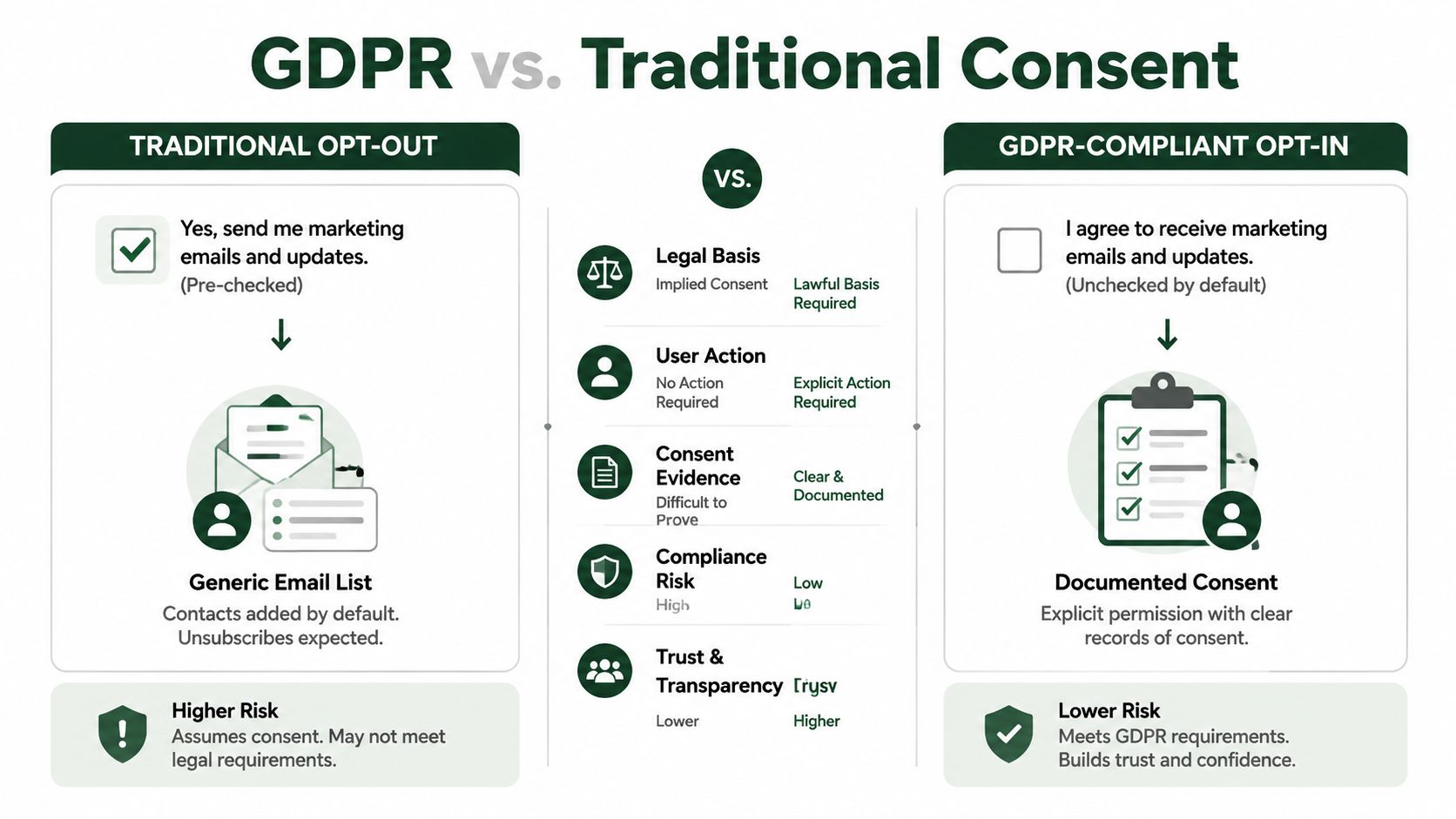
The U.S. CAN-SPAM Act, enacted in 2003, became the first federal law to establish nationwide rules for commercial email, and it applies to commercial messages sent to recipients in the United States. It doesn't require prior consent before the first email, which is why many US outbound teams operate an opt-out model. That flexibility isn't a general exemption for B2B marketing.
A commercial email whose primary purpose is advertising or promoting a product or service must use truthful header information, avoid deceptive subject lines, include a physical postal address, and provide a functioning opt-out mechanism, according to the FTC's CAN-SPAM compliance guide. The FTC also states that unsubscribe requests must be honored within 10 business days. Promotional content that sends traffic to a commercial website remains within the broad scope of commercial messaging.
What B2B teams commonly misunderstand
“There's no consent requirement” is an incomplete interpretation. The law doesn't require prior consent for the first commercial email, but it still requires truthful identity, a non-deceptive subject, a physical address, and a clear opt-out path. A business recipient doesn't lose those protections because the sender found the address on a public page or because the copy includes the prospect's company name.
The enforcement exposure is calculated per message. FTC guidance says violations can lead to penalties of up to $51,744 per email according to the cited compliance guidance. That per-message ceiling creates substantial potential exposure when a campaign repeats the same defect across a large send.
A compliant implementation should therefore:
Identify the sender: Use accurate header information and a recognizable sending identity.
Match subject and body: Don't imply a deadline, offer, or relationship that the message doesn't support.
Show a postal address: Put the sender's valid physical postal address in the commercial message.
Process opt-outs centrally: Suppress the recipient across connected systems, not only in the sequence that received the request.
Test the unsubscribe path: Confirm that it works from the recipient's perspective and that the request reaches every relevant sending workflow.
A practical cold email guide can help with campaign mechanics, but the operating standard should remain stricter than “the email technically sent.” Every campaign needs an owner for suppression, review, and evidence.
GDPR and European Email Marketing Consent Rules
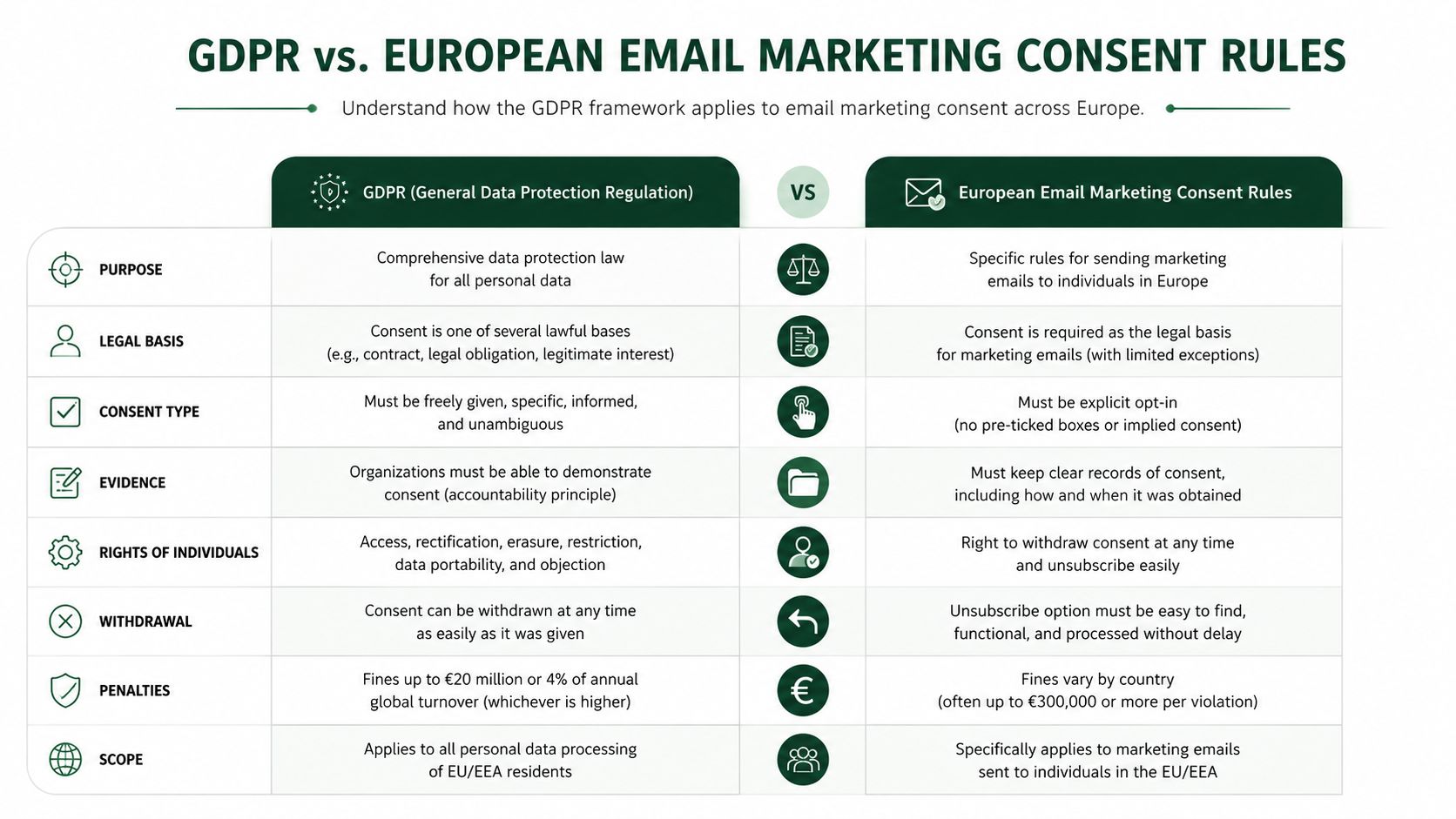
The GDPR, effective from 25 May 2018, changed the compliance posture for outreach involving EU residents. It applies to organizations worldwide when they process personal data belonging to people in the EU, so a US-based outbound system doesn't avoid the regulation merely because its infrastructure sits outside Europe. For serious violations, GDPR Article 83 allows administrative fines of up to €20 million or 4% of global annual turnover, whichever is higher, as outlined in email marketing law guidance covering GDPR.
That doesn't mean every European B2B email requires the same analysis. It does mean teams must document a lawful basis for processing personal data and account for the ePrivacy rules governing electronic marketing. Consent, where used, must be freely given, specific, informed, and unambiguous. A preselected box or vague permission for “partners” isn't a reliable foundation for a narrowly targeted campaign.
Soft opt-in is narrow, not a prospecting shortcut
The soft opt-in exception generally applies to an existing customer when the sender obtained the address during a sale or negotiation for a similar product or service, gave the person a simple opt-out at collection, and repeats that opt-out in every message. It isn't a general permission to email a scraped business directory, a conference attendee, or a person whose company resembles an existing customer.
The EU and UK frameworks also require separate attention. UK email marketing continues to operate under PECR regulation 22, with consent required unless the existing-customer soft opt-in applies and its conditions are met, as described by the UK Information Commissioner's Office guidance on electronic mail marketing. A 2025 CJEU ruling clarified that when the soft opt-in conditions are satisfied, a separate GDPR legal basis isn't required, but that clarification doesn't broaden the exception beyond its conditions.
For teams asking whether they can email European prospects from a US system, the answer depends on more than personalization. Check the recipient's location, the message's commercial purpose, the collection context, the consent record, and the applicable national implementation before placing the person into a sequence.
Privacy obligations also extend beyond EU member states. For a wider regional perspective, the guide to Israel's updated Privacy Law offers useful context for teams comparing European-style privacy requirements with adjacent markets.
Canada CASL Compliance for Commercial Electronic Messages
Canada's Anti-Spam Legislation, commonly called CASL, starts from a stricter premise than CAN-SPAM. A commercial electronic message generally requires prior consent, sender identification information, and a working unsubscribe mechanism, according to the CRTC's CASL guidance. The rule matters to B2B teams because a commercial message is defined by its purpose, not by whether the recipient uses a business email address.
Express consent requires a proactive opt-in action. The CRTC states that express consent isn't time-limited unless the recipient withdraws it, so a well-designed permission record can remain useful over time. That doesn't mean a team can stop maintaining the record. You still need to preserve what the person agreed to receive, how the consent was collected, and how withdrawal is processed.
Build consent evidence into the workflow
A practical CASL collection flow should capture:
The person and address: Store the email address and the identity associated with it.
The permission event: Record the form, event, request, or interaction that produced the opt-in.
The scope: State what type of commercial communication the person agreed to receive.
The timestamp and source: Keep the collection date and the page, form, or system that captured it.
The withdrawal path: Make the unsubscribe action simple, visible, and connected to every relevant campaign.
Implied consent is more constrained. It may arise from an existing business relationship or another recognized context, but the team must document why the relationship qualifies and when that basis ends. A salesperson's assumption that “we spoke once” isn't sufficient evidence.
A consent record should let another operator reconstruct the decision without asking the original rep what happened.
For mixed-market campaigns, create a Canada-specific audience rule rather than relying on a global suppression field. If the record lacks qualifying consent, hold the contact out of commercial email until the team has a lawful collection path. This adds friction, but it prevents a US-style opt-out workflow from being copied into a market that expects proactive permission.
APAC Email Marketing Regulations and Regional Variations
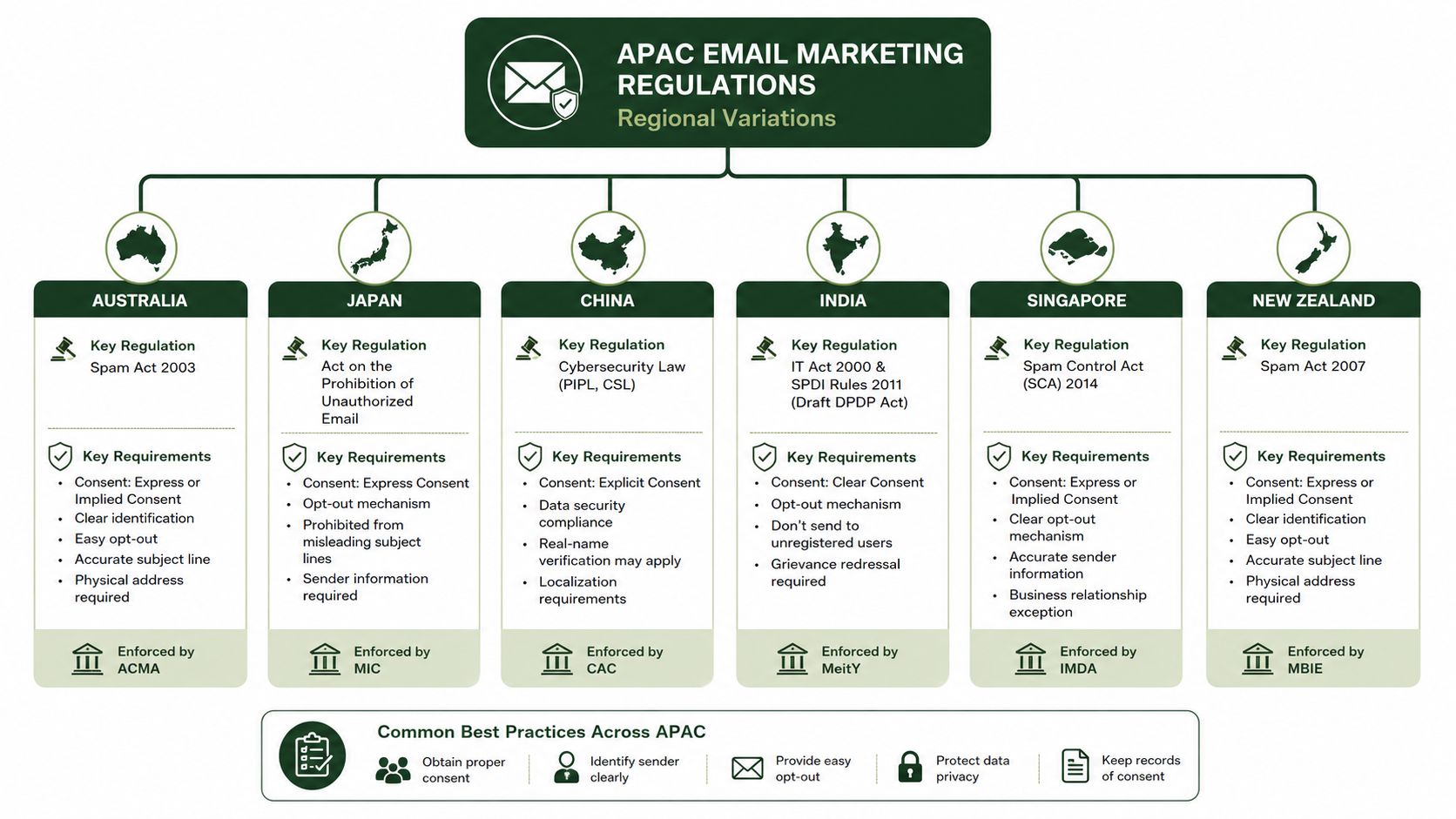
APAC isn't one compliance market. A campaign that works for a Singapore contact may require a different consent and suppression design for an Australian, Japanese, or other regional recipient. National privacy and electronic marketing frameworks differ, and the practical expectations of business communication vary alongside the formal rules.
The operational mistake is to classify APAC as “less regulated” and use a single global sequence. That approach hides uncertainty instead of managing it. When the legal position isn't clear, the system should default to a conservative contact policy, preserve evidence, and route ambiguous records for review.
Use market controls, not regional assumptions
A multi-market APAC system needs at least four layers:
Market identification: Maintain the recipient's current country or territory, the source of that field, and a process for correcting it.
Policy mapping: Assign each market a contact policy, such as prior consent, permitted business outreach subject to conditions, or manual review.
Evidence storage: Keep source, collection context, consent language, and withdrawal history with the contact record.
Message governance: Localize sender identity, footer details, language, timing, and opt-out handling where appropriate.
A contact's job title can help with relevance, but it doesn't establish permission. Nor does a public business email automatically convert a promotional message into a non-commercial communication. The safest distinction is between relationship-led communication and promotion-led communication. A genuine reply, requested introduction, or active commercial conversation may support a different workflow from a cold product pitch, but the system should record that context rather than infer it.
Teams entering several APAC markets often need a regional outbound operating model that connects list building, localization, sending, and reporting. If a campaign remains centralized, market-specific policy fields must still control eligibility. One sending platform can serve several countries, but it shouldn't apply one consent assumption to all of them.
Mailbox Provider Enforcement and Deliverability Compliance
A lawful message can still fail before a buyer sees it. Gmail, Yahoo, and other mailbox providers evaluate authentication, sending behavior, recipient engagement, complaints, and list quality. Their controls operate independently of whether a campaign includes an unsubscribe link or a physical address.
Recent industry coverage describes stricter Gmail and Yahoo bulk-sender enforcement, pressure toward DMARC p=reject, and the growing importance of authentication and complaint signals in email operations, as discussed in this 2025 to 2026 email regulation and deliverability roundup. These aren't replacements for legal rules. They're an additional enforcement layer that can suppress or filter messages globally.
Fix the technical failure before changing the copy
When compliance and deliverability appear to conflict, prioritize the controls that affect both trust and lawful operation:
Authenticate the sender: Configure SPF, DKIM, and DMARC correctly for the sending domains and services in use.
Control list quality: Remove invalid, stale, role-based, and repeatedly unresponsive records according to a documented policy.
Watch complaints: Treat complaint activity as a stop signal, not merely a reporting metric.
Separate audiences: Don't mix opted-in subscribers, existing customers, and cold prospects in one stream with identical cadence and copy.
Honor suppression everywhere: A person who unsubscribes from one workflow shouldn't continue receiving messages from another connected tool.
A warming feature or sequencing platform can't make an unwanted message wanted. Email delivery platforms can support infrastructure management, but the team still owns targeting, consent, message relevance, and complaint response.
Operational risk often appears as quiet suppression rather than a legal notice. Messages land in spam, domains lose reputation, and sales teams interpret the resulting silence as a messaging problem. Build a dashboard that separates eligible contacts, delivered messages, complaints, unsubscribes, bounces, and positive replies. Without those distinctions, operators may increase volume to compensate for a technical problem and make it worse.
B2B Email Compliance Checklist for Outbound Teams
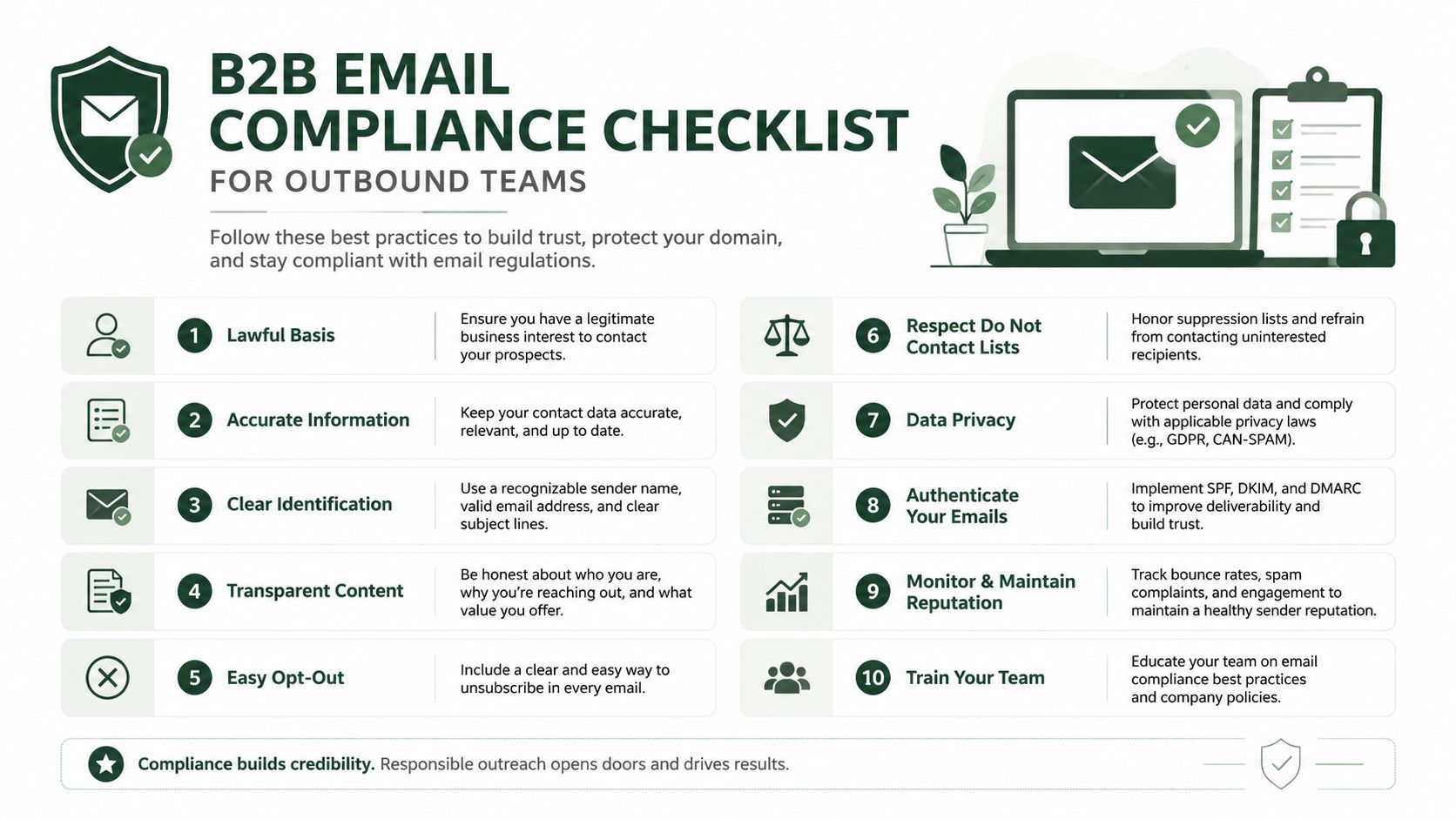
A useful checklist follows implementation priority. Start with the decisions that determine whether a message may be sent, then verify the email's required content, then maintain the technical and operational controls that protect delivery.
Priority one, eligibility and evidence
Classify the market: Store recipient country and flag records whose location is uncertain.
Classify the message: Mark whether the primary purpose is promotional, transactional, relationship-led, or mixed.
Record relationship history: Capture customer status, prior inquiry, event interaction, reply history, and the source of the address.
Assign a consent model: Choose opt-out, prior opt-in, soft opt-in, or manual review based on the recipient's market and relationship.
Preserve evidence: Keep the collection source, consent wording, event context, and relevant timestamps in the CRM or consent store.
If a record can't pass this layer, don't solve the problem by improving the copy. Remove it from the send or route it to review.
Priority two, message and suppression controls
CAN-SPAM campaigns need truthful headers, non-deceptive subject lines, a physical postal address, and a functioning unsubscribe mechanism. Commercial messages to Canada generally require prior consent alongside sender identification and unsubscribe functionality. European and UK workflows need a documented basis for processing and must respect the narrow conditions around soft opt-in.
Test the unsubscribe action: Send test messages, click the link, and confirm suppression across every connected sender.
Review subject lines: Remove false urgency, misleading offers, and implied relationships.
Check the footer: Confirm sender identity, postal details where required, and a clear opt-out path.
Run a suppression preflight: Compare the final audience against global and market-specific suppression lists immediately before launch.
Priority three, infrastructure and monitoring
Verify authentication: Check SPF, DKIM, and DMARC alignment for each sending path.
Monitor complaints and bounces: Define a pause rule and assign an owner for investigation.
Audit vendors: Ensure enrichment, automation, and sending providers pass suppression and consent fields correctly.
Train operators: Give sales and marketing teams examples of commercial, transactional, and prohibited follow-up behavior.
Document changes: Record policy updates, campaign approvals, incidents, and remediation.
The cold email inbox toolkit can support execution, but verification must happen in your own systems. A tool may show that a sequence is configured. It can't prove that every recipient was eligible.
Choosing the Right Consent Model by Market and Relationship
Consent should be selected at the intersection of market and relationship, not from the campaign name. “B2B outbound” is too broad to determine eligibility. A former customer in one country, a cold prospect in another, and an event contact with unclear permission require different treatment even if they appear in the same CRM view.
Market | Cold Prospects | Existing Customers | Event Contacts | Documentation Required |
|---|---|---|---|---|
United States | CAN-SPAM opt-out model may apply to commercial email, subject to truthful identity, non-deceptive content, postal address, and unsubscribe requirements. | Commercial follow-up still needs the required message controls. | Record source and confirm the message's commercial purpose. | Market, source, commercial classification, sender details, unsubscribe history |
EU and UK | Prior consent or another documented lawful route should be assessed before marketing email. | A narrow soft opt-in may apply for similar products or services when its conditions are met. | Event attendance alone doesn't establish permission. | Consent language, collection context, lawful basis, relationship, suppression |
Canada | Prior consent is generally required for a commercial electronic message. | Assess express or qualifying implied consent. | Capture the opt-in context rather than assuming badge scans equal consent. | Consent event, scope, source, identity, withdrawal record |
APAC | Apply the relevant national rule and use manual review where the market or context is uncertain. | Relationship history may affect the applicable workflow, but it must be documented. | Separate attendance from marketing permission. | Country, source, consent status, policy version, opt-out history |
A practical decision sequence
Ask whether the recipient is in a market requiring prior consent. Then ask whether a recognized existing-customer exception applies. If neither answer is clear, don't place the record into a fully automated promotional sequence.
Event contacts deserve special caution. A person may have shared an address to receive event logistics, a calendar invitation, or a requested resource. That interaction doesn't automatically authorize unrelated product promotion. Store the stated purpose of collection and use it to determine the next permitted action.
Real-World Compliance Scenarios for Multi-Market Campaigns
A US-based team launches one product sequence and uploads a list containing recipients in the US, EU, UK, Canada, and APAC. The copy is personalized by company and role, and every message includes an unsubscribe link. The sequence still shouldn't be launched as one audience.
The US records can be assessed under CAN-SPAM's commercial-message requirements. The EU and UK records need a consent or other documented lawful-basis analysis, with soft opt-in limited to the existing-customer conditions described earlier. Canadian records generally need prior consent, sender identification, and unsubscribe handling. APAC records require country-specific policy mapping rather than a blanket regional assumption.
Scenario one, a mixed list with uneven evidence
Suppose the CRM contains a “marketing permitted” checkbox, but no source, wording, or collection context. That field is not enough for a defensible cross-border workflow. Split the list into evidence-backed segments, isolate records with missing context, and prevent the uncertain segment from entering automated promotional email.
The same person may also exist in several tools. A suppression event in the CRM must reach the email sender, enrichment workflow, LinkedIn automation, and any manual call task. Otherwise, the company may interpret continued outreach as a data-sync problem while the recipient experiences it as repeated unwanted contact.
Scenario two, a prospect replies and the campaign continues
A cold prospect replies with a question, then the automated sequence sends another promotional message. The reply changes the relationship context, but it doesn't give the system unlimited permission. Pause automation, route the conversation to a human owner, and classify future messages according to what the prospect requested.
A product answer may be relationship-led. A new promotional sequence for unrelated services may require a separate analysis. Operators should preserve the thread, the request, the next action, and any expressed preference.
Scenario three, the contact changes location
A contact moves from a US office to an EU office, or a company changes the person's business address. Don't let the old market field control every future send. Revalidate location, review the applicable policy, and carry forward suppression and consent history rather than resetting the record.
Operational boundary: Personalization improves relevance. It doesn't replace permission, truthful identity, or a valid withdrawal process.
Ongoing Compliance Management and Quick Reference Framework
Compliance is a living operating process. New markets, vendors, domains, campaigns, and data sources create new review points, so the system needs ownership and recurring checks rather than a one-time legal sign-off.
Use a simple control rhythm:
Before launch: Review market segmentation, message classification, consent evidence, suppression lists, sender identity, postal details, and unsubscribe behavior.
During sending: Monitor bounces, complaints, opt-outs, delivery patterns, and replies. Pause a segment when the signals indicate a targeting, content, or infrastructure problem.
After sending: Preserve the final audience, message version, sending identity, approval record, suppression changes, and incident notes.
When conditions change: Trigger review after entering a new country, changing a vendor, adding a channel, changing the offer, or receiving a regulatory or mailbox-provider alert.
Quick jurisdiction reference
For the United States, verify CAN-SPAM requirements for commercial messages, including truthful headers, non-deceptive subjects, a physical postal address, and a functioning unsubscribe mechanism. For the EU and UK, assess consent, lawful basis, ePrivacy or PECR requirements, and the narrow soft opt-in conditions. For Canada, verify prior consent, sender identification, and unsubscribe handling under CASL. For APAC, apply the relevant national policy and avoid treating the region as a single legal category.
A practical stack can combine an enrichment system, a CRM consent object, a sending platform, suppression monitoring, and a human approval queue. LinkedIn or social workflows should inherit the same market and suppression controls rather than operate as a loophole around email rules. The Social Search designs and operates outbound systems across email and LinkedIn, with ICP, data, messaging, sending infrastructure, deliverability, routing, and reporting connected into one workflow.
Train sales reps to recognize three stop conditions: uncertain eligibility, an explicit opt-out, and a message whose purpose has changed from the original interaction. Train operations staff to audit records and vendors, not just campaign copy. When a business is expanding into APAC or managing mixed global lists, The Social Search can help build a documented outbound system that connects market rules, consent evidence, deliverability controls, and team handover. Visit the site to discuss an email and LinkedIn workflow designed around the markets you sell into.
