Outbound Sales Script: Write, Test, and Scale
Master the outbound sales script with a signal-driven framework. Learn to write, test, and scale email and LinkedIn sequences that actually convert.
Most outbound sales advice starts in the wrong place. It tells you to find a clever hook, shorten the opening line, or add the prospect's first name. Those details matter, but they won't rescue a message sent to the wrong account, at the wrong moment, through a damaged sending setup.
A modern outbound sales script is better understood as a small GTM system. It combines account selection, trigger data, channel choice, message logic, follow-up timing, deliverability, and reply analysis. Tools such as Instantly for cold email, warming, and sequencing, HeyReach for LinkedIn outreach and automation, Apollo for data enrichment, and Whitewhale for intent signals can support that system, but none of them replaces sound targeting or relevant judgment.
Table of Contents
Why Generic Outbound Sales Scripts Fail
The perfect opening line is mostly a distraction. A polished script still fails when the recipient has no visible reason to care, when the list contains stale contacts, or when the message arrives before a relevant business event creates urgency.
The baseline reality is harsh. A large analysis of 12 million outreach emails found an average response rate of 8.5%, which means 91.5% received no reply. The same analysis reported that one follow-up lifted responses by 65.8%, repeated contact produced about twice as many responses, and personalized message bodies improved response rates by 32.7%. These findings are reported in Cognism's outbound research, and they point to a practical conclusion: copy is only one variable in the system.
A generic script treats every account as if it shares the same problem. That assumption breaks down across APAC markets, where buying roles, business maturity, communication preferences, and local context vary widely. A finance leader who has just joined a company needs a different opening from an operations leader at the same company who has been in role for years.
The script is not the strategy
Static templates also create operational problems. Reps send the same message to broad lists, receive little useful feedback, and respond by increasing volume. That can produce fatigue inside the team and put unnecessary pressure on sending infrastructure. A weak message isn't only ineffective. Repeated at scale, it can damage the conditions required for future outreach.
Deliverability deserves the same attention as wording. Authentication, list hygiene, sending reputation, and controlled volume determine whether the buyer sees the message at all. A script that never reaches the primary inbox hasn't failed as copy. It has failed as a system.
Practical rule: Never diagnose a message before checking the account, contact, trigger, channel, and delivery path.
The most useful mindset shift is from copywriting to GTM engineering. Instead of asking, “What is the best cold email template?” ask, “Which signal justifies contact, what does that signal imply, and what is the smallest relevant next step?” That question leads to a more durable process, supported by workflow automation playbooks that connect research, routing, messaging, and follow-up.
This is also why teams should evaluate whether cold email marketing works in their specific market, rather than treating a generic benchmark as a promise. Reply rates vary because list quality, relevance, timing, deliverability, and qualification vary. A strong outbound sales script creates a credible reason to respond. The surrounding system determines whether that reason reaches the right person.
Architecting a Multi-Touch Sequence
A single email isn't an outbound strategy. It is one hypothesis in a sequence that should give the prospect several clear opportunities to engage without repeating the same pitch.
Research from Outreach's cold calling and emailing benchmark found that multi-channel sequences generated a 7% response rate, compared with 5% for email-only sequences. The same benchmark reported an average reply rate of 5.8% across 16.5 million cold emails in 2024, down from 6.8% in 2023 and 8.5% in 2019. It also found that 4 to 7 message sequences achieved about a 27% reply rate, compared with 9% for sequences containing 1 to 3 messages, while the first follow-up generated about 40% more replies than the opening message.
Those figures don't mean every team should copy one cadence. They show why the sequence itself must be designed and tested.
Give every touch a different job
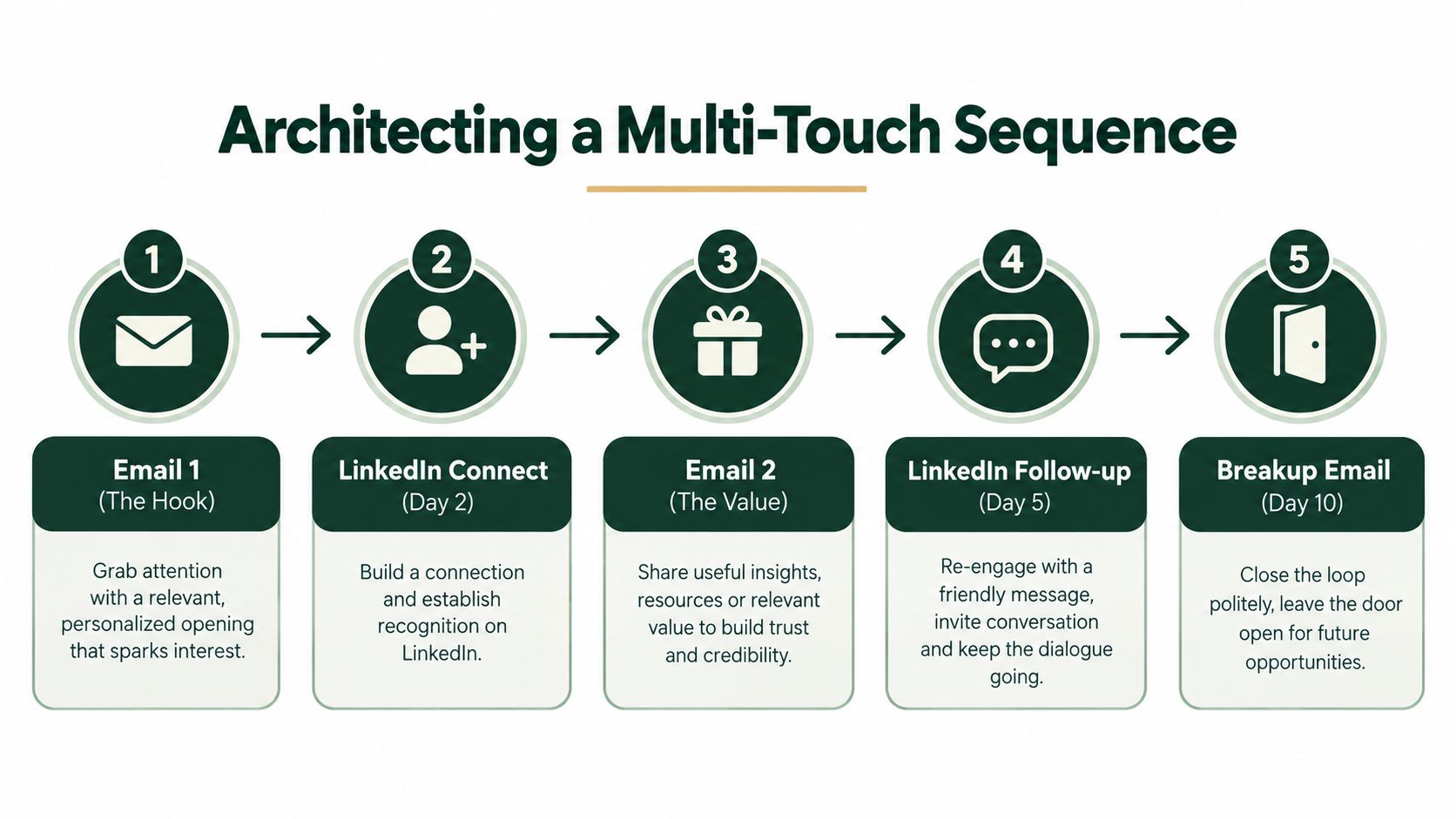
A practical sequence might use five touches, but each one should add context:
Email one, the hook: State the trigger, connect it to a plausible business issue, and ask for a low-friction response.
LinkedIn connection: Create recognition without copying the email. Keep the request conversational and avoid turning the connection note into a pitch.
Email two, the value: Share a relevant observation, diagnostic question, or useful resource. Don't merely say you're following up.
LinkedIn follow-up: Reference the business context briefly and offer a simple way to continue the conversation.
Breakup email: Close the loop respectfully. Give the recipient an easy way to decline or suggest a better owner.
The sequence should adapt to the signal. A hiring trigger may justify a message about ramping a new team. A leadership change may call for a note about priorities during transition. A product launch may support a conversation about operational capacity. The channel remains consistent, but the reason for contact changes.
A sequence also needs account-level throttling. Contacting every senior person at one company at the same time can make the outreach feel coordinated in the wrong way. Apollo cites research showing that contacting only 1 to 2 people per account can reach a 7.8% reply rate, while contacting 10 or more people at the same account drops reply rates to 3.8%. The figures appear in Apollo's account-level outreach guidance.
Protect the delivery path
Build the sequence on a dedicated, properly authenticated sending setup and warm it gradually. Keep prospecting volume separate from important one-to-one business communication, suppress bounced or disengaged contacts, and remove records that no longer match the ICP.
Your CRM should record the trigger, account, persona, channel, sequence version, last touch, and reply disposition. Without those fields, a team can't tell whether a poor result came from targeting, delivery, timing, or wording.
Use this practical guide to cold email outreach sequences to document the cadence before loading it into your sending platform. The document should specify when to pause, when to route a reply to a human, and when to stop contacting an account.
Engineering Signal-Driven Personalization
Adding a first name isn't personalization. Adding a company name isn't personalization either. Those tokens may make a template look less generic, but they don't demonstrate that the sender understands why contact might be relevant now.
Signal-driven personalization starts with a verifiable event and changes the message logic around it. The signal might be a hiring event, funding round, leadership change, product launch, expansion into a new market, or observable intent activity. The script should answer three questions:
What happened?
Why could it matter to this role?
What small next step would clarify whether the issue exists?
A hiring event doesn't prove the account needs your product. It creates a reason to investigate. Your message should avoid pretending to know the buyer's internal situation.
A useful trigger creates permission to ask a relevant question. It doesn't give you permission to claim an unverified problem.
Match the message to the trigger
Consider how the opening changes by signal:
Hiring: “I noticed your team is hiring for several outbound roles. Teams making that change often revisit how they source and qualify accounts. Is improving rep productivity part of the hiring plan, or is the focus elsewhere?”
Leadership change: “You recently took over the revenue function at [Company]. New leaders often review pipeline sources and handoff points early in the role. Are you currently evaluating outbound performance, or is that review still ahead?”
Funding or expansion: “Your recent expansion suggests the team may be entering a new growth phase. I work with revenue teams that need repeatable account coverage across markets. Is regional outbound already standardized?”
Product launch: “The new product release appears to widen the audience you can serve. How are you deciding which accounts to prioritize while the market learns about the offer?”
Intent signal: “Your team appears to be researching [category]. I don't want to assume that means an active project, but would it be useful to compare how similar teams approach [specific problem]?”
The language remains cautious because the data is directional, not conclusive. Signal quality improves prioritization, but it doesn't eliminate the need for qualification.
Decide how much research is enough
Deep personalization has a cost. A rep can spend too long investigating one account and lose the ability to cover a meaningful market. The answer isn't to personalize everything equally. Use tiers.
Tier one applies to high-value accounts or strong signals. Research the event, relevant stakeholders, business model, market, and likely operational consequence. Write a bespoke opening.
Tier two applies to credible but weaker signals. Confirm the event, segment the account, and use a modular message with one account-specific sentence.
Tier three applies to low-confidence accounts. Keep the message short, avoid invented context, and prioritize learning over persuasion.
A cited study of 20 million or more cold emails found reply rates near 18% for advanced personalization, compared with roughly 9% for basic templates, according to Lemlist's personalization analysis. Another benchmark reported a spread from 1.2% for generic copy to 9.8% for hyper-personalization, with segmented copy and deep personalization between those levels, as detailed by FirstSales' cold email benchmarks. These results support progressive personalization, but they don't justify spending unlimited research time on every contact.
Use an enrichment platform to collect role, company, hiring, technology, and account data, then let a human verify the trigger before launch. For a deeper framework on finding high-value signals and prioritizing prospects, see these gold prospecting techniques.
Script Templates for Email and LinkedIn
Templates become useful when they expose the decision logic behind a message. They become dangerous when reps copy them without understanding the trigger.
Consider a fictional account, Meridian Systems, which has started hiring regional sales leaders. The objective isn't to claim that Meridian has a pipeline problem. The objective is to test whether the hiring plan is connected to a need for better account coverage.
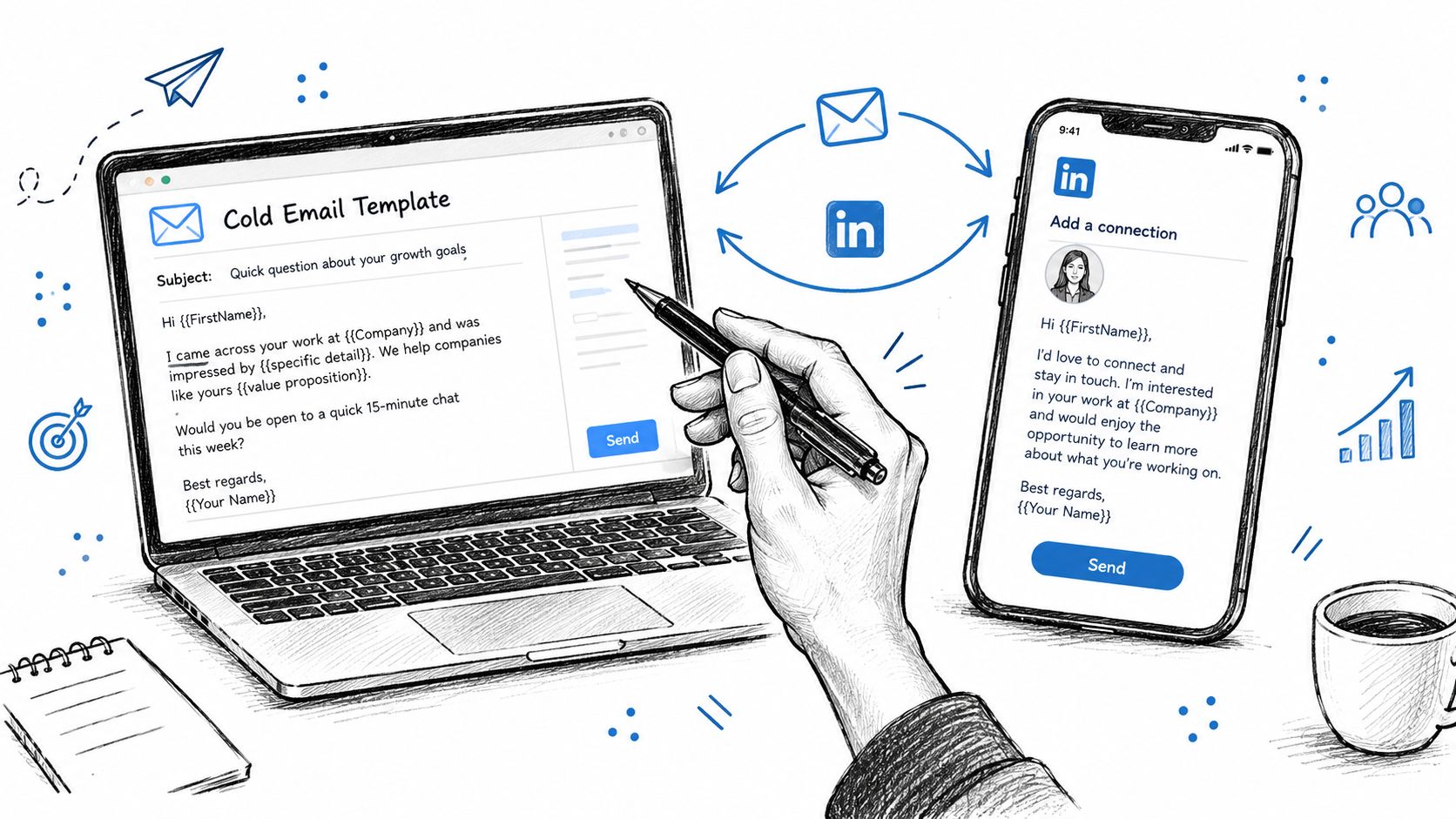
A signal-based cold email
Subject: Meridian's regional sales hiring
Hi [Name],
I noticed Meridian is hiring for regional sales leadership roles. That usually creates a decision about how the team will prioritize accounts and maintain consistent coverage across markets.
We help B2B teams connect account data, trigger events, and outbound sequences so reps can focus their time on qualified conversations.
Is regional account prioritization already defined for the new team, or is that still being worked out?
Best,
[Sender]
The subject is specific without pretending to know the buyer's priorities. The opening names the event, the second paragraph states the relevant capability, and the question offers two plausible answers. It doesn't force a meeting before the prospect confirms that the problem is real.
A different trigger needs a different message. For a product launch:
Subject: After the [Product] launch
Hi [Name],
The launch of [Product] appears to broaden the market you can serve. Teams in that position often need to decide which accounts should receive focused outreach first, especially when the existing list spans several regions.
How are you separating active buying signals from general interest?
If that question sits with someone else, I'm happy to speak with them instead.
Regards,
[Sender]
This version uses a diagnostic question rather than a product claim. That choice reduces the risk of sounding like the sender has been monitoring the company in an intrusive way.
A LinkedIn adaptation
LinkedIn should feel more like a professional exchange than an email pasted into a social channel.
Connection request:
Hi [Name], I saw Meridian is building out regional sales leadership. I work on account prioritization and outbound operations for B2B teams. Thought it would be useful to connect.
Follow-up after acceptance:
Thanks for connecting. I'm curious how your team is approaching account coverage as the regional roles come online. Are you standardizing the process centrally, or letting each market run its own playbook?
The LinkedIn version is shorter and more conversational. It doesn't repeat the email, include a long proof paragraph, or ask for a meeting immediately. A useful supporting resource on narrative structure is cómo aplicar storytelling en presentaciones comerciales, but storytelling in outbound should clarify relevance, not turn a short message into a performance.
For more channel-specific examples, compare these LinkedIn outreach message frameworks. The strongest versions preserve the same trigger while changing the rhythm, length, and call to action for the channel.
Iterating Scripts Using Reply Data
The first outbound sales script is a hypothesis. Treating it as finished copy prevents the team from learning what the market is telling them.
Start with a clean measurement model. Track positive reply rate, meeting conversion, unsubscribe rate, bounce rate, and the proportion of replies that reveal a real business problem. Total replies alone can mislead. A polite decline and a qualified buying conversation are not equivalent outcomes.
True cold outreach can produce extremely low results. A benchmark covering 74.3 million cold emails reported an average reply rate of 0.60% and a positive reply rate of 0.10%, meaning only about one in six replies was warm enough to pursue, according to Saleshandy's sales statistics. That benchmark is a reminder to separate volume metrics from commercial value.
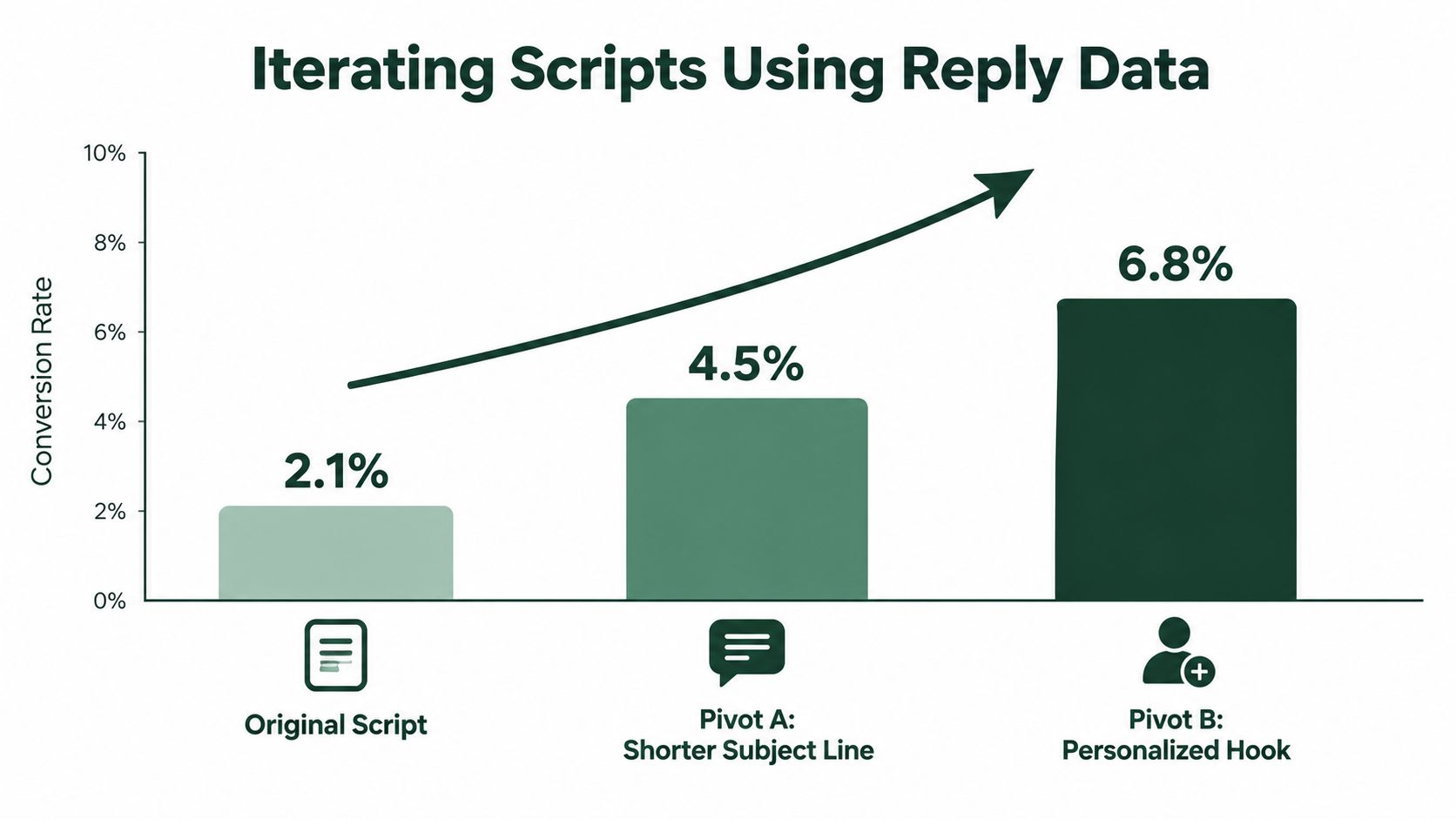
Change one meaningful variable
A disciplined test keeps the account segment, trigger type, channel, and offer stable while changing one major element. Possible variables include:
Opening context: Trigger-first versus role-first.
Question design: A binary diagnostic question versus an open-ended question.
Offer: A short benchmark, a teardown, a working session, or a direct conversation.
Subject line: Event-led versus problem-led.
Sequence length: Fewer touches with tighter relevance versus more touches with distinct value.
Don't change the subject, opening, offer, CTA, audience, and timing at once. If the result improves, you won't know why. If it declines, you won't know what to restore.
Read replies qualitatively. Prospects often reveal that your assumed problem is wrong, your timing is premature, or another person owns the issue. Tag those responses in the CRM. A reply such as “we handle that centrally” should change routing and persona selection, not trigger another version of the same pitch.
Know when to stop
Kill a script when the segment is wrong, the trigger doesn't correlate with a relevant need, or replies consistently show that the offer is outside the buyer's responsibility. Iterate when the audience engages but objects to the timing, asks for different information, or responds positively to one part of the message.
Sequence data should also influence prioritization. If a trigger produces engaged replies but low meeting conversion, improve qualification and the call to action. If messages are opened but ignored, investigate relevance and deliverability before rewriting every sentence.
The right process protects the total addressable market. Start with a defined segment, run a controlled test, record what buyers say, and only then expand the winning logic to adjacent accounts.
Launching and Maintaining Your Outbound System
A script can't compensate for a broken operating system. Before launch, confirm that the team knows whom it wants to reach, why those accounts matter, and what evidence justifies the first touch.
Use this launch checklist:
Define the ICP: Document industries, regions, company characteristics, roles, disqualifiers, and priority account tiers.
Verify the data: Check contact roles, employment status, account ownership, trigger dates, and consent or compliance requirements.
Prepare sending infrastructure: Warm domains, authenticate sending, establish suppression rules, and monitor deliverability.
Load the sequence: Add email, LinkedIn, and manual tasks with clear pause conditions and reply routing.
Train the team: Reps should understand the trigger, the hypothesis, objection paths, and the boundaries of acceptable personalization.
Schedule review: Inspect positive replies, meeting quality, unsubscribes, bounces, and trigger performance on a regular cadence.
Maintain the system by refreshing lists, removing stale contacts, checking trigger freshness, and rotating message hypotheses when the audience shows fatigue. Don't rotate scripts just because the calendar changed. Rotate when reply language, segment performance, or market conditions provide a reason.
A documented sales automation process helps keep ownership clear between marketing, sales, operations, and leadership. Bring in fractional GTM leadership when the team has a clear offer but lacks the time or operating experience to connect ICP, data, messaging, infrastructure, and reporting. The goal isn't to outsource judgment. It's to build a system the internal team can understand, operate, and improve.
The Social Search designs and runs outbound systems for B2B teams expanding into APAC and global markets, connecting ICP definition, data enrichment, signal-driven messaging, email and LinkedIn sequencing, deliverability, and pipeline reporting. Visit The Social Search to discuss a system build, message iteration program, or embedded fractional GTM support for turning your outbound sales script into a measurable pipeline process.
