7 Cold Email Outreach Sequence Examples
Explore 7 cold email outreach sequence examples with timing, subject lines, personalization hooks, channel mixes, and reply triggers for different ICPs.
Most cold email advice assumes one cadence fits everyone. It doesn't. The right cold email outreach sequence depends on the signal you have, the pain the buyer feels, the proof you can show, the trust the purchase requires, and whether email is even the best first channel.
That's why I don't start with sequence length. I start with buyer context. A finance leader with a visible collections problem needs a different progression from a founder who just raised capital, a partner manager who might want a collaboration, or an enterprise buyer who won't take a meeting until you've earned credibility. The sequence has to match the reason they should care now.
For the mechanics, I'd still set the foundation early with Instantly for sending infrastructure, warming, deliverability control, and sequence management. If you're layering LinkedIn, HeyReach fits well. If your personalization depends on account and contact enrichment, Apollo, Trigify, and Whitewhale are useful depending on whether you need firmographic data, social signals, or intent timing.
One more thing. Most inbox problems don't come from weak copy alone. They come from weak targeting, bad timing, and volume habits that avoid spam in cold outreach only when you tighten the whole system.
Below are seven complete cadences, each matched to a different buying context. Every one includes subject line direction, body progression, personalization hook, timing, reply trigger, ICP fit, and the email versus LinkedIn trade-off.
Table of Contents
1. The Problem-Agitate-Solve Sequence
PAS is overrated for broad prospecting and underrated for sharp, evidence-backed outreach. It underperforms when the pain is vague or still theoretical. It works when the buyer already feels the problem in weekly operations and you can point to a cost they would recognize immediately.
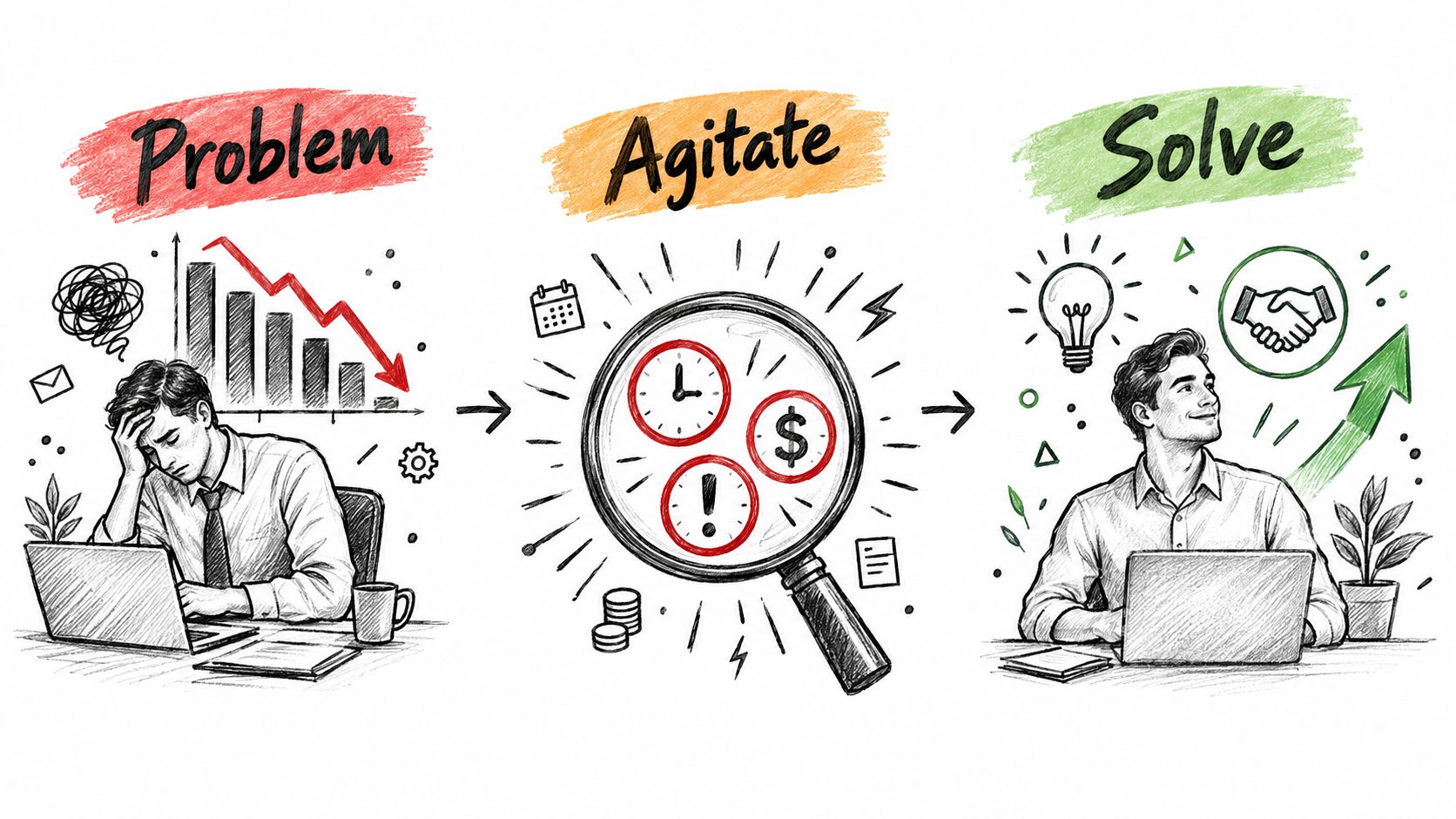
Among the seven cadences in this article, this one fits buyers with active pain, low education needs, and a clear operational trigger. That usually means subject lines can stay direct, body copy can tighten fast, and email should carry more of the sequence than LinkedIn. A finance lead with visible collections issues is a better PAS fit than an enterprise stakeholder evaluating a new category.
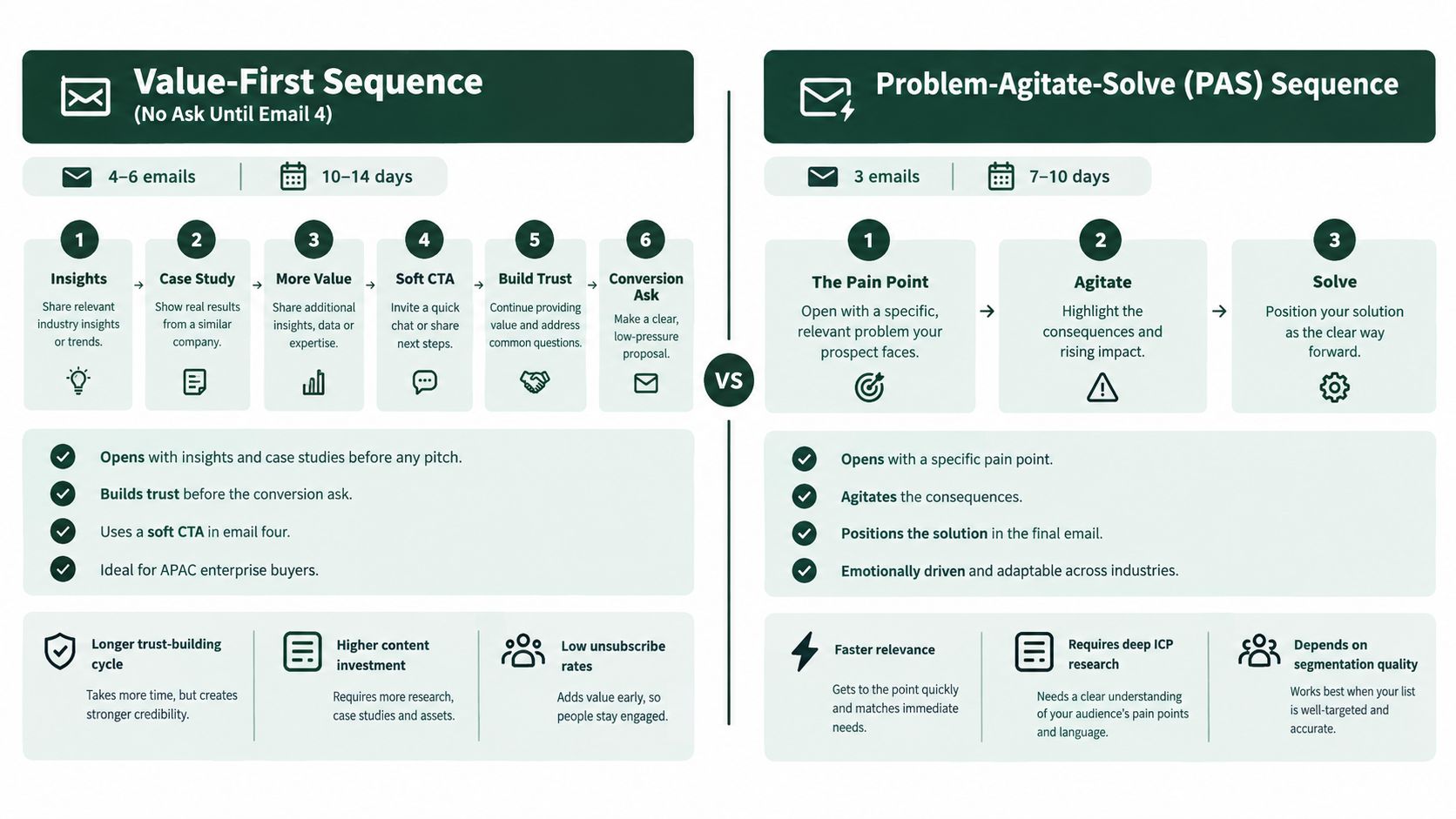
I'd run this as three emails across 7 to 10 days. Wait 2 to 3 days after the first note, then 3 to 4 days after the second. Shorter gaps can feel repetitive when the message is pain-led. Longer gaps weaken the build from problem to consequence to fix.
How the copy should progress
Email 1 names the problem in plain language. For a mid-market finance ICP, the subject line might reference DSO, overdue receivables, or manual reconciliation backlog. The body should open with a specific operational observation, tie it to a business cost, and end with a low-friction question.
Email 2 raises the cost of inaction, but it needs restraint. Good agitation sounds like pattern recognition, not pressure. If the first email focused on late collections, the second can move to forecast accuracy, rep time lost to chasing, or customer friction caused by inconsistent follow-up.
Email 3 introduces the solve. Keep it narrow. Show the mechanism that removes the bottleneck, not the full company story, feature list, or deck summary.
A simple progression looks like this:
Email 1: Problem named clearly
Email 2: Downstream consequence made concrete
Email 3: Specific fix and reply trigger
Subject lines should change with the buying context. A VP Finance may respond to operational language such as “DSO drift” or “collections workflow.” An operations leader may react better to “handoff delays” or “manual follow-up load.” That is the broader pattern across all seven cadences. The sequence only works when the subject line and problem framing match how that ICP describes the issue internally.
Practical rule: Use PAS only when the buyer already accepts the problem. If the prospect still needs category education or internal consensus, this cadence gets replies like “not a priority” or no reply at all.
Channel choice matters here too. Email usually does the heavy lifting because you need enough room to frame the problem and consequence with precision. LinkedIn works better as a support touch, such as a profile view, a connection request after email two, or a short message that references the same issue. For senior buyers in conservative markets, I would not lead with a long LinkedIn pitch on a pain-heavy angle.
For APAC outreach, tone control matters more than in many US sequences. Direct works. Confrontational usually does not. Strong PAS copy in these markets sounds informed and measured, especially when you are writing to finance, HR, or compliance-adjacent roles.
Personalization should come from signal quality, not from surface-level tokens. Use category research behavior or recent operational changes if you have them, and rewrite the pain statement by function. Finance, HR, and operations should not receive the same problem framing. The Social Search guide on B2B cold email marketing shows useful examples of how teams adjust messaging by role and market.
A practical example: a B2B services company selling into APAC might open on retention pressure for HR leaders, shift to hiring cost and compliance burden in the second touch, then introduce a staffing or process fix in the third. The same PAS structure can work for enterprise software, but the problem often changes to process sprawl, reporting inconsistency, or platform overlap. The cadence stays the same. The trigger, language, and channel mix change by ICP.
2. The Value-First Sequence
A lot of cold sequences ask for time before they have earned attention. That approach breaks down with enterprise buyers, regulated functions, and teams evaluating category risk, not just vendor fit. In those cases, value-first outreach works better because it gives the buyer something they can judge before they decide whether you are worth a reply.
I use this cadence when scrutiny is high and internal forwarding is likely. It also fits buying contexts where the ICP cares how you frame the problem, not just whether you can solve it.
The trade-off is speed. Value-first sequences usually produce fewer instant meetings, but the replies tend to be better qualified.
What the first four emails look like
The body-copy progression should change by buying context, not just by persona. A CFO at a large fintech, an operations leader at a logistics company, and a compliance head at a healthcare group may all need "value" first, but they do not need the same version of it.
A practical pattern looks like this:
Email 1: Lead with a relevant insight, benchmark, policy change, or operating pattern tied to the account
Email 2: Add interpretation, usually a peer example, teardown, or concise framework
Email 3: Offer a practical artifact such as a checklist, model, or assessment angle
Email 4: Ask for a low-friction reply about fit, priority, or ownership
Subject lines should stay plain. "Question on onboarding controls" will usually outperform a dressed-up subject if you are writing to risk, finance, or IT. For mid-market operators, a subject tied to a current initiative can work better, such as "Reducing handoff time in claims ops."
The reply trigger also changes by ICP. Senior finance buyers often respond to a point of view they can challenge. Operations leaders respond more often to a concrete process observation. Technical evaluators are more likely to reply when email three includes something they can inspect quickly, not a long attachment.
A finance software seller might run the sequence like this:
Email 1: Note a regulation change or reporting bottleneck and include one useful benchmark
Email 2: Show how a similar team reduced review time or exception volume
Email 3: Share a control checklist or close-process framework
Email 4: Ask whether this is worth discussing for their current workflow
Analysts at Woodpecker found that campaigns with follow-ups outperformed one-off sends in their review of cold email performance, according to Woodpecker's cold email statistics. The useful takeaway is not to add touches blindly. It is to make each touch carry a distinct reason to reply.
Where value-first fails
It fails when the "value" is really generic content distribution. A broad report with no account relevance gets ignored. A checklist sent without context reads like bait for a meeting.
Good value-first copy still needs signal quality. Company context, role scope, recent change, and category maturity matter more than surface personalization. Apollo enrichment can help pull role and company data for tighter framing. Social signals can also show whether the contact has engaged with a topic recently, which is often a better personalization hook than a scraped technographic field.
Channel choice matters too. I would keep this cadence mostly in email for buyers who need to review and forward information internally. LinkedIn is usually better as light support, not the main delivery mechanism, unless the ICP is visibly active there and your value asset is easy to consume in-feed.
Among the seven cadences in this article, this one fits buyers who need proof of judgment before they will consider a pitch. It is a slower sequence, but for large accounts and careful evaluators, slower often means more credible.
3. The Multi-Channel Sequence
More channels do not automatically improve reply rates. A second channel helps only when it adds context, timing, or familiarity that email alone would miss.
This cadence fits buyers who are visible on LinkedIn but still make decisions from their inbox. That usually means founder-led SMB, agency owners, recruiters, consultants, and mid-market department heads. It is a weaker fit for security, finance, and procurement-heavy ICPs, where LinkedIn activity rarely translates into buying motion and email needs to carry almost all of the persuasion.
The mistake is sending the same pitch twice. Good multi-channel sequences split jobs by channel. Email carries the business case, specifics, and forwardable detail. LinkedIn handles recognition, lighter touches, and soft proof that a real person is behind the outreach.
A practical 14 to 21 day cadence looks like this:
Day 1: LinkedIn connection request tied to role or context, with no pitch
Day 2 or 3: Email with the primary angle and a clear reply path
Day 5: LinkedIn message after acceptance that references the email in one line and adds a low-friction question
Day 10: Thoughtful engagement on a post, only if the prospect is active and the comment can stand on its own
Day 12 or later: Follow-up email with a different proof point, a tighter pain angle, or a referral ask
Subject lines and message progression should change with the buying context. For a founder, a direct email subject such as “reducing no-show demos” can work, and the LinkedIn follow-up can stay casual. For a VP in a larger team, the email often needs a more concrete frame such as “idea for improving SDR connect rates,” while LinkedIn should stay brief and avoid acting like a second inbox. Across the seven cadences in this article, this one is the clearest example of channel fit shaping the sequence itself, not just the order of touches.
Keep LinkedIn messages short. Two sentences is usually enough. If the DM reads like a compressed cold email, response rates drop and the coordination starts to feel automated.
Channel order also changes by persona. C-suite buyers usually get email first because they review commercial conversations there and can forward them internally. Managers, recruiters, and operators who post and comment regularly often respond faster to LinkedIn first, then email after they recognize the name. I use that split only when the social signal is real. A dormant profile is not a channel. It is just noise.
Use HeyReach for LinkedIn outreach if you need coordinated sending across a team, and keep email execution in Instantly. If you're refining LinkedIn role-based plays, this LinkedIn outreach strategy resource is relevant.
4. The Trigger-Based Event-Driven Sequence
Generic follow-ups are overrated when the account just gave you a reason to reach out. A real trigger changes both timing and copy. It also changes which of the seven cadences in this article fits the situation, because a founder after a fundraise, a newly hired VP, and a product team after a launch do not need the same subject line, message progression, or channel mix.
A trigger-based sequence starts with a specific event that creates buying context. Funding. A new executive hire. Pricing page visits tied to a target account. A product launch. An earnings comment that puts cost, growth, or efficiency under pressure. The message works because the buyer is already likely discussing the problem internally.

Compress the sequence
This cadence should move faster than a standard outbound sequence. Three or four touches across 7 to 10 days is usually enough, because the relevance window closes quickly.
Analysts at Popupsmart found that early touches capture the large majority of cold email replies, which is why event-driven outreach should not drag on for weeks, according to Popupsmart's cold email statistics summary. I treat that as a practical timing rule, not a script. A high-intent website visit can justify a same-week follow-up. A broad trigger like funding often needs more restraint so the note does not read like automated congratulations.
Subject lines should track the event itself. “Congrats on the raise” can work, but only if the first line shifts immediately to the operational consequence. For a new operations leader, “first 90 days in ops at [Company]” is often stronger. For product-led teams showing pricing-page activity, a direct subject tied to evaluation usually beats a clever one.
What to personalize
Personalization needs to stay attached to the trigger, not drift into generic flattery. Mention the event, state the likely downstream priority, then give the buyer a low-friction reason to reply.
Good trigger hooks:
Funding: The process gap that gets expensive once hiring or pipeline volume increases
Job change: A priority the new leader is likely expected to address in the first quarter
Website behavior: A direct next step for an active evaluation, without forcing a demo
Product launch: The operational need created by new demand, onboarding load, or support volume
Channel choice also changes by trigger quality. Website behavior and hand-raiser signals usually justify email only, because speed matters more than orchestration. A job change can support email first, then LinkedIn if the person is visibly active there. A broad company event with weak persona relevance should not get a full sequence at all.
If you want a practical reference for spacing the follow-ups after a trigger fires, this follow-up guide with templates and timing for cold outreach is a useful companion.
5. The Social Proof Sequence
Big logos do not rescue a weak fit. Social proof works when the buyer can see their own situation inside the example.
That makes this cadence highly context-dependent. It tends to work best with risk-aware buyers, established categories, and deals where the prospect wants evidence before they spend time on a call. It is a poor choice for novel products, weak case studies, or broad top-of-funnel lists. If the proof is not tightly matched to the ICP, a value-first or trigger-led sequence usually performs better.
Sequence design when proof is your lead angle
In this cadence, the proof is the hook. The product details come later.
For a finance leader, the subject line should signal peer relevance, not generic credibility. "How fintech ops teams cut manual QA" is stronger than "Trusted by 500+ companies." For an APAC commercial team, regional proof often matters more than a global logo set. For a mid-market RevOps manager, a result from another 200-person company usually beats a Fortune 500 name they cannot relate to.
Email 1 should name the comparable customer, the problem, and the outcome in one short pass. Email 2 should explain the case briefly and stay close to the same use case. Email 3 can add a second layer of proof, such as a quote from the same buyer persona, a short before-and-after metric, or a relevant implementation detail. Email 4 makes the ask, but only after the earlier touches have established that the comparison is legitimate.
Channel choice should follow buying context. Email usually carries the case-study detail better than LinkedIn. LinkedIn becomes useful when the proof has executive recognition value, or when the target account is active there and a light social touch can reinforce credibility without repeating the email.
Analysts at Cirrus Insight found that longer follow-up sequences generated more replies than very short ones, according to Cirrus Insight's sales follow-up statistics. That pattern fits social proof especially well because one touch rarely carries enough evidence on its own.
What strong proof actually looks like
Strong proof matches along three dimensions:
Customer type: Same industry, similar size, similar operating model
Problem: The specific pain the recipient is likely measured on
Stakeholder: Validation from the function you are emailing
One proof point is usually enough.
A crowded email with five logos, two screenshots, and a testimonial block often reads like marketing collateral pasted into outreach. A single relevant example feels more credible and is easier to process on mobile. It also gives the prospect a cleaner reply trigger: "Is this similar to what your team is dealing with?" or "Worth sharing the short write-up?"
Field note: Prestige helps less than similarity. Buyers respond faster when the example reflects their constraints, team shape, and priorities.
For teams building reusable case-study assets that support outreach, this B2B sales collateral resource is directly relevant.
6. The Curiosity-Driven Sequence
Curiosity is overrated in cold outbound.
In the wrong buying context, it lowers reply intent because the buyer has to work too hard to decode the point. In the right context, it gets attention from prospects who ignore another generic value prop. That trade-off matters more here than in any other cadence in this article.
This sequence fits accounts that are not actively shopping, but are likely sitting inside an expensive blind spot. It works best when your ICP shares a bad default, a missed operational constraint, or a reporting gap they do not describe as a problem yet. Compared with the trigger-based sequence, where timing does the heavy lifting, curiosity depends on a sharper point of view. Compared with the social proof sequence, it starts with tension first and explanation second.
Use it only when the insight is stronger than the ask
The first email needs one job. Create enough interest to earn the second read.
Keep it short. Three or four sentences is enough. Subject lines usually perform best when they hint at a mistaken assumption, a hidden cost, or a pattern the buyer has not named yet. For a VP of Operations, that might be a subject line tied to forecast accuracy, routing logic, or handoff friction. For a founder, it might be tied to pipeline quality or time-to-value. The hook should change with the ICP, not just the wording.
The body copy should also progress differently by buying context. In a crowded SaaS category, Email 1 can raise the question. Email 2 can explain the mechanism. Email 3 can connect that mechanism to a measurable business cost. Email 4 can make a low-friction ask, such as whether the prospect wants the short version or a quick teardown. If the account shows light engagement, such as an open from a relevant title or a LinkedIn profile view, a LinkedIn touch after Email 2 can reinforce recognition. If the signal quality is weak, keep it in email and avoid adding channel noise.
Analysts at Belkins reported wide performance gaps between average programs and top senders in their overview of cold email response rates. In practice, curiosity sequences sit on the wrong side of that gap when the list is broad, the insight is recycled, or the copy hides the offer too long.
Where this cadence breaks
It breaks when the buyer already has a clear trigger.
If a team just hired a new sales leader, announced expansion, or posted an open role tied to the problem you solve, direct relevance usually beats cleverness. The same applies in categories where the pain is obvious and budgeted. A cryptic opener there slows the conversation down.
It also breaks with weak personalization. Curiosity without a credible reason for outreach reads like copywriting. A better personalization hook is one observed constraint tied to the account or function, not a compliment about their latest post.
A realistic example is outreach to operations leaders at mid-market logistics firms. Subject line: “why on-time reporting gets distorted.” Email 1 points to one upstream workflow issue. Email 2 explains how the reporting distortion happens. Email 3 shows the operational cost and where teams usually misdiagnose it. Email 4 asks whether comparing notes would be useful. That progression works because the copy earns the reveal instead of withholding it for effect.
If you're refining hook construction and psychological framing, this persuasion techniques resource can help sharpen the copy.
7. The Collaborative Mutually-Beneficial Sequence
Cold outreach for partnerships fails for the opposite reason sales outreach fails. The pitch is usually too vague, too early, and aimed at the wrong owner.
This cadence works when the buying context is shared distribution, shared delivery, or shared product fit. That makes it different from the other six sequences in this article. The subject line, copy progression, and channel choice should reflect partner economics, not buyer pain. A VP Partnerships at a services firm needs a different email than a product lead at an integration-friendly SaaS company, even if both serve the same ICP.
Build the sequence around a specific mutual outcome
Start with overlap you can verify. Shared customer profile, adjacent implementation scope, regional strength, or a product gap the other company does not want to build internally all work. Generic lines about "synergy" get ignored because they force the recipient to do the strategy work.
Email 1 should name that overlap in plain language. Subject lines like "APAC fintech overlap" or "possible partner fit with your Salesforce practice" usually beat clever copy here. The body should stay short. State who you help, where the customer overlap appears, and one reason a joint motion could make sense.
Email 2 should move from overlap to model. Referral arrangement, co-sell intro path, bundled delivery, integration pilot, or co-marketing are not interchangeable options. Pick one. The right choice depends on ICP and channel fit. Services firms often respond to revenue-sharing or delivery-extension angles. Product teams respond better to implementation lift, activation gains, or partner-enabled distribution.
Email 3 should add evidence that the idea is practical. That can be one account pattern, one implementation constraint you keep seeing, or one example of where your offer fits before or after theirs in the buying process. Reply triggers change by audience. Partnership leaders reply to route-to-market logic. Product leaders reply to use-case clarity. Regional commercial leads reply to pipeline potential.
A 2026 benchmark reported an overall average reply rate of 3.43%, while elite senders exceeded 10%, according to Instantly's cold email benchmark report. Collaborative sequences can beat a standard demo ask when the overlap is real and the next step feels commercial, not speculative.
Email usually leads. LinkedIn supports.
I would still start with email in most cases because partnership ideas need more context than a connection request can carry. LinkedIn helps after the first email, especially if the decision sits across product, alliances, and regional sales. One person rarely owns the whole motion.
Timing should also be different from a demand-gen cadence. Give more room between touches. Three to five business days is usually enough because the recipient may need to sanity-check the idea internally before replying. Pushing daily follow-ups makes a partner pitch feel like a low-trust outbound sequence.
A practical example: a consultancy focused on APAC expansion sees a SaaS vendor selling to the same operations leaders. Email 1 points to the customer overlap and regional delivery advantage. Email 2 proposes a joint diagnostic or referral path tied to expansion projects. Email 3 explains where the consultancy reduces implementation drag after the software sale. That is a better progression than jumping straight to "want to partner?" without showing how the motion would work.
7-Point Cold Email Sequence Comparison
Sequence | 🔄 Implementation complexity | 💡 Resource requirements & tips | ⚡ Speed / efficiency | 📊 Expected outcomes (⭐) | Ideal use cases |
|---|---|---|---|---|---|
The Problem-Agitate-Solve (PAS) Sequence | 🔄 Medium, 3-email flow, needs accurate ICP research | 💡 Requires strong buyer pain data, segmentation, use Instantly/Whitewhale; include one early stat | ⚡ Moderate, 7–10 days; good early engagement | 📊 High engagement & relevance; builds credibility quickly (⭐⭐⭐⭐) | Venture-backed SaaS, mid-market sales, cross-industry outreach |
The Value-First Sequence (No Ask Until Email 4) | 🔄 High, 4–6 emails, content-heavy and iterative | 💡 Needs 3–4 reusable content assets (benchmarks, case studies), Apollo for enrichment, track engagement before ask | ⚡ Slower, 10–14 days; longer nurturing cycle | 📊 Strong trust and higher-quality replies; lower churn (⭐⭐⭐⭐) | Enterprise SaaS, consultancies, long-cycle APAC deals |
The Multi-Channel Sequence (Email + LinkedIn + Social) | 🔄 High, coordinates multiple platforms and timelines | 💡 Requires LinkedIn tooling (HeyReach), email infra (Instantly), cross-channel personalization and tracking | ⚡ Moderate–fast visibility, 14–21 days but higher touchpoint density | 📊 Increased visibility & response (40–60% lift vs email-alone) (⭐⭐⭐⭐) | Targeting C-suite, senior decision-makers, accounts with strong LinkedIn presence |
The Trigger-Based/Event-Driven Sequence | 🔄 High, real-time signal monitoring and automation | 💡 Needs signal tooling (Whitewhale, Apollo), pre-written trigger templates, real-time alerts and ops | ⚡ Fast, compressed 3–5 emails over 7–10 days; timely activation | 📊 Very high response rates when timed right (⭐⭐⭐⭐⭐) | Data-driven teams, mid-market/enterprise SaaS, rapid-growth startups |
The Social Proof Sequence (Case Study + Social Validation) | 🔄 Medium, 4–5 emails focused on references and outcomes | 💡 Requires referenceable customers/case studies, Apollo for mutual connections, segment-by-industry | ⚡ Moderate, 10–14 days typical; credibility accelerates interest | 📊 Strong credibility and conversion when references resonate (⭐⭐⭐⭐) | Established vendors, mid/enterprise sellers, APAC markets valuing peer validation |
The Curiosity-Driven Sequence (Pattern Interrupt + Intrigue) | 🔄 Medium–High, copywriting- and test-heavy | 💡 Needs strong copy, data-driven hooks, A/B testing, use Whitewhale/Apollo for topical hooks | ⚡ Fast, typically 3–4 emails; high open rates but variable downstream | 📊 High opens; variable conversion depending on delivery (⭐⭐⭐) | Startups with differentiated offers, saturated markets, early-adopter personas |
The Collaborative / Mutually-Beneficial Sequence (Partnership Angle) | 🔄 High, account research and alignment across teams | 💡 Requires partner research (Apollo), concrete co‑op ideas, internal partnership criteria, multi-team buy‑in | ⚡ Slow, 4–5 emails, longer partnership development timeline | 📊 High-quality conversations and partnership leads; longer wins (⭐⭐⭐) | Companies seeking integrations, channel partners, consultancies, ecosystem plays |
Choose the Cadence Your Evidence Supports
The best sequence is rarely the cleverest one. It's the one your evidence supports.
Use PAS when the pain is already visible and role-specific. Use value-first when the buyer needs trust before they'll accept a meeting. Use multi-channel when the person is active across inbox and LinkedIn. Use trigger-based outreach when your timing signal is real enough to justify compressed follow-up. Use social proof when you have matched customer evidence. Use curiosity when the insight is differentiated. Use collaborative outreach when there's actual ecosystem overlap, not just a vague desire to “partner.”
Don't judge performance by opens alone. A 2026 cold email statistics summary reported an average open rate of 27.7%, while a good open rate was framed as above 45%, and another benchmark source similarly described 40% to 60% as good and 65%+ as elite, according to Laxis's cold email outreach playbook. Useful context, but opens only tell you whether the door cracked. They don't tell you whether the message deserved a response.
Track the signals that help you improve the system:
Positive replies: Did the sequence create real interest?
Qualified conversations: Did the right accounts convert to live meetings?
Unsubscribe and negative reply signals: Did the message fit the list?
Channel attribution: Did email, LinkedIn, or a combined motion create the response?
Trigger type: Which events produced useful conversations?
Time to reply: Which cadence created momentum fastest?
One benchmark on 12 million outreach emails found only 8.5% received any response, meaning 91.5% were ignored, according to this cold email research summary. That's the reality check. Most first emails won't do enough on their own. Sequence design matters because recovery from non-response is part of the job, not an exception.
My default workflow is simple. Define the ICP tightly. Validate the hook before scaling. Choose the shortest sequence that still fits the buying context. Personalize the first touch around a real signal. Protect deliverability with Instantly. Then iterate from reply data, not from opinions inside your team.
If you need a more connected outbound build, The Social Search is one relevant option for teams that want ICP definition, data, messaging, channel execution, routing, and reporting to work as one owned system rather than separate tools and handoffs.
If your team needs more than templates, The Social Search builds and runs outbound systems that connect ICP definition, messaging, email, LinkedIn, signals, routing, and reporting into one operating workflow. If that's the gap you're solving, visit The Social Search to see how its outbound setup fits this kind of cold email outreach sequence work.
