8 Gold Prospecting Techniques for Smarter Targeting
Compare 8 gold prospecting techniques, from signal-driven targeting to outreach cadences, with practical examples and guidance on when to use each.
Sending more outreach doesn't solve weak prospecting. It usually hides it. If your list contains accounts with no relevant trigger, incomplete contacts, or no credible reason to engage, adding volume only creates more noise and makes performance harder to diagnose.
The better approach mirrors disciplined field exploration. Start broad by identifying where attention is warranted, narrow the territory with account and contact evidence, validate assumptions directly, then coordinate channels around the signals that produce qualified conversations. Whitewhale can help surface intent signals, Trigify can monitor social signals, and Apollo can enrich the accounts and contacts that deserve research.
The eight gold prospecting techniques below follow that progression. They move from low-cost sensing and direct sampling to increasingly resource-intensive validation, then translate each method into an outbound decision. For teams that need help connecting ICP definition, prioritised lists, messaging, automation, routing, and reporting, The Social Search builds system-first outbound operations for APAC and global markets.
The best technique is the one that matches the evidence, timing, and buying context.
Table of Contents
1. Pan and Sluicing
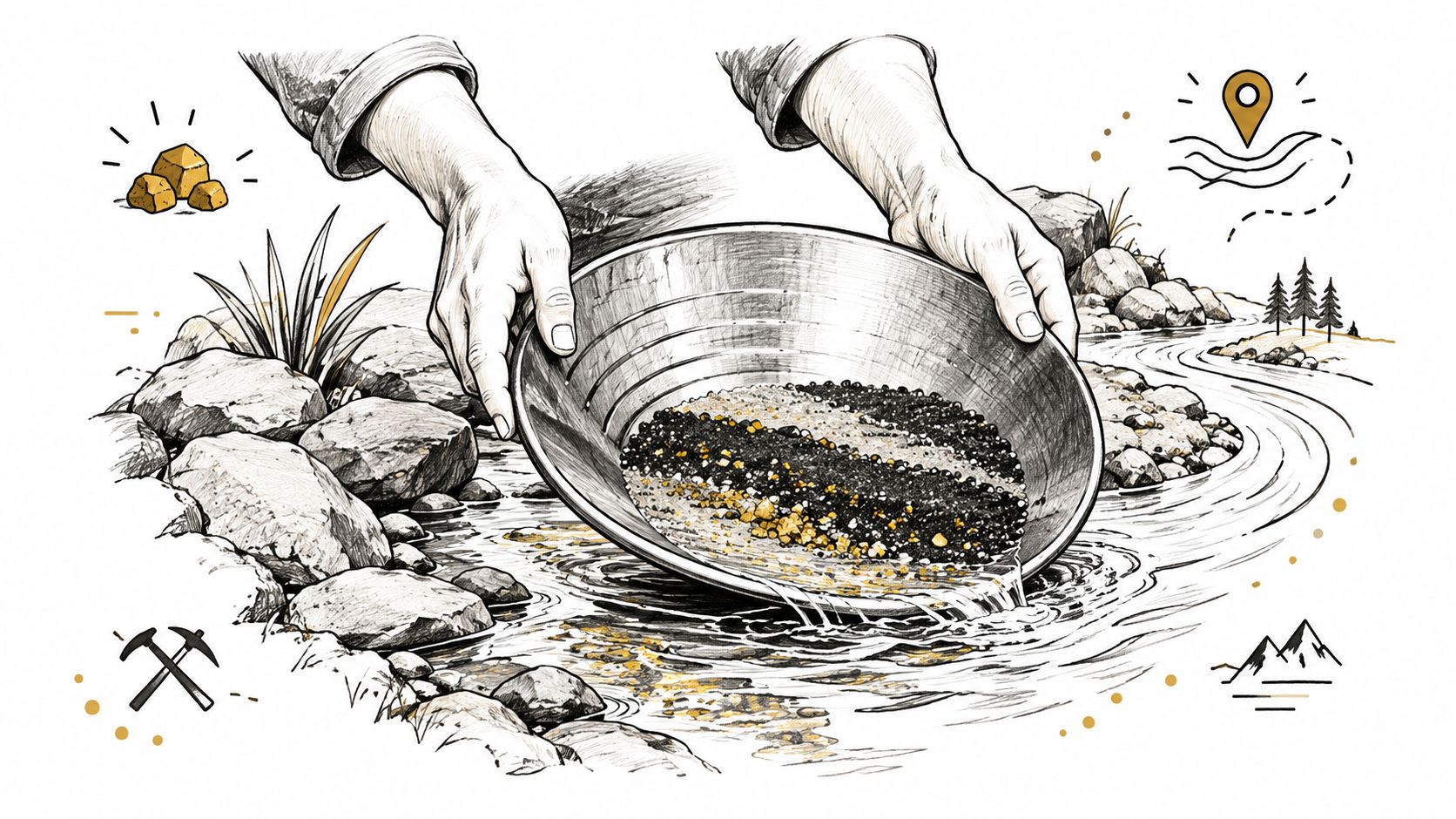
Panning is the simplest expression of gravity separation. A prospector swirls sediment in a shallow pan, washing lighter material away while dense gold settles toward the bottom. Sluicing applies the same principle at higher throughput, using an inclined channel and riffles to trap heavy particles as water carries gravel through.
Gold's density explains why these methods work. USGS material cited in a practical prospecting guide places gold's density around 16 to 18, compared with associated gangue rock at about 2.5, making gravity-based separation effective for clay, silt, sand, and gravel (density guidance for gravity separation). In placer deposits, gold also settles preferentially against lighter quartz during stream transport, which is why bends, plunge pools, bedrock cracks, and obstacles deserve attention.
Where the method earns its place
Panning is a discovery technique, not automatically a production method. Sample several locations before committing to heavier processing. A small positive result in one bend doesn't prove the entire claim is productive, while repeated results across nearby traps provide a stronger basis for further work.
The same logic applies to outbound. Use intent signals to identify accounts already showing relevant interest, then test whether the signal survives basic qualification. Don't treat every visitor, engagement, or keyword event as a conversation-ready opportunity.
Screen first: A prospecting guide recommends using at least a quarter-inch screen, or 4 mesh, before panning, and suggests separating material larger than 20 mesh for easier concentrate handling (screening guidance).
Refine the motion: Use a circular movement with slight tilting to wash away lighter material, then process black sands carefully because gold can remain in the heaviest fraction.
Record the evidence: Log location, material source, signal strength, and result. In outbound, that becomes account, trigger, persona, message, reply, and meeting data.
A clear process for attracting, qualifying, and converting leads follows the same discipline as sampling before scale (lead generation process guidance). Even a simple field setup benefits from practical transport, such as a wagon for surf fishing setup, when equipment and samples need to move across difficult ground.
2. Metal Detecting
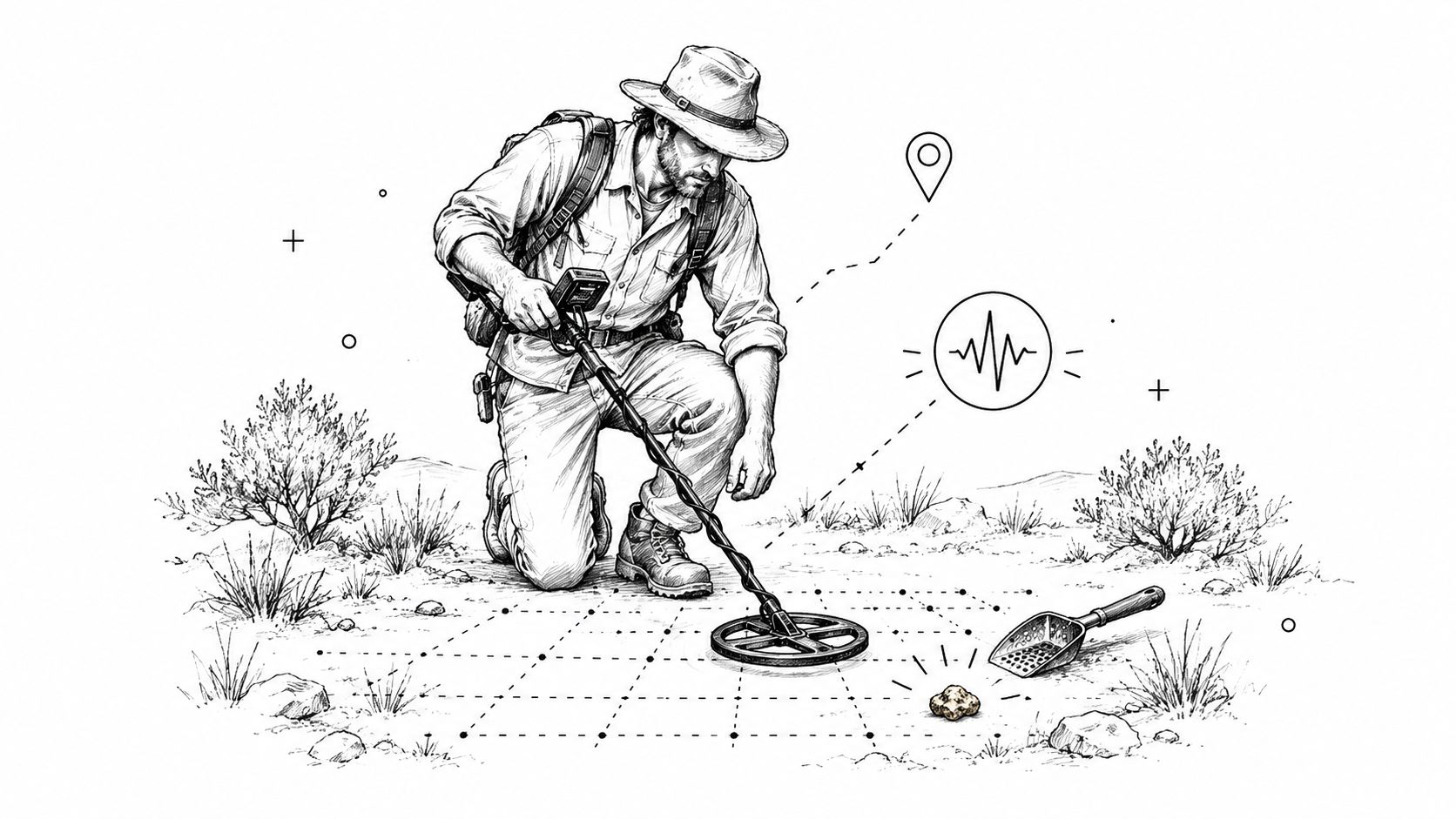
Metal detecting changes the question from “where does sediment settle?” to “where is a conductive target buried?” Gold-specific detectors use electromagnetic responses to locate nuggets and mineralised ground. The result depends on soil conditions, detector settings, ground balancing, and the operator's ability to separate a useful response from noise.
Treat detecting as a coverage and validation method. Random walking can miss productive ground, while a grid search creates repeatable coverage and exposes hotspot patterns. In outbound, the equivalent is a prioritised account set built from intent, firmographic fit, historical relevance, and usable contact data. Broad market sensing identifies where interest may exist, then systematic coverage tests which accounts and contacts deserve direct attention.
Systematic coverage beats enthusiasm
Choose between VLF and pulse induction equipment according to ground conditions and the target. General-purpose detectors can create frustration in mineralised terrain, so serious prospectors need gold-suitable equipment and practice ground balancing before interpreting signals. A detector locates a target, but it cannot establish whether nearby ground supports a repeatable opportunity.
Historical records improve the starting point. Old workings, production records, claim information, and local prospecting clubs can indicate where previous operators found workable ground. In a GTM territory, Apollo enrichment plays a similar role by turning an account hypothesis into company and contact context for qualification.
A strong signal tells you where to investigate. It does not replace qualification.
Document GPS coordinates, signal strength, soil conditions, and what excavation reveals. Those records connect target selection to field results. Outbound teams need the same feedback loop: track the account, trigger, persona, message, reply, and meeting outcome instead of treating activity alone as proof of campaign quality.
A clear lead generation definition separates discovery from qualification. Detecting works best when targets are shallow, ground is accessible, and the operator can cover it methodically. It loses efficiency when mineralisation is concealed or terrain creates too many false signals. In outbound, use detecting for direct validation after broad sensing, then combine confirmed signals with other channels before scaling effort.
3. Geological Mapping and Core Sampling
Some prospects deserve more than surface indications. Geological mapping records rock types, structures, alteration, veins, and surface mineral indicators. Core sampling goes deeper, extracting continuous rock sections that help geologists understand subsurface structure, grade distribution, and deposit continuity.
This is the equivalent of defining an ICP before launching a large outbound programme. A team that knows the buyer profile, use case, market, and disqualifiers can allocate effort intelligently. A team that skips that work may spend heavily reaching accounts that resemble the market but lack the underlying conditions required for a deal.
Move from hypothesis to deposit model
Start with desktop research using published geological surveys, mining databases, historical reports, and available maps. Field reconnaissance should then test whether surface indicators support the initial theory. Airborne magnetic and radiometric data can guide drill locations, but interpretation still requires geological judgement and ground verification.
Core samples provide the structural context that loose surface material can't. Sample logs should capture lithology, alteration, fractures, mineralisation, recovery, and assay references in a consistent format. Professional geological oversight also matters because resource estimation and regulatory compliance depend on defensible records.
The historical progression of gold exploration shows why capital follows evidence. During the California Gold Rush, prospectors began with pans, then adopted rocker or cradle boxes and later hydraulic mining, developed in 1853, as deposits and financing justified higher-throughput methods (California Gold Rush mining history). The lesson for outbound is practical. Start with cheap evidence, then increase investment when results support the next stage.
In account research, that means separating an initial fit hypothesis from validated buying context. Map the organisation, identify relevant roles, understand the operational problem, and only then commit to a multi-touch campaign. This overview of prospecting reinforces the value of understanding structure before treating a lead as ready.
4. Bulk Sampling and Test Mining
Bulk sampling tests whether a geological opportunity survives contact with operations. Rather than trusting isolated assays, operators extract and process a representative volume of ore. The work exposes grade variability, recovery behaviour, equipment limits, and site logistics. Test mining adds evidence about whether the proposed mining sequence functions under practical conditions.
The outbound equivalent is a controlled pilot. A team can test a defined market, persona, offer, and channel before committing resources across the full programme. Cold email infrastructure and sequencing, or LinkedIn outreach automation, can support that test and show whether the system performs before expansion.
Validate the operating model
A bulk sample should represent the deposit, not its most attractive visible material. Process ore from multiple zones where variability is expected, compare suitable recovery routes, and record operating costs with discipline. Independent assay verification strengthens confidence among investors, regulators, and partners.
A GTM pilot needs the same operating discipline. Set the target-account threshold, contact roles, outreach trigger, offer, channel, and success criteria before launch. Replies without qualified conversations point toward positioning or qualification problems. Poor delivery or low opens point toward infrastructure or data quality. Each result should change the next test, not just add activity.
Historical gold rushes show why scale alone does not create value. The Klondike rush drew an estimated 100,000 prospectors between 1896 and 1898, and many goldseekers spent an average of three months hauling supplies over mountain passes during the first year. Production later peaked in 1903 after heavier equipment arrived (Klondike Gold Rush history). Access, logistics, equipment, and capital determined which discoveries could become productive.
Pilot rule: Scale a process only after evidence shows that the target, method, and operating constraints work together.
Test mining must also account for environmental disturbance and rehabilitation. The outbound equivalent is protecting sender reputation, documenting the playbook, and confirming that the team can run the system after the experiment ends. A signal-led programme combines broad sensing with account qualification, direct validation, and measured multi-channel execution. The pilot decides which combination deserves more effort.
5. Stream Sediment and Soil Sampling
Stream sediment sampling looks downstream for clues. Fine material from active watercourses can carry gold and indicator minerals away from a source, allowing explorers to screen broad terrain without drilling every location. Soil sampling serves a similar purpose over land, detecting geochemical signatures that may point toward concealed mineralisation.
This method is efficient because it narrows an area before expensive validation. The sample isn't the deposit. It is evidence that changes the priority of a location.
Build a comparable signal layer
Sampling design must follow geology and drainage, not convenience. Collect material from active channels where recent transport is meaningful, use consistent collection and preparation methods, and analyse both gold and pathfinder elements such as arsenic, bismuth, and tellurium. Spatial databases and contour maps then make it possible to distinguish isolated anomalies from coherent trends.
The outbound equivalent is market sensing. Technical SEO analysis with SearchAtlas can help a team inspect demand patterns and identify where content or commercial attention may be justified before building a larger programme. The principle is the same as soil sampling. Use a relatively efficient signal to decide where deeper investigation belongs.
A sample becomes more valuable when it supports comparison. If every account is researched differently, an outbound team can't tell whether one segment outperforms another. Establish consistent fields for industry, size, geography, technology, hiring, funding, leadership change, content engagement, and known pain. Then score only the signals that have a defined action attached.
Positive results require follow-up. Closer-spaced sampling, outcrop mapping, trenching, or drilling can test whether an anomaly has continuity. In outbound, a signal should trigger enrichment, message adjustment, or routing, not an automatic mass send. A relevant event from a poorly matched account remains a weak opportunity.
Practitioners avoid false precision. Geochemical anomalies guide attention, but they don't prove commercial value. Treat website behaviour, content engagement, and intent events as prioritisation evidence until direct validation confirms need, authority, timing, and fit.
6. Trenching and Pit Excavation
Trenching exposes the ground instead of asking an indirect signal to carry the entire decision. Narrow excavations across a mineralised structure can reveal its lateral extent, thickness, orientation, and relationship with surrounding rock. Pits provide broader surface exposure for mapping and sampling where shallow overburden hides the geology.
The method has a direct analogue in account research and discovery calls. Public data may suggest a fit, but direct observation often reveals the operational detail that determines whether a prospect is worth pursuing. A conversation with the right buyer can expose workflow constraints, ownership, urgency, and internal alternatives that enrichment alone can't provide.
Expose the decision-making layer
Trenches should cross mineralised structures rather than run along them, because the objective is to measure the zone rather than repeatedly follow its easiest surface expression. Sampling must be systematic, with photographs, sketches, geological logs, and clear records of the material removed. Safety controls, drainage, benching, backfilling, and rehabilitation aren't optional details.
Direct discovery requires similar discipline. Don't turn a call into an unstructured pitch. Ask how the problem appears in the current process, who owns it, what has already been tried, what would block change, and what event makes the issue timely. Record answers in a consistent format so the next operator can use them.
A trench result should guide deeper work, not be treated as a complete resource model. Likewise, a positive conversation should improve qualification and messaging, not automatically convert into a forecast opportunity. Use direct evidence to update the account record, route the opportunity, and decide whether deeper research is justified.
The practical distinction is between observing and assuming. A prospect's job title may suggest responsibility, while a discovery conversation can confirm it. A website may show a strategic initiative, while a buyer can explain whether it has budget, ownership, and a current implementation path. Prospecting in the sales process is strongest when those observations feed a repeatable process rather than remaining in one rep's notes.
7. Percussion and Diamond Drilling
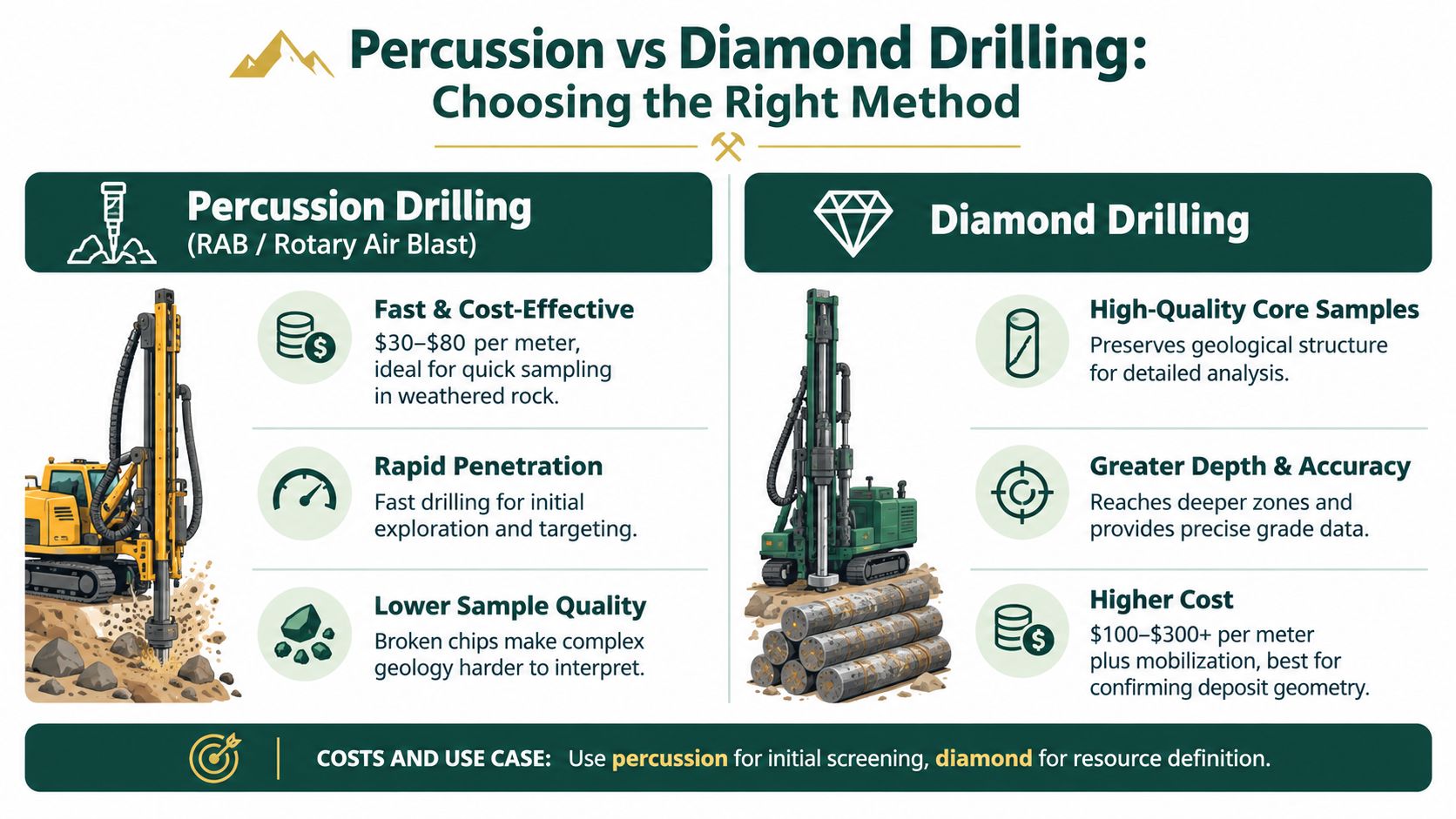
Percussion drilling and diamond drilling answer different questions. Percussion methods, including rotary air blast and reverse circulation approaches, break and remove rock quickly, making them useful for early subsurface targeting. Diamond drilling cuts a cylindrical core that preserves geological structure and supports detailed interpretation at greater depth.
The comparison is useful for outbound teams entering APAC markets. Rapid outreach screening can test whether a segment, role, or offer produces a credible response. High-touch discovery then examines the account in more detail, especially when deal complexity, geography, procurement, or implementation risk justifies the extra effort.
Match speed to uncertainty
Use percussion or reverse circulation to define broad targets and identify where mineralisation may continue. Reserve diamond drilling for deposit geometry, structural relationships, and detailed confirmation. Quality assurance should include standards, duplicates, consistent logging, and careful sample handling. Retaining core also preserves an asset for future interpretation as the geological model develops.
In outbound, the fast method should not become careless method. A short sequence can screen a qualified segment, but it still needs accurate contacts, a relevant reason to reach out, and a clear disqualification path. Once an account shows meaningful engagement, shift to deeper research and a human-led discovery process.
The choice also depends on the cost of being wrong. If a weak signal can be tested cheaply and stopped quickly, a lighter touch makes sense. If a potential opportunity involves multiple stakeholders, a specialised product, or a difficult market entry, more detailed research earns its place before further outreach.
Build a feedback loop from results. Drill intersections refine a three-dimensional model and influence the next hole. Replies, objections, meetings, and no-decision outcomes should refine the ICP, message, routing rules, and channel allocation.
8. Remote Sensing and Geophysical Surveys
Remote sensing and geophysics cover the broadest reconnaissance layer. Satellite and aerial imagery can show structures, alteration patterns, terrain, and environmental change. Magnetic, gravity, electromagnetic, and radiometric surveys add subsurface evidence, helping exploration teams rank areas that are too large or inaccessible for immediate ground work.
Their value is speed and prioritisation. These methods turn a large territory into ranked hypotheses, not confirmed targets. An anomaly may reflect rock type, a geological boundary, or cultural interference rather than gold, so interpretation still requires geological context and field verification.
Use macro signals to allocate micro effort
Start with published regional magnetic data and available satellite imagery before commissioning expensive airborne surveys. Compare datasets because any single signal can mislead. A line visible in imagery may mark structure, while a magnetic response may indicate different rock types.
B2B outbound teams can apply the same sequence. Social activity can identify a timely reason to inspect an account, but qualification still depends on firmographic fit, role relevance, and direct evidence. B2B lead generation guidance is useful when it connects discovery, qualification, outreach, and measurement rather than treating channels as separate tactics.
Remote sensing earns its cost when a finding changes the next action. Define that action before collecting more data. A high-priority pattern might justify field reconnaissance or soil sampling, while stronger evidence could support trenching or drilling. If an anomaly does not alter the exploration plan, additional coverage is unlikely to improve the decision.
The outbound equivalent is a signal-led workflow. A prospect commenting on a relevant topic may warrant monitoring or a focused response. It does not justify contacting every employee at the company. Assign each signal a role, then measure whether it produces qualified conversations.
The operating model is layered: broad sensing for coverage, account and contact qualification for focus, direct validation for confidence, and coordinated multi-channel execution for scale. That sequence limits wasted effort while preserving a clear path from weak signal to tested opportunity.
Comparison of 8 Gold Prospecting Techniques
Method | 🔄 Implementation complexity | ⚡ Resource requirements | ⭐ Expected outcomes | 📊 Ideal use cases | 💡 Key advantages / Tips |
|---|---|---|---|---|---|
Pan and Sluicing | Low (manual skill; labor‑intensive) | Low equipment cost; water access required | Localized, low–moderate recovery; immediate visual feedback | Small streams, recreational prospecting, confirming placer presence | Portable and cheap; work stream bends/behind obstacles; sample multiple spots |
Metal Detecting | Moderate–High (tuning, technique) | Moderate to high equipment cost; single‑operator portable; permissions needed | Good for nugget discovery; variable recovery by ground conditions | Grid searches in nugget fields, dry terrain, previously worked areas | Use gold‑specific detectors; master ground balance; document coordinates |
Geological Mapping & Core Sampling | High (specialist interpretation, planning) | High: geologists, drilling, labs; significant upfront cost | High confidence in geology, grades, and deposit model | Feasibility, acquisition due diligence, district targeting | Start with desktop studies; use airborne geophysics to focus drilling |
Bulk Sampling & Test Mining | High (operational planning, permits) | Very high capital, processing facilities, extended timeline | Strong, validates recoveries, converts resources toward reserves | Pilot validation before development, financing support | Design representative samples; test multiple processes; independent assays |
Stream Sediment & Soil Sampling | Low–Moderate (sampling design, QA/QC) | Low cost per area; scalable; lab assays required | Good reconnaissance signal; directional indicators but not grades | Greenfield regional screening, covered/outcrop‑poor terrain | Sample drainage channels, analyze pathfinders, maintain consistent methods |
Trenching & Pit Excavation | Moderate (excavation, safety, permits) | Moderate: excavators, sampling teams, site access | Direct visual confirmation of near‑surface mineralization | Shallow deposit definition, follow‑up on geochemical anomalies | Trench perpendicular to structures; sample at regular intervals; rehabilitate |
Percussion & Diamond Drilling | High (mobilization, technical crews) | High per‑meter cost (RAB/RC lower; diamond highest); logistics | High‑quality subsurface data; essential for resource estimation | Subsurface delineation, grade/depth definition, infill drilling | Use RAB/RC for screening, diamond for confirmation; enforce QA/QC |
Remote Sensing & Geophysical Surveys | Moderate–High (data processing, expertise) | Variable: free satellite to costly airborne surveys | Excellent regional targeting and structural insights; interpretive only | Large‑area reconnaissance, inaccessible terrain, priority setting | Integrate multiple datasets; ground‑truth anomalies; begin with public data |
Build a Prospecting System, Not a Single Tactic
The eight methods work as a progression because each one answers a different level of uncertainty. Remote sensing and social signals help identify where attention may be warranted. Stream sediment, soil sampling, panning, and enrichment narrow the field. Trenching, discovery calls, and contact validation expose the actual opportunity. Drilling, bulk sampling, and controlled outbound pilots test whether the opportunity can support investment.
A practical outbound system should follow the same logic:
Choose one primary signal: Select the event most closely connected to your ICP's buying context. Use Whitewhale for intent signals when active research matters, or Trigify when relevant social behaviour provides the clearest timing.
Define an account threshold: Set the minimum combination of fit, market, problem relevance, and signal strength before an account enters active outreach. Don't confuse a broad TAM list with a prioritised working list.
Enrich the right contacts: Use Apollo to identify likely owners, influencers, and operational stakeholders after the account passes the threshold. Enrichment should support a decision, not create a larger spreadsheet.
Assign channel roles: Use email for concise, relevant direct validation, LinkedIn for context and relationship building, and other channels only when the buyer and market support them. Instantly fits cold email deliverability and sequencing, while HeyReach fits LinkedIn outreach and automation when those channels are appropriate.
Test the message: Change one meaningful variable at a time, such as the problem framing, proof point, role, trigger, or call to action. Keep the message connected to the evidence that caused the account to enter the sequence.
Review replies and meetings: Track which signals, accounts, personas, channels, and messages produce qualified conversations. Route positive responses quickly, record disqualifiers, and use the findings to improve the ICP and next campaign.
The historical record supports this staged approach. California prospecting moved from panning to rockers and hydraulic mining as deposits, throughput requirements, and financing changed. In the Klondike, logistics and heavier equipment shaped outcomes as much as discovery itself. In both cases, success depended on matching method and investment to the evidence available at that point.
That principle prevents a common GTM failure. Teams buy more data, add more automation, and increase activity before proving that the target account, buyer problem, timing, and offer belong together. A connected system makes each layer accountable. Signals create priority, data creates context, messaging creates relevance, routing creates speed, and reporting shows what deserves more investment.
Qualified pipeline comes from connected ICP, data, messaging, routing, and reporting, not activity volume alone.
The Social Search approaches outbound as a system that teams can operate and own. It can define the ICP, build prioritised account and lead lists, develop messaging from buyer needs, implement email and LinkedIn operations, route signal-led opportunities, and consolidate performance into reporting. That model is particularly useful for B2B teams expanding into APAC, venture-backed SaaS companies building outbound from scratch, mid-market sales teams, founders without SDR capacity, and agencies pursuing enterprise clients.
Use the techniques as a decision ladder, not a menu of disconnected tactics. Start with broad sensing, invest more only when evidence strengthens, and let qualified outcomes determine which signals and channels remain in the system.
If your outbound motion feels like random digging, The Social Search can define the target, connect your data and signals, build the messaging and automation, and create reporting your team can operate. Visit The Social Search to turn scattered prospecting activity into a repeatable system for qualified pipeline.
