Sales Automation Process How to Build Pipeline That Scales
Learn the sales automation process step by step — from ICP and data to sequencing, deliverability and reporting. Build a system that books meetings reliably.
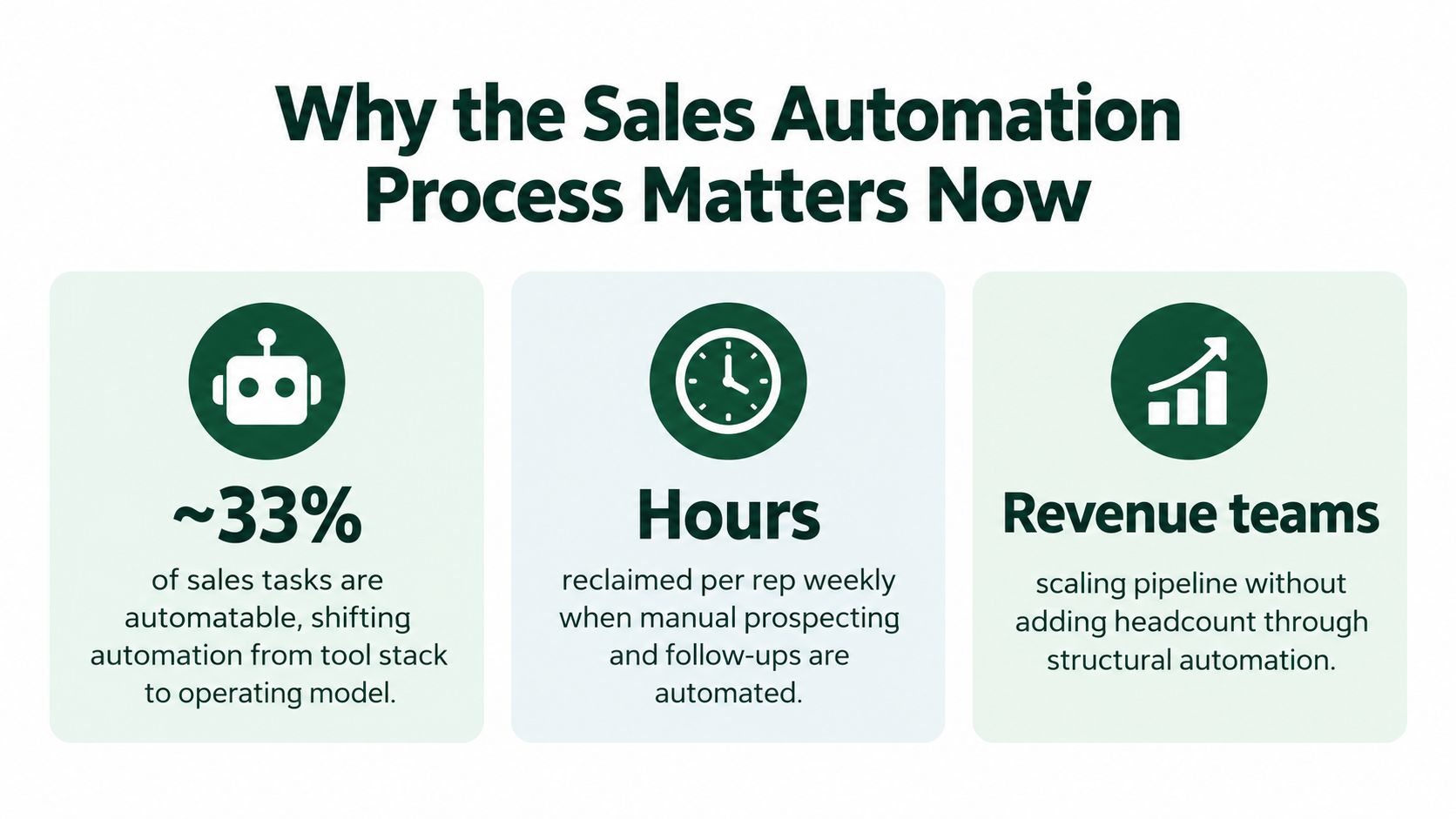
McKinsey Global Institute estimated that about one-third of sales and sales operations tasks could be automated with technology available in 2020 (verified summary of the estimate). That figure changes the question. Sales automation isn't just about sending more emails or reducing admin. It's about deciding which work software should execute, which decisions require a seller, and how data moves from the first signal to qualified pipeline.
The market reflects that shift. One industry summary valued the global B2B sales automation market at $7.5 billion in 2020, with a projection of $18.4 billion by 2026, while another reported the broader sales force automation market at $8.6 billion in 2023, with a projection of $19.5 billion by 2030 (market figures and projections). The competitive advantage won't come from owning the most tools. It will come from building a connected machine that survives imperfect data, regional complexity, rep turnover, and changing buyer behavior.
Table of Contents
Why the Sales Automation Process Matters Now
Sales automation became strategically important when teams recognized that repetitive work wasn't merely inconvenient. It was consuming capacity that sellers could have used for research, discovery, qualification, and relationship building. The McKinsey estimate of roughly one-third of automatable sales and sales operations tasks framed the issue as a structural change in how revenue teams allocate human effort, not as a feature comparison between software products (McKinsey estimate and context).
That distinction matters in practice. A point solution can send an email, enrich a record, or assign a lead. A functioning sales automation process must connect those actions. A company needs a defined ICP, verified records, segmentation rules, an offer, a sequence, sending controls, routing logic, CRM updates, and attribution. If any link is weak, adding another tool usually increases failure points rather than pipeline.
The machine has seven connected stages
A practical outbound system usually follows seven stages:
Data enrichment, so account and contact records contain usable firmographic and contact information.
ICP segmentation, so the team separates strong-fit accounts from broad but low-value coverage.
AI-assisted messaging, grounded in the account's role, situation, and likely problem.
Multi-channel sequencing, combining controlled email and social touches rather than treating every contact identically.
Meeting scheduling, removing unnecessary coordination after a prospect shows interest.
CRM hygiene, including deduplication, activity logging, ownership, and stage updates.
Attribution reporting, connecting replies and meetings to the signals, lists, messages, and channels that produced them.
Tools should fit into the process. Apollo for data enrichment can support list construction and record research, while Instantly for cold email, warming, and sequencing is relevant once the team has defined its audience and sending rules. Neither tool fixes an undefined ICP or unclear handoff.
The uncomfortable trade-off is that more automation can make performance worse. Poor records create bad personalization, bad routing sends accounts to the wrong owner, and aggressive sequences damage sender reputation. Teams operating across APAC face additional complexity because territory, language, time zone, data availability, and channel preferences vary by market. Standardization should cover the operating rules, not erase regional judgment.
Useful market context is available in resources such as verified founder contacts from NowFunded, particularly when a team is building an audience of founders or revenue leaders and needs a clearer starting point for account research.
Practical rule: Automate the movement of trustworthy information. Don't automate uncertainty and assume the CRM will hide it.
Define Your ICP and Build a Prioritised Account List
An ICP isn't a paragraph describing a fictional buyer. It's a prioritization model that tells the system which accounts deserve attention first, which signals should change their rank, and which records should never enter a sequence.
Start by mapping the manual work your team already performs. List every step from account discovery to first touch, including research, enrichment, duplicate checking, qualification, owner assignment, and suppression. This exercise reveals where automation can remove repetitive effort and where a human is still making a judgment that hasn't been documented.
Build the list in layers
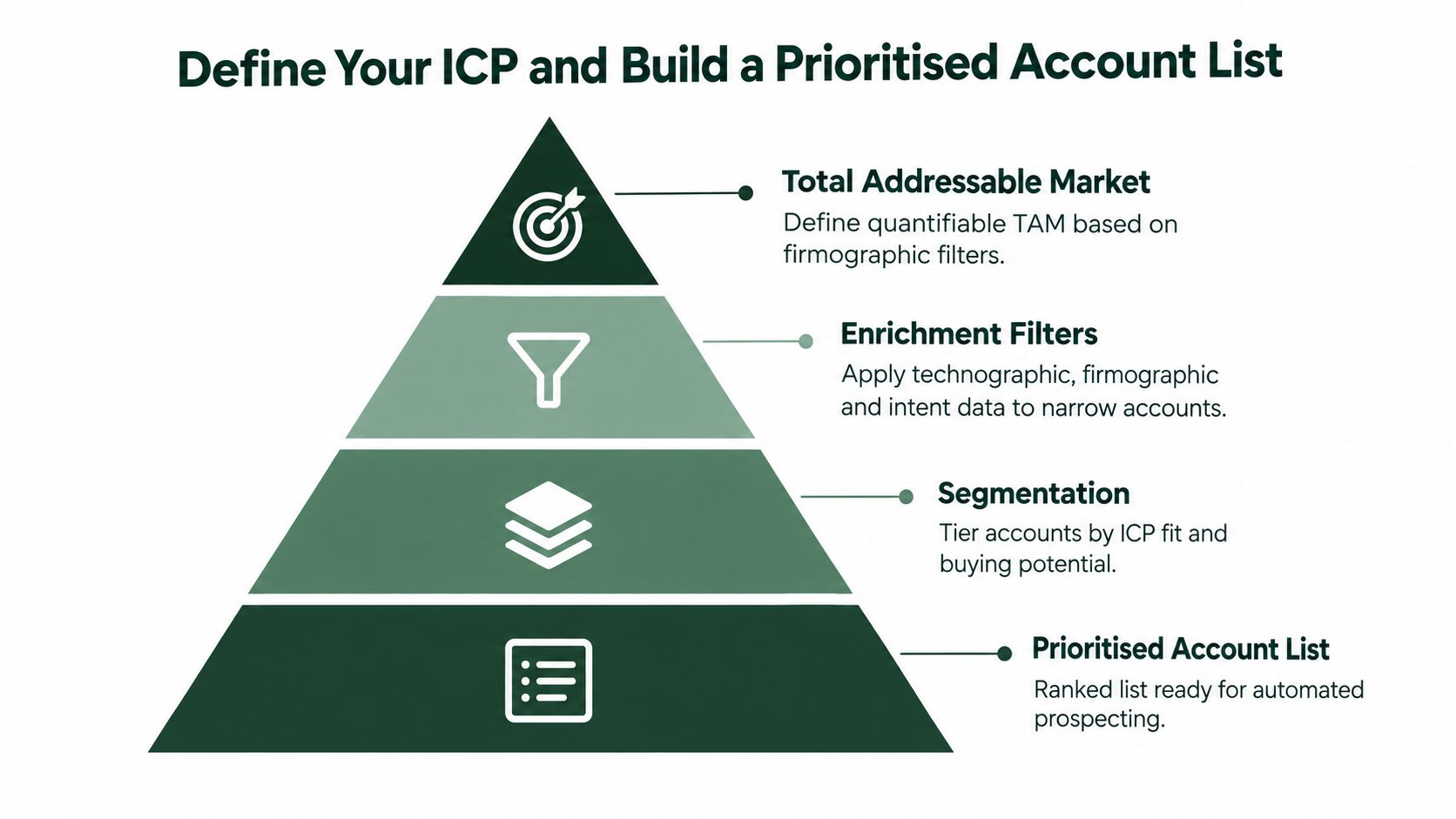
Use firmographic and operational filters to define the initial market. Depending on the offer, those may include industry, geography, employee range, revenue model, technology environment, hiring activity, or an identifiable operational problem. The point isn't to collect every possible field. The point is to identify the fields that distinguish a likely customer from a merely available contact.
Then enrich the accounts and contacts. A practical workflow verifies contact accuracy before sequencing, establishes a recurring enrichment cadence for existing records, and audits data quality rather than treating the first upload as permanent. Apollo's enrichment platform fits this stage because the system needs usable account and contact context before it can personalize, score, or route.
Segment accounts into tiers. A high-fit account with a relevant trigger should receive a different treatment from a high-fit account with no active signal, while a low-fit account shouldn't consume the same research or sending capacity. Rank the list using a combination of ICP fit, buying potential, and timing, not a single lead score that hides the reasons behind the ranking.
Social and intent signals can sharpen that timing. Trigify is relevant for monitoring social signals, while Whitewhale can support intent-signal workflows. Job changes, new leadership, hiring patterns, technology changes, and visible strategic activity may all justify a review, but a signal should trigger prioritization, not bypass qualification.
Design for APAC variation
APAC expansion exposes weak ICP definitions quickly. A title may carry different authority across markets, contact databases may have uneven coverage, and the best channel can vary by buyer and country. Standardize the fields, tier definitions, suppression rules, and ownership logic. Keep local decisions around language, timing, channel mix, and offer framing.
For a practical framework on turning buyer characteristics into a usable account model, see how to define an ideal customer profile. The deliverable isn't a giant spreadsheet. It's a ranked, verified, explainable list that another operator can use without needing the original builder's memory.
A small, tightly matched segment is the right place to begin. If the system can't produce relevant messages and clean routing for a narrow segment, increasing list size only spreads the error.
Design Message Sequences That Earn Positive Replies
A sequence should make a relevant buyer want to continue a conversation. It shouldn't exist to maximize sends, fill activity dashboards, or create the appearance of productivity.
Published cold-outbound benchmarks place average positive reply rates around 5% to 6%, while one benchmark set reports 18% for personalized outreach versus 9% for generic messaging (outbound benchmark summary). Another benchmark found 6 to 8 sentence emails at a 6.9% reply rate, which supports a useful design principle: enough context to establish relevance, but not enough copy to bury the point.
Personalization must change the reason for contact
Cosmetic personalization inserts a first name or company reference into a generic template. Material personalization changes the hypothesis, proof, offer, or call to action based on what the account is doing.
For each segment, define:
The trigger, such as a leadership change, hiring pattern, technology shift, or strategic initiative.
The problem hypothesis, written in the buyer's operational language.
The offer, which should give the prospect a reason to respond even if they're not ready to buy.
The proof point, selected for the segment rather than pasted into every message.
The exit condition, which pauses the sequence after a reply, meeting, unsubscribe, or suppression event.
Email and LinkedIn can reinforce one another, but neither channel should repeat the same message mechanically. HeyReach for LinkedIn outreach and automation is relevant when LinkedIn is part of the buyer's normal working environment. Instantly for email sequencing fits the email side, including controlled sending and follow-up management.
Cap follow-ups based on response quality
The first follow-up in one published benchmark increased replies by 49%, while the fourth reduced replies by 55% (follow-up benchmark data). That doesn't mean every campaign should use the same number of touches. It means sequence length must be treated as a performance variable, with a clear point where persistence becomes pressure.
Sequence Element | Benchmark Result | Implication for Design |
|---|---|---|
Average positive reply rate | 5% to 6% | Measure qualified responses, not raw sends |
Personalized outreach | 18% | Invest in account-specific relevance |
Generic messaging | 9% | Treat generic blasts as a weaker baseline |
6 to 8 sentence email | 6.9% reply | Give enough context without over-explaining |
First follow-up | Replies increased by 49% | Make the first follow-up useful and distinct |
Fourth follow-up | Replies reduced by 55% | Cap the sequence and protect buyer experience |
These figures are directional benchmarks, not promises. Your reporting should separate positive replies from negative replies, meetings booked, disqualified responses, unsubscribes, and spam complaints. A sequence that earns replies but no qualified conversations isn't working well enough.
For a detailed treatment of structure, timing, and message variation, use this guide to cold email outreach sequences. Iterate the offer from actual reply language. Don't use automation to avoid learning from the market.
Set Up Sending Infrastructure and Protect Deliverability
Deliverability is the gate before scale. A strong sequence sent from a damaged domain is still a failed system, and one benchmark summary reports that AI SDR and outbound deployments frequently encounter domain-reputation problems within the first 90 days when warm-up and authentication aren't managed (AI SDR and outbound deliverability data).
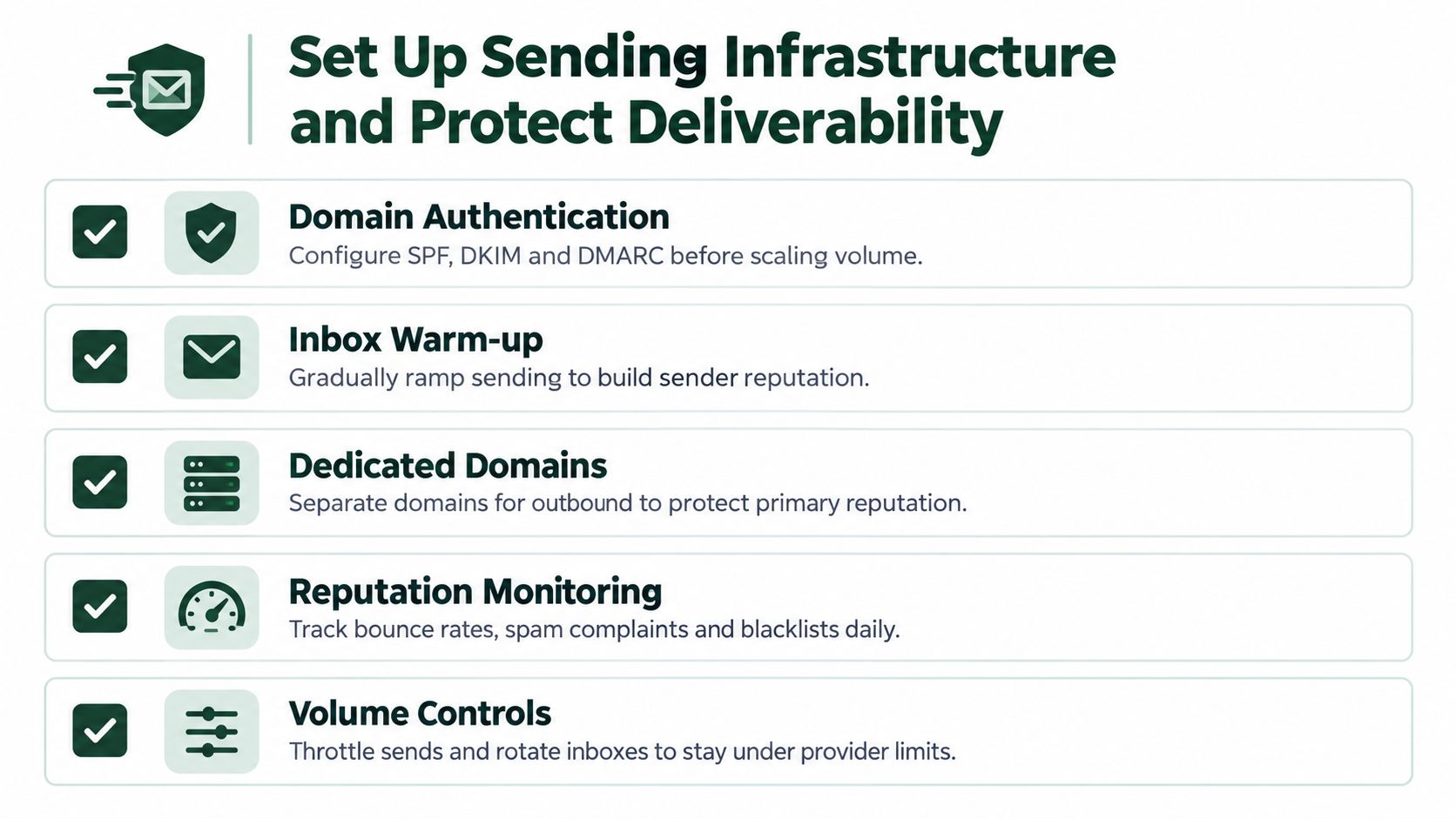
Configure authentication before increasing volume. Google's bulk-sender requirements cited in the same guidance include SPF, DKIM, DMARC, one-click unsubscribe, and spam complaints below 0.30% (Google requirements and deliverability guidance). These aren't decorative settings. They establish whether mailbox providers can identify and evaluate your traffic.
Use a controlled launch sequence
A sensible infrastructure checklist looks like this:
Authenticate every sending domain and mailbox before campaign traffic begins.
Warm up gradually, monitoring placement and reputation instead of treating the first send as a volume test.
Separate outbound infrastructure from critical business mail, so prospecting problems don't damage essential communication.
Verify contact data and suppress risky records before they enter a sequence.
Monitor bounces, complaints, unsubscribes, and blacklist signals daily during launch and after scale.
The benchmark summary reports hard-bounce changes after four weeks of warm-up, from 2.3% to 0.5% for Google Workspace and from 3.1% to 0.9% for Microsoft 365 (warm-up benchmark details). Those results don't guarantee the same outcome for another setup. They do show why reputation building should happen before volume expansion.
Instantly's warming and sequencing tools are contextually useful here, but software can't compensate for poor list hygiene. After waterfall enrichment and verification, run a suppression workflow for hard bounces, unsubscribes, and do-not-contact records. Keep the suppression logic outside individual sequences so a record excluded in one campaign doesn't reappear through another data source.
This email deliverability best-practices guide is useful as an operational checklist. The core principle is simple: reputation is an operating constraint, not a post-launch metric.
A visual walkthrough can help operators understand the infrastructure sequence before they configure it:
Connect Enrichment Routing and CRM Hygiene Into One Flow
Most brittle outbound systems break in the middle. The list exists, the sequence exists, and the sending tool reports activity, but no one can explain why a contact was routed, whether the owner acted, or which signal produced the meeting.
The fix is to define the handoff as carefully as the message. A seven-stage workflow can connect enrichment, segmentation, routing, CRM sync, owner alerts, follow-up automation, and continuous hygiene.

Make every transition explicit
Start with enrichment and ICP segmentation. Then route by territory, account tier, segment, or ownership rule. The CRM should receive clean records with deduplication applied, and the assigned owner should receive a sales-ready alert containing the reason for the handoff.
The follow-up action must also be visible. When the owner accepts the account, the system can trigger a sequence or task. When the owner rejects it, the reason should return to the data and scoring layer. That feedback loop prevents the model from treating every rejection as a rep failure when the actual problem may be inaccurate data or a weak fit definition.
A useful system records:
Source and signal, including where the account came from and why it was prioritised.
Ownership and timing, including territory, responsible seller, and required response window.
Suppression status, so bounces, unsubscribes, and do-not-contact records remain excluded.
Stage movement, including the event that moved a record from prospect to qualified conversation.
Attribution, connecting meetings and pipeline to list, message, channel, and signal.
Teams looking to improve data quality with automation should focus on the recurring loop, not a single cleanup project. Data decays, people change roles, accounts merge, and regional records develop different gaps.
The same system-first thinking applies to the wider GTM engineering model. Light SEO can complement outbound discovery when buyers research the problem independently. SearchAtlas for technical SEO and Outrank for SEO content fit that adjacent demand-capture layer, but they shouldn't be inserted into the outbound machine unless their signals and conversions can be attributed.
Document the workflow so a new operator can maintain it without asking the original builder. If ownership rules live in someone's head, turnover will expose the flaw.
Launch Measure and Improve Without Losing Human Judgment
The right first automation targets are repetitive, rule-based tasks with clear inputs and outputs. Enrichment, scoring, routing, CRM updates, scheduling, activity logging, and first-touch sequencing usually qualify. Discovery, negotiation, complex objection handling, executive relationship building, and high-stakes account judgment don't.
That boundary needs operational triggers. Automation can prepare research, assign an owner, create a task, and suggest a message. A seller should re-enter when a prospect replies, raises a complex objection, shows buying intent, involves multiple stakeholders, or reaches a commercial decision. The system should capture the outcome of that human judgment instead of forcing the seller back into unstructured notes.
Pilot the workflow before scaling it
A 2026 implementation guide recommends a 30-day pilot with five to ten reps, measuring connect rates, email deliverability, and time-to-first-touch before broader rollout (pilot guidance). Use the pilot to test the machine, not to prove a preselected tool was correct.
Track performance at three levels:
Execution, including data completeness, routing accuracy, time-to-first-touch, and deliverability.
Engagement, including positive replies, booked meetings, disqualification reasons, and channel contribution.
Pipeline, including qualified opportunities, stage progression, attribution, and revenue relevance.
A dashboard such as these sales pipeline reports should answer more than how much activity occurred. It should show which segment, signal, offer, and channel produced qualified movement, and where the handoff failed.
Keep the system transferable
Build documentation beside the workflow. Record field definitions, routing rules, sequence entry and exit conditions, suppression logic, review points, and escalation paths. This matters in APAC expansion because a regional operator may need to adjust timing, language, or channel behavior without changing the underlying data model.
The Social Search operates as a go-to-market engineering consultancy, building and running outbound systems across ICP definition, data, messaging, sending infrastructure, routing, reporting, and rep enablement. Its work is designed to be handed over, with clients retaining the infrastructure, documentation, and playbooks.
Review the system regularly. Retire sequences that attract poor-fit replies, update enrichment rules when data quality declines, and revise routing when territories or responsibilities change. The goal isn't maximum automation. It's a reliable division of labor where software handles repetition and sellers handle judgment.
If your outbound motion is producing activity but not qualified pipeline, The Social Search can map the manual workflow, define the ICP, build the data and routing layer, and launch a documented email and LinkedIn system. Visit The Social Search to discuss a build that your team can operate, measure, and own.
