B2B Outbound Sales Strategy That Books Real Meetings
Learn a b2b outbound sales strategy that turns cold outreach into pipeline. Covers ICP, messaging, sequencing, deliverability, LinkedIn, and metrics.
You hired two SDRs. You bought a list. You loaded a sequence into your outreach tool and waited for meetings to show up.
Three weeks later, activity looks healthy and pipeline doesn't. A few replies came in, most of them soft nos, and everyone is already arguing about copy, list quality, or whether outbound still works.
That diagnosis is usually wrong. The problem isn't one email, one rep, or one bad week. B2B outbound sales strategy works when the whole machine is designed correctly. That means ICP, data, signals, messaging, channels, deliverability, routing, and reporting all have to support each other.
When I build outbound systems for APAC and global teams, I usually start with the same stack of questions. Is the list built around a documented ICP? Are contacts enriched well enough to support trigger-based messaging? Is email infrastructure healthy before volume starts? Is LinkedIn being used to create trust, or is the team hiding behind email alone? Tools matter here. For email sequencing and deliverability operations, Instantly is a practical option. For LinkedIn workflow execution, HeyReach fits well. For contact and account enrichment, Apollo is a common starting point. For social and intent signal capture, Trigify and Whitewhale are useful when you want outreach timed to actual market movement instead of static lists.
The teams that book meetings consistently don't treat outbound like a rep task. They treat it like an operating system.
Table of Contents
Why Most B2B Outbound Strategies Quietly Fail
Monday morning. The sequence went live last week, 4,000 contacts have already been touched, and the pipeline review is tense because nothing credible is forming. The copy gets blamed first. Then the SDRs. Then the market. In practice, the failure usually started earlier, when the team treated outbound as a set of tasks instead of a connected machine.

I see the same pattern across APAC and global teams. Leadership wants meetings fast, spins up two SDRs, buys access to a list, connects mailboxes, and approves a generic sequence built around a soft CTA. Activity goes up. Useful learning does not. Every weak input upstream forces another part of the system to compensate, and outbound does not give you much margin for that.
The rep is rarely the root cause. An SDR cannot rescue bad account selection, weak contact mapping, poor timing, and unstable sending infrastructure with a better first line.
Five structural breaks show up first
Undocumented ICP. The team targets categories like mid-market SaaS or APAC logistics, but nobody has defined fit by segment, buying committee, pain, urgency, or disqualifiers. That creates list volume without account priority.
Shaky contact data. Titles drift, region fields are messy, and key stakeholders are missing. Good messaging still fails if it reaches the wrong person or arrives without any buying context.
Generic offer design. Buyers respond to relevance and timing. They ignore messages built from template libraries with no live trigger, no credible problem statement, and no reason to engage now.
Single-channel execution. Email-only programs ask a cold prospect to trust an unknown sender on the first touch. That is a hard ask, especially for higher-consideration sales.
No deliverability base. Domains, authentication, mailbox distribution, and reply handling get treated as setup work instead of operating constraints. Then inbox placement slips and the team mistakes a delivery problem for a messaging problem.
One broken layer distorts the rest. A weak ICP makes data look worse than it is. Bad data makes copy look weak. Poor deliverability makes every metric downstream harder to interpret.
What teams with a connected outbound machine do instead
They design outbound in order, because order matters.
Define the buying surface first. Pick the accounts, segments, and personas that can produce revenue, not just replies.
Build the data layer around execution. Add fields for triggers, territory, routing, seniority, and committee coverage so the campaign can be segmented and handed off cleanly.
Write from evidence. Use hiring activity, expansion, leadership changes, product launches, and market movement to shape the message.
Run coordinated channels. Email creates reach. LinkedIn adds familiarity and gives the prospect another place to verify who you are.
Treat infrastructure as part of growth. If mailbox health is unstable, scaling volume just burns inventory and creates misleading performance data.
That is the trade-off many teams avoid. Precision lowers top-of-funnel volume at first, but it improves signal quality, protects domains, and gives the team a system they can optimize. If you need a practical primer on how teams structure email touches inside Gmail, these Gmail sales outreach tactics are a useful reference point, especially for early-stage teams that have not yet formalized a full outbound ops layer.
The Reply Rate Collapse and What It Means for Your Strategy
Cold outbound got harder slowly, then all at once. One benchmark reported the average B2B cold email reply rate fell from 8.5% in 2019 to 3.43% in 2026 according to Sales.co cold email statistics. The same source also cites another analysis showing average reply rates at 22% in 2010, 9% in 2023, and 2% in 2026-to-date.
Those numbers explain why so many teams feel like they are doing more work for less return. They are.
The old volume play doesn't scale cleanly anymore
Recent benchmarks put average cold email open rates around 27.7% and reply rates around 3.43%, with many campaigns falling in the 1% to 5% reply band, and only about 0.2% to 2% of cold contacts converting to a deal according to Martal's B2B cold email statistics. The same benchmark notes that 10,000 delivered emails might produce about 343 replies on average.
That should change how you think about headcount planning. If your baseline economics are this lean, adding more send volume without fixing targeting and infrastructure just gives you more low-quality data, more fatigue, and more sender risk.
For a deeper benchmark breakdown, this guide on cold email response rate is worth reading alongside your own funnel numbers.
Reply rate decline versus send volume pressure
Year | Avg Cold Reply Rate | Personalized Emails Needed for 30 Meetings | Avg Sends per SDR/Day to Hit Target |
|---|---|---|---|
2010 | 22% | Qualitatively lower than current requirements | Qualitatively lower than current requirements |
2019 | 8.5% | Higher than 2010 | Higher than 2010 |
2023 | 9% | Higher than 2010 and still materially easier than 2026-to-date | Moderate compared with 2026-to-date |
2026 | 3.43% | Materially higher than prior years | Materially higher than prior years |
2026-to-date | 2% | Highest pressure in the benchmark set | Highest pressure in the benchmark set |
I haven't filled the send-volume cells with invented math because meeting-booked rates vary by targeting, channel mix, and offer quality. The directional point is enough. Every point of reply-rate decay raises the burden on list quality, message relevance, and operational discipline.
Buyers didn't stop needing solutions. They got better at ignoring low-context outreach.
What strategy actually changes
There are two responses to this environment.
The first is to scale harder. More domains, more mailboxes, more contacts, more automation. That can work briefly, but it usually creates a second problem faster than it creates durable pipeline.
The second is to tighten the system. Better ICP definition. Better signal capture. Better sequencing logic. Better channel orchestration. That's the version that survives because it improves both response quality and infrastructure health.
Defining the ICP and Prioritizing the Account List
A rep pulls 300 accounts into sequence on Monday. By Friday, the team has sent plenty of email, learned very little, and blamed copy for weak replies. In practice, the problem usually starts earlier. The account list was never prioritized tightly enough to tell the messaging system who deserves attention now.
Many teams file the ICP as a slide in a deck without operationalizing it. Outbound needs an ICP you can score, route, and revisit every week.
A useful outbound machine starts with a tiered-fit account system, because the list determines how every other part of the motion behaves. If account selection is loose, personalization gets expensive, SDR time gets burned on low-probability targets, and reporting becomes noisy enough to hide what is working.
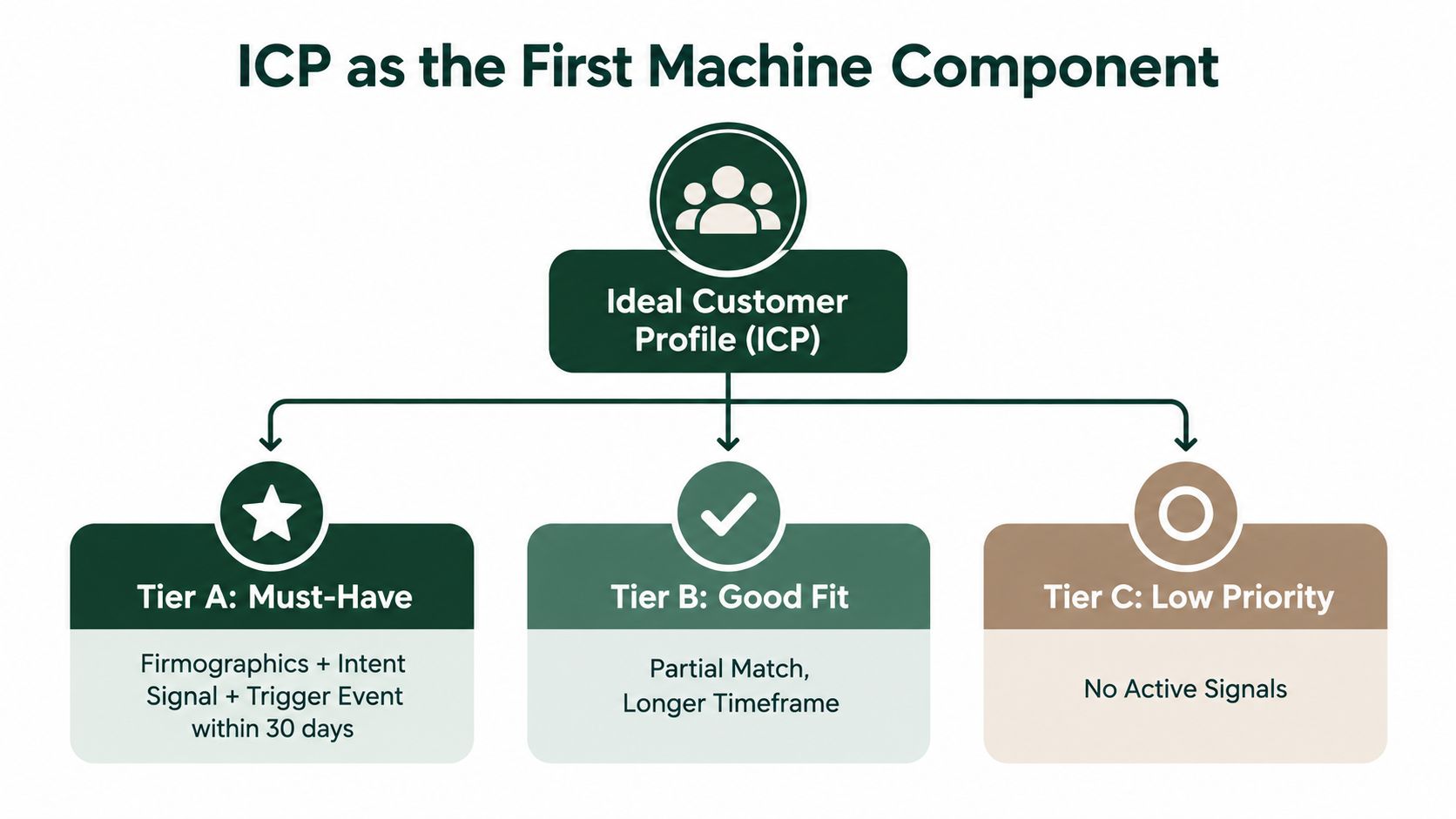
Use a simple three-tier fit model
Tier A. Must-have firmographics, a live intent signal, and a trigger event inside the last 30 days.
Tier B. Strong firmographic match plus one qualifying signal.
Tier C. Firmographic match only, with no active signal.
This is the core idea behind a practical ideal customer profile definition process. The job is not only to describe who could buy. The job is to decide who deserves scarce outbound attention this week.
In 2026, that distinction matters more because reply rates are low enough that list quality has become a hard operating constraint. Tier A should get the highest-effort touches, faster follow-up, and tighter rep ownership. Tier C can still be useful for controlled testing or cheap coverage, but it should not absorb prime domains, manual research time, or senior SDR capacity.
What to score on every account
Score accounts on two dimensions. Fit answers whether the company matches the kind of customer you win. Timing answers whether they have a reason to engage now.
That usually means:
Firmographic fit. Industry, size, geography, operating model.
Technographic fit. Tools in use, likely integrations, platform maturity.
Hiring signals. New openings that indicate expansion or process change.
Company events. Funding, leadership hires, expansion into a region, product launches.
Digital behavior. Website visits, content engagement, review-site activity, social activity, or other intent indicators.
A lot of outbound programs get distorted. Teams overweight firmographics because they are easy to buy in bulk, then wonder why conversion stalls. A clean static list helps with coverage. It does not create urgency.
Operational rules that keep the list honest
A scoring model only matters if it changes execution.
Work Tier A within 48 hours. Timing signals decay fast.
Set a send cap for Tier C. Keep low-signal accounts from filling the calendar just because they are plentiful.
Downgrade stale accounts. If an account shows no engagement or fresh trigger for an extended period, push it behind newer opportunities unless there is a strategic reason to keep pressure on it.
Re-score named accounts weekly. Accounts move between tiers. The system should reflect that.
There is a trade-off here. Precision lowers volume. Volume fills dashboards. Teams that need fast learning across APAC or multiple global segments often need both, but not from the same pool. The fix is to separate list strategy by tier, infrastructure, and expected effort level instead of forcing one blended motion across every account.
A weak list creates fake messaging problems. Teams rewrite copy for weeks when the issue is that they targeted accounts with no reason to care now.
A one-page worksheet for RevOps is usually enough. Define must-have firmographics, disqualifiers, likely personas, trigger events, relevant technologies, and signs of urgency. Once those rules are written clearly, outbound stops acting like a set of disconnected tasks and starts working like a system.
Messaging and Sequencing That Earn Replies
Most outbound copy fails for a simple reason. The message asks for attention before it offers relevance.
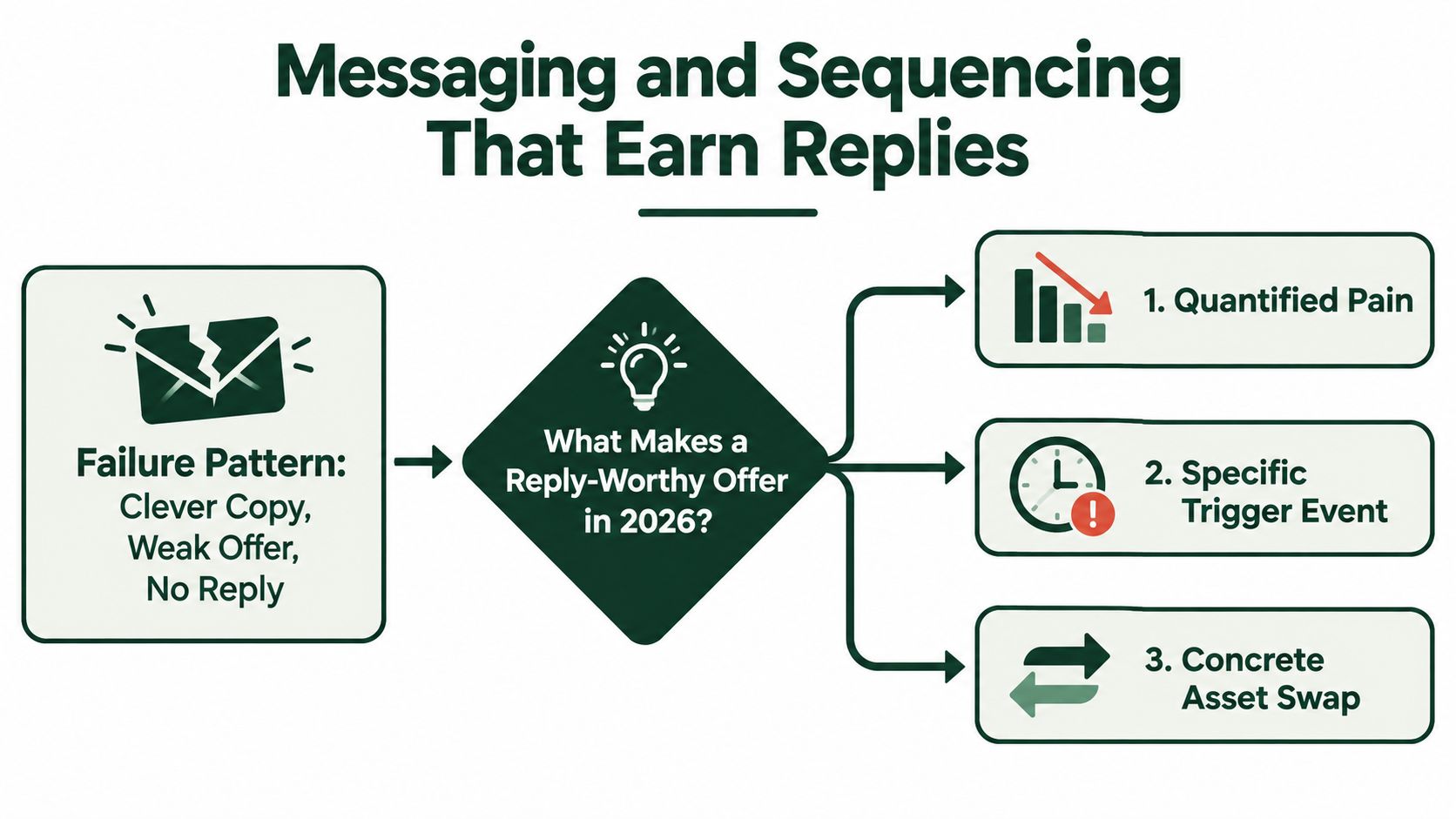
A reply-worthy offer in 2026 is usually one of three things. It connects to quantified pain the buyer already owns, it ties to a fresh trigger event, or it swaps a concrete asset for attention. “Open to a quick chat?” is not an offer. It's a request with no reason attached.
If you want examples of how this translates into outbound copy, this piece on cold email marketing for B2B is a useful companion.
Build around a 3-3-2 sequence
I like a simple sequence structure because it forces discipline.
Three value emails. Each one should stand on its own. Different angle, same problem space.
Three trigger-based follow-ups. These only work if your data layer is feeding fresh account context.
Two breakup messages. Clean, respectful, and easy to answer.
The point of the sequence isn't persistence for its own sake. It's progressive relevance. Each touch should either add context, react to a signal, or reduce friction.
The first-line test
Read your opening line and stop after eight words. Can a buyer tell whether this is about their situation?
If not, rewrite it.
Good openers usually do one of these:
Name a current change. A new market entry, a hire, a system shift.
Point to a known operational pain. Something the persona is already responsible for.
Offer a concrete asset. Audit, teardown, benchmark, comparison, or recommendation set.
A liftable structure
Here are patterns that still work when the signal is real.
Saw the hiring push for regional SDRs. That usually means territory coverage gets ahead of process quickly.
You recently changed systems. We mapped the gaps that teams usually hit in the first rollout phase. Happy to send the notes if useful.
Looks like now isn't the right window. If priorities shift after the quarter, I can circle back with the account map we built.
Subject lines should stay plain. Company name, problem, trigger, or region all work. Novelty subject lines usually age badly.
Every reply matters. Positive replies move forward. Neutral replies get routed to nurture. Negative replies often reveal fit problems, timing issues, or message errors. None of that should die in an inbox.
Email vs LinkedIn Channels and How to Run Them Together
A rep sends a cold email on Tuesday morning. The same prospect gets a connection request that afternoon, then a LinkedIn pitch the next day that ignores the email entirely. Nothing is technically broken, but the motion feels disjointed. Buyers notice that fast.
Email still carries more throughput. LinkedIn carries more identity and context. In practice, the better channel depends on the account, the persona, the signal quality, and whether your team can coordinate touches without creating channel collision. Outbound works better when both sit inside one operating system instead of two separate playbooks.
The LinkedIn numbers support that role. A 2026 study covering more than 180,155 connection requests reported a 27.1% acceptance rate, 27.6% reply rate among accepted connections, and 2.0% booked-meeting rate among accepted connections according to Reachium's LinkedIn outreach benchmarks for 2026. Another 2026 benchmark summary reported that cold list outreach typically gets 10% to 20% connection acceptance and 3% to 8% first-message reply rates, while signal-based outreach improves to 40% to 60% acceptance and 25% to 55% first-message reply rates according to LinkedNav's 2026 LinkedIn outreach summary.
For teams building a social motion around those patterns, this guide to LinkedIn outreach strategy covers the mechanics in more detail.
What each channel is actually good for
Channel Strategy | Acceptance / Connect Rate | Reply Rate | Meeting Rate | Best Use |
|---|---|---|---|---|
Email only | Not applicable | Average cold email reply rate around 3.43% in recent benchmarks | Depends heavily on list quality, copy, and follow-up | Fast testing, broader account coverage, direct CTA |
LinkedIn only | 27.1% acceptance in one 2026 benchmark, with cold list outreach often in the 10% to 20% band | 27.6% among accepted connections in one benchmark, with cold list first-message replies often 3% to 8% | 2.0% booked meeting rate among accepted connections in one benchmark | Warmer introductions, executive outreach, trust building |
Blended email plus LinkedIn | Varies by signal quality and timing | Often stronger than single-channel outreach when coordinated well | Usually improves once both channels reference the same context | Best for named accounts and higher-value deals |
The trade-off is simple. Email gives you scale and cleaner testing. LinkedIn gives you buyer recognition and another path into the account when inbox engagement is weak. If your ACV is low and your TAM is huge, email-heavy usually wins. If you sell into senior operators, regional leaders, or hard-to-reach APAC accounts where trust has to be earned before the meeting ask, LinkedIn usually raises conversion.
How to run them as one sequence
Treat each touch as part of the same conversation.
Start with LinkedIn first when the contact is active, the profile is clearly tied to the pain you solve, and the account matters enough to justify the extra handling time. Keep the connection request clean. No pitch. Just enough context for the buyer to recognize why your name appeared.
Once they accept, send a short note that matches the trigger you are already using in email. Then send the email with the same context, not a fresh angle. Relevance compounds. Random channel switching does not.
A simple pattern works well for many B2B teams:
Day 1: LinkedIn connect request tied to role or trigger.
Day 3: Email that expands on the same problem with one clear CTA.
Day 6: LinkedIn follow-up that references the email naturally.
Day 9 or 10: Second email with a different proof point, objection, or asset.
Reply stays in the channel they chose.
That last rule matters. If a buyer replies on LinkedIn, keep the conversation there until scheduling becomes the next logical step. Forcing them back into email adds friction for no gain.
Plain-text mentions are enough here. HeyReach is commonly used to coordinate LinkedIn activity at scale. Apollo is commonly used for contact enrichment, account mapping, and sequence inputs. The tool matters less than the orchestration logic behind it.
Rules that keep the motion from breaking
Do not hit LinkedIn and email on the same day unless there is a real trigger and a clear reason for both touches.
Do not let the LinkedIn message and the email sound like they were written by two different companies.
Do not ask for a meeting in every touch.
And do not measure channels in isolation. A prospect who sees your name on LinkedIn and replies to email is still a coordinated channel win. That is the point of the system.
Deliverability and Sending Infrastructure as a Growth Constraint
A familiar failure pattern looks like this. The list is decent, the copy is serviceable, the SDR team ships volume, and nothing breaks loudly. Reply rates stay weak because the constraint sits lower in the machine. Mailboxes, domains, authentication, complaint rates, and inbox placement.
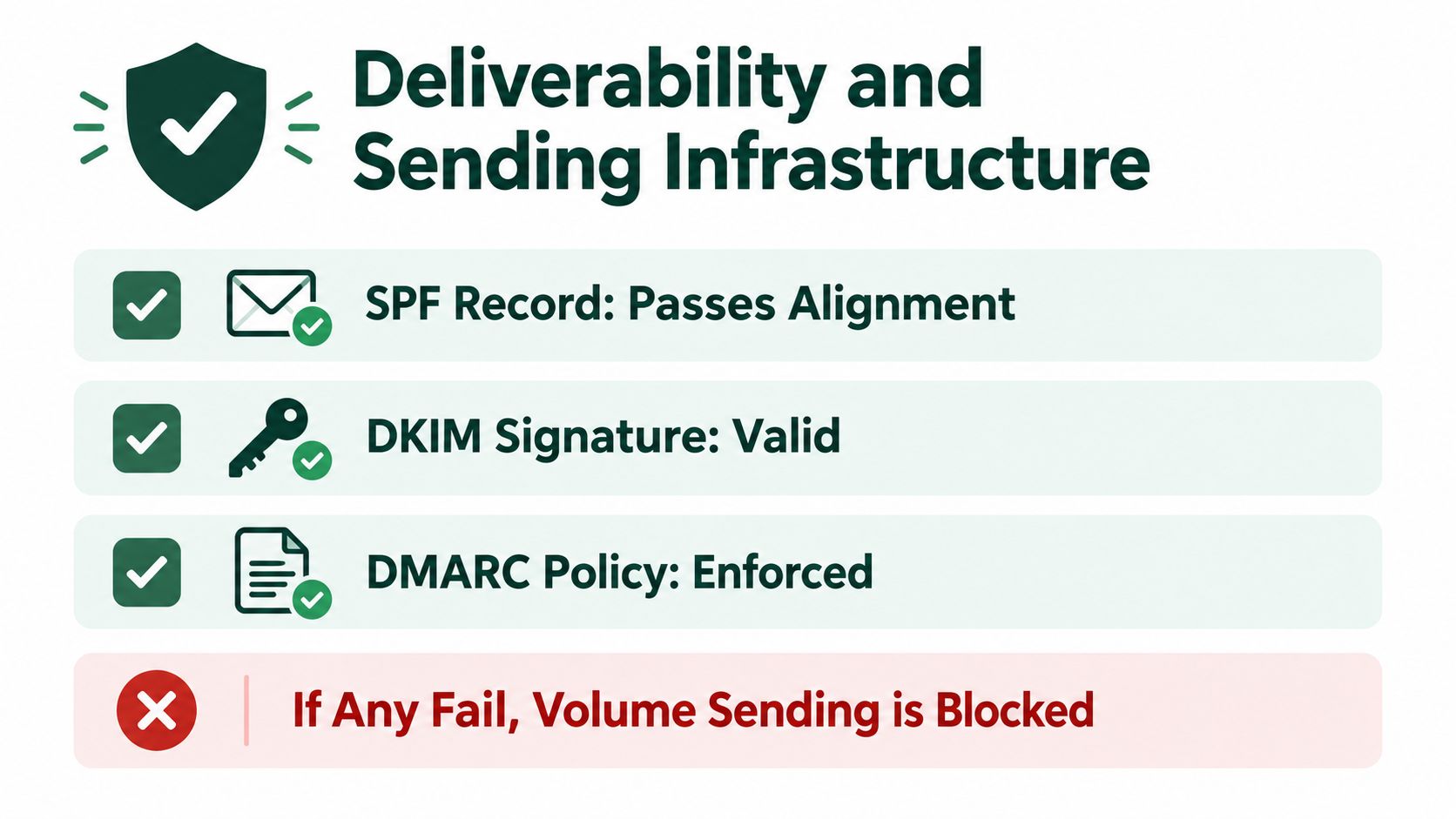
Email authentication sets the floor. Domains configured with SPF, DKIM, and DMARC tend to maintain far stronger inbox placement than loose or incomplete setups, as explained by TrulyInbox on SPF, DKIM, DMARC, and deliverability. In practice, that means infrastructure belongs in the same planning layer as ICP, data quality, and messaging. If delivery health is unstable, campaign results are hard to trust because you cannot tell whether the problem is the offer, the list, or the mailbox reputation.
The 2025 to 2026 benchmark picture is messy in a way that matters. Analysts at Belkins reported a 1.71% bounce rate across 7.5 million emails and framed that as 98.29% deliverability, but their email deliverability benchmark discussion also makes the more important point: accepted by the server does not mean placed in the inbox. Mailforge makes the same operational distinction from another angle, noting in its cold email engagement benchmarks that a meaningful share of global email gets flagged as spam.
That is the trap. Teams look at low bounce rates and assume the system is healthy. Then they keep rewriting copy while the issue is placement.
For a practical operating baseline, these email deliverability best practices line up with how outbound infrastructure should be configured before scale.
Operational rules I would treat as requirements
Authenticate before ramping volume. SPF, DKIM, and DMARC should pass before any serious sequence starts.
Separate outbound from the primary domain. Use dedicated sending domains and mailboxes so sales experiments do not put core brand communication at risk.
Warm and ramp with control. Increase volume gradually, watch bounce trends, placement, and reply quality, and stop adding load when health signals slip.
Manage complaint risk tightly. Google and Yahoo require bulk senders to stay below 0.3% spam complaint rates, and Amplemarket's cold email benchmarks point to under 0.1% as the safer operating target.
Treat mailbox capacity as an engineering limit. More mailboxes create more throughput, but they also create more monitoring overhead, more domains to maintain, and more ways to damage reputation if list quality drops.
Tool choice matters less than control over the system. Instantly can cover warming, sequencing, and mailbox operations in one environment. The Social Search provides outbound system design and operation for teams that want one setup spanning ICP, sending, routing, and reporting.
The strategic mistake is assuming deliverability is a technical cleanup task that sits outside GTM strategy. It does not. Infrastructure determines how much volume the system can absorb, how reliable your tests are, and whether a reply-rate problem is a messaging problem.
Good outbound teams do not ask only, "what should we send?" They also ask, "from which domain, through which mailbox pool, at what daily load, to which segment, with what complaint risk?" That is what turns outbound from activity into a controlled growth channel.
Signals, Routing, Metrics, and the Operating Org
A campaign can generate replies and still fail operationally.
The failure usually shows up one layer deeper. A prospect engages after a hiring spike, a leadership change, or a surge in category research, but the account is still sitting in a stale sequence, two reps touch it at once, or the reply lands in a queue with no clear owner. The issue is not channel choice. The issue is that ICP, signals, routing, and reporting were built as separate workflows.
That is why signal handling needs one job definition. It should answer a single question: why does this account deserve attention now, and who acts on that signal first?
Signals only matter if they change routing
Good signal models are narrower than teams expect. Track the events that change timing or message relevance. Ignore the rest.
A practical routing model needs a few hard rules:
One owner per account. No overlap and no rep competition.
A signal must trigger a routing outcome. Raise priority, switch sequence, create a task, or move the account to AE review.
Reply ownership should be explicit by source. If the contact came in through email, LinkedIn, or a form assist, the handoff rule should already exist.
"Not now" needs a destination. Put those accounts into nurture with a revisit date and the original objection captured.
Fresh signals should reopen closed loops. If a dormant account starts hiring into the problem, changes leadership, or shows renewed activity, it should re-enter the queue automatically.
Plain text tool names are enough here because the tool is secondary to the routing logic. Whitewhale can surface intent patterns. Trigify is useful if social engagement is part of the trigger model. Apollo can support account and contact coverage. None of them fixes a bad ownership model.
The operating org behind the machine
Outbound gets repeatable when each operator owns a specific failure mode.
GTM engineer owns data flow, enrichment logic, automations, deduplication, and handoffs between systems.
RevOps owns scoring rules, field hygiene, routing governance, attribution definitions, and reporting QA.
SDR owns execution quality. Touches sent, notes captured, objections tagged, and fast follow-up on active accounts.
AE owns conversion quality after interest appears, and feeds back which signals, offers, and segments produce real opportunities.
Marketing owns proof. Case studies, comparison pages, product education, and content buyers can review without booking a call first.
That last role matters because buyers do more evaluation on their own before they speak with sales. Research summarized by The Starr Conspiracy on B2B customer buying journey trends says 87% of B2B buyers want to self-serve part or all of their journey, and projects that more than half of large B2B transactions are expected to move through digital self-serve channels. Outbound still needs to create the first response, but it also needs to support silent research after that first touch.
A reply is only one form of progress.
A prospect who clicks twice, reads a case study, forwards the thread internally, and comes back three weeks later can be a better buying signal than a same-day polite response from a poor-fit account. Teams that miss this usually overvalue surface activity and underinvest in account-level tracking.
Outbound operating metrics and health thresholds
The useful dashboard is the one that tells the team what to fix next. It should help answer whether the constraint sits in targeting, timing, message-market fit, routing, or conversion after reply.
Metric | Healthy Range (2026) | Action Trigger |
|---|---|---|
Positive reply rate by tier | Highest in top-fit, signal-rich tiers | Tier A underperforming Tier C suggests ICP, list logic, or scoring is off |
Time to first follow-up on hand-raise signals | Fast enough that active interest is worked the same day | Delays suggest routing or ownership failure, not a messaging issue |
Meetings held per accounts touched | Stable enough to compare by segment, offer, and rep | A drop after no major list or volume change points to timing, message, or qualification drift |
Deliverability health | Spam complaints should remain below 0.3%, with a safer target under 0.1% as noted earlier | Pause added load and inspect infrastructure if complaint risk rises |
Channel response mix | Clear contribution by email, LinkedIn, and any inbound assist | One channel generating replies with no progression usually means poor sequencing or weak qualification |
Pipeline to spend | Improving as targeting and routing get tighter | Flat efficiency after several test cycles suggests the system needs a reset, not more volume |
For APAC and global teams, I also want reporting split by region, language, and market maturity. A sequence that works in ANZ can fail in Singapore. A US-led message can underperform in Japan even when the account fit is strong. If the dashboard rolls all of that into one average, the team learns the wrong lesson and keeps shipping the wrong creative.
The operating org matters because outbound is a connected machine. If the account model is loose, the signal layer gets noisy. If routing is weak, good timing gets wasted. If reporting is shallow, teams keep blaming copy for problems created by ownership, list quality, or handoff design.
A 90-Day Plan to Build and Hand Over the Outbound System
The right way to buy outbound isn't “run some campaigns for us.” It is “build us a system we can own.”
That changes the plan immediately. You're not paying for disconnected activity. You're paying for ICP logic, infrastructure, workflows, messaging assets, reporting, and a handover process your internal team can run after the engagement ends.
Days 1 to 30 build the base
The first month should lock down the foundations:
Finalize the tiered ICP and disqualifiers.
Clean and enrich account data so reps can work from signals instead of guessing.
Install sending infrastructure and prepare mailbox operations before serious volume.
Ship the first two sequences so testing begins with structure, not improvisation.
If you need a useful framework for what structured ramp-up looks like at the rep level, this 30-60-90 day plan for sales reps is a good model to adapt.
Days 31 to 60 calibrate reality
Month two is where theory meets the market.
Launch the blended email and LinkedIn motion against top-priority accounts. Instrument signal capture. Start routing replies properly. Review message performance every week, but don't overreact to tiny samples.
This is also where support content starts to matter. If buyers are self-serving before they reply, your outbound has to point somewhere credible. For teams that need that layer, SearchAtlas can support technical SEO foundations, and Outrank can help build supporting SEO content that gives outbound prospects something useful to find during independent research.
Days 61 to 90 turn it into an internal asset
The last month should feel like operational transfer, not agency theater.
Lock the dashboard so everyone agrees on what healthy looks like.
Document SOPs for list building, sequencing, routing, and inbox management.
Train SDRs and RevOps on what to do weekly.
Transition account and inbox ownership so nothing is trapped with an external operator.
Review pipeline against the original assumptions and decide what to scale, cut, or rework.
Some teams also add adjacent channels here. If WhatsApp is relevant in a given market, Respond IO can support operational messaging. If social comments and DMs are part of the motion, Manychat can help automate follow-up flows.
The trade-off is straightforward. You can keep renting lists and sequences that decay the moment the operator leaves, or you can build an outbound machine your team owns.
The Social Search designs and runs outbound systems for B2B teams that need more than isolated lead gen tactics. If you want help building a connected machine across ICP, data, messaging, email, LinkedIn, routing, and reporting, visit The Social Search.
