What Is Lead Generation: A Practical Guide to Attracting, Qualifying, and Converting Customers
Learn what is lead generation, how it works, and practical tactics using SEO, AI chat agents, Meta and TikTok ads, social media, and automation for measurable growth.
Lead generation is the process of turning audience interest into contactable prospects you can nurture toward a sale. It is the foundation of predictable growth because without a steady stream of leads your sales team has nothing to work with. This guide explains what lead generation is, how it works, modern strategies including AI chat agents and social media ads, measurement and compliance concerns, and clear next steps you can apply this week.
What is lead generation and why it matters
At its simplest, lead generation is a two-step flow. First you attract visitors through content, search, social, ads, or events. Second you capture contact information and permission to follow up. The result is a lead, which is a person or organization that has shown interest in your product or service.
Why this matters now
Predictable revenue depends on lead volume and quality. Higher quality lowers sales cycle time and increases close rate.
Channels and behavior change fast. New tools like AI chat agents and short-form video advertising make it possible to generate leads across more touchpoints.
Privacy and data rules mean first-party data and transparent consent are now competitive advantages.
How lead generation works - the funnel and stages
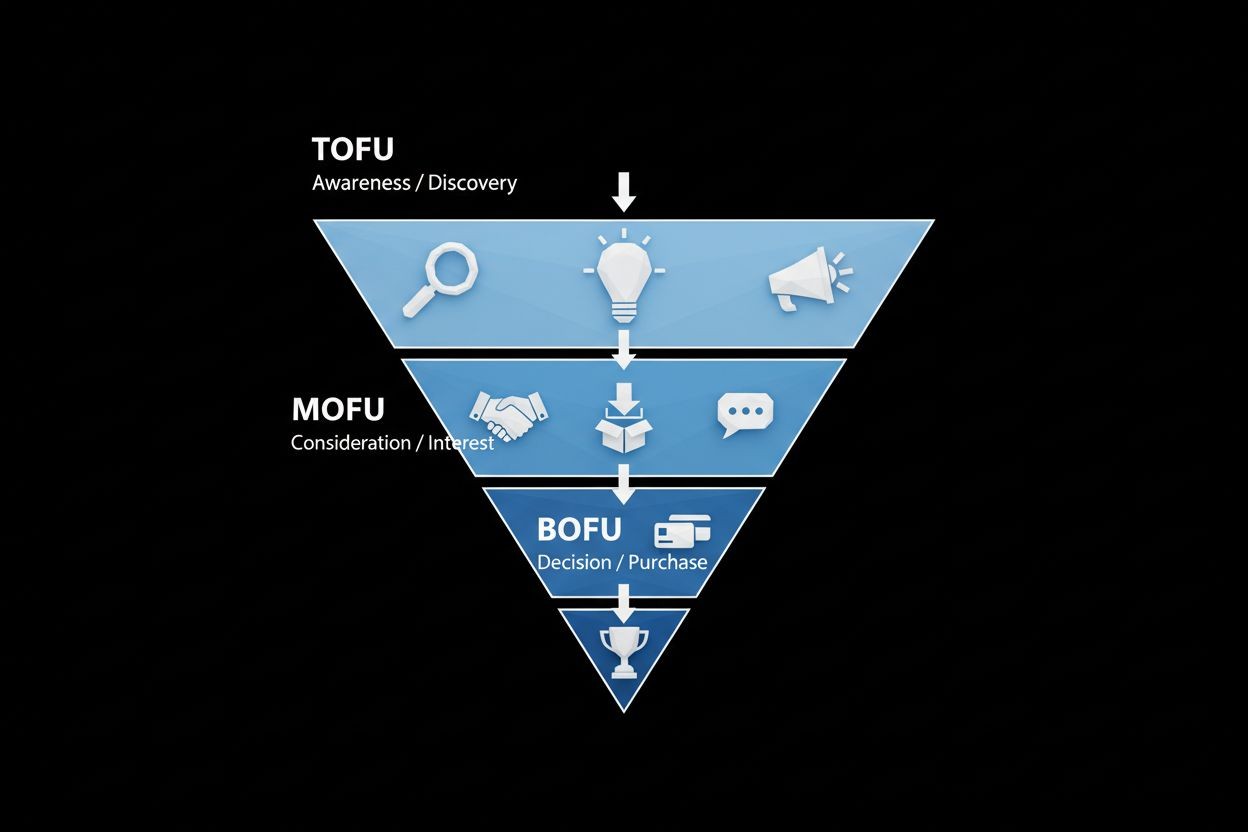
Think of lead generation as a funnel with three main stages: top of funnel TOFU, middle of funnel MOFU, and bottom of funnel BOFU.
TOFU - Awareness
Goal: attract a broad, relevant audience.
Tactics: SEO, organic social, display, educational blog posts, video views, short social clips on TikTok and Reels.
MOFU - Consideration
Goal: convert visitors into leads by exchanging value for contact information.
Tactics: gated ebooks, webinars, quizzes, email signups, conversational chat on site.
BOFU - Decision
Goal: qualify leads and drive purchase decisions.
Tactics: demo requests, free trials, case studies, targeted retargeting ads.
Lead capture elements
Landing pages optimized for a single offer.
Short forms with progressive profiling to reduce friction.
Lead magnets that match the funnel stage and audience intent.
Conversational experiences and chat agents that ask qualifying questions in real time.
Types of leads and qualification
Not every lead is equal. Classifying leads helps teams prioritize follow up.
Common lead types
Cold or unqualified lead - early interest, little data.
Warm lead - engaged with content or offers.
Marketing Qualified Lead MQL - meets marketing criteria for fit and interest.
Sales Qualified Lead SQL - passes sales-ready criteria and is ready for outreach.
Qualification frameworks
Lead scoring: assign points for actions and firmographic fit.
BANT: Budget, Authority, Need, Timing.
Lead grading: simple fit categories based on industry, company size, or persona.
Practical tip: map scoring thresholds to clear sales actions. For example 0-50 nurture in marketing, 51-80 assign SDR outreach, 81-100 pass to account executive.
High-impact channels and tactics
Successful lead generation uses a mix of organic and paid channels tailored to your buyer.
SEO and content
Create TOFU content that answers search intent and sits in front of buyers early.
Use MOFU content like templates or checklists to capture email addresses.
Link content to landing pages with clear CTAs.
Paid search and display
SEM captures high-intent queries with immediate visibility.
Use dedicated landing pages and tight keyword targeting to reduce Cost Per Lead CPL.
Social media and short-form video
Organic social builds trust and brand recognition.
Short video on TikTok and Reels drives discovery and can feed affordable warm audiences for retargeting.
Use platform-specific creative and include a clear one-step CTA.
Meta and TikTok advertising specifics
Meta excels at interest and lookalike targeting. Use conversion-optimized campaigns and test lead forms versus landing pages.
TikTok performs well for upper-funnel discovery and engagement. Use video-first creative and test instant forms for fast capture.
Budget tip: allocate 60 percent to testing creative and 40 percent to scaling winners.
Conversational marketing and AI chat agents
AI chat agents can qualify leads 24-7, answer basic objections, and route high-value prospects to sales.
Use short scripts that gather intent, budget range, and contact details, then hand off to human sales when needed.
If you need help implementing AI chat agents, look at services like Automated AI Chat Agents - The Social Search for setup and best practices.
Email and marketing automation
Nurture sequences move leads from interest to evaluation with progressively deeper content.
Triggered emails based on behavior increase relevance and conversion.
Integrate email with lead scoring to automate handoffs.
For specialized support on automated systems, see Automated Lead Generation - The Social Search.
Industry-specific tactics and examples
Lead generation looks different by industry. Here are quick playbooks for common verticals.
SaaS
Offer a free trial or freemium product as the primary capture mechanism.
Use in-product prompts and onboarding flows to convert trial users into paying customers.
Real estate
Use localized landing pages, neighborhood guides, and home valuation tools as lead magnets.
Combine paid social targeting with open house event captures.
Healthcare
Focus on educational content and compliance-friendly forms.
Use appointment request widgets and secure lead capture.
E-commerce
Use discount codes, back-in-stock alerts, and quiz-driven product recommendations.
Sync ad creative with the product catalog and use dynamic retargeting to recover carts.
B2B enterprise
Prioritize account-based marketing ABM and targeted outreach to named accounts.
Use gated case studies and executive roundtables to qualify decision makers.
If you want a step-by-step automation playbook for B2B, check Lead Generation and Marketing Automation Guide for 2026 Success - The Social Search.
Measuring, attribution, and key metrics
The right metrics tell you whether your lead generation is working and where to invest.
Core metrics
Conversion rate - percent of visitors who become leads.
Cost Per Lead CPL - total spend divided by leads.
Lead to opportunity rate - percent of leads that become sales opportunities.
Lead velocity - growth rate of qualified leads month over month.
Customer Acquisition Cost CAC and Lifetime Value LTV.
Attribution and multi-channel tracking
Use multi-touch attribution to understand the influence of each channel across the buyer journey.
Implement UTM tagging, server-side tracking, and CRM source fields to connect web behavior to closed revenue.
Consider using first-party tracking to reduce reliance on third-party cookies.
Benchmarks and CPL ranges (approximate)
B2B SaaS: $50 to $300 per lead depending on target and product price.
Finance and insurance: $100 to $500 per lead.
Education and healthcare: $30 to $150 per lead.
E-commerce general product: $5 to $50 per lead for newsletter or promo signups.
These are ballpark ranges. Track your actual CPL by campaign and adjust creative and targeting to lower it over time.
Lead qualification, nurturing, and handoff to sales
A fast response improves conversion dramatically. Data shows responding within minutes multiplies contact rates compared to hours. Set SLAs for lead response and automate immediate acknowledgements.
Nurturing framework
Welcome - deliver the lead magnet and set expectations.
Educate - provide case studies, use cases, and product details across 2-4 weeks.
Convert - present a clear next step such as demo, trial, or call.
Automation and CRM integration
Pass leads automatically to CRM with source and score information.
Use workflows to assign tasks, send follow-up emails, and update lead status.
For a practical CRM strategy guide, see What Is CRM in Marketing: A Complete Guide to Strategy, Automation, AI, and Growth - The Social Search.
Privacy, compliance, and first-party data
Privacy rules affect how you collect and use leads. Follow these principles.
Get explicit consent for marketing communications where required.
Keep a clear record of when and how consent was given.
Prioritize first-party data collection and build identity graphs from email and authenticated interactions.
Provide easy opt-out and respect data deletion requests.
Non-compliance leads to fines and damage to brand trust. Make privacy part of your lead generation design.
Technology stack - what you need
A practical lead generation stack includes tools for capture, storage, enrichment, and automation.
Core components
Landing page builder with A/B testing.
CRM for lead storage and lifecycle tracking.
Marketing automation for email workflows and lead scoring.
Conversational AI or chat agent for real-time capture.
Analytics platform for attribution and performance.
Plug-ins and integrations
Lead enrichment tools to append company and job data.
Auto-routing rules between marketing and sales.
Ad platform pixels and server-side conversion APIs to preserve attribution.
For managed services that run ads and automation together, consider Paid Ads Management - The Social Search.
Common mistakes and how to avoid them
What not to do
Do not use long generic forms that kill conversion. Ask only for what you need.
Do not send the same generic email to every lead. Segment and personalize.
Do not assume all leads are ready for sales. Score and nurture.
Do not rely on a single channel. Diversify across organic and paid.
Quick fixes
Reduce form fields from 7 to 3 and use progressive profiling later.
Create simple, automated workflows for immediate follow up.
Run weekly creative tests for Meta and TikTok to avoid ad fatigue.
A short case study example
Scenario
A B2B SaaS company ran a test campaign focused on a new analytics feature. They used a short demo signup landing page plus a TikTok awareness campaign driving to a webinar.
Results after 6 weeks
Traffic to landing page: 12,000 sessions.
Webinar signups: 1,800 leads at a CPL of $22.
Qualified leads to sales: 260 SQLs.
New customers from campaign: 34 with an average deal size of $4,500.
Key takeaways
Pairing short-form video with a focused BOFU offer moved users from discovery to demo efficiently.
Automated email reminders and an AI chat agent on the landing page lifted webinar attendance by 28 percent.
Actionable checklist to start improving lead generation this week
Define your ideal lead and set MQL and SQL criteria.
Map one funnel from TOFU to BOFU and pick one campaign per stage.
Create one high-value lead magnet and a single landing page.
Add a short chat flow to capture intent and hand off hot leads.
Start a small test budget on Meta and TikTok with at least three creative variations.
Implement UTM tagging and ensure leads flow into your CRM.
If you need help building a complete website and landing pages that convert, see Automated Website Creation - The Social Search.
Final thoughts
Understanding what is lead generation and building a repeatable system will make your growth predictable. Focus on matching offers to the funnel stage, use AI and conversational tools to reduce friction, and measure everything so you can optimize spend. Start small, iterate quickly, and scale the channels that deliver the best blend of volume and quality.
If you want hands-on help with strategy, automation, and ads, explore our services and insights at Automated Social Media - The Social Search and schedule a consultation via contact.