Target Account List: Build, Score, and Operationalize It
Learn how to build a target account list that actually converts. Covers ICP definition, data sources, scoring, tiering, and handoff to sales ops.
Most advice about a target account list starts in the wrong place. It tells you to collect company names, add contacts, assign a tier, and hand the spreadsheet to sales. That process produces a list, but it doesn't produce a working outbound system.
A useful list behaves more like an operating asset. It has a clear inclusion rule, contact-level coverage, signal-based prioritization, named owners, suppression rules, and a refresh cadence. For the execution layer, teams may pair verified account data with Apollo for data enrichment, Whitewhale for intent signals, Trigify for social signals, and Instantly for cold email sequencing. The tools matter, but the operating rules matter more.
Table of Contents
Why Most Target Account Lists Fail in Production
Most target account lists underperform because teams treat selection as the finished product. An SDR receives a CSV, works it for a short period, and then returns to familiar accounts, inbound leads, or whichever contacts happen to be easiest to find. The list remains technically accurate while becoming commercially irrelevant.
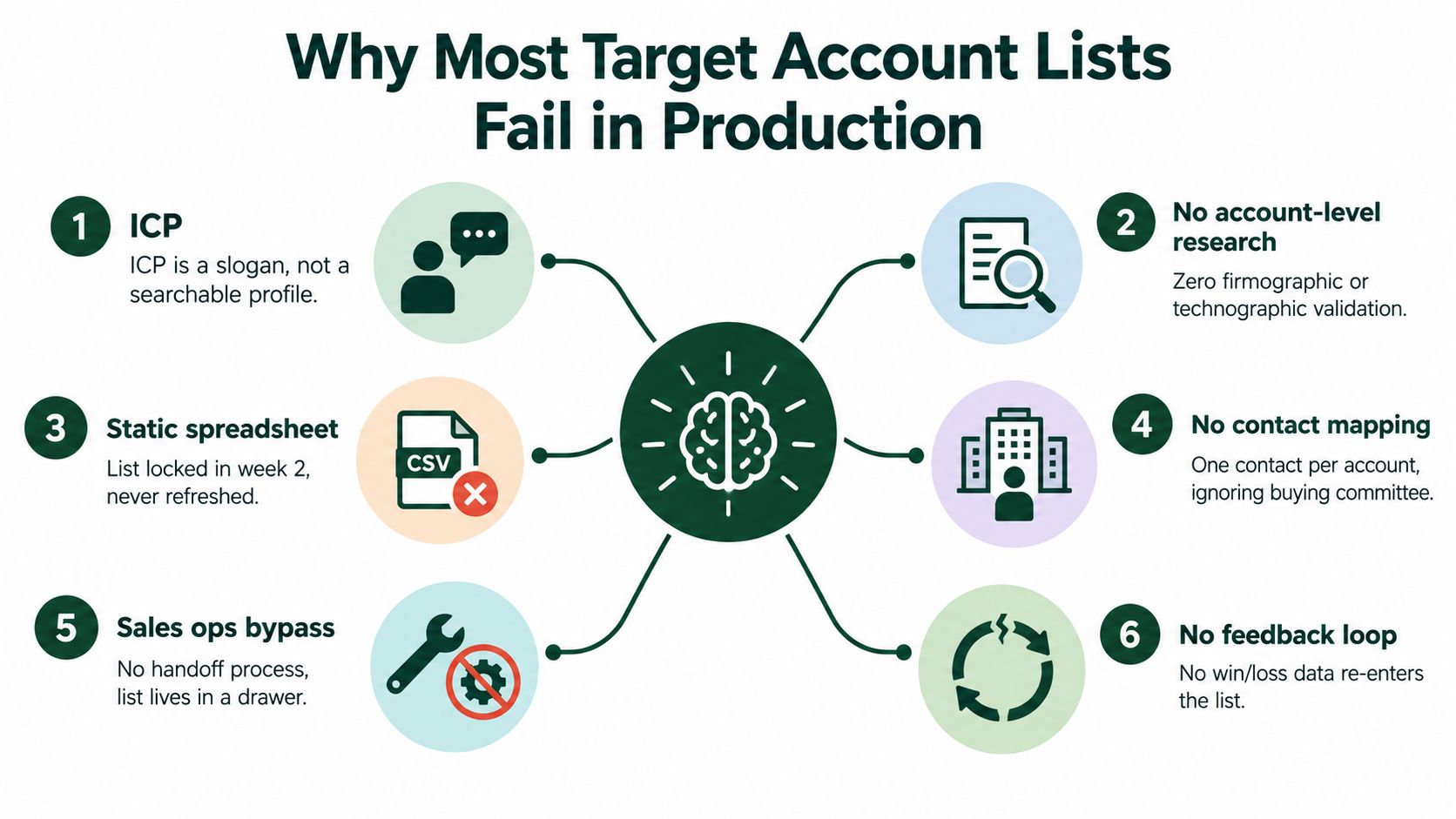
The first failure is an ICP written as a positioning statement instead of a queryable profile. “Fast-growing B2B SaaS companies with complex sales teams” may sound useful, but it doesn't tell a data operator which industries, headcount bands, technologies, regions, or exclusions to apply. The second is scale without prioritization. A broad list gives every account the same apparent importance, so the team either sprays across the entire market or spends too much time researching accounts that don't deserve high-touch treatment.
The silent breakage points
Stale records: Contacts can already be outdated when they enter the list. A changed role, inactive email, or wrong regional ownership creates wasted touches before anyone notices.
Weak account research: Duplicate subsidiaries, parent companies, and rebranded domains distort account counts and split engagement across records.
Single-threaded outreach: One contact per account creates false confidence. The buyer, evaluator, user, procurement lead, and blocker may all sit outside the list.
Sales-operations bypass: If the list has no owner, field requirements, routing rule, or outcome taxonomy, it becomes a document rather than a workflow.
No learning loop: Closed-won and closed-lost outcomes never alter the ICP, score, suppression logic, or source weighting.
A useful benchmark illustrates why disciplined selection beats maximum coverage. A 2026 benchmark found a median target account list size of 87 accounts, with 1-to-1 programs averaging 8 accounts, 1-to-few programs averaging 78, and 1-to-many programs averaging 840 in the same benchmark. Top-performing programs kept lists 23% smaller than median programs and allocated 84% of named accounts to Tier 1 ICP-fit accounts, which reinforces a practical point: efficiency comes from choosing fewer relevant accounts and operating them properly.
Operating rule: A list isn't complete when it has names. It's complete when a team knows who acts, what happens next, what counts as a valid outcome, and when the account must be reviewed again.
Defining the ICP That Actually Filters
An ICP should help a person or system decide whether an account belongs. It isn't a paragraph for the company wiki. Start with your last 20 closed-won deals, then compare the attributes that appeared repeatedly among customers who bought, retained, and expanded. The point isn't to copy every shared characteristic. It's to identify which characteristics are useful enough to become a filter.
Separate observations into firmographic, technographic, commercial, and operational categories. Firmographics might include industry classification, employee band, geography, and business model. Technographics should name the tools or infrastructure that create a real need for your offer. Commercial factors can include sales motion, contract complexity, regional coverage, or the presence of a function your product supports.
Turn patterns into rules
Write each important attribute as a binary or weighted rule. “Enterprise” is too vague if your data provider defines it differently from your sales team. A useful rule might specify a headcount band tied to your ACV, an industry at NAICS code level, or a named technology such as Salesforce, HubSpot, Snowflake, or a specific customer-support platform.
Build negative ICP at the same time. Exclude industries with poor retention, company sizes that can't support the buying process, geographies your team can't serve, and tech stacks that create implementation friction. Exclusions often improve list quality more than adding another positive characteristic because they prevent predictable waste.
For a deeper operating framework, use this guide to defining an ideal customer profile as a reference point, then convert the result into fields your data tools can execute.
ICP Attribute Matrix | Filter Rule Example | Common Mistake |
|---|---|---|
Industry | Include named NAICS categories connected to proven wins | Using broad industry labels that hide very different business models |
Company size | Use headcount bands that match implementation and ACV requirements | Treating every mid-market company as commercially equivalent |
Geography | Define countries, regions, language needs, and service coverage | Adding markets without checking sales capacity or compliance needs |
Technology | Include or exclude named tools and infrastructure | Assuming a category, rather than a specific platform, predicts fit |
Business model | Separate SaaS, services, marketplace, manufacturing, and other motions | Mixing companies with different buying cycles in one segment |
Negative ICP | Document industries, sizes, stacks, and situations to suppress | Leaving exclusions informal and dependent on rep memory |
The final ICP should look like a queryable specification. Someone else should be able to run it, inspect the resulting accounts, challenge individual rules, and update the logic when win-loss evidence changes.
Building the Account List From Real Data
The best account list usually combines first-party, second-party, and third-party data. Your CRM contains historical opportunities, customers, churned accounts, and expansion candidates. LinkedIn Sales Navigator, ZoomInfo, and Apollo can help identify companies by firmographics and contacts. BuiltWith and HG Insights can add technographic context, while Bombora, G2, and 6sense can contribute intent signals where the data is available and relevant.
The workflow should begin with a raw candidate set, not a polished spreadsheet. Apply the ICP filters, export the candidates, and then normalize the records before scoring them. For teams designing this kind of connected workflow, this explanation of GTM engineering provides useful context on how data, routing, messaging, and reporting fit together.
A practical enrichment pipeline
Capture the source. Store whether the account came from CRM history, a named data provider, a referral, a partner, intent activity, or manual research. Source visibility helps you identify which inputs produce useful accounts.
Dedupe by domain. Use the primary company domain as the starting key, then inspect aliases, regional domains, and brand names manually where necessary.
Normalize hierarchy. Map subsidiaries to parent companies when the buying decision is centralized. Keep separate records when regional teams buy independently and need separate ownership.
Verify critical attributes. Check headcount, funding, headquarters, technology, business status, and operating region. Mark uncertain records rather than treating them as verified without question.
Flag decay. Add a last-verified date and a confidence field. A record with strong fit but old evidence shouldn't receive the same operational treatment as a recently checked account.
Data Sources for Target Account List Construction | Tool Examples | What It Provides | Known Gaps |
|---|---|---|---|
First-party CRM | Salesforce, HubSpot | Historical fit, opportunities, customer status, outcomes | Incomplete fields and inconsistent rep entry |
Firmographic data | ZoomInfo, Apollo, LinkedIn Sales Navigator | Industry, headcount, location, company and contact discovery | Definitions vary, and records can decay |
Technographic data | BuiltWith, HG Insights | Technology usage and infrastructure clues | Coverage can be incomplete or misclassified |
Intent data | Bombora, G2, 6sense | Research activity and topic-level interest | Intent doesn't prove authority, timing, or budget |
Manual research | Company sites, job pages, professional profiles | Business context, leadership changes, active initiatives | Slow, subjective, and difficult to scale |
Before the list enters scoring, check that every account has a normalized domain, an owner region, an ICP decision, a source, a verification date, a parent-child status, and a reason for inclusion. Records that fail those checks should enter a review queue, not active rotation.
Scoring, Tiering, and Assigning Plays
Scoring should rank attention, not create a false sense of precision. A useful composite model combines firmographic fit, technographic fit, intent relevance, and trigger events. The exact weights should reflect your sales motion, but the model must be explicit enough that RevOps can audit it and sales can understand why an account moved.
A practical starting model is:
Firmographic fit, 35 points: industry, size, geography, business model, and commercial suitability.
Technographic fit, 25 points: required systems, compatible infrastructure, or a clear replacement opportunity.
Intent topic relevance, 25 points: evidence that the account is researching a problem your offer solves, rather than generic site activity.
Trigger events, 15 points: funding, relevant hiring, leadership change, expansion, or another event that changes timing.
These weights are editorial starting points, not universal benchmarks. Cap repeated signals from the same source, prevent multiple contacts from inflating an account's score without meaningful account-level evidence, and apply decay to old activity. Otherwise, a noisy account can outrank a quiet but high-fit account indefinitely.
Make the score control a play
Use score ranges as routing rules. For example, Tier 1 can begin at 80 points, Tier 2 at 60 to 79, and Tier 3 at 40 to 59, with accounts below the minimum threshold excluded or placed into a nurture pool. Those thresholds are a practical configuration, not a market standard. Review them against opportunity creation and disqualification patterns.
Account tiering framework with play assignment | Score Range | Definition | Assigned Play | Owner | Cadence |
|---|---|---|---|---|---|
Tier 1 | 80 to 100 | Strong fit with relevant timing or strategic value | Coordinated ABM with SDR, AE, and marketing | Named account team | High-touch, signal-led |
Tier 2 | 60 to 79 | Good fit with partial timing or coverage | Account-based light touches | SDR or growth rep | Structured review |
Tier 3 | 40 to 59 | Partial fit or weak timing | Nurture or PLG self-serve | Marketing or pooled SDR | Automated and monitored |
A Tier 3 account should move into active play when a meaningful trigger changes the context. A funding event, relevant hiring, leadership change, or sharp intent increase can justify a manual review. Don't let one low-quality page visit move an account three tiers. Require corroboration, such as intent plus a relevant technology signal or a verified contact change.
The practical difference between tiers should be visible in the work. Tier 1 receives account research, coordinated messaging, and AE involvement. Tier 2 gets personalization at the segment level. Tier 3 shouldn't consume the same research hours, or the model has failed its resource-allocation purpose. For further context on execution design, see these account-based marketing campaign patterns.
Covering the Buying Committee Inside Each Account
A company name isn't a buying group. One contact can confirm that an account exists, but that person may not own the budget, evaluate the technology, use the product, or have authority to block the purchase. A target account list with one contact per account is usually a prospect list, not an account-based coverage model.
The required coverage should match the tier. Tier 1 needs an economic buyer, a technical evaluator, an end user or operational champion, and a likely blocker such as procurement, legal, security, or finance. Tier 2 should cover at least two of those roles. Tier 3 can remain single-threaded until the account shows enough fit or intent to justify deeper research.
Coverage beats contact volume
A common production mistake is adding ten junior contacts because they are easy to find while leaving the senior decision-maker unidentified. That creates activity without influence. Title normalization helps, but titles alone aren't enough. Map each person to a role in the buying process, record the evidence for that classification, and distinguish current employees from stale profiles.
Use a sourcing waterfall:
CRM first: Check existing relationships, previous opportunities, referrals, and contacts tied to open or closed deals.
Enrichment second: Use a verified provider such as Apollo to locate missing roles and standardize contact fields.
Manual research third: Inspect company leadership pages, team pages, job descriptions, and professional profiles when the account justifies the time.
Contact-level marketing is becoming more important because identifying the right buyers remains a major ABM obstacle. Recent reporting cites 42% of ABM leaders struggling to identify the right buyers, 37% struggling with timing, and 31% with personalization at scale in its coverage of contact-level strategy. The same source says 42% report limited access to accurate contact data when moving toward contact-level marketing.
A beautiful account list with weak role coverage is still underbuilt.
For detailed role definitions and mapping logic, use this B2B buyer persona framework. Store persona, seniority, function, buying role, contact confidence, verification date, and preferred channel. Direct dials and email addresses don't compensate for a misclassified role.
Handing the List Off to Sales Operations
The handoff should transfer a working process, not just a file. RevOps or SalesOps typically owns the list after handoff, while marketing, SDRs, AEs, and data operations own specific actions within each play. If nobody owns the list after delivery, the first data problem becomes everybody's problem and therefore nobody's responsibility.
Before an account enters active rotation, require the same operational fields every time:
Account identity: Domain, account name, parent-child relationship, region, and source.
Fit data: ICP match score, inclusion reason, exclusion checks, and verification date.
Priority data: Tier, score components, intent topic, trigger event, and next review date.
Coverage data: Target personas, mapped contacts, role status, and missing-contact tasks.
Execution data: Assigned owner, play, sequence, channel, start date, and suppression status.
Put service levels around the work
A handoff SLA should define response time, follow-up expectations, research completion, and outcome logging. The SDR or AE needs to know when an account becomes their responsibility and which event closes the task. A meeting booked, a disqualification, an opportunity created, and a stalled account should each have a controlled disposition.
The reverse flow matters just as much. Every disposition, meeting, opportunity stage, and win or loss reason should write back to the same system that generated the score. Without that connection, the team can't tell whether the model is finding good accounts or merely generating busywork. Teams that need a clearer view of movement from account activity to opportunity can use pipeline reporting by Spreadsheet Upgrade as a practical reporting resource.
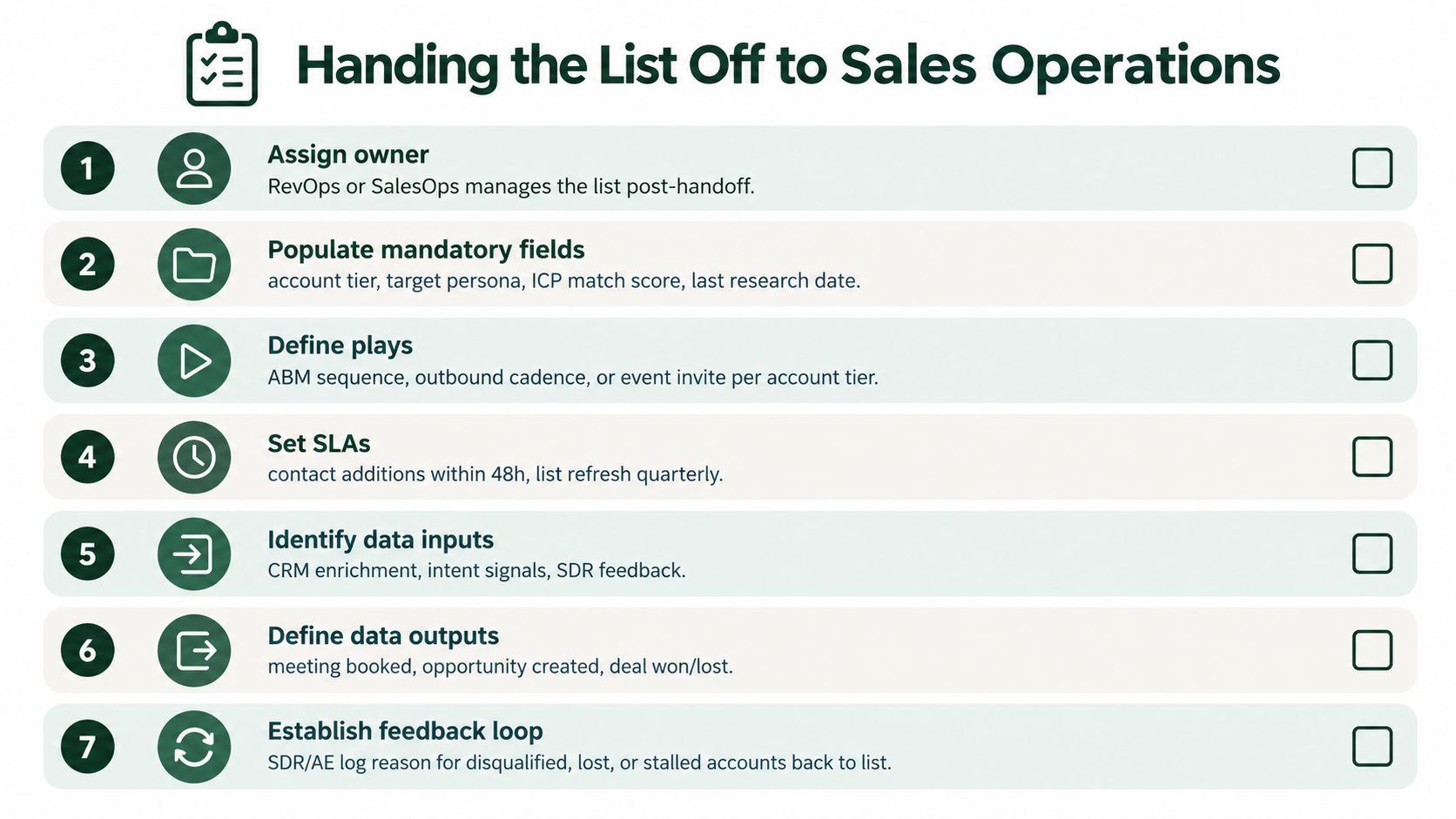
A sound handoff package includes the field dictionary, score logic, tier definitions, assigned plays, ownership map, SLA, suppression rules, source documentation, and reporting view. It should also include examples of accepted and rejected accounts. For broader operating context, this revenue operations overview explains why ownership and feedback architecture need to sit across the revenue process, not inside one campaign.
Refreshing, Retiring, and Re-Ranking on a Cadence
A target account list decays because companies change, contacts move, technologies are replaced, and buying priorities shift. Maintenance needs a schedule and a trigger model. A workable default is a weekly intake window for new signals, a 30-day full re-score, and a quarterly ICP recheck. Those intervals can change by market, but they should be explicit.
The list should also define when an account leaves active rotation. Suppress accounts that are won, disqualified, or closed-lost for a reason that invalidates fit. Pause accounts after sustained non-engagement across the configured outreach window, then review whether the issue is bad timing, poor contact coverage, weak messaging, or genuine lack of fit. Account-level changes such as mergers, acquisitions, layoffs, market exits, or major leadership changes should trigger a fresh review rather than an automatic continuation.
Make movement evidence-based
Tier movement should happen when evidence changes, not because a rep wants a larger pool. A Tier 3 account showing two relevant intent spikes, gaining a new champion, or announcing funding can automatically enter re-ranking. A Tier 1 account with stale contacts, a disqualifying change, or repeated negative outcomes should move down or become suppressed.
Refresh Cadence and Trigger Rules | Cadence / Trigger | Action | Owner |
|---|---|---|---|
New signal intake | Weekly | Add qualified accounts, verify the signal, and queue scoring | RevOps or data operations |
Full re-score | Every 30 days | Recalculate fit, intent, triggers, decay, and tier | RevOps |
ICP review | Quarterly | Compare wins, losses, retention, and exclusions against current rules | Revenue leadership |
Intent spike | At configured threshold, with corroboration | Re-rank and assign the appropriate active play | Marketing operations |
Champion change | Verified role departure or internal move | Re-map the committee and review tier | SDR or AE |
Non-engagement | After the configured touch and time window | Suppress, nurture, or research a new angle | Play owner |
Closed-lost or disqualified | Outcome reason recorded | Apply suppression rule and feed the reason into scoring review | SalesOps |
Each refresh should include a small feedback pull. Compare win and loss reason codes, reply patterns by tier, meeting quality, opportunity progression, and accounts suppressed after review. Mature teams commonly keep 4 to 7 verified buying-committee contacts per account and refresh quarterly, retiring the bottom 20% and refilling from the ICP universe according to this ABM benchmark. Another current benchmark says 6 to 11 verified contacts per target account may be needed to cover the full buying group in its contact-level ABM coverage guidance. Treat those figures as planning references, not rigid quotas. The right coverage depends on deal complexity and account tier.
The evidence supports a living model. ABM adoption reached 70% of B2B marketers in 2024, up from 15% in 2020, while mature programs reported 63% of named accounts generating measurable engagement within six months and a 171% average qualified-pipeline lift versus matched non-ABM controls in a 2024 benchmark reported by The Starr Conspiracy. Those results don't come from a spreadsheet alone. They depend on clear account definitions, operational follow-through, and the discipline to re-rank the market as evidence changes.
The Social Search helps B2B teams define an ICP, build verified and signal-ranked account and buyer lists, connect them to outbound plays, and document the handoff for internal ownership. If your team needs a target account list that earns pipeline through weekly execution rather than sitting in a spreadsheet, visit The Social Search to discuss an account and outbound system for APAC or global markets.
