Account Based Marketing Campaigns: A Practical GTM Framework
Design and execute account based marketing campaigns that drive pipeline. Learn ICP targeting, multi-channel orchestration, and measurement tactics that work.
Most advice about account based marketing campaigns starts in the wrong place. It tells you to personalize a landing page, send a gift, or launch account-targeted ads. Those tactics can help, but they don't fix a broken revenue process. If the account list is stale, buying-group coverage is weak, signals aren't routed to sales, and reporting stops at clicks, personalization makes an inefficient system more elaborate.
ABM works better as systems engineering. The operating model connects ICP definition, data enrichment, intent detection, role-specific messaging, coordinated outreach, sales action, and revenue reporting. For teams expanding into APAC, that connection matters even more because markets, job titles, buying norms, time zones, and data quality vary across countries.
Tools should support that machine, not become the machine. For example, Apollo can support data enrichment, Instantly can support cold email sequencing and deliverability workflows, HeyReach can support LinkedIn outreach, and Whitewhale can help route intent signals. The right stack depends on the workflow you can operate consistently.
Table of Contents
Why Most Account Based Marketing Campaigns Fail at Execution
Mapping Buying Committees and Crafting Role-Specific Messaging
Why Most Account Based Marketing Campaigns Fail at Execution
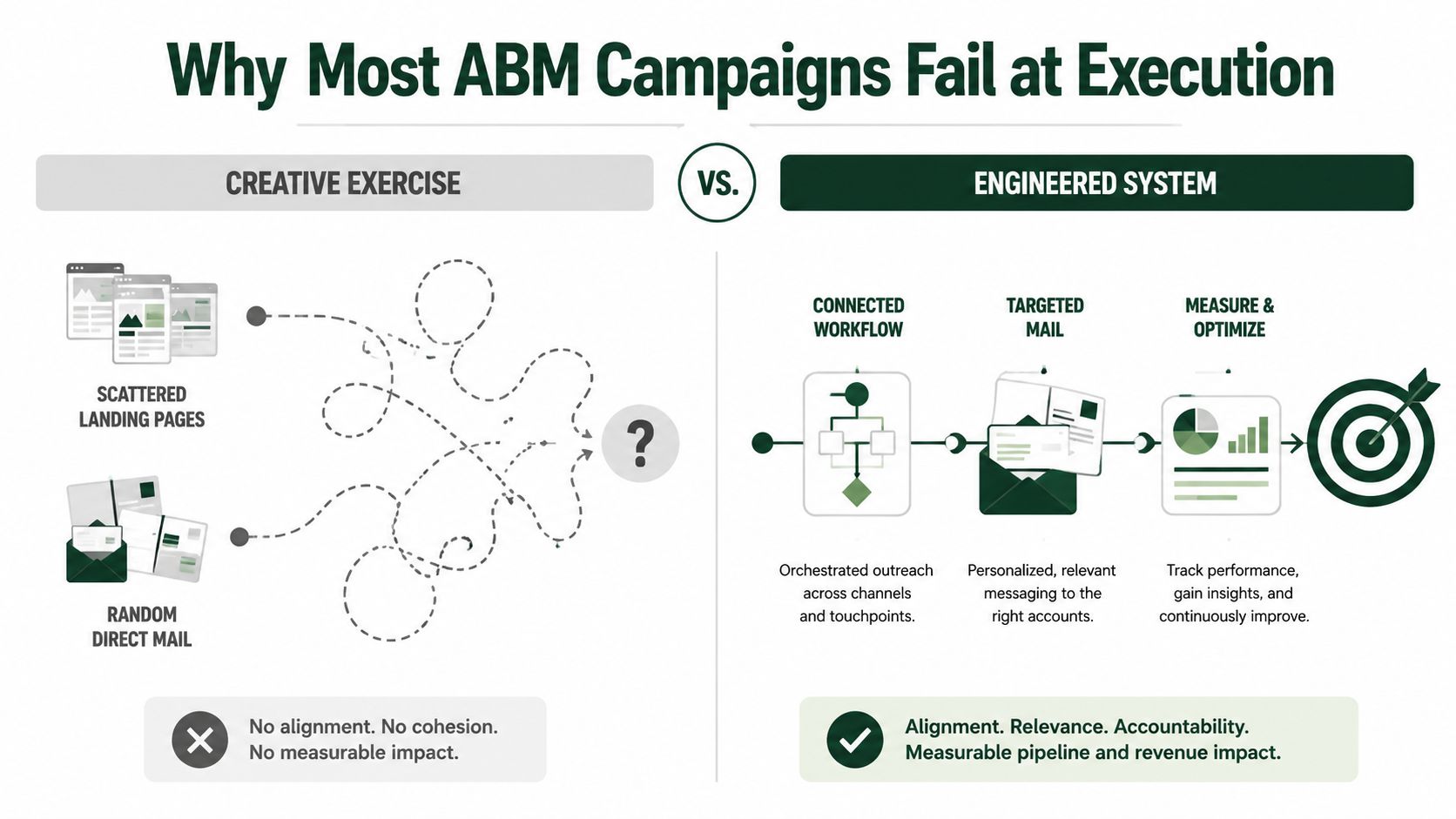
The popular definition of ABM is personalized marketing for a selected group of accounts. That definition is incomplete. Personalization is an output, not the operating model. An ABM program fails when the team treats a revenue system like a creative campaign.
The symptoms are familiar. Marketing creates account-specific landing pages, launches direct mail, and reports engagement. Sales receives a spreadsheet with account names but no explanation of priority, buying-group coverage, or next action. SDRs then ignore the list because it doesn't match their experience in the market. The campaign produces activity without creating a reliable path from signal to conversation.
Practical rule: If sales can't explain why an account is prioritized and what should happen next, the account list isn't ready for activation.
Three execution failures appear repeatedly
Fragmented account lists create the first break. Marketing may segment by industry and company size, sales may work from territory knowledge, and RevOps may use CRM records that contain duplicate or inactive accounts. The result is competing definitions of the target market. Before any message is written, establish one account record, one owner, one tier, and one reason for inclusion.
Individual-level messaging creates the second break. Enterprise purchases involve a group, not a single contact. A message that appeals to a revenue leader may create resistance with security, procurement, or operations. ABM campaigns need a shared account narrative with variations for each role.
Unconnected orchestration creates the third break. An ad impression, website visit, email reply, and sales call often sit in separate tools. Nobody knows which event should change the sequence. A systems approach defines those transitions before launch, including suppression rules, escalation paths, and feedback from sales.
The investment trend makes this operational gap more costly. A 2026 ABM benchmark summary reported that 71.2% of organizations currently implement ABM, while 49.7% plan to increase ABM budgets in 2026. The same summary reported that ABM represented 28.4% of B2B marketing budgets in 2026, compared with 18.7% in 2022, and described adoption rising from 31% in 2018 to 46% in 2022 and 72% in 2026. These figures come from the 2026 ABM benchmark summary.
More budget won't rescue weak infrastructure. Teams need an always-on operating rhythm, where accounts can enter, advance, pause, or leave a program based on evidence. That means ABM shouldn't disappear when a campaign manager changes roles. The playbook, data model, routing logic, and measurement layer must remain usable by the next operator.
Building a Prioritized Target Account List
Account selection determines whether sales sees ABM as useful or as another marketing project. Firmographics are a starting point, not a decision. Industry, region, revenue model, and technology environment can identify a possible fit, but they don't prove that an account has a timely problem or a realistic path to purchase.
Use four filters, applied in sequence.
Start with ICP fit
Define the conditions that make an account commercially attractive. Include the business model, operating complexity, relevant technologies, geographic presence, growth stage, and the problem your offer solves. For APAC, add country coverage, local operating entities, language requirements, regulatory context, and whether the buying team is centralized or distributed.
Then enrich the account record. Apollo can help fill missing company and contact fields, but enrichment isn't validation by itself. Set rules for stale records, duplicate domains, departed contacts, generic inboxes, and accounts that no longer match your market.
Add evidence of active need
Intent should validate fit rather than replace it. Useful signals include repeated visits to relevant pages, content consumption, hiring for a problem-related role, a leadership change, a new market entry, a funding announcement, or a technology change. Store the signal, date, source, affected business unit, and recommended action.
Check relationships and expansion potential
An account with an existing customer, former champion, partner connection, or warm introduction deserves different treatment from a cold account with identical firmographics. Also assess whether the account supports land-and-expand motion, multiple departments, or more than one product use case.
For practical support with ICP list building, the output should be a living list rather than a static export. Define promotion, demotion, retirement, and ownership rules before the list reaches sales.
Tier | Account Count | ICP Fit Score | Intent Signals | Engagement Model | Sales Coverage |
|---|---|---|---|---|---|
Tier 1 | Focused strategic set | Strong fit across required criteria | Multiple recent or high-value signals | 1:1 research, custom assets, multi-threaded outreach | Named AE and SDR ownership |
Tier 2 | Clustered account group | Clear fit with selected gaps | At least one meaningful signal or active trigger | 1:few industry or use-case plays | Shared segment coverage |
Tier 3 | Wider qualified pool | Basic ICP alignment | Limited or no active signal | Programmatic nurture and monitored education | Pooled or trigger-based coverage |
Suppose enrichment produces 500 candidate accounts. Don't send all 500 into a high-touch motion. Apply the fit filters, remove duplicates and excluded segments, confirm signal quality, and ask sales to review the resulting focused Tier 1 group. The exact final count depends on capacity and deal complexity. The important point is that sales receives a defensible list with an explicit reason for every account.
Mapping Buying Committees and Crafting Role-Specific Messaging
An account isn't a persona. It's a group of people who may agree that a problem exists while disagreeing about risk, budget, implementation, and timing. Strong ABM messaging makes those differences useful instead of flattening them into one generic account profile.
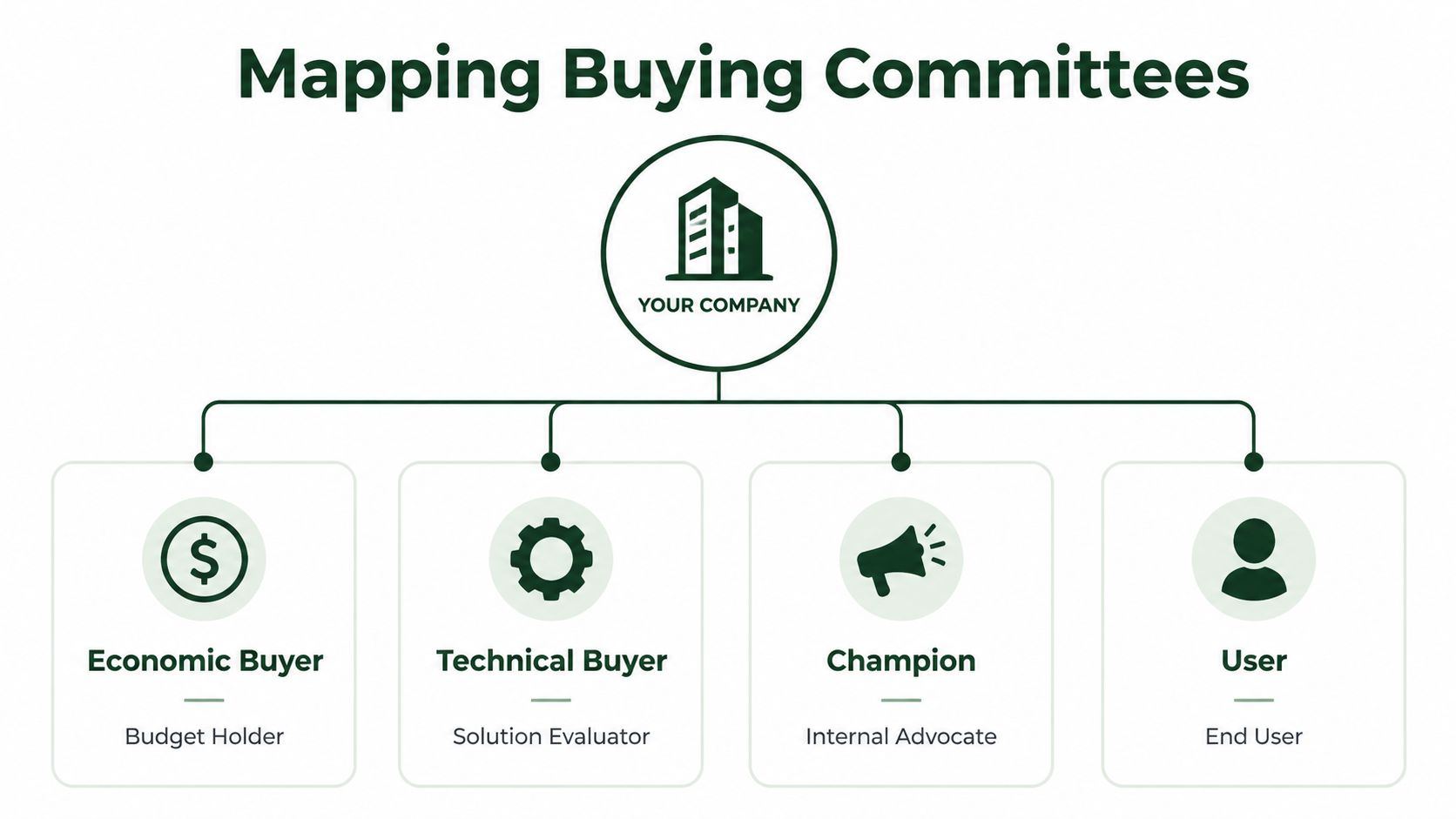
Start by mapping the buying committee around four practical roles:
Economic buyer: Owns budget and cares about business impact, risk, and strategic priority.
Technical buyer: Evaluates architecture, security, integrations, data handling, and implementation effort.
Champion: Builds internal momentum, supplies context, and helps the vendor manage the process.
User: Judges workflow fit, usability, adoption, and day-to-day value.
Use B2B buyer persona development to document each role's desired outcome, objections, proof requirements, preferred language, and likely internal influence. Don't confuse a job title with a role. A regional operations director may be the user in one account and the economic buyer in another.
Build one account narrative with role variations
The account narrative should state the business problem, why it matters now, the operational consequence, and the desired change. Each role then receives a different proof path.
A CTO may need a concise explanation of integration complexity, security controls, ownership, and failure recovery. A VP of Sales may respond to time-to-value, rep adoption, forecast confidence, and quota execution. Procurement needs commercial clarity and a defensible evaluation process. The champion needs internal material that makes the recommendation easier to circulate.
A useful message architecture looks like this:
Trigger: Identify the business change or observed problem.
Impact: Explain what that problem costs the relevant function in time, risk, or execution.
Approach: Show the operating change, not just the product feature.
Proof: Provide a relevant example, workflow, or diagnostic.
Next step: Ask for a low-friction conversation tied to the role's responsibility.
Personalization should change the argument, not merely insert a company name. A message that says, “We help companies like yours improve pipeline,” is still broad. A more precise version might connect an APAC expansion to territory coverage, local data quality, handoff timing, or regional message adaptation, provided the observation is accurate.
Multi-thread without creating noise
Map known contacts, then identify missing roles. Sequence touches around the account narrative, but vary the purpose. A champion may receive a workflow guide, a technical evaluator may receive implementation detail, and an executive may receive a concise business case. Sales should know which contact is being approached, why, and what response would change the next action.
Test offers before scaling. Compare a diagnostic, a peer discussion, a custom audit, and a product conversation against the same account segment. Judge the offers by qualified replies, meetings, buying-group expansion, and opportunity progression, not by individual contact activity alone.
Orchestrating Channels and Signal-Driven Outreach
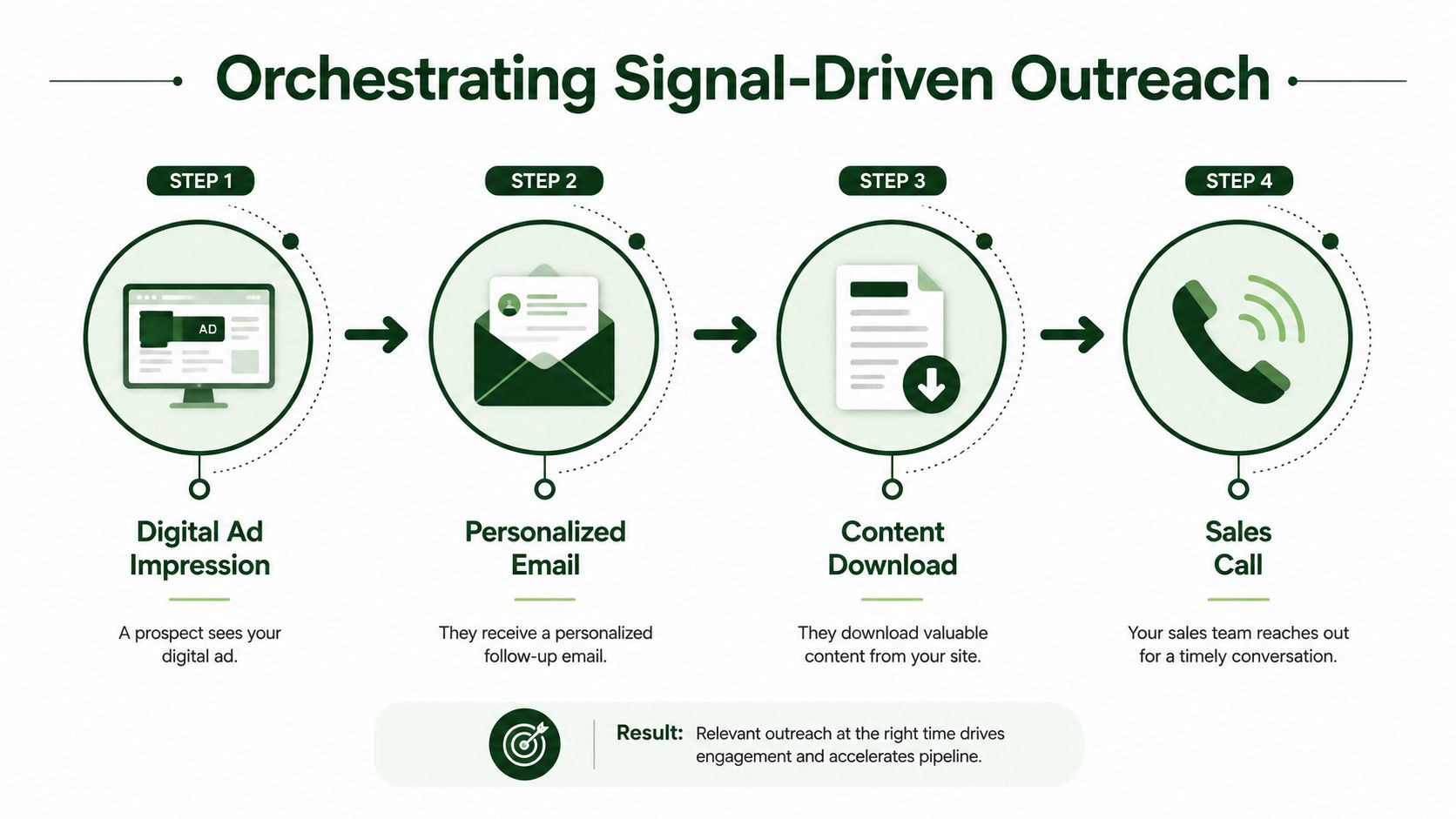
ABM execution fails when channels run as separate campaigns. Treat the program as a routing system. An account revisits a pricing page, a contact accepts a LinkedIn connection, a champion changes jobs, or a buying signal appears. Each event needs a defined action, owner, message variant, and stopping condition.
A practical orchestration layer connects paid media, email, LinkedIn, events, content, and sales activity. Email and in-person events remain common ABM channels, but channel count is not the objective. The operating question is whether each touch adds context for the next action. A LinkedIn lead generation workflow can supply useful account and contact signals when enrichment, consent, and routing rules are configured before outreach begins.
Design the signal-to-action matrix
Signal | Interpretation | Immediate Action | Owner | Suppression Rule |
|---|---|---|---|---|
Relevant page revisit | Possible active research | Send role-specific resource and create review task | SDR | Pause generic nurture |
Content download by a new role | Buying-group expansion | Add contact, map role, notify account owner | Marketing operations | Avoid duplicate asset |
Champion leaves company | Relationship risk | Identify successor and reintroduce account context | AE | Stop champion-specific messaging |
Funding or expansion announcement | Potential priority change | Adapt account hypothesis and send timely point of view | Marketing and sales | Validate before high-touch escalation |
Meeting booked | Active sales motion | Align contacts, stage, and next step in CRM | AE and RevOps | Suppress prospecting sequences |
Routing rules matter more than signal volume. A page visit should not create a sales call if the visitor is unknown, outside the ICP, or already in an active opportunity. A credible buying-group signal from a named target account may justify same-day action, provided the account record is enriched and the owner has a relevant message.
Match effort to account tier
Tier 1 accounts can receive custom research, executive outreach, personalized content, and coordinated sales touches. Tier 2 accounts suit clustered messaging, segment-specific landing pages, and semi-automated sequences. Tier 3 accounts should enter programmatic education until stronger evidence promotes them.
For channel planning, Sift AI's resource on mapping channels for campaigns frames selection as orchestration rather than a list of disconnected tactics. In execution, Trigify can help turn social signals into prospecting context, while Respond IO can support WhatsApp workflows where that channel is appropriate and compliant.
Use frequency caps and suppression lists. Pause outreach after a reply, meeting, active opportunity, unsubscribe, or clear negative response. APAC teams should also account for local working hours and channel expectations. A sequence that feels reasonable in one market can feel intrusive in another. The system should record each decision, so sales and marketing can see why a contact entered, paused, or exited a sequence.
Measuring What Actually Proves Revenue Impact
Open rates and account engagement scores can help diagnose execution, but they don't prove revenue impact. ABM reporting should answer three questions: Do we cover the buying group, are accounts moving faster, and does the program influence pipeline or revenue?
A measurement model should aggregate contact activity without hiding the underlying people. One industry analysis reports that 41% of marketers can't track the right data inside target accounts, which is why account-level reporting must retain contact identity, role, activity type, timing, and stage context. The analysis also recommends account-centric KPIs such as engagement depth, buyer-journey progression, meeting-set rate, deal velocity, and revenue influence. See the industry analysis of account-level ABM measurement challenges, already cited earlier for channel usage.
Use three metric tiers
Coverage metrics reveal whether the team has reached enough of the buying group. Track known contacts by role, active roles, engaged contacts, and the depth of engagement across departments. One highly active contact shouldn't make an account look healthy if the technical or economic buyer remains untouched.
Velocity metrics reveal movement. Track time from first meaningful touch to meeting, meeting to opportunity, opportunity stage progression, and time spent stalled. Segment these measures by account tier, region, source signal, and message variant.
Influence metrics connect activity to commercial outcomes. Track sourced pipeline, influenced pipeline, opportunity creation, stage progression, closed revenue, expansion activity, and loss reasons. Keep sourced and influenced definitions separate so the dashboard doesn't overstate marketing's contribution.
Metric Tier | Metric Name | Definition | Target Benchmark |
|---|---|---|---|
Coverage | Buying-group penetration | Share of relevant roles identified and engaged within a target account | Set by account tier and committee design |
Coverage | Engagement depth | Meaningful activity across contacts, roles, and channels | Define a threshold tied to progression |
Velocity | Meeting-set rate | Qualified meetings created from target-account activity | Compare by segment and signal |
Velocity | Deal velocity | Time and stage movement from opportunity creation | Benchmark against the existing sales motion |
Influence | Sourced pipeline | Pipeline where the ABM motion created the opportunity | Track by program and account segment |
Influence | Influenced pipeline | Pipeline where ABM activity materially supported progression | Require documented influence rules |
Influence | Revenue influence | Closed revenue connected to the account program | Review with Finance and RevOps |
Build an account health score carefully
A health score should combine fit, contact coverage, recent engagement, buying-stage progression, and sales feedback. Don't let opens or isolated clicks dominate the model. Weight actions by evidence of intent and role relevance, then make the score explainable enough for an SDR to understand why an account moved.
Controlled experiments strengthen the analysis. Hold out a comparable group where practical, preserve the same eligibility rules, and compare meetings, opportunity creation, progression, and revenue outcomes. The test won't eliminate every confounding variable, but it will challenge the assumption that all movement came from the ABM program.
The performance evidence explains why disciplined measurement matters. A 2026 roundup reported 48% higher revenue per account, 16% higher customer retention, and 30% higher marketing-attributed revenue among companies using ABM, while another cited survey found 87% of marketers report higher ROI from ABM than from other strategies. The same roundup connected ABM with larger deals, improved alignment, and contact-level meeting conversion gains. These figures are reported in Mailmodo's ABM statistics roundup, and they should be treated as benchmark claims, not a promise for every program.
A weekly dashboard should show target-account coverage, new signals, routed actions, meetings, opportunity progression, pipeline, revenue influence, and stalled accounts. A reporting and pipeline dashboard can consolidate those drivers, but RevOps still owns the definitions and data quality.
Designing ABM as a Transferable Revenue System
An ABM program that only one person understands isn't a system. It's tribal knowledge with a launch date. Staff changes, territory changes, and market expansion will expose every undocumented assumption in the workflow.
Document the system at the level a new operator can use. The playbook should contain:
ICP rules: Inclusion, exclusion, scoring inputs, geographic exceptions, and review cadence.
Account tiers: Required evidence, service level, ownership, and promotion or demotion criteria.
Buying-group maps: Role definitions, contact fields, research sources, and missing-role actions.
Message frameworks: Account hypotheses, role variations, proof points, objections, and approved offers.
Channel sequences: Entry conditions, timing logic, handoffs, suppression rules, and exit criteria.
Reporting definitions: Metric formulas, CRM fields, attribution rules, and dashboard ownership.

Make handover part of the design
A practical handover includes a system map, field dictionary, workflow decision trees, campaign templates, escalation contacts, and recorded operating procedures. Someone new should be able to answer what happens when an account goes quiet, a champion changes companies, a contact opts out, or a buying committee adds a new stakeholder.
The stack also needs clear data flows. Connect the CRM, engagement platform, enrichment source, intent layer, advertising audiences, and reporting model through an explicit ownership map. Avoid fragile point-to-point processes where one changed field breaks routing.
A specialist B2B demand generation agency can help with campaign execution, but the engagement should still produce owned documentation and usable infrastructure. For teams building the broader operating model, B2B lead generation systems should connect ICP, data, messaging, sending, routing, and reporting rather than create another isolated activity stream.
AI increases the need for governance. One recent survey reported that 78.7% of organizations incorporate AI into ABM, while 86.2% expect AI to improve ROI. It also reported that 45% cite integrating AI tools with the existing stack and 43% cite a lack of in-house expertise as major barriers, with 52% reporting RevOps ownership of account scoring. Those figures appear in Outcomes Rocket's ABM and AI trend coverage. AI can increase output, but it doesn't decide which signal deserves human action or who owns the consequence.
Run quarterly system audits. Review signal thresholds, stale-account rates, message fatigue, role coverage, channel contribution, routing failures, and attribution gaps. The audit keeps the machine calibrated as products, markets, buying committees, and APAC expansion priorities change.
The commercial commitment is moving in the same direction. A market analysis projects the global ABM market to rise from USD 1.03 billion in 2025 to USD 1.15 billion in 2026, reaching USD 2.02 billion by 2031 at an 11.94% CAGR, and reports that 49.7% of organizations plan to increase ABM budgets in 2026. These projections and budget findings are available in Twelfth Agency's State of ABM 2026 analysis. More investment makes operational ownership, clean data, and transferable playbooks necessary rather than optional.
The Social Search builds handoff-ready outbound and ABM infrastructure for B2B teams entering APAC, including ICP definition, prioritized account lists, signal routing, email and LinkedIn operations, enablement, and pipeline reporting. If your team needs account based marketing campaigns connected to a measurable GTM system, visit The Social Search to discuss a system build or embedded fractional GTM support.
