LinkedIn Lead Generation Playbook for B2B Teams
A practical LinkedIn lead generation playbook covering profile optimisation, prospecting signals, messaging sequences, and measurement for B2B teams.
You’re probably in the same place a lot of B2B teams get stuck. The founder says LinkedIn is where the buyers are, the first SDR gets told to “just do some outreach,” and three weeks later nobody can explain why accepted connections aren’t turning into meetings.
LinkedIn deserves a central place in linkedin lead generation because it concentrates decision-maker attention better than any other social channel. Industry summaries put LinkedIn at roughly 75% to 85% of all B2B social media leads, with one common benchmark at 80% LinkedIn stats 2026. Separate marketer surveys also show 89% of B2B marketers using LinkedIn for lead generation, 62% saying it generates leads for them, and 40% calling it their single most effective source for high-quality leads LinkedIn lead generation overview.
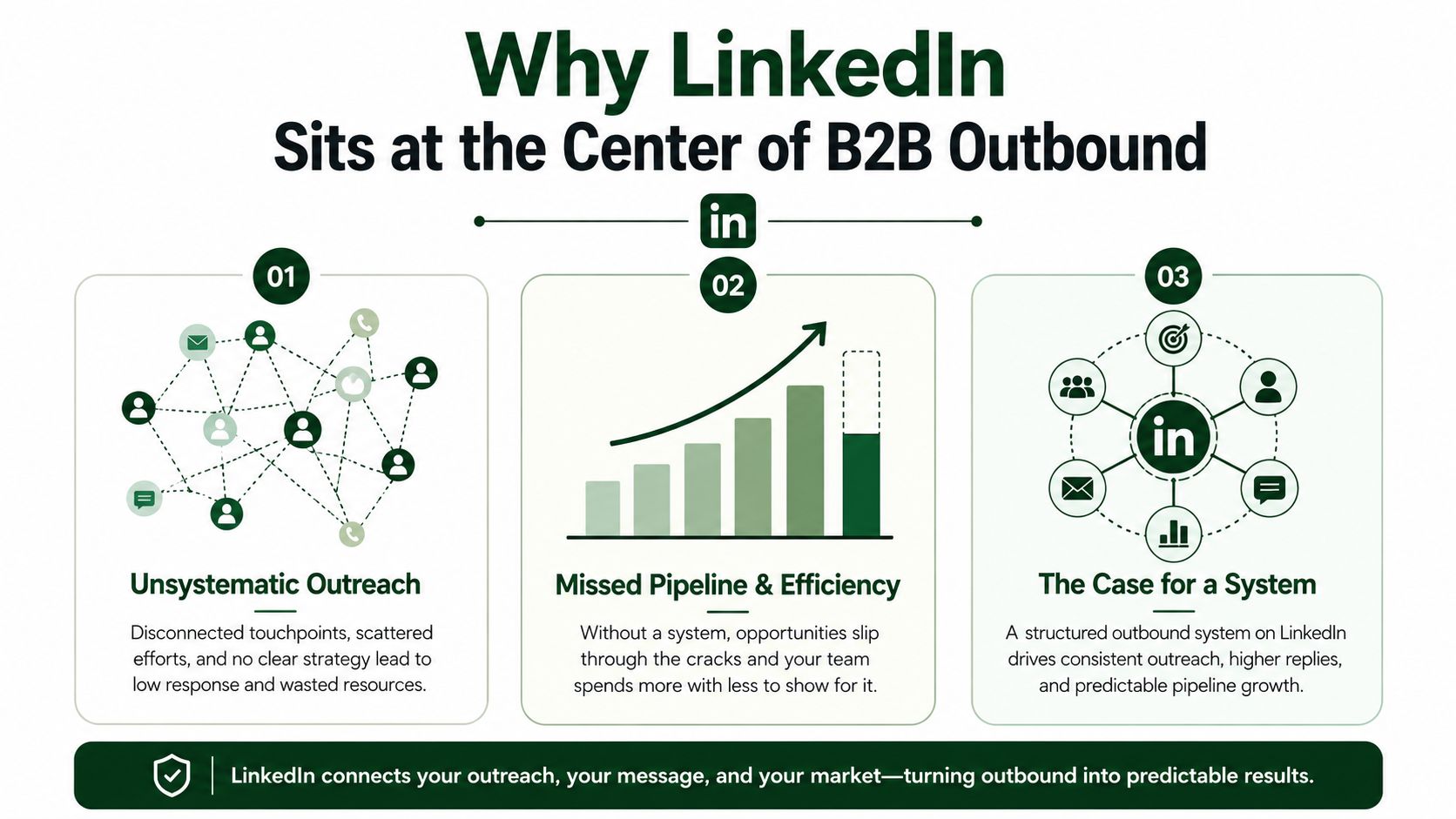
That doesn’t mean LinkedIn is magic. It means the platform is where the buyer graph is densest, so a weak system can still look busy while a strong system can turn attention into pipeline. The difference comes from treating LinkedIn as one node in a connected outbound machine, not as a standalone tactic. For teams that need scalable LinkedIn outbound automation, HeyReach is one of the cleaner ways to coordinate outreach across accounts without making the process feel chaotic.
If you want a tighter tactical primer before building the machine, the guide to LinkedIn lead gen for sales is a useful companion read. For account planning, this works best when you pair channel design with a clear list of the right prospects at the right time, not with random volume, as the toolkit for targeting the right prospects makes clear.
Table of Contents
Why LinkedIn Sits at the Center of B2B Outbound
A Series A SaaS founder hires a first SDR and hears the same advice from three different people, “just do some LinkedIn outreach.” That usually produces activity, not a system. The platform is strong, but the machine behind it is what creates meetings.
The reason LinkedIn gets the center slot is simple. It sits where B2B attention is concentrated, and the benchmark data backs that up. Multiple industry summaries put LinkedIn at roughly 80% of B2B social media leads, with a planning range of 75% to 85% LinkedIn marketing statistics. LinkedIn Marketing Solutions also reports 89% of B2B marketers use LinkedIn for lead generation, and 62% say it generates leads for them LinkedIn lead generation resources.
Read the benchmark the right way
Those numbers are not proof that every inbox on LinkedIn is responsive. They’re proof that the platform concentrates decision-maker access more than other social channels, which makes it a better place to build outbound systems than a channel with thinner buyer density. That concentration matters in B2B because ICP targeting, contact sourcing, and timing all depend on where buyers spend attention.
Practical rule: if the buyer is active on LinkedIn, the channel can support prospecting, authority building, and conversion. If the buyer isn’t there, LinkedIn becomes an expensive detour.
That’s why a system-first framing wins. You need ICP definition, data, messaging, sending, routing, and reporting working together. The offer matters, but so does how the lead gets captured, where it gets synced, and who follows up first. If you want an outside perspective on how to connect those pieces, The Social Search’s ICP list-building service fits naturally into the same workflow.
Why most LinkedIn advice falls short
A lot of LinkedIn content teaches tactics in isolation, one hook, one profile tweak, one content trick. That creates motion without control. A real outbound system uses LinkedIn as a prospecting and conversion layer, then hands leads into the rest of the machine, which is exactly where the operational advantage shows up.
Profile and Infrastructure Setup That Earns Acceptance
A prospect makes a judgment before reading the first line of your message. They scan the profile, check for legitimacy, and decide whether the request belongs in their network or in the ignore pile. The profile is not branding fluff, it is a conversion asset.
Treat the profile like a landing page
The first fix is usually the headline. It should say who you help and what problem you solve, not just your title. The banner, featured section, and About copy need to reinforce the same buyer-facing message, because prospects are looking for relevance, not self-description.
The infrastructure around the profile matters just as much. Sales Navigator filters help you build cleaner lists, and a credible account reduces friction at the acceptance stage. If the profile is thin, start with the headline, banner, About section, and featured proof before adding content or automation.
Profile Credibility Audit | Weak Setup | Optimised Setup |
|---|---|---|
Profile Element | Title-only headline, generic photo, empty About section | Buyer-facing headline, clear visual banner, proof in Featured |
Weak Setup | “Founder at X” with no context | “Helps APAC SaaS teams build outbound pipeline” |
Optimised Setup | No targeted filters or list logic | Sales Navigator filters aligned to ICP and outreach |
Technical hygiene matters too. Keep account behavior human, warm the account gradually, and route leads into your CRM without delay so follow-up does not stall. Speed and consistency matter more than clever tweaks here, because the first conversion is often acceptance, not reply.
The profile should support the same buyer logic used in your ICP list-building workflow, since the people you target will judge whether the account looks built for them or built for everyone.
Reading Buyer Signals Before You Reach Out
A title tells you who someone is. It does not tell you whether they are ready to take a meeting. In LinkedIn lead generation, the sharper move is to target off buyer signals, then use title and firmographic fit to confirm the account is worth a sequence.
Strong signals beat broad fit
Job changes, funding events, hiring patterns, content engagement, post comments, and group activity all point to different kinds of buying momentum. Those signals do not guarantee a deal, but they do tell you there is a live reason to reach out now. Broad fit signals, like company size or industry growth, help with segmentation. They do not tell you when the buyer is likely to care.
The operational shift is simple. Each signal needs to become a routing rule. A job change can move a prospect into a faster sequence. Hiring patterns can flag a team that may need process help. Content engagement can move a lead into a warmer follow-up path instead of a cold one.
A list of 1,000 cold-fit names often underperforms 100 signal-matched prospects because relevance and timing travel together.
APAC and cross-border B2B buyers add more friction than US-centric playbooks usually assume. Seniority norms, language, and network density change how visible a signal is and how risky a direct message feels. In some markets, activity inside a local network matters more than broad profile fit. In others, a buyer who is active but not connected is still reachable if the message is specific enough and the sequence respects how that market uses LinkedIn.
Enrichment turns raw signals into routing
Data enrichment is what turns a signal into something the system can use. Apollo can add contact and firmographic context to raw lists so a signal becomes a usable score inside your sequencing workflow. Once the list is enriched, the outreach path is clearer, and your CRM can route active accounts to the right sequence without manual cleanup.
The missing piece is often social capture, not more prospecting. A good toolkit for social buyer data capture helps teams turn visible activity into fields they can score, route, and act on without guessing.
Building the Connection and Message Sequence
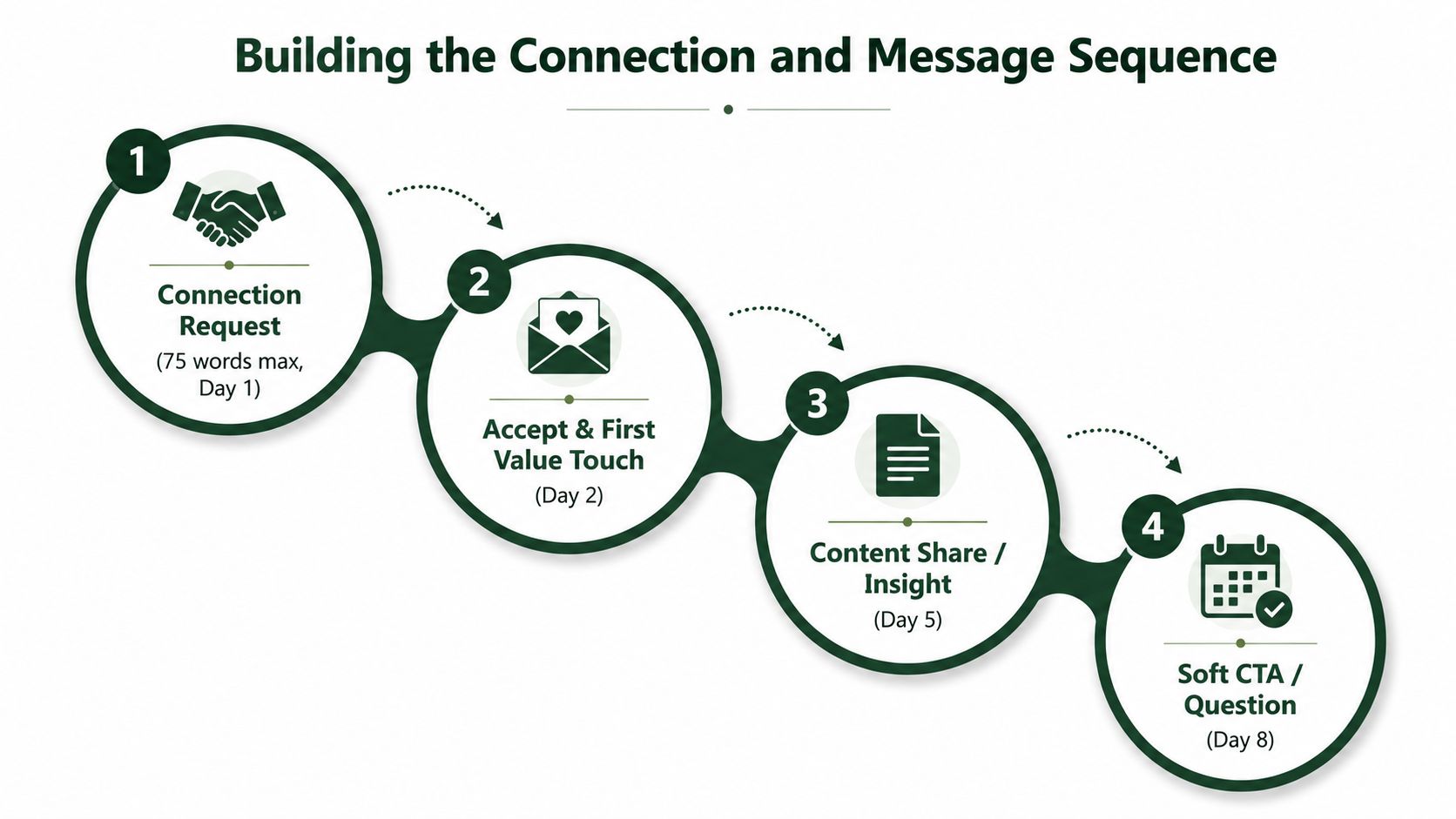
A good sequence is short, relevant, and paced around buyer behavior. The goal isn’t to “follow up” until someone caves. The goal is to create a sequence where each touch has a job, a reason, and a clean next step.
LinkedIn outreach also works best when it sits inside a sustainable cadence. A common execution pattern is 10 to 20 quality connection requests per day and 3 to 5 posts per week LinkedIn lead generation best practices. That rhythm keeps the account active without pushing into spammy volume, and it creates natural engagement windows that make later messages feel less random.
A sequence that can run on Monday morning
Connection request note. Keep it brief and specific. The point is to earn acceptance, not to pitch.
Post-accept value message. Send a short note with one useful observation, not a deck or a wall of copy.
Soft bump. If there’s no response, follow with a lighter nudge tied to the prospect’s context.
Alternative-channel opener. If the fit is real but LinkedIn stalls, shift to email or another channel.
Breakup. Close the loop cleanly so the thread doesn’t linger forever.
Practical rule: one touch should do one thing. Acceptance, relevance, curiosity, or channel shift. Trying to do all four in one message usually tanks the reply rate.
If you’re orchestrating across multiple accounts, HeyReach is useful for safer multi-account coordination and more structured LinkedIn outbound automation. It fits teams that need to manage sending logic, account rotation, and campaign stability without making outreach feel robotic. If the flow needs a parallel cold-email layer, Instantly fits the handoff well because it lets LinkedIn and email support each other instead of competing for attention. The point is not automation for its own sake. The point is stable sequencing with enough structure to stay human.
If the outreach account starts getting restricted, the LinkedIn outreach safety toolkit is the kind of reference that helps teams correct behavior before they damage sending quality.
When LinkedIn Beats Email and When It Does Not
The channel choice should come from ICP fit, not preference. LinkedIn is often the stronger front door when the buyer is senior, the relationship matters, or the account needs context before a reply makes sense. Email tends to win when the buyer graph on LinkedIn is thin, the offer is straightforward, or the outreach needs scale more than social proof.
Use LinkedIn first when network density matters
High-seniority APAC buyers often fit this pattern because LinkedIn visibility, local credibility, and contextual messaging matter more than broad volume. Regulated industries and relationship-heavy enterprise deals also tend to respond better when LinkedIn establishes familiarity before the first ask. The platform’s visitor-to-lead benchmark of 2.74% is a useful reference point because it shows the channel can convert attention when the audience and offer line up LinkedIn lead generation statistics 2026.
Use email first when the offer is simpler
North American mid-market and transactional SaaS often do better with email-led or parallel sequences. The reason isn’t that LinkedIn is weak, it’s that these motions usually reward faster list throughput and tighter deliverability control. If the audience is not active on LinkedIn, a beautifully written InMail still loses to a solid email sequence that reaches the inbox reliably.
Many APAC enterprise journeys also spill into WhatsApp or DM layers after the first touch. That’s where Respond IO and Manychat can support handoff and follow-up without forcing every conversation to live in one channel.
The best orchestration is rarely “LinkedIn only” or “email only.” It’s a sequence that starts where the buyer is easiest to reach, then shifts channels when the signal says to move.
LinkedIn’s value is strongest when it sits at the front of the sequence or as the context layer behind an email program. The wrong move is choosing one channel because it feels modern, then blaming the channel when the buyer doesn’t respond.
Measuring What Actually Drives Pipeline
Vanity metrics hide bad outreach. A profile with more views can still produce no meetings, and a post with likes can still fail to move a single account. The measurement system has to connect activity to pipeline, not just attention to attention.
Track the whole chain
Start with activity metrics, connections sent, acceptance rate, and reply rate. Then add engagement metrics like profile views, post interactions, and demo requests. Finish with pipeline metrics, qualified meetings, opportunities created, and pipeline value. Each layer tells you something different, and none of them should be read alone.
LinkedIn guidance says healthy outreach should reach a 20% response rate and recommends 200 connection requests per week LinkedIn lead generation best practices. Those numbers are useful as a sanity check, not as a target to worship. If the response rate is low, the issue is usually list quality, message relevance, or channel timing.
Build the dashboard around decisions
The dashboard should answer three questions. Which lists created meetings, which messages created replies, and which signals created pipeline? That’s the only way to improve the machine week by week instead of guessing in monthly reviews.
If you need a single view that ties meetings back to source lists and outreach logic, the reporting and pipeline dashboard service maps directly to this problem. It’s especially useful when multiple reps, channels, and signal types are all feeding the same pipeline.
A useful operating habit is to review every campaign against one of two outcomes, either it produced qualified meetings or it didn’t. If it didn’t, the fix is not “more activity.” The fix is usually better targeting, tighter messaging, or a cleaner handoff.
A 90-Day Plan to Stand Up the System
The first 30 days should harden the account and define the market. That means profile cleanup, infrastructure setup, ICP definition, and a real signal map that tells the team who to contact and when. If the list is weak here, the next 60 days only scale the mistake.
A simple implementation sequence
Weeks 1 to 4: profile and content foundation, plus account warming and data prep.
Weeks 5 to 8: build the sequence, launch the first campaign, and connect the CRM routing.
Weeks 9 to 12: analyze replies, adjust the message, and tighten signal scoring.
Week 13: scale what works, document the process, and hand the playbook to the operator.
Apollo is useful for list enrichment during the build phase, especially when you need contact context that supports signal-based routing. HeyReach helps if multiple accounts need orchestration without turning the workflow into manual chaos, especially for teams building a repeatable LinkedIn outbound automation workflow. If email needs to support the LinkedIn motion, Instantly gives the parallel layer a clean operating surface.
If the sequence is getting accepted but not replied to, the problem is usually not volume. It’s either a weak offer, a poor signal, or a message that sounds like everyone else’s.
Common pitfalls show up fast. Over-automation makes the account fragile. Weak offer-market fit makes every message feel forced. Treating LinkedIn as a standalone channel leaves meetings on the table when email, DM, or WhatsApp should be part of the handoff.
If you want this turned into a real outbound system, The Social Search builds the ICP, data, messaging, routing, and reporting layer around it. Visit The Social Search if you want a LinkedIn and outbound setup that’s built to produce qualified pipeline, not just activity.
Created with Outrank tool
