B2B Buyer Persona: Build Committee-Aware Profiles
Learn how to create a b2b buyer persona that maps the entire buying committee and turns research into conversions.
Most B2B buyer persona advice starts with the wrong unit of analysis. It asks, “Who is the decision-maker?” when the central question is, “Which people must agree, what does each person need to believe, and can we discover them in the channels where they research?” A polished profile of one senior champion can look strategic while producing irrelevant lists, weak replies, and stalled opportunities.
Modern buying is self-directed and committee-led. One industry compilation reports that 67% of the B2B buyer journey happens digitally before a buyer speaks with sales, while another estimates that roughly 70% of research is completed anonymously before first contact (B2B buyer journey statistics). A useful B2B buyer persona must therefore describe research behavior, internal influence, reachability, and proof requirements, not just demographics.
Table of Contents
Why Most B2B Buyer Personas Fail Before the First Email
A persona can be accurate and still be unusable. A profile built around one fictional executive may include title, company size, industry, goals, frustrations, and a stock photograph, yet leave outbound teams unable to decide which contacts to source, what event should trigger outreach, or which objection deserves a response.
B2B purchases usually involve a group rather than a single decision-maker. The Forrester discussion of business buying cites common committee sizes of 6 to 10 decision-makers, enterprise purchases averaging about 11.2 stakeholders, and more complex groups involving 13 internal stakeholders plus external participants (Forrester’s State of Business Buying 2024). A champion may create urgency. Finance tests the economics, IT examines security and integration risk, procurement enforces process, and operators judge whether the solution works in daily use.
Reachability is part of persona quality
A persona that cannot be mapped to real contacts is a hypothesis, not a target.
Titles vary across markets. Contact databases omit some functions. A role may influence the purchase but remain unreachable through the channels an outbound team operates. The FullEnrich buyer persona strategies resource is useful for framing persona research around actionable audience attributes rather than an attractive profile.
Every persona field should answer a targeting question:
Role: Which function owns the problem, evaluates the solution, or controls approval?
Evidence: What observable activity supports the assumption?
Reachability: Can the role be verified in contact data?
Message fit: Which business consequence makes the conversation relevant?
Next step: What low-friction action matches that stakeholder’s risk?
First contact often occurs well into the buying process. The research cited earlier places seller contact around 61% to 69% through the buying journey. A cold email that only asks for a demo can therefore arrive after private research and comparison have already shaped the buyer’s expectations.
AI-mediated discovery adds another constraint. Buyers may encounter vendors through generated summaries, comparison pages, peer discussions, or internal research tools before a seller appears in the conversation. Persona design must record the questions, proof, terminology, and objections that shape that discovery, then connect them to identifiable committee roles.
Practical rule: If you cannot identify the role, trigger, evidence, and channel, the persona is unfinished.
Build an account-level persona set. Document the likely champion, economic buyer, technical evaluator, user, and procurement contact, then map how each role influences the others. For execution, the cold email inbox toolkit connects persona assumptions with message construction and deliverability, keeping the model tied to contacts and conversations rather than a slide deck.
Core Components of a Committee-Aware B2B Buyer Persona
A committee-aware B2B buyer persona is a connected model of people, responsibilities, evidence, and decision movement. It still includes firmographics, but firmographics only define where to look. Behavioral and organizational details determine what to say and when to say it.
Gartner describes four buying jobs, problem identification, solution exploration, requirements building, and supplier selection, and also emphasizes validation and consensus creation in enterprise purchases (Gartner’s B2B buying journey). Map those jobs to roles instead of assuming one person performs all of them.
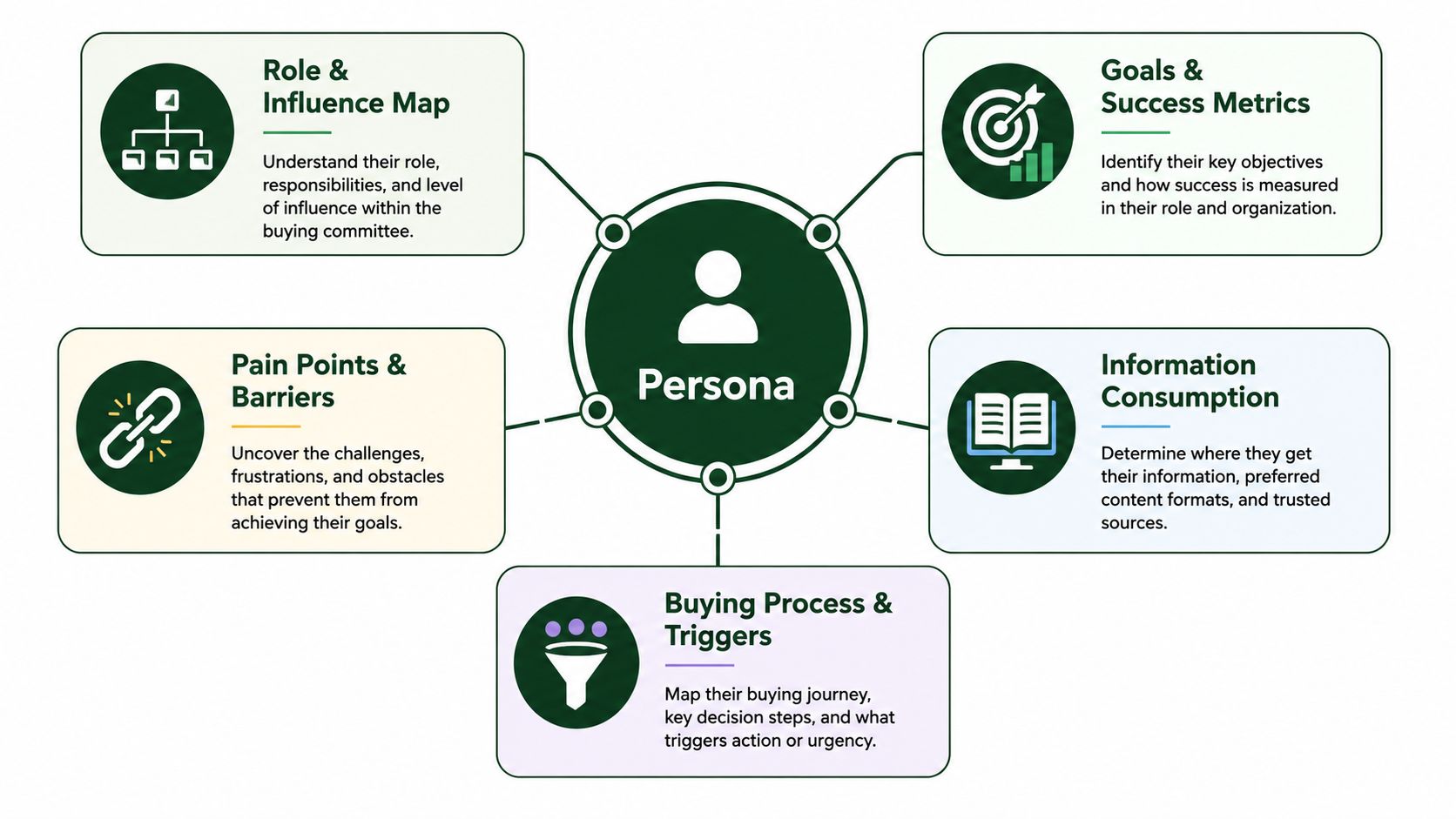
The five components that matter
Role and influence map. Start with functions, then add titles. A champion may own the project and advocate internally. An economic buyer controls financial approval. A technical evaluator tests integration, security, and operational risk. An end user judges workflow fit. Procurement manages commercial and policy requirements. The same person may hold multiple roles in a smaller account, while larger accounts usually require more separation.
Goals and success metrics. Record what each stakeholder must improve or protect. The champion may care about adoption and implementation speed. Finance may care about cost visibility and defensible value. The operator may prioritize fewer manual steps. These aren’t interchangeable goals, so one generic value proposition usually underperforms.
Pain points and barriers. Separate the problem from the reason action stalls. A team may acknowledge inefficient reporting but still delay because data access is unclear, implementation ownership is disputed, or the buyer fears switching costs. Capture the barrier attached to each role.
Information consumption. Note what each stakeholder searches, compares, downloads, asks peers, and validates independently. Gartner-linked research indicates buyers spend only 17% of total buying time in direct vendor contact, leaving roughly 80% of the journey to independent activity (Gartner and Forrester research summary). Your persona should describe the proof that reaches a role before a meeting.
Buying process and triggers. Identify events that create urgency, such as a new operating mandate, leadership change, expansion, system replacement, or visible performance problem. Then connect the trigger to the first role likely to act and the other roles that must validate the decision.
These components should feed a consistent offer and message system. Teams that need to translate role differences into sharper positioning can use offer and messaging development as a practical reference point. The goal isn’t to create endless profiles. It’s to preserve one coherent commercial story while changing the evidence, objection handling, and next step for each stakeholder.
Building Your B2B Buyer Persona Template
A useful template behaves like an operating record, not a biography. Each field should help someone build a list, select a signal, write an opening line, or decide whether a contact belongs in the sequence.
Start with the account layer. Capture industry, operating model, geography, employee band, relevant technologies, growth context, and exclusion criteria. Then add the role layer, including function, seniority, likely committee position, responsibilities, success measures, risks, objections, preferred evidence, and likely buying job.
A field structure for execution
Use separate fields for observed facts, inferred traits, and unverified hypotheses. This distinction prevents a confident workshop assumption from becoming a permanent targeting rule. Enrichment platforms such as Apollo can help verify contact roles and account attributes, but the tool doesn’t prove that a person owns the buying problem. Outreach and conversation data still have to validate influence.
Field Category | Example Fields | Data Source | Outbound Application |
|---|---|---|---|
Account fit | Industry, geography, operating model, relevant technology | CRM, company records, enrichment | Include or exclude the account |
Role and influence | Function, seniority, committee role, reporting line | Contact data, org research, calls | Select contacts and thread accounts |
Business context | Expansion, hiring, leadership change, system transition | Company updates, public signals, CRM | Create trigger-based campaigns |
Goals and barriers | Success measures, internal risks, implementation concerns | Interviews, call notes, win-loss reviews | Shape the offer and objection handling |
Research behavior | Search topics, peer channels, AI tools, content consumed | Website analytics, replies, interviews | Match proof to the research stage |
Channel preference | Email, LinkedIn, events, referrals, messaging apps | Historical engagement and conversations | Choose sequence and follow-up channel |
Proof requirements | ROI, security, integration, workflow, terms | Stakeholder interviews, opportunities | Route role-specific assets |
Validation status | Confirmed, inferred, rejected, last reviewed | CRM and campaign data | Keep the persona current |
AI-mediated discovery deserves its own field. Recent buyer research says 90% of buyers research before first contact and almost two-thirds use GenAI tools as much as or more than traditional search (Inside the B2B Buyer’s Mind 2025). Record the questions a role might ask an AI assistant, the evidence it would trust, and whether the economic buyer appears in the answers your market produces.
The template should also specify the smallest credible next step. A technical evaluator may accept a security overview, while an economic buyer may prefer a concise commercial case. The GTM strategy for startups resource offers useful context for connecting these persona fields to an early outbound motion without turning the document into a marketing-only artifact.
Aligning Personas with ICP Signals and Intent Data
An ICP tells you which accounts deserve attention. A persona tells you which people inside those accounts matter. Intent data tests whether the relationship between the two reflects current buying behavior.
A common failure is to define the ICP at the company level, then target the most visible senior title at every matching account. That shortcut ignores the role currently researching the problem. A technical evaluator may show the earliest signal, while the economic buyer becomes relevant later. Treat the persona as a hypothesis that must be confirmed by account activity, role behavior, and outreach response.
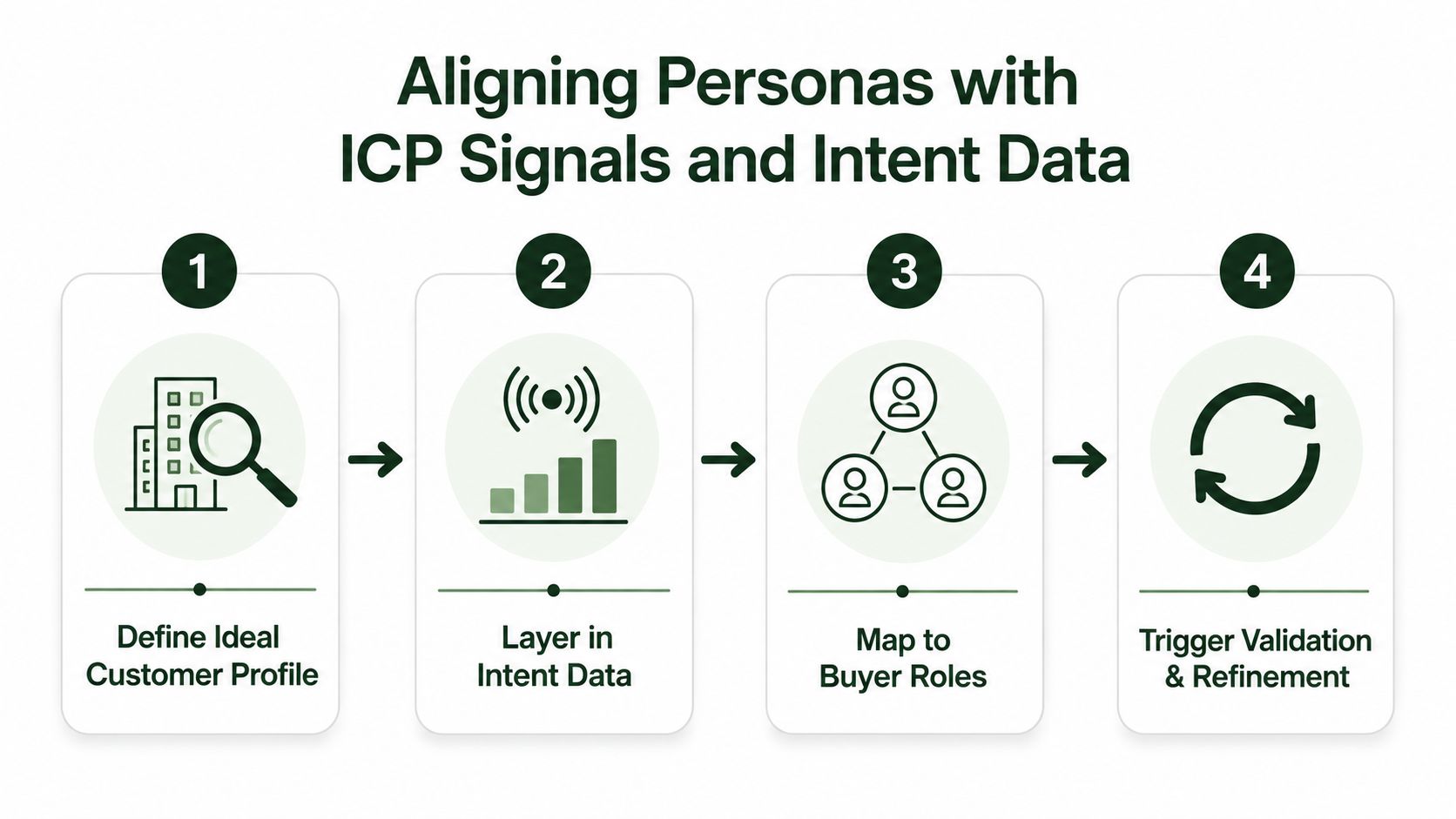
Use signals to test, not decorate, the model
Build the loop in four moves:
Define the account pattern. Establish the firmographic and operational conditions that make a company worth pursuing.
Layer in intent. Look for research behavior, topic engagement, hiring activity, technology changes, or other relevant triggers.
Map activity to roles. Ask which stakeholder is most likely to create, evaluate, or circulate that signal.
Refine the persona. Promote confirmed patterns, downgrade assumptions, and remove roles that never create useful movement.
Tools should support distinct signal types. Whitewhale is relevant when you need intent signals to identify accounts or topics associated with active research. Trigify fits social-signal workflows, where public engagement can help indicate changing priorities or buying-stage progression.
Intent tells you that attention exists. It doesn’t automatically tell you who can approve a purchase.
The economic buyer presents a particular challenge. Recent analysis says buyer visibility in AI answers is uneven, and the economic buyer is often the least visible persona (Inside the B2B Buyer’s Mind 2025). Don’t discard the role because it generates little observable activity. Instead, use visible researchers and champions as paths into the less visible approver.
Market structure also matters. A market mapping guide for 2026 can help teams think beyond isolated accounts and examine categories, competitors, relationships, and whitespace. For teams that need verified contacts attached to a defined account model, ICP list building provides the operational bridge from persona theory to usable coverage.
How APAC Buying Behavior Changes Persona Design
A North American SaaS persona rarely transfers cleanly into APAC. The problem isn’t that one region moves quickly and another moves slowly. The issue is that procurement structures, approval paths, language expectations, market maturity, and preferred channels can change the order in which stakeholders become involved.
Consider a software company expanding from the United States into Singapore, Australia, and Japan. Its original persona targets a revenue operations leader, uses English email, and asks for a discovery call after a product-led content touch. In APAC, the account may still contain a champion, technical evaluator, finance approver, and procurement contact, but the sequence into those roles can differ. Local operating requirements and regional authority may matter before a central team agrees to evaluate the product.
The regional data changes the operating assumptions
A 2025 APAC report of procurement professionals found that the region’s average B2B buying journey lasted 11 months, down from 13 months the year before, while the average buying team fell to 11 people from 13 (Green Hat APAC B2B Buyer Journey Research Report 2025). That is still a long evaluation window, even with a smaller group.
The timing of vendor engagement shifted as well. The same APAC research reports that first contact moved from about 73% through the process in 2024 to 60% in the latest study, meaning sellers are entering roughly 12 weeks earlier (APAC B2B buyer journey coverage). An outbound team that waits for an obvious “request a demo” signal may miss the earlier research phase.
For the expansion scenario, the persona set should therefore include:
Local champion: Owns the operational problem and can explain the local business case.
Regional evaluator: Tests whether the solution works across markets, systems, and processes.
Central economic buyer: Needs a concise view of risk, cost, and organizational impact.
Procurement and legal: Require terms, data handling, service commitments, and vendor documentation.
User group: Reveals workflow friction that senior stakeholders may overlook.
The channel mix should reflect account evidence rather than a fixed regional stereotype. Combine email and LinkedIn where those channels are active, use local referrals or events where trust carries more weight, and adjust message cadence for longer consensus-building. Teams entering APAC without internal coverage can use an outbound marketing agency as a reference for regional process design, but the persona still needs validation account by account.
Common Persona Mistakes That Kill Outbound Performance
Persona mistakes rarely announce themselves as persona mistakes. They appear as poor list quality, generic messaging, unproductive calls, and opportunities that stop after initial interest. Forrester reported that 86% of B2B purchases stall during the buying process (Forrester’s State of Business Buying 2024). A committee-blind persona can contribute to that stall by helping a team start conversations without giving every required stakeholder a reason to continue.
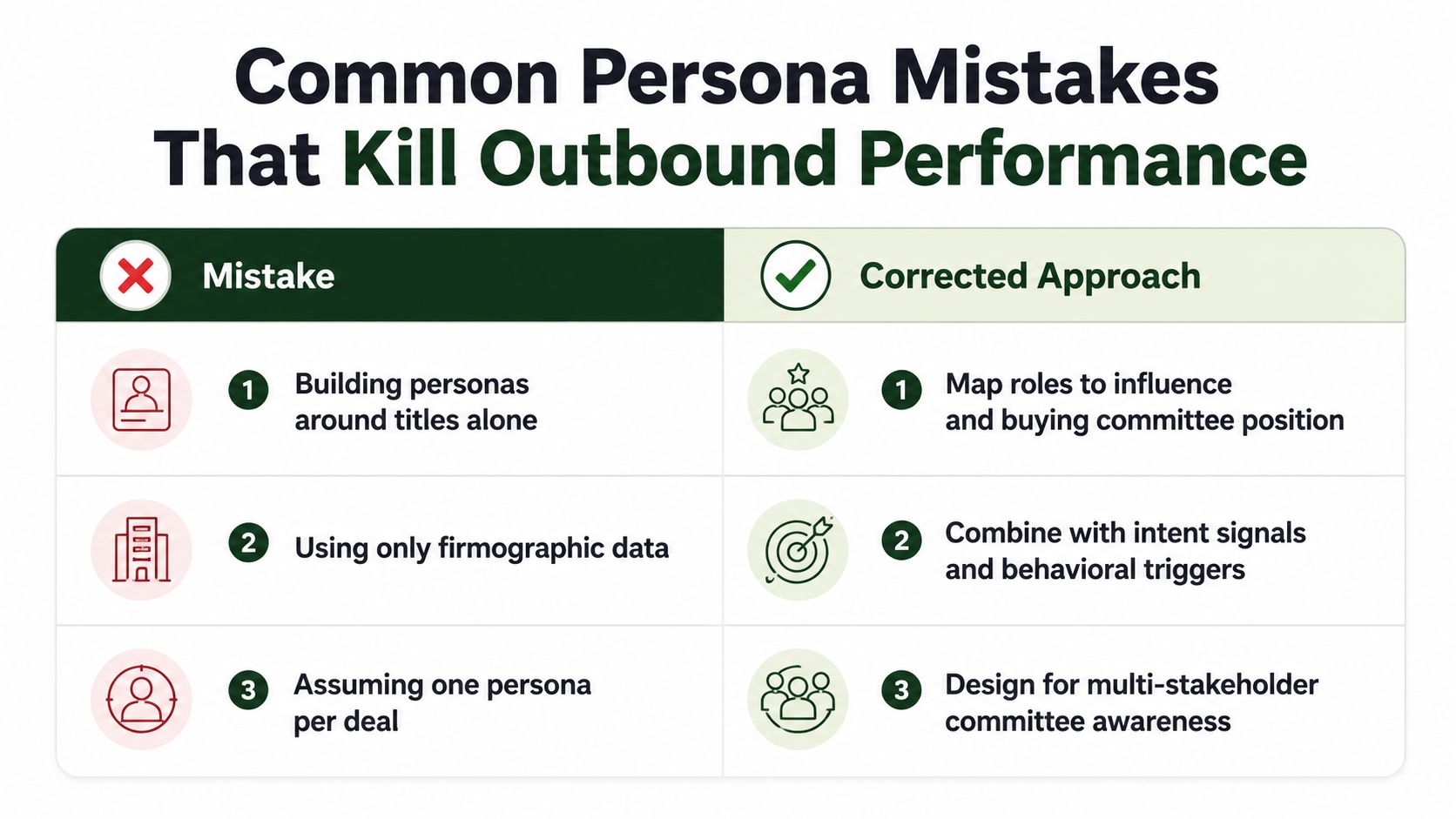
Broken approach versus usable system
Broken approach | What it causes | Corrected approach |
|---|---|---|
Building around a title alone | A list full of nominal decision-makers who don’t own the problem | Map the role to influence, buying job, and committee position |
Using only firmographic data | Relevant accounts with no timing or message relevance | Combine fit with intent signals and behavioral triggers |
Assuming one persona per deal | A champion engages while evaluators and approvers remain unconvinced | Build a role-aware persona set and plan multi-threaded coverage |
The first mistake is treating seniority as authority. A chief executive may approve a strategic purchase but never research the category or evaluate implementation. A functional leader may own the business case and introduce the vendor. Outreach should distinguish visibility from influence.
The second is mistaking account fit for readiness. Firmographics tell you where the company belongs in the ICP. They don’t tell you whether the problem is active, whether a stakeholder is searching for answers, or whether a trigger justifies contact.
The third is ignoring AI-mediated discovery. Buyers increasingly form preferences before speaking with sales, and the role visible in search or AI results may not be the person who controls budget. Work on Nuwtonic Agentic AI Citation Optimization is relevant when teams need to examine how their evidence appears in AI-assisted discovery, especially for stakeholders who aren’t generating obvious website traffic.
A strong correction changes the operating metric. Don’t ask whether the persona document is complete. Ask whether target accounts have appropriate committee coverage, whether each role receives credible proof, and whether outreach produces movement beyond the initial champion.
Validating Personas with Real Outreach Data
A persona becomes credible when real prospects behave as predicted. Until then, it remains a structured assumption. Validation requires controlled outreach, clean role segmentation, and enough discipline to distinguish a targeting problem from a deliverability or offer problem.
Start with a narrow hypothesis. For example, you might believe that an operations leader at a regional company feels the problem, a technical manager validates feasibility, and a finance executive needs a commercial summary. Define the trigger, role, message angle, expected objection, and suitable next step for each person before launching.

Run the validation loop
Verify the contacts. Confirm that titles, functions, company attributes, and geography match the hypothesis. Bad data can make a good persona look wrong.
Separate channels. Use Instantly for cold email sequencing and deliverability testing, and HeyReach for LinkedIn outreach and automation. Keep role and message variables identifiable.
Track meaningful outcomes. Monitor open rates, replies, positive sentiment, meetings, objections, and progression after the first conversation. An open doesn’t prove relevance, and a meeting doesn’t prove committee fit.
Read response patterns. Repeated objections from one role may reveal a missing proof point. Replies that redirect you to another function may identify the actual owner. Polite interest followed by silence can indicate that the committee wasn’t covered.
Update the record. Mark which assumptions were confirmed, rejected, or still uncertain. Change one major variable at a time when possible, so the team knows what caused the result.
Low open rates can indicate a sending or data problem before they indicate a persona problem. Strong opens with irrelevant replies often point to weak positioning. Positive replies from champions followed by stalled opportunities usually signal missing economic, technical, or procurement coverage.
The most valuable reply may be a referral to the person who actually owns the next buying job.
Review campaign data by role, account segment, trigger, geography, and channel. Don’t pool every response into one average. A persona may work in Australia but fail in Japan, or perform for mid-market accounts while missing enterprise evaluators.
The Social Search designs and operates outbound systems that connect ICP definition, data, messaging, email, LinkedIn, signal routing, and reporting for B2B teams selling into APAC and global markets. Visit The Social Search to turn your buyer persona into a verified, committee-aware prospecting system with outreach workflows your team can continue operating.
