B2B Appointment Setting: A Practical Guide
Master B2B appointment setting with proven tactics for sequencing, qualification, outreach templates, and handoff. Learn how to build a system that books
A 2026 benchmark puts typical B2B cold email performance at 8 to 25 meetings per 1,000 emails, or 0.8% to 2.5% email-to-meeting conversion (Revenueflow). That's the number that should reset expectations before anyone rewrites a subject line. Most outbound emails won't create a meeting, even with solid targeting and healthy deliverability.
B2B appointment setting works when you treat it as an engineered pipeline. List quality, offer relevance, channel order, follow-up, scheduling friction, show-rate protection, and sales handoff all influence the final result. A small improvement at one stage helps, but a coordinated system is what turns narrow conversion math into usable pipeline.
Table of Contents
The Conversion Math Behind B2B Appointment Setting
Appointment setting becomes predictable when each conversion stage has its own definition and owner. The measurable chain runs from delivered outreach to positive replies, booked meetings, held meetings, qualified opportunities, and revenue.
A 2026 benchmark report places common cold B2B campaigns around 2% to 4% reply rate, 0.5% to 1.5% meeting rate, and 0.15% to 0.5% opportunity rate. Stronger programs are described around 4% to 7% replies, with 7% or more considered excellent (Revenueflow's conversion benchmarks). Another benchmark found a 7.4% median reply rate across 500 B2B cold emails, while a separate platform-wide benchmark reported a 3.43% response rate across 2025 and 2026 (GetGangly's cold email study).
Those ranges reflect different list quality, markets, offers, and measurement methods. A tightly segmented account list can produce stronger replies than broad-market outreach, while the same campaign may still lose momentum before replies become calendar commitments.
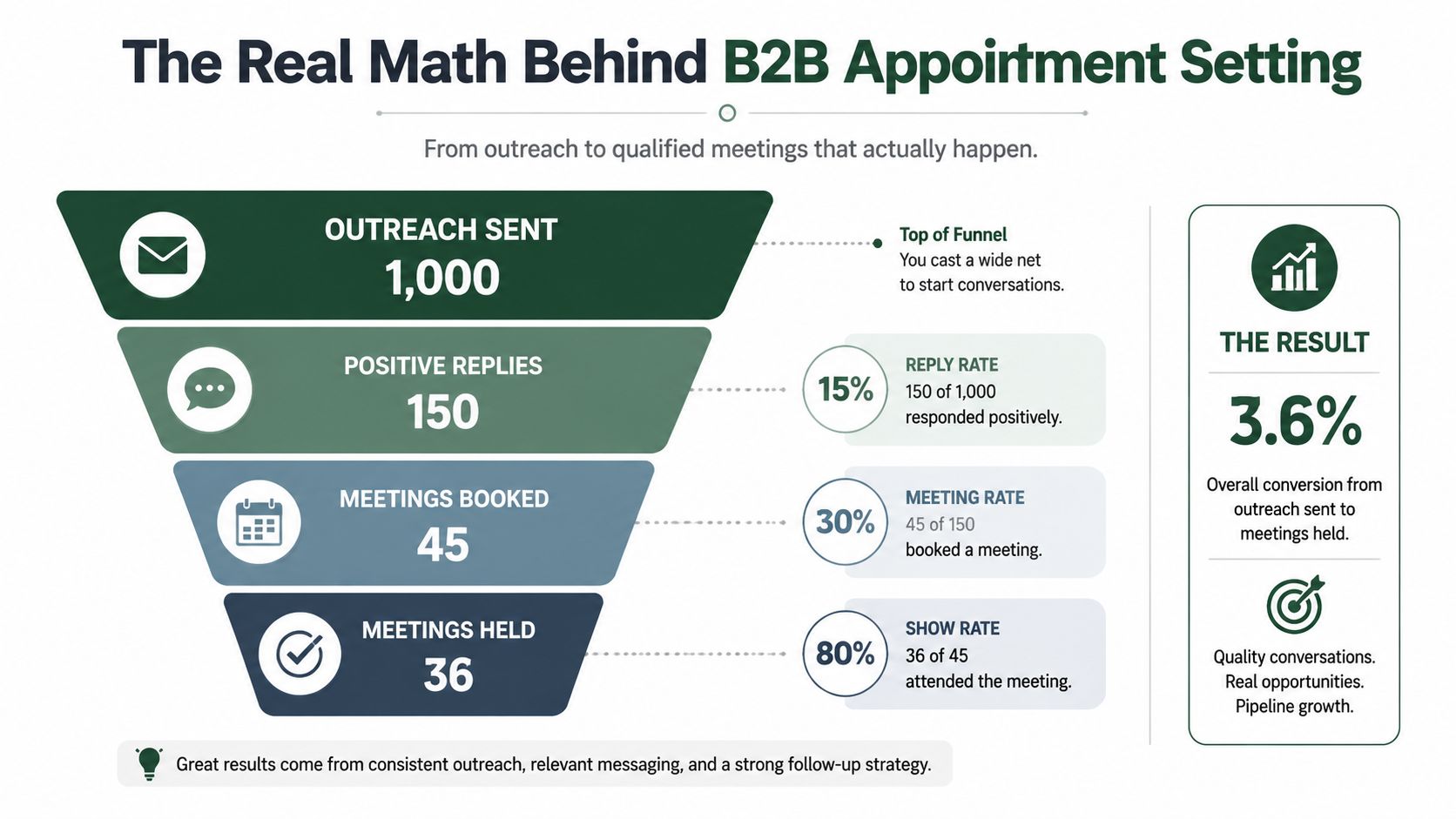
Model every conversion separately
Use this chain to locate leakage:
Delivered emails create replies. Data accuracy, inbox placement, targeting, and message relevance shape this stage.
Positive replies create booking opportunities. Gross replies include objections, referrals, automatic responses, and polite declines. Positive replies provide a cleaner operating signal.
Booking opportunities become calendar events. Scheduling friction, weak calls to action, and delayed responses reduce conversion.
Booked meetings become held meetings. Confirmations and reminders protect attendance.
Held meetings become opportunities. Qualification and sales handoff determine whether a meeting enters active pipeline.
One 2026 benchmark notes that 2% or more sequence reply rate is solid, 4% or more is top quartile, and 0.5% or more positive reply rate is a more meaningful target than gross replies (Boomerang's benchmark glossary). The same source estimates that only about 0.3% to 0.7% of cold emails become booked meetings when the full send-to-meeting funnel is measured, with bookings from positive replies averaging 10% to 15%.
A higher reply rate therefore needs a second check: booked-meeting conversion. Replies can signal curiosity, confusion, objections, or buying interest, and those outcomes require different follow-up.
Plan around batches, not miracle messages
The 8 to 25 meetings per 1,000-email benchmark means a team sending 10,000 targeted emails in a month might generate roughly 80 to 250 booked meetings under those conditions, although actual performance varies by market, offer, and industry (Revenueflow's 2026 cold email benchmark). The value of this model is planning discipline. Consistent volume, precise ICP selection, and controlled sequencing make performance easier to diagnose than isolated message tests.
For the operating model, LinkedIn outbound from RoverLead AI provides relevant context. Appointment setting requires a defined owner for every stage, from list preparation through sales handoff.
Teams interpreting email performance can also use this guide to compare cold email response rates. Outbound teams should measure held, qualified meetings rather than raw send volume.
Building a Tight ICP and Prioritized Lead List
The highest-impact appointment-setting decision happens before any sequence is written. A poor-fit account turns sharper copy into a more efficient way to reach the wrong person.
A usable Ideal Customer Profile needs more than industry and company size. Define the commercial conditions that make a conversation relevant: the operating problem, current technology, likely buyer role, urgency signals, and disqualifiers. This definition gives every later funnel stage a clearer denominator, from delivered messages to qualified meetings.
Define fit before you collect names
Start with accounts, then map the people inside them. A strong ICP usually includes:
Firmographic fit: Industry, company size, geography, business model, and sales motion.
Technographic fit: Tools, platforms, infrastructure, or workflows that indicate the problem you solve.
Operational pain: The process creating cost, delay, risk, or missed growth.
Buying role: Economic buyer, functional owner, technical evaluator, champion, or blocker.
Trigger events: Hiring activity, leadership changes, product launches, expansion, vendor changes, or public signs of strategic movement.
Disqualifiers: Company types, roles, regions, or use cases that repeatedly produce weak meetings.
A buyer persona should describe responsibilities and incentives, rather than stopping at a job title. The B2B buyer persona framework provides a useful reference for connecting role-specific priorities to outreach language.
Score each account on fit and readiness. Fit asks whether the company could benefit. Readiness asks why it might care now. A high-fit account without a relevant signal can enter a nurture pool. A high-fit account showing an active trigger should receive faster research and outreach.
Build a ranked account list
Data enrichment validates and completes your assumptions. Use it as a complement to, not a substitute for, your ICP definition. Apollo can support contact discovery and enrichment, while the operating team defines which records qualify for a sequence. Poor data creates irrelevant messages, more complaints, and weaker sender reputation.
Signal tools help prioritize timing. Trigify can help teams monitor social signals, and Whitewhale can support intent-signal workflows. Treat these signals as reasons to investigate. They require confirmation before an account enters a high-effort sequence.
A practical list structure might include:
Tier one accounts: Strong ICP fit plus a recent, relevant trigger. These deserve account research and customized messaging.
Tier two accounts: Strong fit with weaker or less immediate signals. These can receive structured personalization.
Tier three accounts: Partial fit or limited evidence. Keep them out of the core sequence until the data improves.
Qualification also applies to inbound and campaign-generated prospects. Growform lead qualification forms can capture the information needed to route conversations before a seller spends calendar time.
Protect the list as infrastructure
Every sequence needs an entry rule and an exit rule. Remove contacts when the role is wrong, the company falls outside the ICP, the prospect asks not to be contacted, or another rep owns an active sales process for the account.
Review tier movement regularly. New triggers can raise an account's priority, while stale signals or changed firmographics should lower it. The strongest list is not the largest. It is the list where each contact has a defensible reason to receive the next message.
Designing Multi-Channel Sequences That Convert
Single-channel outreach leaves gaps in the operating data. Email scales efficiently, phone can create urgency, LinkedIn adds account context, and social activity may show whether a prospect is discussing the problem now.
A global report analyzing 500,000 or more calls, 1.4 million emails, and 321,000 meetings found that phone drove 85% of booked meetings, compared with 8% from email and 7% from LinkedIn (memoryBlue's global outreach report). Use that finding as a planning input, not a fixed channel mix. The right sequence still depends on reachability, urgency, buyer preferences, and market.

Choose the channel order deliberately
Phone leads when the buyer is reachable and the problem is urgent. Email leads when the audience prefers written context, the list spans multiple time zones, or the first touch needs supporting evidence. LinkedIn can build recognition and add context, while a guide to LinkedIn lead generation provides a useful reference for that channel. A connection request by itself usually lacks the commercial detail needed to earn a meeting.
Regional conditions affect sequence design. APAC motions may require closer attention to local working hours, language, seniority, and trust-building than a North American motion. Enterprise accounts often need coverage across several stakeholders, while mid-market opportunities may move faster through one clear owner. Regulated markets require careful consent, transparency, and suppression practices. Privacy handling belongs in the operating process.
LinkedIn results also show why engagement and meetings must remain separate funnel stages. A 2026 dataset covering 180,155 connection requests recorded 27.1% acceptance, with 27.6% of accepted connections producing a reply and 2.0% resulting in a booked meeting (Reachium's LinkedIn outreach benchmarks). A separate benchmark covering more than 15 million contacts reported a 7.2% overall LinkedIn reply rate, with industry results ranging from 4.2% to 10.5% (Belkins' LinkedIn outreach study).
Use timing as a testable variable
A 2026 study found that Wednesday and Thursday produced the highest weekday reply rates at 0.48% each. Morning sends from 8 AM to 12 PM performed best overall, with a 0.54% reply rate and 0.4% meeting conversion (Occura's outreach timing study). Treat these results as starting hypotheses, then segment performance by region, persona, and channel.
A sequence might combine personalized email, a LinkedIn interaction, a phone attempt, a relevant follow-up, and a low-pressure close. Set each touch a defined job, then measure send-to-reply, reply-to-meeting, and meeting-to-show conversion instead of managing activity volume alone.
Technical execution affects those rates. Use Instantly for cold email sequencing, deliverability workflows, and controlled sending operations. Keep list hygiene, domain health, suppression, and campaign monitoring in the same operating process.
Use a CRM to implement follow up CRM strategies that preserve context across channels. The team should see which touch occurred, what the prospect engaged with, and what action comes next.
Crafting Outreach Messages That Earn Replies
Good outbound copy makes relevance obvious quickly and focuses on a specific business problem. The sender earns a reply by showing enough account understanding to start a useful conversation, without forcing the recipient through a product tour.
A strong initial email has four parts: a specific observation, a business problem, a credible reason for contacting the person, and a low-friction question. The observation should come from the account's context, such as a hiring pattern, market change, or operational shift. Scraped compliments add little evidence of relevance.
Write the first touch around a problem
A practical structure looks like this:
Observation: “You're expanding the commercial team into new regions.”
Problem: “That often creates inconsistent targeting and uneven follow-up across markets.”
Relevance: “We help revenue teams connect account selection, messaging, and sequencing.”
Question: “Is improving qualified meeting flow a priority this quarter?”
The example stays within claims the recipient can assess. It opens a conversation about an identifiable operating problem and gives the buyer an easy way to confirm, reject, or redirect it.
Subject lines should identify the topic without implying an existing relationship. The opening line should demonstrate account understanding. The call to action should request a small response, such as whether the issue exists or who owns it.
Follow up with new information
A follow-up needs a distinct purpose rather than a lightly edited copy of the first email:
Follow-up one: Clarify the specific operational problem.
Follow-up two: Add a useful observation, benchmark, or relevant resource.
Follow-up three: Ask whether another person owns the issue.
Close-out message: Give the prospect an easy way to decline or defer.
LinkedIn messages should be shorter and more conversational than email. Start with a relevant interaction, such as a post, role change, hiring pattern, or market move. Keep the channel additive. Repeating the email creates more noise without increasing the prospect's context.
Personalize without creating a manual bottleneck
Personalization at scale depends on structured inputs. Store the trigger, account category, buyer role, pain point, and proof point as fields that shape the message. Automation can assemble the context, while a human checks whether the final message is accurate and coherent.
For writing guidance, use this cold email guide. Test one variable at a time where possible, then judge performance by positive replies and booked meetings rather than opens alone. Cold email remains a low-conversion channel at scale, with one 2026 benchmark reporting an average 0.45% reply rate across 2025 campaigns (Belkins' cold email response-rate study). That math makes list quality and problem relevance more important than clever phrasing.
Routing Meetings to Sales and Protecting Show Rates
A booked meeting becomes useful only when the right buyer reaches the right seller with enough context to continue the conversation. Prospects may miss the call, bring no stakeholder with decision authority, or meet a seller who has not reviewed the account.
Set routing rules at booking. Define ownership by territory, product line, account status, deal complexity, and buyer role. If an account already belongs to a rep, keep that relationship unless a clear exception applies. Manual queues create delay and make accountability harder to audit.
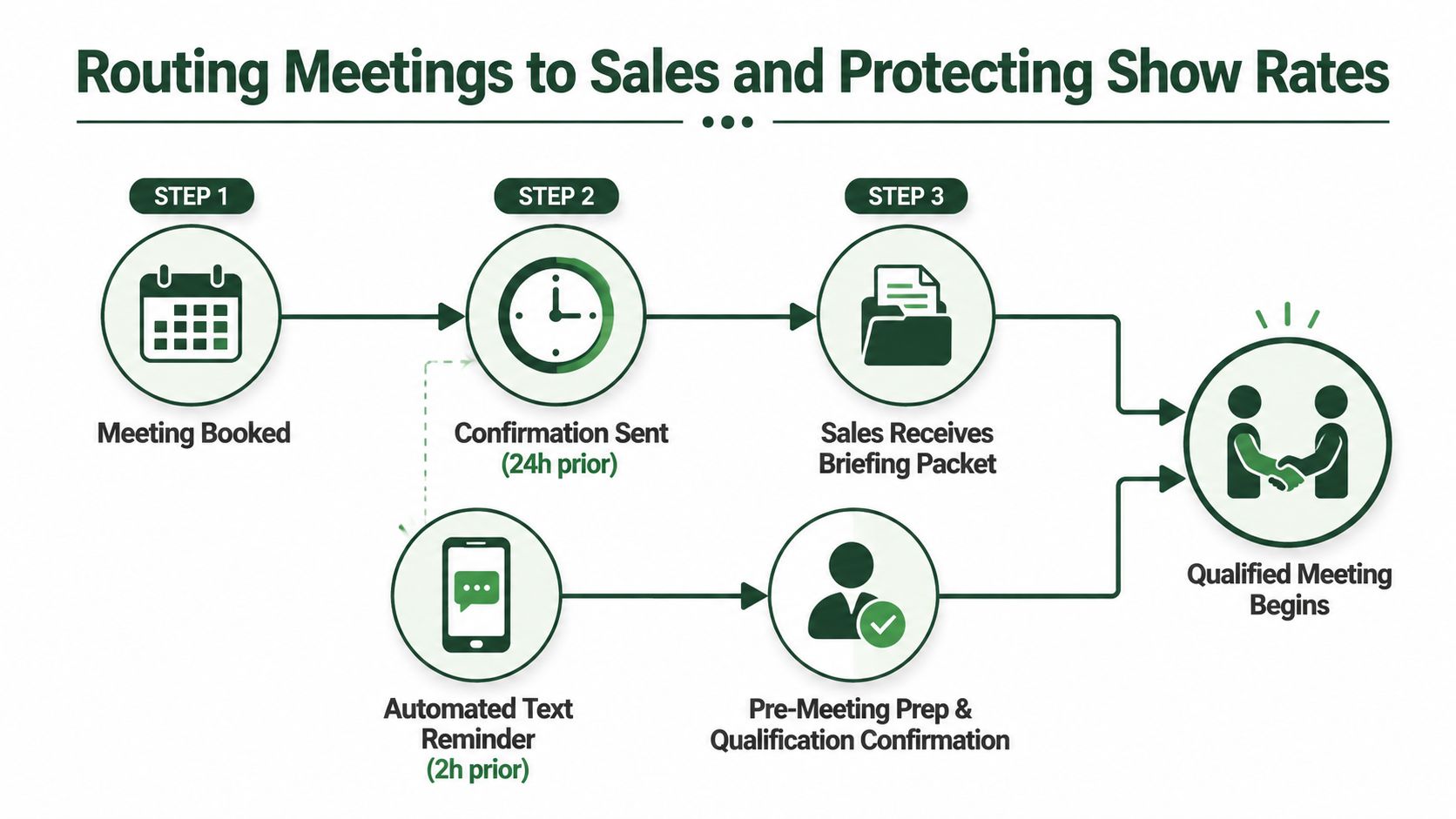
Qualify before the calendar
Collect only information that changes routing, preparation, or meeting suitability. Useful fields include the business problem, current approach, affected team, expected timing, and participants likely to influence the decision. Extra form fields add friction without improving the handoff.
Appointment-setting programs often produce 4% to 10% contact-to-meeting conversion, 65% to 80% show rates, and 25% to 55% meeting-to-qualified-opportunity conversion (Revenueflow's appointment-setting benchmarks). The sequence matters operationally. A higher booking rate cannot compensate for weak attendance or poor qualification.
The seller's briefing packet should include:
Account context: Company profile, relevant signals, current tools, and ownership.
Conversation reason: The problem or trigger that generated the meeting.
Qualification notes: Answers captured during booking and unresolved gaps.
Recommended opening: A first question that reflects the prospect's stated context.
Next-step rule: The conditions for opportunity creation, recycling, or disqualification.
Confirm without creating pressure
The confirmation should state the purpose, participants, duration, and expected preparation. A reminder should make the meeting easier to attend by restating the purpose and offering a simple rescheduling path. A later reminder can confirm that the time still works and surface conflicts before they become no-shows.
For messaging-led reminders and workflows, Respond IO can support WhatsApp automation where that channel is appropriate and compliant. Choose the method according to buyer preference, regional norms, and consent. Channel availability alone is not a routing criterion.
Give no-shows a defined recovery path. Send a concise follow-up that preserves the original context, offers a small number of alternatives, and makes declining acceptable. If a prospect attends but then stalls, route the record into nurture or re-engagement, with a clear status and next action, so the meeting remains visible in reporting.
Measuring What Matters Across the Appointment Funnel
A useful dashboard tracks delivered-email reply rate, positive-reply rate, meeting-booked rate, show rate, and meeting-to-opportunity conversion separately. Each metric answers a different operational question. Keeping the stages distinct lets the team identify where conversion breaks down and assign the right fix.
Funnel Stage | Average Range | Top Quartile |
|---|---|---|
Cold B2B reply rate | 2% to 4% | 4% to 7% |
Positive reply rate | 0.5% or more is a meaningful target | 4% or more sequence reply rate is top quartile |
Contact-to-meeting rate | 0.5% to 1.5% for cold B2B campaigns | 1.5% or more within that benchmark range |
Show rate | 65% to 80% | Higher performance depends on confirmation and qualification quality |
Meeting-to-qualified-opportunity rate | 25% to 55% | Strong qualification moves performance toward the upper end |
The table is a diagnostic tool, not a quota promise. A low reply rate usually sends the team back to list fit, deliverability, timing, or message relevance. Healthy replies with weak bookings point to a call-to-action or scheduling problem. Strong bookings with poor show rates indicate weak confirmation, unclear value, or low-intent qualification.
Report drivers, not just totals
Tag each meeting by account tier, persona, trigger, channel, sequence, message version, owner, and outcome. Connect those fields to held meetings and opportunities, then review conversion by segment instead of judging the program on a single aggregate rate.
A dashboard supporting revenue operations should show which combinations of signals, personas, channels, and messages create qualified pipeline. This makes the operating loop concrete: identify the failing stage, change one input, and measure the downstream effect on meetings and opportunities.
The Social Search builds and operates outbound systems covering ICP definition, prioritized lists, messaging, email and LinkedIn sequencing, signal-driven prospecting, routing, and reporting for B2B teams targeting APAC and global markets. Teams that need appointment setting measured from first touch through opportunity creation can visit The Social Search to discuss a system build or embedded GTM support.
