The Complete Cold Email Guide: How to Write Outreach That Actually Gets Replies
Learn how to write cold emails that get real replies. This guide covers frameworks, deliverability, compliance, metrics, and multi-channel sequencing.
Most cold emails get deleted in under three seconds. Not because the product is bad or the timing is off, but because the email itself gives the recipient no reason to keep reading. Cold email remains one of the highest-ROI channels in B2B sales and lead generation, but the gap between campaigns that generate meetings and ones that generate spam complaints keeps growing. This guide covers everything you need to write cold emails that land in inboxes, get opened, and convert into real conversations.

What Makes Cold Email Different From Other Outreach
Cold email is outbound outreach sent to someone who has no prior relationship with you. Unlike a warm lead who downloaded your ebook or clicked a Meta ad, a cold prospect has never heard of you. That distinction matters enormously for how you write.
Where paid ads interrupt with visuals and social proof baked into the creative, cold email relies entirely on words and relevance. There is no retargeting pixel backing you up. No brand familiarity. Just your subject line, your first sentence, and the value you can communicate in 60 to 90 words.
When it works, it works well. ROI figures consistently land above $36 per dollar spent, and reply rates for well-crafted campaigns push past 10% compared to an industry average hovering around 2-4%. The upside is real, but only if you understand the mechanics.
The Anatomy of a Cold Email That Works
Every effective cold email shares the same structural logic, even when the templates look wildly different on the surface.
Subject Line
Your subject line determines whether any of the rest matters. Short, specific, and ideally personal. Something referencing their company name, a recent trigger event, or a concrete outcome performs better than vague curiosity bait.
What works:
“Quick question about [Company Name]’s onboarding flow”
“Saw your LinkedIn post on [topic]”
“Idea for [Company Name]’s Q3 pipeline”
What doesn’t:
“Exciting opportunity for you!!!”
“Following up on my previous email”
“Are you the right person?”
Opening Line
Skip the “Hope this finds you well.” Open with something that tells the recipient you actually know who they are. Reference a trigger event (funding round, hiring surge, product launch, published article). This signals that the email was written for them, not copy-pasted into a sequence with their name swapped in.
Value Proposition
Get to the point. What do you do, who do you do it for, and what outcome should they expect? One to two sentences maximum. The PAS formula works well here: identify a problem they likely have, briefly agitate why it matters, and introduce your solution as the path forward.
Call to Action
One ask. Not three. The most effective CTA is low-friction and specific. “Would you be open to a 15-minute call this Thursday or Friday?” outperforms “Let me know if you want to learn more” every single time because it removes ambiguity and offers a clear next step.
Signature
Include your name, title, company, and a website link. Keep it simple. Fancy HTML signatures with logos and social media icons can trigger spam filters and slow load times on mobile.
Cold Email Frameworks That Drive Replies
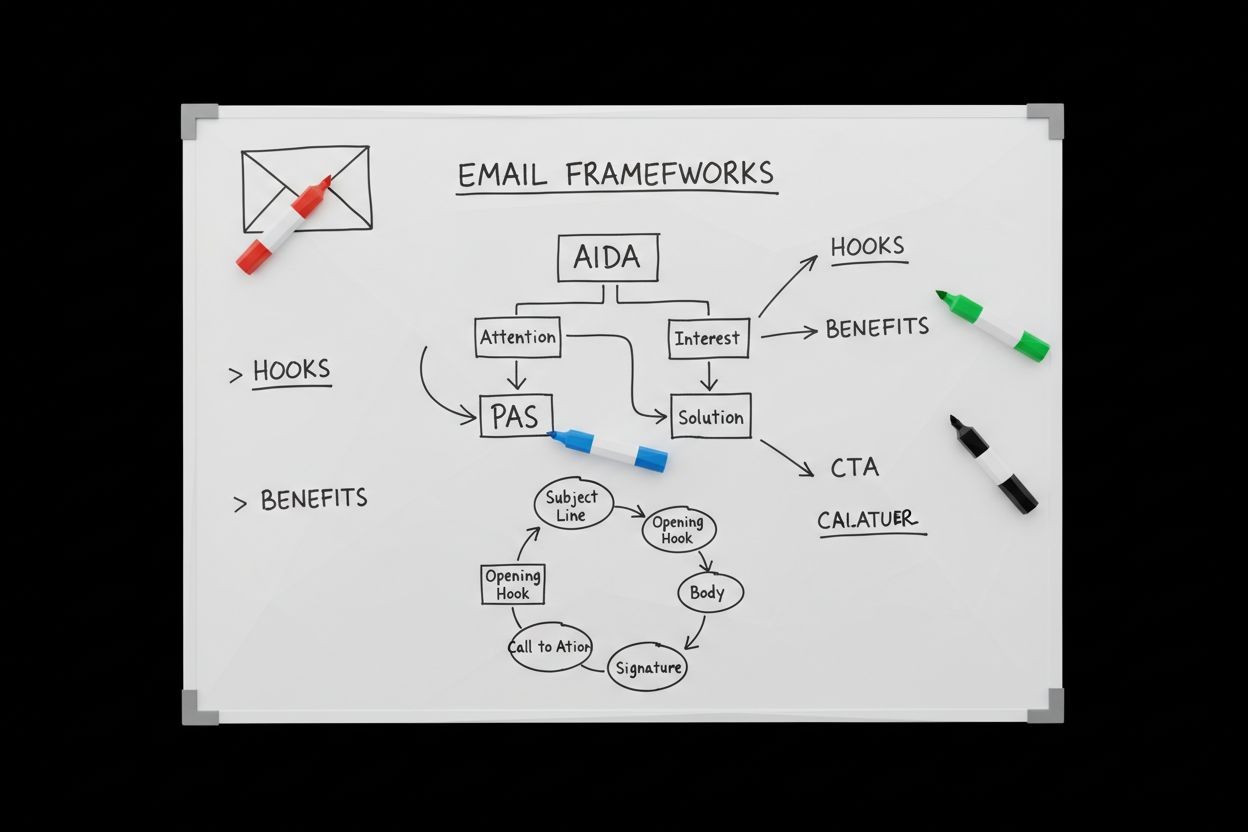
Frameworks give you a repeatable structure so you are not staring at a blank page every time. Here are the three most useful ones.
PAS (Problem-Agitate-Solve)
This is the workhorse of cold email copywriting. Start by naming a specific problem your prospect likely faces. Then briefly expand on why that problem is costly or frustrating. Then position your solution.
Example structure:
“Most [job title]s I talk to are spending hours manually qualifying leads before they ever get to a real conversation. That backlog kills pipeline velocity. We built a system that automates the qualification layer so your team is only talking to buyers who are already warm. Happy to show you how it works in 15 minutes.”
AIDA (Attention-Interest-Desire-Action)
AIDA works well for prospects who are less problem-aware. Hook their attention with a surprising stat or observation, build interest by connecting it to their world, create desire by showing what better looks like, then close with a CTA.
The Trigger Event Framework
This one is underused and often outperforms both of the above. When a prospect raises funding, launches a new product, posts a thought leadership piece, or hires aggressively in a specific department, they are in a moment of change. Change creates buying windows. Reference the trigger, connect it to the pain that usually follows, and offer your solution as the timely fit.
If you are running automated lead generation workflows, trigger-based sequences are where automation really earns its keep. Tools can monitor signals like funding announcements or job postings and fire the right email at exactly the right moment.
Multi-Channel Sequencing: Where Cold Email Fits
Cold email does not live in isolation. The highest-performing outbound programs treat email as one layer in a coordinated sequence that includes LinkedIn, phone calls, and sometimes even paid retargeting.
A typical five-touch sequence might look like:
Day 1: LinkedIn connection request (no note)
Day 3: First cold email (trigger-based, personalized)
Day 6: LinkedIn message referencing the email
Day 9: Follow-up email adding new value (a relevant case study, article, or data point)
Day 14: Final email with a clear opt-out
Follow-ups are not optional. Data consistently shows that 70%+ of replies to cold email sequences come on the second, third, or fourth touch. Sending one email and waiting is one of the most common and costly mistakes in outbound.
This kind of sequencing pairs naturally with broader marketing and sales automation strategies where your outreach runs in the background while your team focuses on closing.
Personalization at Scale: The Real Challenge
Every guide tells you to personalize. Few explain how to do it without spending 45 minutes per prospect.
The answer is tiered personalization. Not every prospect deserves the same level of research. Segment your list:
Tier 1 (top 10-20 accounts): Deep research. Check their LinkedIn activity, recent press, company blog, and leadership team. Write a genuinely custom opening. This is your dream-client list.
Tier 2 (mid-priority): Use firmographic and technographic signals to customize the value prop. “We work with SaaS companies between 50-200 employees that are scaling their sales team” is more relevant than a generic pitch without requiring individual research.
Tier 3 (broad outreach): Template-driven with merge fields for name, company, and industry-specific pain points. Solid copywriting does the heavy lifting here.
AI tools now make Tier 2 personalization faster. Tools that pull in LinkedIn data, news mentions, and company signals can draft personalized opening lines in bulk. The key is reviewing outputs before sending. AI-generated lines that sound robotic or generic do more damage than a clean template.
Cold Email and Lead Generation: The Bigger Picture
Cold email is a channel, not a strategy. The best results come when it feeds into a broader lead generation engine where prospects who reply move into a CRM, get scored, and receive the right follow-up based on where they are in the buying process.
If you have not thought about how cold outreach integrates with your CRM workflows, this piece on what CRM means in marketing is worth reading before you build out a sequence. The handoff between outbound email and your sales process determines whether you convert replies into revenue or just conversations.
For companies building out a full outbound function, check out this breakdown of lead generation and marketing automation to understand how the pieces fit together.
Deliverability: Why Your Emails Might Not Be Landing

You can write the best cold email in your industry and still see a 0% reply rate if your emails are landing in spam folders. Deliverability is the unsexy technical foundation that most guides gloss over.
The basics you must have in place:
SPF, DKIM, and DMARC records configured on your sending domain
Domain warm-up before sending at volume (start with 20-30 emails per day and ramp up over 4-6 weeks)
Dedicated sending domain separate from your primary company domain to protect brand reputation
Clean lists with email verification run before any campaign launch
Spam trigger words avoided in subject lines and body copy (“free,” “guarantee,” “no risk,” “act now”)
Sending to a list where even 3-5% of addresses bounce signals to inbox providers that your list is low quality. That reputation damage can take weeks to recover from.
Legal Compliance: CAN-SPAM, GDPR, and CASL
This section gets skipped in most cold email content and it should not be. Getting compliance wrong creates real financial and legal exposure.
CAN-SPAM (US): Requires a physical mailing address in every email, a clear opt-out mechanism, no deceptive subject lines, and honor of opt-out requests within 10 business days. B2B cold email is generally allowed under CAN-SPAM as long as these requirements are met.
GDPR (EU): Significantly stricter. You need a legitimate interest basis or consent to email EU-based prospects. You must have a privacy notice accessible to recipients and process opt-outs immediately. If you are targeting European companies, GDPR compliance is not optional.
CASL (Canada): Among the strictest globally. Generally requires express or implied consent before sending commercial email to Canadian recipients. Implied consent exists if you have a prior business relationship.
The safest path is building your cold email infrastructure with compliance baked in from day one rather than retrofitting it later.
Metrics That Actually Matter
Most cold email tools surface open rates prominently. Open rates are increasingly unreliable because Apple Mail Privacy Protection and other inbox tools pre-load images, registering “opens” that never happened.
Focus on these instead:
Metric | Why It Matters | Benchmark |
|---|---|---|
Reply rate | Direct signal of email quality | 3-10% good; 10%+ excellent |
Positive reply rate | Separates interest from objections | 1-3% solid |
Meeting booked rate | Revenue-relevant conversion | 0.5-2% from cold list |
Bounce rate | Deliverability health signal | Under 3% |
Unsubscribe rate | Audience fit indicator | Under 0.5% |
Track at the sequence level, not just the individual email level. A campaign where email one underperforms but email three drives 60% of meetings tells you something important about your audience’s buying timeline.
A/B Testing Cold Email: A Simple Framework
Everyone says to test. Here is how to actually do it without muddying your data.
Test one variable at a time. Common high-leverage variables:
Subject line (curiosity vs. direct benefit vs. name-personalized)
Opening line (trigger event vs. flattery vs. shared connection)
CTA (specific time slot vs. open-ended ask)
Email length (50 words vs. 100 words vs. 200 words)
Split your list 50/50. Run each variant for the same time window. Require statistical significance before calling a winner (minimum 100 sends per variant, ideally 200+). Document results. Build a learning library over time.
Teams that do this consistently for six months tend to develop sequence templates that are dramatically more effective than anything they started with.
Cold Email for Non-Sales Use Cases
Cold email is not just for sales. The same principles apply across a range of outreach scenarios.
PR outreach: Pitching journalists and editors requires the same tight structure. Reference their recent work, make the pitch relevant to their beat, and keep the ask specific.
Link building: SEO teams use cold email to earn backlinks. The best link building emails offer genuine value in exchange (a data asset, a useful resource, a relevant addition to existing content). Check out the automated SEO services space for how this is being scaled today.
Partnership development: Reaching out to potential integration partners, co-marketing partners, or referral partners follows the same logic. Lead with what is in it for them.
Investor outreach: Founders raising capital use cold email to get warm introductions or direct conversations with investors. The framework is identical, but the trigger events and value props look different.
What Bad Cold Email Looks Like (And Why It Fails)
Learning from poor examples is often more useful than reading more templates. Here is an annotated example of what not to send:
Subject: Exciting partnership opportunity!
Hi [First Name],
My name is John and I am the Sales Director at XYZ Corp. We are a leading provider of cutting-edge solutions for businesses of all sizes.
I wanted to reach out because I believe there could be a great synergy between our companies.
Would love to schedule a call to explore how we can work together. Let me know your availability.
Best, John
Why this fails: The subject line is generic and promises nothing specific. The opening line is about the sender, not the recipient. “Leading provider” and “cutting-edge” are meaningless filler. “Synergy” signals that no research was done. The CTA is vague and puts all the work on the prospect.
Contrast that with an email that opens on a trigger event, names a specific problem, shows one concrete result from a relevant client, and asks for 15 minutes on a specific day. That email might be shorter, but every sentence earns its place.
Building a Cold Email System That Scales
A one-off cold email campaign is a tactic. A cold email system is a growth asset. The difference is infrastructure: a clean, regularly enriched prospect list, a sending domain with solid reputation, a sequencing tool, a CRM integration that captures every reply, and a feedback loop that routes what you learn back into your templates.
For teams that want to build this without hiring a dedicated outbound specialist, there are now automated lead generation systems that handle the prospecting, enrichment, and sequencing layers. The human judgment still lives in the strategy and copy, but the operational overhead comes down significantly.
Cold email is not going away. If anything, as paid acquisition costs on Meta and TikTok continue rising, direct outbound becomes more attractive as a channel for businesses that want predictable pipeline without purely relying on ad spend. The teams that invest in building their outbound muscle now will have a meaningful advantage as the market shifts.