Cold Email Response Rate: Benchmarks and Tactics That Work
Discover the real cold email response rate benchmarks for 2026, why averages mislead, and the system-level tactics that push reply rates into the top 5%.
Platform-wide cold email reply rates now cluster around 3.43%, while strict net-new outreach datasets report figures as low as 0.45%. That spread makes the “average” far less useful than sequence-level conversion analysis.
The question isn’t whether cold email still works. It’s whether your system is built to produce replies in a market where the distribution is brutally skewed, inboxes are crowded, and small gains in targeting or follow-up can matter more than writing a clever subject line. For outbound teams, the response rate is a system output, not a copywriting trophy.
Table of Contents
What a Realistic Cold Email Response Rate Looks Like in 2026
Real-World Tactics That Lift Reply Rates From Median to Top 5%
Why Open Rates and First-Email Reply Rates Are Misleading Goals
What a Good Cold Email Response Rate Means for Your Business
What a Realistic Cold Email Response Rate Looks Like in 2026
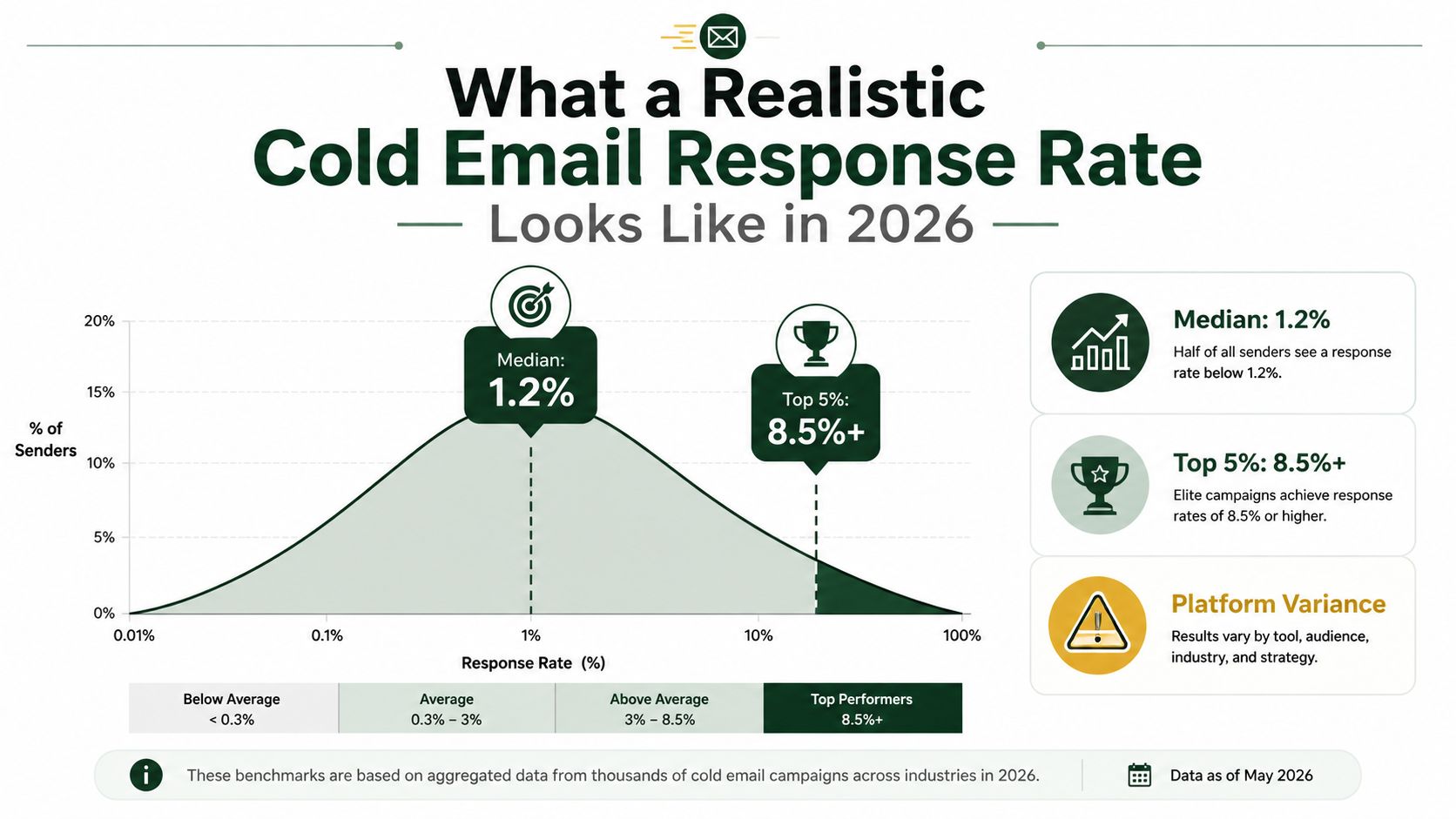
A realistic cold email response rate in 2026 depends on what you’re measuring. Platform-wide averages cluster around 3.43% in recent benchmarks, while strict net-new outreach datasets go as low as 0.45% across 2025 campaigns, which tells you how much denominator choice changes the story. One number includes broader campaign mix, the other reflects true cold outreach at its harshest.
Why the average is a weak operating target
An average response rate sounds clean, but it hides the part operators need. If your list includes warmer traffic, mixed campaign quality, or broad platform-wide measurement, the headline number will look healthier than a true cold sequence. If your denominator is delivered emails in a strict outbound dataset, the same channel can look unforgiving.
That’s why the median matters more than a glossy average. When the top 5% of senders reach 16.3% reply rates while the median sits at 0.48% (CopyCrest), you’re not looking at a channel with gentle variance. You’re looking at a system where list quality, offer relevance, and follow-up mechanics create massive separation.
Practical rule: if two teams quote the same “response rate,” ask how they define delivered emails, replies, and positive replies before comparing anything else.
The operational takeaway is simple. Treat your cold email response rate as a variable output of list intent and sequence design, not a fixed channel constant. If your team is chasing a single benchmark without agreeing on the denominator, you’re probably optimizing the wrong dashboard.
The most useful internal comparison is against your own sequence-level baseline, not a generic industry post. For a deeper view of how outbound fits into a broader acquisition motion, the lead generation for SaaS overview is a useful adjacent read.
How Cold Email Benchmarks Have Shifted Over Time
The benchmark story has moved in one direction. Cold email used to be judged against a higher ceiling, with older summaries putting a strong outcome around 8.5%, or roughly 1 reply for every 12 emails sent. More recent roundups place the market more often in the 1% to 5% band, which makes the older ceiling a useful reference point for what “good” once looked like, not what average outbound teams should expect now.
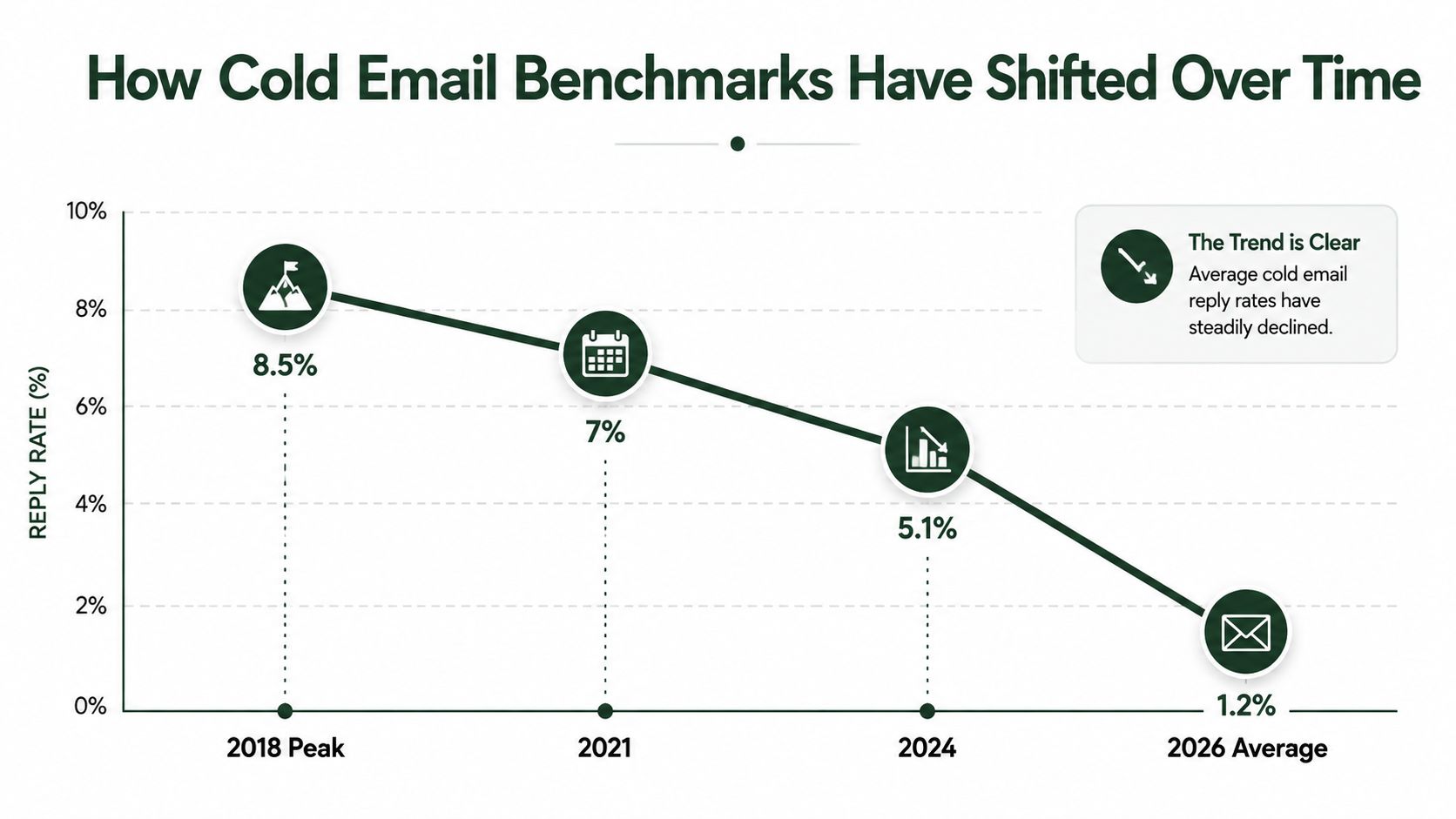
Recent benchmark summaries show the same direction. One 2024 summary reported an average response rate of 5.1%, down from 7% the year before. Another report said reply rates fell to 5.8% from 6.8% in 2023, a 15% year-over-year decline. By 2026, some datasets put platform-wide averages at 3.43%, which points to a channel that has become less forgiving as inbox filtering and spam controls tightened.
What changed operationally
The channel did not vanish, but the penalty for weak execution got much steeper. Generic outreach gets filtered by software and buyers faster than it used to. Teams that built their playbooks around mid-single-digit expectations often miss the mark now because the market punishes undifferentiated lists and low-context messaging far more aggressively.
The spread at the top end widened too. Independent summaries still place typical campaigns in the 1% to 5% range, while top performers can reach 10%+ (Saleshandy). That gap matters because it shows the issue is not whether cold email works. It shows the operating standard has shifted from volume to precision.
The system behind the send is the key variable. ICP definition, list quality, sequencing, deliverability, and signal use all shape the final cold email response rate. A strong offer sent to the wrong list still underperforms, and a clean list without sequencing discipline leaves reply volume on the table.
Practical rule: if your reply rate improves after sending more emails, the lift may come from list quality or timing. If it improves after tighter segmentation, the system is working.
For teams rebuilding outbound, the useful comparison is against current market conditions, not older blog-era averages. A practical starting point is the lead generation strategies 2026 guide, which fits well with a broader review of outbound planning. If your team is also using automation to support follow-up and routing, the complete guide on AI automation is a useful companion.
The Four System Levers That Actually Drive Reply Rates
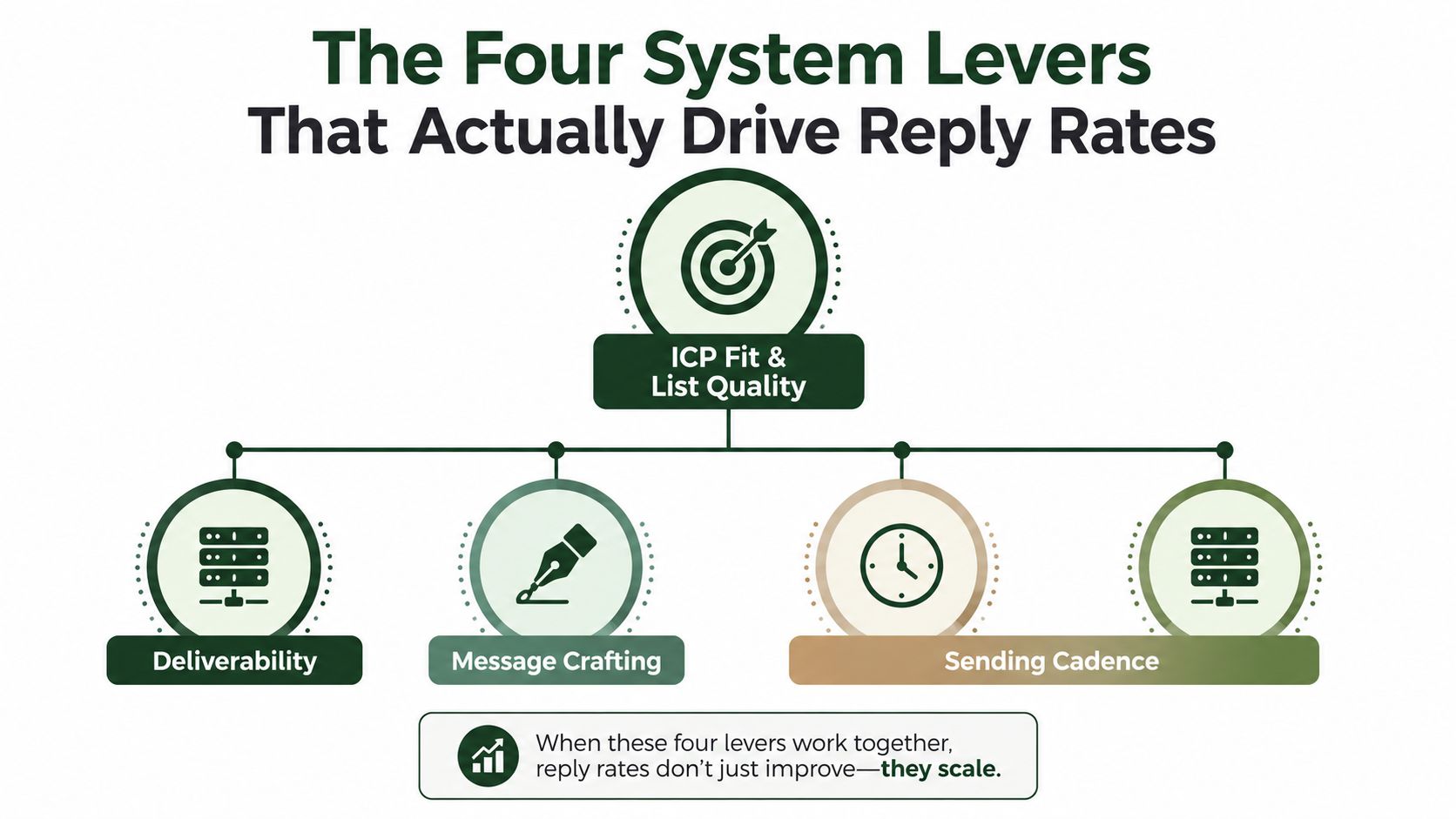
The gap between median and elite performance comes from system design, not a single clever line of copy. In real outbound programs, four levers matter most, ICP fit and list quality, deliverability, message crafting, and sending cadence. When those pieces work together, the campaign behaves like a machine. When one is weak, the rest of the system can’t fully compensate.
ICP fit and list quality come first
A small, tight list usually outperforms a broad one because relevance is easier to maintain. That’s why campaigns under 50 recipients are often stronger than large blasts, and why targeted outreach around one shared pain point is easier to operationalize than a generic sector list. The list is the first filter, not the last.
Good list work means the campaign has a reason to exist. It can be based on industry, size, geography, tech stack, hiring motion, funding, or some other trigger that creates a believable fit. If you can’t describe the shared denominator in one sentence, personalization becomes decoration instead of a signal.
Deliverability and sequencing are part of the same system
Deliverability isn’t a backend detail. If the message doesn’t land, the reply rate can’t improve, no matter how strong the copy looks in a draft folder. That’s why many operators pair outbound sequencing with tooling like Instantly for sending, warming, and sequencing discipline, while using Apollo when the list needs cleaner enrichment.
Signals make timing relevant
Signal-driven outreach gives the email a reason to arrive now. Hiring, funding, launches, role changes, and tech-stack shifts are all examples of context that sharpen timing. For teams building around signals, Trigify is a natural fit for lead intelligence, and HeyReach can complement email with coordinated LinkedIn motion when the buyer path needs more than one touchpoint.
Message craft still matters, just not alone
Copy matters most when it reflects the list and the signal. A generic paragraph can’t rescue a weak targeting strategy, but a clear offer framed around a real trigger can make the rest of the system feel coherent. If you’re mapping workflow options across research, sequencing, and orchestration, this complete guide on AI automation is useful context for how teams are automating the right parts without handing over judgment.
The strongest outbound teams treat these levers as one stack. That’s the logic behind a connected system approach, not an isolated writing exercise. For a practical example of how targeted account selection fits into that model, the ICP list building service overview is a relevant reference point.
How to Measure Response Rate the Right Way
The most common measurement mistake is counting every reply as equal. A “response” that says remove me, send later, or asks for clarification is not the same as a reply that moves into a meeting. If the dashboard doesn’t separate those outcomes, it tells you almost nothing about pipeline.
Measure by sequence, not just by first email
Sequence-level measurement is more useful than first-email measurement because follow-ups materially change outcomes. Recent benchmark summaries recommend tracking replies across the full sequence, excluding bounces and undelivered emails, then separating positive replies from any response at all. That matters because a campaign can look healthy on surface metrics and still fail to create meetings.
Here’s a simple framework.
Measurement Approach | What It Includes | What It Misses | Pipeline Predictive Value |
|---|---|---|---|
First-email reply rate | Replies to the first send only | Follow-up impact, delayed intent, sequence lift | Low |
Sequence reply rate | Replies across all sends in the sequence | Reply quality unless segmented further | Medium |
Positive reply rate | Replies with interest, questions, or meeting intent | Negative and neutral responses | High |
Meeting conversion rate | Replies that turn into booked conversations | Early intent that stalls later | Very high |
A good reporting view should also let you segment by list, message, and signal. That’s where a dashboard becomes operational instead of descriptive. If you want a cleaner structure for that layer, the reporting and pipeline dashboard service page shows the kind of view that connects activity to pipeline.
Don’t celebrate a reply rate before you know how many of those replies were useful.
What to exclude from the headline
Bounces and undelivered emails distort the denominator, so they need to be removed before you evaluate sequence performance. Auto-responders, out-of-office messages, and vague acknowledgements also need to be handled separately from real buyer intent. Without that cleanup, your response rate can look better than your sales motion deserves.
Once the measurement is honest, the next question becomes attribution. The best systems tie meetings back to the specific list segment, trigger, and message variant that produced them. That’s the difference between “we got replies” and “we know what produced qualified pipeline.”
Real-World Tactics That Lift Reply Rates From Median to Top 5%
The fastest way to move out of the median is to shrink the amount of guesswork in the campaign. Micro-segmentation, trigger-based timing, and disciplined follow-up all do more for the cold email response rate than cosmetic copy edits. The best teams don’t spray more emails, they make each email more structurally relevant.
Tight lists and trigger-based timing
Smaller lists tend to reply better when the segment is real, not just small for its own sake. Benchmark summaries note that micro-segmented campaigns can nearly 2x replies versus larger lists, especially when the contacts share a concrete buying context. That’s why trigger-based outreach works well for APAC expansion and early-stage SaaS, where a recent hire, funding event, or product launch creates a clear reason to reach out now.
In practical terms, this means a campaign should look like one conversation to one defined group. A list of growth-stage SaaS firms hiring an SDR leader needs a different message from enterprise accounts adopting a new stack. The signal is the bridge between the target and the ask.
Timing and follow-up are not optional details
One 2025 benchmark reported the highest reply rate, 0.54%, for sends between 8 AM and 12 PM, and another 2026 benchmark said Tuesday and Wednesday are the peak reply days, with Wednesday highest (Belkins) (Instantly 2026 benchmark). Those numbers don’t mean timing fixes a weak campaign, but they do show that the schedule can amplify a good one. The easiest mistake is to treat send time as irrelevant.
Follow-up structure matters just as much. One benchmark summary says 58% of replies come from step one and 42% come from follow-ups, which means a one-touch sequence leaves a lot of response volume on the table. In practice, that’s why a follow-up should add something new, not just repeat the first ask.
Practical rule: if your follow-up could have been written before you sent the first email, it probably doesn’t deserve to be sent.
For teams that need a cleaner sending baseline, resources like fix email bounce with Mailbeam are useful because bounce control is still part of reply-rate math. A clean sequence with a narrow segment and a real trigger often beats a broader campaign with better copy but weaker list discipline. The cold email guide is also a practical companion if you’re rebuilding the motion from scratch.
Why Open Rates and First-Email Reply Rates Are Misleading Goals
Open rates are a noisy proxy, and first-email reply rates can be just as misleading. A campaign can get opened, earn a few replies, and still fail to create meetings if the targeting is weak or the offer is off. Revenue doesn’t come from looking active, it comes from conversations that progress.
Vanity metrics can hide a broken funnel
Open rate is especially shaky because it can be inflated by tracking behavior rather than human attention. That makes it a directional signal at best. Even a solid first-email reply rate can be deceptive if follow-ups produce the bulk of actual pipeline.
The cleaner view is sequence-level conversion. Measure how many replies come from the full sequence, then separate positive replies from objections and dead-end responses. If the first email looks strong but later messages generate no meeting quality, the campaign is probably optimized for attention instead of intent.
A dashboard that rewards opens can push teams toward curiosity bait. A dashboard that rewards meetings pushes them toward relevance.
Reporting should reflect revenue, not activity
A useful reporting stack tracks list segment, trigger source, message variant, reply type, and meeting outcome together. That’s enough to see whether one audience consistently converts better than another, or whether a message works only when paired with a specific signal. It also prevents teams from overvaluing early engagement that never becomes pipeline.
The question leaders should ask is simple. Did the sequence create useful conversations with the right buyers, or did it create noise that made the team feel busy? When reporting is built around response quality instead of raw response count, the channel becomes easier to manage and far easier to scale.
What a Good Cold Email Response Rate Means for Your Business
A good cold email response rate only makes sense inside the system that produces it. A venture-backed SaaS startup building outbound from scratch can treat a mid-single-digit result as a real signal that the list, offer, and timing are close enough to work. A mid-market sales team with a mature motion should expect a tighter bar, because the process should already be cleaner, the targeting sharper, and the operating errors smaller.

Use the benchmark band as a diagnostic
The broad industry range of 1% to 5% works best as a baseline band, not a number to chase blindly. Strong campaigns can still reach 10%+, which usually points to high-intent lists, precise personalization, or timely triggers rather than luck. A response rate above the band is useful, but only if the replies are from the right accounts and the conversations can move forward.
If performance sits below the band, the problem is usually structural. The list may be too broad, the deliverability may be weak, or the offer may not fit the audience. If performance is inside the band but pipeline is still thin, the issue is often reply quality, list size, or weak downstream conversion. If performance is above the band, the next constraint is often operational consistency, not message creativity.
Set targets by business model
A startup usually needs to optimize for learning speed and message-market fit. A SaaS team with a repeatable segment can focus more on consistency and pipeline attribution. Enterprise outreach often shows a lower raw response rate because the sales motion is narrower and the buying group is more complex, so the useful metric becomes qualified meetings, not just replies.
Good outbound teams do not chase one benchmark forever. They use response rate to find leaks in the system, then improve the right lever, list quality, deliverability, sequencing, or signal timing. A reply rate by itself does not tell you whether the motion is healthy. It becomes meaningful only when it reflects the quality of the ICP, the strength of the signals, and the amount of qualified pipeline the sequence creates.
The Social Search builds outbound systems that tie ICP definition, list building, sequencing, deliverability, and reporting into one operating model, so you can stop guessing why replies are up or down. If you want a team that can engineer the full motion and connect it to qualified pipeline, visit The Social Search and see how a system-first outbound build can work for your market.
