What Is B2B Outside Sales: A Practical Field Guide
What Is B2B Outside Sales. Learn what B2B outside sales is, how it differs from inside sales, when to use it for APAC expansion, and the metrics that actually
$308 is a realistic average cost for an outside sales call, compared with about $50 for an inside-sales call. That gap is why what is B2B outside sales is really a question about economics, not just travel.
For teams selling complex B2B offers, field work still matters, but only when the account can justify the cost of physical coverage. The smartest setups pair digital prospecting with selective in-person meetings, and tools like Instantly for cold email, Apollo for enrichment, and HeyReach for LinkedIn outreach help keep that motion efficient.
Table of Contents
What B2B Outside Sales Means in Practice
B2B outside sales, also called field sales, is a territory-based motion that uses in-person access to move qualified business opportunities forward. Reps may visit a prospect's workplace, a customer site, a trade event, or another professional venue. The work combines physical visits, face-to-face presentations, on-site demonstrations, relationship development, and coordination among multiple stakeholders. The Social Search's guide to B2B sales provides broader context on how this motion fits into a B2B sales system.
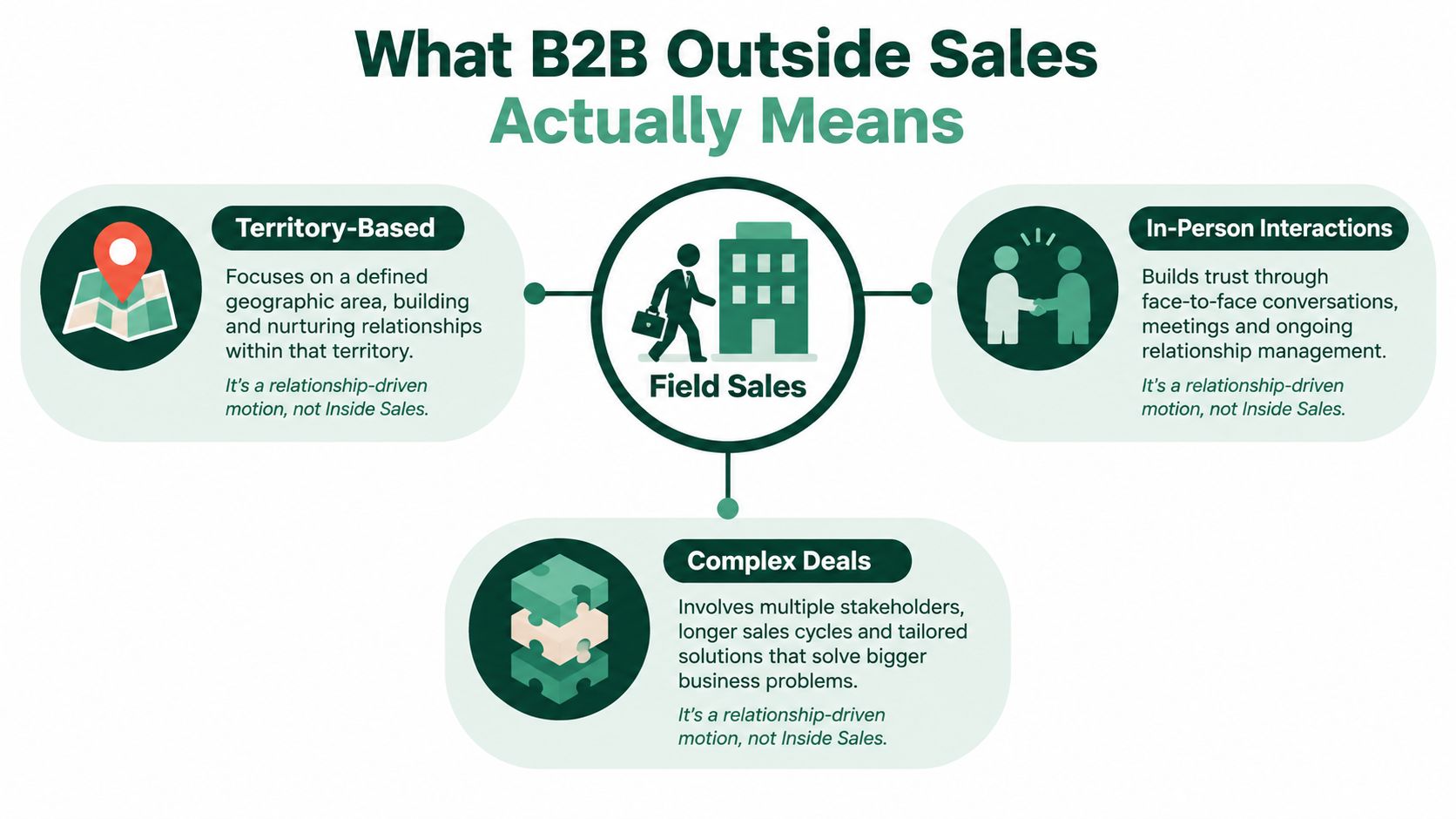
The distinction is operating model, not job title
Inside sales runs mainly through phone, email, video conferencing, and other remote channels. Outside sales assigns meaningful capacity to travel, account coverage, and access to senior stakeholders. The distinction is therefore operational, not just whether a rep leaves the office. It is a relationship- and territory-intensive channel, where territory design affects results as much as relationship quality. See this outside sales definition and operating model overview for additional terminology.
Field selling became common in complex commercial transactions because sellers needed to inspect operating environments, demonstrate products, and build trust through repeated visits. That reasoning still applies when implementation risk, technical complexity, or multi-party approval makes a remote-only process fragile.
Digital now handles early-stage discovery and qualification. Field reps become useful later, when the account needs technical validation, executive alignment, or a credible demonstration in the room.
Why the phrase gets misused
Teams often use “outside sales” as a job description and overlook the mechanics that make the motion work. A rep can spend substantial time traveling while producing weak results if the territory is poorly designed, meetings lack qualification, or the CRM does not record stakeholder alignment. The practical test is direct: does physical presence materially help the opportunity advance?
Practical rule: If the account needs only a quick response, a deck, and a pricing call, field coverage is probably wasteful. If the buyer needs validation, consensus, or proof in the room, outside sales can justify its cost.
The motion fits enterprise software, industrial products, professional services, construction, logistics, and other categories that require coordination among decision-makers. Digital prospecting fills the top of the funnel and prepares the account. In-person coverage then supports the high-trust moments where remote communication alone leaves uncertainty, such as site validation, technical review, executive consensus, or final commercial alignment.
Outside Sales vs Inside Sales Economics
Outside sales carries a higher cost because each visit requires travel, scheduling, field time, and preparation. A commonly cited benchmark places an outside-sales call at about $308, compared with roughly $50 for an inside-sales call, making the field interaction about 6.2 times more expensive. This lead-generation guide provides useful context on how demand generation feeds the sales motion. Teams can also use this guide to calculating customer acquisition cost when comparing channel economics.
Side-by-side comparison
Metric | Inside Sales | Outside Sales |
|---|---|---|
Primary motion | Remote selling through phone, email, and video | In-person selling in the field |
Average cost per call | About $50 | About $308 |
Active prospects per month | About 100–150 | About 25–40 |
Best use case | Broader, lower-friction prospecting | Fewer, more complex opportunities |
Capacity constraint | Messaging volume and follow-up discipline | Travel time and territory density |
The ranges are directional rather than universal. Geography, contract value, territory design, and sales maturity all change the calculation. B2B sales benchmarks and statistics offer broader context, but each team still needs its own account-level model.
Where the economics make sense
Field selling becomes rational when a closed account can generate substantial recurring revenue, expansion potential, or strategic credibility. It is a poor fit when the deal cannot absorb travel cost or the buying process is simple enough to complete remotely. Outside reps should therefore reserve face-to-face time for late-stage discovery, executive alignment, site visits, negotiation, and implementation planning.
Practical rule: The account value, territory shape, and buying complexity must justify the higher cost of physical engagement before field coverage is rational.
A blended team usually gives leaders more control over this trade-off. Remote channels can generate and qualify opportunities at lower cost, while field reps enter when the opportunity has enough commercial value or stakeholder risk to justify travel. Digital prospecting tools such as Instantly and Apollo can support the early stages, with field coverage triggered by account value, buying-stage signals, and the number of stakeholders who need direct alignment.
Use contribution margin, expected expansion, and travel requirements to set the handoff threshold. That decision rule prevents field capacity from being allocated by habit, seniority, or the loudest request for an in-person meeting.
Navigating the Multi-Stakeholder Buying Journey
Outside sales stays relevant because B2B buying is rarely a single-person decision. Gartner describes the journey as four concurrent buying jobs, problem identification, solution exploration, requirements building, and supplier selection, and those jobs can be handled by different people at different times. The buyer-intent guide is useful if you want to tie those stages to live outreach triggers. Buyer persona reference
Multi-thread the account, not just the contact
A field seller can't rely on one champion and hope the deal survives procurement, finance, technical review, and executive scrutiny. The account has to be multi-threaded, which means mapping business, technical, procurement, finance, and executive stakeholders, then recording who owns which buying job inside the CRM. If that sounds operational, it is. Outside sales works best when the seller knows exactly which stakeholder still needs confidence and what evidence will move them.
In-person workshops and executive meetings are useful because they compress alignment work that would otherwise drag across email threads. They're especially effective when the buyer needs to reconcile conflicting priorities, such as budget, implementation risk, and internal accountability. The point isn't to replace digital communication, it's to give the team a moment where people can challenge assumptions and resolve tension in real time.
Use field time where consensus is the bottleneck
Many teams waste visits by using them too early. If the buyer hasn't clarified the problem, identified requirements, or agreed on who decides, a trip rarely fixes that. Field meetings pay off when they help the account move from curiosity to consensus.
For that reason, the most useful outside-sales moments are usually:
Executive alignment meetings, where a senior sponsor needs to validate the business case.
Site assessments, where the seller has to understand the operating environment.
Technical workshops, where requirements need to be clarified across functions.
Procurement negotiations, where terms, risk, and scope are being finalized.
Outside sales is strongest when the seller can read the room, adjust live, and lock down next actions before the meeting ends. Digital can get the team most of the way there. Physical presence often closes the last gap when the buying committee is stuck.
Is Outside Sales Still Relevant Today
Yes, but only if you deploy it selectively. McKinsey's 2024 B2B research found that buyers divide interactions roughly equally among in-person, remote, and digital self-service channels, and in-person preference rises to 41% when evaluating a new supplier and 40% for a first-time purchase. McKinsey's B2B buying research shows the answer isn't “field or digital,” it's “which stage gets which channel.”
Where physical presence still wins
Outside sales is disproportionately useful at high-trust, high-risk, or multi-stakeholder moments. That includes executive alignment, site assessments, complex demonstrations, procurement negotiations, and implementation planning. Those are the points where a buyer needs to see the seller, challenge the plan, and decide whether the relationship can hold under pressure.
The mistake is assuming every account deserves the same travel-heavy treatment. Buyers already do a lot of the journey before sales enters, so sending a rep out too early often burns time without changing the outcome. The stronger play is stage-based coverage, where digital prospecting and qualification do the front-end work, and field coverage is reserved for the moments where trust and consensus matter most.
The hybrid model is the practical default
In practice, the best teams don't defend field sales as a tradition. They treat it as one channel inside a broader buying journey. If a prospect can be moved by email, video, and self-serve content, that should happen first. If the account needs a room full of people to agree, the rep should show up.
Field sales is relevant when presence changes the quality of the decision, not when it merely adds travel.
That framing is especially helpful for teams that worry outside sales is outdated. It isn't outdated, it's just more selective now. The seller's job is to identify the moments where showing up in person creates more trust than another remote touch ever could.
Applying Outside Sales to APAC Expansion
APAC expansion exposes the cost of treating outside sales as the default motion. Travel spans wide territories, while buying committees may sit across several markets. Use digital prospecting to narrow the field, then assign field coverage to accounts whose value, timing, and buying complexity justify it. The Social Search's outbound marketing agency overview provides an operator's view of how outreach systems are assembled.
Start with signals, not flights
Use Apollo to enrich target accounts and build sequences in Instantly so initial contact happens remotely. When accounts show stronger buying intent, Whitewhale can help prioritize field time, while HeyReach keeps LinkedIn activity aligned with email outreach. The trip becomes the final stage of a qualified sequence rather than the opening move.
For APAC, territory economics matter. A rep cannot cover a wide geography by default and still maintain enough selling capacity. Accounts that justify a visit generally combine high potential value with enough geographic concentration to support a sensible route. If either condition is absent, remote qualification usually produces a better return.
A practical deployment pattern
A workable sequence looks like this:
Build the account list with enrichment and ICP filters.
Run remote qualification to confirm timing, authority, and use case fit.
Review intent signals that show active evaluation or internal movement.
Book field meetings when the account needs consensus, demonstration, or validation.
Reserve in-person time for executive discussions, technical walkthroughs, and final alignment.
This approach makes field coverage a stage-based decision inside a hybrid buying journey. It also gives leaders a clearer way to assign territory resources: digital channels create and qualify demand, while field sellers handle the high-trust moments that can change deal confidence or stakeholder agreement.
Every flight should trace back to a named account, a confirmed buying job, and a stakeholder who needs to be in the room.
Measuring Field Sales Performance
Outside sales should be managed with field-day metrics, not just activity counts. The right measures are qualified onsite meetings per day, travel time per opportunity, opportunity value per territory, and stage conversion after face-to-face meetings. Field sales performance measurement is ultimately about whether the territory is producing enough value to justify the operating cost.
What to track in the CRM
The CRM should capture more than activity volume. It should record stakeholder role, buying-job ownership, unresolved requirements, and the next consensus action. That gives managers a way to see whether a visit advanced the deal or just consumed a day.
A practical reporting stack usually centers on:
Qualified onsite meetings per day, because raw visit counts can hide bad qualification.
Travel time per opportunity, because geography can erode capacity.
Opportunity value per territory, because not all routes deserve equal attention.
Stage conversion after face-to-face meetings, because meetings should move deals forward.
If the numbers look busy but the pipeline stalls, the problem is usually territory design, meeting quality, or stakeholder coverage. Good field sales is not about being everywhere. It's about being in the right rooms.
How leaders should read the data
Managers should compare territory density, meeting quality, and stage progression before they compare rep personality or hustle. A compact territory with strong account fit will usually outperform a dispersed one with similar prospect counts. That's why the best outside-sales leaders think like operators, not just coaches.
A rep's calendar can look full while the territory is underperforming. The difference is often where the meetings are, not how many there were.
That's the core measurement shift. Once you manage outside sales as a territory system, the higher cost of field coverage becomes visible and controllable. Without that discipline, travel just turns into a very expensive form of activity reporting.
Building a Hybrid Outbound System
The strongest B2B outbound systems treat outside sales as one part of a connected machine. ICP definition, data, messaging, send infrastructure, routing, reporting, and field coverage all need to work together. The Social Search's sales automation process reflects that same system-first mindset, and it's the right model for teams building into APAC or global markets.
What the system should do
Digital discovery should qualify the account before a rep ever books travel. Once the account shows enough fit and intent, the field motion can take over for the moments that need in-person trust. That keeps the team from wasting routes on low-value accounts while preserving the benefit of physical presence where it matters.
The tools matter, but the sequencing matters more. Use remote channels to create momentum, then use field meetings to resolve the parts of the deal that don't close well over email or video. That's how you keep ownership of the pipeline and avoid turning outside sales into an expensive habit.
A practical operating stance
The right stance is not “field first” or “digital first.” It's hybrid by design. Use digital to find and qualify, use in-person meetings to validate and close, and keep the territory tight enough that the travel cost makes sense. If you're building that system from scratch, the work should start with the account list, the signals, and the routing logic, not with a flight calendar.
The Social Search builds outbound systems that connect ICPs, data, messaging, and channel operations into one pipeline engine. If you want to design a hybrid motion that uses digital prospecting and selective field coverage without wasting travel, visit The Social Search and see how that system can be structured for your market.
