What Is B2B Sales? A Practical Guide to Process, Lead Generation, and Growth
Learn what B2B sales is, how the process works, key roles and metrics, and the lead-generation tactics behind SEO, social, ads, and AI chat.
B2B sales is simple to define and harder to execute. At its core, it means one business sells a product or service to another business, but the real job is helping a buying group move from awareness to consensus without losing trust along the way. That is why modern teams combine SEO, paid ads, social content, demos, AI chat, and strong follow-up into one revenue system instead of treating sales as a single conversation. (salesforce.com)
What is B2B sales?

B2B sales, or business-to-business sales, is when one company sells goods or services to another company. In practice, that usually means longer cycles, more touchpoints, more decision-makers, and more proof before anyone signs. Salesforce notes that B2B deals often involve presentations, product demos, negotiations, and chains of approval, which is why the sales cycle is typically longer than in consumer sales. (salesforce.com)
A good way to think about B2B sales is this: you are not just selling a product, you are selling confidence. The buyer wants to know the solution will save time, reduce risk, make money, or improve performance. That is true whether you sell software, logistics, consulting, manufacturing, or a service package. (salesforce.com)
Common traits of B2B sales include:
Multiple stakeholders. Decision-makers often include managers, department heads, finance, procurement, and senior leaders. Salesforce says stakeholders can stretch from mid-level managers all the way up to the C-suite. (salesforce.com)
ROI-driven buying. B2B buyers usually need to see the business case, not just features. They want to understand how the purchase helps the company over time. (salesforce.com)
Longer close times. More people, more review, and more internal approvals usually mean a slower decision. (salesforce.com)
Higher value relationships. B2B contracts often have recurring revenue, larger deal sizes, and a stronger focus on retention and expansion. (salesforce.com)
If your goal is lead generation, this definition matters because it changes how you attract buyers. The best B2B systems do not rely on one channel. They use content, search, social, ads, and smart follow-up to move people from curiosity to conversation. For teams building that engine, automated lead generation is often the first place to tighten the process.
B2B sales vs B2C sales
B2B and B2C both involve selling, but the buying behavior is very different.
Buyer type. B2B sells to organizations. B2C sells to individual consumers. (salesforce.com)
Decision style. B2B is usually logical, stakeholder-driven, and based on business impact. B2C is often faster and more personal. (salesforce.com)
Sales cycle. B2B cycles are generally longer because the buyer needs more internal approval and more evidence. B2C is usually shorter and simpler. (salesforce.com)
Deal size. B2B often involves larger contracts, recurring commitments, and customized pricing. (salesforce.com)
Channels. In B2B, buyers move between in-person meetings, remote calls, chat, self-service, and digital research. McKinsey describes this as a roughly even mix of traditional, remote, and self-service channels. (mckinsey.com)
The practical takeaway is that B2B sales needs more education, more trust-building, and more alignment across channels. That is why the best campaigns often pair search visibility with LinkedIn, email, chat, and retargeting instead of betting everything on one touchpoint. (mckinsey.com)
What the modern B2B buyer journey looks like
B2B buyers rarely move in a straight line anymore. They research on their own, compare vendors, read content, ask colleagues, and bring more people into the decision before they ever talk to a rep. LinkedIn says B2B buyers are doing their homework and leaning on trusted creator content to validate decisions, while Gartner found that 74 percent of B2B buyer teams showed unhealthy conflict during the buying decision process. (linkedin.com)
That matters for lead generation because it changes the content you need at each stage:
Awareness. Buyers want educational content, not a hard pitch.
Consideration. Buyers compare approaches, pricing, and proof.
Evaluation. Buyers look for demos, case studies, ROI, and implementation details.
Consensus. Different stakeholders need different proof, from budget impact to technical fit. Gartner says tailoring content to the buying group improves consensus, while one-size-fits-one messaging can actually create conflict. (gartner.com)
This is why modern B2B content should answer the questions buyers are already asking. The strongest pages usually cover pain points, outcomes, integrations, pricing logic, implementation, and social proof. If you want to support that journey, automated social media can keep your brand visible while your sales team focuses on the highest-intent conversations.
The B2B sales process from first touch to close
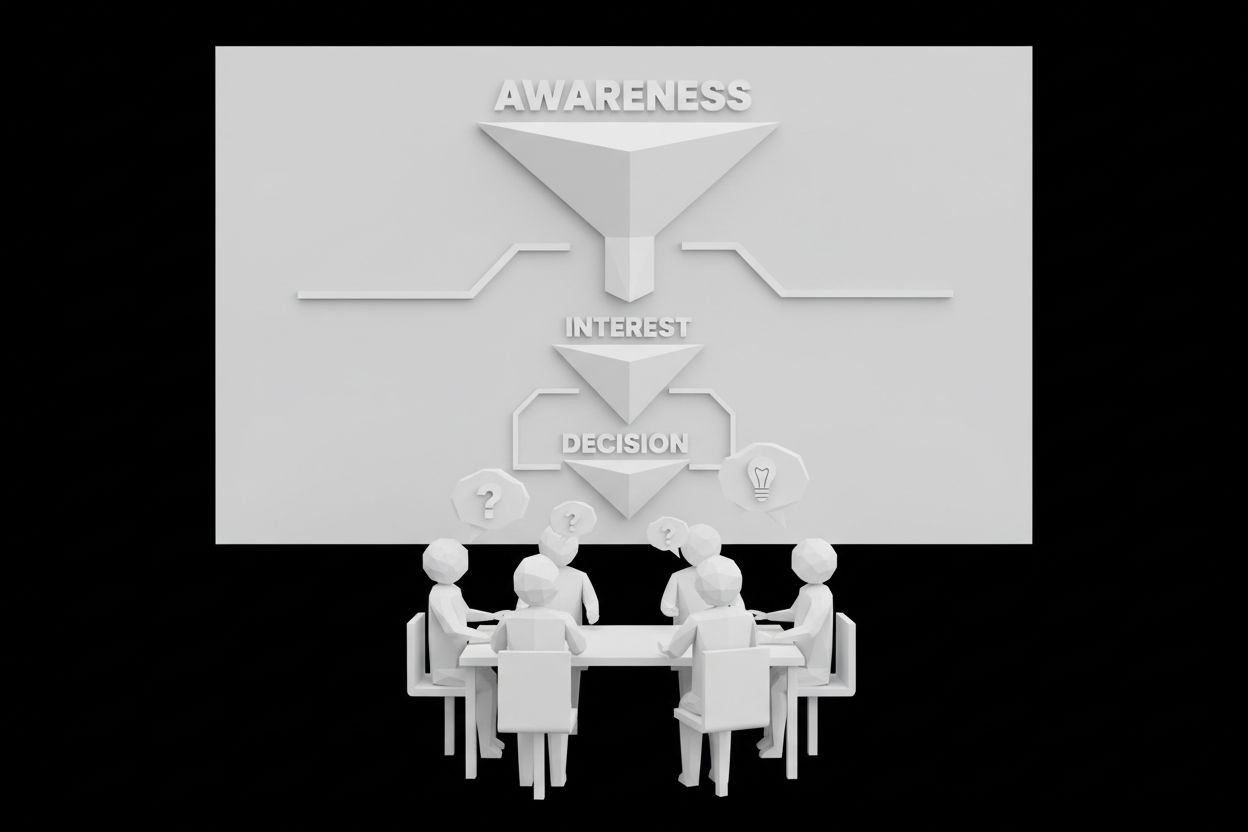
Salesforce breaks the B2B sales process into lead generation, qualification, needs assessment, proposal, negotiation, and close. In a real team, those stages often overlap, but the sequence stays the same: attract, qualify, diagnose, present, resolve objections, and close. (salesforce.com)
1. Prospecting and lead generation
This is where sales and marketing create demand. A prospect might come from organic search, paid ads, social media, referrals, outbound outreach, or a chat conversation on the website. Salesforce notes that lead generation can come from ads that attract interested prospects or from outreach based on research. (salesforce.com)
2. Qualification
Not every lead should become a sales opportunity. The goal here is to decide whether the company is a fit, whether there is a real problem to solve, and whether the timing makes sense. This is where a fast response matters. If your site gets inbound interest, automated AI chat agents can answer common questions, qualify basic intent, and book meetings before the lead goes cold. Salesforce says AI agents can handle questions, objections, and scheduling, which helps sellers focus on deeper conversations. (salesforce.com)
3. Discovery
Discovery is where you learn the real business case. Ask about the trigger, the current process, the cost of inaction, the buying committee, and what success looks like. The best discovery calls sound more like a diagnosis than a pitch.
Helpful discovery call questions:
What triggered the search now?
What is not working with the current setup?
Who else needs to weigh in?
What does a good result look like in 90 days?
What proof will matter most to your team?
4. Demo or workshop
A good demo is not a product tour. It shows the buyer their future workflow, their likely objections, and the business outcome they care about most. For complex deals, a workshop often works better than a polished demo because it feels collaborative and specific.
5. Proposal and business case
At this point, the buyer wants specifics. That includes scope, pricing, timeline, implementation, and expected return. If the deal is important, this is also where you should provide case studies, comparison notes, and a clear next step.
6. Negotiation and procurement
This stage can stretch longer than expected because legal, finance, security, and procurement often step in late. The smoother your internal documentation is, the faster this stage moves.
7. Close and handoff
The sale is not finished when the contract is signed. In B2B, onboarding and adoption are part of the sale because expansion and retention depend on early success.
A simple way to improve this process is to make every stage measurable. If a lead is qualified, document why. If a deal stalls, note the blocker. If a close fails, record the reason. That discipline makes the next round of prospecting much smarter.
Types of B2B sales with real-world examples
B2B sales shows up in many industries, but the core logic is the same: a business needs something that helps it operate better, sell more, or reduce risk. Salesforce highlights SaaS as a classic B2B example and notes that B2B purchases can include software used to improve operations or customer experience. (salesforce.com)
Common B2B sales categories include:
SaaS and software. CRM, analytics, marketing automation, security, and workflow tools.
Manufacturing and suppliers. Components, raw materials, equipment, and industrial parts.
Wholesalers and distributors. Bulk goods sold to retailers or businesses.
Agencies and professional services. Marketing, design, accounting, legal, and consulting.
Healthcare and finance providers. Tools and services that support compliance, operations, or customer service.
Government and nonprofit purchasing. Organizational buying for public or mission-driven work. (salesforce.com)
The buying motion changes a little by industry, but the structure is the same. A SaaS buyer may ask for integrations and onboarding support. A manufacturing buyer may care more about reliability and supply terms. An agency buyer may care about speed and measurable outcomes.
The roles inside a B2B sales team
Most B2B teams are not built around one person doing everything. Salesforce says common B2B sales roles include SDRs, BDRs, account executives, account managers, and sales engineers. BDRs and SDRs usually generate and qualify leads, account executives close deals, and account managers or customer success teams handle the relationship after the sale. (salesforce.com)
Here is the practical version:
SDR or BDR. Finds prospects, qualifies interest, and books meetings.
Account Executive. Runs discovery, demos, proposal, and close.
Sales Engineer. Handles technical questions and product fit.
Account Manager or CSM. Protects the relationship and expands the account.
Sales Leader. Keeps the pipeline clean and the forecast realistic.
That structure matters because handoffs fail when roles are unclear. If your team is small, one person may wear several hats. If your team is larger, the process works best when each role knows exactly when to step in and what success looks like.
Metrics that tell you whether the pipeline is healthy
A B2B sales team should not guess whether things are working. It should measure them. HubSpot says a sales dashboard can track pipeline value, win rate, revenue, and activity in one place. It also gives a useful pipeline velocity formula: Sales Velocity = (Number of Opportunities x Deal Value x Win Rate) / Length of Sales Cycle. HubSpot also defines CAC as spending divided by customers acquired. (blog.hubspot.com)
The most useful B2B sales metrics are:
Conversion rate. How many leads become opportunities.
Win rate. How many opportunities become customers.
Sales cycle length. How long it takes to close a deal.
Average deal size. How much revenue each closed deal brings.
Pipeline velocity. How quickly revenue moves through the funnel. (blog.hubspot.com)
CAC. How much it costs to acquire a new customer. (blog.hubspot.com)
Retention and expansion revenue. How much value existing customers add over time.
If you want a better way to centralize those numbers, our guide to what CRM in marketing is is a useful next read because the CRM is where lead history, deal notes, and follow-up discipline come together.
B2B sales strategies that actually work now

The best B2B sales strategies are usually not the loudest ones. They are the ones that make it easier for buyers to trust you, compare you, and say yes with confidence.
Sell to the buying group, not just the champion
Gartner found that buyer teams often contain conflict, which means the same message will not work for everyone. A good sales motion creates different proof points for the champion, the economic buyer, the technical evaluator, and procurement. (gartner.com)
Align marketing and sales around the same accounts
Salesforce says alignment means both teams share goals, target accounts, customer data, and budget. That is not a nice-to-have. It is what keeps lead gen from becoming a pile of disconnected leads. (salesforce.com)
Use content and social proof to build trust
LinkedIn says B2B buyers are influenced by content, prefer credible voices, and use social media to make purchasing decisions. That is why case studies, short videos, expert posts, and founder content can be so effective in the middle of the funnel. (linkedin.com)
Show up across channels
McKinsey found that B2B buyers use a mix of traditional, remote, and self-service channels at each stage of the buying process. If a buyer sees you in search, on LinkedIn, in email, in chat, and in retargeting, you feel familiar when the deal gets serious. (mckinsey.com)
Use AI to reduce response time
Salesforce says AI sales tools can automate non-selling tasks like inbound nurturing, outreach, scheduling, and CRM-based responses. Its AI agents can also answer questions, manage objections, and book meetings, which is especially useful when a lead comes in after hours or from a paid campaign. (salesforce.com)
Keep your demand engine connected
If you are running Meta or TikTok ads, the goal is usually not to close on the first click. It is to capture attention, retarget engaged visitors, and move them into a conversation. That is where paid ads management, automated social media, and lead generation and marketing automation work best together.
Common mistakes in B2B sales
The fastest way to lose a B2B deal is to make the buyer do too much work.
Common mistakes include:
Poor qualification. Chasing leads that will never buy.
Feature dumping. Talking about product details before the business problem.
Single-threaded deals. Building a relationship with only one contact.
Weak follow-up. Letting a good conversation go cold.
Messy CRM data. Losing context between marketing, sales, and customer success.
Overusing cold outreach. Ignoring the trust-building power of search, content, and social.
Skipping proof. Not bringing case studies, ROI logic, or implementation clarity.
A lot of these mistakes are avoidable if you treat sales as a system. Buyers research across channels, so your follow-up, proof, and content should be easy to find and easy to trust. (mckinsey.com)
How B2B sales is changing in 2026 and beyond
The future of B2B sales is less about pressure and more about orchestration. AI is already helping teams automate manual work, improve forecasting, and prioritize the right deals. Salesforce says AI is shaping forecasting, territory management, pipeline optimization, and other parts of the sales process. (salesforce.com)
At the same time, buyers are still moving between channels. McKinsey says buyers continue to use a mix of face-to-face, remote, and self-service interactions, and many still want real-time service and consistent experiences across channels. (mckinsey.com)
LinkedIn’s latest research also shows that B2B buyers are increasingly consuming creator-led content, using it to validate ideas, understand solutions, and justify decisions. That means the best sales teams will work closely with content, social, and demand generation, not outside of them. (linkedin.com)
If you want the next step to be easier, build a system that does three things well:
Captures demand through SEO, social, and ads.
Qualifies demand quickly with forms, chat, and routing.
Converts demand through human follow-up, useful proof, and a clear next step.
That is where AI, automation, and good sales process start to pay off together. If you are putting that stack together now, automated lead generation and automated AI chat agents are two of the most practical building blocks.
FAQ
What is B2B sales in simple terms?
It is selling a product or service from one business to another business, usually through a longer and more consultative buying process. (salesforce.com)
What is the difference between B2B sales and B2B marketing?
B2B marketing creates and captures demand. B2B sales qualifies that demand, runs discovery, presents the solution, and closes the deal. Salesforce says the two work best when they share goals, target accounts, and customer data. (salesforce.com)
What channels work best for B2B lead generation?
Usually a mix of search, content, social, email, chat, webinars, and direct outreach works best. McKinsey’s omnichannel research shows buyers move across traditional, remote, and self-service channels, so no single channel is enough on its own. (mckinsey.com)
How do you know if your B2B sales process is working?
Track pipeline velocity, win rate, CAC, sales cycle length, average deal size, and retention or expansion revenue. HubSpot recommends using a dashboard to keep those numbers visible and actionable. (blog.hubspot.com)
B2B sales works best when it is built like a system. Search, social, ads, chat, and sales follow-up should all support the same buyer journey. If you want to make that easier to manage, connect your content, CRM, and automation first, then refine the scripts, demos, and follow-up that turn attention into revenue.