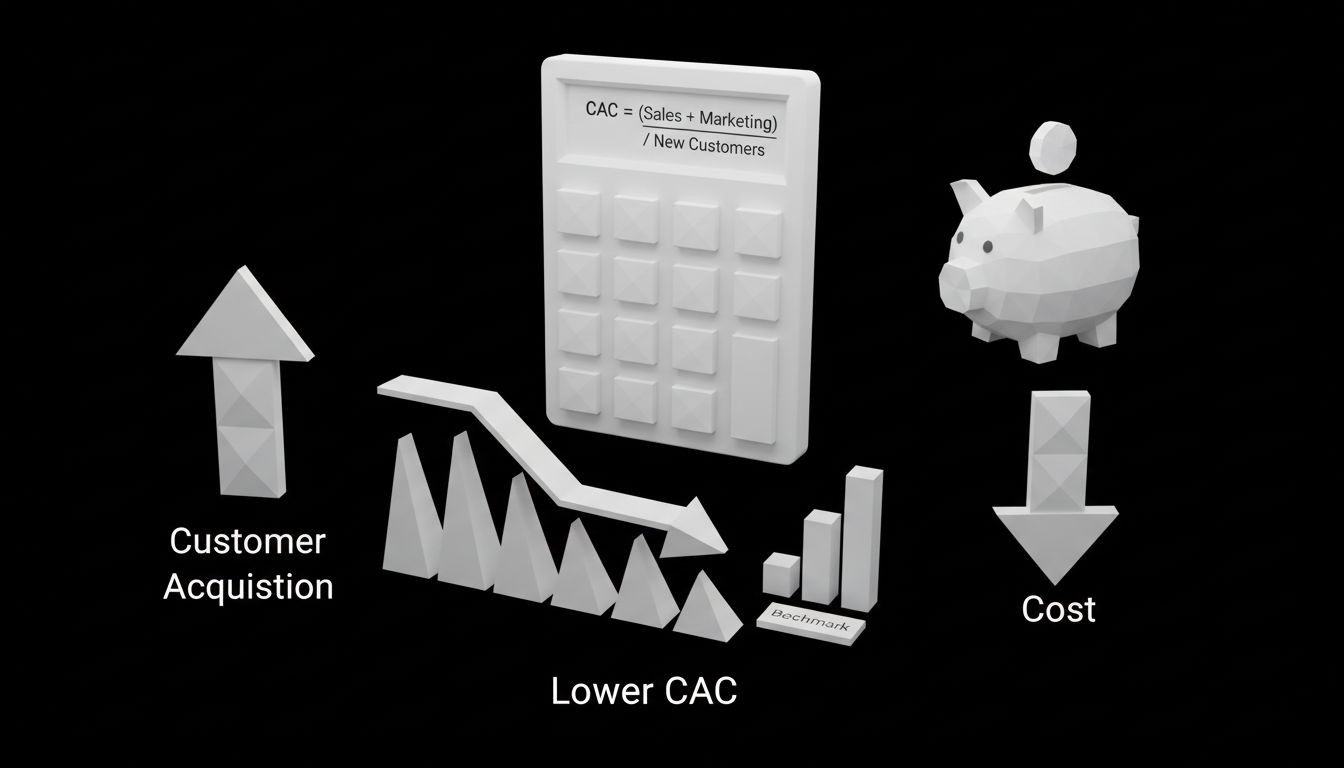
Customer Acquisition Cost Formula: How to Calculate, Benchmark, and Lower CAC
Learn the customer acquisition cost formula, step-by-step calculations, industry benchmarks, mistakes to avoid, and proven tactics to lower CAC for growth.
Every dollar you spend on marketing and sales should be tracked and evaluated. The customer acquisition cost formula gives you a clear number to compare against lifetime value, campaign performance, and investor expectations. This guide explains the formula, walks through real examples, highlights common mistakes, and shows how modern tools like AI chat agents and targeted social ads can lower CAC and improve ROI.
What is customer acquisition cost and why it matters

Customer acquisition cost, or CAC, measures how much it costs your business to gain a single new customer over a chosen period. It is a core unit economics metric. If CAC is higher than what a customer is worth to your business, growth becomes expensive or unsustainable.
Why CAC matters now
Investors and boards track CAC to understand scalability and capital efficiency.
Marketing teams use CAC to compare channel performance across ads, organic, social, and partnerships.
Product and customer success teams connect CAC to retention and lifetime value to prioritize product improvements.
Core definition in one line
Customer acquisition cost is the total sales and marketing spend divided by the number of new customers acquired in the same time period. The next sections unpack each part and show how to apply the customer acquisition cost formula in real situations.
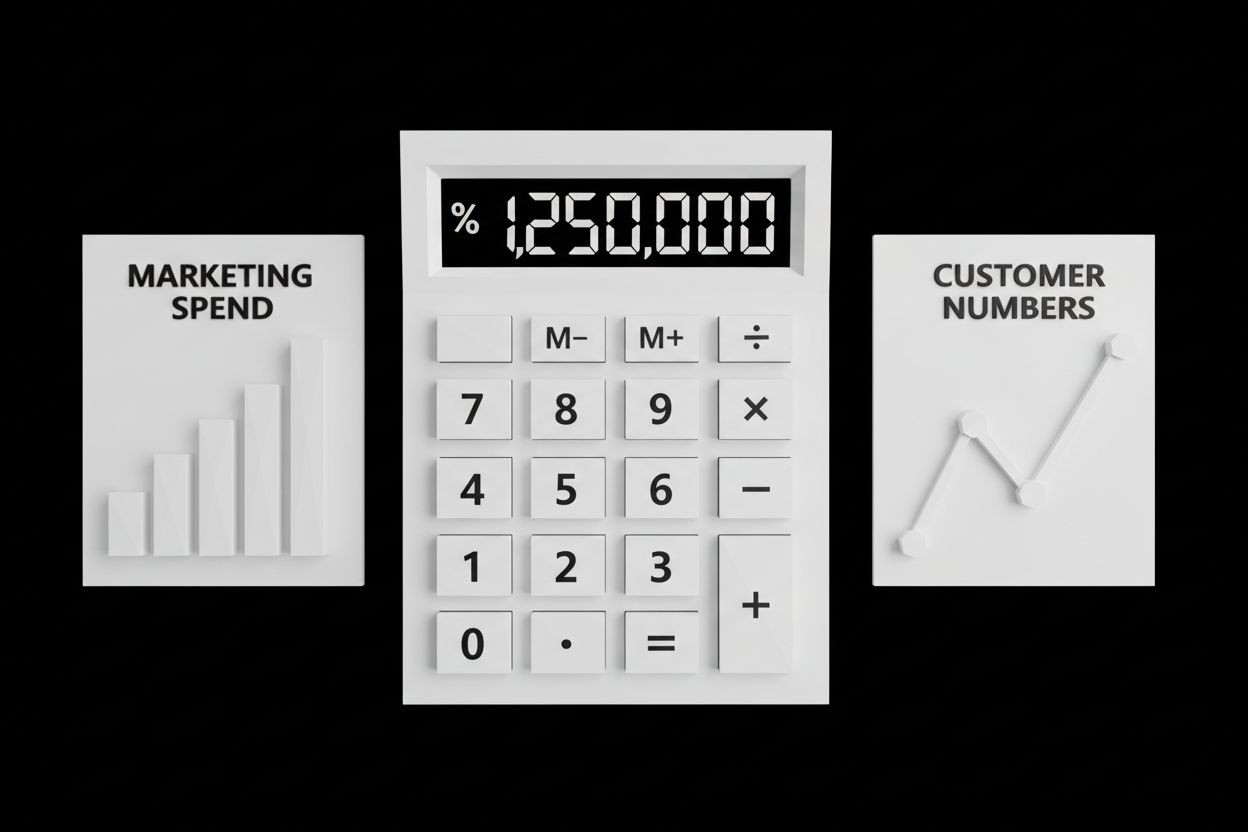
How to calculate CAC - the customer acquisition cost formula
Step 1 - Choose a time period
Decide whether you want monthly, quarterly, or annual CAC. Early-stage startups often track monthly CAC to react quickly. Mature businesses prefer quarterly or annual CAC for smoother trends.
Step 2 - Add up all acquisition costs
Include direct and indirect expenses related to sales and marketing for that period. Typical items to include:
Paid media spend (Meta, TikTok, Google, programmatic)
Agency and creative costs
Salaries and commissions for the marketing and sales teams
Tools and subscriptions used to acquire customers (ad tracking, analytics)
Content production and influencer fees when used specifically for acquisition
Overhead allocation tied to marketing and sales functions
Do not include customer success or retention costs unless those teams directly assist in acquiring customers for that period.
Step 3 - Count new customers
Count only net new customers acquired during the same period. Avoid mixing renewals or upgrades unless your business model treats them as new customers.
Step 4 - Apply the formula
customer acquisition cost formula:
(Total Sales and Marketing Expenses) / (Number of New Customers)
Example
If your company spent $120,000 on marketing and sales in a quarter and acquired 600 new customers, your CAC is:
$120,000 ÷ 600 = $200 per customer
This number becomes meaningful when compared to LTV and channel benchmarks.
What to include and what to exclude in CAC
Common inclusions
Ad spend on Meta and TikTok campaigns focused on conversion
Landing page and conversion rate optimization tools
Sales team commissions tied to new customer bookings
Creative and production costs for acquisition campaigns
Common exclusions
Support and retention team salaries
Costs for existing customer upgrades unless they drive new customer acquisition
Infrastructure costs unrelated to acquiring customers
Avoid timing mismatches by aligning expenses and customer counts to the same period. Attribution windows and cross-channel attribution can cause differences, so document your rules and stick to them.
Variations of CAC to track
New CAC: CAC for only brand new customers during the period
Blended CAC: CAC that mixes new and returning customer acquisition costs
Channel CAC: CAC calculated per channel such as Meta ads, TikTok, organic search, paid search, referral
Cohort-based CAC: CAC for customers acquired during a specific campaign or month, tracked over time
Tracking multiple CAC variants helps you answer questions like which channel brings the cheapest customers and which cohorts produce the highest long-term value.
Industry benchmarks and CAC by business stage
Benchmarks vary a lot by industry and model. Use these as starting points, not rules. Your product pricing, sales cycle length, and lifetime value will shape acceptable CAC.
Estimated CAC ranges by industry (approximate)
B2B SaaS: $500 to $5,000 per customer depending on ACV and sales motion
Consumer ecommerce: $10 to $150 per customer based on average order value
Mobile apps and games: $1 to $10 for non paying users, $2 to $50 for paying users depending on monetization
Marketplace platforms: $50 to $500 depending on take rate and onboarding complexity
CAC by business stage
Startup / pre-product market fit: CAC is typically high and volatile. Expect negative unit economics while optimizing product market fit.
Growth stage: Focus on lowering CAC and improving LTV:CAC ratio to attract growth capital.
Mature: CAC stabilizes. Emphasis shifts to retention, cross-sell, and predictable payback periods.
What is a good CAC - LTV and the 3:1 rule
CAC is only useful when compared to customer lifetime value, or LTV. A common benchmark is an LTV:CAC ratio of 3:1. This means the lifetime value should be about three times your acquisition cost.
Other useful measures
CAC payback period - how long it takes to recover CAC from gross margin on recurring revenue
LTV:CAC by cohort - helps show whether early customers are more valuable than later ones
Context matters. A 3:1 ratio is a guideline. High-growth companies may accept 1:1 or 2:1 temporarily if CAC payback is fast and growth is strategic.
Common calculation mistakes and attribution pitfalls
Mistake 1 - Mixing periods
Including marketing spend from one month and customers from another month can distort CAC. Keep periods aligned.
Mistake 2 - Bad attribution rules
Over-attributing conversions to brand campaigns or the last click can hide true channel performance. Decide on multi touch attribution or last touch and document it.
Mistake 3 - Including retention costs
Including customer success costs inflates CAC. Track retention costs separately and combine later for unit economics analysis.
Mistake 4 - Ignoring cohort effects
A campaign that produces low immediate revenue may attract high LTV customers. Evaluate cohorts over time before passing final judgment.
Advanced CAC metrics and segmentation
CAC by customer segment. Calculate CAC for enterprise customers, SMBs, and consumer segments separately.
CAC by product line. When you sell multiple products, allocate acquisition spend to calculate product-level CAC.
Cohort CAC. Track CAC for customers acquired in the same month across their lifecycle.
CAC efficiency score. Ratio of revenue growth to sales and marketing spend. Useful for board reporting.
These advanced views reveal whether a channel is expensive overall but efficient for your highest value customers.
Tools and automation for tracking CAC
Modern stacks make CAC tracking repeatable and near real time. Key tools and integrations include:
CRM with opportunity tracking and closed won data
Ad platforms (Meta and TikTok) linked to your attribution and analytics layer
Analytics platforms that support cohort analysis and LTV modeling
Automation and chat agents that qualify leads before they reach sales
If you use AI chat agents to pre-qualify leads, you can reduce wasted sales time and lower CAC. Learn more about deploying AI chat agents for lead qualification in this guide on automated AI chat agents: Automated AI Chat Agents - The Social Search.
Other useful integrations and services include automated lead generation tools and automated social media to feed consistent demand. See how automated lead generation works: Automated Lead Generation - The Social Search and how automated social media supports ongoing demand: Automated Social Media - The Social Search.
How to reduce CAC - practical strategies that work
Improve conversion rates
Small lifts in conversion rates reduce CAC directly. Run A B tests on landing pages, optimize ad creative for clarity, and use stronger calls to action.
Reallocate to high-performing channels
Compare channel CACs and shift budget toward channels with better LTV:CAC. Use experiments on Meta and TikTok to find scalable creative that resonates.
Use AI for qualification and personalization
AI chat agents can answer questions, pre qualify visitors, and schedule demos. This reduces sales time per closed deal and lowers CAC. Pair chat with retargeting to move prospects through the funnel.
Increase average order value and upsell
Bundling, recommended products, and cross sell campaigns increase revenue per customer which improves LTV:CAC.
Improve onboarding and retention
Lower churn makes acquisition spend go further. Invest in onboarding sequences, email campaigns, and customer success touchpoints.
Optimize creative and messaging for platforms
Creative that works on Meta may not perform on TikTok. Test vertical short video creative on TikTok and carousel or collection ads on Meta. Better creative reduces cost per conversion.
Reduce waste with better audience targeting and negative keywords
Tighter targeting and excluding irrelevant audiences reduces wasted spend. Use data from CRM segments to build lookalike audiences for higher intent prospects.
Automate reporting and experiment reproducibility
Standardize metrics and dashboards so learnings get applied quickly across campaigns and channels. Tools for automated reporting help scale what works.
If you need help managing ads to control CAC while scaling, consider professional paid ads management: Paid Ads Management - The Social Search.
Channel examples with numbers
Example 1 - DTC ecommerce on Meta
Monthly ad spend: $30,000
Creative and production: $3,000
Marketing salaries allocation: $7,000
New customers acquired: 2,000
Total CAC = ($30,000 + $3,000 + $7,000) / 2,000 = $20 per customer
Example 2 - B2B SaaS with inbound and SDRs
Paid search and content: $50,000
SDR salaries and commissions: $80,000
Marketing ops and tools: $10,000
New customers (net new logos): 100
Total CAC = ($50,000 + $80,000 + $10,000) / 100 = $1,400 per customer
These examples show why context is everything. A $1,400 CAC can be excellent for an enterprise SaaS product with $30,000 average contract value.
Red flags and when CAC is dangerously high
Watch for these warning signs
CAC steadily rising while LTV remains flat
CAC payback period longer than 12 months for subscription-based businesses
Marketing spend increases but new customers do not follow
Channel concentration: relying on a single channel for the majority of customers
If you see these signs, prioritize quick wins like conversion rate optimizations and short payback initiatives such as trial offers or time-limited discounts.
Case study - anonymized before and after
Company X is a mid stage ecommerce brand. Problems identified:
High CAC on paid social
Low repeat purchase rate
Actions taken
Implemented AI chat on the site to answer product questions and reduce returns
Launched a post purchase cross sell campaign that increased AOV by 18 percent
Improved landing page flow and cut page load time which increased conversion by 12 percent
Results after 6 months
CAC fell from $45 to $32
LTV:CAC improved from 2:1 to 3.2:1
Monthly growth rate remained positive while marketing spend stabilized
This case shows how combining retention, automation, and conversion optimization lowers CAC sustainably.
Integrating CAC into financial models and forecasting
To plan for growth, integrate CAC into your financial model by:
Forecasting CAC per channel based on historical trends and planned optimizations
Modeling LTV by cohort and applying expected churn improvements
Running scenarios where CAC rises or falls and measuring cash runway impact
Track CAC payback period to know how much capital you need to fund growth and when new spend becomes self sustaining.
For a deeper look at CRM strategy that supports CAC tracking and automation, read this guide: What Is CRM in Marketing: A Complete Guide to Strategy, Automation, AI, and Growth - The Social Search.
Quick CAC checklist for immediate action
Align period for spend and customer counts
Break down CAC by channel and cohort
Test creative and micro conversions often
Add AI chat to reduce wasted sales time
Improve onboarding to raise LTV and shorten payback
Automate reporting to apply learnings quickly
If you want an end to end approach that includes automated social content, lead generation, and conversion optimization, learn about our services: Automated Social Media - The Social Search and Automated Lead Generation - The Social Search.
Conclusion and next steps
The customer acquisition cost formula is simple, but accurate measurement and ongoing optimization require discipline. Track CAC by channel and cohort, compare it to LTV, and prioritize experiments that reduce acquisition cost or increase value per customer. Use AI-driven qualification, targeted social ads on Meta and TikTok, and strong onboarding to achieve sustainable growth.
Ready to lower CAC and scale efficiently? Start by mapping your current CAC calculation, run a cohort analysis for the last six months, and pilot one experiment that aims to reduce payback period within 90 days. If you need help getting started, contact an expert in paid media and automation who can build a measurable plan and run tests quickly: Paid Ads Management - The Social Search.