10 Outbound Marketing Agency Options for APAC
Compare 10 outbound marketing agency options for APAC and global outreach, with services, trade-offs, case studies, and a selection checklist.
The popular advice is to find an outbound marketing agency with the biggest service menu. That’s usually the wrong starting point. The decision is which operating model matches your growth motion: a system-building consultancy, managed SDR capacity, specialist regional coverage, calling-led execution, or broader sales-and-marketing support.
That distinction matters more in APAC, where market entry involves local timing, language, data quality, channel preferences, and handoff discipline. An agency can produce activity without producing usable pipeline. This list compares ICP and data ownership, channel mix, APAC reach, reporting, pricing clarity, client ownership, case-study relevance, and follow-up responsibilities. Public performance claims are treated as signals to validate during procurement, not as proof that a program will work for your company.
Outbound remains economically relevant because email became a major commercial communication medium in the 1990s, and benchmark data still reports average open rates around 20.73% to 21.5%, with wide variation by industry. B2B services reached 39.48% in one benchmark set, while SaaS reached 21.3% in another, supporting a practical conclusion: segmentation, deliverability, and message relevance matter more than sending volume alone. Benchmark data on email marketing performance helps establish a baseline, while teams that need to find new clients with reporting should connect activity to pipeline rather than stop at opens or booked meetings.
Table of Contents
1. The Social Search
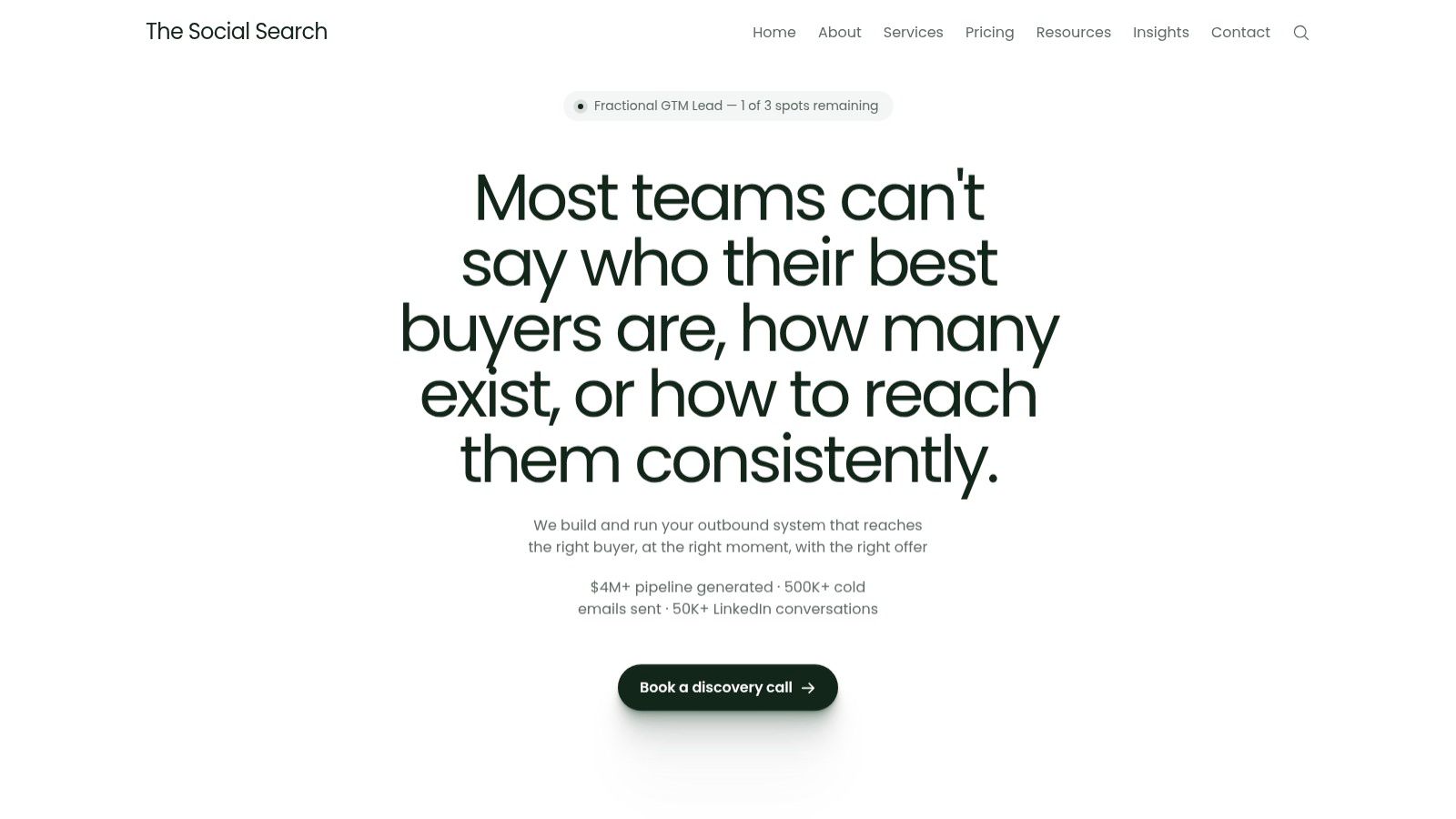
The Social Search operates as a GTM engineering consultancy, rather than a conventional appointment-setting vendor. Its model connects ICP definition, account prioritisation, offer and messaging development, email and LinkedIn sequencing, deliverability, signal-based prospecting, routing, sales enablement, and pipeline reporting. That integrated scope is relevant to B2B teams entering APAC or coordinating outbound across global markets, where ownership and handoff quality can matter as much as activity volume.
The main distinction is what remains with the client. The work is designed for handover, with clients retaining infrastructure, documentation, and playbooks, or for continuation through an embedded fractional GTM Lead or Engineer. The company describes typical builds as going live in about three weeks, with early outreach starting in the first month. These are company-reported timelines, so procurement should test them against data readiness, approval cycles, CRM configuration, and regional adaptation needs.
Where the model fits
This approach fits a B2B team that has an outbound motion but lacks a dependable operating layer. The stated scope includes ICP and list building, messaging changes based on live replies, automated email and LinkedIn outreach, buying signals, routing, light SEO, sales-representative enablement, and a shared dashboard. The system may include Instantly for cold email, deliverability, warming, and sequencing, HeyReach for LinkedIn outreach, Apollo for data enrichment, Trigify for social signals, and Whitewhale for intent signals.
The company reports $4M+ in generated pipeline, 500K+ cold emails sent, and 50K+ LinkedIn conversations on its site. These figures indicate reported operating history, not expected client outcomes. Its published commercial range runs from a one-time build around $500 to a managed function near $10,000 per month, alongside a stated target of approximately 8 to 12 qualified meetings per month by day 90 on a dialled-in list. Each figure should be tested in the statement of work, including the definition of a qualified meeting, attribution rules, and client responsibilities.
The practical advantage is infrastructure ownership and clearer attribution, not a promised meeting count.
The trade-off is specialisation. This is an outbound-first partner for B2B offers where a qualified conversation can support the operating cost. Smaller transactional businesses, or teams seeking full brand, paid media, and inbound coverage, may require other providers. Clients still own response speed, opportunity qualification, sales conversations, and revenue close.
2. CIENCE
CIENCE offers a managed outbound SDR model built around research, AI-assisted personalisation, and multi-channel execution across email, phone, and LinkedIn. It’s aimed at teams that want to launch without recruiting and managing an internal SDR organisation.
The delivery model is more capacity-led than system-transfer-led. CIENCE supplies trained SDR teams, onboarding, supervision, appointment setting, and campaign orchestration. It also presents an SDR talent or marketplace option for companies that want staffing at pass-through cost rather than a fully managed program.
CIENCE publicly positions early results around 30 days, a claim that should be tested against the client’s ICP clarity, list approvals, technical setup, and meeting definition. A month-to-month structure can reduce commitment risk for a market-entry experiment, but it doesn’t remove execution risk. Fast deployment can still produce weak meetings if the agency and client disagree about personas, buying triggers, or qualification.
For teams comparing delivery models, the key question is whether CIENCE owns the operating system or mainly supplies managed SDR capacity. Ask who controls the data, sequence logic, messaging changes, CRM records, and learning archive if the engagement ends. The outsourced SDR services perspective is useful context for separating staffing from broader outbound system design.
Pros
Fast launch: The company’s public positioning emphasises early meetings around the first month.
Channel breadth: Email, phone, and LinkedIn allow testing beyond a single channel.
Flexible commitment: Month-to-month terms can suit a controlled market test.
Staffing option: The talent marketplace may suit teams that want SDR capacity closer to an internal model.
Cons
Pricing complexity: Setup, platform, and SDR-capacity components can make like-for-like comparison difficult.
Quality dependence: Results depend heavily on SDR assignment, client oversight, and message-market fit.
Handoff risk: Procurement should define data access, CRM ownership, qualification, and follow-up responsibilities.
3. Belkins
Belkins is a broad B2B lead-generation and appointment-setting provider with an end-to-end orientation. Its stated scope runs from ICP and list development through copy, sending, inbox and reply management, and meeting handoff. Email and LinkedIn sequencing sit alongside phone outreach and demand-generation strategy.
That breadth makes Belkins a reasonable fit for a buyer that wants a mature playbook rather than a narrow test of one channel. Vertical experience and a substantial case-study footprint can help procurement teams investigate relevance, provided they examine similarities in deal size, buyer role, geography, sales cycle, and offer complexity rather than relying on aggregate social proof.
A useful diligence question is whether the agency’s inbox management and qualification process remain consistent across regions. APAC programs often need local working hours, market-specific messaging, and clear escalation rules. A generic omnichannel sequence may be operationally complete while still feeling poorly adapted to Singapore, Australia, Japan, or other target markets.
The cold email outreach agency guide provides a useful comparison point for examining deliverability, list quality, and message iteration instead of evaluating copy in isolation.
Pros
Full-funnel coverage: ICP work, list building, messaging, sending, reply handling, and handoff can sit with one partner.
Vertical playbooks: Industry familiarity may shorten the learning curve for established B2B categories.
Omnichannel execution: Email, LinkedIn, and phone support coordinated outreach.
Evidence base: Public case studies give buyers material to investigate, although relevance still needs verification.
Cons
Limited price visibility: Buyers should expect a scoped commercial conversation.
Potential overreach: A broad program may be inefficient for a narrowly defined single-channel experiment.
Regional questions: Ask for the actual APAC team, working hours, language capability, and approval process.
4. Martal Group
Martal Group positions itself around onshore SDRs and sales executives, with omnichannel outbound across email, LinkedIn, and phone. Its strongest apparent fit is a North American-focused go-to-market motion where buyers value local delivery and want an external team to act as an extension of sales.
The model goes beyond simple appointment setting. Martal describes support for discovery and demos, fractional sales assistance, AI-supported optimisation, and intent signals. That can help a company that needs more than top-of-funnel activity, but the buyer should define exactly where the agency’s responsibility ends. Booking a meeting, conducting discovery, progressing an opportunity, and closing a deal require different skills and different success measures.
International reach is part of the positioning, with plays for areas such as MSP and ecommerce. APAC buyers shouldn’t infer regional depth from international language alone. Request named coverage by country, the expected time-zone overlap, localised messaging ownership, and examples involving comparable buying committees.
The main trade-off is the same one found in many managed SDR programs. Technology can improve testing and routing, but it doesn’t compensate for an unclear ICP or weak offer. The scope and cost also require discovery because public pricing is limited.
Martal is therefore a candidate for companies prioritising onshore sales execution, particularly in North America. It’s less obviously suited to a team whose main need is a transferable outbound infrastructure layer for multiple APAC markets.
5. Operatix
Operatix focuses on outsourced SDR and marketing acceleration for B2B software vendors. Its stated coverage includes North America, EMEA, LATAM, and APAC, with multilingual and region-aware delivery. That makes it one of the more directly relevant options for software companies planning coordinated market entry rather than a single-country campaign.
The provider describes a large SDR organisation, with 300+ SDRs supporting international coverage. That figure is company-reported and indicates potential capacity, not guaranteed seniority or dedicated attention for a particular account. Procurement should ask how many people will work on the program, who manages them, how quality assurance operates, and whether regional capacity is assigned permanently or drawn from a broader pool.
Operatix’s specialisation in complex B2B technology and SaaS buying centres is important. Enterprise software campaigns often require multiple personas, technical validation, business-case messaging, and longer handoffs than simple lead capture. Its ability to support outbound SDR, inbound qualification, and marketing acceleration may suit a business that needs coordinated coverage across several stages.
The company sits under memoryBlue ownership, so buyers should evaluate how that relationship affects tooling, staffing, reporting, escalation, and commercial governance. Ownership can create operational scale, but it can also make the actual delivery structure harder to understand.
For teams assessing go-to-market consulting, Operatix is strongest where complex B2B software, multilingual execution, and regional expansion outweigh the need for public pricing or a lightweight pilot.
6. SalesHive
SalesHive fits a calling-heavy outbound motion more closely than a channel-neutral program. Its stated model uses US-based SDR teams and an in-house platform for scripts, data, and reporting, with cold calling and appointment setting at the centre. Email can support the program, but phone execution is the clearest stated focus.
Cold outreach remains a significant B2B channel. A compiled industry report says more than 50% of B2B leads still originate from cold calling, while the average cold-call success rate was 4.82% in 2024. The same compilation cites a study of more than 200,000 cold calls with a 2.3% average conversion rate, and reports that top performers reached 5% to 8% dial-to-meeting performance Outbound benchmark context. These benchmarks can frame testing, but they do not predict results for a specific ICP. Compare them with cold email response rate benchmarks when assessing how calls, email, and handoffs work together.
The proprietary environment may improve visibility into scripts, data quality, call outcomes, and reporting. Buyers should confirm whether records sync cleanly to their CRM, who owns campaign learnings, and whether attribution remains available after meetings enter the client’s pipeline. Those details affect operating control more than the platform label itself.
Pros
Phone expertise: A suitable model for teams making calling the primary channel.
US-based delivery: Potentially useful for North American accounts and local conversation quality.
Process visibility: Scripts, data, and reporting are presented through an internal platform.
Flexible positioning: The company presents no long-term contracts, but contract terms still require review.
Cons
Custom pricing: Meeting definitions, quality standards, and attribution rules should appear in the statement of work.
Follow-up dependency: Slow client response can reduce the value of generated meetings.
Regional fit: APAC buyers should verify time-zone coverage, language capability, and expectations in each target market.
7. SalesRoads
SalesRoads uses a high-touch outsourced SDR and appointment-setting model with dedicated SDRs, custom playbooks, CRM integration, and structured reporting. The positioning is less about inexpensive activity and more about controlled execution, documentation, quality, and show rates.
That distinction is relevant for organisations with an established sales process. A dedicated SDR can follow account rules, qualification standards, and escalation paths more consistently than a generic pooled model, but only if the client supplies clear inputs and reviews the work. Before signing, ask to see the reporting cadence, sample activity records, qualification fields, and process for rejecting meetings that don’t meet the agreed definition.
The provider’s US-based delivery suits companies prioritising calling quality and domestic coverage. It may be less suitable for a distributed APAC motion unless the agency can demonstrate relevant time-zone, language, and market experience. Global claims should be separated from actual staffing for the countries in scope.
SalesRoads maintains an extensive client case-study and client-success documentation footprint. Use that material carefully. A case study becomes relevant only when the target market, buyer seniority, offer, sales cycle, and handoff model resemble your own.
The B2B lead generation services reference helps frame the central procurement issue: are you buying dedicated execution with accountable process, or buying a quantity of meetings?
Best fit
Dedicated ownership: Teams that want named SDR capacity and a defined operating rhythm.
Process discipline: Buyers that value custom playbooks, CRM integration, and documented reporting.
US calling: Organisations where US-only delivery supports the target market.
Watch closely
Price floor: High-touch dedicated delivery can cost more than pooled alternatives.
Effort-based scope: Define success metrics rather than assuming activity equals outcome.
Client readiness: The model depends on timely feedback, usable CRM data, and sales follow-up.
8. EBQ
EBQ is the broadest fit for a buyer that wants outbound inside a wider sales-and-marketing operating model. Its Department-as-a-Service approach combines dedicated BDRs with adjacent marketing services such as content, automation, paid media, and web work.
The practical differentiator is coordination. EBQ describes defined cadences and qualification criteria, ICP-fit contact-list support, and structured invite, confirmation, and meeting-handoff processes. Those steps address a common failure point in outsourced outbound: a meeting gets booked, but the prospect receives no confirmation, the account record is incomplete, or the sales rep lacks context.
A broader department model can reduce the number of vendors a company manages. It can also introduce unnecessary scope for a team that only needs a short outbound test. Buyers should separate essential deliverables from optional marketing services and specify who owns the CRM, contact data, campaign assets, automation workflows, and reporting configuration after the engagement ends.
EBQ’s US-based positioning makes it more naturally suited to US go-to-market programs than to APAC expansion unless regional support is confirmed directly. The same applies to meeting definitions. “Qualified” should identify the required persona, business problem, timing, fit criteria, and next-step standard.
This model makes sense for a company whose outbound bottleneck is connected to marketing operations. It’s less compelling if the sole problem is a lack of targeted account research and sequence execution.
9. Callbox
Callbox combines global B2B lead generation, appointment setting, data services, and nurture programs across voice, email, social, chat, websites, webinars, and SMS. Its stated APAC presence makes it particularly relevant for companies that need coordinated regional coverage rather than a US-only calling team.
The platform approach includes Callbox Pipeline, in-house automation, human SDRs, and access to a large global database. That combination can support multi-country rollouts, but scale increases the importance of governance. Ask which team handles your accounts, who approves data and messaging, how regional variations are managed, and what quality assurance looks like across delivery pods.
Callbox also offers webinar marketing and integrated nurture. Those services can help improve the path from first response to attended meeting, especially when prospects need education before a sales conversation. They should still be measured separately. A nurture touch, a marketing response, a qualified meeting, and a sales opportunity are not interchangeable outcomes.
The main procurement risk is regional variability. Pricing and deliverables may differ by market, so insist on a country-by-country scope, data ownership terms, approval rights, and a clear CRM handoff. Request team résumés and examples of the actual QA process rather than relying only on the provider’s global scale.
Callbox is a plausible choice for APAC coverage and cross-region rollout, particularly where outbound needs to connect with webinars, data work, and nurture. Its breadth warrants tighter governance, not less.
10. memoryBlue
memoryBlue specialises in outsourced SDR-as-a-service for complex B2B technology markets. Its dedicated teams execute prospecting, qualification, and meeting generation through phone, email, and LinkedIn, supported by management, reporting, CRM integration, and formal SDR training.
Training and operational oversight are the central fit signals. Complex technology sales often require disciplined research, persona-specific messaging, and consistent qualification across several stakeholders. A trained SDR team can provide that structure, but the client still needs to supply product expertise, approve positioning, and join the feedback loop.
memoryBlue’s global reach expanded following its acquisition of Operatix. That creates potential regional capacity, especially for companies selling enterprise technology across multiple markets. It also creates a diligence requirement. Buyers should determine whether the two organisations use shared tooling, shared reporting, shared escalation processes, and a consistent definition of a qualified meeting.
The model is not a substitute for ICP clarity. Like other outsourced SDR providers, memoryBlue will perform better when the client defines the account universe, buying triggers, exclusion rules, competitive context, and follow-up process. Ask whether the pilot produces reusable playbooks and clean CRM data, or whether the main asset remains agency-controlled activity.
memoryBlue fits a complex B2B technology company that values SDR training, management, and operational governance. It may be excessive for a founder testing one narrow audience, and its pricing, pilot terms, success metrics, and review cadence need to be clarified before commitment.
Top 10 Outbound Marketing Agencies Comparison
Provider | Core focus ✨ | Target 👥 | Price/Value 💰 | Outcomes ★ | USP 🏆 |
|---|---|---|---|---|---|
🏆 The Social Search | System-first outbound engine: ICP → data → messaging → email & LinkedIn sequencing → routing → dashboard ✨ | B2B tech/SaaS teams expanding into APAC & global; teams needing handover or fractional GTM 👥 | Flexible tiers: ~$500 one‑time → ~$10K/mo; claims payback on one deal 💰 | ★★★★☆, $4M+ pipeline, 500K+ emails, 50K+ LinkedIn convos ★ | System-first, handover-ready, APAC expertise, measurable attribution 🏆 |
CIENCE | Managed outbound SDR programs, AI-assisted research & personalization, multi-channel (email/phone/LinkedIn) ✨ | Teams wanting quick start without building SDR org; testing & scale 👥 | Quote-based, month-to-month flexibility; pass-through SDR staffing option 💰 | ★★★★☆, early meetings ~30 days ★ | Managed SDRs + talent marketplace for quick scale ✨ |
Belkins | Full-funnel lead-gen: ICP/list work → copy → sending → inbox/reply mgmt, demand-gen ✨ | Buyers wanting end-to-end appointment setting and vertical playbooks 👥 | Retainer / possible per-meeting; pricing not fully public 💰 | ★★★★☆, strong case studies & vertical wins ★ | Vertical playbooks and large delivery team ✨ |
Martal Group | On-shore SDRs & sales execs, omnichannel outbound, AI-driven optimization ✨ | North America–focused GTM, teams wanting on‑shore delivery 👥 | Custom pricing; scoped per engagement 💰 | ★★★★☆, NA on‑shore delivery & experiment-driven results ★ | On-shore SDRs + fractional sales support beyond meetings ✨ |
Operatix | Outsourced SDR + inbound qualification, multilingual global delivery (incl. APAC) ✨ | Enterprise B2B/SaaS needing multi-region, multi‑language coverage 👥 | Pricing by scoping/procurement; not public 💰 | ★★★★☆, depth in complex B2B motions ★ | Large multilingual SDR bench for global rollouts ✨ |
SalesHive | US-based SDRs, cold calling + email via proprietary platform, appointment setting ✨ | Teams prioritizing cold-calling and scalable meeting volume (US focus) 👥 | Custom pricing; flexible/no long contracts positioning 💰 | ★★★☆☆, strong calling capability, variable outcomes ★ | Cold-calling expertise + proprietary scripts/platform ✨ |
SalesRoads | High-touch outsourced SDRs, dedicated reps, CRM integration, custom playbooks ✨ | Companies valuing US-only delivery, quality show rates & documentation 👥 | Higher price floor; effort-based retainers, defined SOWs 💰 | ★★★★☆, documented process & strong show rates ★ | Dedicated SDRs + rigorous reporting cadence ✨ |
EBQ | Department-as-a-Service: BDRs + marketing ops, structured handoff to reduce dropped meetings ✨ | Teams wanting unified sales + marketing under one partner 👥 | Retainer/scoped pricing; not public 💰 | ★★★★☆, reduces handoff leakage with process focus ★ | Unifies outbound with adjacent marketing ops ✨ |
Callbox | Multi-channel outreach (voice, email, social, webinars), AI-assisted targeting, strong APAC footprint ✨ | Cross-region rollouts needing APAC coverage and integrated nurture 👥 | Region-dependent pricing; confirm data ownership & deliverables 💰 | ★★★★☆, good APAC coverage; integrated nurture lifts show rates ★ | Broad multi-channel stack + webinar/nurture programs ✨ |
memoryBlue | SDR-as-a-service with deep SDR training, dedicated teams, CRM & ops governance ✨ | Complex B2B tech vendors needing trained SDR teams and governance 👥 | Pricing not public; pilots/scoped engagements typical 💰 | ★★★★☆, strong training & operational oversight ★ | Long-tenured SDR training + expanded global reach post-acquisition ✨ |
How to Choose Without Buying Meetings Blind
Start with the buying motion, not the agency name. Define the target market, account type, buyer role, deal complexity, sales cycle, and reason a prospect should engage now. A company entering APAC may need a region-aware system and local execution. A US software vendor may need dedicated calling capacity. A founder building outbound from scratch may need ICP definition, data, infrastructure, and playbooks before adding SDR labour.
Coverage needs verification. Ask for the actual countries, time zones, languages, delivery pods, managers, and channels included in the proposal. “Global” can mean a distributed team, or it can mean a central team using a global database. The distinction affects relevance, response handling, compliance review, and meeting attendance.
Inspect case studies by similarity, not by headline totals. Look for comparable buyer roles, market-entry conditions, offer complexity, sales cycle, channel mix, and handoff structure. A large pipeline figure from another vertical doesn’t prove fit for your APAC expansion. Public performance claims should be treated as hypotheses that the agency explains and your pilot tests.
Procurement questions that expose execution risk
ICP ownership: Who defines the profile, exclusion rules, account tiers, and buying signals?
Data sources: Which databases and enrichment methods support the list, and who owns the resulting records?
Infrastructure: Who configures domains, sending systems, sequencing, LinkedIn workflows, CRM routing, and permissions?
Deliverability: How are authentication, bounce control, inbox placement, and sending reputation monitored?
Messaging iteration: Who reviews replies, objections, calls, and negative signals, then changes the sequence?
Qualification: What exactly counts as a qualified meeting, and can the client reject poor-fit bookings?
Show-rate reporting: Are booked, confirmed, attended, rescheduled, and accepted meetings reported separately?
CRM handoff: What fields, notes, recordings, context, and next steps reach the sales rep?
Attribution: Can the dashboard connect pipeline to specific lists, signals, channels, and messages?
Commercial terms: Is pricing fixed, capacity-based, retainer-based, per meeting, or split across setup and platform fees?
Exit rights: Can the client retain domains, inboxes, data, playbooks, dashboards, sequences, and documentation?
Deliverability deserves particular attention because reply-rate benchmarks can conceal inbox-placement problems. One dataset reports an average platform-wide reply rate around 3.43%, while a stricter study measured 0.45% replies across 7,530,489 emails sent. Another benchmark places many campaigns between 1% and 5%, showing why teams should ask whether a reported reply rate is based on platform activity, delivered messages, or a stricter reply-per-send calculation. Research on B2B outbound performance and measurement quality supports a contrarian conclusion: copy may be the visible problem, but list quality and deliverability often determine whether prospects evaluate the copy at all.
Authentication should also be part of the scope. DMARC doesn’t require both SPF and DKIM to pass. A message can be delivered when either SPF or DKIM succeeds, while DMARC policy determines how failures are handled through none, quarantine, or reject, with alignment required between the visible From domain and the authenticated domain. NIST’s technical note on DMARC explains the authentication logic, and Microsoft’s email-authentication guidance describes alignment between MAIL FROM and From domains. A commonly used rollout sequence is SPF, then DKIM, then DMARC at p=none before stricter enforcement, as outlined in this SPF, DKIM, and DMARC guide.
Channel choice should follow the market and signal, not agency habit. Recent benchmark commentary suggests LinkedIn messages can outperform cold email on reply rate, but they require more manual-feeling personalisation. Generic sequences may produce around 1% to 2% reply rates, while research-backed personalised outreach can reach approximately 5% to 8% in some benchmarks. B2B outbound benchmark analysis supports testing email, LinkedIn, or both according to ICP precision, timing signals, and market-specific execution.
Use a scoped pilot when the offer and ICP are already clear. Use a documented system build when the main problem is fragmented ownership, weak infrastructure, or an inability to repeat what works. A pilot should define the audience, channels, deliverables, meeting standard, reporting fields, review cadence, and exit rights. A build should define the assets the client receives and the training required to run them.
No agency removes the client’s responsibility for follow-up and closing. The sales team must respond to meetings, prepare for discovery, update CRM records, provide objection feedback, and progress opportunities. A booked meeting without client capacity is an operational liability, not pipeline.
For the final match, choose The Social Search when you need a connected, handover-ready outbound system and APAC-aware GTM engineering. Choose providers with clearly stated APAC coverage when regional scale is the priority. Choose US-based specialists for calling-heavy North American programs. Choose agencies such as EBQ when outbound must sit alongside broader marketing operations. A practical modern agency growth playbook can help teams connect these decisions to a wider commercial plan rather than treating outbound as an isolated campaign.
The Social Search designs, builds, and runs outbound systems that connect ICP definition, data, messaging, email and LinkedIn execution, buying signals, routing, deliverability, and pipeline reporting for B2B teams targeting APAC and global markets. If you’re comparing an outbound marketing agency by ownership, attribution, and handoff quality, visit The Social Search to assess a system build or embedded fractional GTM engagement for your market-entry plan.
