10 Sales Pipeline Best Practices for GTM Teams
Explore sales pipeline best practices for ICP targeting, sequencing, routing, reporting, enablement, and APAC-focused GTM execution.
More activity doesn't automatically create more pipeline. A large list, a busy sequence, and a full CRM can still produce weak revenue if the accounts are poorly selected, the data is incomplete, messages miss the buyer's priorities, emails land in spam, or qualified replies sit unassigned.
A sales pipeline is better understood as an interconnected operating system. It starts with best-fit account selection, moves through enrichment and buyer-centric messaging, coordinates email, LinkedIn, and intent signals, and ends with routing, opportunity management, attribution, and enablement. Each component affects the next. Strong outreach can't compensate for weak data, and accurate reporting can't repair a process that never captures buyer evidence.
The following sales pipeline best practices focus on that complete path. They also account for APAC execution, where local timing, market coverage, language preferences, holidays, distributed decision-making, and regional data quality can materially change how a system performs. Teams building this foundation can also review these Eludic pipeline building strategies for another perspective on connecting prospecting activity to qualified opportunities.
Table of Contents
1. Define and Prioritize Your Ideal Customer Profile with Data-Backed Segmentation
2. Build and Test Buyer-Centric Messaging Informed by Real Reply Data
5. Use Intent Signals and Trigger-Based Routing to Time Outreach Precisely
6. Implement Account-Based Sales Motion for High-Value Targets
7. Establish Transparent, Attribution-Driven Reporting and Pipeline Dashboards
8. Scale Your Outbound System Sustainably with Proper Team Structure and Handoff
9. Layer Demand Capture Alongside Outbound to Multiply Pipeline
10. Recommended Tools, Integrations, and Practical Notes for an Outbound and Inbound Pipeline
1. Define and Prioritize Your Ideal Customer Profile with Data-Backed Segmentation
An ICP shouldn't be a broad description such as “B2B companies that need automation.” It should identify the account conditions that make a useful sales conversation more likely. Start by examining your best customers and compare their industry, company size, technology environment, buying trigger, stakeholders, sales cycle, retention pattern, and commercial fit.
Use Apollo to enrich account and contact records, then look for patterns rather than collecting data for its own sake. A SaaS company might discover that its strongest customers share a particular HR system, operate across several markets, and have recently changed leadership. A consultancy may find that its best conversations begin with a finance leader after a funding event or regulatory change.
Practical rule: An account belongs in a priority tier because its characteristics support a buying hypothesis, not because it's merely large or recognizable.
Build tiers that change execution
Tier 1 accounts deserve deeper research, customized messaging, and multi-threaded engagement. Tier 2 accounts can receive relevant personalization built from reliable firmographic and technographic data. Tier 3 accounts remain useful for learning, but they shouldn't consume the same research time or sequence intensity as high-fit targets.
For APAC, enrich the ICP with decision-making structure, budget cycles, language preference, local competitors, and market-specific triggers. A regional account may look like a perfect fit on paper but have a buying process that requires several stakeholders or a local partner.
Document the assumptions behind each segment and revisit them as your offer, market, and customer base change. Your target account list should show why each account is included, which tier it occupies, and what evidence would cause you to remove or reprioritize it. For more context, this customer profile guide can help structure the research behind your segmentation.

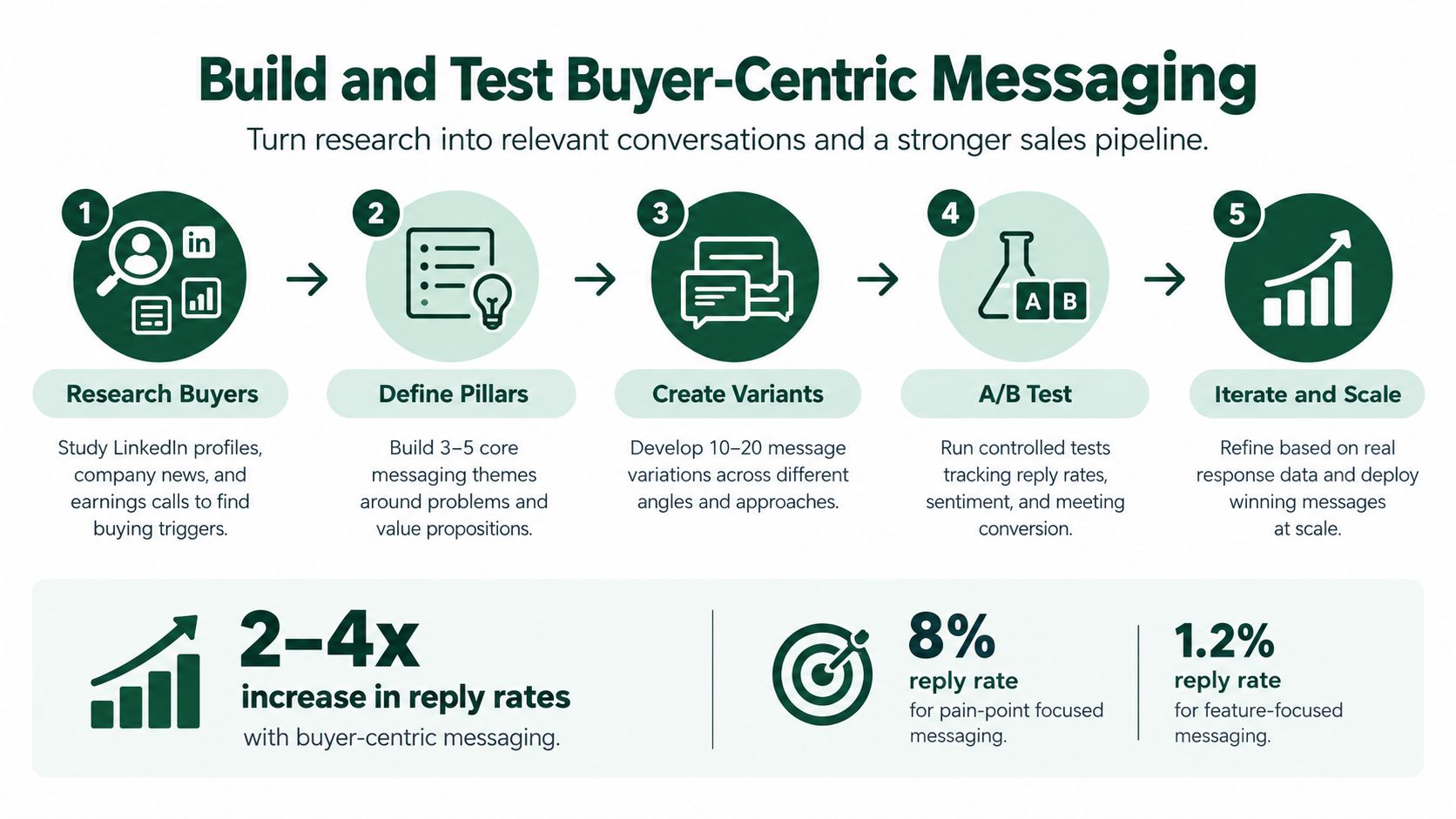
2. Build and Test Buyer-Centric Messaging Informed by Real Reply Data
A message earns attention when it reflects a business problem the recipient recognizes. Product features matter later. The first message should connect a relevant situation to a plausible business consequence and give the buyer a low-friction reason to respond.
Research the prospect's role, company changes, public priorities, hiring activity, market pressures, and existing technology before writing. Then create several message angles around a small set of durable pillars, such as operational efficiency, risk reduction, revenue visibility, or regional compliance. Keep the language different across channels. An email can provide context, while a LinkedIn message should feel shorter and more conversational.
Test messages in controlled batches and judge them by reply quality, sentiment, qualified meetings, and opportunity creation, not by activity volume alone. A polite response that never produces a relevant conversation shouldn't receive the same weight as a buyer who confirms a business trigger and agrees to a next step.
Use replies as product and positioning feedback
When a message performs poorly, don't immediately add more follow-ups. Check whether the account fit, offer, trigger, and recipient were appropriate. Positive replies can reveal new language for the ICP, while objections can expose unclear positioning or a missing proof point.
Instantly can help manage sequencing and message variations, but automation shouldn't replace judgment about who should receive a message or how quickly a human should handle a high-intent reply. Keep a record of the list, signal, message angle, and outcome so the team can distinguish a copy problem from a targeting problem.
For additional guidance on interpreting outbound performance, use this cold email response rate analysis. The strongest message is the one that makes the buyer's situation clearer, not the one that describes the product most completely.
3. Implement Multi-Channel Outreach with Coordinated Timing
Multi-channel outreach works when the channels tell one coherent story. It fails when a prospect receives an email about one problem, a generic LinkedIn request, and an unrelated follow-up from another rep. Coordination matters more than adding more touchpoints.
A practical motion might begin with a researched email, followed by a LinkedIn connection that references the same business context, then a follow-up triggered by a meaningful account event. The sequence should give the buyer a consistent reason to engage while allowing each channel to do its own job. Email carries detail, LinkedIn builds recognition, and intent signals help determine when relevance is highest.
Assign a role to every channel
Use HeyReach for LinkedIn connection and follow-up workflows when scale is appropriate, but keep the language natural and respect platform rules. Use Whitewhale to identify intent signals that can inform account prioritization, then verify the signal against account fit before contacting anyone.
For an APAC campaign, map the sequence against local business hours, public holidays, time zones, and language expectations. A message sent at a convenient time in one market may arrive outside working hours in another. The team should also define ownership when a prospect engages on one channel but not another.
Track conversations and qualified meetings by channel, sequence, signal, and account segment. This LinkedIn outreach strategy provides useful context, but the operating principle is simple: don't optimize channel activity in isolation. Optimize the coordinated path from relevant signal to buyer-confirmed next step.
4. Optimize Email Deliverability and Sending Infrastructure
Deliverability is part of pipeline management, not a technical task that sits outside sales. If messages don't reach the inbox, the team can't learn whether the targeting or message was effective. A poor sending setup also creates misleading performance data because low engagement may reflect placement rather than buyer interest.
Authenticate sending domains with SPF, DKIM, and DMARC. Validate lists before launch, remove risky addresses, monitor bounces and complaints, and separate cold outreach infrastructure from the primary corporate domain where appropriate. Establish clear pause rules. A sudden rise in bounces or complaints should stop a campaign while the team audits the data and sending configuration.
Deliverability problems should trigger an investigation, not a larger send volume.
Build regional resilience
Mailbox providers behave differently, and global campaigns need monitoring by domain, region, and sending identity. APAC execution may require local knowledge of provider behavior, language patterns, and list sources. A domain that performs well in one market shouldn't be assumed to behave identically elsewhere.
Tools such as Instantly can support warming, authentication workflows, and infrastructure management, but they don't make inaccurate data safe. The cold email infrastructure guide is useful when documenting the technical layer for reps and operators.
Treat inbox placement, bounce rate, complaint rate, and reply quality as connected signals. A campaign with strong copy but poor placement needs infrastructure or list remediation. A campaign with clean delivery and irrelevant replies needs better segmentation or positioning. Keep those diagnoses separate so the team fixes the actual constraint.
5. Use Intent Signals and Trigger-Based Routing to Time Outreach Precisely
Intent data becomes useful when it changes an action. A signal without an owner, context, or routing rule is just another field in a database. Prioritize events that create a credible reason to contact the account, such as a leadership change, funding announcement, relevant hiring activity, website engagement, technology change, or regulatory development.
Combine the signal with ICP fit. A pricing-page visit from a high-fit account may justify fast human follow-up. The same visit from an unqualified account may warrant research rather than an immediate sales sequence. Whitewhale can help surface and score signals, while Apollo can enrich the account and identify the relevant stakeholders.
Make routing explicit
For every important signal, define:
Signal owner: The person or team responsible for reviewing it.
Response path: The sequence, channel, or human action that follows.
Evidence requirement: The information needed before treating the signal as meaningful.
Escalation rule: What happens if the assigned owner doesn't act.
Outcome field: How the team records conversation, qualification, and opportunity results.
For APAC accounts, supplement global intent sources with local news, job announcements, and regulatory registers. A compliance change may be a stronger trigger than generic web activity in a regulated market.
Rapid response matters most for explicit hand-raise events. Research covering approximately 1.25 million online sales leads across 2,241 U.S. companies found that contacting a lead within one hour made qualification nearly 7 times more likely than waiting an additional hour, while waiting 24 hours or longer made qualification more than 60 times less likely than responding within the first hour. The sales pipeline automation guide offers a practical framework for connecting signals to routing rather than leaving them in a queue.
6. Implement Account-Based Sales Motion for High-Value Targets
Account-based selling makes sense when the potential value and complexity of an account justify coordinated research. It isn't just sending more personalized emails to a named list. The team needs an account hypothesis, a stakeholder map, a shared narrative, and a way to measure account progress.
Start with a focused group of high-fit accounts. Research the business priorities, current initiatives, likely buying committee, existing vendors, regional structure, and relevant trigger events. Use Apollo to map contacts, but don't confuse contact coverage with stakeholder engagement. A list of names doesn't prove that the account is evaluating a solution.
Measure account progress, not lead volume
Track whether the team has:
A business trigger: The event or priority that creates urgency.
Multiple stakeholder relationships: Engagement beyond one interested contact.
A buyer-confirmed problem: Evidence that the problem affects the account.
A decision process: Clarity about evaluation, approval, procurement, and timing.
A mutual next step: An action agreed by both sides.
This approach is particularly relevant in APAC, where distributed decision-making and multiple stakeholders can make a single enthusiastic contact look like a stronger opportunity than it is. A meeting may show curiosity, but the opportunity becomes more credible when the buyer confirms business relevance, evaluation criteria, and access to the people who influence the decision.
For enterprise targets, align marketing, sales, and leadership around the same account plan. Marketing can create relevant research or executive content, sales can coordinate conversations, and leadership can support introductions when the buying context warrants it. Account-based execution works when every activity advances the account hypothesis. It doesn't work when it becomes a personalization exercise with no shared definition of progress.
7. Establish Transparent, Attribution-Driven Reporting and Pipeline Dashboards
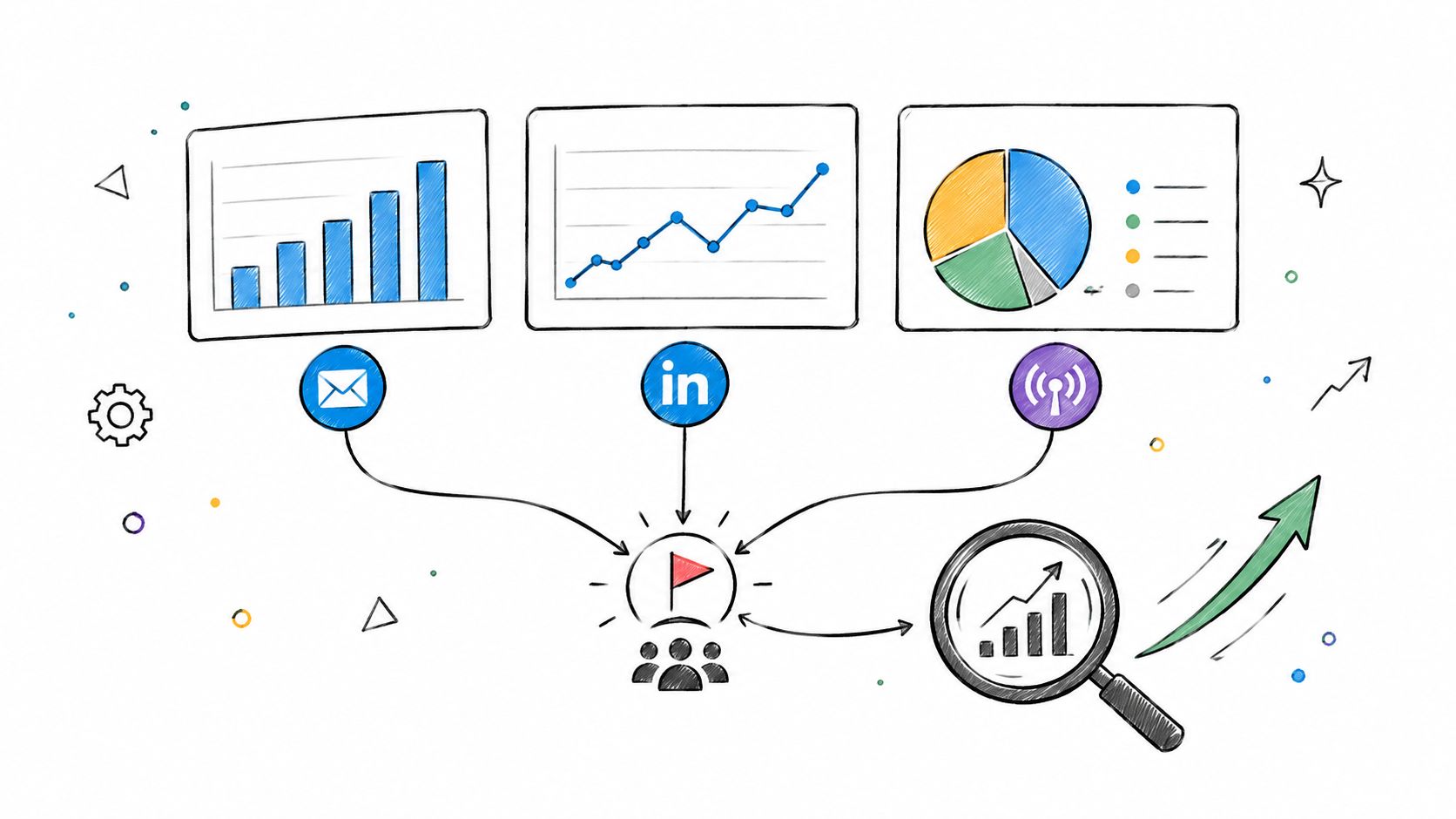
A pipeline dashboard should explain why revenue outcomes are changing. Closed-won revenue is important, but it's a lagging result. Managers also need to see response time, routing failures, contact attempts, qualification, stage conversion, opportunity aging, slippage, source-level win rate, and coverage.
Define terms before building dashboards. “Qualified meeting,” “sales accepted lead,” “opportunity created,” and “sourced by outbound” need consistent meanings across reps and systems. Every campaign should carry identifiers for the account list, signal, message angle, channel, and owner so the team can trace outcomes back to the work that created them.
Separate activity from buyer evidence
Recent buyer research reports that 90% of B2B buyers research before contacting a vendor, and nearly two-thirds use generative AI at least as much as traditional search. The same research points to buyers increasingly arriving with a preferred vendor already in mind. These findings support a practical reporting shift. Track what buyers have independently consumed, compared, or validated instead of treating seller activity as proof of readiness. Read the research on the B2B buyer's mind.
Review dashboards weekly for operating issues and use longer reviews for strategic decisions. Cohort reporting by creation period helps distinguish new performance from old opportunities sitting in the funnel. Share the findings with reps, then connect each problem to an owner and a corrective action.
8. Scale Your Outbound System Sustainably with Proper Team Structure and Handoff
Outbound systems often break during hiring, expansion, or staff turnover because the process exists only in one operator's memory. A sustainable system has documented ownership, clear handoffs, training material, technical specifications, and a regular review rhythm.
Assign a system owner who maintains lists, sequences, routing rules, data definitions, and reporting. That person may be a sales operations leader, a revenue leader, or a fractional GTM operator. The title matters less than accountability. If no one owns the system, every team member changes a small part of it and the full process becomes inconsistent.
Document the system at three levels
The executive summary should explain the operating model and commercial purpose. The team playbook should show reps how to research accounts, use sequences, handle replies, qualify conversations, and update opportunities. The technical specification should document integrations, fields, automations, permissions, error handling, and attribution logic.
Create a ramp path that moves new reps from observation to supervised execution and then independent ownership. Include rules for reply handling, escalation, handoff, and opportunity creation. A positive response shouldn't disappear between a sequence tool and the CRM.
For APAC teams, document local market hours, holidays, language considerations, handoff coverage, and decision-making norms. A system built for one market may need different routing and enablement in another. Monthly reviews should examine both performance and usability. If reps bypass the process, find the friction instead of only demanding more compliance.
9. Layer Demand Capture Alongside Outbound to Multiply Pipeline
Outbound creates deliberate conversations with selected accounts. Organic search and content capture buyers who are already researching a problem. These motions should share the same ICP, buyer language, and commercial priorities instead of operating as separate marketing projects.
Start with the questions your target accounts ask before they speak to a vendor. Build content around operational problems, evaluation criteria, implementation concerns, comparisons, and regional requirements. A page about a generic category may attract attention without creating a useful sales conversation. A practical guide that helps a buyer evaluate options can create stronger context for later outreach.
Connect content to sales action
Add clear paths from content to conversation, but don't force every visitor into a demo request. Offer useful next steps such as a diagnostic, account-specific assessment, relevant comparison, or consultation. Capture the topic consumed, account, contact, and source so sales can understand what informed the conversation.
Use SearchAtlas for technical SEO work when site health is limiting discovery, and use Outrank for SEO content workflows when the strategy and buyer questions are already defined. Content tools can accelerate production, but they can't replace a clear ICP or a useful point of view.
A B2B team selling into APAC might create region-specific content around procurement, compliance, implementation, or market timing, then use that material in outbound conversations with accounts showing related signals. The result is a connected journey. Outbound creates targeted awareness, content supports independent research, and sales sees which topics help buyers validate a decision.
10. Recommended Tools, Integrations, and Practical Notes for an Outbound and Inbound Pipeline
Technology should remove operational friction, not create another collection of disconnected dashboards. Begin with distinct jobs: data enrichment, sequencing and deliverability, LinkedIn execution, intent signals, CRM management, and reporting. Add tools only when the team can explain which pipeline problem each one solves.
A practical stack might use Apollo for account and contact enrichment, Instantly for email sequencing and sending operations, HeyReach for LinkedIn workflows, Whitewhale for intent signals, and a CRM as the system of record. The specific products matter less than the data flow between them. Every handoff should preserve the account, campaign, message, signal, owner, timestamp, and outcome.
Protect attribution and ownership
Before launch, document:
Data ownership: Who creates, enriches, validates, and retires records?
Routing ownership: Who handles a reply, meeting request, or high-intent event?
CRM ownership: Which fields must be updated, by whom, and at what stage?
Attribution logic: How do sequence, signal, list, and message identifiers reach the opportunity?
Regional coverage: Does the tool provide reliable data and mailbox support in the markets you target?
Don't let enrichment completeness substitute for qualification. A filled contact record isn't evidence of a real opportunity. Likewise, an intent score shouldn't override an account's poor fit.
For high-intent inbound inquiries, response speed is a defined operating rule. The widely cited five-minute benchmark comes from a study of more than 15,000 leads across six companies, where contacting a lead within five minutes was associated with contact odds approximately 100 times higher and qualification odds 21 times higher than waiting 30 minutes. The finding concerns lead response, particularly telephone contact after an inquiry, so teams should apply it to explicit hand-raises rather than every cold outbound message. Read the lead response research.
10-Point Sales Pipeline Best Practices Comparison
Approach | 🔄 Implementation complexity | ⚡ Resource requirements & speed | 📊 Expected outcomes / impact | ⭐ Ideal use cases | 💡 Key advantages / tips |
|---|---|---|---|---|---|
Define and Prioritize Your Ideal Customer Profile (ICP) with Data-Backed Segmentation | Medium, requires data analysis and periodic refinement | Moderate, needs data enrichment tools, analysts; data gaps slow progress | Higher reply/meeting rates, lower CAC, faster pipeline ramp | Outbound targeting, APAC expansion, prioritizing high-LTV segments | Start with top 10–20 customers; tier ICPs; use Apollo for enrichment; review quarterly |
Build and Test Buyer-Centric Messaging Informed by Real Reply Data | Low–Medium, writing + A/B testing framework | Moderate, sequencing tool, time for tests (2–4 weeks) | 2–4× reply uplift; higher-quality conversations and better meeting conversion | Cold email sequences, persona-driven outreach, creative optimization | Create 3–5 message pillars; test 10–20 variants; track sentiment; use Instantly |
Implement Multi-Channel Outreach (Email, LinkedIn, Intent Signals) with Coordinated Timing | High, integrates platforms and timing rules | High, multiple tools, integration work, ops coordination | 30–50% higher meeting rates vs single channel; improved recognition | Targeted campaigns, enterprise outreach, timing-sensitive APAC plays | Sequence channels strategically; adapt messages per channel; use Instantly/HeyReach/Whitewhale |
Optimize Email Deliverability and Sending Infrastructure | High, technical setup and ongoing tuning | High, deliverability expertise, domain warming (2–4 weeks), infrastructure | +10–25% inbox placement; fewer bounces; safer scale to high volumes | High-volume cold outreach, global campaigns, scaling to 5k+/week | Use separate sending domain; monitor daily; use Instantly for warming and rotation |
Use Intent Signals and Trigger-Based Routing to Time Outreach Precisely | Medium–High, signal integration and scoring required | Moderate–High, intent providers, integration, validation; ongoing cost | +25–40% meeting rate; compressed sales cycle; better prioritization | Account prioritization, timely outreach after job changes/funding, ABM | Prioritize job changes/funding; combine Whitewhale + Apollo to validate signals |
Implement Account-Based Sales Motion for High-Value Targets | Very high, deep research and multi-stakeholder orchestration | High, cross-team alignment, tailored content, longer timelines | 2–3× close rates on targets; larger ACV; stronger competitive positioning | Enterprise / high-ACV deals, strategic APAC accounts | Start with 10–20 accounts; map decision-makers; align sales & marketing |
Establish Transparent, Attribution-Driven Reporting and Pipeline Dashboards | Medium–High, data integration and consistent definitions | Moderate, CRM/BI tools, clean data, ops support | Faster iteration, better budget allocation, predictable forecasting | Scaling teams, multi-channel programs needing measurement | Define metrics early; track cohorts; use HubSpot/Salesforce; share attribution openly |
Scale Your Outbound System Sustainably with Proper Team Structure and Handoff | Medium, documentation, role definitions, SOPs | Moderate, time to document, ops/ fractional GTM owner, training | Faster rep ramp, knowledge retention, consistent execution across regions | Growing teams, high turnover, multi-region (APAC) scale | Appoint a system owner; document at 3 levels; use 30-day ramp plans |
Layer Demand Capture (Organic/SEO) Alongside Outbound to Multiply Pipeline | Medium, ongoing content + SEO program | Moderate, content creators, SEO tools; results in 3–6 months | Sustainable inbound pipeline; lower CAC over time; compounding leads | Long-term growth, inbound+outbound balanced GTM | Align keyword/content to ICP intent; optimize landing pages; track rankings |
Recommended Tools, Integrations, and Practical Notes for an Outbound + Inbound Pipeline | Low–Medium, select & integrate core tools | Moderate, licensing cost, integrations, attribution setup | Faster execution; preserved attribution; cleaner workflows | Teams implementing full outbound+inbound stack | Start with 3–4 core tools (Apollo, Instantly, Whitewhale, CRM); document data flows |
Turn the Practices into One Operating Rhythm
The best sales pipeline practices reinforce one another. Begin by defining the ICP and separating high-fit accounts from exploratory ones. Enrich and validate those accounts, then document the business triggers and stakeholder conditions that justify outreach. This prevents the team from treating a large database as a qualified market.
Next, build buyer-specific messaging around real business situations. Test the message against reply quality and qualified conversations, not only activity metrics. Establish deliverability before increasing volume, then coordinate email, LinkedIn, and intent signals so every channel supports the same account narrative.
Routing deserves its own operating rule. An inbound form, pricing inquiry, or demo request should receive an immediate owner and a measurable response-time expectation. The Harvard Business Review research covering approximately 1.25 million leads found that companies attempting contact within one hour were nearly 7 times more likely to qualify a lead than those waiting an additional hour, while the audit reported an average response time of about 42 hours among companies that responded at all. Review the speed-to-lead evidence. That gap shows why response time belongs on the pipeline dashboard alongside qualification and opportunity conversion.
Then establish evidence-based stage management. A reply, meeting request, or form submission shouldn't automatically become an opportunity. Require observable buyer evidence such as a relevant business trigger, documented pain, stakeholder involvement, evaluation criteria, access to decision-makers, and an agreed next step. Opportunities without that evidence should be recycled, requalified, or removed instead of inflating the forecast.
Coverage also needs context. A commonly used operating range is 3 to 4 times open pipeline coverage against quota, while long-cycle enterprise motions may require 5 times or more. Coverage should be segmented by stage, age, deal size, source, and historical win rate. For example, a $250,000 quarterly quota implies $750,000 at 3 times coverage and $1 million at 4 times coverage, but those figures are useful only when the underlying opportunities are real and appropriately staged. See the pipeline coverage guidance.
Forecast accuracy depends on maintenance discipline before it depends on AI. Industry reporting cited in the available research places median forecast accuracy at 70% to 79%, with only 7% of organizations reaching 90% or higher. Other findings report that fewer than 25% of companies forecast within a 5% accuracy range, while almost half miss by more than 10%. Review the forecast accuracy data. Require a current close date, documented next step, next-step date, engaged stakeholders, decision process, competitive status, and a reason for stage movement before asking AI to interpret the pipeline.
Run the system on a weekly operating cadence. Inspect response-time distribution, routing failures, stage movement, aging, slippage, qualification, source performance, and buyer evidence. Use monthly reviews to change ICP tiers, messaging, channel allocation, enablement, and regional coverage. Don't optimize isolated activity metrics when the constraint sits elsewhere.
For APAC execution, document local timing, holidays, language preferences, market coverage, data limitations, and decision structures in the playbook. The process should be transferable to new reps and markets without losing the operating logic. Teams that need help building, documenting, handing over, or operating this system can work with The Social Search, a go-to-market engineering consultancy serving B2B teams selling into APAC and global markets. Its work connects ICP definition, data, messaging, email and LinkedIn operations, signal-driven routing, CRM synchronization, reporting, and fractional GTM support.
The practical starting point is not another campaign. Audit one segment from account selection through opportunity creation, identify the first broken handoff, and fix that constraint before adding volume. Once the data, message, routing, and reporting align with one another, the team can scale what produces buyer-validated pipeline instead of just producing more activity.
The Social Search designs, builds, and runs outbound systems that connect ICP definition, account data, messaging, sequencing, routing, CRM synchronization, and reporting for B2B teams. Visit The Social Search to discuss an ICP-to-pipeline system for APAC or global markets, including a documented build, handover, or fractional GTM engagement.
