7 Cold Email Marketing Template Examples
Explore 7 cold email marketing template examples for B2B outreach, with ICP-matched hooks, follow-ups, sequencing guidance, and deliverability tips.
The best cold emails don't start with a clever subject line or a polished script. They start with a clear reason that this prospect, at this company, should hear from you now. One universal cold email marketing template can't account for ICP fit, available evidence, urgency, relationship warmth, or campaign volume. A short message can work for a focused list and fail completely when sent to poorly matched contacts. A detailed proof-led email can open a serious conversation with an enterprise buyer but feel excessive to a founder with no active project.
The practical benchmark is modest. One 2026 analysis reported a 3.43% average reply rate across B2B outbound, with top-performing campaigns exceeding 10%, and found that 58% of replies came from the first email in a sequence. That makes the opening message important, but it doesn't make the template the only lever. Instantly is a relevant option for managing cold email sequencing and sending operations while you test the structures below. Use this comparison to choose a format, adapt the subject line and CTA, build follow-ups, and protect deliverability before you increase volume.
Table of Contents
1. The Problem-First Cold Email Template
A problem-first email earns attention by showing that you understand the buyer's operating reality before mentioning your offer. For a revenue operations leader, that might mean inconsistent pipeline visibility across regions. For a finance leader, it could be slow handoffs between invoicing and collections. For a founder, it might be a sales process that depends too heavily on one person.
The structure is simple:
Relevant problem: Name an issue the role is likely accountable for.
Business context: Explain why the issue matters without exaggerating it.
Credible relevance: Connect your experience or capability to that problem.
Low-friction CTA: Ask whether the issue is worth discussing, rather than forcing a demo.
A SaaS sales tool might write:
Subject: Pipeline visibility at {{company}}
Hi {{first name}}, Teams adding new sales channels often lose a consistent view of where opportunities stall. I noticed {{specific operational signal}} at {{company}}, and thought this might be relevant. We help revenue teams connect activity, stage movement, and ownership in one operating view.
Is pipeline visibility something you're working on this quarter?
The message doesn't claim that the prospect definitely has a problem. It gives them room to confirm or reject the observation. That restraint matters. Persuasion works better when the recipient can recognize their own situation, as the practical principles discussed in this guide to persuasion techniques also suggest.
What to personalize
Use Whitewhale to identify intent signals that support the problem you want to lead with. Then use Apollo to enrich the account and identify whether the relevant contact sits in revenue, finance, operations, or executive leadership.
Reference a real timeframe or observable change when you have one, such as a recent expansion, a new sales hire, or a change in the company's product motion. Don't invent a metric to make the email sound researched. If the problem statement sounds like a disguised vendor pitch, remove it and return to the business outcome.

2. The Intent-Driven Cold Email Template
Intent-driven outreach starts with something the account has done. A funding announcement, a newly hired executive, a competitor adoption signal, a market expansion, or a relevant hiring pattern can turn a generic introduction into a timely business conversation.
The signal should appear early and specifically. “I saw your company is growing” is an observation. “I saw the announcement about your Series B on Crunchbase” identifies evidence. The second sentence must explain why that evidence connects to your offer, otherwise the personalization becomes decoration.
Try this structure:
Subject: Your new GTM build-out
Hi {{first name}}, I saw on Crunchbase that {{company}} announced its Series B. Companies at that stage often need to formalize their GTM process while adding headcount and entering new markets. We help B2B teams build the account data, messaging, sequencing, and reporting around that motion.
Is outbound infrastructure on your agenda as the team grows?
The timing should reflect the signal. A newly appointed VP Sales may be open to operational ideas shortly after the announcement, while an old funding post may no longer be relevant. Combine signals when possible, such as funding plus hiring, but only when both are clearly connected to the buying context.
A 2026 synthesis reported an 18% average response rate for signal-based templates versus 3.4% for generic outreach, while describing 5% to 15% as strong for well-targeted B2B campaigns. Those figures come from Autobound's cold email template guidance, but they shouldn't be treated as a promise. Signal quality, list accuracy, offer fit, and sender health still determine whether the advantage appears in your own campaign.
Route the signal to the right person
Whitewhale can help prioritize accounts showing relevant intent, while Apollo can help identify the contact who owns the resulting initiative. A company announcing expansion doesn't mean every employee is a good prospect. Route a market-entry signal to the GTM leader, a systems signal to operations, and a hiring signal to the executive responsible for that function.
Run the signal-driven sequence separately from generic outreach. Otherwise, you won't know whether the evidence improved the conversation or merely changed the audience.
3. The Multi-Touch Sequencing Template
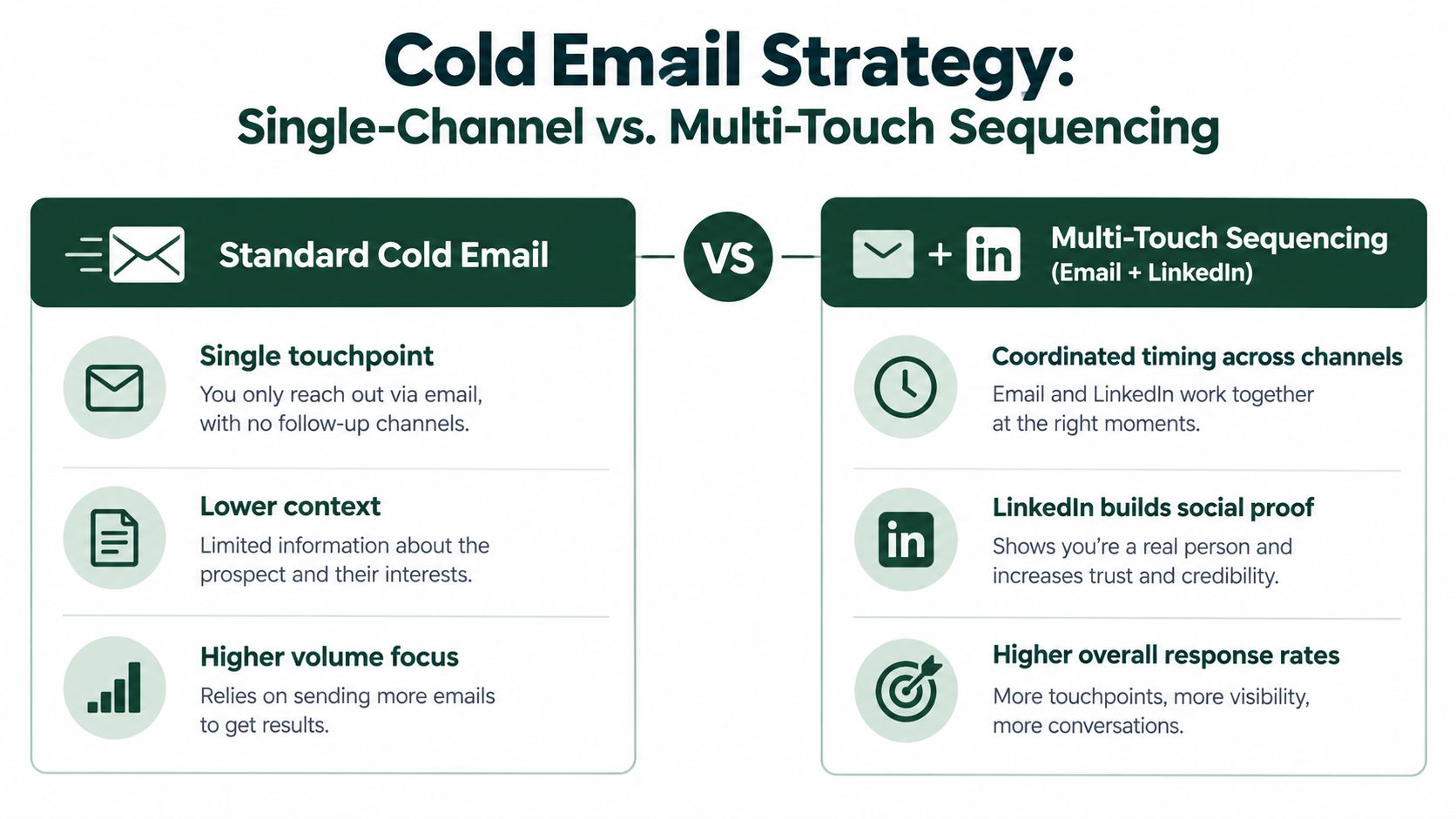
Some B2B purchases need repeated, relevant contact before a buyer replies. A coordinated email and LinkedIn sequence builds familiarity while giving each channel a separate job. LinkedIn can establish context and email can develop the business case. Repeating the same pitch across both channels makes the sequence feel automated.
Begin with a connection request tied to a professional context rather than a sales claim. Follow with an email that explains the business problem in more detail. A later LinkedIn touch can add a relevant observation, while the final email makes the direct ask.
Subject: A thought on {{priority}}
Hi {{first name}}, I noticed {{specific company or role context}} and thought the way you're approaching {{priority}} was relevant to a project we're seeing across B2B teams. We help teams connect ICP definition, data, and outbound execution when growth spans multiple markets.
Worth comparing notes, or is this outside your remit?
Give the messages different language and different work. A connection note can stay conversational. The email can carry the business case and explain why the issue may matter now. Repeating “I help companies generate pipeline” in both channels makes correct timing less useful. This LinkedIn outreach strategy offers guidance on assigning roles to each channel.
Sequence rules that protect attention
Use HeyReach for LinkedIn automation only when every message remains specific and respectful. Use Instantly for email so the send schedule and suppression rules remain visible in one workflow. Keep the sequence easy to audit:
Connection attempt: Mention a real shared business context.
Email introduction: Lead with the account problem or signal.
LinkedIn follow-up: Add a short insight, not a copied pitch.
Email follow-up: Ask whether the issue is relevant.
Final touch: Make a direct request that is easy to decline.
A 2026 benchmark recommends 4 to 7 touches, with early follow-ups spaced 3 to 5 days apart, and reports that 60% of replies arrive after the second follow-up. Laxis's cold outreach playbook provides that benchmark. Treat it as a testing range, not a fixed rule. Track whether replies came from email or LinkedIn, because channel performance can vary by seniority, market, and sales cycle.
For another perspective on the connection message, compare the structure with this cold message from Pipecorn.
4. The Case Study and Social Proof Cold Email Template
Proof-led outreach works when the buyer sees a close match between the example and their own situation. The relevant match might be industry, company stage, sales motion, geography, or the specific operational constraint. A famous customer name means little if the prospect can't see why the result applies to them.
Lead with the outcome and context, then explain the intervention briefly:
Subject: How {{similar company}} handled {{problem}}
Hi {{first name}}, A B2B team with a similar {{company size, market, or sales motion}} was struggling with {{specific problem}}. They changed {{relevant process}} and improved {{business outcome}}.
Your situation looked similar because {{specific reason}}. Would it be useful if I sent over the short case study?
This format is deliberately permission-based. Asking whether the prospect wants the case study creates a smaller commitment than immediately pushing a meeting. If they say yes, the follow-up can deliver the proof and ask one informed question.
Never borrow a customer name without permission. An anonymized example is better than a questionable attribution. If you have a quantified result, confirm that the metric is documented and meaningful to the recipient. If you don't, describe the before-and-after process qualitatively instead of manufacturing precision.
Make the proof do work
A useful B2B sales asset should show the original situation, the decision or intervention, and the resulting business change. The supporting material should be easy to scan, as practical B2B sales collateral guidance recommends. Send a full case study only when it answers the buyer's likely objection. Otherwise, the asset becomes another thing they must process.
Proof is not a logo wall. It is evidence that a buyer with a recognizably similar problem made a decision and reached a relevant outcome.
Use Apollo to find accounts that resemble the customer in the example, then rotate proof points across the sequence. A follow-up can introduce a different type of evidence, such as implementation speed, process clarity, or adoption, rather than repeating the same result. The principles in this guide to deploying social proof without sounding generic are especially relevant when the audience receives frequent vendor claims.
5. The Short-Form, High-Urgency Cold Email Template
Short-form outreach is useful when the offer is clear, the audience is tightly segmented, and the reason to act now is real. It isn't a shortcut around weak targeting. Brevity removes context, so the list and timing must supply more of the relevance.
A founder-to-founder message might look like this:
Subject: Before {{event or deadline}}
Hi {{first name}}, We're speaking with a small group of {{role or company type}} teams about {{specific issue}} before {{genuine deadline}}. I noticed {{relevant signal}} at {{company}}.
Is it worth a brief conversation, or should I close the loop?
The urgency must describe a real constraint, such as limited research capacity, an upcoming market launch, or a defined planning window. Don't invent scarcity. “I only have two spots left” is damaging when the same claim appears in every campaign.
This template suits focused founder outreach and high-velocity SDR programs, but it performs poorly when the prospect needs education before understanding the offer. It also leaves little room for a complex value proposition. If the recipient has to decode your product, the short format becomes efficient only for the sender.
Keep the measurement clean
Use Instantly to test a small number of subject and body variations while maintaining sending controls. Keep the subject line brief and aligned with the first sentence. One CTA is enough, and a calendar link should appear only when it directly supports the request.
The broader environment has become less forgiving. One 2026 study based on more than 40 million emails across over 5,000 campaigns reported that reply rates fell from 8.5% in 2019 to between 3% and 5% in 2026. The same report is summarized in this cold email benchmark analysis. Treat that shift as a reason to improve targeting and sender quality, not as evidence that shortening every email will solve performance.
For a deeper discussion of length and context, see how long a cold email should be. The right length is the shortest version that makes the relevance understandable.
6. The Value-Add First, Ask Later Cold Email Template
A value-first email gives the prospect something useful before requesting a meeting. That could be a concise account observation, a relevant benchmark, a useful introduction, or a personalized explanation of an opportunity. The offer must be specific enough to demonstrate effort, but small enough that you can deliver it consistently.
A market positioning consultant might write:
Subject: A quick observation on {{company}}
Hi {{first name}}, I reviewed {{specific page, offer, or market}} and noticed {{useful observation}}. One opportunity may be to {{practical recommendation}}, especially as you target {{audience or market}}. I also found {{relevant resource or comparison}} that may help your team evaluate it.
Happy to send a short breakdown if useful.
This message doesn't hide a large pitch behind a supposedly free resource. Explain why you're sharing the insight and what it covers. If the value is generic, the recipient will recognize it as content promotion. If it's customized, the follow-up conversation can begin from something concrete.
The trade-off is time. A custom observation takes research, and some recipients will use it without engaging. That can still be worthwhile for high-value accounts, particularly when the insight demonstrates the quality of your work. It is less suitable for a broad list where the cost of preparation exceeds the account value.

Deliver the promised value
Research the prospect's role, market, and current initiative before writing. Apollo can help locate the relevant contact and surface account context, but the insight still needs human judgment. Don't send a gated asset when a short, useful answer would be more credible.
Follow up after a reasonable interval with a question about the observation, not a generic “did you see this?” The ideas in B2B lead nurturing strategies apply here because the first email starts a relationship rather than demanding an immediate conversion.
Track which value offers generate meaningful replies. A positive reply that contains a business question is more useful than a click without context. That distinction keeps the sequence focused on conversations, not vanity engagement.
7. The Referral and Social Proof Cold Email Template
A referral changes the recipient's starting point. The message arrives with a reason to trust the sender, provided the connection is real and relevant. Vague name-dropping creates the opposite effect.
Use the shared context immediately, then connect it to a business initiative:
Subject: Introduction from {{mutual contact}}
Hi {{first name}}, {{John}} suggested I reach out because you're leading {{specific initiative}} at {{company}}. We worked together on {{relevant project or context}}, and he thought your team might be evaluating {{problem area}}.
Would a short exchange be useful, or is someone else closer to this initiative?
The template depends on more than a mutual LinkedIn connection. “We both know John” gives the recipient little to assess. Explain how John knows your work and why he considered the conversation relevant. Ask the referrer before using their name. If the relationship is strong, request a direct introduction instead. That usually provides a better signal than borrowing a name in a cold email.
Find warm paths without forcing them
HeyReach can help identify shared groups and professional paths on LinkedIn, while Apollo can help map relevant contacts at the target account. These tools locate possible routes, but they do not create trust. Verify the relationship before adding it to a sequence, and stop if the connection cannot be explained clearly.
Useful shared attributes include an alumni network, an investor relationship, a professional association, or a specific market community. Mention the common ground briefly, then move to the prospect's role, initiative, or buying context. The personalization should explain why the introduction matters, not just prove that research was done.
Customer references can support the same structure when the customer has agreed to be mentioned. Use the reference to establish relevance, then state the problem or outcome connected to the prospect's situation. A list of logos adds little without that context.
Referral outreach usually suits high-value accounts where verification and personalized copy justify the effort. If the connection is weak, choose a problem-first or intent-driven template. A transparent cold email is more credible than a manufactured warm one. Track replies by referral source and business context, not just opens, so you can see which relationships produce qualified conversations.
Comparison of 7 Cold Email Templates
Template | Core Hook / Features | Effectiveness ★ | Best For 👥 | Effort & Value 💰 | USP ✨🏆 |
|---|---|---|---|---|---|
The Problem-First Cold Email Template | Opens on a clear industry/role pain + evidence, soft CTA | ★★★★ | B2B teams with defined ICPs | 💰 Moderate, research-heavy, high relevance | ✨ Buyer-centric; drives problem-solving convos |
The Intent-Driven Cold Email Template | Leads with recent signal (funding, hiring, tool change) | ★★★★★ | Account-based outreach; time-sensitive buyers | 💰 Moderate–High, needs intent data/tools | ✨🏆 Very timely; strong reply lift when executed fast |
The Multi-Touch Sequencing Template (Email + LinkedIn) | Coordinated email + LinkedIn touches over 10–14 days | ★★★★ | Mid‑market & enterprise ABM plays | 💰 High, setup + integration, better conversion | ✨ Omnichannel credibility; reduces cost-per-reply |
The Case Study / Social Proof Template | Leads with quantified customer outcome and context | ★★★★ | Vendors with proven wins; risk-averse buyers | 💰 Moderate, requires real case data | ✨ Builds instant credibility with metrics |
The Short-Form, High-Urgency Template | Very brief note (<75 words) with scarcity/clear ask | ★★★ | High-volume lists; warm-ish contacts | 💰 Low, scalable, fast to A/B test | ✨ Mobile-friendly; higher open/read rates |
The Value-Add First, Ask Later Template | Gives custom insight/resource upfront, soft follow-up | ★★★★★ | Enterprise & high-touch deals | 💰 High, time-intensive, high ROI | ✨🏆 Positions sender as advisor; best for long-term trust |
The Referral / Social Proof Template | Opens with genuine mutual connection or intro | ★★★★★ | Enterprise, networks, founder/investor paths | 💰 Moderate, depends on warm-path availability | ✨🏆 Highest open/reply lift when warm paths exist |
Turn One Template Into a Measured Sequence
Choose the template based on the evidence available, not on which script sounds most impressive. Use problem-first messaging when you understand the buyer's pain but don't have a strong trigger. Use intent-driven copy when a recent action gives you a timely reason to reach out. Use short-form outreach for focused volume and a simple offer. Use proof-led messaging when the buyer is risk-sensitive and a close customer match exists. Use value-first outreach for high-value accounts where a specific insight is worth the research time. Use referrals only for genuine warm paths. Use multi-touch email and LinkedIn sequencing when the sales cycle requires familiarity across channels.
The sequence matters as much as the first email. A benchmark covering smaller and larger campaign sizes found that campaigns sent to 50 recipients or fewer averaged a 5.8% reply rate, compared with 2.1% for campaigns sent to more than 1,000 recipients. It also found that campaigns with follow-ups averaged 4.9% replies, compared with 3.0% without follow-ups. Those figures appear in Hunter's State of Cold Email 2025. The operational lesson is clear, smaller signal-rich lists and disciplined persistence often outperform indiscriminate volume.
Use this working checklist before launch:
Subject-line relevance: Make the subject accurate, specific, and consistent with the opening sentence.
One CTA: Ask for one simple next step, usually a reply or brief conversation.
Permission-based personalization: Mention real evidence without pretending you know more than you do.
Suppression rules: Remove people who reply, opt out, bounce, or clearly aren't relevant.
Gradual sending: Increase volume only after sender health and inbox placement are stable.
Reply classification: Separate positive replies, objections, referrals, wrong-person responses, and opt-outs.
One-variable testing: Change one meaningful element at a time so the result remains interpretable.
Deliverability comes before copy refinement. Independent guidance places ideal deliverability around 95% to 98% and recommends keeping spam complaints below 0.1%, while ranking inbox placement ahead of reply rate and meetings booked. See SoPro's cold outreach statistics for that operational framework. Another deliverability benchmark reported 87% inbox placement for a properly warmed and authenticated domain, compared with 12% for a new domain without warm-up, and recommended a 6-week warm-up before full cold-email volume. The details are covered in this cold email deliverability guide.
Set up SPF, DKIM, and DMARC, consider a separate cold email domain, use plain-text initial outreach, and include an unsubscribe mechanism. A 2025 guidance source discusses those requirements in its cold email strategies FAQ. Another benchmark places the average open rate for well-executed B2B outreach at about 39%, conditional on authentication and a 2 to 4 week domain warm-up, as explained by Focus Digital. Don't optimize a template while the inbox never receives it.
The Social Search is relevant when a B2B team needs ICP definition, account data, messaging, sending infrastructure, signal-driven routing, and reporting connected into an owned outbound system. Its work can support APAC and global targeting, with documented processes that the client retains. That system-first approach is more durable than treating a cold email marketing template as a standalone growth tactic. For teams that want a practical sequence framework, email marketing made easy can also help turn tested messages into repeatable follow-up flows.
The Social Search designs and runs outbound systems for B2B teams, connecting ICP definition, data enrichment, messaging, email and LinkedIn sequencing, deliverability, signal routing, and reporting. Visit The Social Search to discuss a cold email program built around your target market, buying signals, and owned pipeline infrastructure.
