LinkedIn Outreach Strategy That Books More Meetings
Build a LinkedIn outreach strategy that converts connections into meetings. ICP, sequencing, timing, testing and scale playbook for B2B teams.
A LinkedIn connection request can be accepted and still go nowhere. In the 2026 benchmark analysis of 13.2 million connection requests, average acceptance was 28.5%, but connection-note replies were only 3.0%, while post-acceptance message replies reached 10.4% (Expandi's 2026 LinkedIn outreach benchmark analysis). That gap changes the operating question. The core of a modern LinkedIn outreach strategy isn't writing a clever invite. It's converting accepted connections into relevant conversations, qualified meetings, and clean handovers.
Table of Contents
Why LinkedIn Outreach Still Wins for B2B Pipeline
LinkedIn earned its place in B2B outbound the slow way. Its professional audience expanded while the platform added better ways to identify accounts, study buyer roles, observe relevant signals, and start conversations in context. It launched in May 2003 with 4,500 members, reached 1 million members by August 2004, 100 million by 2010, 500 million by 2017, 850 million by 2022, and over 1 billion professionals by 2025 (LinkedIn's platform history timeline). The addition of Sales Navigator in 2014 separated basic networking from structured prospecting, allowing revenue teams to build repeatable account searches instead of relying on memory, referrals, or broad contact lists.
The funnel is more important than the invite
The operating implication is clear. LinkedIn provides access and context, while the conversion work happens after acceptance. Teams still need a defined ICP, reliable data, a message matched to the buyer's situation, follow-up logic, and reporting that shows where prospects stop progressing.
Independent outreach research covering 15 million or more contacts found an average overall reply rate of 7.2%, with results ranging from 4.2% to 10.5% by industry. HR and Talent professionals replied at 10.9%, while C-level executives replied at 7.0% (Belkins' LinkedIn outreach study). Messenger campaigns aimed at already-connected prospects produced 12.2% total replies in the same study, supporting a post-acceptance workflow rather than an invite-only approach.
Practical rule: Treat connection acceptance as permission to continue, not evidence that the prospect wants a sales call.
For execution, HeyReach can coordinate LinkedIn sequences across senders and campaigns. Trigify can surface social signals that give reps a reason to engage. Neither tool repairs weak targeting or an unclear offer. They support an operating model that should connect with the broader B2B lead generation workflow, including qualification and handover.
Use this guide to LinkedIn reply rates when comparing raw sends with accepted-connection performance. Those denominators measure different stages, so combining them can make a weak sequence appear healthy. The useful system tracks acceptance, post-acceptance replies, qualified conversations, and the point where sales takes ownership.
Define Your ICP and Build a Prioritized Target List
A list of job titles is not an ICP. It is an unfiltered inventory. A workable LinkedIn outreach strategy defines which accounts receive attention first, which people matter within them, and what evidence supports contacting them now. That definition becomes the control layer for the post-acceptance conversion system, not just a filter for connection requests.
Start with firmographics. Specify the markets, company types, locations, revenue model, employee profile, and operating environment where your offer has a credible reason to win. APAC targeting needs more precision than one regional label. Singapore, Australia, Japan, India, and Southeast Asian markets can differ in buying process, language expectations, data availability, and channel preference.
Add technographics and operating context. Record the systems in use, delivery model, growth stage, hiring pattern, and commercial motion that point to a problem your solution can address. A sales leader building a first outbound function needs a different conversation from one replacing an established stack. Those differences should change the segment, message angle, and follow-up path.

Rank accounts before you enrich contacts
Use tiers so the team does not send one sequence to every account:
Tier 1, ideal fit: Accounts match the strongest firmographic and technographic criteria, with a clear buyer role and relevant trigger. Give them the deepest research and most customized messaging.
Tier 2, strong fit: Companies fit the commercial profile but show a weaker signal, secondary buyer, or less visible urgency. Place them in a lighter research and closer nurture path.
Tier 3, broad fit: Accounts fit the wider market but lack evidence for high-touch work. Use them for controlled scale, not the most expensive research effort.
Rank fit and timing together. A perfect account without a current reason to engage may be less useful than a strong-fit account whose leadership team has posted about the problem you solve.
Data quality determines whether the segmentation holds up in execution. Apollo can enrich account and contact records, but enrichment should support a defined workflow. Assign ownership for list creation, verification, exclusions, and refreshes, so outdated contacts do not enter active campaigns.
Whitewhale can support intent-led prioritization, while Trigify fits when public engagement or social activity forms part of the trigger model. If search visibility contributes to account research, SearchAtlas and Outrank belong in the adjacent demand-generation layer, not as substitutes for sales qualification.
The finished record should include account tier, buyer role, trigger, supporting evidence, territory, owner, source, last verification, and the message angle assigned to that segment. For a formal build process, the ICP and list-building service shows how a ranked queue with documented evidence per account looks in practice.
Message Frameworks That Turn Connections Into Conversations
Connection notes should make relevance clear and create a reason to accept. The larger conversion opportunity begins after acceptance. The benchmark gap cited earlier supports that sequencing choice: outbound messages sent after acceptance produced stronger reply performance than connection notes in the same analysis.
A blank invite is fine; what matters is that the invite and the post-acceptance DM do different work.

Use a stage-specific message design
The invitation should establish relevance. Mention a shared market, a specific post, a professional event, or a credible reason your paths overlap. Keep the product pitch out of the request. A founder might write, “I've been following the way you're approaching regional expansion in APAC. We work with B2B teams on the operational side of that motion, and I'd be glad to connect.”
The first DM should deliver an observation. After acceptance, reference a signal that explains why the conversation may matter. For a sales leader, that could be a hiring change, a new market, or a public comment about pipeline quality. For an SDR leader, it might be a list-quality bottleneck or inconsistent handover.
The CTA should ask for a small next action. Offer a short teardown, suggest comparing notes, or ask whether the issue is currently a priority. “Would it be useful if I sent over the framework?” creates less resistance than requesting a meeting before context exists.
Personalize around evidence, not compliments
Flattery is easy to automate. Evidence requires a defined review process. A useful personalization line connects three elements:
Signal: What changed or what did the prospect publish?
Implication: What operational problem often follows?
Permission: Is the issue relevant enough to continue?
For a founder, the angle may address building a repeatable outbound motion without creating founder dependence. For a sales leader, it may focus on segment performance and conversion after acceptance. For an SDR, it may focus on execution quality, routing, and the clarity of the next action.
The offer and messaging development service fits teams that have activity but no consistent message architecture. Keep the framework stable, then vary the evidence and angle by segment. Your sequencing tool can run the workflow once the logic is clear, while Instantly can carry the email side when a LinkedIn conversation needs a coordinated second channel.
Use the message as an operational handoff, not a compressed product page. It should show why the prospect was selected, identify the relevant signal, and make the next action clear. That structure gives a salesperson enough context to continue the conversation without rewriting the research from scratch.
Sequencing Timing and Staying Within LinkedIn Limits
Message quality and sequence design control different failure points. A relevant DM can still underperform if it arrives immediately after acceptance, repeats the same pitch, or drives more activity than the account can safely sustain. Treat LinkedIn outreach as a post-acceptance conversion system. Give every touch a job, wait long enough for a response, and route each prospect according to the signal they create.
Start with the connection request, then pause after acceptance. Send an observation or useful resource, and introduce a different angle only if the prospect remains silent. Replies, role changes, opt-outs, and positive buying signals should stop or reroute the workflow rather than push the contact through every step.
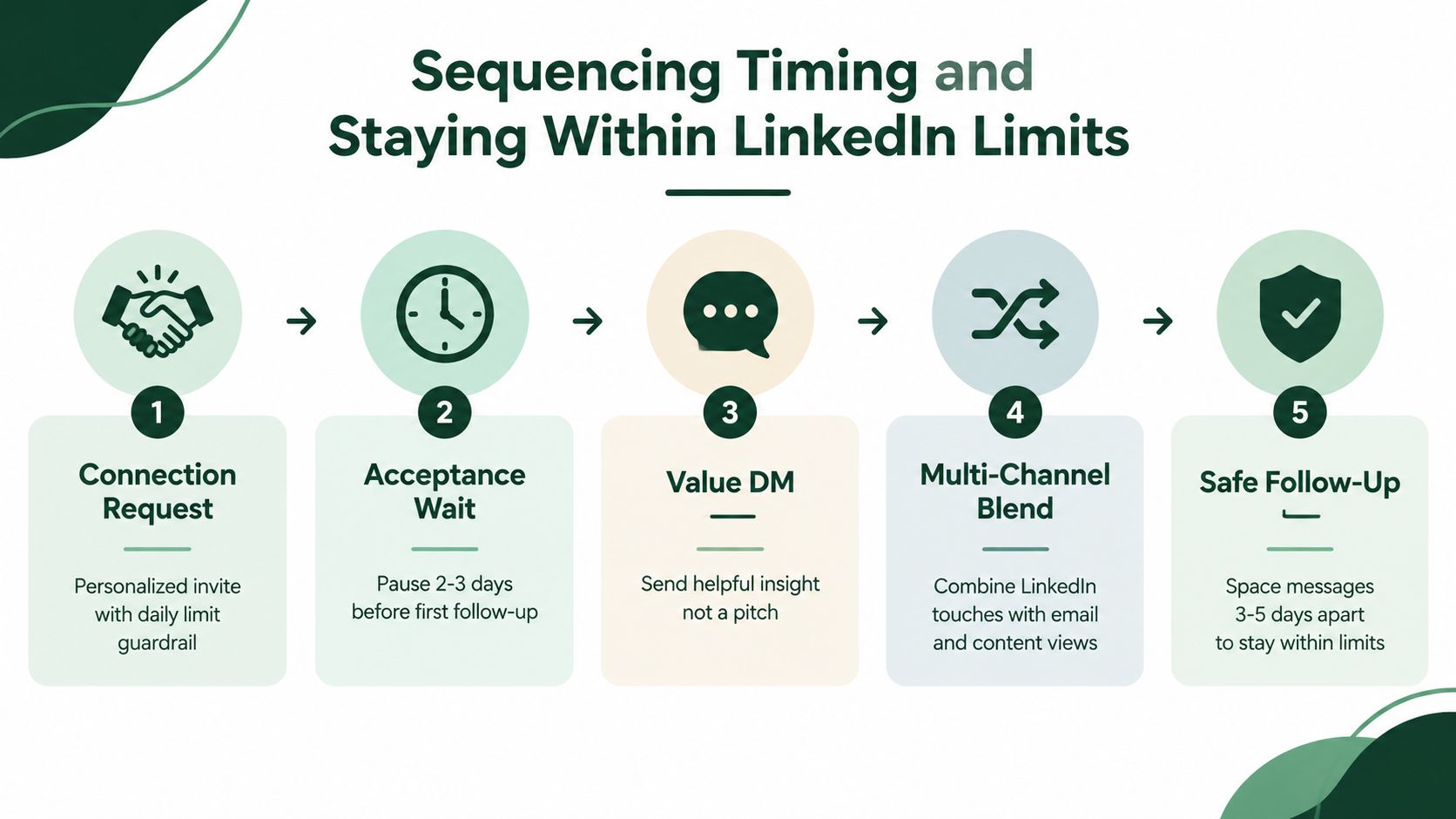
Build the cadence around capacity
LinkedIn uses a rolling seven-day invitation window, not a fixed weekly reset. Industry reporting places the practical ceiling at about 100 connection invitations per week for most accounts, while some established accounts receive higher limits (RevenueFlow's LinkedIn limits guide). Design the campaign around that operating constraint before launch. The ceiling is a boundary, not a quota.
Sales Navigator provides 50 InMail credits per month for Core, Advanced, and Advanced Plus accounts, with a maximum accumulation of 150 credits. Credits renew on the first day of each month regardless of billing cycle (Sales Navigator credit guidance). LinkedIn's help guidance also states that Sales Navigator users can't purchase extra InMail credits, so higher volume requires a plan change rather than a top-up (InMail credit explanation).
Constraint | What It Means for Your Sequence |
|---|---|
Rolling seven-day invitation window | Pace invitations continuously and monitor the active window instead of waiting for a weekly reset. |
Practical ceiling of about 100 invitations per week for most accounts | Prioritize high-fit accounts and avoid treating the ceiling as a target. |
50 monthly InMail credits on listed Sales Navigator plans | Reserve InMail for high-value non-connections or defined fallback cases. |
150-credit accumulation maximum | Plan credit use before unused capacity stops accumulating. |
No extra InMail purchases | Build the sequence around available credits, not assumed top-up volume. |
Blend channels without creating noise
LinkedIn-only outreach leaves fewer options when a prospect does not accept or reply. A coordinated email step can preserve continuity when it has a distinct reason to exist, such as extending the resource or operational detail introduced after acceptance. Use your email sequencing platform for that handoff and keep the message consistent with the LinkedIn context.
WhatsApp fits markets where the prospect has explicitly opted into that channel or where an existing business relationship supports it. Respond IO is relevant for that kind of WhatsApp automation. Manychat fits social DM or comment workflows. Move a prospect to another channel only when permission and a clear value reason are present.
Timing needs an owner. Teams coordinating founder outreach, sales calls, and regional time zones can use this guide to schedule optimization for entrepreneurs to define operating windows. Document local send times, review periods, escalation rules, and pause conditions so handovers do not depend on memory.
The LinkedIn outreach compliance toolkit helps turn those guardrails into team practice. Use automation to enforce approved pacing and routing, never to bypass platform limits. Capture the reason for each route so the next salesperson can continue from the prospect's latest signal.
Measure What Matters and Run A/B Tests That Improve Replies
A send-count dashboard can make an inactive campaign look productive. Track the funnel from account selection through acceptance, reply, qualification, meeting, and pipeline. Each stage measures a different operating question. Use the earlier studies as directional benchmarks, then compare performance within the same funnel stage and audience.
The Belkins study reported 7.2% average overall replies across 15 million or more contacts, with industry results from 4.2% to 10.5%. It also recorded 18.7% connection acceptance, 17.6% replies among connected prospects, and 1.3% meeting bookings among connected prospects. The Expandi benchmark analysis reported 28.5% acceptance from 13.2 million connection requests, alongside 3.0% connection-note replies and 10.4% post-acceptance message replies. Apply each benchmark only to the stage and audience it measures.
Diagnose the stage that is breaking
Low acceptance usually points to targeting, profile credibility, account fit, or invite relevance. Healthy acceptance with weak replies shifts attention to the first post-acceptance DM, the delivery delay, and the evidence supporting its opening. Positive replies with few meetings indicate friction in qualification, the CTA, calendar handling, or sales follow-through.
Seasonality belongs in the analysis. The Belkins study found April at 7.9% and September at 6.3% for overall reply rate. Treat those results as timing context, not as a rule for every segment.
Run tests that isolate one meaningful change:
Targeting test: Compare a trigger-led segment with a broad title-led segment.
Message test: Hold the segment constant while changing the opening observation or CTA.
Timing test: Compare a shorter and longer pause after acceptance.
Offer test: Compare a resource offer with a low-friction diagnostic conversation.
Set the primary metric before launch. If the goal is meetings, a variant should not win because it generates more low-intent replies. Record positive replies, qualified replies, meetings held, and pipeline created by segment, sender, trigger, and message version. These fields also make handover decisions clearer, because the next owner can see which signal and message produced the outcome.
The reporting and pipeline dashboard service can consolidate those dimensions into one operating view. Review results on a fixed rhythm, pause weak variants, and retain the evidence behind each decision. LinkedIn outreach improves when acceptance is treated as the start of conversion, not the campaign's finish.
Scale and Hand Over Your LinkedIn Outbound System
A LinkedIn outbound system is ready to scale when another capable operator can run it without asking the founder what each message means. Document ownership, decision rules, and stop conditions first. Scaling activity before those pieces exist only scales ambiguity.
Build a handover pack with these operating assets:
ICP definition: Record firmographic, technographic, buyer-role, territory, and exclusion criteria.
List protocol: Document enrichment sources, verification rules, ownership, refresh logic, and suppression handling.
Signal catalogue: Define which events justify outreach and the message angle for each.
Sequence library: Store invitations, post-acceptance DMs, follow-ups, reply routing, and opt-out handling.
Reporting model: Connect acceptance, replies, meetings, and pipeline to segment, sender, signal, and message.
Rep enablement: Provide personalization examples, escalation rules, and handover expectations for SDRs and AEs.
Separate judgment from repetition. A rep judges whether a prospect's post about hiring freezes creates relevance. The workflow assigns the matching sequence, pauses on reply, and routes the thread to the account owner. This keeps human context at the decision point while standardizing execution after acceptance.
External support may help when the team lacks an operator who can connect data, messaging, tooling, and revenue accountability. If recruiting is the constraint, Hire SDRs is a relevant resource for adding execution capacity. The Social Search provides outbound system work covering ICP definition, prioritized lists, messaging, LinkedIn and email sequencing, signal-driven routing, reporting, and enablement, with optional fractional GTM leadership.
Run the first 30 days as a controlled operating loop:
Week 1: Confirm the ICP, tiers, ownership, and exclusions.
Week 2: Build the initial list and define signal rules.
Week 3: Launch a limited sequence within account and InMail constraints.
Week 4: Review acceptance, post-acceptance replies, qualified conversations, and meetings. Keep winning evidence, remove weak segments, and update the playbook before increasing volume.
