Lead Generation for SaaS: A Tactical Playbook for 2026
Lead generation for SaaS in 2026 — a tactical playbook covering outbound, SEO, product-led growth, and the metrics that matter at every ARR stage.
Most advice on lead generation for SaaS starts with the wrong question. It asks which channels to run, then hands you a shopping list of tactics that look busy and burn budget before they build pipeline. The better question is simpler and more uncomfortable: what stage are you in, what motion fits that stage, and what should you ignore for now?
That’s the part many teams skip. A founder at $500K ARR does not need the same operating system as a revenue leader at $20M ARR selling across APAC and global markets. When you force both into the same playbook, you get noisy attribution, weak deliverability, and a team that can’t tell which lever moved revenue.
The data backs that up. Email is used by 88% of businesses, LinkedIn has a 97% adoption rate for lead generation, and LinkedIn drives 80% of B2B social media leads in the 2025 B2B SaaS lead generation report, while cold calling success has dropped to 2.3% in 2025 from 4.82% in 2024, all in the same source (2025 B2B SaaS lead generation report). That doesn’t mean every team should spam inboxes and social feeds. It means sequencing, deliverability, and profile-based outreach have become core infrastructure, not side tasks.
Table of Contents
Why Most SaaS Lead Gen Playbooks Fail Before They Start
Most SaaS teams don’t fail because they choose the wrong channel. They fail because they launch too many motions at once before any one of them is operational. That creates the illusion of activity, but it buries the signal you need to decide what’s working.
A founder-led outbound motion, a content sprint, paid search tests, and a LinkedIn push all sound reasonable on a slide. In practice, they compete for the same small pool of attention, messaging, and reporting. The result is predictable, you can’t tell whether the problem is targeting, offer, list quality, or channel fit, so the team keeps adding tactics instead of fixing the bottleneck.
Stage-based sequencing solves that. Under $1M ARR, the right move is usually founder-led outbound, founder LinkedIn, and referrals. Around growth stage, SEO, content syndication, webinars, and paid search start making sense. At larger scale, ABM, intent data, partner ecosystems, and executive events belong in the mix (stage-based channel guidance).
Practical rule: if you can’t explain which motion should produce pipeline in the next 30 days, you’re probably trying to run a system built for a later stage.
This is why lead generation for SaaS has to be treated like an operating model, not a list of tactics. A smaller company needs focus, one channel pair, one ICP slice, one message set, one measurement loop. A larger team can afford more complexity, but only after the first motions are already producing clean data and attributable pipeline.
Locking the ICP and Building the Right Account List
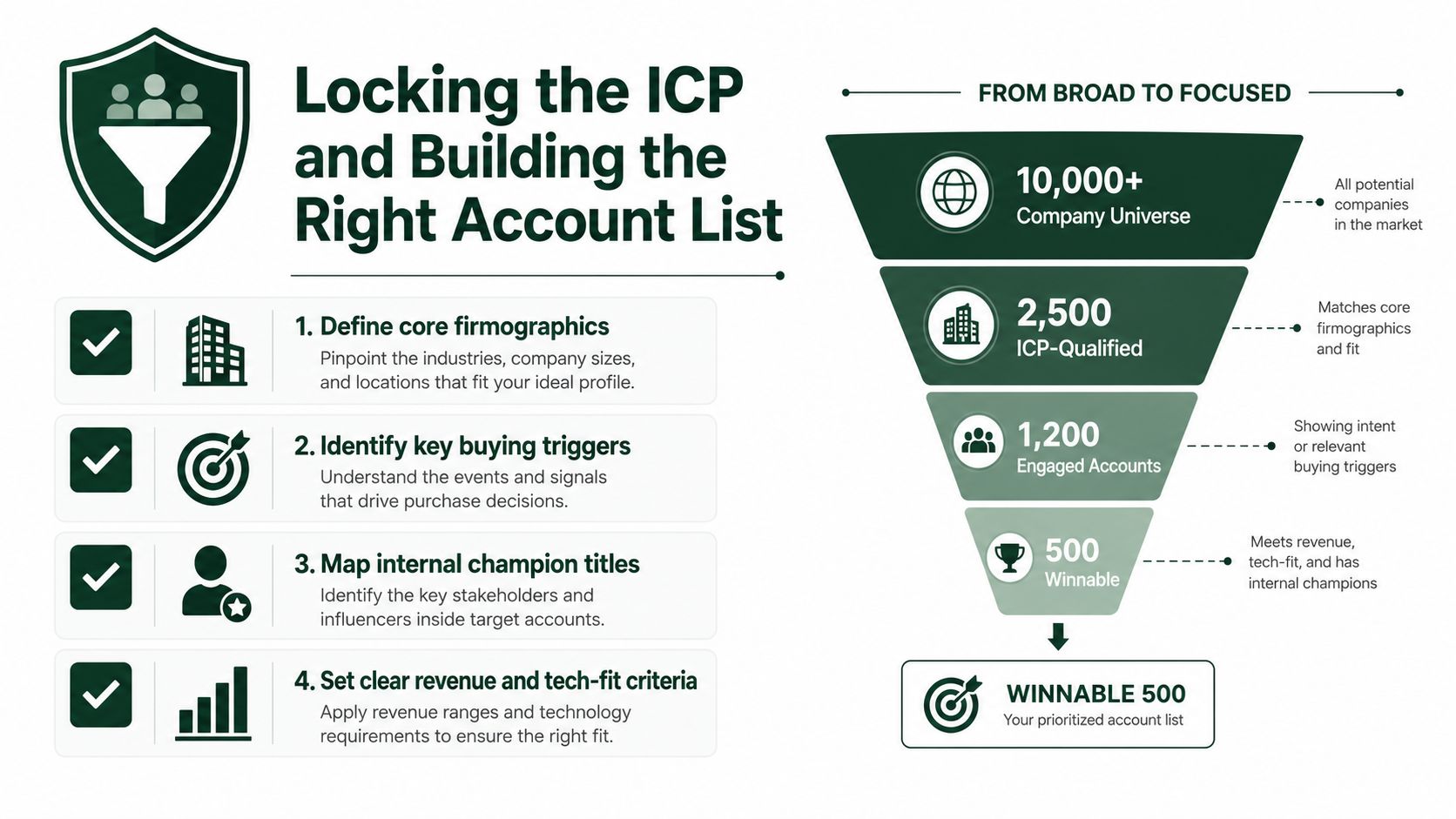
Before you spend a dollar on outreach, the ICP needs to be sharp enough to cut a broad market into a winnable list. I’d rather see a team define a tight account universe and learn fast than chase a big TAM with vague personas. Broad definitions create weak replies, low-quality handoffs, and sales follow-up that feels random.
Start with your highest-value customers
The fastest way to pressure-test the ICP is to look at your highest-LTV customers with shorter sales cycles and ask what they share. That usually means patterns across company size, industry, tech stack, trigger events, and geography. If those patterns don’t repeat, your ICP isn’t ready yet.
The point isn’t to create a perfect persona document. The point is to build a filter that can reduce a huge universe into a smaller list your team can work. If the list is too broad, reply quality falls. If it’s too narrow, you starve the funnel and spend your time justifying why the pipeline is empty.
The practical workflow is straightforward. Pull public emails from LinkedIn, use domain-based finders to predict company email patterns, cross-check the data against enrichment databases, and validate every email before outreach. Tag leads by confidence level so your team knows where the risk sits and who gets the first pass.
Operational rule: don’t let a bad list become a messaging problem. Most weak sequences were never the real issue.
If you need a structured way to build a target account list, the process is usually cleaner when it’s handled as a dedicated exercise, not a side task inside outreach. A service like ICP list building fits naturally here because list quality shapes everything that comes after it.
The cleanest account list usually looks boring. It’s narrow, explicit, and based on evidence from actual customers rather than internal hope. That’s the standard you want before a single sequence goes live.
Building Outbound That Actually Lands and Replies
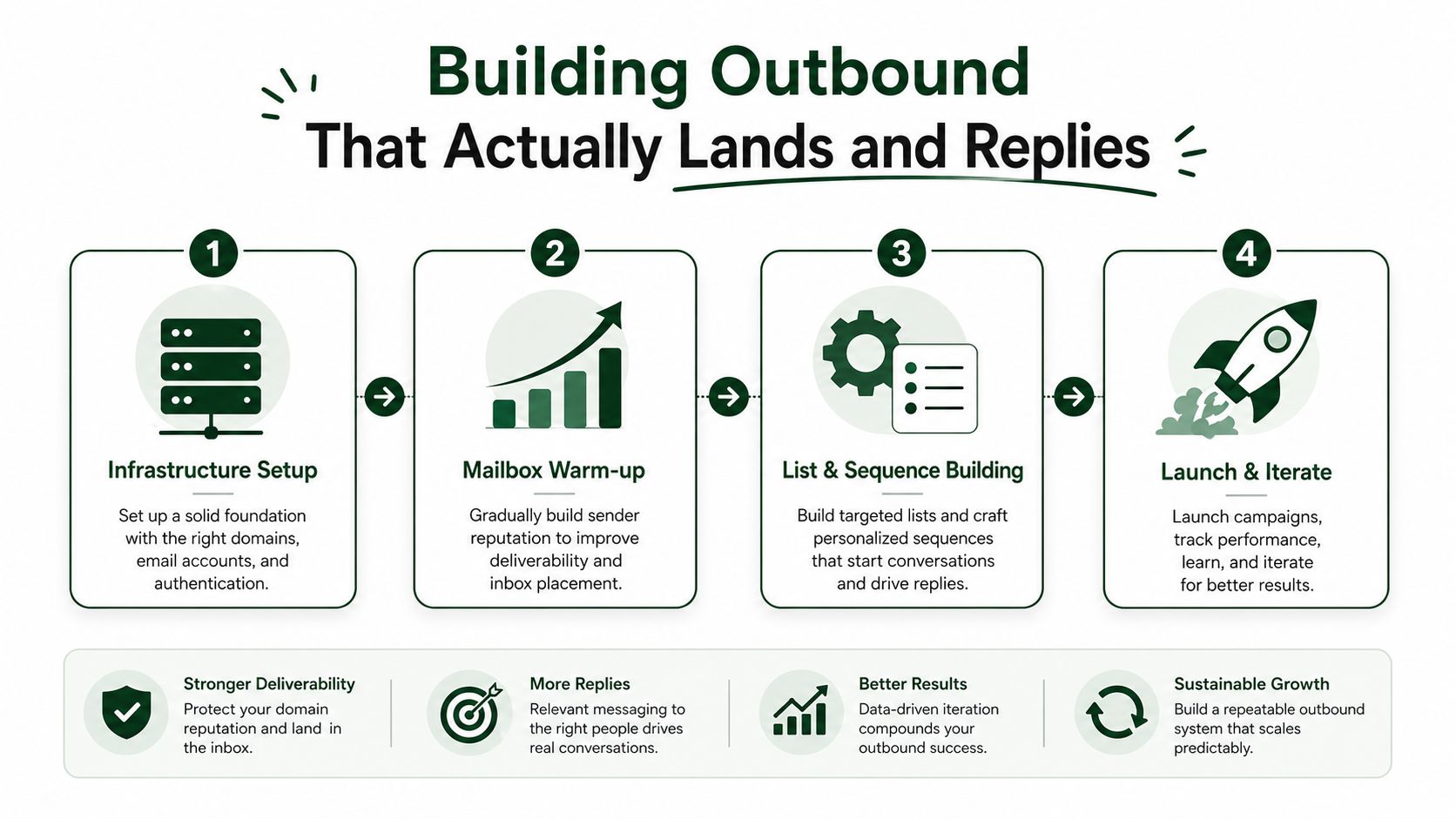
Outbound breaks when teams reverse the order of operations. They write copy, load leads, and hit send before the infrastructure is ready. That’s how you end up with inbox issues, flat reply rates, and a team that blames messaging when the problem is deliverability.
Set the machine up first
Start with sending infrastructure, then warm mailboxes gradually over 2 to 3 weeks. Don’t spike volume early. Don’t pour unverified leads into fresh domains. The operational sequence matters because sudden volume jumps and dirty data are classic filtering risks in SaaS outbound (practical outbound build guidance). If you want one tool to support cold email execution across deliverability, warming, and sequencing, Instantly fits that layer well.
After that, run a small pilot segment of about 200 to 500 contacts against one entry role. That pilot is not about scale, it’s about truth. It tells you whether the ICP, the offer, and the list quality are good enough to deserve more volume.
Then move into an 8 to 12 touch multichannel sequence across 14 to 21 days. The sequence should blend email and LinkedIn rather than treating one as a replacement for the other. Email still does the heavy lifting, and LinkedIn adds profile-level credibility and persistence. If you want a sensible LinkedIn layer, HeyReach is a practical option for outreach and automation that complements email rather than replacing it. In practice, teams often get the best result when Instantly handles the email side and HeyReach handles the LinkedIn side inside the same sequence logic.
The message still has to earn attention. That means pressure-testing the offer against actual reply data, not internal opinion. If the market ignores the angle, the answer is rarely “send more.” It’s usually “tighten the offer, sharpen the list, or change the entry role.”
For teams that need a more systemized outbound build, an automated layer like automated outbound systems can help connect infrastructure, sequencing, and routing without turning outreach into random activity.
One useful habit is to review the reply path line by line. If prospects open but don’t answer, the issue may be relevance. If they answer but don’t book, the issue may be offer fit or CTA friction. If deliverability slides, the issue is upstream, not copy.
A simple Gmail follow-up resource like improve Gmail follow-up tactics can help tighten the response workflow for teams that still rely on manual follow-up. Use it as a process reference, not a crutch.
Content and SEO as a Compounding Demand Channel
Outbound creates pipeline now. SEO and content create pipeline later, then keep doing it without adding the same level of marginal effort. That’s why I treat SEO as infrastructure, not a side project. If you wait until the team feels “ready” for content, you’re usually just delaying the compounding curve.
The editorial mix that works for SaaS is not random blogging. It starts with bottom-of-funnel comparison pages, moves into problem-aware tutorials that meet buyers during evaluation, and adds thought-leadership pieces that earn links and founder distribution. If your site only publishes generic awareness posts, you’re feeding traffic into a leaky funnel.
The right investment depends on stage. Pre-PMF or sub-$1M ARR teams often get better payback from outbound because content compounds slowly and the market signal is still unclear. Once the product and ICP are more stable, content becomes a stronger asset because it can support demand capture as well as demand creation. A useful editorial framework for that middle stage is laid out in this content strategy guide for SEO and lead growth.
What good looks like in practice
Comparison pages: own the searches buyers use when they’re evaluating alternatives.
Problem tutorials: answer the exact question prospects ask when they’re trying to solve a workflow issue.
Founder POV pieces: publish real opinions that a sales team can reuse in conversations and social distribution.
Website hygiene: make sure the pages you’re earning traffic to convert and route intent.
The important distinction is time horizon. Outbound can move faster, but it stops when you stop sending. SEO and content move slower, but they keep working if the site architecture and topics are aligned with buying intent. That’s why mature teams usually need both, just not at the same time and not in the same order.
If you’re mapping the transition from demand generation to customer acquisition, The Social Search’s customer acquisition guide for scalable growth engines fits naturally into that planning.
When Product-Led Growth Outperforms Both Outbound and SEO
PLG is often sold as a magic shortcut. It isn’t. It works only when the product has a clear activation moment, a visible aha experience, and a usage pattern that can signal real buying intent. Without that, PLG becomes another vague strategy label pasted onto a weak funnel.
The companies that benefit most from PLG usually have obvious in-product value, low-friction onboarding, and enough usage depth to identify when a user is becoming a real prospect. Dev tools and horizontal SaaS with lighter-touch motions tend to fit that model better than regulated enterprise software, where buying committees, compliance, and implementation complexity slow everything down.
What to instrument
You need a clear activation event first. Then you need to track PQL signals such as usage thresholds, invite behavior, and team expansion. Those signals should route into sales without strangling the self-serve experience. If sales jumps in too early, you lose product adoption. If sales waits too long, you miss the buying window.
For a clean comparison of motion fit, PLG vs sales-led motion is a useful reference point. The practical takeaway is simple. Don’t force PLG just because it’s fashionable. Borrow the parts that fit, and ignore the rest.
PLG works when product usage is already telling you who is ready to buy.
A good PLG motion does not replace qualification discipline. It gives you a different signal source, one that can outperform form fills when users are already inside the product and showing expansion intent. If your product doesn’t generate those signals cleanly, stay focused on outbound, SEO, and routing discipline instead.
For teams thinking about how acquisition mechanics roll up into broader growth systems, The Social Search’s customer acquisition guide is relevant because PLG only matters if it connects to actual pipeline behavior.
Signal-Driven Timing for APAC and Global Markets
In APAC and global markets, timing often beats volume. A long list of accounts is useful only if you know when each account is likely to care. Random outreach into a non-buying period wastes attention, lowers reply quality, and makes the team think the market is colder than it really is.
The strongest signals are usually the simplest ones to understand. Tech-stack changes suggest a workflow is in flux. Competitor renewal windows can open a replacement conversation. G2 and TrustRadius intent shows active research. Funding announcements, hiring surges, and conference attendance all point to moments when teams are spending or planning. Combined with role filters in tools like LinkedIn Sales Navigator, those signals give you a much better route to contact than a generic list ever will.
Imagine two accounts in the same sector. One just hired a new operations leader and announced a funding round. The other has no visible change and no buying cues. Sending the same message to both is lazy. The first account deserves a tighter sequence because the timing is aligned with change, budget, or evaluation. The second account can wait.
The other side of timing is knowing when to pause. Non-buying periods, leadership transitions, and post-acquisition freezes are bad windows for aggressive outreach. Teams that keep pushing through those periods often waste their best touches on accounts that can’t move anyway.
A routing logic built around signals is more effective than another prospect source. It tells reps whom to contact, when to contact them, and why now matters. That’s the difference between list-based prospecting and event-based prospecting, and the latter is usually the better fit for cross-border SaaS motions.
For teams that want the data layer behind that process, Apollo is a reasonable option for enrichment and lead signals. The tool matters less than the discipline. Without routing logic, enrichment just gives you a bigger list to ignore.
The Funnel Metrics That Actually Matter
Most SaaS teams track activity instead of outcomes. They report emails sent, website sessions, and MQL volume, then wonder why pipeline still feels unpredictable. The dashboard should be built around conversion and payback, not vanity output.
The benchmarks worth paying attention to are clear. Salesforce’s State of Sales data, cited in a 2025 benchmark roundup, reports 26% average sales-accepted lead rates across 5,500 sales professionals in 27 countries, with median MQL-to-SQL conversion at 13% (benchmark roundup). The same roundup reports a median cost per SQL of $762, a median cost per MQL of $198, and a 17-month median CAC payback period in SaaS (same benchmark source). Separately, B2B SaaS lead generation benchmarks show lead-to-customer conversion at 7%, lead-to-MQL at 30%, and MQL-to-SQL at 13% (lead generation statistics).
SaaS Lead Generation Funnel Benchmarks
Funnel Stage or Metric | Median Benchmark | Why It Matters |
|---|---|---|
Lead-to-customer conversion | 7% | Shows whether the full funnel is turning demand into revenue (benchmark data) |
Lead-to-MQL conversion | 30% | Indicates whether lead quality and initial qualification are strong enough (benchmark data) |
MQL-to-SQL conversion | 13% | Reveals whether handoff and qualification are actually working (benchmark data) |
Sales-accepted lead rate | 26% | Shows how much of the funnel sales is willing to take forward (benchmark roundup) |
Cost per MQL | $198 | Helps you compare acquisition efficiency across channels (benchmark roundup) |
Cost per SQL | $762 | Useful for judging whether a channel can scale without breaking unit economics (benchmark roundup) |
CAC payback period | 17 months | Tells you how long growth capital stays tied up in SaaS economics (benchmark roundup) |
The point isn’t to chase averages blindly. The point is to read the funnel as a system. A decent MQL-to-SQL rate with a weak lead-to-customer rate usually points upstream to list quality or offer mismatch. A weak MQL-to-SQL rate usually means lead quality, routing, or qualification is off. A long CAC payback period tells you the economics are too slow for the motion you’re running, or that the pipeline is too expensive relative to what it closes.
If inbound speed is part of your motion, the response window matters too. Responding to inbound leads within 1 hour is reported to lift MQL-to-SQL conversion to 53%, and following up within five minutes can increase conversion ninefold (response-time benchmark). That’s not a reason to celebrate speed for its own sake. It’s a reason to build routing, alerts, and human follow-up that doesn’t wait until tomorrow.
Cold email benchmarks stay modest, which is exactly why the system matters. One 2024 B2B technology benchmark reports a 1% to 5% cold email reply rate, while another compilation cites an average cold reply rate of 5.1% (cold outbound benchmark roundup). If reply rates are that limited, then list quality, personalization, and sequencing can’t be treated as polish. They’re the machine.
For teams calculating payback and acquisition efficiency correctly, The Social Search’s customer acquisition cost formula guide is a sensible reference because CAC only makes sense when tied back to the motion that created the lead in the first place.
Under $1M ARR, I’d keep the motion tight, founder-led outbound, founder LinkedIn, referrals, and a single content hub. Between $1M and $10M ARR, I’d scale outbound with deliverability discipline, add SEO around bottom-of-funnel terms, use signal-driven routing, and test PLG only where product usage is obvious. At $10M+ ARR, ABM, intent data, partner ecosystems, executive events, and a fuller PLG layer start to make sense, but only if the earlier motions are already clean.
If you want a pipeline system built around ICP clarity, signal routing, email and LinkedIn sequencing, and clean attribution, The Social Search can design and run that motion for SaaS teams selling into APAC and global markets. Visit The Social Search if you want a system that turns list quality, timing, and messaging into qualified pipeline instead of just more activity.
Powered by Outrank tool
