LinkedIn Automation Messaging That Converts
Master LinkedIn automation messaging with proven GTM strategies. Learn to build high-converting sequences, avoid spam filters, and integrate with email.
Most advice about LinkedIn automation messaging starts in the wrong place. Teams debate the perfect opening line, add a first name variable, and then increase volume when replies disappoint. That approach treats a revenue system like a copywriting contest.
The message matters, but it can't rescue a weak audience, stale data, poor timing, or a broken handoff after a prospect replies. A better operating model connects ICP definition, enrichment, signal detection, LinkedIn sequencing, email follow-up, and pipeline reporting. For teams building that system, HeyReach for LinkedIn outreach automation fits the channel layer, while Instantly for cold email sequencing and deliverability can carry the parallel email motion.
Table of Contents
Why Most LinkedIn Automation Fails Before the First Message
LinkedIn automation usually fails before a message is written. A team exports a broad search, loads the records into an automation platform, and expects personalization to compensate for weak fit. It cannot. A polished message sent to the wrong buyer remains irrelevant, while an accurate message delivered after the buying moment has passed is still poorly timed.
Benchmarks expose the funnel problem. One analysis of 13.2 million connection requests reported 28.5% connection acceptance, 3.0% replies to connection-request notes, and 10.4% replies to outbound messages after acceptance (Expandi's 2026 benchmark). Those figures measure separate stages. Combining them into one LinkedIn reply rate hides where performance drops.
A separate Reachium dataset covering 180,155 matured connection requests recorded 27.1% acceptance, 27.6% replies among accepted connections, and 2.0% meetings among accepted connections (Reachium's 2026 research). Acceptance can therefore look healthy while meeting conversion remains weak.
The unit of optimization
Treat each campaign as a controlled sequence of states:
Target fit: Does the account and role match the buying hypothesis?
Data confidence: Can the team verify the company, role, trigger, and exclusion status?
Acceptance: Did the prospect choose to connect?
Conversation: Did the post-acceptance message give the prospect a useful reason to respond?
Qualification: Does the reply indicate a relevant problem or timing?
Handoff: Did a human respond promptly and route the opportunity correctly?
Copy operates inside this chain. It does not determine the chain's performance alone.
Connection notes and post-acceptance messages also serve different jobs. The first earns permission to continue. The second earns attention after permission exists. Treating them as the same asset creates friction, especially when a connection note delivers a pitch before any relationship has formed.
Practical rule: Optimize the next funnel transition, not the message in isolation.
Ownership must follow the workflow. The person building the list defines exclusions, the operator controls pacing and stop rules, and sales owns reply handling. Teams mapping automation across channels can use this guide to social media automation. For a focused comparison of workflow choices, review LinkedIn outreach automation tools. Signal-based triggers and coordinated email cadences then extend the sequence beyond LinkedIn, giving each prospect a relevant next step instead of forcing every interaction through the same message path.
Configuring Your Infrastructure for Safe and Scalable Outreach
LinkedIn automation has a platform-policy problem that teams can't solve with better software settings. LinkedIn's published help guidance says that third-party software or browser extensions that scrape, modify the site, or automate activity aren't allowed (LinkedIn's published policy guidance). Any operating plan should therefore begin with risk awareness, account ownership, and conservative execution, not a promise of perfect safety.

Build the sending layer deliberately
Start with real, professional sender profiles. Each profile needs a credible headline, current role, relevant activity, and a clear reason a prospect would accept a connection. A thin profile lowers trust before automation runs, so profile quality belongs in campaign QA.
Next, separate channel responsibilities. Use HeyReach to manage LinkedIn sequences and sender allocation, then connect accepted conversations or qualified replies to your CRM. Run email in a separate system such as Instantly, with suppression rules shared across both channels. A prospect who replied on LinkedIn shouldn't receive an unrelated cold email from another sequence.
LinkedIn doesn't publish universal public automation limits, so practical volume guidance should be treated as soft operating ranges rather than guarantees. Independent 2026 guidance cites ranges such as 20 to 25 connection requests per day, about 100 per week, and roughly 50 to 150 messages per day, depending on account age and activity patterns (LinkedIn automation limits guidance). Start below your operating ceiling, vary activity naturally, and reduce volume when acceptance, replies, or account health deteriorate.
Use warm-up as an operating phase
New or idle accounts shouldn't jump directly into a full campaign. Begin with low activity, verify that the profile and data are correct, and increase gradually only when the account behaves normally. Warm-up isn't a loophole around platform rules. It's a way to discover operational problems before they affect a large audience.
Keep the following controls in place:
Rate limits: Set hard daily caps and distribute actions across working hours.
Stop conditions: Stop sequences when a prospect replies, opts out, becomes a customer, or is assigned to a human.
Suppression: Exclude existing customers, open opportunities, competitors, and do-not-contact records.
Account consistency: Avoid abrupt changes in login location, ownership, or activity pattern.
Review queue: Manually inspect the first records and replies before expanding the campaign.
If content publishing supports the outreach motion, a resource on how to schedule LinkedIn posts in 2026 can help coordinate organic activity with outbound. The operating principle remains the same: publishing and prospecting should reinforce credibility, not create a burst of disconnected activity. Teams can also consult this LinkedIn outreach toolkit for avoiding restrictions before launch.
Architecting High-Converting Multi-Channel Sequences
Copy templates do not create a reliable outbound motion. The sequence must coordinate LinkedIn, email, and human follow-up around one account narrative, with shared timing, ownership, and suppression rules. LinkedIn establishes context, email adds another route to the buyer, and a human takes over when the conversation earns attention. Separate lists and disconnected offers turn automation into repeated noise.
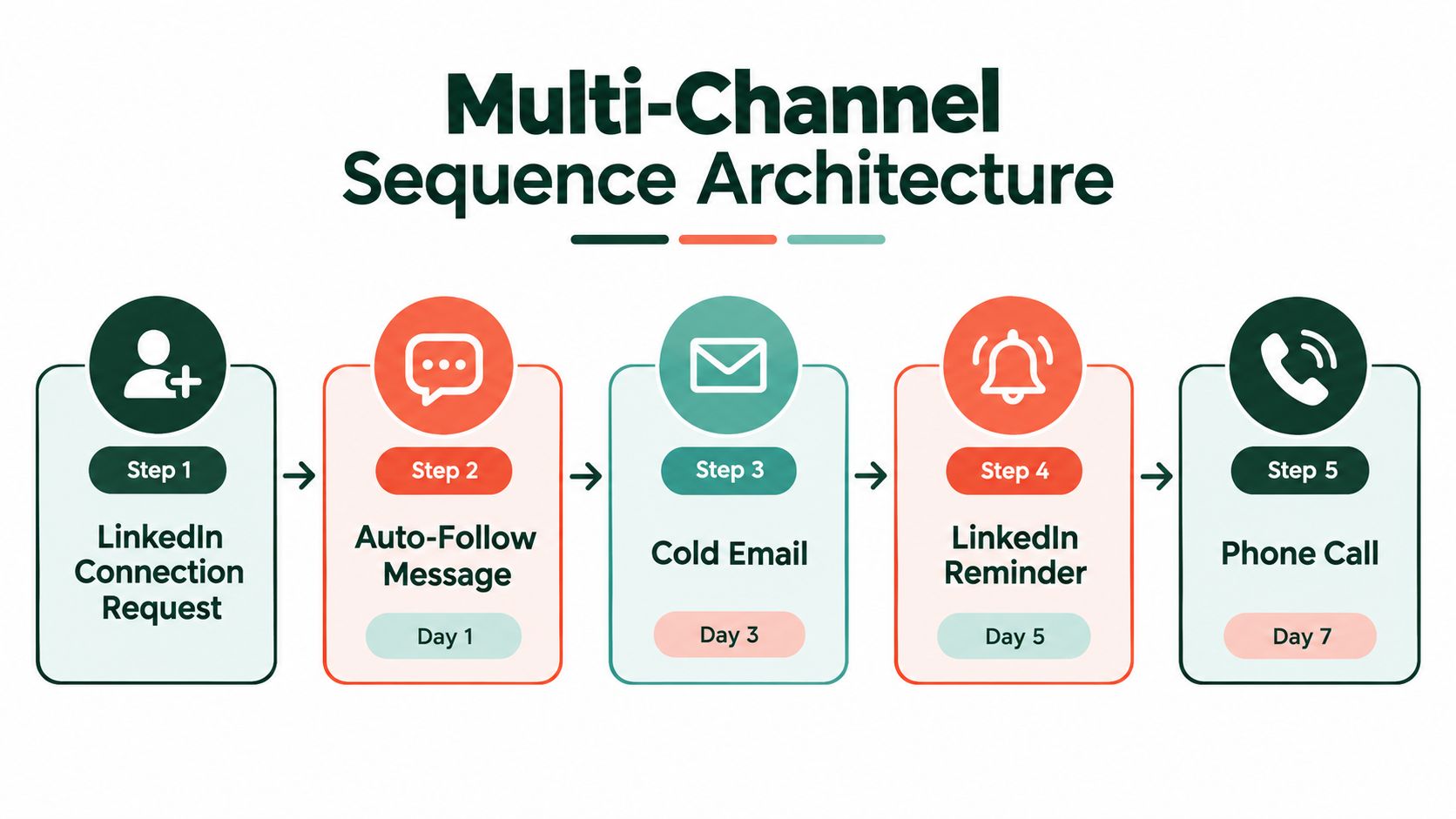
The available benchmark supports a staged design. Connection notes generated 3.0% replies, while outbound messages sent after acceptance generated 10.4% replies in Expandi's dataset of 13.2 million connection requests and 6.7 million messages (Expandi's LinkedIn outreach benchmarks). Keep the invitation lightweight, then make the substantive point after acceptance.
A practical sequence architecture
Step one, connection request. Give one relevant reason to connect, such as a shared market, role-specific issue, or verified trigger. Do not attach a link or ask for a meeting inside the invitation.
Step two, post-acceptance value message. Acknowledge the connection and offer a useful observation. The recipient should see a reason to continue without translating a product pitch into a business problem.
Step three, email reinforcement. If the contact is legitimately available for email outreach, send a concise email that develops the same point. Add context rather than copying the LinkedIn message. Keep the original relevance visible.
Step four, LinkedIn reminder. Return to the trigger or observation. The reminder should lower the effort required to respond, not reproduce the entire pitch.
Step five, human call or handoff. Call only when the account, role, and timing justify it. Reference the prior context so the conversation feels continuous.
The sequence needs stop rules more than additional steps. Stop after a reply, pause on “not now,” remove people who change roles, and route positive intent to an owner. Teams designing the next stages can use these B2B lead nurturing strategies to connect replies with lifecycle follow-up.
Order should reflect the segment. A warm engager may receive a human message first, while a cold account may need a signal-led LinkedIn touch before email. Each contact should add context, change the channel's job, or offer a clear next action.
The video below shows outreach as one connected workflow rather than isolated sends.
Leveraging Intent Signals for Deep Personalization
Adding a first name isn't personalization. It's formatting. Useful personalization answers a harder question: why should this person hear from us today?
The strongest inputs usually come from three layers. Firmographic data identifies whether the account fits. Social signals show what the buyer or company is discussing. Intent signals suggest that a relevant problem may be active now. I use Apollo for data enrichment, Trigify for social signals, and Whitewhale for intent signals as separate inputs rather than treating one data source as a complete profile.
Turn signals into message decisions
A signal is valuable only when it changes the action. A funding announcement might justify account prioritization, but it doesn't automatically justify a message. A leadership change may identify a new stakeholder, yet the message still needs a relevant business reason. Content engagement can indicate interest, but one interaction shouldn't become an exaggerated claim about buying intent.
Use a simple signal record:
Trigger: What happened?
Evidence: Where did the information come from?
Role relevance: Why does it matter to this person?
Message angle: What useful observation follows?
Next step: What can the buyer do without significant effort?
For example, a leadership change can prompt research into the executive's priorities and existing initiatives. A relevant post can support a concise response that addresses the topic rather than hijacking it for a sales pitch. A hiring signal can inform segmentation, but the outreach should connect the hiring pattern to a plausible operational problem.
The personalization paradox is operational. Fully manual research produces quality but doesn't scale efficiently. Fully automated AI drafting produces speed but often turns weak inputs into confident fluff. The practical middle is structured enrichment plus human review. Feed the system a small number of verified signals, ask it to draft a restrained opener, and reject anything that invents context or overstates certainty.
Segment before you automate
Signal-led personalization works best when segmentation is explicit. Separate founders from functional leaders, active engagers from silent prospects, and high-fit accounts from opportunistic names. This B2B marketing segmentation guide is useful for translating audience differences into campaign logic.
Don't cram every signal into one message. One strong trigger and one supporting detail usually create a clearer opening than a paragraph of research. The prospect should recognize the relevance immediately, while the sender retains enough context for a natural follow-up.
Research into 2025 and 2026 outreach also points to a changing personalization problem. One compilation reported approximately 45% acceptance for personalized requests versus about 15% for generic requests, while Reachium reported accepted-connection replies declining from 32.2% in 2025 to 22.0% in 2026, a relative decline of about 32% (Overloop's benchmark compilation). The implication isn't that AI personalization is useless. It's that superficial personalization is easier to produce, so specificity, timing, and audience fit increasingly separate useful messages from automated noise.
Testing Variables and Iterating Based on Funnel Metrics
Copy changes rarely fix a broken outbound system. Find the funnel constraint, change one variable, and measure whether more prospects reach the next stage.
Track three metrics first:
Acceptance rate: accepted connection requests divided by sent requests.
Reply rate: unique replies divided by the relevant message population.
Meetings booked: meetings attributed to the sequence, rather than conversations that sounded positive.
Keep each denominator visible. A reply to a connection note cannot be compared directly with a reply after acceptance. One benchmark separates 3.0% note replies from 10.4% replies to post-acceptance messages, showing why dashboards need stage-specific definitions. Another benchmark tracks meetings among accepted connections, which keeps reply volume from becoming a false proxy for pipeline. Treat these figures as reference ranges, not targets.
Test one layer at a time
If acceptance is weak, examine targeting, profile credibility, request relevance, and pacing. Rewriting the post-acceptance CTA first will not address a problem that prevents prospects from reaching that step.
If acceptance is healthy but replies are weak, test the first message after connection. Compare a direct observation with a short value offer, or change timing while leaving the copy unchanged. Keep the audience, sender group, and sequence rules stable so the result remains interpretable.
If replies arrive but meetings do not, inspect qualification and handoff. The campaign may attract curiosity without a commercially relevant problem, or the CTA may request a meeting before the prospect has enough context. Read the actual replies, then compare them with meeting outcomes. The reply count alone cannot show whether the sequence is creating buying intent.
Test long enough to make a useful comparison, but do not declare a winner from a handful of responses. Benchmark research can establish broad operating ranges, while your segment, market, sender credibility, and offer determine the local result. Use the same discipline across LinkedIn and email. A weak LinkedIn transition may need a different follow-up cadence, not another version of the same sentence.
Diagnostic matrix for sequence bottlenecks
Symptom | Likely Cause | Engineering Fix |
|---|---|---|
Low acceptance | Weak ICP fit, poor profile credibility, or generic request context | Narrow the audience, improve the sender profile, and add a verified relevance signal |
Healthy acceptance, weak replies | The post-acceptance message asks for too much or lacks a useful reason to respond | Rewrite the first follow-up around one observation, one benefit, and a low-friction question |
Replies without qualified interest | The trigger attracts attention but not a commercially relevant problem | Tighten the segment and define qualification criteria before launch |
Positive replies, few meetings | Slow routing, unclear ownership, or an overly aggressive CTA | Set a human handoff rule, assign an owner, and offer a smaller next step |
Replies decline during a campaign | Message fatigue, list drift, or a changing signal | Rotate angles, clean the list, and pause records whose trigger is no longer current |
Restrictions or warnings | Excessive activity, prohibited tooling, or unnatural patterns | Stop activity, review platform policy, reduce risk, and reassess whether automation is appropriate |
The test plan should cover operations as well as wording. Compare sender groups, response time, signal types, email follow-up, and handoff outcomes. When the dashboard shows a leak, fix the system responsible for that leak. Pipeline quality is the final measure, so optimize transitions between stages rather than chasing a higher reply rate in isolation.
Operating Your Outbound System for Long-Term Pipeline
A launch is only a first test. Long-term pipeline comes from operating outbound as a revenue function, with weekly review, clear ownership, and recorded changes. Judge the system by the audience, signal, sender, channel, and handoff that create qualified opportunities, not by whether one template received replies.
Performance changes by market and season. Treat broad benchmarks as context rather than campaign targets, and report results by market, segment, and stage. A global reply rate can hide weak routing in one region or strong intent in another, which makes segmentation necessary for useful decisions.

Run the system with a weekly control loop
A practical review covers:
Data quality: Remove customers, duplicates, opt-outs, role changes, and expired triggers.
Funnel health: Review acceptance, replies, qualified conversations, meetings, and opportunities by segment.
Message quality: Read positive, negative, and ambiguous replies manually.
Operations: Check stop rules, routing speed, ownership, and unresolved conversations.
Experiment log: Record what changed, why it changed, and which metric should move.
The test plan must cover operations as well as wording. Compare sender groups, response time, signal types, email follow-up, and handoff outcomes. If acceptance is healthy but opportunities are not advancing, inspect qualification and routing. If email follow-up creates meetings while LinkedIn replies stall, adjust the sequence rather than rewriting every message.
Attribution should connect each meeting to its list, signal, message variant, sender, and channel. The Social Search describes this connected work across ICP definition, data, messaging, sending, routing, and reporting. Its revenue operations overview provides context for assigning these responsibilities across the wider GTM function.
Bring in fractional GTM leadership when activity exists without an operating rhythm, ownership is fragmented, or APAC expansion requires regional process instead of another list export. A fractional operator can define the system, document the playbook, connect the tools, and train the team to run it after handoff.
Operator's checklist: clean list, credible sender, conservative pacing, signal-led segment, short sequence, stop-on-reply logic, fast human handoff, and one dashboard with stage-specific metrics.
LinkedIn automation messaging should function as a living revenue system. Review the data, change one lever at a time, and increase volume only after the funnel behaves predictably. If the team cannot explain why a prospect received a message or what happens after a reply, the system needs more controls before expansion.
The Social Search designs and operates outbound systems that connect ICP research, signal-driven targeting, LinkedIn and email sequencing, routing, and pipeline reporting for B2B teams in APAC and global markets. Visit The Social Search to discuss a system build or an embedded fractional GTM engagement that turns LinkedIn automation into an accountable pipeline process.
