10 B2B Lead Nurturing Strategies That Convert
Explore 10 b2b lead nurturing strategies for better timing, personalization, channel mix, intent signals, and APAC pipeline growth.
More follow-ups don't create better B2B lead nurturing strategies when the underlying system is disconnected. If the ICP is vague, contact data is incomplete, buying signals aren't routed, and sales doesn't know when to act, another email only adds noise. The nurture program fails before the first touch because the team hasn't decided whom it should prioritize or what meaningful behavior should change the next action.
The practical alternative is to build nurturing as a connected operating system. Start with account selection, add intent and behavioral triggers, coordinate email and LinkedIn, develop content for different stakeholders, create conversations, supply proof, and define a sales handoff that people can execute. A commonly cited benchmark is 6 to 12 touches before conversion, which supports persistence, but persistence only works when every touch has a reason to exist. Lead-generation benchmark coverage provides that context.
This system-first view is especially useful for APAC and global outbound, where channel preferences, timing, language, and follow-up ownership vary by market. It's the type of connected GTM approach associated with The Social Search, which links ICP definition, data, messaging, routing, and channel operations instead of treating them as separate campaigns.
Table of Contents
1. Account-Based Marketing with Intent Signals
Account-based nurturing begins with a commercial decision, not an automation workflow. Choose accounts that fit your ICP, identify the roles that influence the purchase, and then use intent signals to decide when those accounts deserve attention. A pricing-page visit, relevant content download, job change, or hiring pattern can be useful, but no single signal should automatically make an account sales-ready.
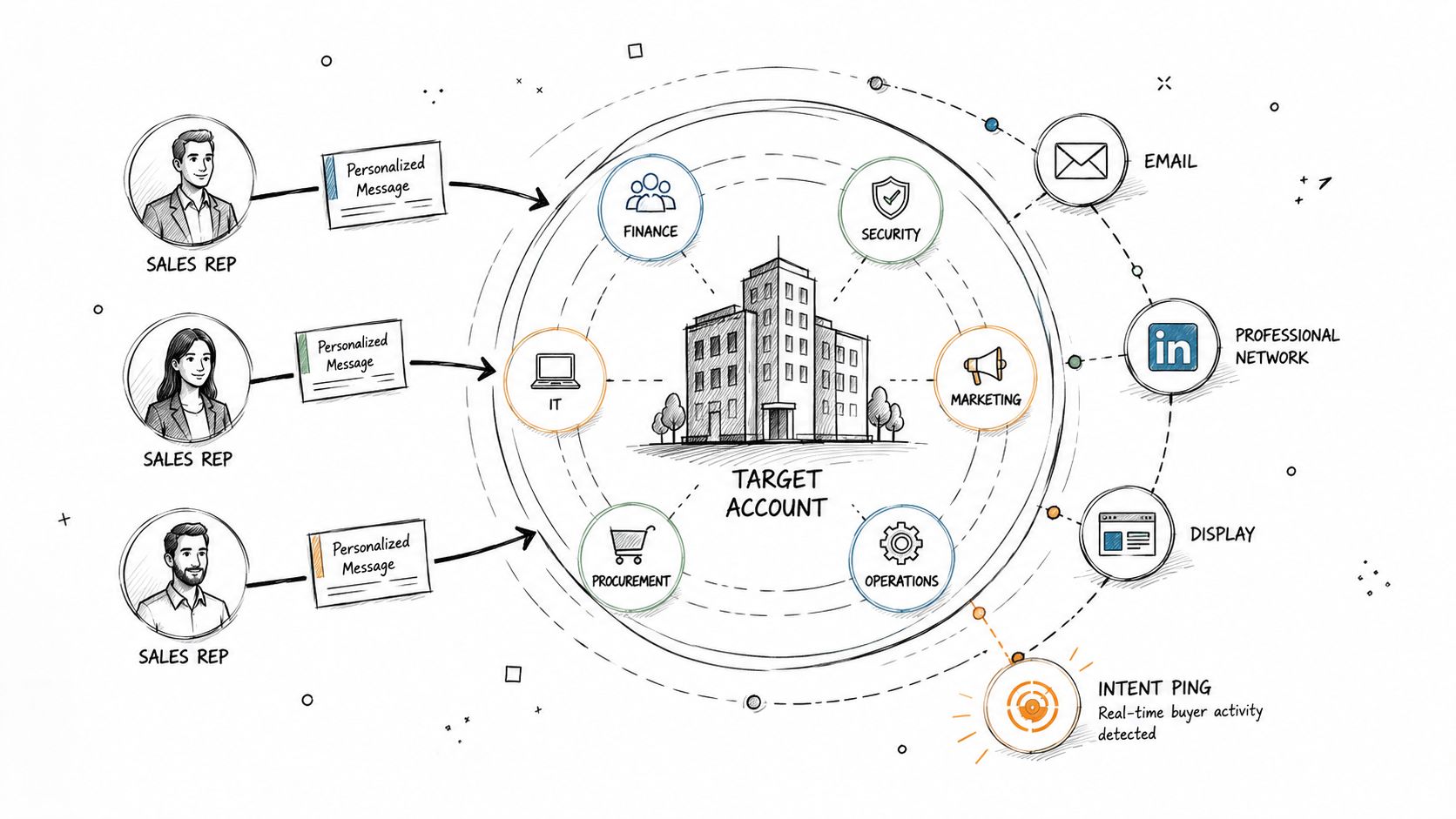
Run a focused pilot with a manageable account set. For each account, map a champion, economic buyer, technical evaluator, and likely blocker. Give each person a different reason to engage, while keeping the commercial narrative consistent. A technical evaluator may need integration detail, while an executive may need a concise business case.
Whitewhale fits when you need intent signals to inform account prioritization. Apollo can support enrichment and contact discovery, but enriched records still require human review. Bad data makes an automated mistake look more precise.
Practical rule: Score the account and its buying group, not just an individual contact.
Measure account engagement, meetings across stakeholders, opportunity creation, pipeline influenced, and deal quality. Don't optimize for lead volume when the strategy is designed to create coordinated account movement. For a deeper operational perspective, see Pipecorn's ABM strategy guide.
2. Cold Email Sequences with Personalization and Testing
Cold email works best when it behaves like a structured conversation rather than a batch send. The first message should establish relevance through a real business context, then each follow-up should add a different reason to respond. Repeating the same pitch with new subject lines isn't nurturing. It's repetition.
Start with a narrow hypothesis. For example, target revenue leaders at companies entering a new market and test whether the message should lead with pipeline creation, localization, or sales capacity. Keep the email short, use one clear CTA, and make the response easy. A question that can be answered quickly often creates less friction than an immediate meeting request.
Use Instantly where cold email sequencing, sending infrastructure, deliverability controls, and reply-based automation need to work together. Warm sending infrastructure gradually, monitor bounce and reply behavior, and suppress contacts as soon as they reply, opt out, or become irrelevant.
Test the message, not your entire system
Change one major variable at a time. Test the opening hook before changing the CTA, then test the offer before changing the audience. A positive reply is more useful than an open because it shows that the message created enough relevance for action.
Use cold email response-rate guidance to frame the conversation, but don't treat any benchmark as a promise. Your real baseline depends on list quality, offer strength, market, sender reputation, and timing. Route positive replies directly to the assigned owner, and document why the prospect responded so the next touch feels informed.
3. LinkedIn Outreach and Multi-Touch Campaigns
LinkedIn nurturing should feel like professional recognition, not an automated obstacle course. Start by following the prospect's work, reading their recent posts, and identifying a credible reason to connect. A connection request tied to their role, company direction, or shared professional context has more substance than a generic compliment.
HeyReach is relevant when LinkedIn outreach needs repeatable sequencing and campaign coordination. Automation should support the workflow, not replace judgment. Review profiles before launching, limit aggressive behavior, and pause outreach when a person engages or replies.
A strong sequence may begin with thoughtful engagement on a relevant post, continue with a connection request, and then move into a short message that references the original context. Share useful material only when it answers a likely question. Sending a product brochure immediately after connecting usually makes the interaction feel transactional.
LinkedIn lead-generation guidance can help teams structure the channel, but APAC campaigns still need local judgment. Buyers in Singapore, Australia, Japan, and other markets may differ in formality, response timing, and preferred channel. Don't assume that one regional playbook will transfer unchanged.
Once a LinkedIn conversation gains momentum, continue it through email only with permission or a clear business reason. Cross-channel follow-up should preserve context. The prospect shouldn't have to explain the same issue twice.
4. Behavioral Trigger-Based Nurturing
Calendar-based nurturing asks, “What should we send on day seven?” Trigger-based nurturing asks, “What changed, and what should happen now?” That distinction improves timing because the workflow responds to evidence instead of treating every contact as if they followed the same journey.
Useful triggers include pricing-page activity, visits to implementation content, a job change, a funding announcement, a new hiring pattern, or repeated engagement from several people at one account. Social activity can add context, especially when a prospect discusses the problem your offer addresses. Trigify can help capture social signals that would otherwise remain outside the CRM.
A trigger becomes useful only when it changes an action. Define the signal, the owner, the message, the suppression rule, and the response window before turning it on.
High-confidence signal: Connect the behavior to a specific message and sales owner.
Weak signal: Keep the account in a lighter nurture path rather than forcing a sales task.
Multiple signals: Increase priority only when fit and behavior support each other.
Negative signal: Pause or reduce contact when the prospect disengages or opts out.
Marketing automation workflow guidance is useful for designing routing logic, but automation can't repair unclear ownership. A pricing visit that lands in a generic queue is still a missed opportunity. Send qualified triggers to the assigned account executive or SDR, include the evidence, and show the recommended next step.
5. Nurture Email Campaigns and Drip Marketing
Drip email earns attention by helping buyers make progress without demanding a meeting at every stage. A person who downloads an educational guide shouldn't automatically receive a demo sequence. First, identify the subject they care about, then offer the next useful piece of information.
Segment by role, account type, buying stage, and declared preference. Zero-party data, such as a selected topic, preferred format, or buyer-chosen cadence, can be more reliable than assumptions based on a single click. Consent-led frequency control also protects trust and deliverability. More automation isn't always better if the buyer experiences it as pressure.
Build progression into the sequence
An awareness track might explain the operational problem. A consideration track can compare approaches, address implementation concerns, and provide customer proof. A decision track should help the internal champion answer procurement, security, technical, and financial questions.
Use soft CTAs early, such as a relevant guide or webinar. Move to a consultation only after the prospect displays stronger intent or explicitly requests help. Email marketing strategy guidance can support the channel plan, but your own engagement and pipeline data should determine the cadence.
Track replies, meaningful clicks, content progression, meetings, opportunities, and unsubscribes. Open rates can provide directional information, but they shouldn't decide whether a nurture program is commercially successful. Use progressive profiling to learn more over time instead of putting every question on the first form.
6. Omnichannel Sequencing with Email, LinkedIn, and Ads
Omnichannel nurturing isn't the same as copying one message into three platforms. Each channel should perform a distinct job. Email can carry a detailed argument, LinkedIn can create a lighter professional interaction, and advertising can maintain recognition while the buyer researches independently.
Build the sequence around a shared account state. If someone replies to email, stop the automated LinkedIn messages. If an account visits an implementation page, shift the ad creative toward proof or technical validation. If the contact hasn't engaged, reduce pressure rather than adding another channel.
Buyers don't experience your CRM stages. They experience the combined frequency and quality of your messages.
Coordinate audience sync carefully and use suppression lists across platforms. A prospect who has already booked a meeting shouldn't keep seeing acquisition ads. Set a cross-channel contact policy, and let sales override it when a live conversation begins.
Measure both direct and assisted contribution. Last-touch reporting may credit the channel that captured the meeting, while LinkedIn engagement or advertising may have supported recognition earlier. The useful question is not which channel “won.” It's which sequence created movement from target account to conversation to pipeline.
APAC execution needs country-level adaptation. A channel mix that works for one market may be poorly suited to another, so compare response quality, not just activity.
7. Content-Driven Lead Nurturing and SEO Integration
Content gives buyers a way to evaluate your expertise without entering a sales conversation. It also gives outbound teams a useful destination beyond “book a demo.” The strongest content answers a specific buying question, such as how to compare approaches, justify investment, manage implementation, or avoid a common operational failure.
Start with search intent and sales objections. Interview customers and revenue teams, then build pages around the language buyers use. Technical SEO matters because even excellent content struggles when search engines can't crawl, understand, or index it properly. SearchAtlas can support technical SEO workflows, while Outrank is relevant for planning and producing SEO content.
Connect content to routing
A visitor reading an awareness article doesn't necessarily need sales contact. A visitor returning to comparison, pricing, security, or implementation content may deserve a different path. Connect content events to CRM records where consent and data quality allow it, then use those events as context rather than automatic proof of buying intent.
A practical content system includes ungated educational material, more detailed evaluation resources, customer proof, and implementation assets. Outbound messages should link to the asset that matches the prospect's current concern. Content should also tell sales what the buyer may already understand, so follow-up begins at the right level.
Don't confuse traffic with nurture performance. Measure qualified engagement, return visits, replies influenced by content, meetings, pipeline, and the questions prospects ask after consuming an asset.
8. Social Proof and Community-Based Nurturing
Buyers need evidence that your solution works in conditions similar to theirs. Social proof is most persuasive when it matches the prospect's industry, company context, role, and risk profile. A technical evaluator may care about deployment detail, while an executive may need confidence that the change is commercially justified.
Create proof assets with the customer's permission and make the situation clear. Explain the starting problem, the implementation context, the people involved, and the outcome without turning every story into a vague success statement. If you don't have permission to publish precise results, describe the operational change qualitatively.
Community can extend proof beyond a static case study. Invite prospects to educational sessions, customer forums, or peer discussions where they can see how existing users think through the problem. The community should provide value even when a prospect isn't ready to buy. Otherwise, it becomes another disguised sales channel.
Match proof to role: Give finance, technical, operational, and executive stakeholders material they can use internally.
Use customer language: Preserve the terms buyers recognize instead of replacing them with marketing slogans.
Show constraints: Explain what required effort, change management, or integration.
Respond to criticism: Review platforms and public feedback reveal objections your nurture content should address.
Customer advocacy needs a process. Identify willing customers, prepare them well, and make participation easy. Proof should reduce perceived risk, not create another unsupported claim.
9. Conversational Nurturing with Chatbots and Live Chat
A form asks buyers to wait. A conversation lets them clarify the question that brought them to your site. That matters when the prospect needs help choosing a resource, understanding fit, or deciding whether a meeting is worthwhile.
Use chatbots for predictable requests, such as product basics, qualification questions, resource recommendations, and meeting availability. Route complex questions to a person. A scripted bot that refuses to acknowledge a specific technical concern damages trust faster than a delayed email.
Respond.io is a relevant option when WhatsApp automation and multi-channel messaging need to connect with qualification and follow-up workflows. WhatsApp can be particularly useful in APAC, but consent, regional norms, and message expectations must shape the program. Don't assume that a phone number equals permission to send promotional messages.
Treat conversation data as buying intelligence
Log chat outcomes in the CRM. Capture the question, stated use case, urgency, role, and requested next step. That information can improve email content, sales enablement, website copy, and routing rules.
Social and messaging conversations can also support nurture continuity. If a prospect asks about implementation, the next email should provide implementation detail, not another generic overview. The conversation is the signal. The automation should respond to it.
Human handoff rules should be explicit. Define which questions, account types, and intent combinations require immediate sales attention, and give the receiving rep enough context to continue naturally.
10. Account Intelligence and Predictive Scoring for Prioritized Nurturing
A score only creates value when it changes the next action. Predictive models can rank accounts using fit, behavior, engagement, and similarity to existing customers. They can also create false confidence when data is incomplete, biased toward past buyers, or disconnected from current market priorities.
Start with an account model that reflects the buying motion. Define the firmographic traits that matter, then add behavior and intent signals. Use separate scoring rules for segments with different deal sizes, stakeholders, or sales cycles. A small business contact and an enterprise buying group should not automatically share the same threshold or handoff rule.
Make the score operational
Assign an action to every score band. High-priority accounts can enter coordinated sales and marketing plays. Mid-priority accounts can receive trigger-based nurture when new activity appears. Low-fit or low-intent records should receive limited communication until stronger evidence emerges.
Connect those actions to the broader system. Whitewhale or another account-data workflow can support prioritization, while Instantly and HeyReach can execute approved email and LinkedIn touches. Use Apollo data already collected earlier in the process to fill gaps, then verify role, account fit, consent, and recent activity before routing.
Review the model against commercial outcomes. Check whether high-scoring accounts produce qualified meetings, advance through the pipeline, and remain attractive opportunities. If salespeople override the score, record the reason. Their feedback may expose missing firmographic fields, misleading engagement events, or an ICP that needs revision.
A model is useful only when a human knows what to do after the score changes.
Measure routing accuracy, accepted handoffs, opportunity creation, pipeline progression, and revenue contribution. Model complexity matters less than whether the score improves prioritization and gives each team a clear next move.
10-Strategy B2B Lead Nurturing Comparison
Strategy | Implementation Complexity 🔄 | Resource Requirements | Expected Outcomes ⭐📊 | Ideal Use Cases | Key Advantages ⚡💡 |
|---|---|---|---|---|---|
Account-Based Marketing (ABM) with Intent Signals | Very high 🔄, ICP, orchestration, integrations | High, intent data, ABM platform, dedicated AM/AE/SDR time | Very effective ⭐⭐⭐⭐, higher conversion, larger deals, strong pipeline attribution 📊 | Enterprise / mid‑market high‑value accounts; long sales cycles | Precision targeting; sales/marketing alignment; efficient spend on high‑potential accounts ⚡💡 |
Cold Email Sequences with Personalization and Testing | Medium 🔄, sequence design, deliverability setup | Medium, sequencing tool, data enrichment, copy/testing resources | High ROI ⭐⭐⭐, scalable reply rates; fast lead generation 📊 | Scalable outbound prospecting; early growth and SDR teams | Scalable templates; rapid A/B testing; low incremental cost per send ⚡💡 |
LinkedIn Outreach and Multi‑Touch Campaigns | Medium 🔄, platform limits, manual personalization | Low–Medium, LinkedIn tools, profile/content time | Moderate ⭐⭐⭐, trust building, solid meeting conversion 📊 | Relationship‑driven sales; APAC enterprise targeting | Builds credibility in professional context; good for hard‑to‑reach decision‑makers ⚡💡 |
Behavioral Trigger‑Based Nurturing | High 🔄, real‑time signals, integration complexity | High, intent providers, automation, routing rules | Very effective ⭐⭐⭐⭐, timing boosts response (50–70% uplift reported) 📊 | Time‑sensitive buying windows; product/price page visitors | Highly relevant outreach; scalable contextual personalization; clearer attribution ⚡💡 |
Nurture Email Campaigns and Drip Marketing | Medium 🔄, content workflows and CRM integration | Medium–High, content creators, marketing automation, segmentation | Moderate (long‑term) ⭐⭐⭐, builds trust; steady MQL flow over months 📊 | Top/mid‑funnel education; lead warm‑up and onboarding | Cost‑effective at scale; low unsubscribe rates; reusable assets ⚡💡 |
Omnichannel Sequencing: Email + LinkedIn + Ads | Very high 🔄, cross‑channel sync, attribution challenges | High, ad spend, multiple platforms, campaign managers | High ⭐⭐⭐⭐, stronger brand recall and multi‑touch conversion lift 📊 | Complex buying committees; regions with mixed channel preferences | Reinforced messaging across channels; increased conversion probability ⚡💡 |
Content‑Driven Lead Nurturing and SEO Integration | Medium 🔄, content strategy, SEO practices | Medium–High, writers, SEO tools, distribution budget | High (long‑term) ⭐⭐⭐⭐, compounding organic leads and authority 📊 | Inbound/Demand‑gen focus; long‑term brand building | Sustainable traffic, authority, and lower CPL over time ⚡💡 |
Social Proof and Community‑Based Nurturing | Medium 🔄, community ops and advocacy coordination | Medium, customer success, content production, moderation | Moderate ⭐⭐⭐, higher trust and lower sales friction 📊 | SMBs, product‑led growth, retention & referrals | Credibility via peers; scalable repurposable assets; stronger conversions from trust ⚡💡 |
Conversational Nurturing: Chatbots and Live Chat | Medium 🔄, conversation design, CRM routing | Medium, chat platform, bot design, live agents | High ⭐⭐⭐⭐, immediate qualification and engagement; faster routing 📊 | APAC messaging‑preferred markets; high web traffic/product trials | Instant responses; efficient qualification; scalable via bots ⚡💡 |
Account Intelligence & Predictive Scoring | High 🔄, modeling, data pipelines, bias management | High, historical data, analytics, enrichment tools | Very effective ⭐⭐⭐⭐, prioritization improves close rates and efficiency 📊 | Data‑rich orgs, sales‑ops driven territories, enterprise focus | Focuses resources on highest‑probability accounts; dynamic nurturing and improved win rates ⚡💡 |
Turn the List Into a Nurture Operating System
The ten strategies work best as a sequence, not as a menu of unrelated campaigns. If targeting is unclear, start with ICP definition and account tiers before changing copy or buying another automation platform. If data is weak, clean and enrich account records, standardize fields, and identify which missing information blocks routing. If timing is poor, choose one high-confidence trigger and attach a clear owner, message, and response rule.
If engagement is low, audit relevance before increasing frequency. Review the audience, offer, proof, CTA, and channel fit. A nurture program can produce 50% more sales-ready leads at 33% lower cost, while nurtured leads can produce 47% larger purchases, according to the lead-nurturing benchmark summary. Those results support systematic nurturing, but they don't excuse generic campaigns. The same source frames nurturing as especially important because many early-stage leads aren't ready to buy immediately.
Execution quality remains a serious constraint. Only 8% of marketers rate their current nurture programs as excellent, while 45% say they need improvement and 14% describe them as poor or inadequate, according to Marketing Charts' nurture-program benchmark. The practical lesson is to fix workflow design, handoff discipline, consent, and content progression before expanding volume.
A sensible rollout looks like this:
Define the ICP, account tiers, personas, exclusions, and buying committee.
Enrich records and verify the data required for personalization and routing.
Select one high-confidence trigger, such as meaningful content intent or account activity.
Launch one focused email or LinkedIn sequence with a clear hypothesis.
Add a second channel only after the first workflow has suppression and handoff rules.
Create role-specific content and proof for the stakeholders most likely to block progress.
Measure replies, qualified meetings, accepted handoffs, pipeline, progression, and assisted conversions.
Review outcomes with sales and recalibrate the rules based on actual conversations.
Adoption matters as much as platform availability. A 2026 benchmark reports that 84% of B2B marketers use a marketing automation platform, while another reports 68% average user adoption across platforms and says 41% of active teams reach 71 to 100% adoption, according to the cited marketing automation benchmark. If reps don't trust the data or understand the workflow, the system will remain underused.
For APAC coverage, localize the account list, channel mix, timing, consent process, and sales ownership. The Social Search can help B2B teams design, build, document, and operate outbound systems that connect these components across APAC and global markets. Teams can also use nurture leads with onboarding dashboards as a reference point when deciding how to make workflow performance visible.
The strongest B2B lead nurturing strategies don't maximize touches. They improve the quality of each decision, from selecting the right account to recognizing the right signal and giving sales the right context.
The Social Search designs and operates outbound systems for APAC and global B2B teams, connecting ICP definition, enriched data, messaging, email and LinkedIn sequencing, signal-based routing, and pipeline reporting. If your nurture program needs clearer ownership and better execution, visit The Social Search to discuss a system build or embedded GTM support.
