B2B Marketing Segmentation That Drives Pipeline
Learn b2b marketing segmentation frameworks that turn firmographics, intent, and buying centres into prioritised pipeline for APAC and outbound GTM.
Your outbound team has a 6,000-account list, three versions of the ICP, and a dashboard full of MQLs nobody trusts. The campaign technically launched, but SDRs can't explain which accounts deserve attention today, why the message fits, or whether Singapore and Japan should receive the same sequence.
That's the practical problem with B2B marketing segmentation. A segment isn't useful because it has a label. It's useful when it tells sales who to contact, why now is the right time, which buying group to reach, and what motion the team should run. For cold email execution, Instantly can support sequencing and deliverability operations, while Apollo can help enrich account and contact data. For intent-layered targeting, Whitewhale is another relevant option.
The operating model that works is simple to state, but demanding to run: a stable macro layer, a ranked account layer, and a micro layer that changes as signals change. Build the macro layer around firmographic and use-case anchors, rank it with fit, need, and feasibility, refresh micro-segments from technographic, intent, and buying-centre signals, then match execution to each tier.
Table of Contents
Why Most B2B Marketing Segmentation Quietly Fails
The first failure is volume without ownership. A list of thousands of accounts feels like market coverage, but it often gives sales no practical queue. If accounts don't have a priority, a reason to contact them, and a named owner, SDRs either work the easiest records or revert to spray-and-pray outreach. The symptoms are familiar: low connect rates, inflated MQL counts, weak replies, and marketing-sales arguments about lead quality.
A second failure is putting personalization on top of a vague ICP. Changing a company name or inserting a local reference doesn't fix a segment that mixes different industries, buying triggers, use cases, and decision-makers. The copy may look customized while still addressing nobody's actual business problem. Teams then blame the channel, the sender, or the sequence when the upstream account selection is the core issue.
Practical rule: Personalization can improve a relevant message. It can't make an irrelevant account relevant.
The third failure appears during regional expansion. Japan and Singapore may both sit under “APAC,” but that label says little about language expectations, procurement patterns, partner access, buying roles, or the level of local proof required. Bundling them into one segment creates a campaign that's broad enough to miss both markets.
A workable segmentation system has four layers:
Macro segments: Build a stable set of 4 to 7 segments around industry, geography, company profile, and use case. The number is a practical operating range, not a universal law.
Priority ranking: Score accounts by fit, need, and feasibility so the team knows which segment deserves resources first.
Micro-segments: Refresh membership from intent, technology changes, hiring, funding, engagement, and buying-centre signals.
Execution pattern: Assign ABM, intent-triggered outbound, vertical messaging, nurture, or partner-led coverage according to segment quality.
The difference between a list and a system is whether the segmentation changes what someone does next. Teams building that connection between ICP, data, messaging, and execution can use B2B lead generation guidance as a practical reference point, but the operating discipline still has to live inside the CRM and sales workflow.
The Core Idea Behind B2B Market Segmentation
B2B segmentation has a useful historical foundation. In 1974, Wind and Cardozo introduced a two-stage approach that first divided industrial markets into macro-segments and then refined them into micro-segments, as documented in B2B market segmentation research. The distinction still matters because account-level classification and person-level buying context solve different problems.
Macro-segmentation answers, “Which kinds of organizations should we consider?” It uses observable characteristics such as industry, geography, size, growth stage, and operating model. Micro-segmentation answers, “Which account, buying centre, or use case deserves action now?” It adds behavior, need, technology, intent, and stakeholder context.
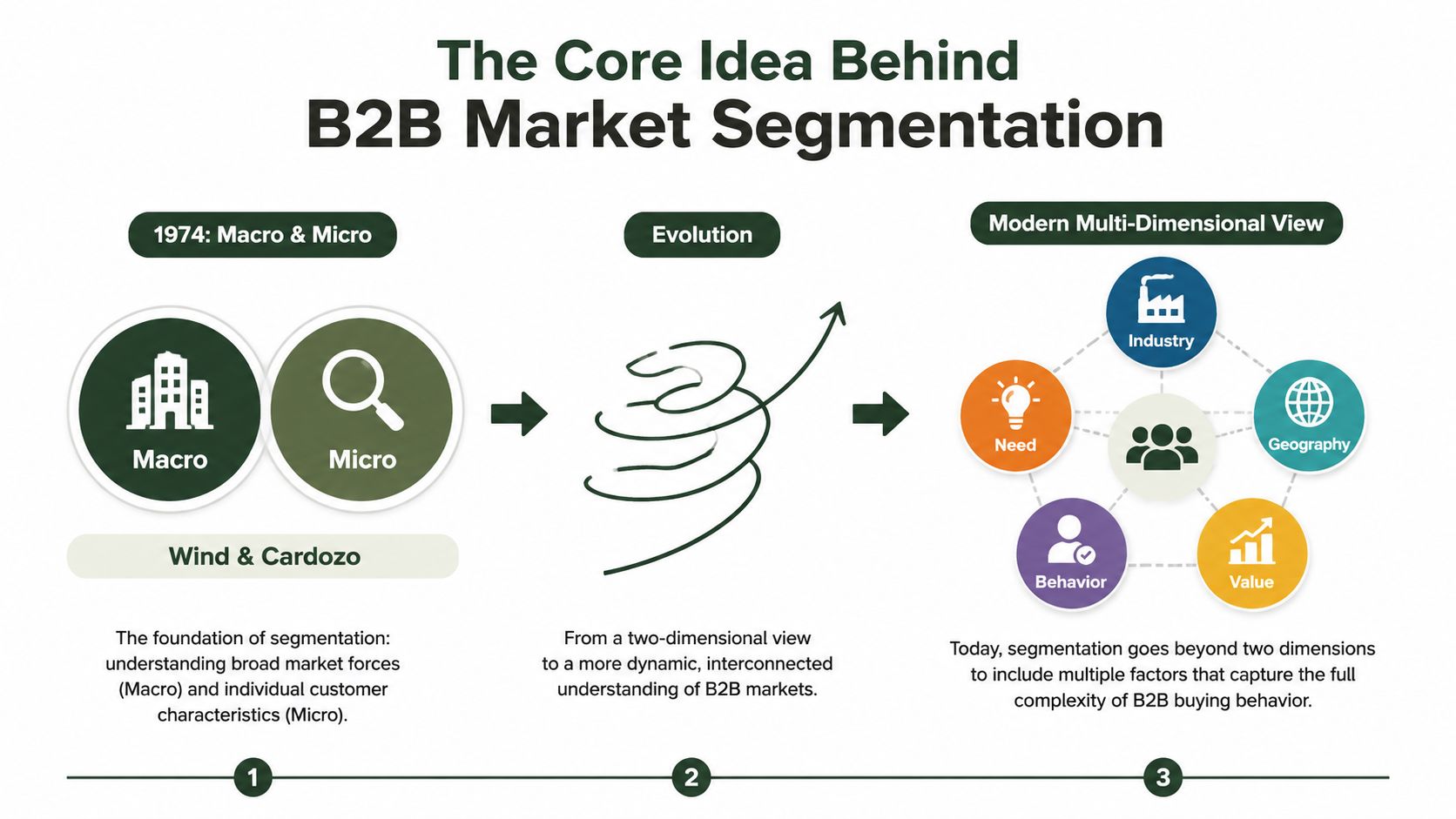
A filter such as “SaaS companies with 200 to 2,000 employees and an APAC headquarters” is an ICP starting point, not a complete segment. It tells you who the account is, but not what has changed, whether the company has a relevant problem, or which internal group owns the decision.
Three dimensions make a segment executable
A practical segment combines at least three independent views:
Account identity: Industry, size, revenue band, geography, growth stage, and operating environment.
Current motion: Technology adoption, hiring, funding, competitor research, content engagement, product usage, or other evidence of change.
Decision structure: Economic buyer, technical evaluator, operational champion, procurement, security, and the relationships among them.
The same company can belong to different campaigns depending on the product line and the current buying motion. A manufacturing account may be a broad vertical target for one offer, a competitor-displacement account for another, and a high-priority opportunity after a relevant hiring surge.
For readers who need a concise conceptual reference, AI customer segmentation definitions are useful for separating static audience description from more adaptive segmentation logic. In practice, the question isn't only whether an account fits. It's whether the segment can drive list construction, message selection, routing, and measurement.
That's also why persona work should connect to account design rather than float separately. A useful B2B buyer persona framework should identify the role's responsibilities, pressures, influence, objections, and preferred evidence inside the account.
The Five Segmentation Dimensions You Actually Need
No single dimension can carry a B2B outbound system. Each dimension answers a different operational question, and each fails when teams ask it to do more than it can.
Dimension | Best For | Where It Breaks |
|---|---|---|
Firmographic | Defining the addressable account universe and stable macro segments | It changes slowly and says little about timing or buying intent |
Technographic | Finding stack compatibility, replacement opportunities, and implementation context | Vendor data can be stale or incomplete |
Intent | Identifying accounts showing interest in a topic, category, or competitor | Signals become noisy without a mapped business topic and buying-stage interpretation |
Buying-centre | Assigning outreach to the people who influence, approve, evaluate, or use the purchase | Contact data can miss hidden influencers and consensus dynamics |
Use case | Connecting the offer to a specific operational or financial outcome | A broad use case can collapse into generic vertical messaging |
Firmographic anchors the market
Start with industry, employee headcount, annual revenue range, headquarters, operating regions, ownership, and growth stage. These fields help you define the macro universe and avoid wasting research time on accounts that could never buy.
Their limitation is speed. Firmographics rarely tell an SDR why an account should be contacted this week. They're the boundary conditions, not the trigger.
Technographics reveal environment
Technology data helps answer whether the account has the systems, architecture, or vendor relationships that make your offer plausible. It can also expose displacement opportunities, such as a target using a competing platform or operating with a fragmented stack.
Treat technographics as directional evidence. A listed installation may be unused, outdated, deployed only in one region, or scheduled for replacement. Verify important technology assumptions through job postings, public documentation, first-party engagement, and conversations.
Intent supplies timing, but not certainty
Intent can include topic surges, competitor research, review-site activity, repeat visits, or engagement with high-value pages. It's useful for moving an account from a general queue into an active one.
The failure mode is confusing interest with readiness. A company researching a category may be educating itself, comparing vendors, or solving a problem that won't receive budget. Tools such as Trigify can add social-signal context, but the signal still needs a topic map and a clear next action.
Buying-centre data changes the contact strategy
B2B purchases involve multiple roles. Segmenting only by lead title creates false confidence because the visible contact may not control budget, technical approval, procurement, or implementation.
Map the buying centre by role, influence, access, and likely objection. One contact may need business-case proof, another may need security evidence, and another may care about implementation effort. A single sequence rarely handles all three.
Use case gives the message a job
Use-case segmentation connects a company and buying group to a measurable outcome, such as reducing manual handoffs, replacing a legacy workflow, improving regional coverage, or standardizing reporting. It's the layer that turns “we help companies like yours” into a reason to reply.
For outbound, intent plus buying-centre context usually deserves the greatest weight because it combines timing with reachability. For APAC entry, use case plus geography and feasibility carries more weight because local execution, partners, language, and proof can determine whether a good-fit account is realistically serviceable.
Prioritising Segments With a Fit Need Feasibility Model
A segment ranking model prevents the most common prioritization mistake, treating firmographic fit as if it were buying readiness. A practical framework scores every account across fit, need, and feasibility, using 40 points for fit, 35 for need, and 25 for feasibility, as outlined in this B2B account prioritization model.
Dimension | Weight | Sub-factors | Sample APAC Mfg Score | Sample NA SaaS Score |
|---|---|---|---|---|
Fit | 40 | Industry, size, technology environment, geography, use-case match | Score against manufacturing and regional criteria | Score against SaaS and market criteria |
Need | 35 | Intent, competitor displacement, trigger strength, measurable pain, executive attention, budget path | Score evidence of operational or regulatory pressure | Score evidence of active category or competitor research |
Feasibility | 25 | Stakeholder access, sales-cycle practicality, language, partners, procurement, implementation readiness | Score local coverage, partners, and buying access | Score seller coverage, access, and implementation conditions |
The score doesn't need false precision. Its job is to force an explicit discussion about why an account belongs in a priority tier.
An APAC manufacturing segment might have strong fit because the industry and use case align, but weak feasibility if the company lacks a local partner, the account has a complex procurement process, or the team can't support the relevant language. A North American SaaS segment might score lower on strategic fit for a regional expansion thesis but higher on feasibility because seller coverage, buyer access, and implementation support already exist.
Use the columns to expose trade-offs
Fit asks whether you can help. Need asks whether the account has a reason to act. Feasibility asks whether your team can reach and serve the account under current conditions.
The trap is awarding nearly every point to fit. A large account in the right industry can look attractive while producing no meetings because there's no active problem or accessible buying group. Keep Need visible, and let Feasibility influence regional prioritization rather than treating it as an afterthought.
For APAC expansion, feasibility may deserve more practical attention than the default model suggests. The formal weights can remain a consistent baseline, while the team uses feasibility as a hard gate for accounts that lack partner coverage, local access, or a credible delivery path. A structured GTM strategy for startups can help connect that prioritization to channel and market-entry decisions.
Four Segment Driven GTM Plays Compared
The play must match the segment's strongest signal and the team's ability to act on it. Named-account ABM fits when the account and buying group are known. Intent-triggered outbound fits an active buying signal. Vertical plays fit a repeated use case across similar organizations. APAC-region plays fit markets where geography changes access, trust, delivery, or channel choice.
GTM Play | Strongest Segment Dimension | Required Inputs | Motion Intensity | Failure Mode |
|---|---|---|---|---|
Named-account ABM | Account identity plus buying-centre reachability | Named accounts, contact map, account hypotheses, coordinated channels | High, coordinated AE and SDR coverage | Personalizing accounts the team cannot reach or influence |
Intent-triggered outbound | Buying-stage intent plus relevant need | Topic map, trigger source, recency, contact data, suppression logic | High at the moment of signal | Reacting to category buzz instead of purchase intent |
Use-case vertical play | Repeated use case across an industry | Industry proof, pain language, outcome, objections, role mapping | Moderate, scaled with selective customization | Letting the vertical label replace a specific business problem |
APAC-region play | Geography plus feasibility and local buying context | Market coverage, partner access, localization, regional proof, routing | Variable, often multi-channel | Treating “APAC” as one market |
Named-account ABM requires a reachable buying centre, a credible account hypothesis, and enough contact coverage to coordinate outreach. For a deeper look at execution, see our guide on account-based marketing campaigns. Demandbase's account-based marketing campaign guidance addresses the coordination problem, but no platform fixes missing contacts or a weak reason to engage.
Intent-triggered outbound should respond to a buying-stage problem, not a popular topic. Define the trigger source, its recency, the reason it matters, and a suppression rule for accounts that are not ready or relevant. The message should connect the signal to the account's likely workflow, role, and business consequence.
Vertical plays scale when the outcome and pain language repeat across the segment. They still need industry proof, objection handling, and role-specific routing. A vertical label alone cannot support credible outbound.
APAC plays need country-level operating rules. Partner access, language coverage, local proof, channel preference, and procurement expectations can change who receives the message and how the deal progresses. Refresh these inputs as signals change, rather than treating the region as a fixed firmographic bucket.
No play deserves default status. Choose the motion from the segment's purpose, signal quality, reachability, and delivery conditions.
Matching Message Depth to Segment Quality
Personalization is a cost, not a moral virtue. A loose segment containing tens of thousands of companies doesn't deserve handcrafted copy because the account selection is still too broad to support a precise hypothesis. A tight segment with a named account, an active signal, and a mapped buying centre can justify deeper research.
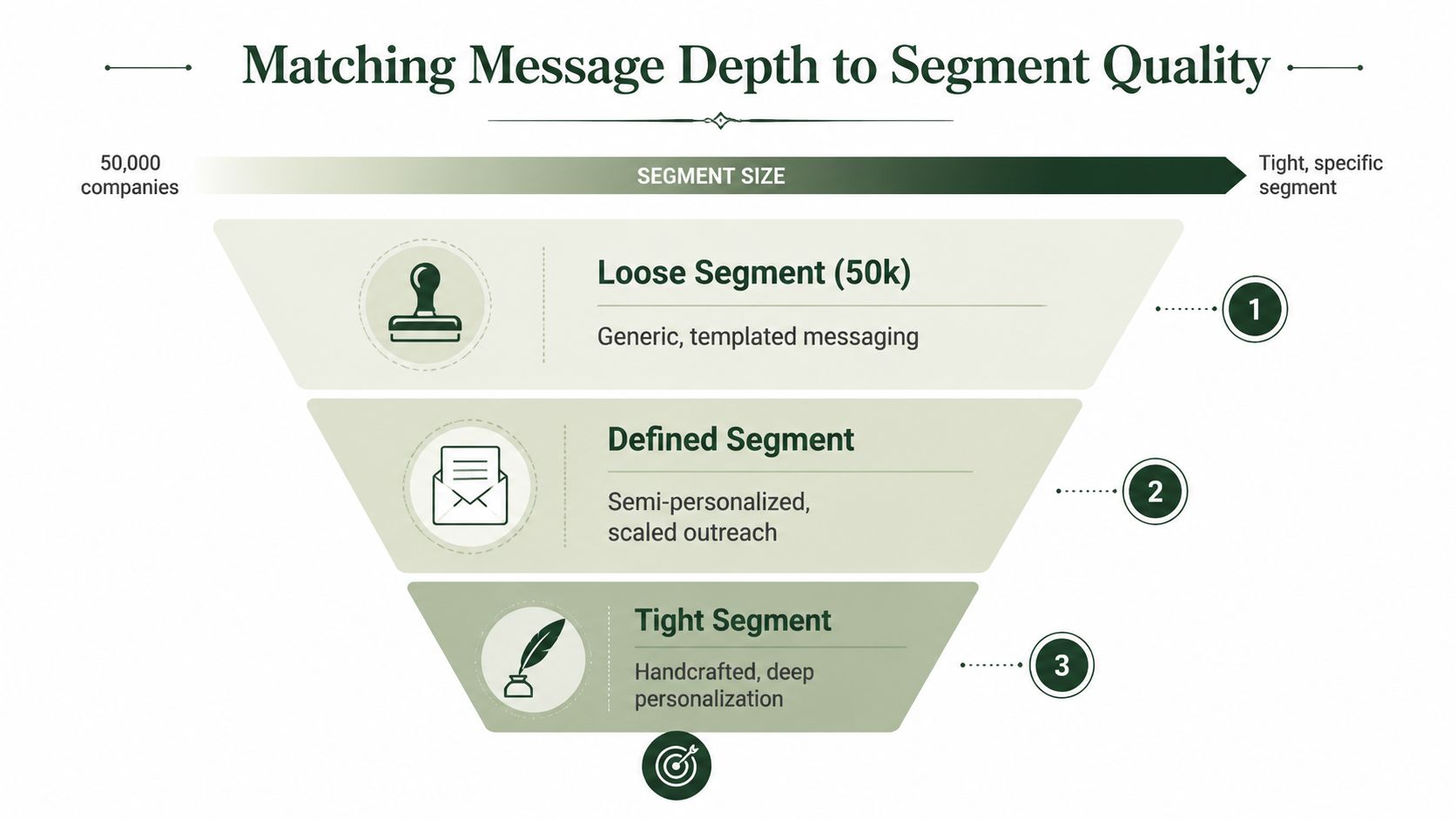
A useful depth ladder looks like this:
Loose segment: Use generic vertical messaging that establishes the problem and audience.
Defined segment: Merge firmographic context into scalable copy, such as industry, operating model, and company stage.
Use-case segment: Tie the message to a specific workflow, trigger, role, and expected business outcome.
Named-account segment: Write bespoke outreach around the account's situation, buying group, technology, public changes, and likely objection.
The common mistake is moving straight to bespoke copy because modern tools make it easy. That creates expensive research on weak accounts, inconsistent quality, and a false sense that the campaign is advanced.
A better rule is to connect message depth to the Fit, Need, and Feasibility score. High fit with low need gets a relevant educational message, not a heavy sales push. High fit and need with low feasibility may need partner-led outreach or nurture. High scores across all three dimensions justify multi-threaded, account-specific communication.
Your value proposition should remain stable enough to recognize across a segment, but the proof and problem framing should change as the segment tightens. A focused unique value proposition framework can help keep the core promise clear while allowing role, industry, and trigger-specific variations.
Treat Segmentation as a Living System Not a Quarterly Project
A quarterly worksheet becomes stale as soon as account conditions change. The practical alternative is to operate three loops with different owners, sources, and downstream users.
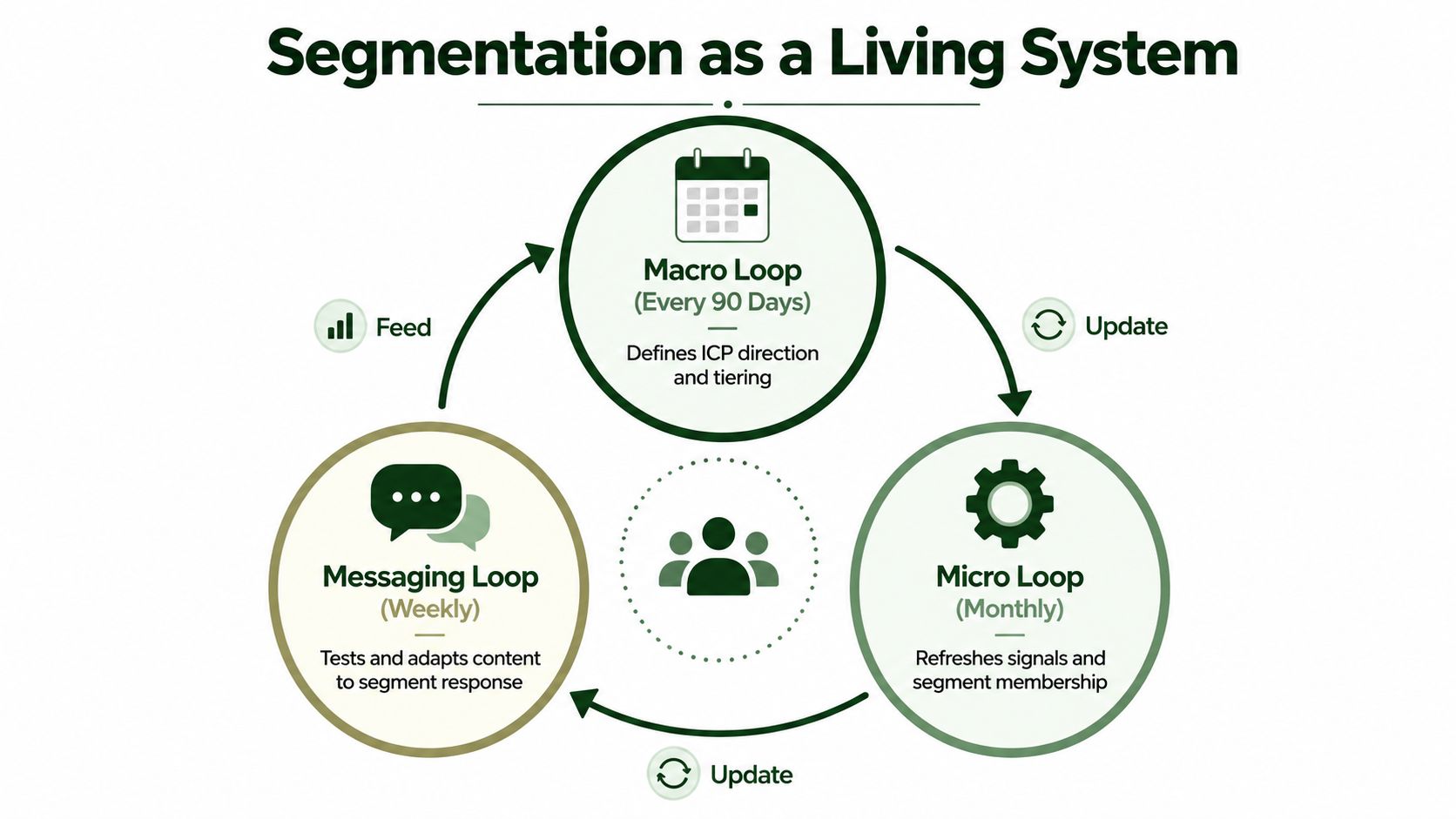
The macro loop runs on a longer planning rhythm. Marketing and RevOps use it to review ICP direction, segment definitions, regional boundaries, and account tiers. The mid loop checks whether account conditions have changed through technology, hiring, funding, engagement, and operational events. The micro loop feeds SDR queues with current intent, first-party activity, buying-centre changes, and suppression rules.
Each loop needs three named fields:
Owner: Who maintains the segment logic?
Trigger source: Which data changes membership or priority?
Consumer: Does sales, marketing, RevOps, or leadership use the output?
Sales needs an actionable queue and account context. Marketing needs audience definitions, content themes, and campaign measurement. RevOps needs data quality, routing, scoring, and historical movement. Put all three teams on one undifferentiated dashboard and nobody gets the view needed for their work.
First-party pricing-page activity, review-site research, technology changes, and social engagement can all support micro-segment refreshes. External intent providers such as Bombora and review platforms such as G2 may be useful inputs, but the team still needs a clear interpretation layer. A signal without an owner or action is decoration.
Static segmentation produces bloated TAM, SDR fatigue, and regional plays built on outdated assumptions. Living segmentation keeps the list smaller, the reason for contact clearer, and the operating system closer to the market.
Your 30 Day Segmentation Operating Plan
Start on Monday with an operating plan that produces working views, owners, and routing rules rather than another strategy slide.
Week one builds the account universe
On days one through three, define two or three macro-segments with explicit boundaries. Write down why each segment exists, which use case it represents, which geographies it covers, and which accounts are excluded. Assign an owner for every segment.
On days four and five, enrich accounts with firmographic, technographic, and intent data. Reconcile duplicates against the CRM, normalize geography and industry fields, and remove records that lack enough information to score responsibly.
Week two creates priority
Score every account against fit, need, and feasibility. Place accounts into A, B, and C tiers, then assign named SDR owners. Don't let a high-fit account jump tiers without evidence of need or a credible path to access.
Week three wires the plays
Use one-to-one ABM or coordinated account coverage for the strongest A-tier accounts. Use intent-triggered sequences and targeted vertical messaging for B-tier accounts. Put C-tier accounts into nurture, education, or a lower-intensity program.
Confirm routing, suppression, campaign attribution, and UTMs before launch. For teams building founder-led or SaaS content around segments, SaaS founder content ideas can provide useful inspiration, but the content still needs to map to a defined use case and buying stage.
Week four makes the system repeatable
Schedule signal refreshes, add an alert when an account changes tier, and run a 30-day review of which segments produced qualified movement. Track account-to-MQL conversion by segment each week. That metric proves whether the segmentation system is alive because it connects account selection to downstream response.
The Social Search designs and operates outbound systems that connect ICP definition, prioritized lists, data, messaging, sending, routing, and reporting for teams entering APAC or selling across global markets. If your segmentation is still a spreadsheet and your SDRs lack a reliable reason to contact each account, visit The Social Search to discuss building a signal-driven GTM system your team can own.
