Email Delivery Failure: A Practical Fix Playbook
Learn what email delivery failure means, why it happens, and how to fix it with practical steps that boost inbox success.
A campaign can show a healthy delivery rate while producing almost no commercial outcome. In a widely cited 2023 Validity benchmark, inbox placement was roughly 83.5%, meaning about one in six legitimate, permission-based marketing emails didn't reach the inbox. The same benchmark reported 6.1% placed in spam, with the rest lost to blocking and other non-inbox outcomes. Validity's 2023 Email Deliverability Benchmark makes the operational problem clear: email delivery failure often isn't a visible rejection at send time. It's filtering, rerouting, and silent loss.
That distinction changes the fix. A bounce report tells you that some messages failed at the server boundary, but it won't tell you whether accepted messages reached Primary, Promotions, a tab, or spam. The practical job is to measure the whole path, from authentication and reputation to placement, link health, and recipient response.
Table of Contents
Why Your Emails Stop Reaching the Inbox
A sender launches a carefully written campaign, then watches engagement collapse. Open rates fall sharply, but the bounce dashboard barely moves. Nothing appears obviously broken because the receiving servers are still accepting most messages.
That scenario is common because acceptance isn't the same as visibility. A receiving system can accept a message and still place it in spam, route it to a secondary tab, or suppress it from prominent view based on authentication, sender history, complaint signals, and recipient behavior. The sender sees a reassuring delivery number while the buyer never sees the email in the place that matters.
The Validity benchmark provides a useful baseline. About 83.5% of legitimate marketing emails reached the inbox, while 6.1% went to spam, and other messages experienced blocking or different non-inbox outcomes. Why email marketing remains important depends on understanding that distinction, because a message that technically arrives but stays unseen has limited value.
Rejection is only the visible layer
An outright SMTP rejection creates a clear operational event. You receive an error, classify the response, suppress or retry the address, and investigate the sending system. Filtering-based failure is quieter. The server may accept the message, but a provider's ranking system decides that the recipient shouldn't see it in the primary inbox.
That makes bounce rate an incomplete health check. A list can have clean addresses and still underperform because the sender's reputation has weakened, authentication doesn't align, or the content and engagement pattern resembles unwanted mail. A campaign can also reach inbox-adjacent locations while generating few replies because links fail or the message is buried in a tab.
Practical rule: Treat email performance as a placement funnel, not a single delivery percentage.
The useful questions are therefore more specific:
Was the message accepted?
Where did the provider place it?
Did the recipient see a usable message?
Did every destination link work?
Did the recipient engage, ignore, unsubscribe, or complain?
Teams that answer only the first question will miss most commercially important email delivery failures. The rest of this playbook focuses on separating those stages so each failure has an appropriate fix.
Delivery Versus Inbox Placement
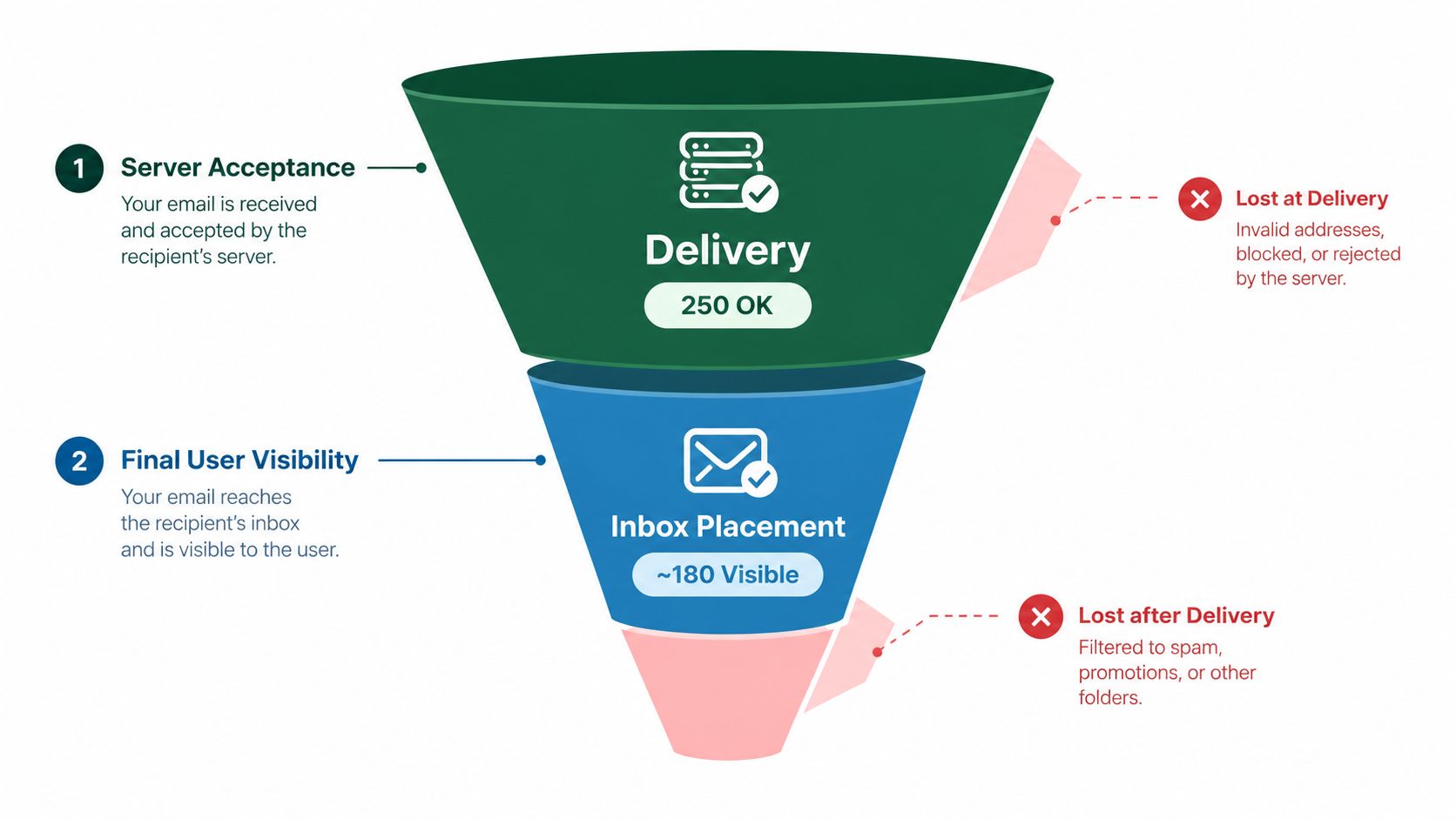
Mail systems commonly treat delivery as a server event. If the recipient server accepts the message, the sending platform may record it as delivered. Inbox placement is a later outcome, determined by the recipient's filtering and filing systems.
Mailgun's deliverability guidance explains the distinction directly. An email can count as delivered even when it lands in spam, while bounces and server rejections represent outright delivery failure. The same guidance states that 0.1% spam complaints equals one complaint per 1,000 emails, and that reaching 0.3% makes spam filtering very likely. Mailgun's State of Email deliverability guidance is useful because it prevents teams from treating a successful SMTP response as proof of inbox visibility.
Instrument the two stages separately
Create separate reporting for server acceptance and mailbox placement. Your sending platform should expose bounce and rejection data, while seed-list tests and provider-specific monitoring should show where messages appear after acceptance. If those views are combined, a high delivery percentage can conceal a serious placement decline.
For teams sending cold outreach, infrastructure and pacing matter before content experimentation. A warming and sequencing platform such as Instantly for cold email and deliverability workflows can help organize gradual sending, mailbox rotation, and sequence controls. It won't repair a misaligned DMARC policy or rescue a list that generates complaints, but it can provide a more controlled operating layer while reputation stabilizes.
A sensible investigation follows this order:
Confirm server outcome. Separate accepted messages, hard bounces, temporary deferrals, and policy blocks.
Check final placement. Test representative messages at major providers and record Primary, tabs, spam, and missing outcomes.
Compare recipient signals. Review complaints, replies, unsubscribes, clicks, and engagement by mailbox provider.
Trace changes. Match placement declines to volume changes, new sending sources, domain migrations, or campaign changes.
A detailed email deliverability score explanation can help teams interpret the difference between delivery health and inbox visibility. The key principle is simple: delivery is a gate, placement is the commercial result.
Authentication Breakdowns Behind Most Email Delivery Failure
Authentication isn't a single checkbox. SPF, DKIM, and DMARC answer different questions, and a sender can pass one control while failing the policy decision that determines whether the message is trusted.
SPF verifies whether an authorized sending service can send for the envelope domain. The record has a hard limit of 10 DNS lookups during evaluation, as documented by SPF Monitor's explanation of the lookup limit. Nested includes from an ESP, CRM, and marketing platform can push a record over that limit even when the visible syntax looks tidy. The result can be a PermError, which contributes to authentication and delivery problems.
DKIM attaches a cryptographic signature to the message. Common operational failures include a missing selector, a selector that wasn't published, a signing domain left behind after a subdomain migration, or a platform that stopped signing after configuration changes. Test the selector used in the DKIM-Signature header, not the selector you expect the vendor to use.
DMARC evaluates alignment. At least one of SPF or DKIM must pass and align with the visible From domain. A separate pass isn't enough if the authenticated domain doesn't match the domain the recipient sees. Valimail's DMARC failure explanation describes this alignment requirement, while Proofpoint's DMARC policy guide explains the enforcement outcomes: p=none reports failures, p=quarantine sends them toward spam or quarantine, and p=reject blocks them at the SMTP layer.
Compare the controls before changing content
Control | What It Verifies | Common Failure Mode | Diagnostic Command |
|---|---|---|---|
SPF | Whether the envelope domain authorizes the sending service | The record exceeds the lookup limit or omits a sending source |
|
DKIM | Whether the message carries a valid signature from the configured selector | Missing selector, wrong selector, or incorrect signing domain | Inspect |
DMARC | Whether SPF or DKIM passes and aligns with the visible From domain | Authentication passes independently but fails alignment | Inspect the DMARC result and review aggregate reports |
Debug the message, not just DNS
Start with the full Authentication-Results header from a real delivered message. Record the SPF domain, DKIM selector, DKIM signing domain, and DMARC alignment result. Then compare those values with the sending services your organization uses.
Use dig or nslookup to inspect published records, and use a validator such as Mailhardener's email validation tools to identify syntax, lookup, selector, and policy issues. Finally, review DMARC aggregate reports for legitimate sources that aren't aligned. Fixing the record without checking actual message headers is how teams end up solving the wrong configuration.
Bounces, Blocks, and Complaint Rate Thresholds
Bounce handling starts with accurate classification. A permanent address failure, a temporary mailbox problem, and a reputation block require different actions, so they should not share one retry queue.
Type | SMTP Code / Signal | Typical Cause | Recovery Action |
|---|---|---|---|
Hard bounce | Usually a 5xx response, such as an unknown recipient | Invalid or nonexistent mailbox | Suppress the address immediately and investigate list capture |
Soft bounce | Usually a 4xx response, such as a temporary deferral or full mailbox | Recipient capacity, transient server trouble, or rate limiting | Retry cautiously, then suppress repeated failures |
Block bounce | Policy, reputation, or complaint language in the response | IP or domain reputation damage, authentication failure, or filtering | Pause the affected stream, inspect reputation and authentication, and contact the relevant provider or abuse desk |
Complaint signal | Spam report or feedback-loop event | Recipient did not recognize, want, or trust the message | Stop future sends to the complainant and reduce the source of unwanted volume |
Suppress hard bounces immediately. Repeated attempts to invalid addresses show weak list hygiene and can add avoidable reputation pressure. Soft bounces justify controlled retries, but an address that continues deferring should not remain active indefinitely. Block bounces usually indicate a system-level issue. Changing the subject line alone rarely resolves one.
Complaint thresholds behave like guardrails
Complaint rate links recipient behavior to provider enforcement. Current guidance places the preferred target below 0.1%, while 0.3% is a critical ceiling. The Validity benchmark report expresses those levels as approximately one complaint per 1,000 delivered emails and three complaints per 1,000 delivered emails. Gmail and Yahoo guidance also uses 0.3% as a ceiling for high-volume senders. Complaints above three per 1,000 may contribute to reputation problems, bulk-foldering, or rejection, according to Mailflow Authority's Gmail and Yahoo sender guidance.
A small change in audience quality or targeting can push an entire stream toward that limit. Strong delivery rates do not compensate for a complaint rate that keeps rising. Review complaints by campaign, acquisition source, mailbox provider, and sending identity so the responsible stream is isolated instead of penalizing every program.
Track bounce classifications alongside complaints, unsubscribes, replies, and placement through email marketing metrics for deliverability monitoring. Suppression is a preventive control, not the diagnostic event. The bounce or complaint explains why the address was suppressed and points to the list, content, consent, or targeting problem that needs correction.
The Silent Failure Mode That Undermines Outbound Revenue
A “delivered” status does not show where a message went or whether it produced a result. The provider may accept it into the inbox, a Gmail tab, or spam. The recipient may also see a broken destination after clicking, while the sending platform records the same top-line outcome.
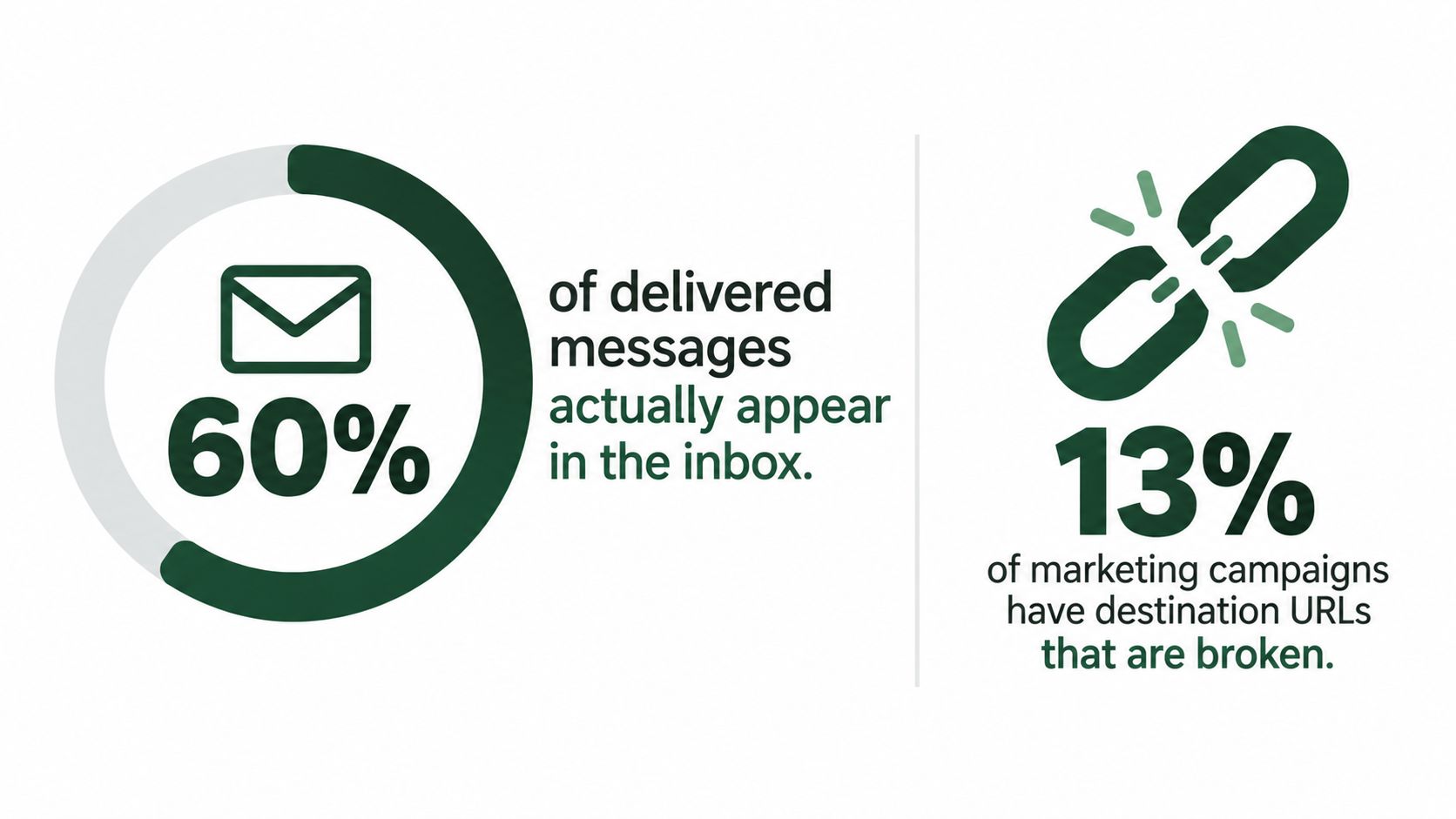
The 2025 Unspam Email Deliverability Benchmark found that 60% of emails reached a visible mailbox location when inbox placement and Gmail tabs were counted together. The report also recorded 36% filtered to spam and 4% blocked entirely, while 13% of analyzed emails had broken or unreachable links.
Visibility does not guarantee commercial success
Counting tabs as reach can make sense for delivery reporting, but it can misrepresent outbound revenue. A recipient may not inspect Promotions. A link may redirect to the wrong page, work only for logged-in users, or lead to a retired destination. The message still appears delivered, yet replies and conversions disappear without a bounce.
Provider behavior varies by mailbox. Gmail, Microsoft 365, and Apple Mail can assign different placement and engagement outcomes to the same campaign. Apple Mail Privacy Protection can distort open reporting, and aggregate dashboards can hide weak performance among Microsoft recipients while Gmail remains stable. Segment results by mailbox provider, domain, sending identity, campaign, and link destination.
The metric that matters is not whether the server accepted the message. It is whether the intended recipient could see it, trust it, and complete the next action.
The same operational risk appears in Pazi on silent agent failures. A system can show no obvious error while the intended outcome fails. Apply that discipline to email by defining the business outcome, recording each intermediate state, and investigating missing results before a bounce spike forces attention.
A Sequential Diagnostic Workflow for Outbound Systems
Debugging becomes slower when teams jump from subject lines to domain rotation without reading the evidence. Use a fixed sequence so each test narrows the possible causes.
Start with the message header
Pull a message that was accepted and inspect its Authentication-Results header. Confirm SPF, DKIM, DMARC, alignment, the sending source, and the recipient provider. Then compare an accepted message with a spam-foldered message from the same campaign. Differences often reveal provider-specific treatment that a sending dashboard won't show.
Next, review DMARC aggregate reports. Group failures by source, domain, and alignment result. Unknown or unauthorized sources deserve investigation, but legitimate vendors can also fail if their envelope domain and visible From domain don't align.
Test placement before rewriting everything
Run a seed-list test across Gmail, Outlook, and Yahoo, then record the exact folder or tab. How to test email deliverability is useful for structuring tests around authentication, spam placement, missing mail after acceptance, and changes after volume adjustments.
Escalate based on the result:
Authentication failure: Fix SPF, DKIM, or DMARC alignment before changing copy.
Broad spam placement: Review complaint history, list source, volume pattern, and sending reputation.
Provider-specific failure: Compare infrastructure and engagement by mailbox provider.
Working placement but weak response: Inspect offer fit, link health, targeting, and message relevance.
Google Postmaster Tools can add reputation context for eligible sending streams. Treat its cards as directional evidence, not a substitute for seed placement or recipient-level analysis.
During recovery, email volume may need to slow. LinkedIn outreach through HeyReach for LinkedIn automation can supplement signal gaps while email throughput is constrained, but it should function as a channel fallback, not an excuse to ignore the email root cause. For teams building a consistent B2B audience stream, a B2B SaaS newsletter service can also provide a separate owned-channel motion while outbound infrastructure is repaired.
Choose infrastructure changes only after diagnosis. Isolate a damaged stream on a subdomain when the problem is confined to one use case. Consider domain rotation only when governance and brand risk justify it. Replace broader infrastructure when provider evidence points to persistent IP or platform-level reputation damage.
A Unified Mitigation Framework for Stable Deliverability
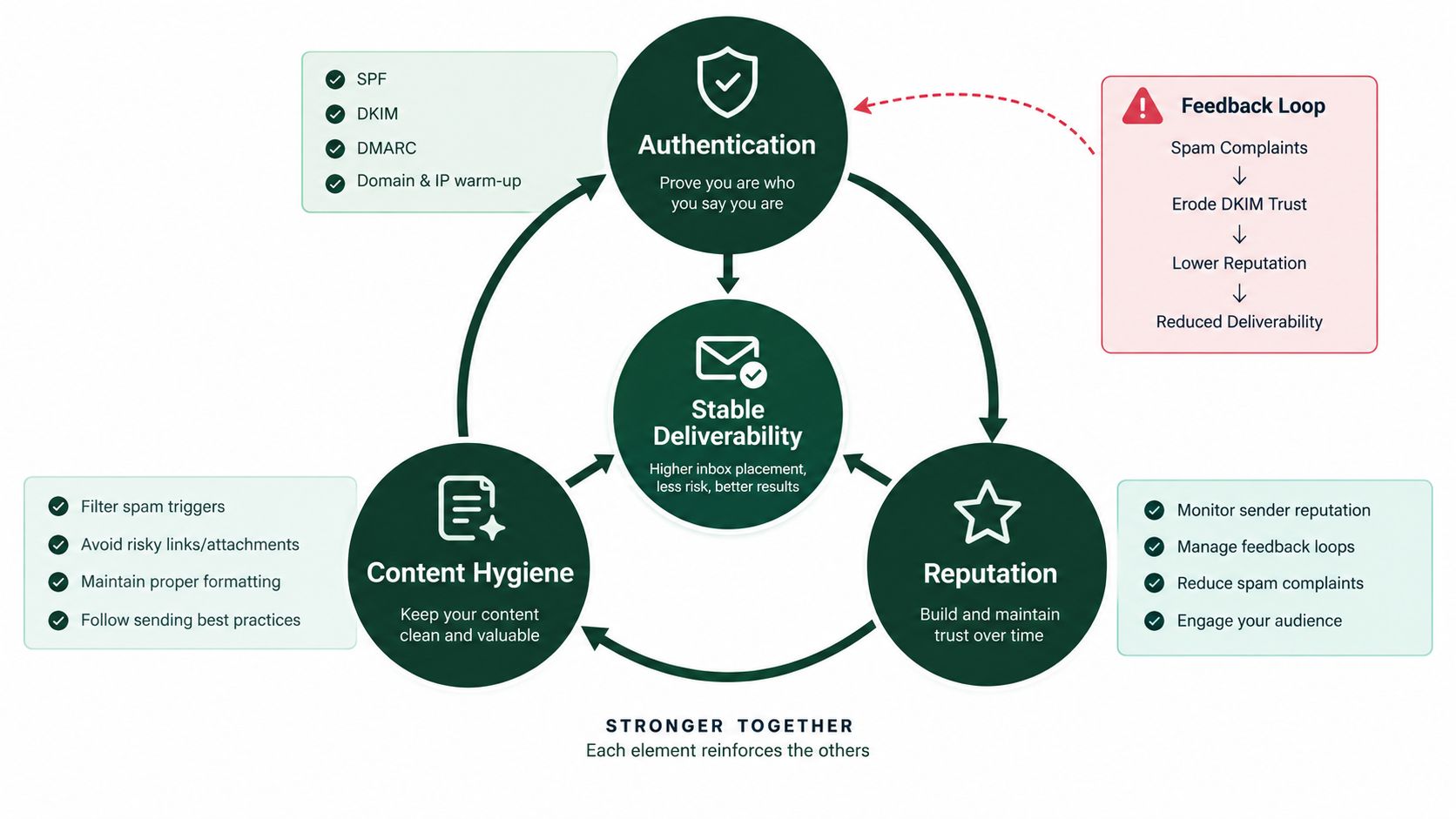
Authentication, content hygiene, and reputation aren't separate projects. They form a feedback loop. A poor list creates complaints, complaints damage reputation, filtering reduces engagement, and lower engagement makes future filtering more likely. A message can pass authentication and still fail because the audience doesn't recognize the sender or the campaign pattern produces unwanted behavior.
Build the foundation first
The foundation includes SPF within its lookup limit, DKIM signing from the intended domain, DMARC alignment, valid reverse DNS, and clear ownership of every sending source. Dedicated sending infrastructure can make diagnosis easier because transactional, marketing, and cold outbound traffic don't all share one reputation pool.
Use p=none when you need visibility into unknown sources, but don't leave monitoring disconnected from remediation. Move toward p=quarantine when legitimate sources align and failures are understood. A p=reject policy blocks unauthenticated, misaligned mail, so it should follow careful source inventory rather than a rushed DNS change.
Control signals before they become penalties
Hold complaint rate below 0.1% as an operating target, with 0.3% treated as the hard ceiling, using the thresholds documented in Validity's benchmark guidance. Segment by engagement recency, message type, provider, and acquisition source. A broad send to inactive recipients can create a reputation problem even when the creative looks polished.
Warming should be gradual and measured. Keep new infrastructure on controlled volume ramps, watch deferrals and complaints after each change, and avoid sudden bursts that make provider-specific throttling harder to interpret.
Keep data and content clean upstream
Validate addresses when they enter the system, not only after they bounce. Apollo for data enrichment and address validation workflows can support upstream data hygiene, while Trigify for social signals can help identify engagement signals that inform audience selection. Neither tool replaces consent, relevance, suppression, or authentication controls.
Review every link, redirect, tracking parameter, and destination before sending. The 2025 benchmark's broken-link finding shows why content quality isn't cosmetic. A technically delivered message with a dead next step still fails commercially.
For a broader view of infrastructure choices, see email delivery platforms and their operational trade-offs. Stable deliverability comes from preventive architecture, not repeated emergency cleanup.
Operational Checklist and Next Steps
Treat the first week as an operating reset, not a one-time audit. Assign an owner to each check, record the result, and preserve the evidence so future changes can be compared against a known baseline.
Validate SPF: Confirm the record stays below the 10 DNS lookup limit, using the SPF Monitor reference when reviewing nested vendor includes.
Review DKIM selectors: Rotate selectors on a scheduled basis, confirm the active selector is published, and verify that real messages use the intended signing domain.
Enforce DMARC deliberately: Publish at least
p=quarantineonce legitimate sources are understood, and use aggregate reports to investigate alignment failures before stricter enforcement.Classify bounce logs: Review the last 90 days by response code and reason. Suppress hard bounces, manage temporary retries, and investigate block bounces as reputation or policy events.
Segment inactive recipients: Separate subscribers inactive for more than 180 days from engaged recipients before re-engagement or removal campaigns.
Check infrastructure signals: Verify reverse DNS, confirm the abuse mailbox is monitored, and make sure responsible staff can respond within 24 hours.
Run placement tests: Test representative campaigns across Gmail, Outlook, and Yahoo before major sends, recording inbox, tab, spam, and missing outcomes.
Project complaints: Keep the expected complaint rate below 0.1%, using the Mailgun complaint-rate guidance to translate the threshold into recipient counts.
Close the week by instrumenting recipient feedback, scheduling quarterly reputation reviews, and documenting who can pause sending when a major provider throttles traffic. Your deliverability process should state the trigger, owner, escalation path, and recovery test for each failure type.
The Social Search designs and operates outbound systems across ICP definition, data, messaging, email and LinkedIn infrastructure, signal-driven prospecting, and reporting. If email delivery failure is limiting your pipeline, visit The Social Search to discuss a diagnostic-led system build or an embedded GTM operating model that connects deliverability to qualified pipeline.
