How Long Should a Cold Email Be to Get Replies
Wondering how long should a cold email be? Get data-backed length guidelines, templates, and tests to boost replies without losing context.
50 to 125 words is the safest answer for most B2B cold emails, with 50 to 70 words usually strongest when the goal is replies. A 34 million-email analysis also found a peak in the 20 to 39 word range, which tells you the answer isn’t “as short as possible,” it’s “short enough to be read fast, but long enough to earn relevance” Overloop’s cold email length analysis.
Cold email length is a reply-rate lever, not a writing preference. In APAC inboxes, where buyers often scan on mobile between meetings, the wrong length gets punished fast. The practical job is to keep the first touch concise, keep the ask visible, and use the body to create just enough context that a prospect can say yes or no without working for it.

If you want a practical framework for testing length without trashing inbox placement, The Social Search’s cold emailing guide is the kind of system-level resource that fits this problem. Tools like Instantly are useful here because you can test variants at the sequence level instead of guessing from one polished draft.
Table of Contents
Introduction Why Cold Email Length Directly Affects Replies
A cold email that fits the screen earns more replies. That is the practical answer to how long should a cold email be. For B2B outreach, the safest working range is still 50 to 125 words, because it leaves room for a personalized opener, one clear point of context, and a single ask without making the message feel heavy on a phone Artisan benchmark. Keep the body tight enough that the prospect can decide fast.
Length matters because buyers scan, filter, and move on quickly. They respond to emails that are easy to parse, relevant to their situation, and simple to answer. Extra copy usually adds friction, especially when the sender is trying to say too much in the first touch.
Practical rule: if the ask is below the fold on mobile, trim the email.
Mobile changes the length equation
Mobile reading turns brevity into a reply-rate lever. A 2025 Litmus report found 42% of emails were opened on smartphones or tablets, so the first screen does most of the work Litmus 2025 report. On APAC inboxes, that matters even more because many prospects are checking mail between meetings, not sitting at a desk with time to spare.
Shorter emails can also win on reply behavior. An analysis of 34 million cold emails found the highest average reply rate in the 20 to 39 word range, while broader summaries still place strong performance in the 50 to 125 words band Overloop analysis. The useful takeaway is simple. Ultra-short works when the relevance is obvious. Slightly longer works when the prospect needs a little context before they can say yes or no.
For teams testing outbound at scale, the right move is to test word-count bands instead of debating taste. The Social Search’s cold emailing guide is useful because it keeps the focus on process, not polish. SearchAtlas and Outrank fit later in the workflow, but the same principle applies. Keep the message short enough to read fast, long enough to carry context, and clean enough to test against another version without guessing.
The Ideal Length Framework for Cold Emails
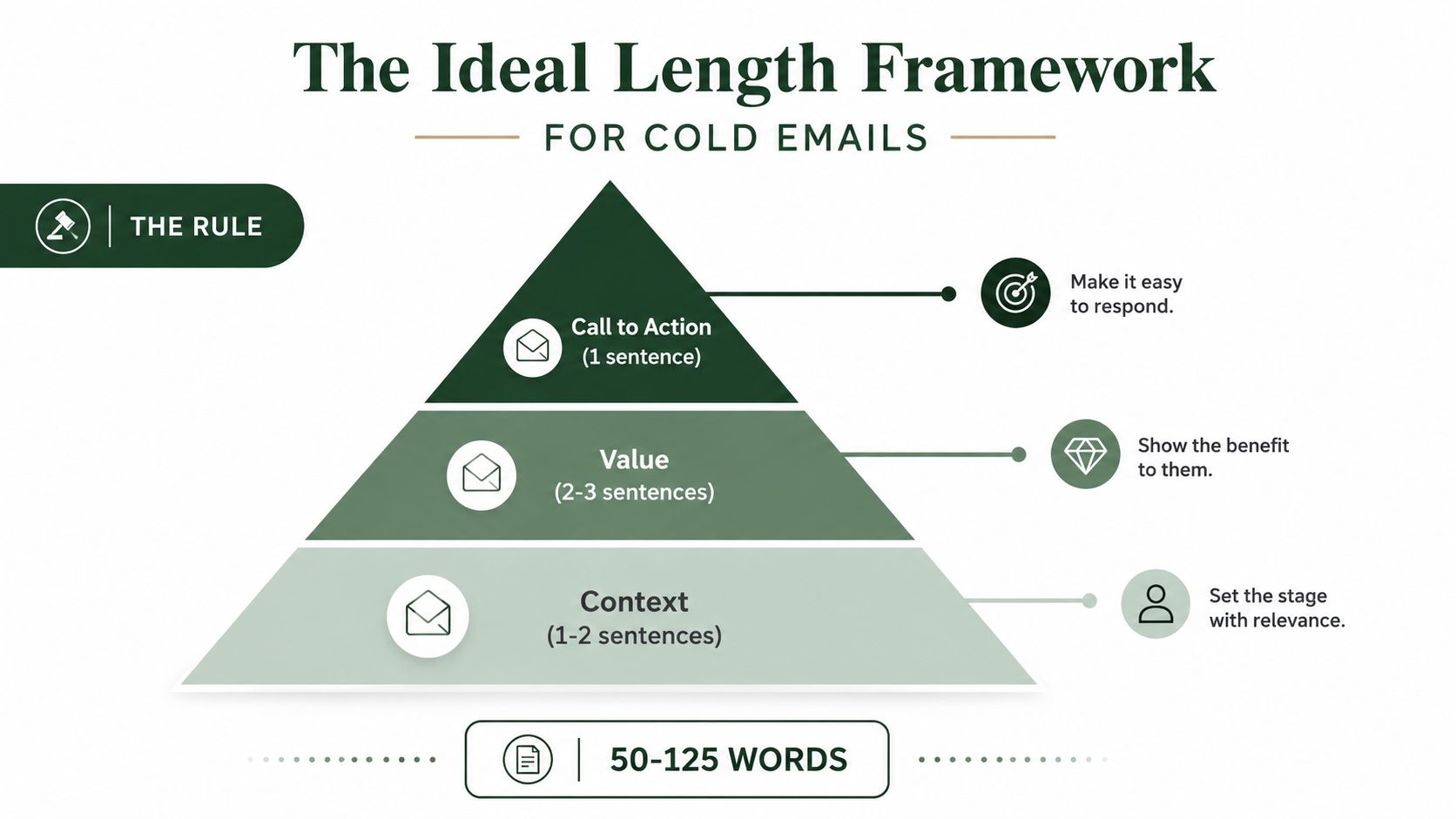
A cold email works best when the reader can understand it quickly on a phone and decide whether to reply without extra effort. For that reason, treat length as a reply-rate lever, not a style choice. Once a message gets into the 50 to 125 word range, every sentence has to carry weight, because a weak opener or a second CTA can drag the whole note out of the zone where response rates hold up Artisan benchmark. A simple structure works, context first, value second, ask last.
Build the email in three parts
Start with 1 to 2 sentences of context. That should show why the email belongs in their inbox, not yours. A trigger, role change, team move, or relevant pain point usually gives enough reason to keep reading.
Use 2 to 3 sentences for value. Cold emails get bloated when the sender tries to prove everything at once. One concrete outcome, one proof point, or one relevant observation is enough.
End with 1 sentence for the CTA. Keep it low friction. A direct question usually performs better than a long close that tries to soften the ask.
Keep the CTA visible without scrolling, especially for mobile-first buyers.
For contact research, Apollo helps enrich the lead before you write, which matters because short email only works when the personalization is specific. Use the enrichment to sharpen the opening, then leave the body focused on relevance.
Use the range that matches the job
A 50 to 70 word note usually fits a first touch when the ask is simple and the buyer is busy. A 75 to 125 word note fits better when the offer needs more explanation, the value proposition is harder to grasp, or the buyer wants context before replying. The same rule applies in The Social Search messaging framework, where the message has to earn attention fast and stay readable on mobile.
The framework gets easier if you think in reader impact, not just word counts. A message that reads like a short note from a real person will usually beat a cleaner paragraph that sounds like a campaign asset. If the draft cannot fit the structure above, it is too long for cold outbound.
How Short Medium and Long Emails Perform in Practice
APAC inboxes punish unnecessary length fast. A short cold email can work when the prospect already knows the category, a medium email earns its place when the offer needs a little context, and a long email usually pays a readability tax before trust is there.
Reply.io’s research summary found that 54-word templates produced the best reply rate at 5.72%, and emails in the 50 to 70 word band averaged 9% more replies than longer variants Reply.io research summary. That pattern lines up with what I see in production, especially on mobile, where every extra line increases the chance the reader stops before the ask.
Word count by use case
Word Count Band | Average Reply Signal | Best Use Case |
|---|---|---|
20 to 39 words | Highest average reply rate in one large analysis | Ultra-focused first touch, simple ask |
50 to 70 words | Strong reply generation, above longer variants | Most first-touch B2B outreach |
75 to 125 words | Defensible baseline for clarity and context | Complex offer, technical buyer, warmer lead |
Over 100 words | Performance starts to slip below average in large studies | Use only when the added context is truly necessary |
The most useful takeaway is the trade-off. Short copy helps deliverability and mobile readability, but it fails if the reader cannot tell why you reached out. Longer copy can rescue a complicated offer, yet it usually costs you some reply intent. The cleanest way to judge your own ceiling is to run word-count tests on the same offer and watch where replies drop once you add explanation.
A separate analysis from Hunter’s cold email word count analysis found that emails under 100 words performed slightly better overall than longer ones, 3.9% vs. 3.7% average reply rate. The gap is modest, but at scale it still matters because it confirms that extra copy rarely earns its keep unless it changes the decision.
Working rule: if the longer version doesn’t change the prospect’s decision, cut it.
For practical prospecting prompts, Writingmate sales prospecting tips is a useful companion because it pushes you toward sharper angles. That matters in APAC outreach, where first-touch emails compete with dense inboxes and buyers often dismiss anything that reads like a template. Email and LinkedIn follow different readability rules, but the same principle holds, keep the message short enough to scan, then make the relevance obvious fast.
Proven Cold Email Templates by Word Count
The cleanest way to judge length is to test the same offer at different word counts. Keep the scenario fixed, a B2B SaaS team expanding into APAC, so only the wording changes. That shows how the message reads on mobile, how fast the value lands, and where the ask starts to feel heavy.
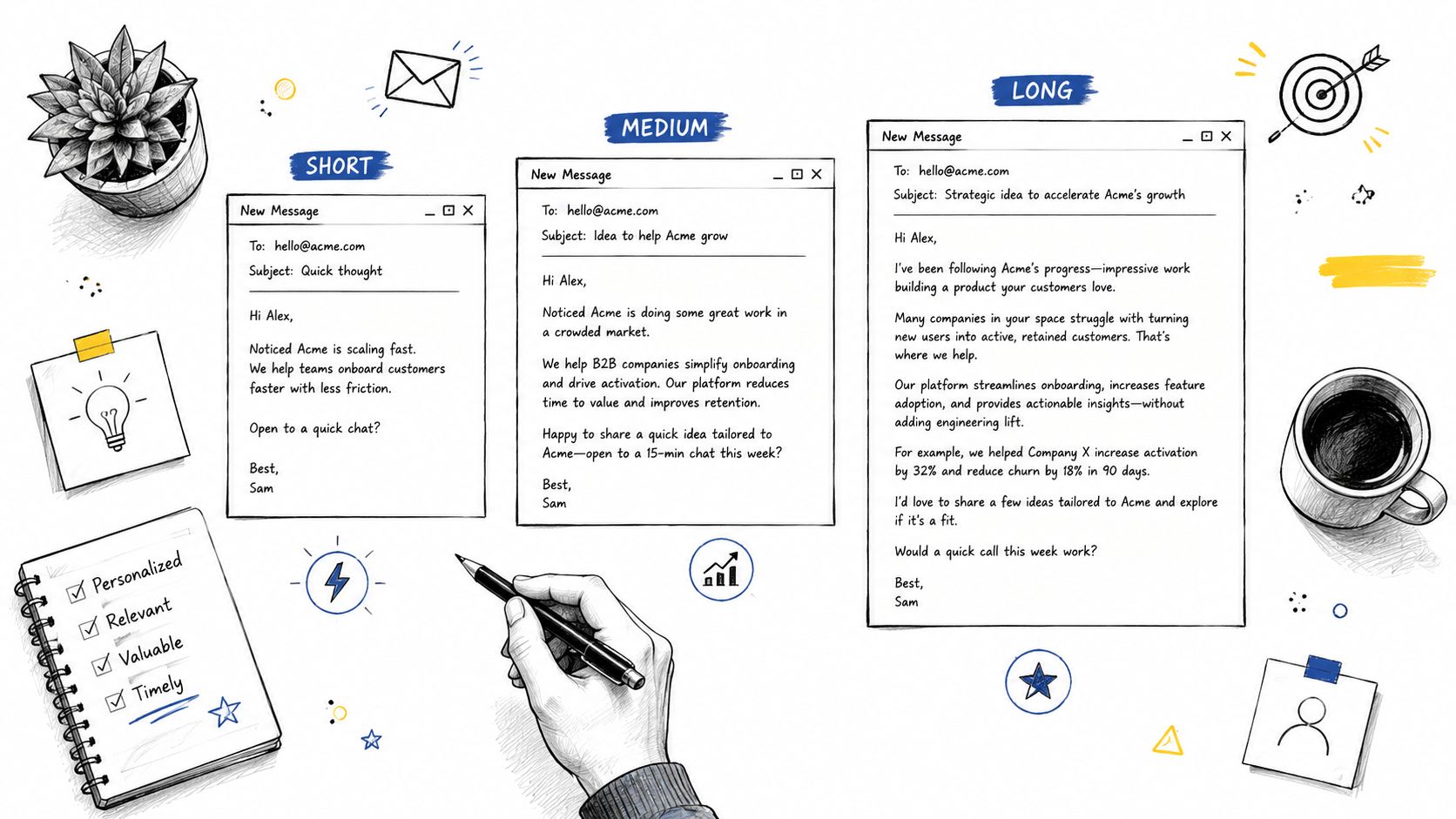
Short version around 55 words
Hi Maya,
I saw your team is expanding into Singapore. We help B2B SaaS teams localize outbound so reps can start booking meetings faster in new markets. If APAC pipeline is a priority this quarter, would it make sense to compare notes on what’s working?
This version stays tight because it gives the signal, the offer, and the ask without extra explanation. It works best when the trigger is obvious and the value prop can be understood in one pass. For teams adapting the same motion to LinkedIn, HeyReach keeps the sequence short while preserving control across touches.
Medium version around 88 words
Hi Maya,
Noticed your sales team is opening a Singapore office. That usually means the messaging that worked in one market starts underperforming in another. We build outbound systems for B2B SaaS teams entering APAC, including targeting, first-touch copy, and follow-up sequencing, so reps can get into market with something sharper than a generic template. If this is on your roadmap, would a quick comparison of approaches be useful?
This is the version I use most often in first-touch campaigns. It gives enough context to sound informed, but it still leaves room for the prospect to reply without reading a white paper. For examples of reusable outreach structure, The Social Search’s email marketing templates are a practical reference.
Slightly longer version around 118 words
Hi Maya,
Saw the Singapore expansion note and thought this might be relevant. When SaaS teams enter APAC, the first thing that breaks is usually the outbound message, not the product. We help teams rebuild that first-touch motion with cleaner targeting, localized messaging, and sequence design that matches how buyers in the region scan email. If your team is trying to get outbound live without turning every rep into a copywriter, I’d be happy to share the framework we use.
Would a quick call next week be worth it?
This version still works within a defensible range because every sentence gives the reader something useful. For signal-based timing, Whitewhale and Trigify help you add relevance without bloating the email with extra explanation.
Common Length Mistakes and How to Trim Without Losing Context
Cold emails usually get too long for simple reasons. The sender adds a greeting that does no work, lists every feature, then asks for a meeting twice. That does not improve persuasion, it adds friction.
Mobile reading makes brevity a functional requirement. Keep the first screen clean, because if a prospect has to scroll before they understand the point, reply odds fall fast. If you want a practical editing reference, The Social Search’s cold email toolkit is a useful benchmark for tightening copy without blurring the ask.
Trim the parts that do not change the decision
Filler openers like “I hope you’re well” rarely earn space in a cold email.
Feature dumps turn a specific pitch into a product brochure.
Double CTAs confuse the reader about what you want.
Premature pitches ask for time before the prospect has any reason to care.
The cleanest trimming method is direct. Read each sentence and ask whether removing it would change the reply decision. If the answer is no, cut it. If the sentence only exists to sound polite, keep the tone polite and remove the extra words.
One practical test I use in APAC inboxes is this: after trimming, does the ask still fit comfortably on a phone screen, and does the email still tell the prospect why they should care? If either answer is no, the draft is still too heavy.
If the email still feels crowded, move supporting context into another channel. Respond IO works when a WhatsApp follow-up fits the motion better than a longer email, and Manychat can carry the conversation in social DM instead of forcing every detail into the first message.
A cold email should open the door, not carry the entire sales argument inside it.
Write the first draft fast, then cut until the ask is clear, the context is complete, and the message reads cleanly on mobile.
Testing Your Ideal Length and Next Steps
The safest way to find your answer is to test length against your own list, not chase a universal number forever. Start with three versions, 45 words, 85 words, and 120 words, then compare which one gets replies from the same persona and market segment. Keep the offer identical so length stays the variable.
Reply quality matters more than opens. Opens are noisy, and in cold outbound they do not tell you whether the message deserved a response. Watch for real conversation starters, objections to the offer, and whether one length performs better by seniority or region.
Executives usually need less context because they scan fast and decide fast. Technical buyers can handle a little more explanation if the problem framing is credible. Regional differences matter too, since the same length can feel crisp in one market and heavy in another.
One useful signal from Litmus 2021 engagement data is that a large share of reads happen on mobile, which matches what I see in APAC inboxes. Shorter copy tends to win when the first read happens on a small screen.
For channel choice, email and LinkedIn do not deserve the same length treatment. Email needs enough context to earn the reply in one pass. LinkedIn usually works better when the message is tighter and the follow-up adds detail after the connection is accepted.
If a draft still feels crowded, move supporting context into another channel. The Social Search designs and runs cold email and LinkedIn systems that connect targeting, messaging, and sequence operations. If you are testing length seriously, start with one list, one offer, and three word-count bands, then use the data to decide what to scale.
