7 Best Lead Generation Companies for B2B Growth
Compare the best lead generation companies for B2B growth, including services, pricing tiers, proof points, strengths, drawbacks, and buyer fit.
Lead volume is the wrong way to identify the best lead generation companies. A provider can produce meetings while missing your ICP, damaging deliverability, targeting the wrong geography, or handing opportunities to a sales team that can't follow up. This comparison ranks companies by the operating model they support, from a handover-ready outbound system and managed SDR execution to phone-first appointment setting and content-led demand generation.
The evaluation focuses on channel strategy, execution depth, pricing visibility, geographic coverage, reporting, and the work your team must complete after handoff. The Social Search stands out as a system-first option for B2B teams that need ICP definition, clean data, messaging, email, LinkedIn, signal-driven timing, and reporting connected into one owned outbound engine. Teams that need specialist infrastructure can pair that model with Instantly for cold email infrastructure, warming, and sequencing, HeyReach for LinkedIn outreach and automation, Apollo for data enrichment, Trigify for social signals, or Whitewhale for intent signals.
The market's scale explains why this category has become strategic. One projection values global lead generation solutions at about $5.1 billion in 2025, reaching $15.55 billion by 2031 at a 17.48% CAGR (lead generation market data). The practical question isn't who promises the most activity. It's who fits your sales motion, target market, average contract value, internal capacity, and preferred ownership model. A strong SEO strategy for B2B companies may be the right complement when outbound needs inbound support.
Table of Contents
1. The Social Search
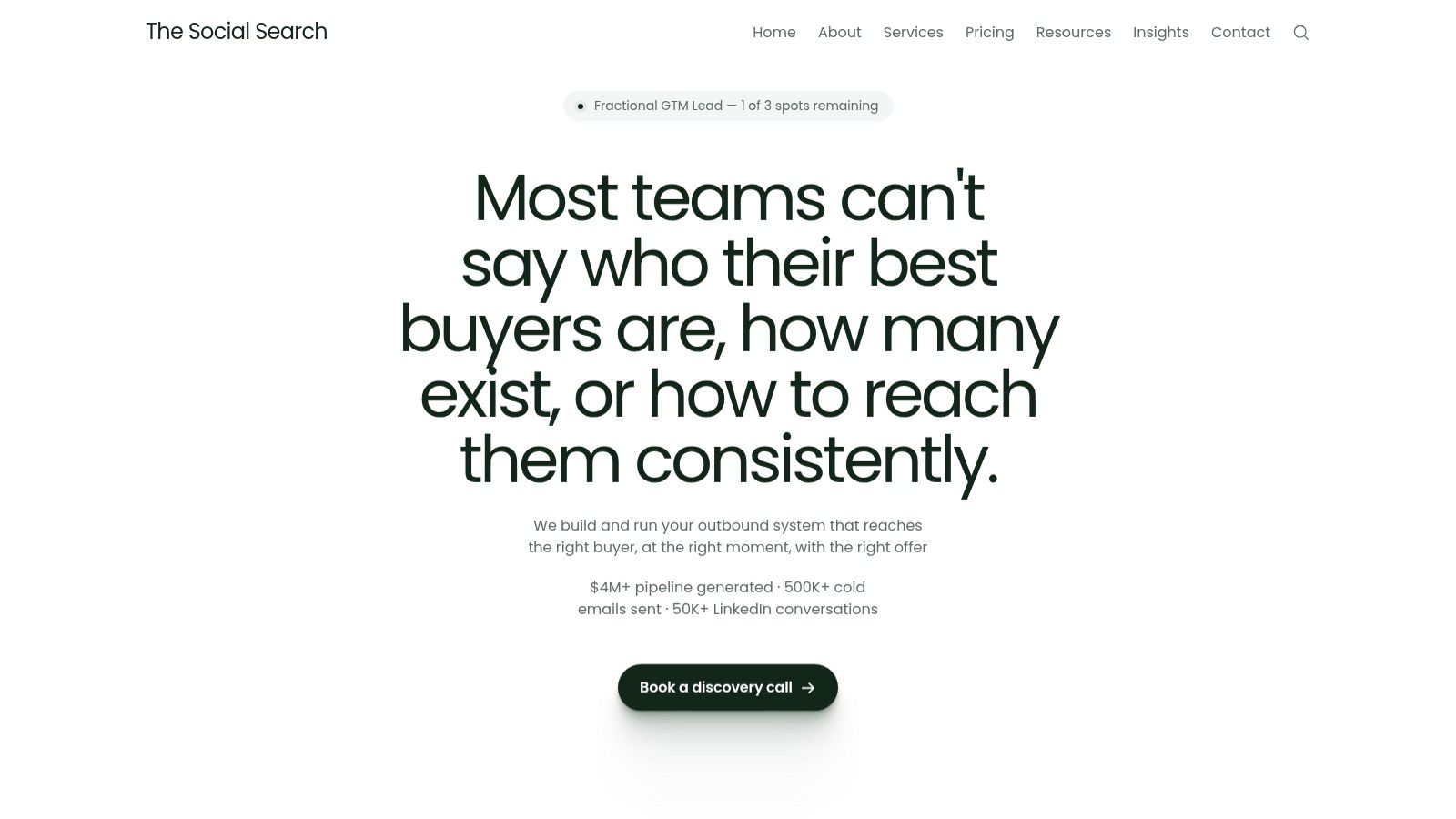
The Social Search is the strongest fit for teams that want a working outbound system, not a disconnected collection of prospecting tasks. This go-to-market engineering consultancy designs, builds, runs, and hands over automated outbound systems for B2B companies selling into APAC and global markets. Its model connects ICP definition, account and lead list building, buyer-aligned offers, messaging, email, LinkedIn, signal-driven timing, routing, and reporting.
The distinction matters. Many providers execute outreach on your behalf, but the client may be left with limited documentation or an unclear view of which signals, lists, and messages created pipeline. The Social Search positions the infrastructure as an owned asset, with documentation, playbooks, and rep enablement included in the handover. Engagements can range from a one-time system build to an embedded fractional GTM Lead or Engineer who operates the function for the client.
Its site cites $4M+ in generated pipeline, 500K+ cold emails sent, and 50K+ LinkedIn conversations. These are provider-reported proof points, so buyers should validate the underlying definitions, attribution method, and relevance to their market before signing.
Why its operating model stands out
Systems can go live in about three weeks, with early meetings often appearing within the first month. The consultancy targets roughly 8 to 12 qualified meetings per month by day 90 on a well-defined list, while leaving closed-won revenue to the client's sales team unless the client chooses the fractional GTM tier. The result is a clear division of responsibility, but it also means your team must qualify, run discovery, and close effectively.
Buyer-fit signal: Choose this model when you need outbound built around your market, signals, and handoff process, especially during APAC expansion or an outbound launch from scratch.
Pricing varies by scope, from a roughly $500 one-time build for a basic setup to a fully managed function near $10,000 per month. That flexibility creates a trade-off. A small build can suit a team with internal execution capacity, while the managed tier may be difficult to justify for a very early-stage company with low contract values.
Read the company's perspective on lead generation for SaaS. The Social Search is best for venture-backed SaaS companies, mid-market sales teams, founders, revenue leaders, and agencies pursuing enterprise clients.
Pros
Owned infrastructure: Documentation, playbooks, reporting, and enablement support a genuine handover.
Signal-led execution: Outreach can be routed around buyer and account signals rather than generic volume.
Flexible delivery: Buyers can choose a build, an ongoing retainer, or an embedded fractional GTM function.
Cons
Closing remains your responsibility: The meeting target doesn't guarantee closed revenue.
Scope can expand quickly: The difference between a basic build and a managed GTM function is substantial.
Requires sales readiness: Your team still needs a clear offer, responsive follow-up, and the ability to close.
Website: The Social Search
2. Belkins
Belkins is a strong turnkey choice for companies that want managed outbound and appointment setting without assembling the operating team themselves. Its programs combine email, LinkedIn, calling, and event-led tactics such as executive dinners. Deliverability and research are bundled into retainers, while add-ons include ABM, paid activation, CRM integration, and enablement.
The company's packaging emphasizes annual appointment targets, including tiers built around 100+ or 200+ appointments per year. Those targets can make commercial conversations more concrete than an activity-based proposal, but they also create a potential mismatch for complex enterprise sales motions where one carefully qualified account may matter more than a standardized appointment volume.
Belkins has broad industry coverage and international positioning, which makes it relevant for teams that need more than a single-channel campaign. Buyers should still ask how the provider defines an appointment, which decision-maker seniority qualifies, whether rescheduling counts, and how no-show or poor-fit meetings are handled. A B2B lead generation services comparison is useful when separating appointment volume from qualified pipeline.
Commercial visibility and client obligations
The packaging communicates inclusions and outcome expectations, but dollar pricing isn't published. Prospects need a sales-led scoping process before they can compare total cost with alternatives. That isn't automatically a weakness, though it does make contract clarity and pilot design more important.
Belkins suits SMB and enterprise teams that prefer a managed, multi-channel engine. It may be less suitable for a buyer that wants to own every part of the infrastructure or a highly specialized enterprise motion that can't be represented by fixed annual appointment targets.
Pros
Broad channel mix: Email, LinkedIn, calling, and events can support a coordinated program.
Turnkey execution: Research and deliverability are part of the managed model.
Expansion options: ABM, paid activation, CRM integration, and enablement extend the engagement.
Cons
Limited price transparency: Final costs require consultation.
Target rigidity: Annual appointment packages may not match unusual qualification standards.
Handoff still matters: Your sales team must act quickly and consistently after meetings are booked.
Website: Belkins
3. CIENCE
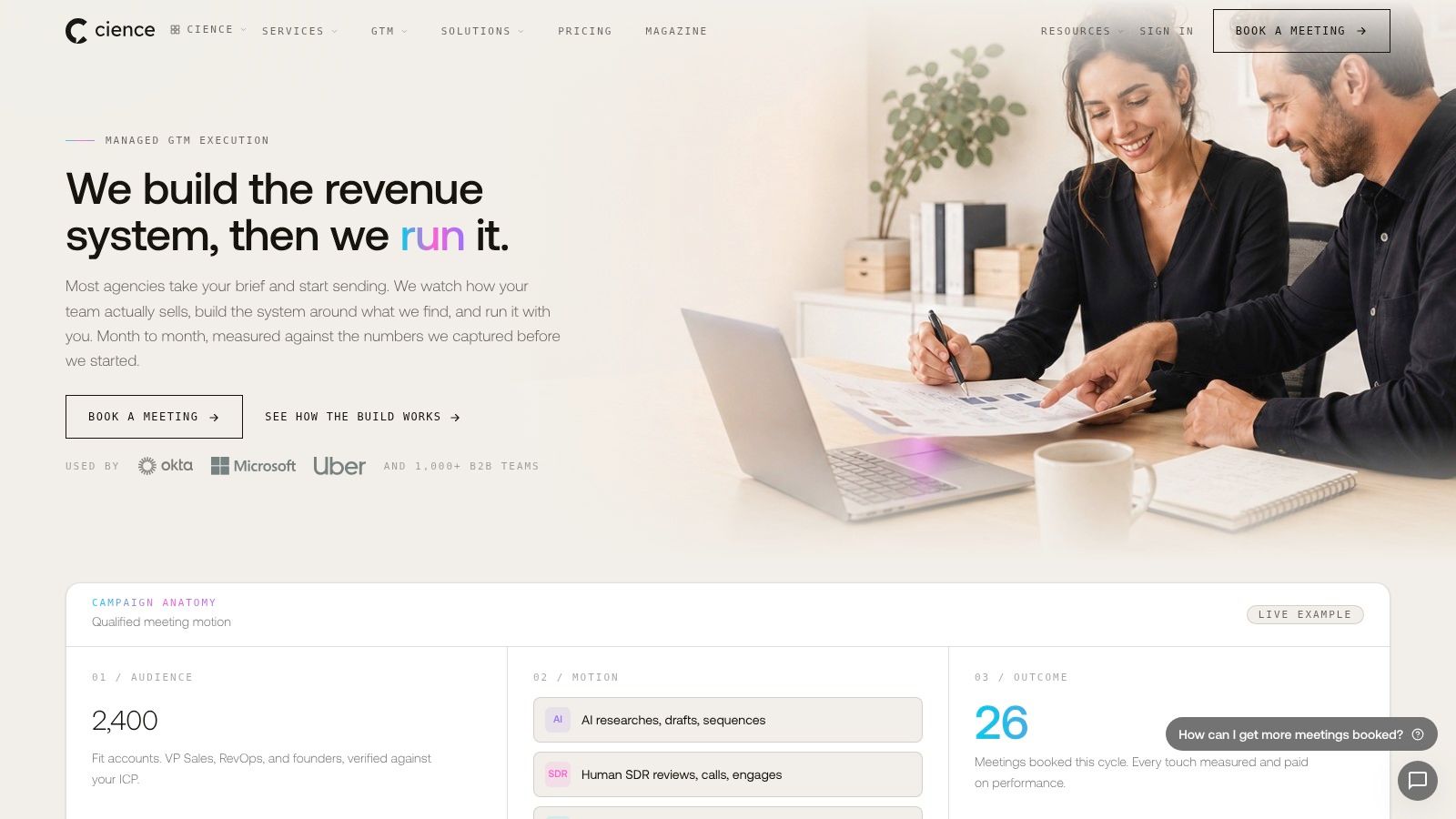
CIENCE is built for buyers who want to combine outsourced SDR execution with revenue-system design. Its three engagement modes let clients ask the company to run SDR execution, build the system alongside the internal team, or work through the CIENCE platform. That makes it broader than a simple appointment-setting vendor.
The operating model combines AI-assisted research with human SDR execution and programmatic controls. CIENCE also presents review badges and case-library transparency across more than 2,500 clients and 250+ industries. Those figures describe the breadth of its stated experience, not a guarantee that the same approach will fit your segment. Buyers should examine examples involving comparable deal complexity, geography, buyer seniority, and sales-cycle length.
A broader system than many teams need
CIENCE publishes starter pricing and offers a 60-day system setup option, which gives buyers more early clarity than providers that disclose no commercial framework. It can scale toward enterprise SDR programs and local-market coverage, including APAC.
That breadth is the attraction and the risk. If you need an integrated combination of data operations, process design, SDR execution, and platform support, CIENCE can reduce vendor fragmentation. If you only need a lightweight appointment-setting campaign, the broader GTM scope may add operational complexity, onboarding work, and platform dependence that you don't need.
A useful test is to ask whether you want a team to perform outreach, build your sales development system, or provide the infrastructure your team will operate. CIENCE supports all three, but they aren't the same purchase.
Clients should define CRM ownership, reporting access, list governance, and what happens if the relationship ends. A practical outsourced SDR services review should also assess the internal manager required to keep an external SDR team aligned.
Pros
Multiple engagement modes: Run, build, or platform support can match different levels of internal capability.
Published entry structure: Starter pricing and a defined setup period improve initial planning.
Enterprise scalability: The model can support larger SDR programs and regional coverage.
Cons
Potential overbuy: Smaller teams may not need the full GTM architecture.
Platform complexity: A platform tie-in may be undesirable for teams seeking a light vendor footprint.
Management remains shared: Your team still needs to provide positioning, feedback, and sales follow-through.
Website: CIENCE
4. Sopro
Sopro supports a people-led, multi-channel outbound model with campaign data visible to the buyer. Its documented mix includes email and LinkedIn outreach, display-audience synchronization, web chat, and intent tracking. The company also describes live-data audience building and downloadable prospect records that may include several stakeholders at one account.
That configuration suits account-based programs where one contact rarely represents the full buying group. Teams can coordinate outreach across roles and channels, although the value depends on accurate targeting and consistent follow-up rather than channel count alone.
The performance portal and recurring strategy calls give buyers access to campaign oversight. Before signing, ask which metrics the portal displays, how meetings are attributed to channels, and whether intent signals change targeting or only populate reports. Those answers show whether Sopro is operating one connected process or presenting separate dashboards.
Pricing, speed, and handoff
Sopro advertises a public starting price, no minimum contract, and go-live timelines often around three weeks. This lowers the initial commitment for teams testing a market. The starting figure still leaves scope questions: complex audiences, additional stakeholders, regions, and channels may alter the final cost.
Sopro reportedly gives clients ownership of prospect data created during campaigns. That term matters for teams that want to retain records after the engagement, but ownership does not define who responds to each handoff or how quickly. Teams should require written routing rules for web-chat, LinkedIn, and intent-triggered leads before signing, specifying which internal role accepts each handoff within a set response window.
For buyers assessing the social channel specifically, LinkedIn lead generation provides useful context for comparing Sopro's LinkedIn and email motion with other outbound options.
Pros
Multi-channel coverage: Email, LinkedIn, display, web chat, and intent tools can operate within one campaign.
Commercial flexibility: Public starting pricing and no minimum contract make an initial test easier to scope.
Data ownership: Campaign-built prospect records remain an important buyer consideration.
Cons
Final pricing varies: Audience complexity and campaign scope can change the actual cost.
Client follow-through required: Internal owners must respond to handoffs across channels.
Signal interpretation needs scrutiny: Buyers should confirm how intent data changes action, not only reporting.
Website: Sopro
5. SalesRoads
SalesRoads is the phone-first option for US-focused teams that care more about conversation quality than raw outreach volume. It offers Smart Email Appointment Setting alongside full outsourced SDR appointment-setting teams, but its positioning centers on live qualification, brand representation, and highly qualified meetings.
That focus changes the client requirement. Phone-first programs need more than a target account list. SalesRoads' representatives must understand the offer, objection patterns, acceptable qualification standards, and the tone expected when speaking for the brand. Your internal team must also provide usable discovery criteria and make time for feedback.
The company presents strong case studies across industries and call difficulty levels. Buyers should pressure-test those examples rather than accepting them as universal evidence. A difficult call environment in one sector doesn't automatically predict performance in another, particularly when buyer roles, geography, and contract value differ.
Where the higher-touch model makes sense
SalesRoads gives a public indication of its engagement starting point, helping teams assess budget fit before a deeper consultation. Its program details are generally finalized through that consultation rather than a fixed menu, so the buying process still depends on defining qualification and handoff terms in writing.
This is a better fit for organizations that value trained SDR conversations and brand-sensitive appointment setting in the United States. It may be less attractive for teams that want a low-cost email-led experiment, a fully owned outbound infrastructure, or broad APAC coverage.
Handoff rule: A qualified appointment only creates value when the receiving seller knows why the prospect agreed to meet and what the SDR learned during the conversation.
Use the company's B2B appointment setting perspective to distinguish phone-led qualification from simple calendar filling.
Pros
Conversation quality: Live qualification supports more context-rich handoffs.
Brand representation: The model suits companies that can't risk generic outreach.
Engagement clarity: A published starting point supports early budget alignment.
Cons
Higher-touch economics: Phone-first execution can cost more than email-led providers.
US orientation: Regional buyers may need a different coverage model.
Consultative scoping: Final program design requires direct sales discussion.
Website: SalesRoads
6. Operatix
Operatix is designed for established B2B software and technology vendors that need SDR coverage across regions. Its offering combines outbound sales development, account-focused targeting, inbound lead qualification, and marketing acceleration. That combination makes it relevant to companies trying to improve both net-new prospecting and the conversion of existing marketing leads.
The regional footprint includes North America, EMEA, LATAM, and APAC, with multilingual coverage. For a technology company entering several markets, this can reduce the burden of coordinating separate SDR vendors. It also gives the provider a role in qualifying inbound demand, not only creating outbound activity.
Best suited to a defined sales motion
Operatix favors organizations with an established ICP and higher ACV. That isn't a flaw. Complex software sales require enough deal value to support research, training, qualification, and regional execution. A company still testing its positioning may need a strategy and messaging partner before it can get full value from an outsourced SDR bench.
The wishlist-account model is particularly relevant for teams selling into named accounts. However, buyers should clarify how account priorities are refreshed, how multiple stakeholders are mapped, and whether inbound qualification follows the same standards as outbound meetings.
Pricing is fully customized, with no public rate card. That limits quick comparison, so the proposal should separate SDR capacity, management, market coverage, inbound qualification, data, and reporting. It should also state what the client owns at the end of the engagement.
Pros
Technology specialization: The model is aligned with complex B2B software sales.
Regional coverage: Multilingual North America, EMEA, LATAM, and APAC support can simplify expansion.
Blended motion: Outbound, inbound qualification, and marketing acceleration can operate together.
Cons
Limited price visibility: Buyers need a detailed custom proposal.
Maturity requirement: Teams without a stable ICP may not be ready.
Higher-ACV bias: Smaller transactions may not support the operating model.
Website: Operatix
7. INFUSE
INFUSE is the strongest fit when lead generation needs to extend beyond direct outbound. Its demand generation programs center on content syndication, buying-group intelligence, and omnichannel activation across external publishers. Instead of relying only on email, LinkedIn, or calls, INFUSE helps put a client's content and offers in front of new audiences and then routes qualified demand into the sales process.
Its programs include CPL-based content activation and targeted MQL or SQL delivery. The company also describes always-on brand-to-demand orchestration, real-time analytics, optimization, dedicated client success, proprietary demand technology, and global reach. This makes it more suitable for demand capture and audience development than for a narrow appointment-setting brief.
The content requirement is real
INFUSE can complement outbound by creating awareness and identifying buying-group activity before direct sales outreach. But the model depends on useful content assets, clear qualification criteria, and a sales process that can nurture contacts who aren't ready for a meeting.
The performance structure can be attractive because programs use CPL or other performance approaches without added subscription or per-seat platform fees. That doesn't eliminate budget risk. True ABM and complex enterprise motions may require larger budgets and longer timelines, while an MQL delivered at a stated threshold may still need substantial sales qualification.
INFUSE suits companies that want external demand generation to feed outbound and nurture. It isn't the obvious choice for a founder who needs a fast, owned cold-email system or a small team without content resources.
Pros
Content-led reach: Useful for creating demand beyond direct prospecting.
Buying-group intelligence: Supports broader account coverage than a single-contact lead model.
Performance structure: CPL-based programs avoid added subscription or per-seat platform fees.
Cons
Content dependency: Weak or limited assets can restrict campaign value.
Longer enterprise motion: ABM programs may need more budget and patience.
Different handoff type: The client may receive MQLs or SQLs rather than sales-ready meetings.
Website: INFUSE
Top 7 Lead Generation Companies Comparison
Provider | 🔄 Implementation Complexity | ⚡ Resource Requirements | 📊 Expected Outcomes | 💡 Ideal Use Cases | ⭐ Key Advantages |
|---|---|---|---|---|---|
The Social Search | Medium, system-first build; ~3-week go‑live | Moderate, ICP, clean data, messaging; optional fractional GTM ($500–$10k/mo) | Measurable pipeline & meetings; targets ~8–12 qualified meetings/mo by day 90; $4M+ proof points | Venture-backed SaaS, mid-market, APAC expansion, building outbound from scratch | Fast launch, handover documentation, signal-led timing, transparent attribution |
Belkins | Low–Medium, turnkey managed programs | Retainer-based; packaged deliverables with included deliverability tools | Predictable appointment volume with annual targets per package | Teams preferring fully outsourced appointment setting and predictable outputs | Clear packaging, multi-channel, bundled deliverability & research |
CIENCE (graph8 Services) | Medium–High, system + execution or platform tie-in | SDR execution, data ops, platform options; published starter pricing/60-day setup | Scalable SDR ops and structured GTM system; enterprise-capable | Organizations wanting both execution and a repeatable GTM architecture | Flexible engagement modes, AI-assisted research, large client footprint |
Sopro | Low–Medium, people-led multi-channel; fast go‑live (~3 weeks) | Flexible, no minimum, public starting price; client owns campaign data | Leads, downloadable prospect records, live performance portal | Teams needing flexible, short-term campaigns and clear pricing | Transparent pricing, data ownership, strong customer reviews |
SalesRoads | Medium, high-touch, phone-first qualification | Higher-cost, US-focused outsourced SDR teams | High-quality, deeply qualified phone appointments | Companies prioritizing phone qualification and brand-led conversations in the US | Emphasis on conversation quality, brand representation, robust case studies |
Operatix | Medium–High, outsourced SDR with global reach | Custom pricing; large SDR bench; multi-lingual, multi-region coverage | Multi-region pipeline generation and inbound qualification support | Tech vendors with established ICPs and higher ACVs needing global coverage | Deep B2B tech focus, blended outbound/inbound motions, global SDR capacity |
INFUSE (INFUSEmedia) | Medium, content-led, CPL/performance programs | Requires strong content assets; publisher network access; performance fees | Qualified leads from content syndication and buying-group intelligence | Demand-gen teams seeking off-site audience activation and intent capture | CPL/performance model, buying-group intelligence, real-time analytics |
Choose the Partner That Matches Your Pipeline Motion
The best provider depends on the bottleneck your team needs to remove. Choose The Social Search when you need an owned, signal-led outbound system, APAC expansion support, or a documented process your team can operate after handover. Its model is especially relevant when ICP definition, data quality, messaging, deliverability, routing, and reporting are currently fragmented.
Choose Belkins or Sopro for turnkey multi-channel programs. Belkins is a stronger fit when packaged appointment targets and managed outbound matter most. Sopro is more compelling when you want email, LinkedIn, display, web chat, intent tracking, data ownership, and flexible engagement terms in one program.
Choose CIENCE when you need a broader blend of SDR execution, systems, and platform support. Its multiple engagement modes suit teams deciding how much of the operating model to outsource. Choose SalesRoads for phone-first qualification and brand-sensitive conversations in the US, particularly when a live SDR's discovery matters more than a high activity count.
Choose Operatix if you're an established B2B technology vendor that needs multi-region SDR coverage, account-focused targeting, and inbound qualification. Choose INFUSE for content-led, omnichannel demand generation that reaches net-new audiences and supports buying-group activation beyond pure outbound.
Before signing, compare the providers against the realities of your sales process:
ICP maturity: Can your team clearly define target accounts, buyer roles, exclusions, and qualification?
Target geography: Do you need US, Europe, APAC, LATAM, multilingual, or global coverage?
ACV and sales cycle: Can the expected contract value support the provider's level of research and execution?
Preferred channels: Should the program prioritize phone, cold email, LinkedIn, content, events, web chat, or intent?
Handoff ownership: Who responds, qualifies, reschedules, runs discovery, updates the CRM, and closes?
Pricing model: Is the engagement based on a retainer, appointments, CPL, performance, platform access, or custom scope?
Reporting expectations: Can you attribute meetings and pipeline to specific accounts, signals, lists, messages, and channels?
Internal capacity: Does your team have the time and skill to qualify and close the opportunities created?
Validate the technical layer before launch. Check deliverability and sequencing requirements with Instantly, enrichment needs with Apollo, and intent or social-signal workflows with Whitewhale and Trigify. Cold email deliverability remains a gating factor, with one 2026 benchmark reporting 87.2% global inbox placement, including 89.8% for Gmail, 87.3% for Yahoo, 77.4% for Microsoft, and 82% for Apple Mail (deliverability benchmarks). That evidence makes infrastructure a buying criterion, not a technical afterthought.
If you're also building demand through social channels, review this guide to profile optimization for Instagram leads and decide whether social discovery should support, rather than distract from, your core pipeline motion.
The right partner won't just send more messages or deliver more names. It will fit your market, protect your channels, define a usable handoff, and show which operating decisions create qualified pipeline.
The Social Search designs, builds, and runs owned outbound systems for B2B teams selling into APAC and global markets, connecting ICP definition, data, messaging, email, LinkedIn, signal-driven timing, routing, and reporting. Visit The Social Search to explore a one-time system build or a fully managed fractional GTM function that turns lead generation into a measurable pipeline operation.
