Why Is Sequencing Important for Outbound
Learn why is sequencing important for B2B outbound: timed follow-ups, inbox health, and APAC pipeline conversion, not one more email.
A single cold email gives a buyer one chance to respond. A sequence adds timely, relevant messages, creating more opportunities for a conversation while giving your team clear rules for when to continue, pause, or hand the exchange to a person.
For teams selling into APAC, sequencing means choosing who enters, what each message adds, and which local working hours to respect. It also means treating the sequence as a state machine: a reply, a bounce, or a change in buyer fit should change what happens next.
Table of Contents
Why Outbound Sequencing Changes Pipeline Results
Outbound sequencing turns separate messages into a system for learning which accounts progress and why. A single email gives you little context: no reply could mean poor timing, a weak offer, or that the buyer needs another useful touch before responding.
A follow-up often brings a meaningful share of replies, so judging an offer after only the opening email can leave potential conversations undiscovered. Sequencing also makes the path measurable, from account selection to the point where a buyer engages.
What a sequence controls and how to measure it
Job | If you skip it | What to measure |
|---|---|---|
Pipeline quality | Unranked accounts share one path | Qualified meetings per 1,000 prospects |
Deliverability | Volume burns placement before replies arrive | Bounce rate and spam complaints |
Timing | The next touch waits on rep memory | Contact rate by delay bucket |
Personalization | Later steps repeat the first pitch | Positive reply rate by touch |
Conversion | The program stops after email one | Share of replies from follow-ups |
Use the table as an operating scoreboard
Pipeline quality starts with account selection. A regional operations director evaluating expansion and a founder still validating demand may work in the same industry, but they are unlikely to need the same message.
Deliverability affects how much you can learn from a campaign. If emails are not reaching inboxes, changing the closing question will not fix the problem. Track delivery indicators alongside replies so you can separate inbox placement issues from message performance.
Timing makes execution visible. Record when a prospect becomes eligible and when each touch is sent. That helps a manager see whether a weak result comes from delayed execution or from the message itself.
Personalization should change the value of each touch, not just add a company name. A later message can introduce implementation evidence, a relevant comparison, or a different stakeholder's problem.
Conversion measurement needs to distinguish interest from activity. A decline, unsubscribe, or removal request is a response, but it is not evidence that the sequence is creating pipeline.
Assign tools to defined jobs
For email sequencing, warming, and sending limits, consider Instantly. Use it to run a defined path, not to compensate for an unclear offer.
For coordinated LinkedIn outreach, HeyReach is a relevant option. For enriching contact and company records before enrollment, consider Apollo, then verify the fields your targeting depends on.
Teams that need shared language for follow-up can plan a consistent sales follow-up sequence. Agree on how channels, timing, and ownership fit together before configuring automation.
A sequence succeeds when the right accounts progress without unnecessary contact.
Sequencing matters because it makes the decisions behind pipeline visible and adjustable. This guide covers B2B outbound sequencing, not DNA sequencing or project scheduling.
How Sequence Timing Runs as a State Machine
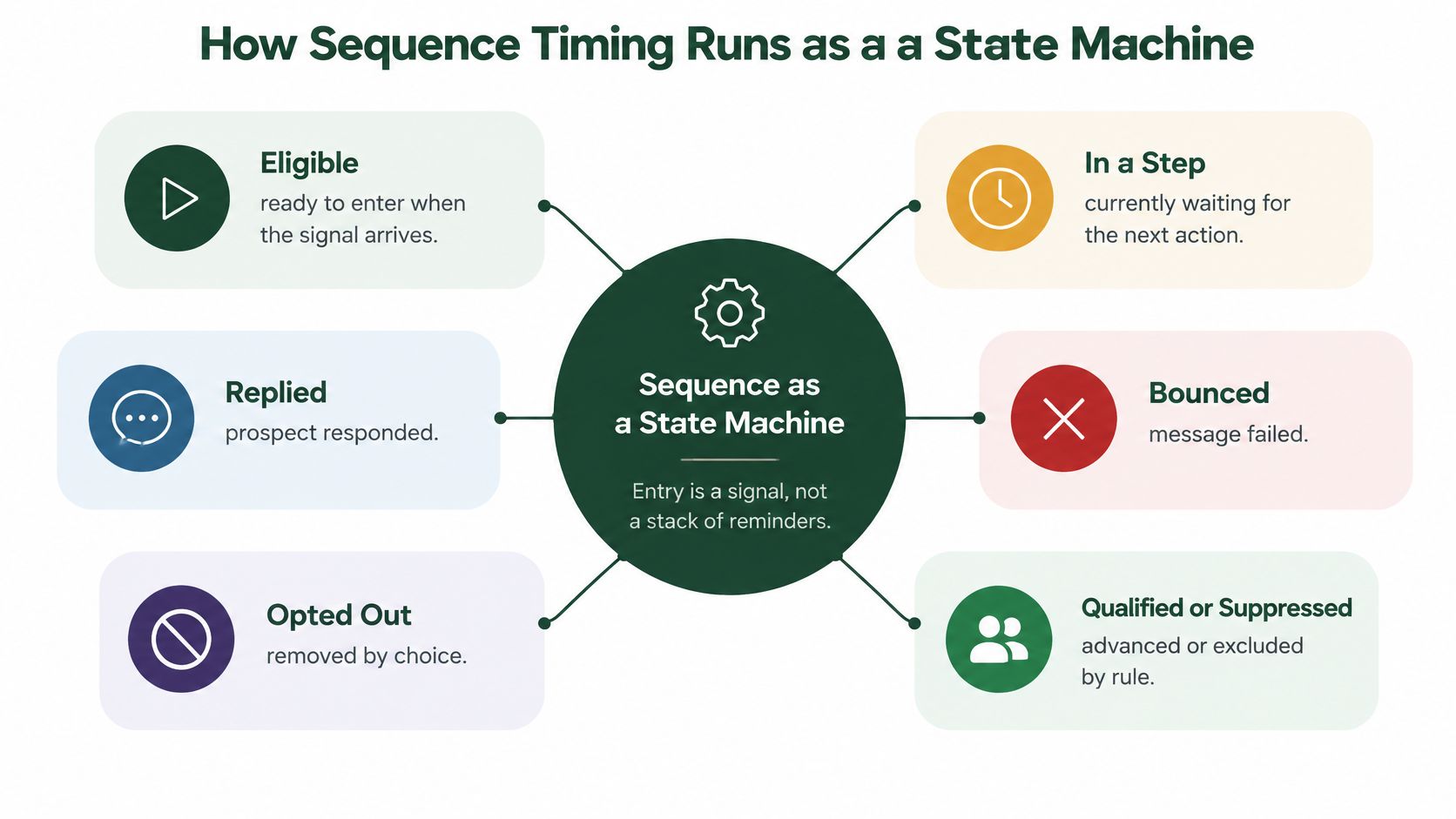
A state machine is a system in which a record's current status determines what can happen next. In outbound, a prospect waiting for a follow-up is eligible for a different action from someone who has replied or opted out.
The operator defines the transitions. A timer can release the next message, but a reply must override that timer.
Establish eligibility before enrollment
At The Social Search, our list-building process has four steps: ICP definition, data sourcing, signal layering, and prioritisation. The result is a ranked list handed off ready to sequence, rather than a database export handed to a rep to interpret.
For signal-led entry, consider Whitewhale as an intent-signal solution. Use a relevant trigger to decide who should be considered today, then check fit, record quality, previous conversations, and exclusions before enrollment.
A signal isn't permission to ignore eligibility. Hiring activity might explain why an account could care, but an existing opportunity or previous opt-out should still prevent automated prospecting.
We build the offer first and write outreach sequences around it. Our messaging process pins down the angle and the problem it solves before moving through cross-channel sequence design, copywriting, and optimisation against live replies.
The operational path should be explicit:
Trigger received: Record the business event and its relevance to the offer.
Eligibility confirmed: Check fit, contact details, suppression status, and account ownership.
Action released: Send a message with a business reason, then wait for the next permitted action.
Event detected: Reroute on a reply, bounce, opt-out, or qualification event instead of continuing blindly.
Test timing without changing everything else
The InsideSales cadence study found average contact rates above 42% for touches spaced one to two days apart, while cadences generating an immediate response in under 24 hours achieved more than three times the contact rate of those delayed beyond 24 hours.
Treat those findings as a reason to test responsiveness, not as a universal schedule. High-intent accounts can enter the same day when eligibility and local working hours allow.
For a controlled experiment, compare a first follow-up inside 24 hours with one at 24 to 48 hours, using the slower arm as the control. Keep list quality, message, and channel constant so you can reasonably attribute differences to timing.
Measure contact rate by delay bucket, sequence position, persona, and market. Opens alone don't establish that you've reached someone willing to engage.
A Singapore SaaS buyer and a Jakarta operations lead shouldn't automatically receive the same send hour, channel, or proof. Keep the underlying transition rules consistent while adapting execution to the buyer's context.
How Many Touches a Sequence Should Run
There isn't a universal touch count that makes persistence productive. The useful limit is the point where you run out of different, relevant reasons to contact the buyer.
As a planning default to test, consider four to six touches across about three weeks. That's an editorial starting point, not a performance benchmark or a promise that every account needs the whole path.
Give every touch a different purpose
For example, a hypothetical schedule could look like this:
Day 0, business trigger: Send a short email explaining why a recent event makes the problem relevant.
Day 2, regional relevance: Add a LinkedIn note with an appropriate regional proof point, rather than copying the email.
Day 5, independent research: Offer a one-page benchmark the buyer can assess without booking a call.
Day 9, practical impact: Share substantiated customer evidence or an impact model with clearly stated assumptions.
Day 16, low-friction close: Ask whether the issue is relevant and make declining easy.
The example works only if you have the promised material. Don't invent customer results to fill a scheduled slot, and don't turn every touch into another request for calendar time.
Decide where persistence ends
Remove a prospect from the automated path when they reply, bounce, opt out, or book a qualified meeting. A neutral reply can justify a different workflow, but it shouldn't leave the original pitches running.
Review cumulative positive replies, unsubscribe behavior, and pipeline relative to enrolled prospects. Our guide to cold email response rate can help you distinguish useful engagement from a superficially busy inbox.
Practical rule: A touch earns its place through incremental qualified conversations, not because you already wrote it.
Say a later touch adds no positive replies while removal requests increase. Cut that touch and investigate the offer or segment instead of extending the same pitch.
Keep completed prospects out of immediate re-enrollment. A new campaign should require a materially different reason to engage, not a refreshed subject line.
How Sequences Protect Inbox Placement
Say a campaign stops producing conversations. The sales team rewrites the offer, but mailbox providers are filtering the messages before buyers see them.
That's an infrastructure problem masquerading as a commercial problem. Check authentication and reputation signals before concluding that the market rejected your positioning.
Make inbox health an input
Mailgun's email authentication requirements guide explains that Gmail and Yahoo require bulk senders to use SPF and DKIM, with DMARC providing policy and reporting controls, and that Microsoft introduced comparable requirements for high-volume Outlook.com, Hotmail.com, and Live.com senders beginning in 2025.
Authentication doesn't guarantee inbox placement. It establishes an identity foundation that still needs sound targeting, valid records, and messages recipients don't consider unwanted.
Inbox signals and the sequence change they require
Signal | What it means | Sequence change |
|---|---|---|
SPF or DKIM failing | The mailbox provider cannot trust the sender | Pause bulk steps and fix authentication |
DMARC missing or not aligned | Policy and reporting are blind | Do not raise volume until alignment is fixed |
Rising bounce rate | Risky or bad records are in the path | Suppress and re-verify before the next step |
Spam complaints rising | The list or the step is unwelcome | Cut the daily cap and rewrite that step |
Unsubscribe spike | Persistence has become noise | Shorten the path and honour the stop |
DMARC policy and reporting may exist even when alignment fails. Operationally, distinguish a missing policy from messages failing alignment, then correct the actual fault rather than treating them as identical technical conditions.
Separate pause decisions from copy decisions
An authentication failure warrants stopping affected bulk activity until the technical owner resolves it. A weak positive-reply rate with healthy inbox signals calls for reviewing targeting and messaging, not automatically rebuilding the sending setup.
For rising bounces, inspect the source and age of the records. Suppress affected contacts and re-verify the relevant segment before releasing another wave.
For complaints, investigate which audience and message produced them. Reduce exposure while checking whether the problem is poor fit, misleading positioning, or excessive persistence.
Assign an owner: Give someone authority to pause sending without waiting for a campaign review.
Record the change: Log the affected provider, segment, step, and remediation so you can interpret subsequent performance.
Resume deliberately: Confirm the fault is addressed before restoring volume.
Use Instantly's warming, send limits, and inbox controls within those operating rules. Warming doesn't override complaints or repair broken authentication.
Keep limits appropriate to the campaign and mailbox-provider mix. A small targeted APAC campaign and a high-volume consumer-mailbox push shouldn't inherit identical settings.
Our email deliverability best practices provide a broader operating reference for keeping infrastructure checks connected to campaign decisions.
When a Sequence Should Hand Off to a Human
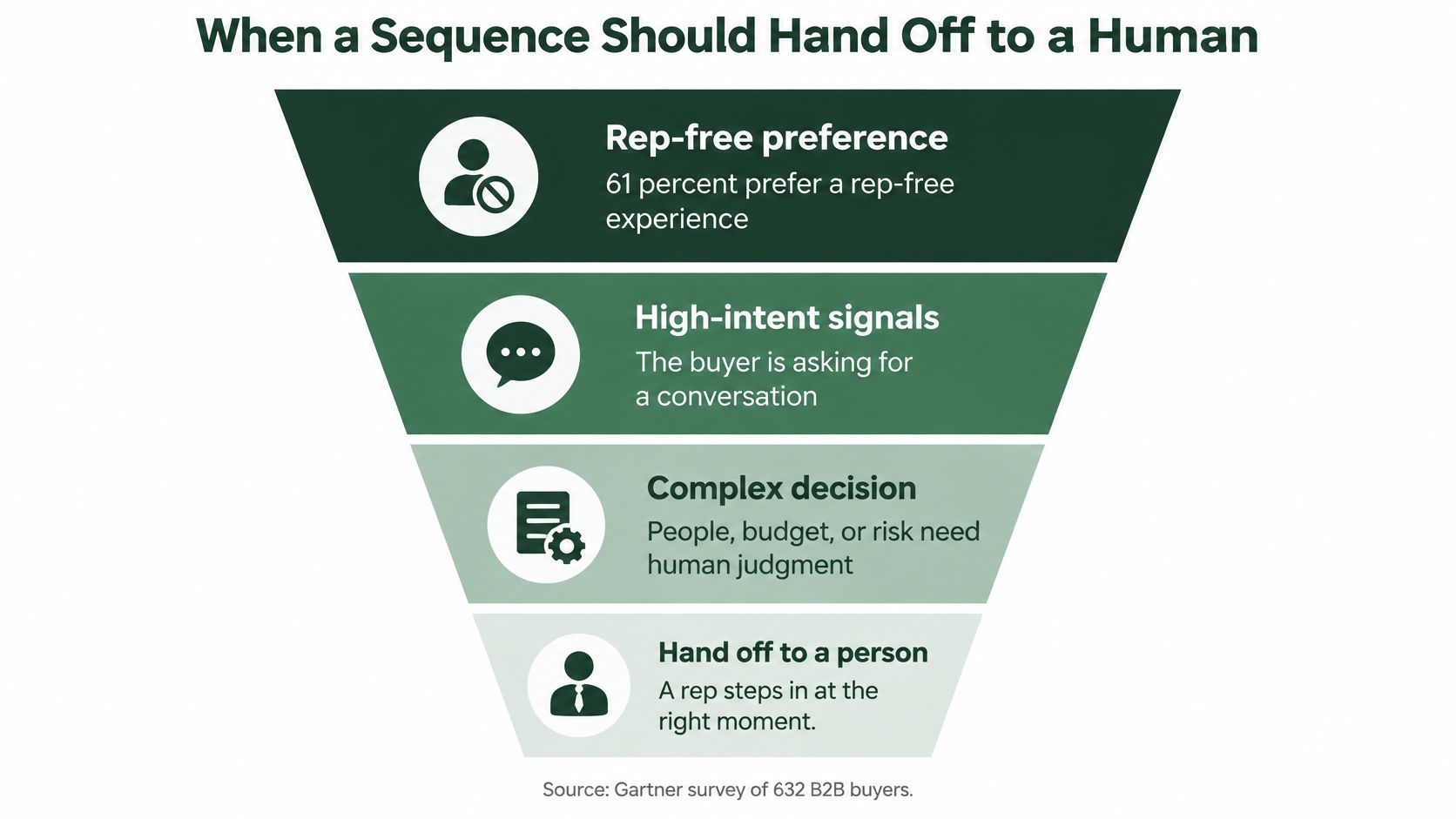
61% of buyers preferred a rep-free buying experience in Gartner's survey of 632 B2B buyers, yet buyers still preferred seller input for contextual tasks such as determining whether a solution fits their company.
That isn't an argument for removing sellers. It's an argument for bringing them in when their judgment is useful rather than making a conversation the price of accessing basic information.
Distinguish information from interpretation
A request for a product comparison is usually an information task. A request to explain which option works across an existing regional technology stack requires interpretation.
Early messages should offer usable self-serve material: a clear use case, an implementation overview, or a short comparison. The buyer should be able to understand the substance without first accepting a meeting.
A longer sequence can become counterproductive when it keeps teaching basics after the buyer has started evaluating fit. Generic educational messages can make the seller appear inattentive to a specific question.
Buyer request | Next best interaction |
|---|---|
Send the integration overview | Provide the relevant asset |
Explain compatibility with our custom workflow | Route to a knowledgeable person |
Share your security documentation | Provide the approved material |
Help us resolve a security exception | Arrange a diagnostic conversation |
Make the handoff useful
The rep should receive the trigger, messages already sent, assets requested, and the buyer's actual question. Asking someone to repeat all of that wastes the context your sequence collected.
For a buying committee, tailor the next interaction to the role. A champion may need implementation evidence, while an economic buyer needs a credible view of business impact.
Stop generic education when the buyer needs judgment about their own situation.
Route that conversation to someone who can answer it. A multi-country rollout question may require operational input, while a security exception needs the appropriate technical owner.
Local working hours matter here too. Schedule the response around the buyer's time zone rather than the seller's convenience, especially when handing conversations between regional teams.
Before launch, mark each planned action as asset or human, then define the behavior that changes the route. Our approach to B2B appointment setting connects the meeting to a clear buyer question rather than treating any calendar booking as success.
An APAC Sequence From Signal to Meeting
Consider a hypothetical venture-backed SaaS company selling workflow software to mid-market operations leaders in Singapore, Australia, and Indonesia. Its ranked list contains 400 accounts, and relevant funding or hiring signals make 40 eligible for the live path that day.
The operator doesn't enroll every available contact. They choose the relevant operations stakeholder, check exclusions, and preserve account ownership so another rep doesn't start a competing conversation.

Build the path around one operational problem
The opening email connects the signal to a plausible workflow issue. For a hiring account, the message might ask whether onboarding more operations staff is increasing manual approvals, without pretending the sender knows the answer.
It goes from warmed infrastructure during an appropriate local sending window. The offer is an assessment of approval bottlenecks, not a vague invitation to discover a new platform.
In this hypothetical path, a LinkedIn note follows two days later. It adds a substantiated regional example or implementation consideration rather than repeating the opening email.
The next action offers a one-page benchmark that the buyer can inspect independently. Include its methodology and limitations so the recipient can judge whether the comparison applies.
Singapore contact: Use evidence relevant to their operating model, rather than assuming geography alone establishes fit.
Australian contact: Check the recipient's actual location and working hours instead of applying a single country-wide send window.
Indonesian contact: If public email coverage is weak, consider a consented WhatsApp follow-up through Respond.io, with the same suppression rules as email.
WhatsApp isn't a workaround for missing consent or an ignored opt-out. Use it when the buyer has agreed to that channel and the conversation belongs there.
Evaluate the ask and the outcome
The final action asks whether a diagnostic conversation would help, provided there's no reply or adverse signal requiring a different route. If the buyer asks about rollout complexity, the operator assigns a person and removes the remaining automated pitches.
Use the prospecting stage of the sales process to keep account selection connected to what happens after contact. Record cumulative positive replies, qualified meetings, unsubscribes, and pipeline by touch, using a consistent prospect-based denominator.
Remove actions whose incremental meetings don't justify their reputation and execution costs. A busier dashboard isn't evidence of a better commercial outcome.
At The Social Search, we measure our success on meetings and pipeline, not activity. We're accountable for the system and the meetings it generates, targeting 8 to 12 qualified meetings a month by day 90 on a dialled-in list, rather than treating that target as a guarantee for every campaign.
Finish the System Before You Scale Volume
Don't increase sending volume while ICP, offer, authentication, stop rules, or ownership remain unresolved. More activity makes an unfinished process harder to diagnose and exposes more prospects to its mistakes.
The practical next step is a focused build, not a larger tool stack. Write email and LinkedIn messages that advance the same offer through different evidence, then define who owns each exception.
Check readiness before expansion
Use these checks before releasing more accounts:
Ranked list: Every enrolled account has a clear fit reason, a relevant contact, and a defensible priority.
Progressive sequence: Each action changes the reason to respond instead of repeating a line through another channel.
Enforceable pause rule: Someone can stop affected sending when inbox signals deteriorate, with a documented route to remediation.
Test the handoffs as well as the messages. Send a test reply, record a simulated opt-out, and confirm that scheduled actions stop across connected channels.
A documented sales automation process should make those decisions inspectable by the people who'll run it after launch. At The Social Search, our reporting shows channel-to-pipeline results so clients can see what's working rather than infer performance from task completion.
Start with a working conversation
For a B2B team expanding into APAC, a discovery call should clarify how buyers would be found, how the system would run, and how pipeline would be attributed. We use that conversation to show how those parts connect before recommending a build.
Scale when your team can explain why an account entered, why the next action is appropriate, and what would stop it. That's the difference between sending follow-ups and operating an outbound system.
The Social Search designs, builds, and runs connected outbound systems across ICP definition, data, messaging, sending, routing, and reporting. Visit The Social Search to book a discovery call and work through how a signal-led sequence could generate qualified pipeline for your APAC market.
