What Is Demand Generation? a 2026 Guide
What is demand generation - Learn what demand generation is and how it drives B2B pipeline growth. See how it differs from lead gen and works with outbound
95% of B2B buyers are not actively in-market at any given time, which means most outreach is aimed at people who aren’t ready to buy today. That single fact is why traffic-heavy campaigns so often miss pipeline, and why demand generation has to be treated as a revenue system, not a content habit (Omnibound).
A team that only chases form fills is working against buyer reality. A team that builds demand, captures intent, and routes signals into outbound has a system that can produce pipeline while the market is still warming up. That’s the difference between busy marketing and useful marketing.
Table of Contents
Understanding Demand Generation From a Fresh Perspective
A buyer may start evaluating vendors long before they raise their hand, and that creates a gap between market activity and pipeline creation. Sales teams feel that gap as traffic without enough conversations, content without enough response, and campaigns that look busy without producing opportunities. Demand generation exists to close that gap by shaping memory, trust, and familiarity before intent shows up.
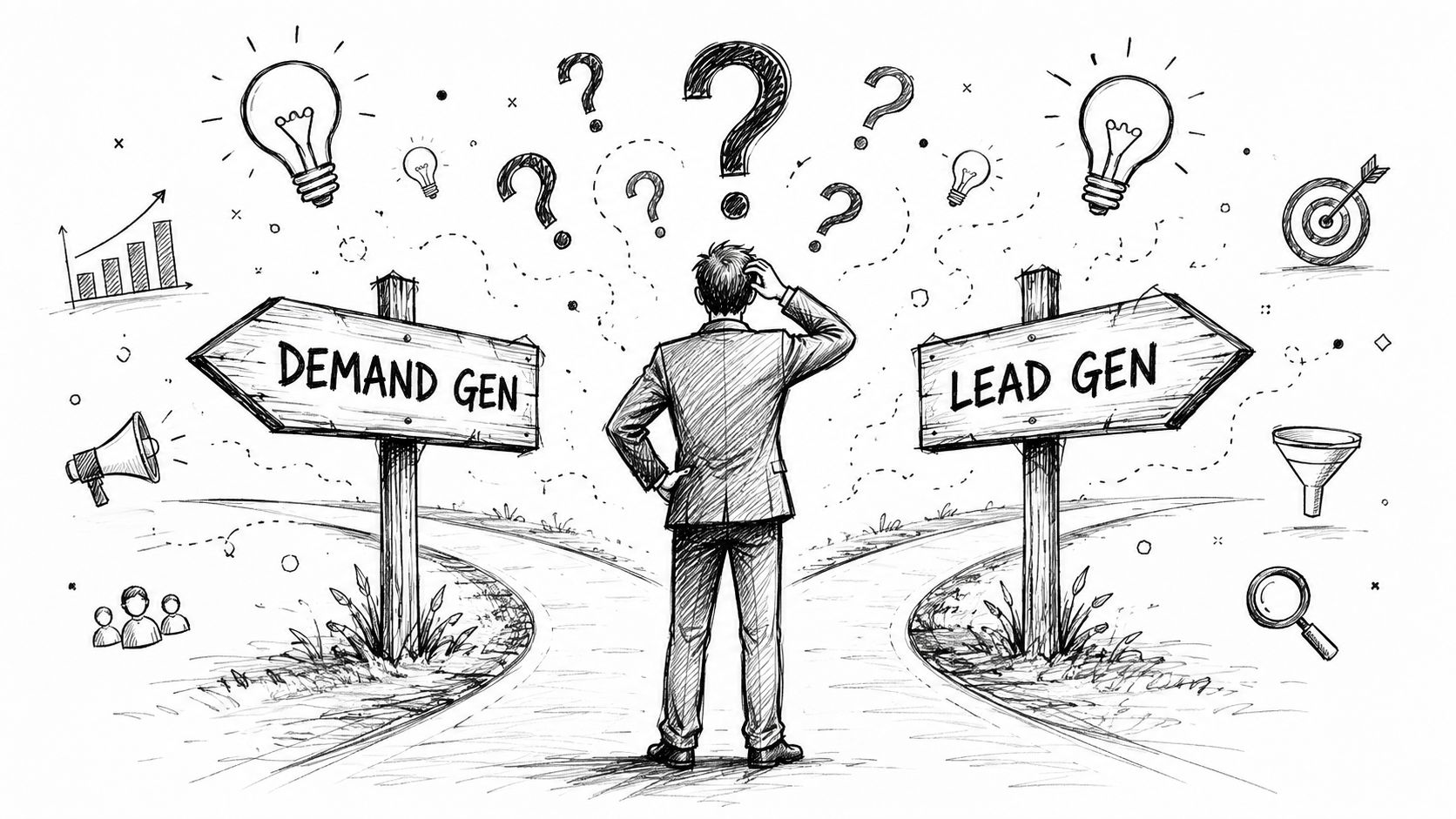
A sales leader usually recognizes this pattern right away. The team runs ads, publishes content, and drives visits, but the pipeline stays thin because only a small part of the market is ready for direct response. Demand generation fills that gap by working on the buyers who need education before they need a demo.
Why the market feels quiet even when you’re active
The goal is not to flood the funnel with names. The goal is to shape the market so more people recognize the problem you solve, remember your category, and respond when they do become active.
Demand generation works like a full-funnel operating system. It covers people who do not yet know they have a problem, people who are casually researching, and people who are ready to compare vendors. This customer life cycle guide helps map those buyer states to practical marketing work.
Practical rule: if your campaigns only work when buyers are already looking, you do not have a demand gen system, you have a capture tactic.
A useful mental model is simple. Demand generation creates the conditions for future sales conversations, while sales activity converts the conversations once buyers are ready. The work is slower than lead capture, but it is also broader, because it treats the entire market as a pipeline asset.
Demand Generation vs Lead Generation Defined
The terms get mixed up all the time, but they do different jobs. Demand generation is the broader discipline, it builds awareness, nurtures interest, and captures intent across a market over time. Lead generation is narrower, it captures people who are already showing buying intent and asks them to identify themselves.
Here’s a direct comparison.
Aspect | Demand Generation | Lead Generation |
|---|---|---|
Scope | Market-wide, full-funnel | Prospect-level, capture-focused |
Timing | Starts before buying intent appears | Starts after interest is already visible |
Primary goal | Create and shape demand | Convert existing interest into leads |
Core outputs | Awareness, engagement, intent, pipeline readiness | Contact capture, MQLs, sales follow-up |
Typical risk | Slow attribution if the system is weak | Empty pipeline if demand isn’t warmed up |
Lead generation sits inside demand generation, not beside it. That matters because a gated asset or demo request form won’t perform if the audience has no reason to care yet. This lead generation guide is a good companion if you want to see where capture starts and demand gen ends.
The simplest way to tell them apart
If the work is designed to make the market more aware of your problem, category, or point of view, it’s demand generation. If the work is designed to collect a contact from someone already leaning in, it’s lead generation.
That distinction matters operationally. Demand generation answers, “How do we create future buyers?” Lead generation answers, “How do we convert the people who’ve already shown up?” Teams that blur those questions usually end up measuring success by form fills alone, which tells you almost nothing about pipeline quality.
A strong funnel needs both. Without demand generation, lead generation dries up. Without lead generation, demand generation never turns into a hand raiser list.
A sales leader should care about this split because it changes expectations. The job isn’t to force every campaign to close immediately. The job is to make sure some campaigns educate the market, some capture active interest, and both feed the same revenue motion.
The Full-Funnel System Behind Demand Generation
Demand generation works as a full-funnel operating system when two motions stay connected. Demand creation reaches buyers who are not actively shopping yet. Demand capture converts buyers who are already showing intent. ZoomInfo’s framing of demand creation and demand capture is useful here, because it makes the split explicit and ties both motions to pipeline work (ZoomInfo).
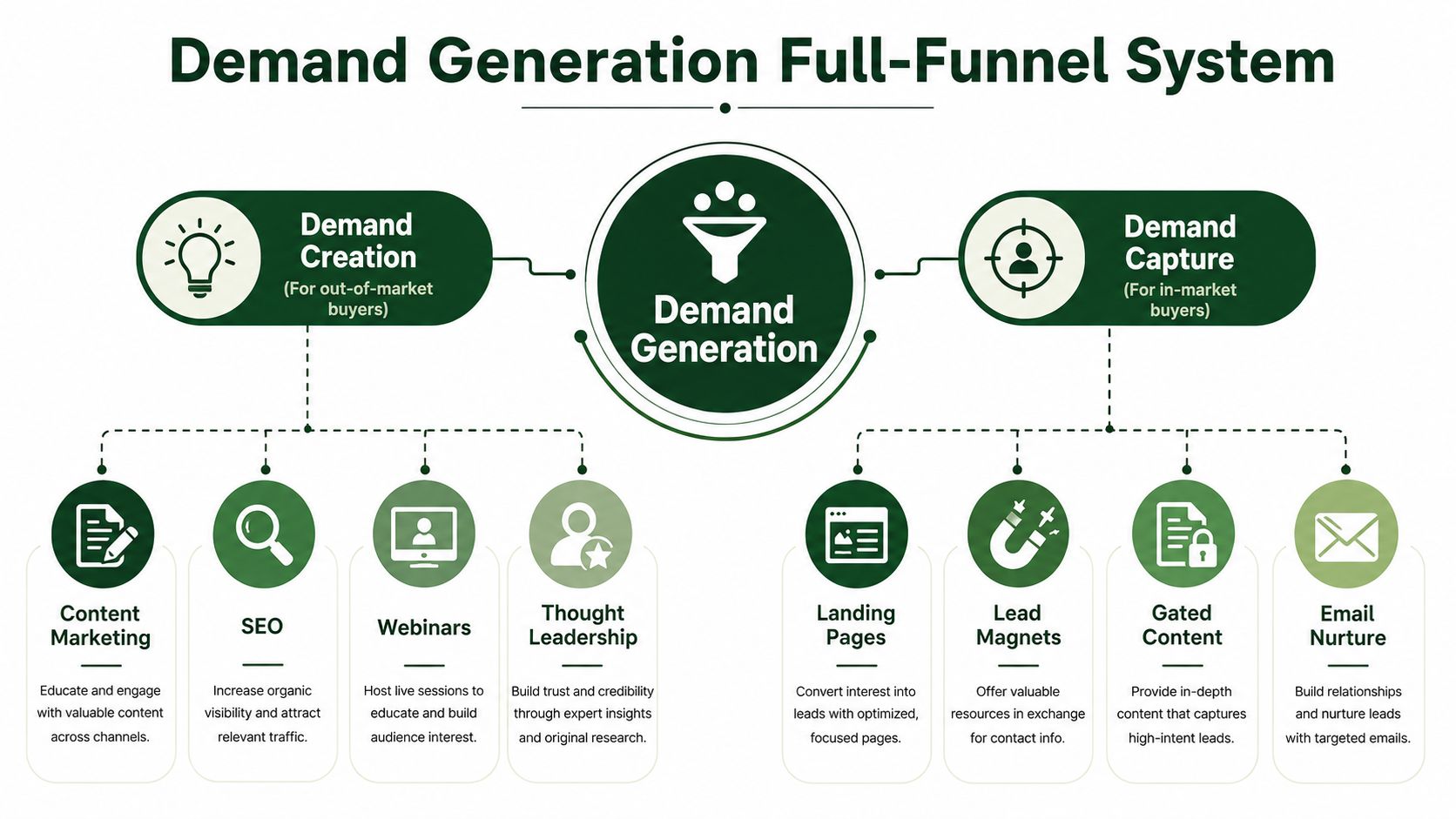
A useful analogy is a store with two entrances. One entrance brings in people who are still learning what to buy, the other serves people who already know what they want. Both doors matter, but they do different jobs. If a team only focuses on the second door, it waits for intent that may never arrive. If it only focuses on the first, it creates attention without a clear path to revenue.
The mistake many teams make is treating those motions as separate departments. Marketing creates content, sales waits for leads, and nobody agrees on what should happen when someone downloads an asset, visits pricing, or comes back twice in a week. The result is noise, not pipeline.
Demand creation and demand capture do different work
Demand creation uses content, SEO, webinars, and education to shape future buyers. Demand capture uses landing pages, email nurture, retargeting, and conversion paths to catch people once intent is visible. Those are different buyer states, so they need different assets and different timing.
The system becomes reliable only when marketing and sales agree on the handoff. That means aligning ICP definition, behavioral signals, lead scoring, and qualification criteria so a marketing-qualified lead and a sales-qualified lead mean the same thing to both teams. If that alignment is missing, sales treats marketing’s output as weak, and marketing treats sales as impatient.
A pipeline generation guide helps make that handoff concrete, because it shows how to define the signals that separate curiosity from real buying intent.
What the operating system needs to function
A practical demand gen system usually includes a few essentials:
Clear ICP rules, so content and outreach target the same buyer profile.
Signal capture, so visits, downloads, and repeat engagement aren’t lost.
Lead scoring, so the team can separate curiosity from purchase intent.
Defined handoff criteria, so sales knows when to act.
Nurture paths, so buyers who aren’t ready don’t disappear.
Practical rule: if the handoff isn’t explicit, the system leaks. Marketing thinks it passed a lead, sales thinks it got a bad one, and the buyer gets ignored.
A useful supporting step is to review how to build converting email lists so nurture and capture can work from a list that has engagement potential.
Demand gen stops being a campaign and becomes revenue infrastructure. The goal is not just to create interest. The goal is to create a measurable path from awareness to qualified pipeline, then make that path visible enough that both teams can improve it.
Core Channels and Tactics in Demand Generation
Demand generation isn’t a single channel, it’s a coordinated mix of content, search, email, events, social, paid media, and automation. DemandScience lists content marketing, social media, email, SEO, events, webinars, and paid advertising as core tactics, which matches how most B2B teams build demand systems (DemandScience).
The mistake is to overinvest in one channel and call that strategy. A blog without distribution doesn’t move many buyers. Ads without a useful offer tend to burn budget. Email without a real list is just an empty sending plan, so it helps to think about how to build converting email lists before you ask a sequence to do pipeline work.
Channel roles by funnel stage
Channel | Funnel Stage | Primary Role |
|---|---|---|
Content marketing | Awareness and consideration | Educate and frame the problem |
SEO | Awareness and discovery | Capture search intent and build visibility |
Webinars | Consideration | Create deeper engagement and trust |
Social media | Awareness | Extend reach and keep the brand visible |
Email nurture | Consideration and conversion | Move prospects toward action |
Events | Awareness and consideration | Build familiarity and direct conversation |
Paid advertising | Awareness, consideration, and capture | Amplify messages and drive specific actions |
Marketing automation | All stages | Route, score, and nurture engagement |
That view makes channel selection easier. SEO and educational content help buyers find you while they’re still defining the problem. Email nurture and automation help you keep the relationship alive after first contact. Paid media can support both demand creation and capture, depending on the audience and the offer.
This Google Ads guide for demand generation is a useful reference if you want to see how paid search fits into that mix without turning your whole plan into a lead-gen squeeze page.
When a team asks which channel is “best,” the right answer is usually “best for which stage.” Demand generation works when the pieces reinforce each other. One channel opens the door, another deepens the relationship, and automation keeps the signal from getting lost.
Integrating Demand Generation With Outbound Outreach
Demand gen becomes measurable in pipeline when it connects to outbound. A buyer who downloads a guide or returns to the site twice is sending a signal, and sales shouldn’t wait for that signal to go stale. Gartner’s 2024 CMO Spend Survey noted that 65% of marketing leaders said proving marketing’s value was harder than a year earlier, which is exactly why signal-driven routing matters.
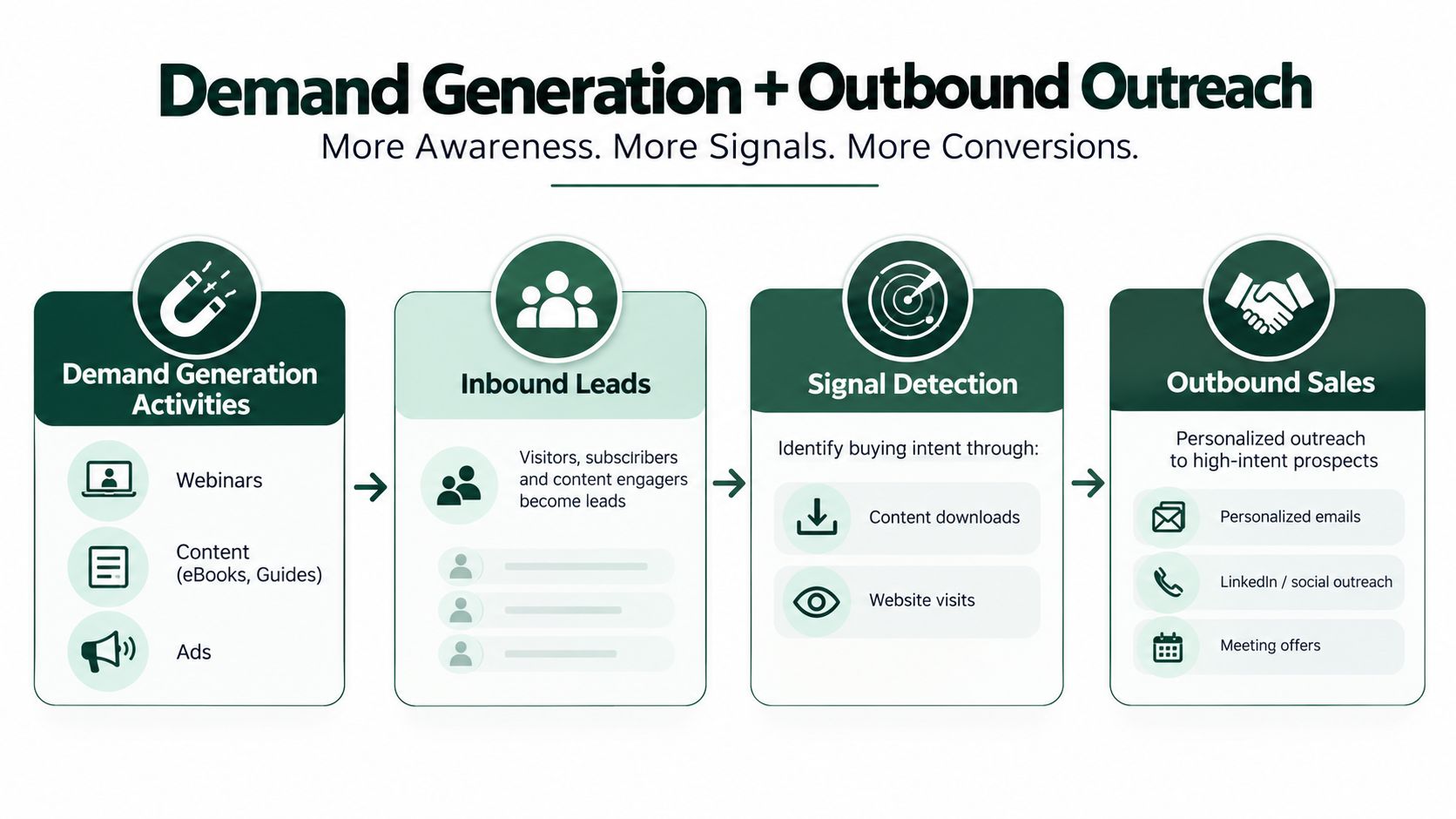
When outbound runs cold and disconnected, reps send the same message to everyone and wonder why reply rates sag. When demand gen runs without outbound, the company may build awareness but leave qualified opportunity on the table. The strongest teams connect both sides so marketing creates buying signals and sales reacts while intent is still warm.
How signals change outbound timing
Behavioral triggers matter more than volume. A prospect who visits pricing, downloads a comparison asset, or returns to the site after reading thought leadership has given you a reason to prioritize outreach. That’s where lead scoring and account prioritization turn marketing activity into sales timing.
Tools can help here when they’re used for the right job. Trigify is a natural fit for lead signals, Apollo for data enrichment, Instantly for cold email sequencing and deliverability, and HeyReach for LinkedIn outreach automation. If you need to catch reply intent in social or chat-driven channels, Respond IO and Manychat can support the follow-up layer, while SearchAtlas and Outrank fit teams using demand gen content to support discovery.
The point isn’t to automate blindly. The point is to let behavior decide who gets attention first.
This LinkedIn lead generation guide is helpful if your outbound motion depends heavily on LinkedIn as the follow-up channel.
The handoff between marketing and sales
A clean integration looks like this. Marketing builds visibility and captures signals. Ops routes engaged accounts. Sales uses the signal to personalize outreach instead of starting from zero. That shortens the distance between interest and conversation.
Personalization works best when it’s based on observed behavior, not just job title and company size.
The same logic applies across email, LinkedIn, and multi-touch sequences. If a rep knows which topic a prospect engaged with, the first message can reference that topic and offer the next useful step. That’s how demand generation stops being a branding exercise and starts becoming outbound fuel.
Real-World Demand Generation Examples in Action
A useful example is a B2B SaaS team that’s moving from ad hoc outbound to a structured system. It starts by defining its ICP tightly, then building content around the business problem the buyer is already trying to solve. The content doesn’t need to shout, it needs to be clear enough that the right accounts recognize themselves in it.
The team then layers in SEO, educational assets, and social distribution to create repeat visibility. As prospects engage, they get tagged in Apollo for enrichment, scored by behavioral activity, and watched for high-intent signals. At that point, the system can send the account to outbound instead of waiting for a demo request.
What the workflow looks like in practice
A few tools fit naturally in that motion:
Apollo enriches contacts and accounts so outreach doesn’t start with incomplete data.
Instantly handles cold email sequencing and sending infrastructure when the team needs scale and deliverability discipline.
HeyReach supports LinkedIn outreach automation for teams that want social selling to be part of the sequence.
Trigify helps surface signals that tell reps when an account is paying attention.
A team working through account-based motions can also use best ABM strategy examples to compare how targeted demand and outbound work together at the account level. That’s especially useful when the buying committee is small and the path to pipeline depends on coordinated touches, not broad awareness.
The lesson is that demand gen and outbound aren’t separate philosophies. Demand gen warms the market, outbound converts the warm spots, and the two motions become much more effective when they share the same data and qualification rules.
Where The Social Search fits
The Social Search sits naturally in the outbound and GTM engineering side of this process. It builds ICP definition, account lists, routing logic, and outbound systems across email and LinkedIn, which makes it one option for teams that want demand signals tied directly to pipeline ops. It also offers automated lead generation as part of that system-first approach, which matters when the objective is not just attention, but meetings and qualified conversations.
Building Your Demand Generation System
A working demand gen system doesn’t start with channels. It starts with the buyer, then the data, then the routing logic that connects interest to action. Adobe describes demand generation as a gradual, complete approach rather than a quick fix, and that’s the right mindset for teams that want pipeline to compound instead of spike and fade (Adobe).
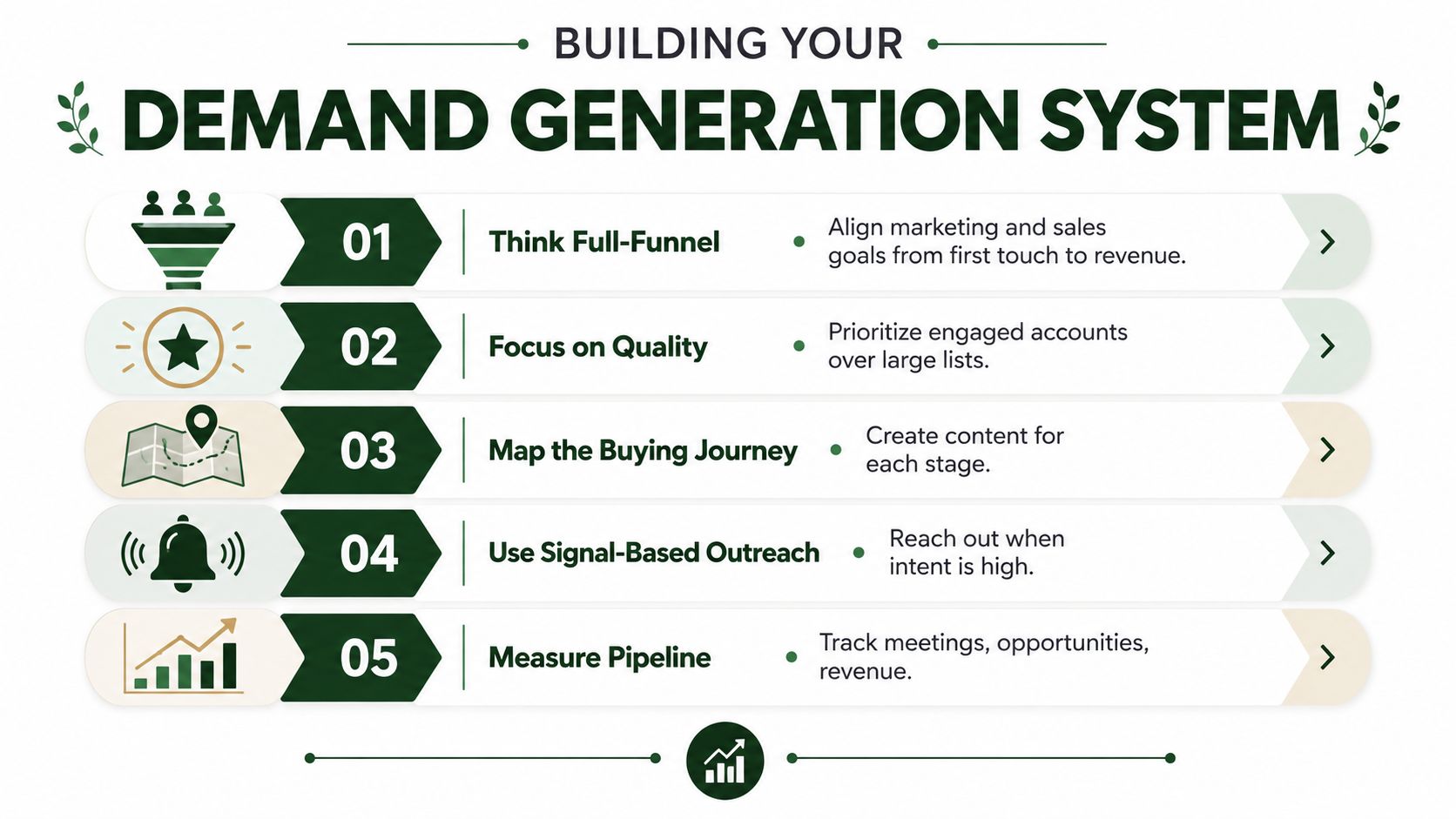
The fastest way to make this operational is to think in five moves. Define the ICP, map buyer readiness states, choose the right channel mix, capture signals, and connect those signals to outbound routing. Once those pieces are in place, the team can stop guessing which campaigns matter and start looking at what becomes pipeline.
A practical build sequence
Think full-funnel. Marketing and sales need shared targets from first touch to revenue.
Focus on quality. Engaged accounts matter more than huge lists that never convert.
Map the buying journey. One asset won’t work for every stage.
Use signal-based outreach. Reach out when intent is visible, not when the calendar says so.
Measure pipeline. Traffic and clicks are inputs, meetings and opportunities are the test.
If measurement is still fuzzy, SourceLoop’s marketing measurement guide is a useful place to tighten the reporting layer. The key question isn’t whether people visited. It’s whether the system created enough movement to justify more investment.
Demand generation pays off when it’s treated like infrastructure. The teams that win with it aren’t the ones publishing the most. They’re the ones who connect education, signal capture, and outbound follow-up into a repeatable motion that the business can own.
The Social Search builds the outbound and GTM systems that make demand generation useful after the click, from ICP definition and signal routing to email and LinkedIn execution. If you want a team that connects market education to pipeline production, visit The Social Search and see how a system-first approach can support your next stage of growth.
