Customer Life Cycle Explained: Stages, KPIs, and a Strategy for Growth
Learn the customer life cycle stages, KPIs, and practical tactics to improve retention, automate follow-up, and grow revenue at every step of the journey today.
The customer life cycle is the full path someone takes with your brand, from first awareness to purchase, repeat value, and advocacy. When you understand that path, you can match content, offers, follow-up, and support to what people actually need. The best teams do this with CRM data, automation, and tailored messaging, not by guessing or blasting the same campaign to everyone. (salesforce.com)
What the customer life cycle means

In simple terms, the customer life cycle is a business-led model of how a customer relationship develops over time. Qualtrics describes it as a generalized view of customer behavior, while Salesforce frames lifecycle marketing as engaging customers at every stage of the relationship, from awareness to loyal advocacy. The goal is not just to win a sale. It is to keep the relationship useful, relevant, and profitable for both sides. (qualtrics.com)
That is why customer life cycle thinking helps teams outside marketing too. Sales can see where prospects stall, support can see where customers need help, and leadership can see where churn or growth is being created. When the lifecycle is clear, every team works from the same map instead of running separate plays. (qualtrics.com)
Customer life cycle vs customer journey
A customer journey is the specific sequence of touchpoints one person experiences, and it is shaped by the choices they make along the way. A customer life cycle is the broader model you use to organize those behaviors across your customer base. Journey mapping helps you understand what is happening in the real world, while lifecycle management helps you decide how the business should respond. (qualtrics.com)
Use customer life cycle thinking when you want to define stages, assign ownership, and measure progress across the whole relationship. (qualtrics.com)
Use customer journey thinking when you want to study a specific path, such as a trial signup, a checkout flow, or a support interaction. (qualtrics.com)
The five stages of the customer life cycle
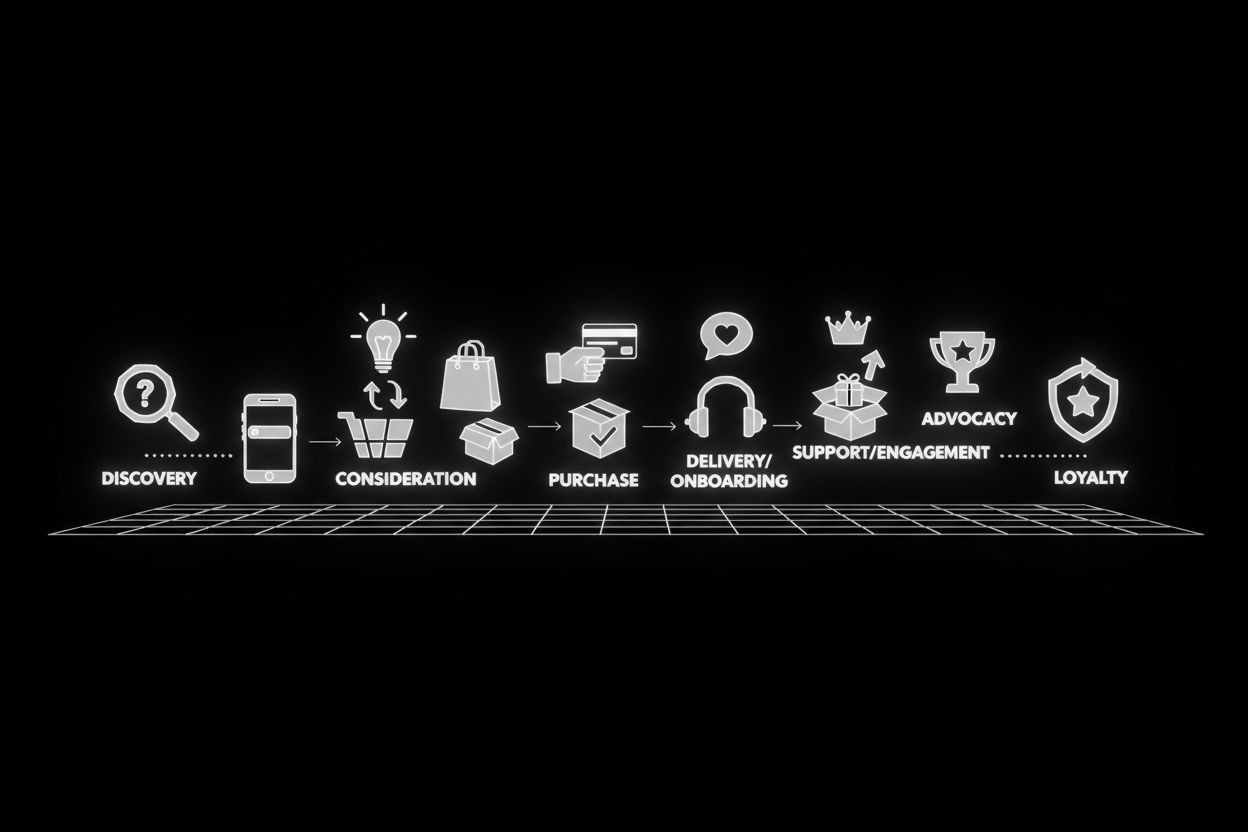
Most businesses can organize the customer life cycle into five stages: awareness, consideration, purchase, retention, and advocacy. Some sources use conversion instead of purchase, or engagement instead of retention, but the logic stays the same. Each stage needs its own message, its own offer, and its own metric. (salesforce.com)
Awareness
Awareness is the moment someone first notices your brand. That might happen through search, social content, creator videos, a referral, or paid media. The job here is not to sell too early. It is to earn attention with something genuinely useful, whether that is a short-form video, a helpful article, a lead magnet, or a focused ad campaign. This is also where automated social media and paid ads management can keep your reach consistent, especially if you are running Meta or TikTok campaigns and need a steady flow of new attention. (salesforce.com)
Consideration
In consideration, people compare options, read reviews, ask questions, and decide whether your offer deserves a closer look. Case studies, comparison pages, FAQs, demos, and pricing clarity all help here. This is also the stage where an automated AI chat agents setup can do real work, because it can answer common questions, qualify leads, and route hot prospects without forcing them to wait for a human reply. (salesforce.com)
Purchase
Purchase, or conversion, is where interest becomes revenue. Friction matters a lot here. Clear offers, fast checkout, simple forms, and a clean handoff between marketing and sales can make the difference between a closed deal and a stalled one. Salesforce notes that CRM automation can handle tasks like follow-up emails, appointment scheduling, and cart-abandonment prompts, which is exactly the kind of support that helps a near-sale move across the line. (salesforce.com)
Retention
Retention starts after the first sale. This is where onboarding, support, self-service, customer success, and well-timed reminders keep people active. Salesforce recommends looking at retention rate alongside churn, purchase frequency, and customer lifetime value, because one number alone never tells the full story. If customers keep getting value, they buy again, renew, and stay more engaged. (salesforce.com)
Advocacy
Advocacy is what happens when satisfied customers start helping you grow. Reviews, testimonials, referrals, and user-generated content extend your reach without forcing you to buy every new impression. Salesforce and Qualtrics both connect this stage with stronger loyalty, better experience, and higher lifetime value. (salesforce.com)
KPIs to track at each stage
If you want the customer life cycle to drive decisions, give each stage one primary KPI and one supporting signal. Journey maps help define the moments that matter, and CRM metrics show whether the experience is getting better over time. (qualtrics.com)
Awareness: reach, CTR, branded search, qualified traffic. (salesforce.com)
Consideration: time on page, demo requests, lead quality, chatbot completion rate. (qualtrics.com)
Purchase: conversion rate, checkout abandonment, proposal acceptance. (salesforce.com)
Retention: repeat purchase rate, churn rate, CSAT, NPS, purchase frequency. (salesforce.com)
Advocacy: referral rate, review volume, UGC shares. (salesforce.com)
How to build a customer life cycle strategy
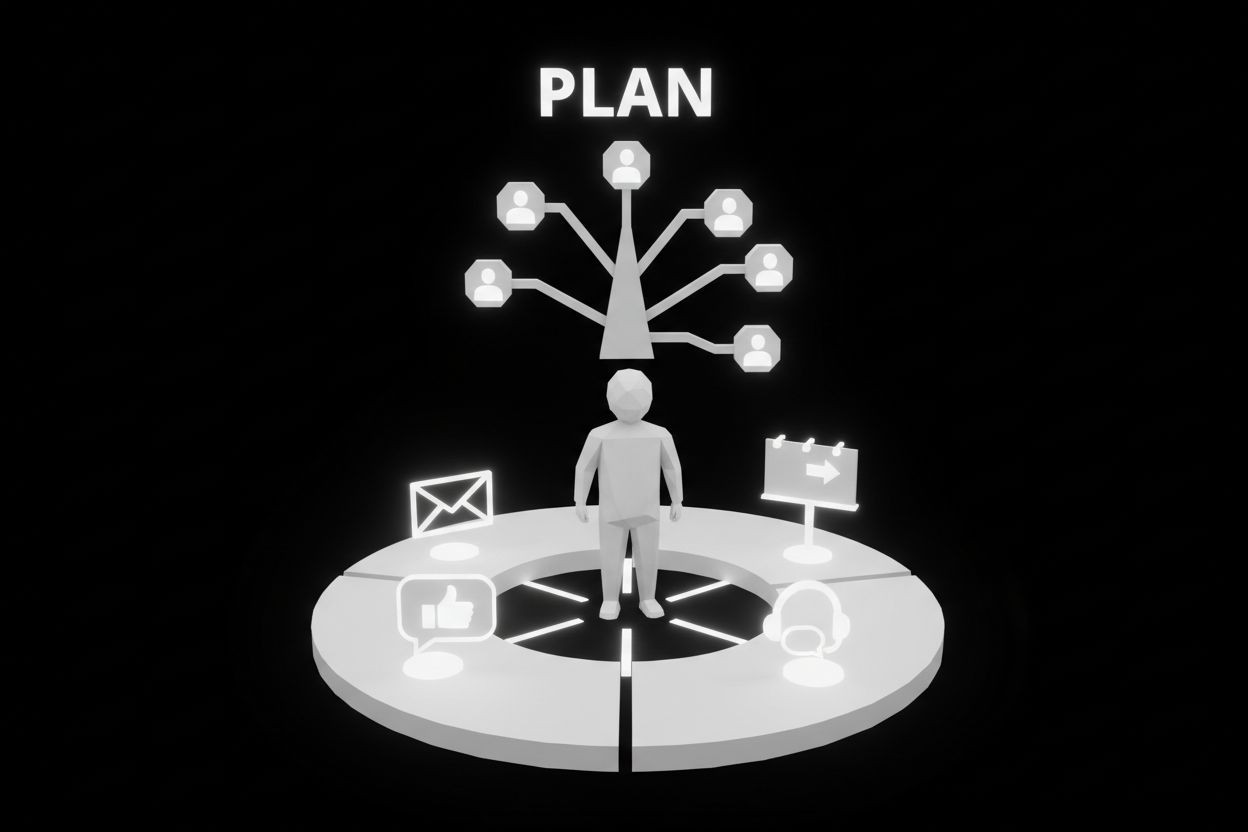
A practical customer life cycle strategy usually follows six steps. Start with the data you already have, then map the friction, then automate the repetitive work. Salesforce recommends mapping the journey, using CRM metrics, and applying AI and automation where they help with follow-up and handoffs, while Qualtrics emphasizes aligning teams around the customer experience at each stage. (salesforce.com)
Map your current lifecycle. List the main stages your customers actually move through today, not the ones you wish they moved through. If your data is spread across tools, start with a CRM strategy and automation framework so sales, marketing, and support are looking at the same customer. (salesforce.com)
Find the friction points. Look for where people hesitate, drop off, ask the same questions, or need human help. That could be a weak landing page, a slow sales response, a confusing checkout, or a bad onboarding experience. Journey mapping is useful here because it helps teams focus on the moments that matter most. (qualtrics.com)
Assign one KPI to each stage. Awareness might be measured with reach and CTR, consideration with demo requests, purchase with conversion rate, retention with churn or repeat purchase rate, and advocacy with referrals or reviews. Keep it simple enough that the team can actually use the numbers. (salesforce.com)
Create stage-specific content and offers. A good lifecycle plan gives each stage its own assets. Use educational posts and short videos for awareness, FAQs and case studies for consideration, onboarding emails for purchase and retention, and referral prompts for advocacy. If you want a deeper playbook for nurture and follow-up, our Lead Generation and Marketing Automation Guide for 2026 Success shows how those pieces connect. (salesforce.com)
Automate the repeatable parts. Welcome emails, abandoned cart reminders, lead routing, appointment booking, renewal nudges, and review requests are all good candidates for automation. Salesforce specifically calls out AI agents and CRM automation for tasks like follow-up emails, scheduling, and abandoned-cart prompts, which is why these workflows are worth building early. (salesforce.com)
Review and refine every month. Lifecycle management is not a one-time project. Look at what changed, what converted, what churned, and what customers asked for. Then tighten the messages, timing, and handoffs. (salesforce.com)
Customer life cycle examples by business type
The exact touchpoints change by business model, but the underlying logic does not. Awareness creates the first conversation, purchase turns interest into revenue, retention protects that revenue, and advocacy helps the cycle restart through trust. (salesforce.com)
SaaS: awareness often comes from search content, product-led social posts, or free trials. Consideration is about demos and feature comparison. Retention depends on onboarding and usage. Advocacy happens when customers hit success milestones and are happy to refer others.
eCommerce: ads and social posts drive discovery, product pages and reviews support decision-making, cart and checkout flows handle conversion, and post-purchase emails drive repeat orders.
B2B services: case studies, lead magnets, webinars, and discovery calls move prospects through consideration. After the sale, account check-ins and reports keep the relationship healthy.
Subscription brands: the first job is activation, then ongoing value reminders, renewal campaigns, and upgrade offers keep the customer engaged.
Local businesses: local search, maps, and reviews matter early, while appointment reminders, service follow-ups, and review requests keep the relationship active.
Common mistakes that weaken the customer life cycle
The biggest mistake is treating acquisition as the whole story. When post-purchase work is weak, churn rises, CLV falls, and teams end up spending more just to replace customers they could have kept. (salesforce.com)
Launching campaigns without a retention plan.
Sending the same message to every segment.
Ignoring onboarding, support, and self-service.
Using too many tools without one shared customer view.
Automating broken workflows instead of fixing them first.
Automation is helpful, but it does not repair a messy process on its own. Qualtrics is clear that lifecycle management depends on unifying data and insight across teams, which is where a lot of companies still fall short. (qualtrics.com)
FAQ
What are the stages of the customer life cycle?
The standard model is awareness, consideration, purchase or conversion, retention, and advocacy. Some brands use slightly different labels, but the structure is the same. (salesforce.com)
What is the difference between customer life cycle and customer journey?
Customer life cycle is the business-led model you use to organize stages, while customer journey is the customer-led path of touchpoints and decisions. Journey mapping shows what actually happens, lifecycle management shows how the business should respond. (qualtrics.com)
Why is customer lifecycle management important?
It helps you improve experience, reduce churn, increase lifetime value, and build stronger loyalty. Salesforce ties retention to CLV, while Qualtrics emphasizes smoother experiences and better team alignment. (salesforce.com)
Which metrics should I track?
Use a small set of stage-specific KPIs, such as reach and CTR in awareness, demo requests in consideration, conversion rate in purchase, churn and CLV in retention, and referrals or reviews in advocacy. CRM metrics, journey analytics, and customer feedback give the clearest picture when used together. (salesforce.com)
What tools help manage the customer life cycle?
A CRM, marketing automation platform, analytics stack, feedback tool, and AI-assisted support layer are the usual core pieces. Salesforce points to CRM, automation, CDPs, analytics, and AI agents as the foundation for lifecycle marketing. (salesforce.com)
If you want the customer life cycle to actually move revenue, start by improving the stage where customers get stuck most often. Fix the handoff, measure the change, then repeat the process stage by stage. That is how a simple framework becomes a real growth system. (salesforce.com)