How to Build Sales Enablement Training for SDR Teams
A step-by-step framework for sales enablement training covering curriculum, playbooks, roleplays, handoff, and measurement for SDR and account teams.
Your new SDRs have finished onboarding. They can explain the product, use the CRM, and launch a sequence. Yet their messages still sound interchangeable, buyers push back on relevance, and account executives keep returning meetings that aren't qualified.
The problem may not be effort or product knowledge. Sales enablement training needs to teach people how to operate your outbound system, including when to question its data, stop an automated workflow, or reject an account that shouldn't have entered the queue.
Table of Contents
Why SDR Enablement Needs a System, Not a Course
Consider a newly assembled SDR team that completes onboarding but still struggles to book useful meetings. The manager adds product sessions. Reps get more templates. Nobody checks whether they can distinguish a credible buying signal from an interesting company announcement.
That's a workflow problem disguised as a training problem. A rep can know the offer and still lack the judgment to choose the right account, interpret a reply, or make an accurate handoff.
Define proficiency through live work
The historical evidence makes the distinction worth taking seriously. In a 2018 Training Industry study of sales training effectiveness, organizations with effective training reported average proficiency at 24 weeks, versus 31 weeks where training was ineffective, a 7-week difference.
Those figures describe associations across surveyed organizations, not a guaranteed result from buying training. They also provide a more useful planning perspective than assuming that completing onboarding means a seller is ready to work independently.
Define readiness in operational terms:
Account judgment: The rep can explain why an account fits, using evidence rather than a company-size filter alone.
Message judgment: The rep connects a verified observation to a plausible buyer problem without claiming to know the buyer's priorities.
Opportunity judgment: The rep distinguishes interest, qualification, and a meeting that an account executive should accept.
Use the responsibilities described in this SDR role and skills guide to establish role boundaries before designing assessments. Otherwise, SDRs may be evaluated on closing responsibilities they don't own.
Keep expansion assumptions testable
For an APAC expansion, make territory assumptions explicit. Specify which personas, markets, channels, and language expectations the team must validate rather than treating the region as a single audience.
When developing market hypotheses, PitchSmart insights on expansion opportunities can sit alongside account research as an additional reading resource. Reps should still validate each outreach claim against an identifiable source before using it.
Practical rule: Training is complete when a seller can make the required decision in the workflow, not when they can repeat the explanation.
The investment decision is therefore broader than choosing a course. You're allocating time to assessment, practice, manager reinforcement, and operating documentation. If those responsibilities remain unassigned, adding curriculum won't resolve the underlying execution gaps.
Map the Outbound Workflow Before You Write Curriculum
Start with the work queue, not the slide deck. Follow an account from selection to handoff and record every decision, system change, and exception a seller encounters.
For a practical outbound stack, consider Apollo for data enrichment, Whitewhale for intent signals, Instantly for cold email sequencing and deliverability workflows, and HeyReach for LinkedIn outreach. These are recommended workflow options, not substitutes for qualification rules or human review.
Map decisions before tool clicks
Use the workflow below as the curriculum backbone. Attach an owner, required evidence, and completion condition to each stage.
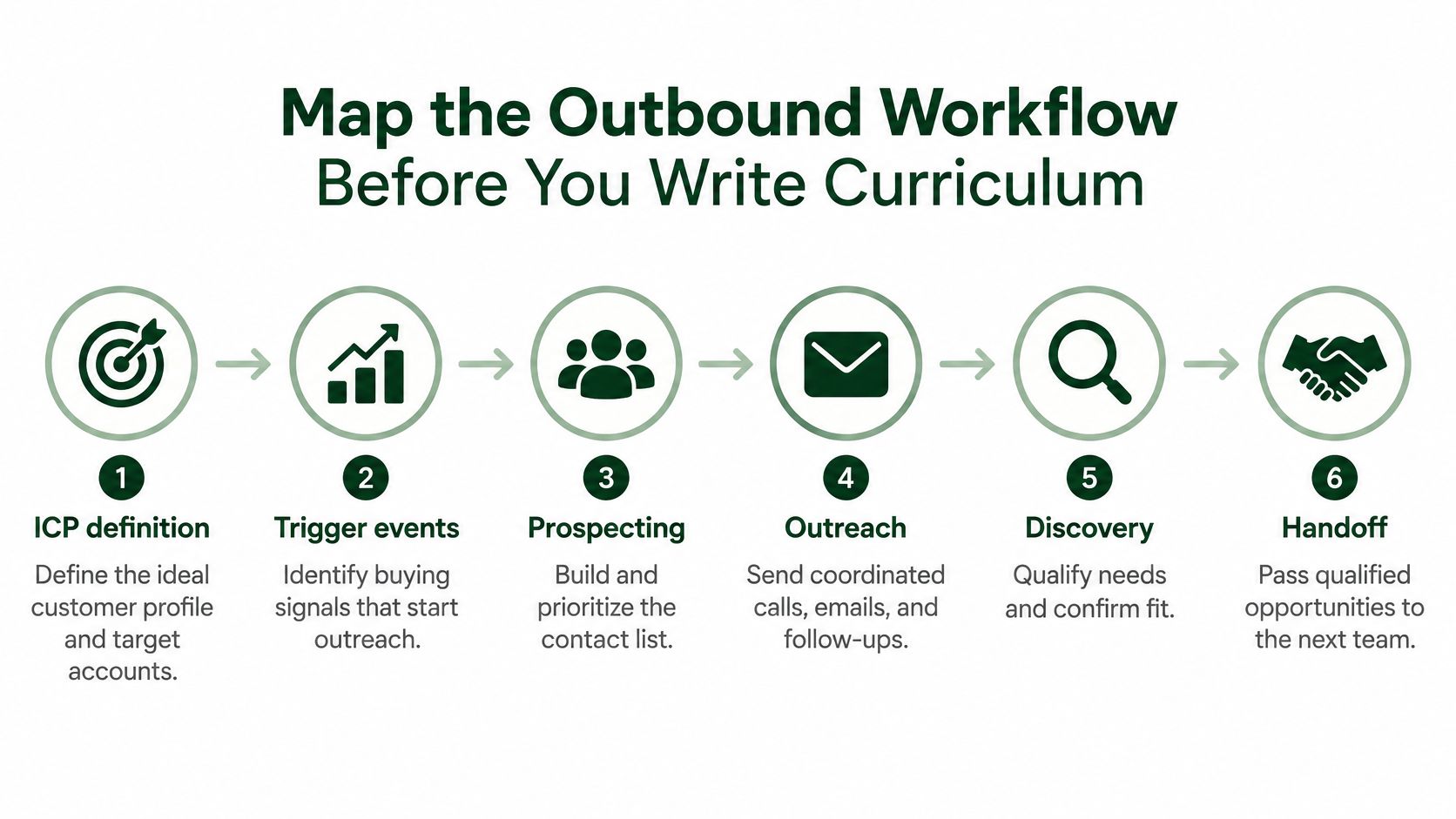
ICP definition begins with exclusion. Document what makes an account unsuitable, including unsupported use cases and buyer groups your offer doesn't serve. Training should require reps to reject an attractive-looking account when it fails those conditions.
Trigger selection needs a different artifact: a signal record. Capture the underlying event, its source, when it was observed, the relevance hypothesis, and the reason it justifies contact. A hiring announcement may justify investigation without proving purchase intent.
For prospecting, teach reps to inspect enrichment rather than accept it automatically. Check whether the contact still holds the relevant role, whether the account matches the intended entity, and whether another rep already owns the relationship. This guide to prospecting in the sales process provides useful context for positioning that work before outreach.
Document exceptions as carefully as the happy path
Outreach instruction should cover both execution and restraint. Reps need to know which message elements they can edit, when a sequence should stop, and when a response requires manual handling.
Include these operational controls:
Sending readiness: A named owner approves infrastructure readiness and investigates deliverability concerns. Reps don't compensate for a suspected sending problem by increasing activity.
Channel coordination: Email and LinkedIn activity must follow shared ownership rules so buyers don't receive conflicting approaches.
Routing: Positive replies, referrals, objections, and opt-outs receive different dispositions and destinations.
Handoff evidence: The account executive receives the buyer's stated problem, qualification evidence, unresolved questions, and agreed next step.
The CRM should hold the authoritative account status, while the playbook explains how to set it. Avoid teaching a process that depends on a rep remembering which spreadsheet contains the latest rule.
Finally, test the map with a deliberately awkward account: conflicting contact data, an ambiguous signal, and an existing owner. If the team can't agree on what happens next, resolve the operating rule before turning it into training.
Turn Playbooks and Roleplays Into Certified Skills
Use a simulated skeptical reply to test whether the playbook supports real judgment. An SDR has drafted outreach around a verified expansion announcement, and the buyer responds: “We're expanding, but that doesn't mean we need your service.”
This is a training scenario, not a customer case study. Its value comes from exposing the difference between identifying a signal and assuming a need.
The practice environment should let the rep consult the same materials they'll use on the job.

Score the decision behind the response
A weak response repeats the pitch or insists that expansion creates a problem. A stronger response acknowledges the unsupported assumption, asks permission to clarify relevance, and accepts that the account may not be ready.
For example, the rep could say: “Fair point. I treated the announcement as a reason to ask, not evidence that you need help. Is outbound coverage part of the expansion plan, or is that outside your remit?”
The manager then evaluates observable behavior, not whether the wording matches a script.
Behavior | Evidence of readiness | Reason to repeat practice |
|---|---|---|
Signal validation | Separates the announcement from inferred need | Presents inference as established fact |
Objection handling | Acknowledges the buyer's correction | Defends the original assumption |
Discovery sequencing | Clarifies relevance before diagnosing | Asks leading questions to force fit |
Next-step judgment | Offers a proportionate next action | Pushes for a meeting regardless |
CRM disposition | Records uncertainty and the buyer's response | Marks the account qualified without evidence |
A usable sales playbook should contain the decision rule behind each row. Templates help with execution, but they shouldn't hide the reasoning.
Require a fresh attempt after feedback
Have the manager identify the precise moment where the rep lost relevance. Then repeat the exercise with a changed objection or a different buyer role, so the rep must apply the principle rather than memorize the correction.
Research evaluating manager-led live sales coaching supports supervised practice as an assessable component of coaching. Its setting shouldn't be treated as proof of a specific B2B outbound result, but it provides a rationale for observing performance rather than relying on passive instruction.
Certification should require both a successful simulation and supervised application. A rep who handles the conversation well but misrecords the result hasn't demonstrated the complete workflow.
Certify the behavior you need under pressure, including the decision not to advance an unsuitable prospect.
Keep scoring categories simple: demonstrated independently, demonstrated with prompting, or not demonstrated. Managers should compare assessments using the same recording and resolve disagreements before using the rubric to authorize independent work.
Hand Off Tools and Coach Managers After Training
A working automation isn't a complete handoff. The receiving team also needs access ownership, editable documentation, exception rules, and someone accountable for keeping those rules current.
Start by separating seller permissions from system administration. An SDR may own contact review, approved personalization, reply handling, and CRM updates without owning sending configuration or routing logic.
Give managers an operating contract
The reinforcement gap deserves explicit attention. A 2025 study discussed by SBI found that more than 70% of companies provided some individual-contributor training, but only 39% had dedicated frontline-manager enablement programs.
Don't assume that a capable seller automatically knows how to diagnose another seller's performance. Give managers a repeatable review routine and teach them to distinguish skill gaps from system defects.
Use a weekly reinforcement contract:
Who coaches: The frontline manager owns behavioral feedback. Revenue operations owns routing, access, and data defects.
What gets reviewed: Select a call, a message thread, and the associated CRM record. Inspect the complete interaction rather than an isolated sentence.
When feedback happens: Review evidence before the coaching conversation, agree on a practice task during it, and inspect application at the next review.
What gets escalated: Broken integrations, conflicting ownership, questionable source data, and deliverability concerns go to the named system owner.
What gets documented: Record the observed gap, evidence, agreed action, owner, and reassessment condition.
This creates a useful boundary. Managers coach decisions they can observe; they don't ask reps to overcome technical faults through persistence.
Teach safe delegation alongside tool use
AI-assisted research and drafting need their own approval rules. Let reps use assistance to organize evidence or suggest wording, but keep source validation, account fit, factual claims, and customer contact human-owned.
Training should require sellers to check source freshness, unsupported personalization, sensitive information, and regional appropriateness before sending. A fluent draft isn't evidence that its underlying claim is true.
Post-training support also needs to be scheduled rather than left to initiative. A peer-reviewed study of e-learning sales training examines manager feedback and coaching as a distinct part of training effectiveness.
Handoff acceptance should include the manager demonstrating the review process. Ask them to inspect an interaction, diagnose the issue, assign a targeted practice task, and route a system fault correctly. That's more meaningful than confirming that they received the documentation.
Choosing Between Internal Builds and Outside Help
A training system can launch on schedule and still fail by the second month if nobody owns the tools, playbooks, and coaching that keep it current. Choose a delivery model based on who will maintain those parts after launch. An experienced internal team may need implementation support, while a founder without SDR management capacity may need an operator rather than another training library.
Curriculum design, technical implementation, and ongoing coaching are separate jobs. A contract for one does not automatically cover the others.
Delivery Options for Sales Enablement Training
Option | Best Fit | Main Trade-off | Ownership of Playbooks |
|---|---|---|---|
Internal build and delivery | Teams with experienced sales leadership and operations capacity | Direct control, but internal staff must design, maintain, and coach | Internal ownership and maintenance |
Self-run system with outside guidance | Teams able to operate a documented workflow after implementation | Less external dependence, but internal managers carry reinforcement | Require editable client-owned documentation |
Outside partner builds and operates | Teams without sufficient implementation or management capacity | Less internal operating work, but greater ongoing spend and coordination | Establish client ownership and access contractually |
Internal delivery works when someone can resolve process disputes and keep the system aligned. Without that authority, teams can end up with conflicting prospecting, messaging, and qualification documents. Reps then receive different instructions across training, CRM fields, and campaign tools.
A self-run system with outside guidance suits teams whose managers can coach but lack time to build the operating workflow. The handoff should include editable playbooks, troubleshooting steps, and a named owner for changes. Launch instructions alone do not prepare the team to maintain the system.
An operated service fits teams that need execution capacity as well as design. Specify who reviews replies, approves message changes, handles exceptions, and coaches sellers. “Managed” should mean named people own those tasks, not that the client can access a dashboard.
Compare the continuing workload
The Social Search is one outside-partner option that designs, builds, and runs B2B outbound systems, with client-owned documentation and playbooks. Its published service information describes one-time builds from about $500, a fully managed function near $10,000 per month, and typical go-live timing of about three weeks.
These are different scopes, not interchangeable offers. Go-live means the agreed system is operational. It does not mean a new SDR has reached proficiency, and it is not a promised meeting date.
Compare proposals against the work your team will still own:
Documentation ownership: Can your team edit playbooks, inspect routing logic, and retain access when the engagement ends?
Coaching capacity: Who reviews calls and messages after implementation, and who has time to act on what they find?
Regional localization: Who checks buyer terminology, contact assumptions, channel choices, and handoff expectations for each target market?
Launch dependencies: Which approvals, access permissions, account decisions, and messaging inputs must your team supply?
Define the boundary between implementation and sales enablement consulting in the scope. A consultant may establish the method without operating outreach. An operator may run campaigns without training managers to maintain the system. Match the agreement to the specific tools, signals, and messages the reps will use.
Before signing, ask each provider or internal owner to explain what happens when a rep faces an unfamiliar objection or routing breaks after handoff. The answer should identify the owner, the action they take, and how the team updates its training materials.
Measure Behavior Change and Iterate Every 30 Days
A rep finishes the course, opens the sequencer, and sends the same generic message as before. That gap is the measurement problem. Treat enablement as the operating layer of outbound: each module should change a behavior in a specific tool, with a signal you can inspect in real work.
Before a cohort starts, record the training version, assigned manager, territory, segment, prior experience, and starting assessment. These details help reviewers interpret differences between reps instead of attributing every change to training.
Course completion is an administrative record, not evidence of transfer. Gartner recommends combining assessments, structured interviews, observation, and immediate coaching in its guidance on sales skills training and talent.
Connect observed behaviors to outcomes
Use one review view that puts learning evidence beside sales performance. Keep CRM fields, call notes, message examples, and manager feedback visible together.

For each module, define the behavior, where it appears in the workflow, and the outcome it may influence.
Training behavior | Observation evidence | Related outcome |
|---|---|---|
Trigger-based personalization | Message contains a verified, relevant signal | Reply quality |
Discovery sequencing | Questions clarify fit before pitching | Meetings accepted |
Qualification discipline | CRM evidence supports advancement | Opportunity conversion |
Explicit next-step agreement | Buyer confirms action and ownership | Stage progression |
Keep win rate as a downstream measure. Deals may take longer to mature than an SDR cohort's review window. Use sales pipeline reports to distinguish early execution signals from later commercial outcomes.
When a rep completes every module but still sends generic messages, inspect the work before assigning more content. Can they identify a relevant account signal? Does the source data support the personalization? Has their manager reviewed actual messages and calls? Those checks point to a specific fix, whether the problem is instruction, data quality, or coaching.
Review cohorts without overstating causality
Schedule cohort reviews at 30, 60, and 90 days, following the intervals described in this sales training and coaching research overview. Use the cadence to inspect transfer, not to promise when revenue will change.
At the first review, check whether reps apply the behavior and whether the underlying data is reliable. Later, assess whether the behavior persists and whether related conversion measures move in a useful direction.
Keep comparisons credible: Compare similar roles, segments, and tenure where possible. Record differences in account quality or channel access.
Change one defined variable: If reps misread buying signals, revise that instruction without also replacing the offer, list, and qualification rules.
Keep representative evidence: Save successful and unsuccessful interactions so managers can distinguish improvement from selective reporting.
A useful design prompt comes from designing a workplace safety training curriculum: can someone apply the procedure in practice? Apply that question to sales behaviors, without treating the comparison as evidence of sales results.
Review standard: If you can't show the changed behavior, describe the result as an outcome to investigate, not a training success to claim.
Choose a cohort, define three observable behaviors and two related outcome metrics, and schedule its first 30-day review. Assign the reviewer and specify which messages, calls, or CRM records count as evidence before training begins.
This week, put those requirements into the cohort's review workflow. That gives managers a practical way to coach from observed behavior, while keeping course completion separate from performance claims.
