Fractional Sales Leadership: A Practical Guide for 2026
Learn how fractional sales leadership works, what it delivers, and when B2B teams should hire one to scale pipeline without a full-time executive in 2026.
The founder leaves a board meeting with a familiar problem: revenue isn't collapsing, but nobody can explain why the pipeline keeps slipping. The VP of Sales is buried in deal rescue, reps use different qualification standards, the CRM can't support a credible forecast, and the board wants senior ownership of the go-to-market motion. Hiring a full-time CRO may be the right long-term move, but the economics, ramp time, and organizational maturity don't line up with the urgency.
That gap is where fractional sales leadership belongs. The useful version of the model isn't a senior adviser who joins a monthly call. It's an embedded operator who takes responsibility for the revenue system, creates operating clarity, and leaves behind infrastructure another leader can run. For outbound teams, especially those expanding into APAC, that can include ICP design, data, messaging, sequencing, reporting, coaching, and a disciplined handover.
If the immediate problem is outbound execution, tools should support the operating model rather than substitute for it. Teams can use Instantly for cold email sequencing and deliverability workflows, HeyReach for LinkedIn outreach automation, Apollo for data enrichment, and Trigify for social signals. Intent data from Whitewhale can help a leader prioritize accounts, but only when the ICP and routing rules are already clear.
Table of Contents
When a Growing Team Needs Senior Sales Ownership Without a Full-Time Hire
Core Responsibilities of an Embedded Fractional Sales Leader
Fractional Sales Leader Versus Full-Time CRO, Consultant, and Interim VP
Preparing to Hire and the First 90 Days of a Fractional Sales Engagement
When a Growing Team Needs Senior Sales Ownership Without a Full-Time Hire
The founder's problem usually appears before the company has a clean answer. A Series A business has enough demand to support a serious sales function, but not enough consistency to justify a permanent executive seat with confidence. The founder still joins strategic calls, the VP of Sales handles every escalation, and the board asks for a forecast that depends on optimistic deal notes.
The strategic gap isn't a lack of headcount. The company needs someone to decide which accounts matter, establish how opportunities move, coach managers, and make the forecast believable. Yet a full-time CRO can create a different risk if the revenue system is still changing. The executive may inherit unclear positioning, incomplete data, inconsistent sales behavior, and a board expectation that hiring alone will repair the motion.
Practical rule: Hire senior ownership when the business needs decisions made and enforced, not merely recommendations documented.
A fractional leader can occupy that gap by embedding in leadership meetings, joining forecast calls, reviewing deals, and building the operating cadence the team currently lacks. The engagement should be tied to ownership of defined outcomes, not to a vague promise of strategic guidance. If the leader can't access the CRM, challenge the pipeline, coach reps, and change the weekly rhythm, the company has bought advice instead of leadership.
The operational gap behind the pipeline problem
Founders often underestimate how much infrastructure sits between a good product and predictable revenue. Someone must translate customer evidence into an ICP, turn that ICP into a list, align messaging across channels, set qualification standards, and make sure every opportunity has a defensible next step. A small operational resource, such as service business software for freelancers from Micro CRM, can help organize client work and delivery, but it won't replace an accountable revenue owner.
The same distinction applies when evaluating outsourced SDR services. Outsourcing can add execution capacity, while fractional leadership should determine the system that execution follows. A company needs to know whether it wants more activity, better management, or a repeatable sales machine.
The question founders should answer
Ask whether the current constraint is executive judgment, sales capacity, or market evidence. Fractional sales leadership addresses the first and can build the systems that improve the second. It can't create product-market fit, rescue an offer nobody wants, or compensate for a team that refuses to follow an agreed process.
The decision becomes easier when the company treats the role as a bridge to operational maturity rather than a cheaper imitation of a CRO. The leader should make the business more transferable, not more dependent on one experienced outsider.
What Fractional Sales Leadership Actually Means in 2026
Fractional sales leadership is embedded executive ownership delivered part time. A senior sales operator joins the business for an agreed portion of the week, takes responsibility for the commercial system, and works inside the company's tools, meetings, and decision process. The leader may not be available every hour, but the role has real accountability for pipeline quality, forecast discipline, team execution, and operating clarity.
That makes the model different from adjacent services.
Four models that buyers often confuse
A consultant diagnoses a problem and delivers recommendations. The company then decides whether it has the people and discipline to implement them. A fractional leader doesn't stop at the recommendation. They set the weekly cadence, inspect adoption, coach the team, and adjust the system when evidence changes.
An interim VP generally fills a full-time leadership seat during a transition. That can be the right answer when the company needs constant coverage, but it often prioritizes continuity over designing a transferable operating system. A fractional leader is deliberately constrained, so the engagement must focus on the decisions and routines that create the greatest impact.
Fractional advisory is lighter still. It might involve a monthly call, occasional deal review, or access to an experienced sounding board. That format is useful for a capable sales leader who needs perspective. It isn't enough for a company whose CRM, qualification, messaging, and forecast are all unreliable.
Dimension | Fractional Sales Leader | Full-Time CRO | Sales Consultant | Interim VP Sales |
|---|---|---|---|---|
Primary role | Owns a defined revenue system part time | Owns the complete commercial function | Diagnoses and recommends | Fills a leadership vacancy temporarily |
Team integration | Embedded in operating rhythms | Constant presence | External adviser | Full-time internal presence |
Accountability | Outcomes, adoption, and handover | Broad company-level revenue ownership | Recommendations and project scope | Stabilization and execution |
Best use | Building maturity before or alongside a permanent hire | Scale requiring continuous executive coverage | Specific strategic problem | Leadership transition or urgent vacancy |
End-state | Transferable process, documentation, and successor readiness | Ongoing executive ownership | Deliverables and recommendations | Planned exit after stabilization |
The operating contract matters more than the label
Engagements commonly involve a defined part-time commitment, a retainer, a written scope, and an explicit handover plan. The exact schedule should follow the bottleneck. A company building outbound needs more operating time than a mature team seeking forecast oversight.
The model has moved beyond a niche workaround. A market report says fractional sales leaders in the United States and Canada grew from 5,000 in 2020 to 9,000 in 2024, an 80% increase, with a 2024 average monthly fee of $9,651 and an average hourly rate of $213 (Vendux market data). A separate 2025 report places the broader fractional executive market above $5.7 billion, with annual growth of 14%, while reporting that demand for fractional executives rose 68% year over year in 2024 (Fractional C-Suite market report).
The commercial implication is clear. Buyers shouldn't ask whether a fractional leader can offer useful advice. They should ask whether the person can build a revenue operating system the company can eventually run without them.
For a broader view of outsourced and external sales models, compare the distinction with B2B sales agency approaches, especially where execution ownership sits.
Core Responsibilities of an Embedded Fractional Sales Leader
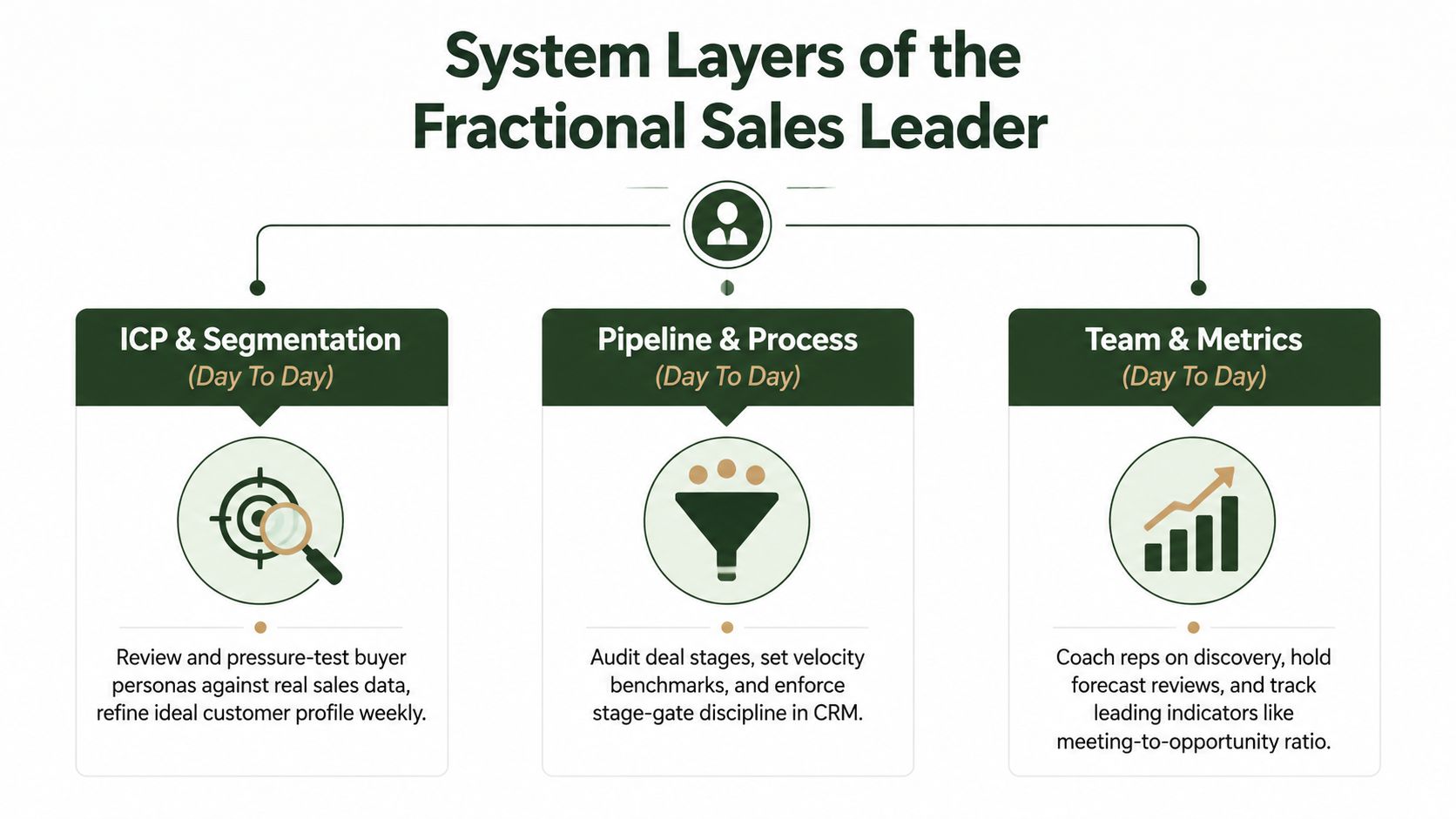
An embedded fractional leader changes the team's weekly operating system. The job connects ICP, messaging, outreach, pipeline management, forecasting, and coaching into one repeatable motion. The measure of success is company-level clarity: people know who to target, what to say, how opportunities advance, and how the team can run the process after the engagement ends.
ICP and segmentation
The leader begins with commercial evidence, not a workshop persona. They review closed-won and closed-lost opportunities, examine buying roles, identify trigger events, and challenge assumptions about company size, industry, geography, and urgency. The ICP becomes a working filter for account selection, messaging, qualification, and routing.
Segmentation must change as evidence accumulates. If the team consistently wins a certain buyer type while spending time on another segment, the leader changes priorities and documents the reason. The deliverable is not a profile stored in a presentation. It is a set of rules that directs selling time and gives the team a consistent basis for deciding which accounts deserve attention.
Messaging and positioning
Sales reps should not rebuild the value proposition on every call. The fractional leader aligns the sales narrative with product marketing, defines the buyer's business problem in their language, and creates talk tracks that support discovery instead of forcing a generic pitch.
Message quality shows up in the field. Objections, ignored sequences, stalled opportunities, and lost deals identify weak positioning. The leader turns those signals into changes to offers, scripts, and qualification rules. That keeps messaging tied to buyer response rather than individual preference.
Pipeline and channel operations
Outbound needs an operating design, not only a sending tool. The leader sets account-selection rules, list-quality checks, channel roles, sequencing logic, reply handling, and escalation paths. They coach SDRs and BDRs on research, relevant first touches, discovery handoffs, and the difference between activity and qualified opportunity creation.
Pipeline management requires the same discipline. The leader defines stage entry and exit criteria, removes false opportunities, and makes coverage visible without encouraging inflated deal values. Teams using social and messaging channels may consider Respond.io for WhatsApp automation or Manychat for social media DM and comment automation. The leader still decides whether those channels fit the buyer journey, who owns the responses, and how qualified conversations enter the CRM.
Reporting, forecasting, and enablement
A single source of truth should show what entered the funnel, what progressed, what stalled, and why. The leader enforces a qualification framework such as MEDDIC or an equivalent method, runs weekly forecast calls, and separates committed opportunities from hopeful ones.
Enablement makes the process visible in daily team behavior. It covers onboarding playbooks, call review, manager coaching, discovery training, objection handling, and CRM hygiene. The leader owns adoption as well as the materials. Teams can refer to sales enablement guidance, but operating standards only matter when managers inspect them, reps use them, and the CRM reflects them. The lasting output is transferable infrastructure, not a folder of documents.
Fractional Sales Leader Versus Full-Time CRO, Consultant, and Interim VP
The right choice depends less on prestige than on the problem that needs solving. A full-time CRO offers presence and broad authority, but that authority carries a permanent cost and a larger hiring risk. A consultant can bring useful expertise quickly, but advice won't repair a forecast unless someone inside the company enforces the changes.
A practical comparison
Dimension | Fractional Sales Leader | Full-Time CRO | Sales Consultant | Interim VP Sales |
|---|---|---|---|---|
Cost band | Retainer-based and bounded by scope | Permanent compensation, benefits, and possible equity | Project or advisory fee | Full-time interim compensation |
Time commitment | Part time, matched to the operating gap | Full time | Limited to agreed work | Full time for the transition |
Accountability | Owns defined system and revenue outcomes | Owns the entire commercial organization | Owns recommendations and deliverables | Owns stabilization and near-term execution |
Ramp tolerance | Works well when the company needs senior judgment without a long executive ramp | Requires a careful executive search and onboarding process | Can start quickly but may lack implementation authority | Starts quickly when a seat is vacant |
Equity expectations | Can be structured without making a permanent executive commitment | Often part of the negotiation | Usually tied to scope rather than executive tenure | Depends on the interim arrangement |
Exit risk | Lower when the handover is designed from the start | Higher if the hire is wrong or the stage changes | Low, but implementation risk remains with the company | Exit is expected, but the successor may inherit incomplete systems |
What remains afterward | Documentation, cadence, dashboards, and trained operators | The executive remains the owner | Recommendations, templates, or project outputs | Stabilized operations, with transfer quality varying by mandate |
The fractional model sits between consulting and full-time leadership. That middle position is its advantage and its limitation. The leader can bring senior judgment into a business before a permanent CRO makes economic sense, but the company can't expect unlimited deal coverage or constant executive availability.
Choose ownership over advice when the quarter demands it
Use a consultant when the question is narrow and the internal team can execute. Use an interim VP when the business has a leadership vacancy and needs full-time management now. Choose a full-time CRO when the commercial organization has enough complexity and volume to justify permanent executive attention, and when the board needs a long-term owner.
Choose fractional leadership when the company needs the system built, adopted, and transferred. A go-to-market consulting engagement may clarify strategy, but the fractional leader's job is to turn that strategy into weekly decisions, behavior, and reporting.
When Startups and Mid-Market Teams Should Hire One
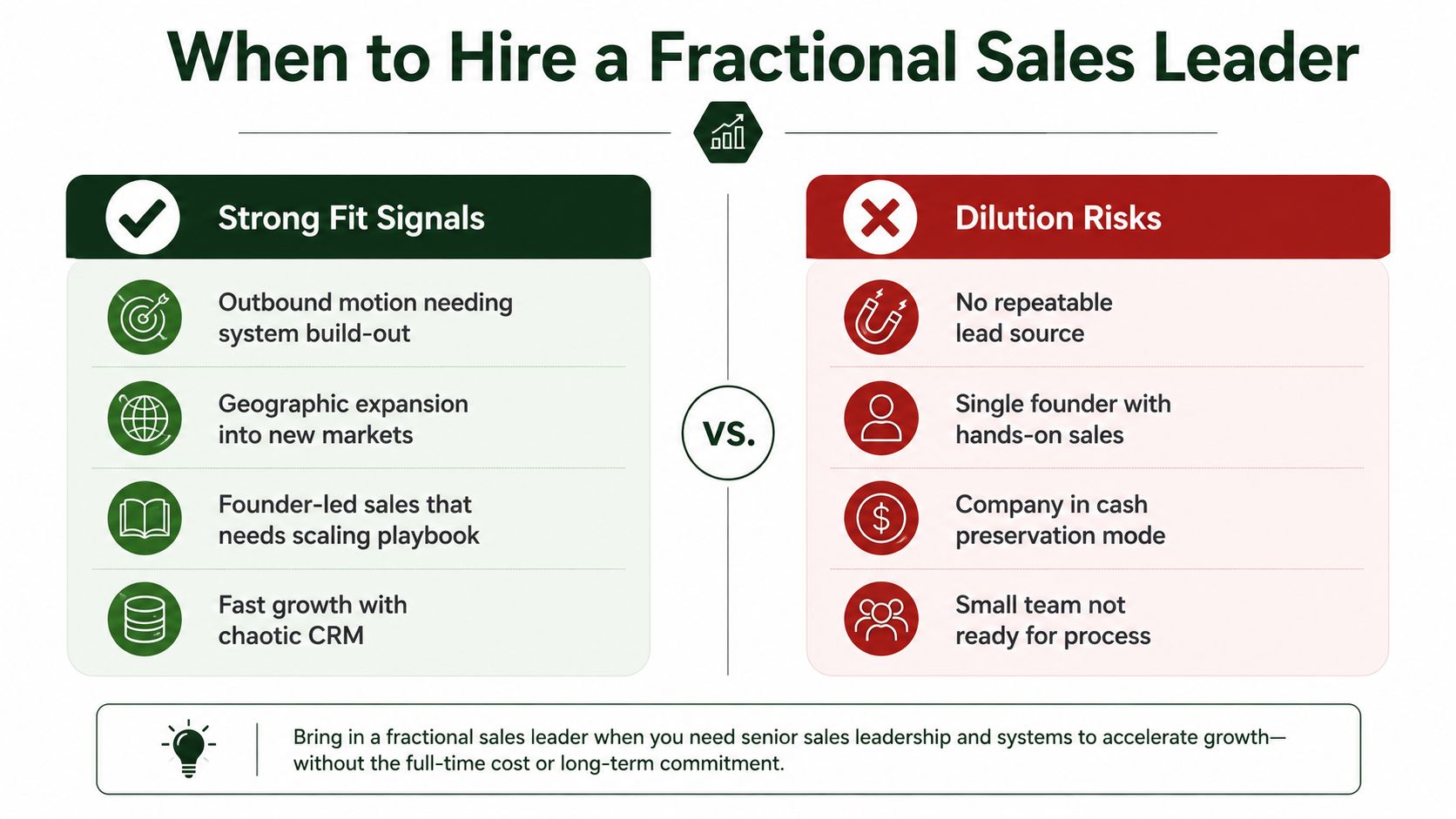
Fractional sales leadership works best when the company is one level of operating maturity away from the next stage of growth. It works poorly when the business lacks a sellable offer, has no execution capacity, or wants a part-time person to perform a full-time job.
The strongest fit is a team with some commercial evidence and a system that has become too dependent on founders or individual reps. The leader can identify what already works, remove noise, and build a repeatable motion around it.
Strong fit signals
Outbound system build: The company knows which buyers it wants but lacks account selection, messaging, sequencing, routing, and reporting discipline.
Geographic expansion: The team is entering APAC or another region and needs a localized operating model rather than a list of prospects and a new title.
Founder-led sales ceiling: The founder still closes important deals, but reps wait for the founder to create urgency, handle objections, or approve messaging.
Post-funding scale-up: New capital has increased expectations, while pipeline coverage and management routines haven't caught up.
Churn-driven leakage: Customer losses reveal weak qualification, poor expectation setting, or a disconnected handoff between sales and delivery.
Chaotic CRM: The company has opportunities in the system, but stages, next steps, owners, and forecast categories don't mean the same thing to everyone.
A fractional leader can also support a mid-market team that has capable managers but lacks a consistent operating standard. The role should strengthen the managers, not become a permanent shadow manager who makes every decision for them.
The conditions that make the model fail
Don't hire one if there isn't at least a small team capable of executing the system. A leader can design an outbound motion, but they can't create sustained pipeline alone while also managing the company, coaching reps, and fixing the CRM.
The model is also a poor fit when the company is in acute cash preservation mode and can't fund implementation, or when the board needs a full-time executive primarily for governance and investor confidence. In those cases, the business should make the trade-off directly instead of disguising a full-time requirement as a fractional brief.
Decision test: If the gap is one level of operating maturity, use fractional leadership. If the gap is a missing full-time owner for a complex revenue organization, hire the executive.
For companies entering a new market, a focused GTM strategy for startups can help clarify the commercial hypothesis before the fractional leader is asked to build the motion. The leader should then validate that hypothesis against live conversations and pipeline behavior.
Handover Processes and How to Measure Real Impact
The engagement succeeds when the company can operate better after the leader leaves. That requires more than improved morale, a cleaner forecast call, or a burst of activity. It requires evidence that the business now has a documented system, a usable dashboard, and people who understand how to run both.
Build the transfer before the work begins
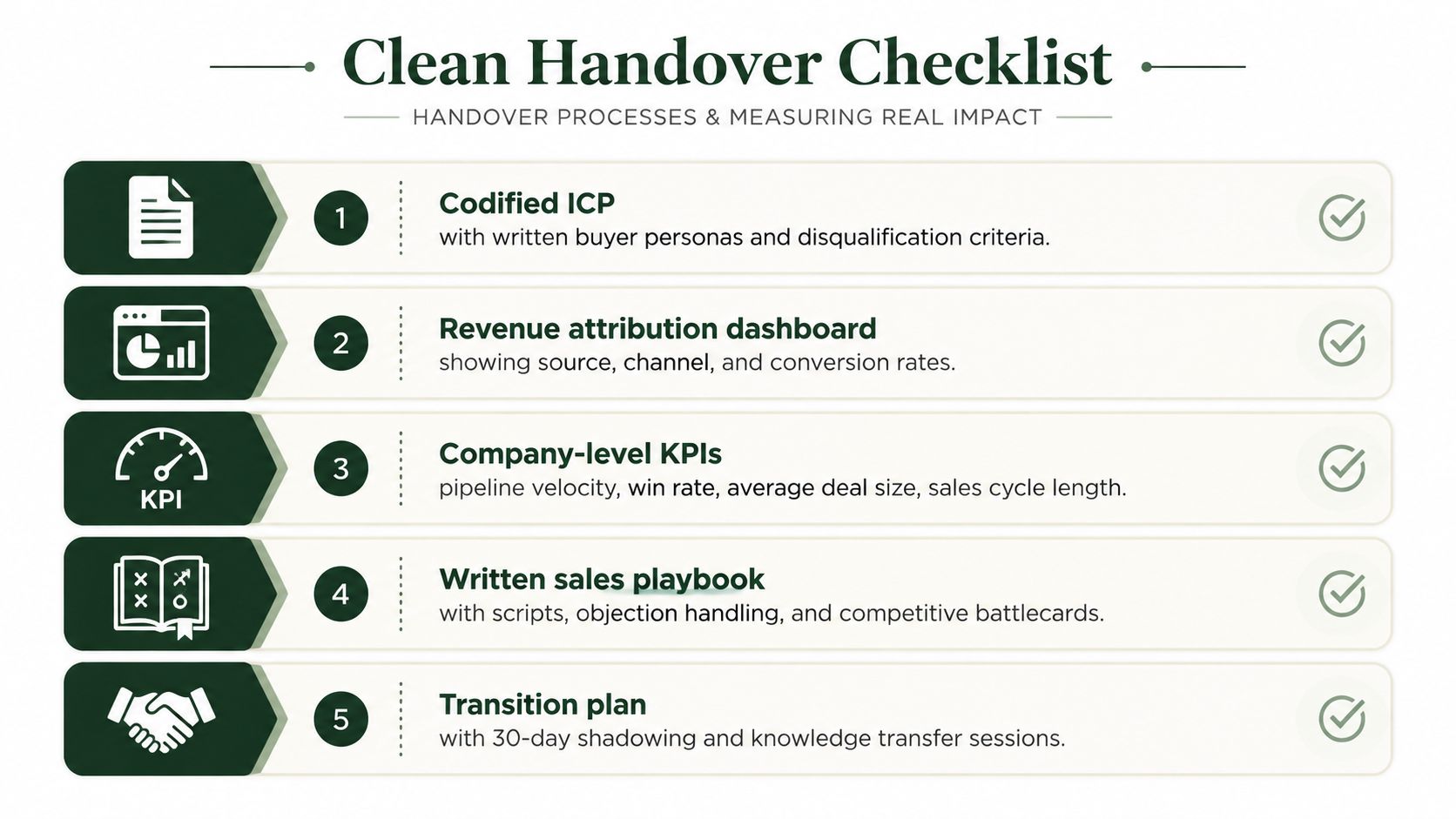
A clean handover starts with explicit ownership. The fractional leader should define what gets documented, who maintains it, which manager shadows the work, and what a successor must be able to do independently. The handover should include:
Codified ICP: Buyer personas, account criteria, prioritization rules, and disqualification conditions.
Operating playbook: Discovery structure, qualification standards, messaging, objection handling, deal review, and escalation.
Instrumented CRM: Consistent stages, required fields, ownership rules, next-step standards, and forecast categories.
Revenue dashboard: Source, channel, conversion, pipeline movement, and the leading indicators management reviews.
Transition plan: Shadowing, recorded decisions, operating meetings, and a documented route for the next leader to assume control.
Measure the company, not just the reps
A buyer should track system-level evidence. That includes pipeline coverage, stage conversion, forecast accuracy variance, sales-cycle movement, win rate, average deal size, and whether the process artifacts remain in use after the engagement. The exact baseline depends on the company, but the measurement logic should be agreed before work starts.
A supported rep can feel more confident without the company becoming more predictable. A 2026 Journal of Selling study cited in the sales-enablement discussion found that company-level sentiment was the only significant predictor of KPI achievement, while individual sentiment had no significant relationship and team sentiment was weaker (discussion of the organizational measurement finding). The practical lesson is that the leader should improve operating clarity across the company, not merely make individual sellers feel coached.
Use attribution to separate motion from coincidence
Every major change needs a traceable reason. If pipeline improves, management should know whether the driver was better targeting, stronger messaging, improved qualification, a channel change, or a temporary market event. If forecasts improve, the team should be able to point to stage definitions and inspection routines rather than personal confidence.
The market is becoming more embedded and benchmark-driven. A 2025 report based on more than 1,000 assignments says average engagements last 9.7 months, weekly commitment has risen to 14.6 hours, and 88% of engagements use retainers (Vendux State of Fractional Sales Leadership report). Those patterns support longer operating relationships, but they also raise the standard. The leader must leave behind a system that survives the relationship.
Preparing to Hire and the First 90 Days of a Fractional Sales Engagement
A fractional sales leader cannot repair a revenue system built on hidden CRM data and optimistic forecasts. Before the first meeting, give them the evidence needed to diagnose the operation and establish a baseline.
Prepare the evidence
Provide access to the current pipeline, CRM fields, sales activity, customer feedback, churn reasons, win and loss notes, existing messaging, and the company's written growth hypothesis. Record how the team measures performance before changing the process. Without that baseline, later improvement may reflect a new measurement method rather than a better sales system.
The hiring brief should define the decisions the leader can make, the meetings they own, the managers they coach, the outcomes under review, and the conditions for handover. A candidate who only offers recommendations is a consultant, not an embedded operator.
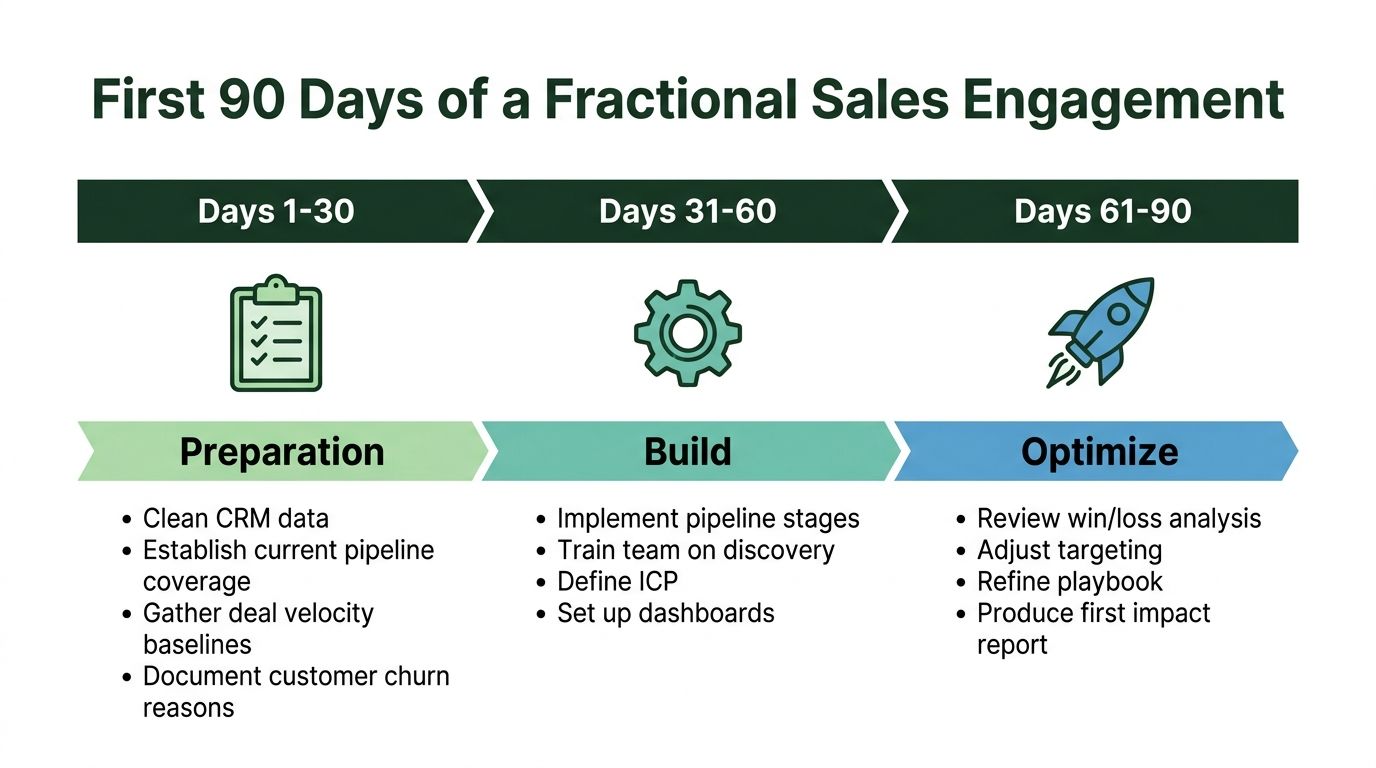
Days 1 to 30, diagnose
The first phase is immersion. The leader interviews founders, sellers, customer-facing teams, and selected customers. They inspect the CRM, review opportunities, test the ICP, listen to calls, and produce a written baseline report.
That report should identify the few constraints limiting pipeline quality, conversion, forecast confidence, and manager effectiveness. A long list of observations is not a diagnosis.
Days 31 to 60, build
The second phase repairs the operating system. The leader aligns messaging, clarifies segmentation, standardizes stages, establishes a reporting cadence, and introduces one or two high-impact playbooks. Reps practice the new discovery and qualification standards in live work, while managers learn how to inspect opportunities and coach against those standards.
By the end of this phase, the operating rhythm should be visible. Meetings have owners, dashboards have defined metrics, and opportunities include meaningful next steps.
Days 61 to 90, operate and transfer
The final phase moves from design to ownership. The leader runs the weekly forecast, coaches reps, reviews win and loss evidence, adjusts targeting, and documents SOPs for the next internal or full-time owner.
Measure the engagement by what survives handover: a defensible pipeline baseline, consistent conversion measurement, stronger forecast discipline, and a transition-ready operating manual. An embedded fractional GTM function from The Social Search can connect ICP definition, data, messaging, outbound operations, reporting, and enablement into a system the client owns and can continue running.
If pipeline depends on founder effort or optimistic CRM notes, begin with an operating diagnosis rather than another campaign. The Social Search builds and runs outbound systems for B2B teams entering APAC and global markets, and its fractional GTM Lead and Engineer service helps turn scattered activity into documented, transferable revenue infrastructure.
