Revenue Operations Consulting: Building Scalable GTM Systems
Discover how revenue operations consulting aligns sales, marketing, and customer success to build scalable outbound systems and accurate pipeline attribution.
The loudest advice about RevOps is usually wrong. Teams are told to buy a cleaner CRM, tighten a few handoffs, and the revenue machine will magically behave. In practice, revenue operations consulting fails fastest when leaders confuse process tweaks with measurement integrity. If finance can’t trust the baseline, then any claimed improvement is just a story with charts.
Table of Contents
Why Most RevOps Engagements Fail Before They Start
A board meeting stalls fast when pipeline numbers do not line up. Sales says the quarter is salvageable, marketing says the source mix changed, and finance asks which number is real. That is the moment most revenue operations consulting work fails before it begins, because the problem is not a missing dashboard, it is unreliable measurement.
The first mistake is treating RevOps like a support ticket for Salesforce hygiene. Clean records matter, but they do not solve the bigger issue, which is that many teams cannot defend their revenue motion in front of finance. That matters because only 28% of marketing leaders say they can measure the impact of all or most of their marketing spend in KPMG’s 2025 RevOps playbook, which means a lot of buyer-side attribution is still too weak to support credible ROI claims.
Practical rule: if the baseline is fuzzy, the conclusion will be fuzzy too.
A RevOps engagement that starts with “we need better alignment” is usually too vague to survive contact with the budget owner. The stronger starting point is a measurement audit, what evidence already exists, where it breaks, and which definitions are inconsistent across sales, marketing, and customer success. That order matters. Process redesign only works after the numbers can be trusted. A broader GTM strategy conversation, like the one in this startup GTM resource, becomes useful only after the revenue data underneath it is stable enough to stand up to scrutiny.
What finance needs to see
Finance does not need applause lines. It needs a clean baseline, a defined target, and a line of sight between the consulting work and the metric being improved. If a team says pipeline quality improved, but the lead source taxonomy changed halfway through the quarter, the claim collapses.
The test is whether the reporting method can survive questions from finance without changing shape. Stable definitions, traceable data, and a clear audit trail matter more than a polished slide deck. Until those pieces hold, any promise about better conversion, faster velocity, or improved retention reads like a story with charts, not a result that can be credited to consulting work.
The RevOps Operating Model Explained
RevOps isn’t a department you bolt on after the fact, it’s a go-to-market operating model. Gartner defines the function as aligning marketing, sales, and customer success around shared accountability, and the practical reason that matters is simple, siloed teams create duplicated records, broken handoffs, and forecasts nobody trusts. The Pedowitz Group describes the operating model the same way, as a system built on shared data, shared processes, and shared revenue responsibility Pedowitz Group.
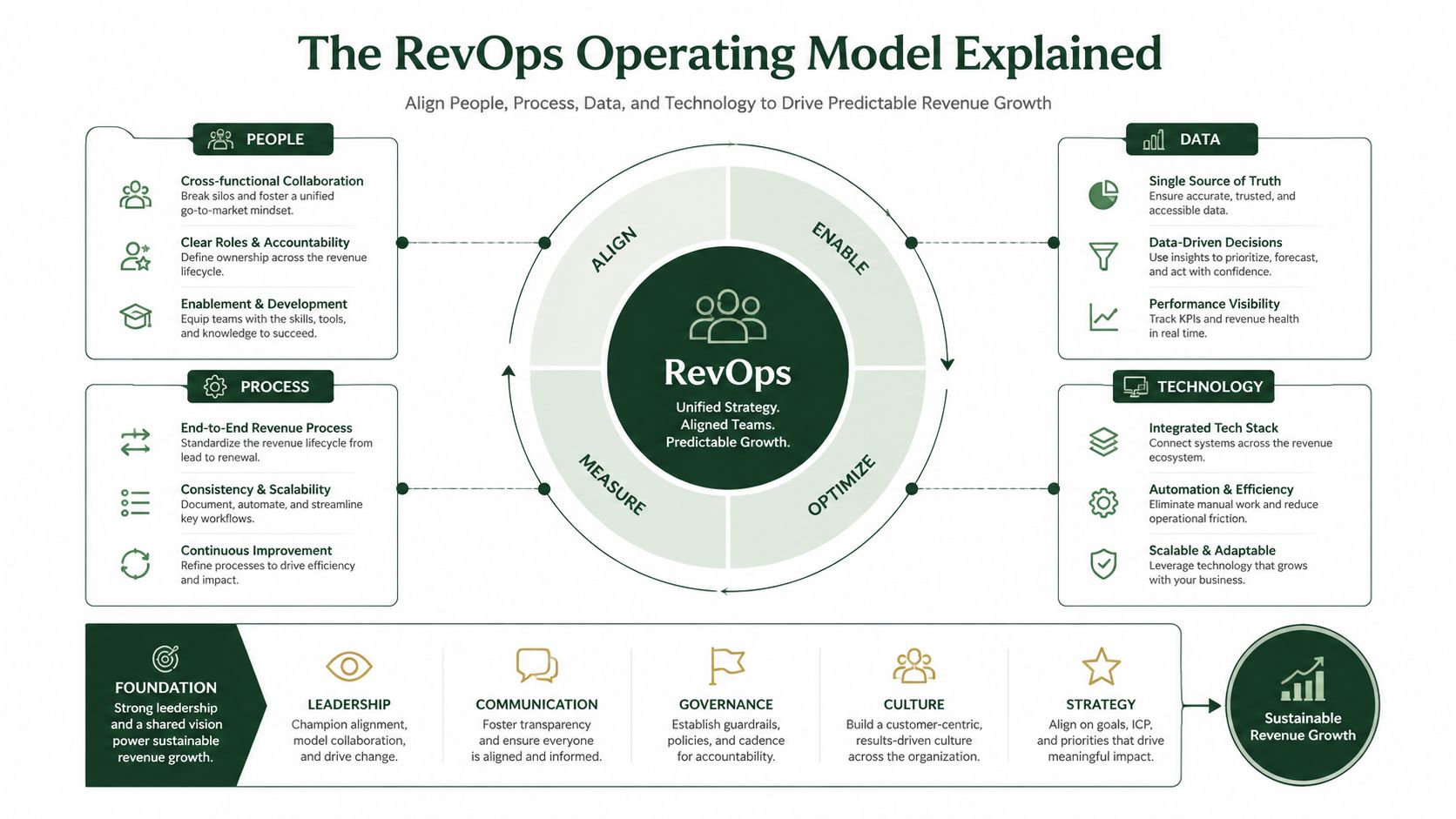
When those three functions work from different definitions, the damage shows up fast. Sales calls an account qualified, marketing still sees it as nurture, and customer success inherits a handoff with missing context. In the $5M to $50M ARR band, those cracks are especially expensive because board reporting starts depending on definitions that haven’t been hardened yet, which is exactly where consulting work on pipeline architecture and forecast integrity earns its keep Pedowitz Group.
The three pillars that matter
The first pillar is shared data. That means one set of revenue definitions, one attribution spine, and one place where CRM and marketing automation data can be reconciled instead of argued over.
The second pillar is shared process. Cross-functional SLAs, pipeline stages, forecast mechanics, and territory logic can’t live in separate team docs if you want repeatable execution. The third pillar is shared accountability, which is the part leaders like to say they want and then resist when it changes how results are reported.
A good consulting engagement touches all three. It doesn’t just clean the CRM, it clarifies who owns the handoff, what counts as a stage change, and how revenue confidence gets measured end to end. The mental model is closer to systems engineering than to admin cleanup, which is why the early discovery work often includes a working session on what is happening inside the funnel and how that differs from the dashboard narrative. For a simpler conceptual overview, the what is revenue operations guide is useful context.
Diagnosing Funnel Leakage with Real KPI Benchmarks
A RevOps consultant earns trust by finding where revenue leaks, not by declaring the funnel “healthy” because top-line lead volume looks busy. Poor lead handoff alone can cause 30% to 50% of marketing qualified leads to fail to convert, and that’s exactly why vanity metrics are useless when the handoff is the bottleneck Elefanter RevOps. If the MQL sits in limbo, the problem isn’t “more top-of-funnel.” It’s routing, response time, or qualification logic.
The fastest way to audit the system is to track the handful of metrics that expose friction. A useful benchmark set is the one tied to conversion, cycle speed, retention, and forecast quality. A practical companion resource is the metrics guide for funnel optimization, because the value isn’t just in tracking numbers, it’s in tracing the point where the number changes.
Core RevOps KPI Benchmarks
KPI | Healthy Benchmark | Warning Sign |
|---|---|---|
MQL to SQL conversion | 25% to 40% | Well below range, or unstable month to month |
Forecast accuracy | Under 15% variance | Constant reforecasting and leadership distrust |
MQL handoff quality | Process dependent | Leads sitting untouched or reassigned late |
Funnel conversion visibility | 8 to 10 core KPIs | Dashboards full of vanity metrics |
Lead handoff leakage | Avoiding the 30% to 50% failure zone | Large share of MQLs never become real sales motion |
That table is more than reporting hygiene. It gives the consulting team a way to separate a true process problem from a data-definition problem. If SQL volume is flat but conversion quality is erratic, the issue could be lead scoring. If forecast accuracy swings, the issue could be stage discipline or pipeline inspection.
The best RevOps fixes usually start where the drop-off is easiest to prove.
The mechanics matter. A consultant will usually quantify drop-offs at each stage, compare response timing across sources, and then decide whether automation should be used to reduce delay, standardize lifecycle progression, or route signals into the right rep queue. The work is boring in the best way. It turns “we think we have leakage” into a specific diagnosis tied to actual pipeline behavior, which is the only kind of diagnosis finance can use.
Building the Outbound Technology Stack
RevOps consulting gets much more concrete once outbound is treated like an integrated system instead of a pile of tools. The stack needs clean input, a signal layer, a sending layer, and a reporting layer that all talk to one another. If they don’t, teams end up with polished dashboards that nobody trusts and a sales team doing manual work that never scales.
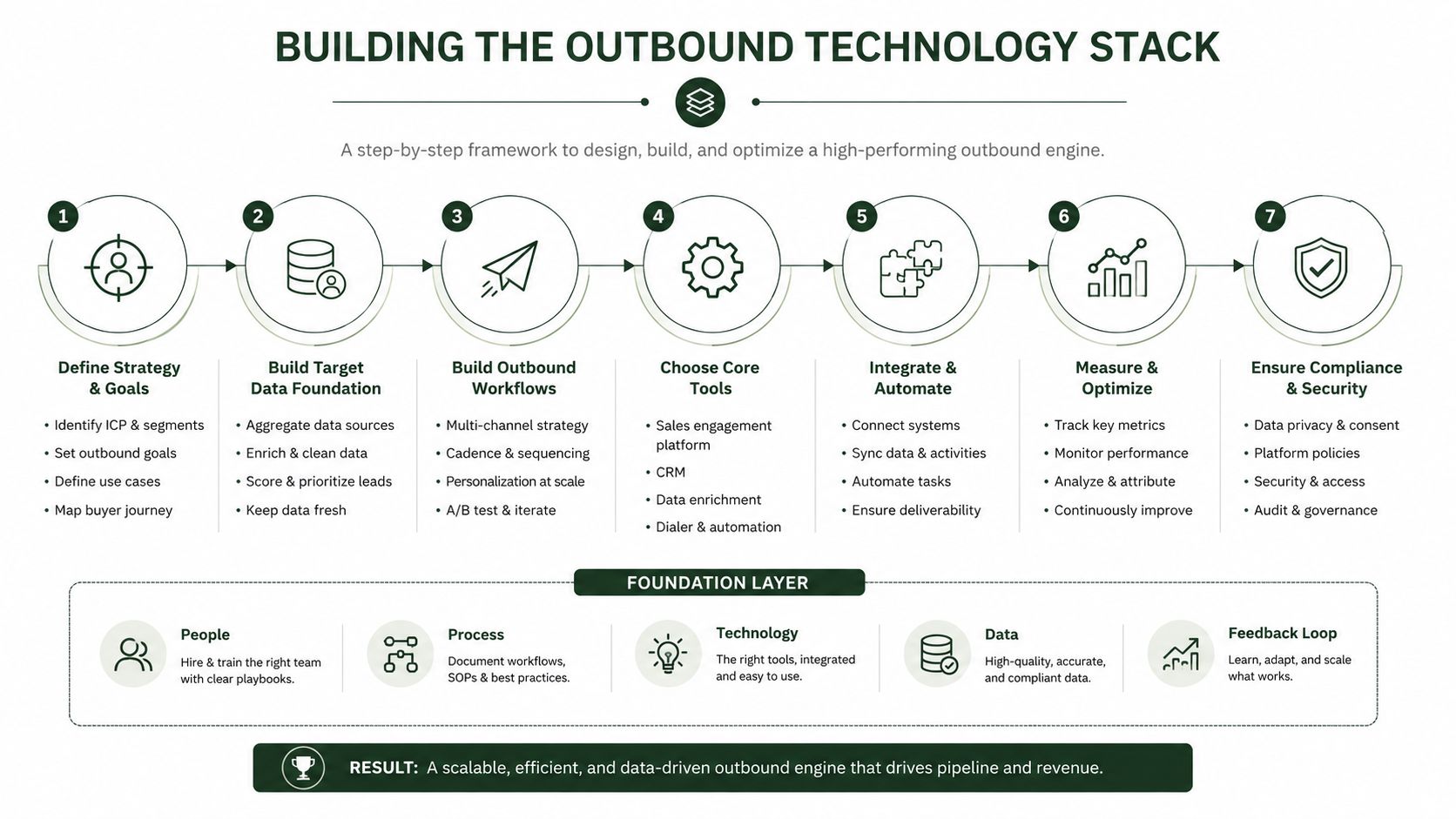
A sane architecture usually starts with Apollo for data enrichment, then adds Trigify and Whitewhale for signal detection and buying intent, Instantly for sequencing and deliverability, and HeyReach for LinkedIn outreach. Those tools only work as a system when data can move cleanly from one layer to the next. If enrichment is weak, targeting is messy. If signal routing is weak, timing is off. If sequencing is weak, sender performance suffers.
Tooling only works when the handoff is designed
The consultant’s job isn’t to pick shiny software. It’s to decide what each tool is responsible for, what data it must receive, and what needs to feed back into the dashboard. A company can have great sending infrastructure and still miss pipeline targets if its routing rules don’t reflect buyer intent or account ownership.
That’s also why the outbound stack should be built alongside process logic, not after it. A lead signal means little if nobody agreed on how it should trigger a sequence, which rep should receive it, or what qualifies as a legitimate follow-up window. A practical email delivery platforms reference is helpful here because deliverability is not an isolated technical issue, it’s one part of a larger revenue workflow.
Operational test: if a rep has to copy data by hand from one tool to another, the stack is still incomplete.
The strongest consulting work creates a straight line from list quality to outreach activity to meeting creation, then back into revenue reporting. That is where a connected stack beats a collection of tools. The stack becomes auditable, and once it’s auditable, it becomes manageable.
Proving RevOps ROI to Finance
When the CFO asks why pipeline grew 18% but revenue only grew 6%, the answer lives in the data definitions, not the tools. Finance does not buy a story about alignment unless the numbers survive a budget review, a forecast call, and a source check. The first job in proving RevOps ROI is to establish which lift came from consulting work, which came from software, and which was already present in the reporting noise.
The same measurement gap noted earlier means a CFO-ready framework has to separate consulting impact from tool-induced lift and from preexisting reporting drift. That is the part many teams skip. They report cleaner dashboards, then struggle to show whether the business changed or the view of the business changed. If the baseline is weak, the before-and-after comparison will not hold up.
What to report first
Start with metrics that finance can trace back to operating behavior. Forecast accuracy is usually the cleanest place to begin because it is difficult to inflate and easy to explain in a review. A Forrester-Clari study found organizations using revenue operations and intelligence are almost three times more likely to forecast with 95%+ accuracy Forrester-Clari study. That makes forecast quality one of the most defensible outcomes to report.
Then show the mechanics behind the forecast. If conversion leakage dropped, pipeline stages tightened, response times improved, or handoffs stopped stalling, those are the operating changes finance wants to see. A reporting pack should show baseline-to-target movement, not a polished snapshot that hides the starting point. Without that sequence, finance will treat the result as a reporting artifact.
The practical test is simple. If the improvement disappears when the tools are removed, the project looks like software lift. If the improvement still stands when you look at process definitions, handoff rules, and rep behavior, the consulting work likely changed process integrity. That is harder to claim and easier to defend.
A strong dashboard turns that argument into something auditable. The reporting and pipeline dashboard resource fits naturally here because the dashboard only matters when it tells a credible financial story. The right reporting does not just show activity, it shows whether the revenue system is becoming more predictable.
When to Hire a RevOps Consultant Versus Building In-House
The decision isn’t “consultant or employee” in the abstract. It’s whether the company needs speed, specialization, or institutional ownership right now. Consulting wins when the problem is cross-functional, urgent, and poorly defined. In-house hiring wins when the motion is already stable enough to justify a dedicated operator who can live inside the business long term.
Stage matters. Companies in the $5M to $50M ARR band are often where consulting pays off first, because the team has enough revenue complexity to need structure but not enough internal depth to design everything from scratch Pedowitz Group. That’s also the point where a broken handoff or inconsistent definition can distort board-level reporting instead of just creating internal annoyance.
A practical decision grid
If the main need is a one-time audit, CRM rebuild, KPI framework, or forecast methodology reset, a consultant is usually the cleaner move. If the company needs ongoing pipeline inspection, system maintenance, and rep support, a fractional operator can make more sense. If the team already has process clarity and just needs someone to own the system every day, a full-time hire is the better long-term play.
Rule of thumb: use outside help when the organization needs pattern recognition faster than it can hire for it.
The trade-off is control versus speed. Consultants move fast and bring outside patterns, but they leave. Internal hires build context and continuity, but they ramp slowly. A strong engagement should transfer documentation, ownership, and playbooks so the company doesn’t become dependent on external labor for routine operations.
If the business is still too small, or product-market fit is shaky, RevOps can be the wrong spend. Operational polish won’t fix a motion that doesn’t yet repeat. But once the motion exists and the data is messy, waiting too long usually costs more than the engagement itself.
What a RevOps Consulting Engagement Actually Looks Like
The cleanest engagements don’t start with software. They start with an audit of how revenue moves through the business. That usually means reviewing the revenue process, tech stack architecture, KPI framework, territory design, forecasting method, cross-functional SLAs, and the change-management plan that keeps the work from dying after handoff Prospeo.

The first phase is discovery and data triage. That means figuring out which metrics are reliable, which systems are conflicting, and which handoffs are breaking the revenue flow. The second phase is architecture, where the consultant defines how pipeline stages, ownership, routing, and reporting should work.
Handover matters more than cleverness
The most important deliverable is rarely the fanciest one. It’s the documentation that lets the client own the machine later. Good consultants write the operating rules, map the dashboard logic, and make sure the team knows what changes are safe versus what changes will wreck integrity.
That’s also why engagements should be judged by transferability, not just by short-term improvement. A team can absolutely hire SDR support for a specific growth push, but the RevOps layer still has to define the rules that make that support productive, measurable, and easy to absorb into the broader GTM motion. Without that layer, execution gets busy but not necessarily better.
The final phase is usually stabilization. That’s where the consultant checks whether the new definitions stick, whether reporting stays consistent, and whether leaders can run the system without constant intervention. The best partners build for exit from day one, because durable revenue operations should leave the client with infrastructure, not dependency.
If you need a revenue system that finance can trust, and not just a prettier dashboard, The Social Search builds the outbound and reporting infrastructure that makes RevOps measurable end to end. If your team needs help connecting ICP, messaging, tooling, and pipeline accountability into one operating system, visit the site and start with a conversation about what’s breaking in the current motion.
