Outbound Sales Strategy: Build a B2B GTM Engine
Master your outbound sales strategy with a system-first GTM framework. Learn to align ICP, data, messaging, and channels for scalable B2B pipeline.
Most advice about outbound sales strategy starts in the wrong place. It tells you to write a sharper subject line, add more personalization, or increase daily activity. Those tactics matter only after the system can identify the right accounts, reach their inboxes, recognize buying intent, and learn from every response.
A cold email benchmark puts the structural problem in perspective. B2B outbound averages a 3.43% reply rate, while lists below 50 recipients average 5.8% and lists above 1,000 average 2.1%, according to benchmark analysis from lemlist. The practical lesson isn't to send less for its own sake. It's to engineer a connected GTM machine in which targeting, data quality, infrastructure, sequencing, routing, and reporting reinforce one another.
Table of Contents
Why Most Outbound Sales Strategies Fail
A better email can't rescue a bad list. If the contact doesn't own the problem, the account has no relevant trigger, or the message lands in spam, copywriting becomes an expensive distraction. Senior revenue teams still lose time reviewing hooks when they should be inspecting the assumptions underneath the campaign.
Outbound fails at the seams between functions. Marketing defines a broad market, sales buys an unverified list, an SDR personalizes manually, and RevOps reports activity without connecting it to pipeline. Each person may perform a reasonable task, yet the buyer receives an irrelevant message from a sender whose infrastructure has already weakened.
The numbers make raw volume a poor operating strategy. A neutral benchmark reports an average B2B reply rate of about 3.43%, with strong campaigns reaching 5% to 10% and top performers exceeding 10%. Campaigns below roughly 2% to 3% usually point to targeting, messaging, or inbox-placement problems, not a small defect in the opening sentence, as outlined in Salesmotion's outbound benchmark summary.
The system-first model
I treat outbound as an engineered loop:
Market definition identifies accounts with a credible fit.
Data enrichment verifies people, roles, technologies, and triggers.
Message design connects a specific problem to a relevant business context.
Sending infrastructure protects inbox placement and domain reputation.
Sequencing and routing determine who receives what, when, and from whom.
Measurement feeds replies, objections, and timing signals back into the next campaign.
A failure in any layer contaminates the layers after it. A precise message sent to stale contacts still produces poor results. A clean list used without follow-up leaves recoverable demand untouched. An enthusiastic SDR working without documented rules creates a process that disappears when that person changes roles.
Practical rule: Diagnose the weakest system layer before changing the copy.
This model also changes what leadership asks for. Instead of asking how many messages the team sent, ask whether the right segment was covered, whether messages reached the inbox, whether replies came from qualified buyers, and whether the team captured reasons for non-response. Outbound becomes a market-learning function, not a queue of isolated SDR tasks.
Engineering the Ideal Customer Profile and Data Layer
An ideal customer profile shouldn't be a decorative slide listing an industry, employee range, and geography. It should tell a seller which account deserves attention now, which person can validate the problem, and what evidence supports the assumption.
Start with the total addressable market, then narrow it through explicit filters:
Firmographics: Record industry, business model, geography, and organizational complexity.
Technographics: Identify the platforms, workflow tools, infrastructure, or operational patterns that create a likely use case.
Commercial context: Separate accounts by growth phase, expansion plans, hiring activity, funding context, or known procurement structure.
Role relevance: Map economic buyers, operational owners, technical evaluators, and potential internal champions.
Timing evidence: Mark an account as active, nurture, or unqualified based on observable context rather than sales optimism.
A practical guide to defining an ideal customer profile helps turn these criteria into a usable account definition rather than a vague persona exercise.
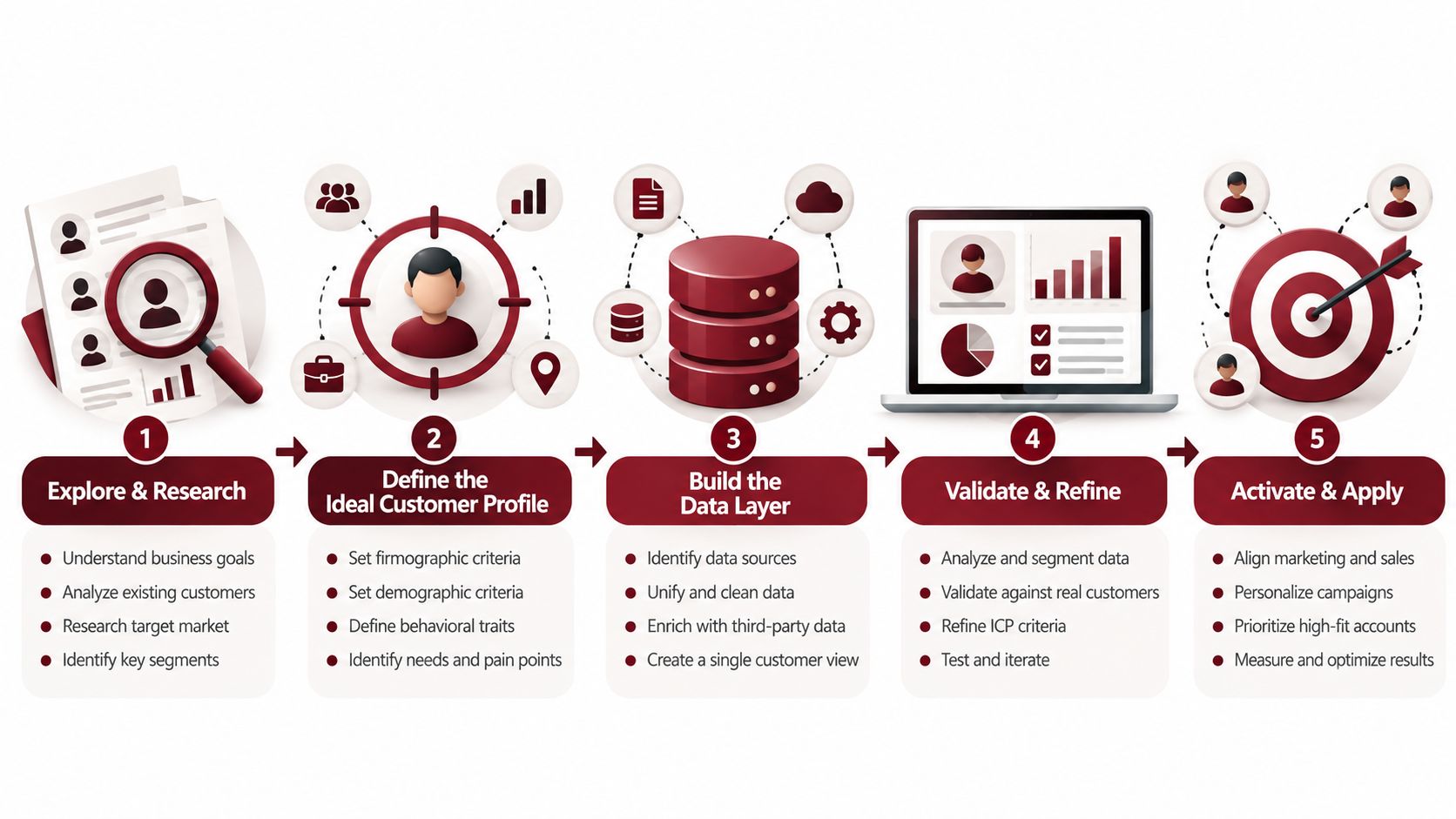
From TAM to a ranked account list
Build the first version of the market map broadly enough to expose patterns, but don't release every record to an SDR at once. Rank accounts by fit and evidence. A small segment with a shared trigger gives you a cleaner test than a mixed list where industry, role, maturity, and pain all vary simultaneously.
Use Apollo for data enrichment to verify contact details and append relevant firmographic or role information. Enrichment isn't a substitute for judgment. It gives the team a starting record, while human review decides whether the contact sits close enough to the problem to receive outreach.
Keep separate fields for fit, signal, and stage. Fit answers whether the company resembles your target. Signal answers whether something changed. Stage answers whether the account is unaware, researching, evaluating, or already engaged. Combining those fields into one score hides useful distinctions. A perfect-fit account with no timing evidence deserves a different motion from a merely good-fit account that has just created a relevant role.
APAC makes the data layer less forgiving. Company names, job titles, subsidiaries, and buying authority vary across markets. A regional director may influence a purchase without owning the budget, while a local entity may operate independently from the global headquarters. Verify the entity, local decision structure, and preferred contact channel before assigning a sequence.
A list is not an asset because it contains names. It becomes an asset when every record explains why the account belongs, why the person matters, and why the timing is plausible.
Designing Multi-Touch Sequences and Deliverability
The first touch is an entry point, not the outbound strategy. Follow-up design determines whether the team gives a relevant prospect enough context to respond or abandons the conversation after one interruption.
One 2026 compilation reports that 42% of all replies come from follow-ups, while 48% of sales representatives never send one, according to Woodpecker's cold email statistics. The same source reports that connected B2B campaigns combining targeting, personalization, and structured follow-up can reach 10% to 18% reply rates, compared with a broader benchmark of 3% to 5%. The gap isn't a reason to automate indiscriminately. It shows why a sequence needs a deliberate progression.
A useful sequence gives each touch a different job:
The opening establishes a relevant problem and a low-friction reason to reply.
The next touch adds a new observation, proof point, or diagnostic question.
A later message tests whether the issue belongs to another team or timing window.
The final touch gives the prospect an easy way to decline, redirect, or defer.
Repeating “just following up” adds activity without adding value. Before setting up automated email sequences, define the decision rules for stopping, pausing, rerouting, and re-entering a contact.
Infrastructure before automation
Deliverability is an operating constraint, not a technical detail delegated to launch week. Warm new sending infrastructure gradually, authenticate sending domains with SPF, DKIM, and DMARC, monitor bounce and complaint patterns, and keep prospecting traffic separate from critical company correspondence.
Instantly is a practical option for teams that need dedicated cold email infrastructure, warming, and sequence management. The tool doesn't make an irrelevant campaign safe. It gives the team more control over sending behavior so a poorly targeted program doesn't put the primary domain at unnecessary risk.
Inbox placement also deserves separate measurement from delivery. A message can be accepted by a receiving server without appearing in the recipient's primary inbox. One recent benchmark placed global inbox placement in the low-to-mid 80% range, meaning legitimate outreach can disappear even when delivery appears healthy, as reported in CopyCrest's state of cold email research.
Build a cross-channel cadence
Email shouldn't operate as an isolated track. A prospect may ignore an email but recognize the sender after a thoughtful LinkedIn interaction. HeyReach can support LinkedIn outreach and automation, but the cadence still needs human logic. Don't send an automated connection request immediately after a prospect received a dense email. Coordinate the touches around the account's context, channel behavior, and stated preferences.
For a deeper operating framework, the guidance on cold email outreach is useful when defining message limits, follow-up logic, and infrastructure responsibilities.
Optimizing Channel Mix and Messaging Restraint
Channel choice is an operating decision, not a copywriting preference. Email and LinkedIn solve different access problems, so the right mix depends on buyer behavior, account context, and the signals your data layer can route to a rep. Email provides direct reach and structured sequencing, but inbox competition and deliverability rules limit how aggressively teams can use it. LinkedIn adds visible context around the sender and supports warmer interaction, while connection acceptance and platform behavior constrain access.
Evaboot's outbound metrics summary reports LinkedIn connection acceptance at around 30%, LinkedIn message reply rates of 10% to 17%, and cold email reply rates of 3% to 5%. The same benchmark set gives a 5% to 15% target for the first LinkedIn message after acceptance, as summarized in Evaboot's prospecting metrics guide. These figures do not make LinkedIn universally superior. They show why channel allocation should reflect the buyer, market, and context available to the seller.

Choose the channel by buyer behavior
Use email when the buyer's role is clear, the account has a relevant business trigger, and the proposition benefits from a concise written explanation. Use LinkedIn when professional visibility, peer context, or a public signal gives the seller a credible reason to appear in the buyer's feed. The LinkedIn outreach strategy guide provides a useful framework for matching visibility and message timing.
Senior buyers may screen unknown emails aggressively, making LinkedIn a practical first touch when the profile and context support it. Operational stakeholders may prefer email because they can forward a concise explanation internally. In mobile-first markets, direct messaging can fit the buying process after permission or an existing relationship. That channel should be selected through regional behavior and account data, not assumed as a universal replacement for email.
Manychat can support social media DM and comment automation for appropriate inbound or engagement-led workflows. Respond IO is relevant when WhatsApp automation fits a regional communication pattern and the recipient has a legitimate basis for receiving the message. Neither tool should disguise unsolicited volume as personal conversation.
Restraint beats synthetic personalization
AI can generate a detailed account summary, but the buyer rarely needs the research process. Lead with one concrete observation, one business implication, and one easy question. That structure gives the rep a repeatable message while leaving room to adapt when the account signal changes.
Personalization should establish relevance, not perform effort. Mention a trigger only when it changes the reason for contact, and remove public facts that have no connection to the offer. For practical campaign structures, actionable B2B campaign examples offer useful reference material. The sequence should remain explainable, operable, measurable, and improvable without turning every prospect record into a writing project.
Leveraging Intent Signals for Precision Timing
Static lists describe who might buy. Intent signals help determine when a conversation deserves attention. Without timing evidence, even an accurate ICP forces the team to interrupt accounts according to an internal calendar rather than the buyer's reality.
Useful signals vary by offer, but the operating principle stays consistent. A prospect's public activity, hiring pattern, technology change, content engagement, or commercial event can alter the relevance of an otherwise cold message. The signal doesn't prove purchase intent. It creates a reason to investigate before routing the account into an outreach motion.
Route signals, don't just collect them
A signal becomes useful only when it changes an action. Define the path before switching on monitoring:
Capture the event and record its source, date, account, and affected role.
Validate the event so a duplicate, stale page, or unrelated company doesn't create false urgency.
Match the event to a play with an approved message angle and channel.
Assign ownership to the rep or market team responsible for the account.
Record the outcome so the team learns whether the signal predicted relevance.
Trigify is suited to monitoring social signals that can identify changes in account or contact activity. Whitewhale can support deeper intent-signal workflows when the team needs more than visible social engagement. The tools surface evidence, but a routing policy determines whether the evidence merits a human review, a nurture action, or a sequence.
Signal quality matters more than signal quantity. A small number of validated triggers can create better timing than a dashboard full of unprioritized activity.
Build a timing catalogue
Store signals in a shared account record rather than leaving them in a rep's browser history. Include what happened, who might care, what problem it suggests, and when the signal should expire. A hiring announcement may justify a timely message, while an old funding reference may no longer support a relevant angle.
This approach also gives “not now” a useful operational meaning. A qualified account that lacks timing evidence can enter nurture, with a clear condition for reactivation. Teams that want to refine this process can use gold prospecting techniques as a reference for prioritizing stronger opportunities instead of treating every contact as equally ready.
Adapting the Framework for APAC and Global Markets
APAC isn't one outbound market. A sequence that works for an English-speaking technology buyer in Singapore may feel unnatural to a procurement stakeholder in Japan, while a message designed for an Australian operator may miss the hierarchy and formality expected elsewhere. Translation changes words. Localization changes the operating model.
A regional rollout often exposes problems that remain hidden in a single-market program. Data vendors may have uneven coverage, company records may use different naming conventions, and LinkedIn usage can vary by audience. Mobile-first messaging can be central in one market and inappropriate in another. The team needs a market-specific hypothesis before it chooses a channel.

Design around local operating realities
Keep the core system consistent, but localize the fields that affect trust and response:
Language and formality: Adapt tone, honorifics, directness, and the level of context expected before a meeting request.
Entity structure: Confirm whether the local office owns the problem or whether decisions sit with a regional or global team.
Channel preference: Use email, LinkedIn, phone, or WhatsApp according to local norms and permission, not because one channel is familiar to headquarters.
Business calendar: Account for public holidays, fiscal calendars, school breaks, and local working patterns when scheduling touches.
Handover design: Document who owns the account when a prospect responds outside the originating rep's time zone.
Time-zone coverage is a routing problem. A global campaign should assign sending windows and response ownership by market, then make the handover visible in the CRM. A buyer shouldn't receive a fast first reply from one region and wait several days because the message landed with a team that's offline.
Preserve relevance across borders
Local teams shouldn't be forced to rewrite the entire value proposition. Give them a central offer, approved proof points, exclusion rules, and room to adapt examples to local business conditions. Review replies by market because the same objection can signal different issues. A concern about authority, implementation, or vendor trust may require a localized answer rather than a translated template.
APAC expansion also benefits from regional segmentation inside the data layer. Separate language, country, role seniority, local entity, and preferred channel so reporting can show whether weak performance comes from the offer, the market, the source data, or execution. Without those fields, leadership may increase volume when the actual need is localization.
Measuring Pipeline and Securing Operational Ownership
Open rates are easy to display and difficult to trust. Privacy controls, inconsistent tracking, and inbox behavior make them weak evidence for whether outbound created commercial interest. The operating dashboard should prioritize outcomes and diagnostic measures that tell the team what to change.
Track replies per 100 sends, positive replies, qualified conversations, meetings held, pipeline created, and deliverability indicators. Keep negative replies and disqualifications visible. They reveal whether the team reached the wrong segment, used the wrong problem statement, or contacted the right account at the wrong time.
Apollo's guidance defines 3% to 6% as a normal, healthy benchmark for broad B2B cold email and says performance below 3% suggests a targeting or deliverability problem. The same guidance cites Belkins' analysis of 16.5 million cold emails, which reported an average reply rate of 5.8% in 2024, down from 6.8% in 2023, as detailed in Apollo's reply-rate benchmark guide. Treat benchmarks as diagnostic context, not a quota detached from market, offer, list quality, and inbox placement.
Use one measurement spine
A useful dashboard connects each result to its cause:
Layer | What to inspect |
|---|---|
Coverage | Which target accounts and roles entered the program |
Data | Verification status, enrichment completeness, and signal freshness |
Delivery | Bounces, complaints, inbox placement, and sending health |
Engagement | Replies, positive replies, objections, and channel responses |
Pipeline | Qualified meetings, opportunities, stage movement, and source attribution |
The benchmark range across 2024 and 2025 was 3% to 5.1% for average B2B cold email reply rates, while top-quartile performers reached 15% to 25% through tight ICP targeting, hook optimization, and structured follow-up, according to The Digital Bloom's cold outbound benchmarks. The spread is large enough to justify regular review of the full system instead of judging individual SDRs by a single reply metric.
Make the system transferable
Document the ICP rules, exclusions, enrichment fields, message versions, signal definitions, sequence logic, sending standards, routing rules, and reporting definitions. Store ownership in the company workspace, not in private spreadsheets or an individual rep's memory.
A revenue operations function should connect those assets to execution. The guide on what revenue operations is provides useful context for defining shared processes across sales, marketing, data, and reporting. Ownership also means deciding who can change a sequence, who approves a new market, who pauses sending after a deliverability issue, and who reviews replies for learning.
The final test is continuity. If one SDR leaves, the next operator should inherit a working system, a clean account history, and clear reasons behind each decision. That turns outbound from a personality-dependent activity into a company asset that can improve through evidence.
The Social Search designs and operates connected outbound systems for B2B teams, covering ICP definition, data, messaging, email and LinkedIn sequencing, signal routing, deliverability, and pipeline reporting. Visit The Social Search to discuss a system build or embedded GTM support for APAC and global markets.
