Cold Email Outreach Playbook: B2B Guide
Master cold email outreach with a step-by-step playbook. Learn ICP targeting, sequencing, deliverability, and optimization strategies that actually work.
Average cold email reply rates sit between 3.4% and 5.1%, while top campaigns exceed 10%. This isn't about sending more emails, it's about smarter targeting, deeper personalization, and proper inbox placement from day one.
Cold email outreach has moved far beyond the old volume-first playbook. A large analysis of 12 million outreach emails found that 91.5% were ignored, leaving only 8.5% with a response in the historical benchmark. More recent benchmarks are even tougher, with one dataset reporting a 0.45% reply rate for broad B2B cold sends.
That doesn't mean the channel is broken. It means your campaign has to earn attention before it can generate pipeline. The teams that perform consistently make deliberate decisions about who receives each message, what evidence makes the message relevant, how safely it reaches the inbox, and what happens after the first send.
For the sending, warming, and sequencing layer, Instantly is a practical solution to consider. It brings campaign execution and deliverability controls into the same workflow, but no platform can rescue an inaccurate list or a vague offer.
Table of Contents
Why Cold Email Response Rates Are Lower Than You Think
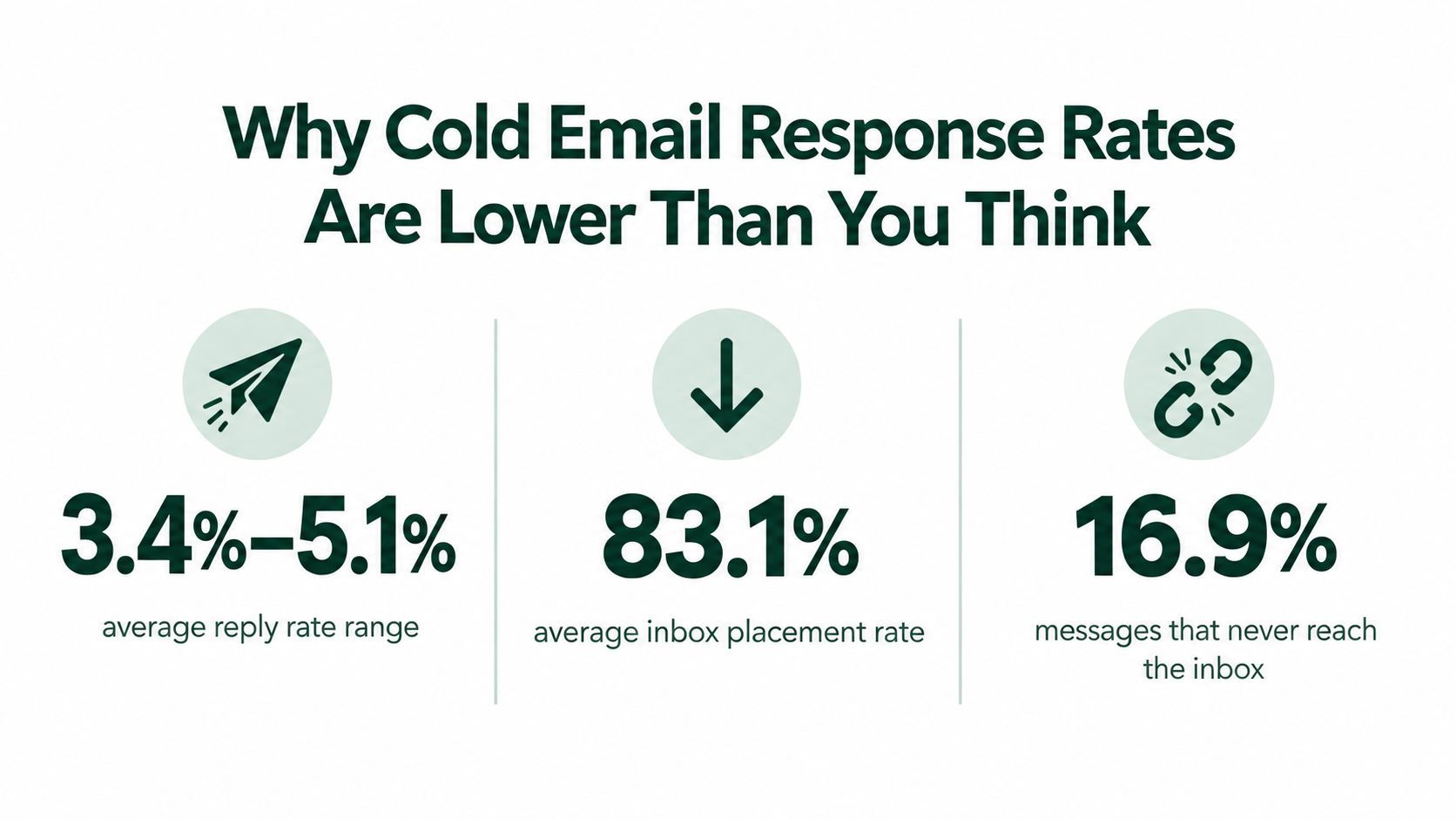
Cold email response rates now commonly sit around 3.4% to 5.1%, and broad campaigns can fall far below that range. A stricter dataset measured a 0.45% reply rate for 7.5 million B2B cold emails, while a separate 2026 B2B study covering 28,400 leads reported an average reply rate of 2.1%, down from 4.7% in 2022. Those figures reflect a channel where small improvements in audience fit, message relevance, and delivery can produce outsized returns.
The numbers describe different conditions rather than a single contradiction. List quality, market, offer, campaign design, and inbox access all affect the denominator. A broad send to weakly qualified contacts may perform dramatically worse than a smaller campaign aimed at people with a clear business reason to respond.
Volume creates activity, not necessarily pipeline
Sending more messages increases activity, but it does not correct poor positioning. Prospects already manage crowded inboxes, providers apply stricter filtering, and irrelevant outreach teaches recipients to ignore unfamiliar senders.
A practical broad-B2B benchmark is 3% to 6% reply rate. 6% to 8% is strong for well-segmented campaigns, while 8%+ generally requires intent-driven or highly targeted outreach as outlined by Woodpecker. The platform-wide average cited there is 3.43%, with top-quartile campaigns at 5.5%+ and top-decile campaigns above 10.7%.
The spread points to three controllable advantages: precise ICP selection, personalization tied to a real business signal, and infrastructure that consistently reaches the inbox. Together, they matter more than merely increasing send volume. Teams that connect outreach activity to commercial outcomes can also use guidance on how to turn leads into revenue with A/B.
Inbox placement changes the denominator
Reply rate can hide a delivery failure. Average inbox placement is about 83.1%, meaning roughly 16.9% of messages may never reach the inbox, per the CopyCrest benchmark referenced later. A weak campaign may therefore reflect ineffective copy, poor list quality, or messages filtered before recipients see them.
Treat delivery as part of campaign performance, alongside targeting and relevance. Sender reputation, domain configuration, authentication, bounce control, and measurement determine how many prospects can respond in the first place. That broader role is also explained in this overview of why email marketing is important.
Building the Right List Before Writing a Word
The list determines who gets a chance to read your message. Start with an ideal customer profile, or ICP, that describes a commercially specific account rather than a broad market category.
Define the account first. Specify the industry, business model, company stage, geography, and signs of operational change. Then define the person who owns the problem. A finance leader, revenue leader, and operations leader may work at the same company, but they won't interpret the same offer in the same way.
Prioritize accounts before contacts
A useful list-building sequence looks like this:
Describe successful accounts: Review customers who converted quickly, stayed engaged, or expanded. Identify shared traits instead of relying on intuition.
Rank firmographic fit: Separate exact-fit accounts from adjacent accounts. Keep geography and market context visible, since buying processes differ across regions.
Add a business trigger: Look for a reason the problem may be active now, such as a new market, leadership change, hiring movement, product launch, or visible operational shift.
Choose the buyer: Match the trigger to the person with authority, budget, or responsibility for the issue.
Test a small segment: Send a controlled campaign before expanding the list. A weak response can reveal a positioning problem before it becomes a deliverability problem.
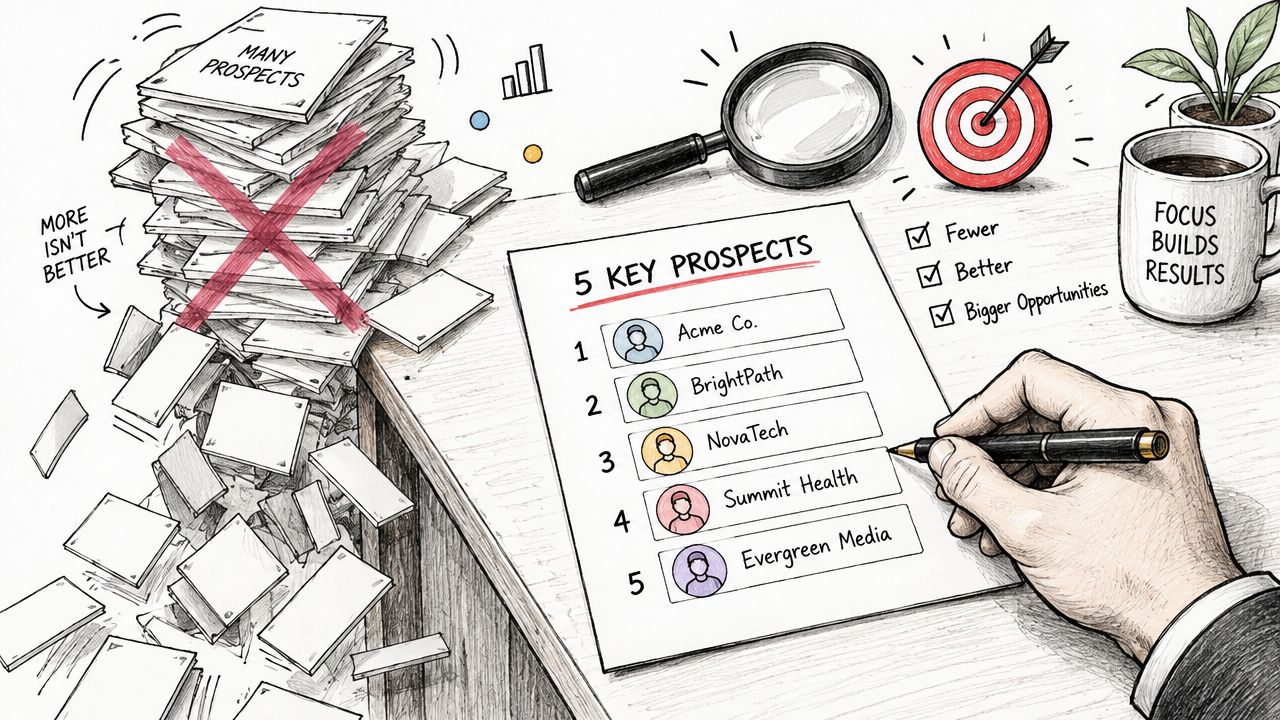
The list should become narrower as you add confidence. A contact isn't qualified merely because a database contains a name and email address.
Enrichment is a verification layer
Apollo can help with contact discovery and data enrichment, including role and company information. Use it as a way to fill gaps and prioritize research, not as proof that every field is accurate. Cross-check important records, remove irrelevant contacts, and suppress anyone who has opted out.
Tool | Best For | Pricing Model | Integration Notes |
|---|---|---|---|
Apollo | Contact discovery and enrichment | Subscription-based | Export or connect enriched records to your sequencing and CRM workflow |
Instantly | Email sending, warming, and sequencing | Platform subscription | Connect verified contacts after list review |
HeyReach | LinkedIn outreach and automation | Subscription-based | Use for coordinated social touches, not duplicated email messages |
Manual research | Trigger and context verification | Internal time cost | Add evidence that automated databases usually miss |
A specialized resource on how to define an ideal customer profile can help turn broad positioning into usable account filters. If the account needs a phone-led motion as well, evaluate external cold callers separately rather than forcing every prospect into an email sequence.
Practical rule: A smaller list with a defensible reason for every contact is more valuable than a large list you can't explain.
Crafting Copy That Gets Replies
With cold email response rates often down to 3% to 5%, copy has less room for vague targeting or decorative personalization. Small improvements in ICP precision, evidence quality, and message relevance can produce larger gains than just increasing send volume.
Personalization works when it changes the recipient's reason for considering the message. A first name or company token adds little on its own. A useful opening connects the recipient to a current situation, observable trigger, or operational problem they plausibly own. Use automation to collect and organize context, then have a person verify that the message applies.
Compare the opening, not just the subject line
A generic version might read:
Subject: Improve your sales process
Hi {{firstName}},
We help B2B companies generate more leads through our platform. Would you be open to a quick demo?
It fails because almost any company could receive it. The sender leads with a broad promise, while the recipient gets no clear reason to care or respond.
A stronger version uses a verifiable trigger:
Subject: Your APAC expansion
Hi Maya,
I noticed your team is hiring for regional sales roles. That usually creates pressure to keep account research and first-touch messaging consistent across markets. We help revenue teams build that outbound workflow. Is improving that process on your agenda?
The second version does not guarantee a reply. It gives Maya a specific reason to decide, keeps the request small, and avoids claiming knowledge that the public evidence cannot support.
Personalization depth also has a practical limit. A researched observation is useful when it changes the problem or wording. It becomes counterproductive when it adds irrelevant details, sounds invasive, or forces the recipient to correct an assumption. Precision beats volume.
Use a compact message architecture
A reliable first touch usually contains:
Relevant subject: Name the situation or problem without exaggerated claims.
Human opening: Reference a trigger that belongs to the recipient.
Problem statement: Show the operational friction you understand.
Specific value: Explain the outcome in plain language, without listing features.
Single CTA: Ask one easy question that can be answered quickly.
Clean signature: Identify the sender and provide a clear opt-out path.
Keep the copy conversational. Avoid multiple links, heavy formatting, inflated urgency, and language that sounds like an advertisement. Use this guide on how long a cold email should be when a draft keeps expanding beyond the attention available for a first contact.
Do not use AI to manufacture personal details. If a line would not survive a follow-up question, remove it. The strongest personalization is often a restrained observation followed by a relevant question. That discipline matters more as response rates fall, because irrelevant volume can increase sending risk without improving conversations.
Deliverability as an Ongoing System
Assume some messages will miss the inbox, based on the placement benchmark covered earlier, and build monitoring around that gap. Deliverability shifts with sending volume, recipient engagement, bounce patterns, complaints, and domain reputation. A reply-rate dashboard cannot show whether a message had a fair chance to be seen.
Warm the sending environment
New cold-email domains should begin at 10 to 20 emails per day and ramp over a 4 to 8 week warm-up period, with no more than 30 emails per inbox per day as recommended in 2026 guidance. Adjust the pace to mailbox health and recipient signals rather than a fixed launch date.
Authenticate the domain with SPF, DKIM, and DMARC before sending. These records help receiving providers verify authorized mail and handle authentication failures. Use dedicated sending domains when appropriate, keep the main company domain separate from prospecting risk, and track inbox placement. Authentication supports delivery, but it does not guarantee it.
Manage bounces as an early warning
A 2026 deliverability summary recommends keeping bounce rates below 2%, removing hard bounces, spam traps, and disposable addresses, and reviewing bounce and complaint signals weekly in its published guidance.
A rising bounce rate calls for a pause, not a subject-line change. Stop the affected campaign, re-verify records, inspect the list source, and review recent volume changes. If complaint signals increase, reduce sending pressure and check whether the targeting or message gives the recipient a legitimate reason to respond.
Use these email deliverability best practices to structure routine checks. The email marketing lessons from a 30-day test can also inform testing, but placement and complaint data should determine the next operational decision.
Inbox placement is the gate. Reply rate is the feedback after the gate opens.
Designing Sequences That Respect Attention
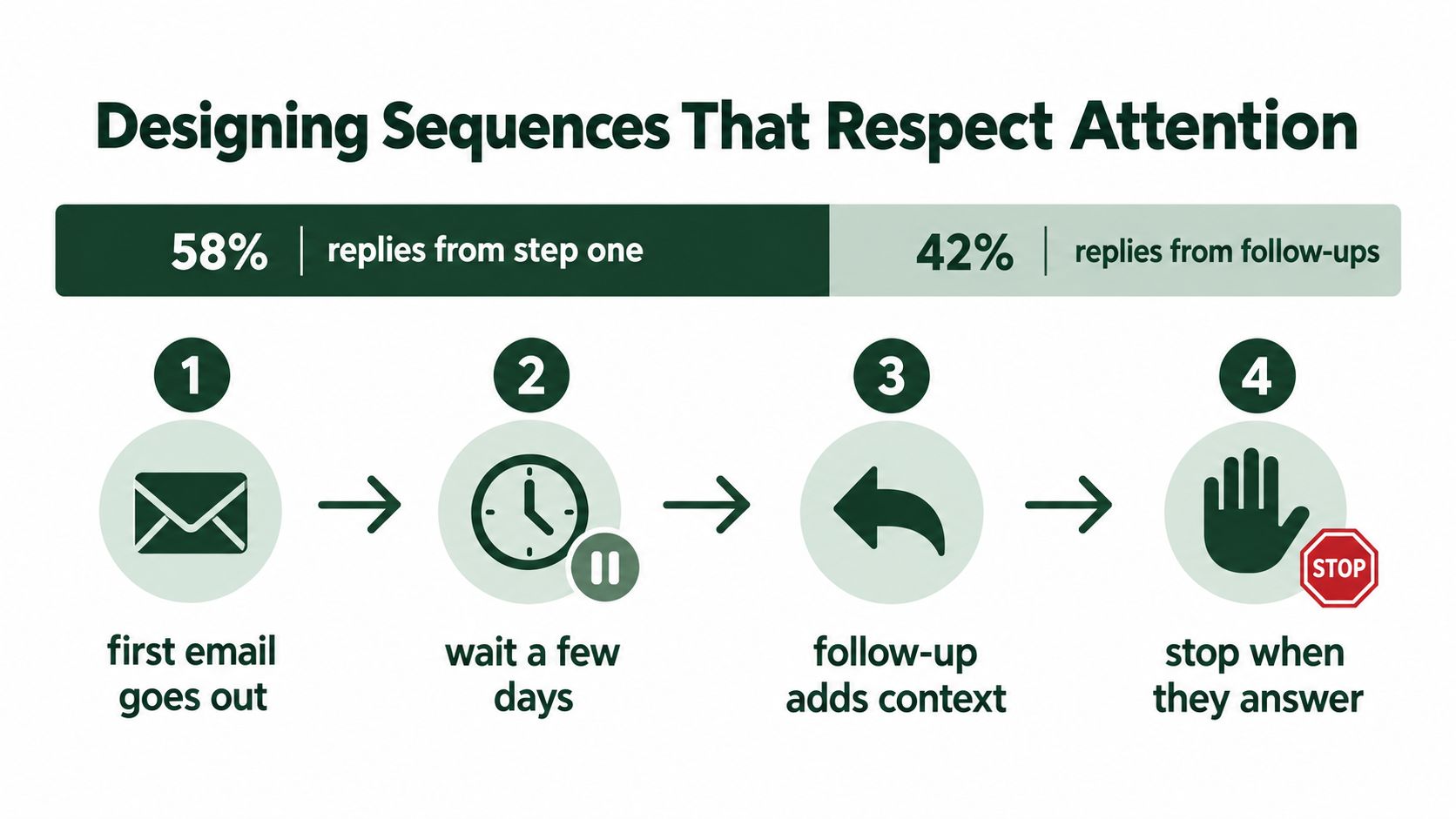
An average reply rate of 3.43% leaves little room for wasted touches. Instantly reports that top performers exceed 10%, while 58% of all replies come from step one and follow-ups produce the remaining 42% in its benchmark report. The practical lesson is clear: improve the first email, then make every later touch earn attention with new context.
Build a restrained cadence
Use 4 to 5 steps across 14 to 21 days. Shorter sequences fit current buyer behavior better than older seven-step approaches, especially when response rates have settled into the 3% to 5% range.
Give each touch a distinct purpose:
First email: Name the trigger, connect it to a problem, and ask one low-friction question.
First follow-up: Explain the operational consequence or add a relevant observation.
Second follow-up: Introduce another angle, such as process, timing, or risk.
Final touch: Make it easy to decline, defer, or identify the right contact.
Pause: Stop when the prospect replies, opts out, or gives a clear no.
Leave a few business days between messages. A follow-up that only says “bumping this” adds pressure without information. Each email should give the recipient a reason to reconsider, such as a sharper ICP-specific observation or a new detail about the problem.
Coordinate channels without duplicating yourself
LinkedIn can support email when it contributes separate context. HeyReach supports LinkedIn outreach and automation, while Trigify can surface social signals for timing and prioritization. Use those signals to choose the next action, not to copy the same pitch across channels.
A practical guide to cold email outreach sequences can help structure the cadence. The operating rule is simple: persistence should increase clarity, not pressure. Stop sending when the sequence has stopped adding value.
Measuring What Actually Matters
Open rates can help diagnose a campaign, but they don't pay for sales activity. A useful dashboard follows the path from sent to delivered, opened, replied, qualified, and converted, then connects each outcome to the segment, trigger, message, and channel that produced it.
Reply rate is a stronger diagnostic than opens, but it still isn't the final business measure. Separate positive replies, objections, referrals, unsubscribe requests, and irrelevant responses. A campaign with more replies can be worse if those replies don't come from qualified buyers.
Build the reporting loop
Track performance at the level where decisions happen:
Delivery and bounce: Identify list and infrastructure problems before interpreting engagement.
Reply quality: Classify positive interest, neutral questions, objections, referrals, and opt-outs.
Meetings booked: Record whether a reply became a scheduled conversation.
Pipeline contribution: Attribute qualified opportunities to the campaign, audience, trigger, and message.
Revenue outcome: Where possible, connect closed business back to the original outbound variables.
Use Instantly for campaign-level reporting and reply handling, then connect those records to your CRM. If LinkedIn is part of the motion, combine email activity with HeyReach events so the team can see whether a social touch supported, duplicated, or harmed the email conversation.
Test one meaningful variable
Don't change the list, offer, copy, cadence, and sender at the same time. Start with one decision, such as a trigger-led opening versus a role-led opening. Keep the audience definition stable, label replies by quality, and decide in advance what evidence would justify keeping the new version.
A/B testing should improve judgment, not create a permanent optimization theater. If a variation wins on opens but loses on qualified replies, reject it. If a shorter message generates fewer total responses but more relevant conversations, it may be the better commercial choice.
The broader lesson from recent benchmarks is that 98.29% deliverability can coexist with very low business outcomes as discussed by Belkins. Reaching the inbox is necessary, but it doesn't make the offer relevant. The system succeeds when clean data, precise targeting, credible copy, disciplined sending, and CRM attribution reinforce each other.
The Social Search builds and operates outbound systems around ICP definition, account prioritization, messaging, email and LinkedIn sequencing, deliverability, signal-based prospecting, and reporting. If your team needs a cold email outreach system that connects those pieces and remains usable after handover, visit The Social Search to discuss a build or embedded GTM engagement.
